
Reports
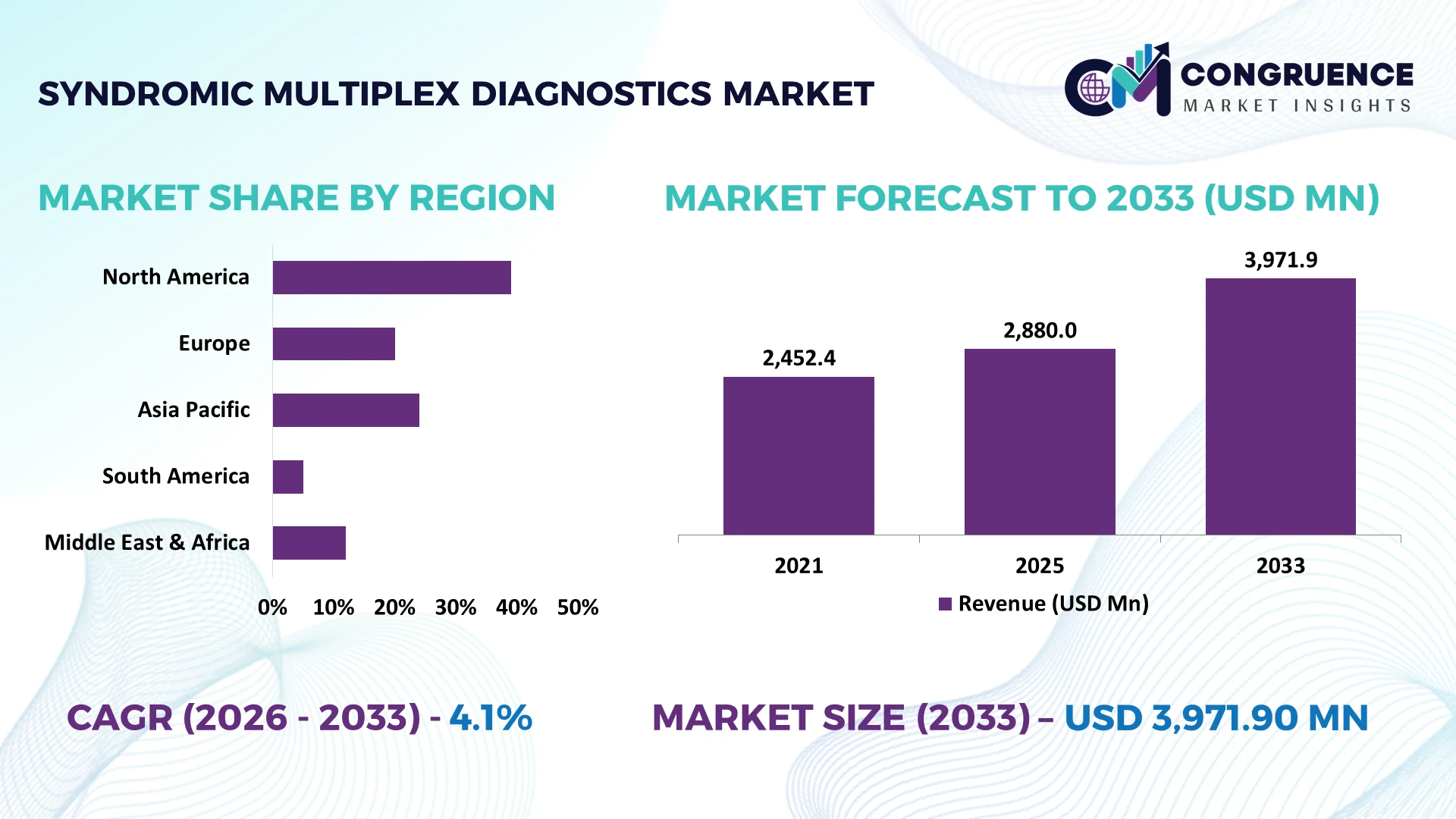
The Global Syndromic Multiplex Diagnostics Market was valued at USD 2880 Million in 2025 and is anticipated to reach a value of USD 3971.9 Million by 2033 expanding at a CAGR of 4.1% between 2026 and 2033. Growth is driven by wider respiratory and gastrointestinal syndromic-panel use, antimicrobial-resistance surveillance, and automation that replaces sequential pathogen testing with single-sample multiplex workflows.
The United States remains the dominant country, representing 56.9% of global syndromic multiplex diagnostics revenue in 2024, with respiratory testing accounting for 33.64% of its market. Emergency-department respiratory-panel penetration reached 62%, while the broader U.S. molecular diagnostics ecosystem received USD 263 million in DDDI FY2022 investment for advanced diagnostic development. Compared with India’s 1.9% global share in 2024, U.S. hospital, laboratory, and infectious-disease testing infrastructure provides substantially deeper deployment capacity.
Strategic decisions should prioritize U.S. platform penetration while targeting Asia-Pacific expansion where diagnostic capacity and multiplex adoption are accelerating.
Market Size & Growth: USD 2.88 billion in 2025 to USD 3.97 billion by 2033 at 4.1% CAGR, supported by automated multi-pathogen testing.
Top Growth Drivers: Respiratory panels 33.55%, multiplex PCR 63.53%, diagnostic laboratories 44.55%.
Short-Term Forecast: By 2030, rapid panels target turnaround reductions of over 80% versus conventional workflows, strengthening laboratory throughput.
Emerging Technologies: AI analytics, automated PCR, and NGS broaden pathogen identification beyond fixed-target panels.
Regional Leaders: North America leads at 41.55%; Europe reaches USD 1.03 billion and Asia-Pacific USD 829.1 million by 2030, with Asia-Pacific showing faster adoption.
Consumer/End-User Trends: Diagnostic laboratories hold 44.55% demand, while point-of-care channels expand at 8.32% CAGR.
Pilot/Case Example: A 2024–2025 UAE multicentre implementation reduced time to optimal antibiotic therapy from 92 to 28 hours, a 69.6% reduction.
Competitive Landscape: bioMérieux reported approximately 70% BIOFIRE share in syndromic multiplex testing in 2024; key players include Roche, Abbott, QIAGEN, BD, and bioMérieux.
Regulatory & ESG Impact: EU IVDR transition requirements extend through 2027 for certain legacy Class B and sterile Class A IVDs, increasing compliance planning requirements.
Investment & Funding: Seegene’s 2025–2026 syndromic-PCR innovation program provides up to USD 600,000 per selected research project, reinforcing partnership-led assay development.
Innovation & Future Outlook: Next-generation panels are shifting toward broader target menus, AI-supported interpretation, decentralized testing, and NGS-enabled detection of unexpected pathogens.
The Syndromic Multiplex Diagnostics Market is increasingly concentrated around respiratory, gastrointestinal, bloodstream, and central-nervous-system testing where clinicians require simultaneous pathogen identification from limited specimens. Respiratory panels held 33.55% share in 2025, while panels covering more than 20 targets are expanding faster as laboratories seek broader diagnostic coverage. Recent product innovation is moving beyond fixed PCR menus toward automated sample-to-answer systems, AI-assisted interpretation, and NGS-based detection. Real-world respiratory testing has demonstrated 91% microbiological yield versus 55% with standard methods, strengthening the operational case for multiplex workflows. The emerging trend is decentralization, with CLIA-waived and near-patient platforms extending syndromic testing beyond centralized laboratories. At the same time, EU IVDR compliance and global supply-chain localization are reshaping product-launch and manufacturing strategies, creating a direct transition into the market’s strategic investment pathways.
Syndromic multiplex diagnostics is becoming strategically important because laboratories are shifting from sequential pathogen testing toward consolidated, high-throughput workflows. Multiplex PCR represented 63.53% of technology adoption in 2025, while panels covering more than 20 targets are expanding as hospitals prioritize broader pathogen coverage. In Italy, a real-world laboratory-network implementation reduced turnaround time by 25.4% and lowered cost per diagnostic detection from €233.80 to €120.86.
The next 2–3 years will be shaped by regulatory modernization and decentralized deployment. Europe’s IVDR transition extends certain lower-risk legacy-device requirements through 2027–2029, increasing compliance workload while encouraging manufacturers to redesign documentation and quality systems. The United States remains a high-scale innovation market, whereas Italy and other European laboratory networks demonstrate stronger hub-and-spoke workflow integration. Companies are responding through automated sample-to-answer platforms, broader panels, and regional partnerships.
Operationally, Italy’s multiplex gastrointestinal testing increased pathogen detection events from 1,388 to 2,839 while reducing laboratory-check-in turnaround from 56 to 41 hours. This demonstrates that value increasingly depends on workflow redesign rather than assay performance alone. Competitive positioning will therefore favor companies combining assay breadth, automation, regulatory readiness, and laboratory integration into scalable diagnostic ecosystems.
Respiratory panels represented 33.55% of syndromic multiplex diagnostics demand in 2025, while multiplex PCR accounted for 63.53% of technology adoption and diagnostic laboratories represented 44.55% of end-user demand. The structural shift toward simultaneous pathogen identification is reducing dependence on sequential workflows and increasing instrument utilization. U.S. platforms now support panels detecting 21 respiratory pathogens in approximately one hour, strengthening emergency and acute-care deployment. Companies are expanding automated platforms, broadening target menus, and partnering with hospitals to convert high-volume testing into standardized workflows.
Multiplex adoption remains constrained by reagent intensity, platform-specific consumables, and regulatory compliance costs. In an Italian implementation, direct diagnostic expenditure increased 5.7%, although total laboratory costs subsequently declined 13.3% after accounting for personnel and instrument economics. Europe’s IVDR transition also requires manufacturers of relevant legacy devices to complete staged conformity activities, with Class C transition requirements extending into 2026 and lower-risk categories into 2027 and beyond. Companies are mitigating exposure through localized manufacturing, dual sourcing, longer-term reagent contracts, and platform standardization.
The strongest opportunity lies in combining multiplex PCR with broader NGS capabilities and decentralized testing. NGS-based assays are projected to expand at 10.75% through 2031, while panels exceeding 20 targets are advancing at 9.82%, indicating demand for broader pathogen coverage. Point-of-care clinics are also expanding faster than centralized laboratory channels, creating opportunities for compact sample-to-answer systems. U.S. and European manufacturers are positioning through R&D partnerships, software-enabled interpretation, and near-patient platforms. The non-obvious advantage is operational: broader panels can increase diagnostic yield without proportionally expanding specimen collection or testing steps.
Long-term deployment increasingly depends on integrating multiplex systems with laboratory information systems, clinical workflows, and antimicrobial-stewardship protocols. The Italian network study showed that multiplex implementation reduced turnaround time by 25.4%, but also required substantial workflow reorganization across hub-and-spoke laboratories. As automated systems expand, cybersecurity, interoperability, instrument utilization, and skilled molecular-diagnostics staffing become operational priorities. Europe’s evolving IVDR framework adds another layer of documentation and performance-monitoring requirements. Companies must therefore invest in interoperable software, workforce training, cybersecurity controls, and standardized deployment models to maintain consistent performance at scale.
PCR Workflow Consolidation: PCR-based systems continue shifting laboratories toward sample-to-answer workflows, with multiplex PCR holding 63.53% technology share in 2025. Automated platforms reduce hands-on processing and support broader pathogen menus, while manufacturers expand cartridge capacity and integrate resistance-marker detection.
Broader Panel Deployment: Panels exceeding 20 targets are expanding as hospitals require simultaneous identification of co-infections and resistance markers, while 11–20-target panels still represented 45.15% of demand. Companies are balancing target breadth with reagent economics and clinical-utility requirements.
Faster Enteric Diagnostics: Gastrointestinal testing is accelerating, with GI panels advancing at 9.25% as laboratories respond to foodborne outbreaks and hospital-acquired infections. The 2025 FDA clearance of an 11-target GI panel strengthened rapid stool-testing capacity and encouraged suppliers to expand enteric portfolios.
Decentralized Testing Expansion: Near-patient deployment is moving syndromic diagnostics closer to emergency and ambulatory settings, with point-of-care channels expanding at 8.32%. U.S. pharmacies and clinics are adopting compact systems, prompting manufacturers to prioritize CLIA-waived workflows, simplified operation, and distributed supply models.
PCR-Based Panels remain the leading technology, accounting for approximately 63.53% of the syndromic multiplex diagnostics market in 2025 because automated multiplex PCR combines established clinical validation, high analytical sensitivity, rapid turnaround, and scalable sample-to-answer workflows. Immunoassay Panels retain relevance where lower instrumentation complexity and rapid screening are priorities, while Isothermal Amplification supports decentralized environments requiring compact equipment and simplified operation. Microarray-Based Panels remain strategically useful for broader target profiling but face workflow and instrumentation constraints. Sequencing-Based Panels represent the fastest-growing technology class, advancing at approximately 10.75% as laboratories seek detection of unexpected, rare, or co-infecting pathogens.
The competitive shift is therefore not a replacement of PCR but a widening technology stack. Companies are protecting PCR scale through broader menus and automation while investing in sequencing partnerships and integrated bioinformatics. Sequencing's deeper pathogen characterization creates value in reference laboratories and complex cases, whereas PCR remains better aligned with routine high-volume diagnostics. This divergence is directing investment toward dual-platform portfolios rather than single-technology dependence.
Respiratory Infections remain the leading application, representing approximately 33.55% of 2025 syndromic multiplex diagnostics demand as influenza, RSV, SARS-CoV-2, and bacterial co-infections create overlapping clinical presentations requiring simultaneous testing. Gastrointestinal Infections represent the fastest-growing application at approximately 9.25%, supported by broader enteric pathogen menus and increasing use of rapid stool testing. Bloodstream Infections are gaining operational importance because rapid pathogen and resistance-marker identification supports time-sensitive sepsis management.
Sexually Transmitted Infections remain more targeted because reimbursement and testing protocols vary across healthcare settings, while Central Nervous System Infections remain lower-volume but clinically critical because meningitis and encephalitis require rapid pathogen differentiation. Companies are therefore concentrating respiratory capacity for high-volume demand while expanding gastrointestinal and bloodstream portfolios. In Italy, a 2025 clinical implementation covering blood, respiratory, CSF, and stool specimens demonstrated high concordance, including 97.7% positive agreement for bloodstream infections, strengthening the case for broader acute-care deployment.
Diagnostic Laboratories remain the dominant buyer group, representing approximately 44.55% of 2025 demand because centralized facilities combine high testing volumes, molecular infrastructure, trained personnel, and established hospital relationships. Hospitals remain strategically important for emergency, intensive-care, respiratory, bloodstream, and CNS testing where rapid results directly affect treatment decisions. Reference Laboratories continue using broader syndromic menus for complex specimens and specialized testing, while Research Institutes emphasize surveillance, assay validation, and emerging-pathogen characterization.
Urgent Care Centers are becoming an important deployment channel as decentralized diagnostics move closer to patients and reduce dependence on centralized laboratories. The broader point-of-care channel is expanding at approximately 8.32%, encouraging suppliers to develop compact, simplified systems that require minimal hands-on intervention. Hospitals are responding by placing instruments closer to emergency departments, while diagnostic and reference laboratories prioritize high-throughput automation. Companies are consequently segmenting portfolios by throughput: centralized buyers receive scalable automation, whereas urgent-care buyers receive compact systems, simplified workflows, and rapid-result configurations.
North America accounted for the largest market share at 41.55% in 2025 however, Asia-Pacific is expected to register the fastest growth, expanding at a CAGR of 7.22% between 2026 and 2033.

Automated Testing Strengthens Acute-Care Deployment
North America held approximately 41.55% of global syndromic multiplex diagnostics demand in 2025, supported by established molecular-testing infrastructure, high hospital laboratory density, and rapid adoption of automated sample-to-answer systems. The United States accounts for approximately 84.4% of regional demand, concentrating deployment across tertiary hospitals, reference laboratories, and integrated healthcare networks. Respiratory-panel use in U.S. emergency departments has reached about 62%, increasing demand for rapid multi-pathogen identification. Canada is expanding through centralized laboratory networks. Companies are responding with broader assay menus, CLIA-waived platforms, automation, and hospital partnerships. The major operational shift is toward decentralized testing supported by centralized quality systems.
United States Market Outlook: The United States remains the principal North American market, accounting for approximately 84.4% of regional demand. Its extensive hospital infrastructure, reference-laboratory network, and molecular-testing capacity support rapid commercialization. Companies are prioritizing respiratory panels, antimicrobial-resistance detection, automated workflows, and near-patient platforms to capture high-volume acute-care testing.
IVDR Modernization Reshapes Diagnostic Platforms
Europe represented approximately 28% of global syndromic multiplex diagnostics demand in 2025, with Germany, France, the United Kingdom, and Italy serving as major deployment centers. Approximately 46% of hospital laboratories have integrated syndromic respiratory testing workflows, reflecting established molecular-diagnostics infrastructure. The European IVDR transition is increasing requirements for clinical evidence, conformity assessment, and portfolio documentation, prompting manufacturers to restructure assay portfolios. Germany combines strong hospital laboratory infrastructure with advanced molecular-testing capabilities, while Italy is expanding multiplex implementation across microbiology networks. Companies are responding through regulatory investment, clinical-validation partnerships, automated laboratory integration, and broader assay menus. Consolidated multiplex workflows also reduce repeated specimen handling and unnecessary testing steps, creating an operational sustainability advantage.
Germany Market Outlook: Germany represents approximately 27.1% of European market demand and provides strong hospital laboratory capacity, molecular-diagnostics expertise, and structured healthcare procurement. Manufacturers are focusing on validated respiratory, gastrointestinal, and bloodstream panels supported by automated laboratory workflows and integrated diagnostic systems.
Localized Manufacturing Accelerates Diagnostic Deployment
Asia-Pacific represented approximately 22% of global syndromic multiplex diagnostics demand in 2025, with China, Japan, India, and South Korea driving deployment. China accounts for approximately 35.3% of regional demand, supported by large hospital networks and expanding domestic molecular-diagnostics manufacturing. India is increasing access to molecular testing beyond major metropolitan laboratories, creating demand for compact and cost-efficient platforms. Supply-chain restructuring is encouraging local reagent production and domestic instrument assembly as manufacturers seek greater control over procurement and logistics. Companies are responding through localized manufacturing, distributor partnerships, regional service centers, and customized assay portfolios. The competitive advantage increasingly depends on combining affordable consumables, reliable technical support, and scalable deployment rather than relying solely on advanced assay technology.
China Market Outlook: China accounts for approximately 35.3% of Asia-Pacific demand and provides the region with substantial hospital capacity and domestic diagnostic manufacturing. Local manufacturers compete through instrument affordability, reagent availability, and assay customization, while international suppliers are strengthening domestic partnerships and distribution networks.
Brazil Drives Centralized Molecular Testing
South America remains a developing market for syndromic multiplex diagnostics, with Brazil representing approximately 38% of regional demand. Adoption is concentrated in metropolitan hospital networks, private diagnostic laboratories, and public-health facilities requiring broader infectious-disease testing. Brazil has stronger laboratory deployment capacity than smaller South American markets, while Argentina and Chile maintain more concentrated adoption through reference laboratories and tertiary-care facilities. Dependence on imported instruments and specialized reagents makes inventory continuity a significant operational consideration. Companies are responding through distributor agreements, localized technical support, centralized laboratory deployment, and regional partnerships. Hub-based testing represents an important operational model because centralized laboratories can process specimens from multiple hospitals without requiring every facility to install expensive molecular platforms.
Brazil Market Outlook: Brazil accounts for approximately 38% of South American demand and provides the region's largest commercial base for syndromic diagnostics. Private laboratory networks and public healthcare facilities support respiratory, gastrointestinal, and bloodstream testing. Companies are emphasizing centralized automation, distributor partnerships, technical service coverage, and dependable reagent availability.
Healthcare Modernization Supports Advanced Deployment
Middle East & Africa represented approximately 7% of global syndromic multiplex diagnostics demand in 2025, with adoption concentrated across the Gulf states, South Africa, and major metropolitan healthcare centers. The United Arab Emirates accounts for approximately 26.6% of regional demand, supported by advanced hospital infrastructure, medical-tourism facilities, and laboratory modernization. Saudi Arabia is expanding molecular-testing infrastructure through healthcare transformation programs, while South Africa remains an important reference-laboratory hub. Procurement increasingly favors automated platforms that reduce specialist labor requirements and accelerate diagnostic turnaround. Companies are responding through hospital partnerships, regional distributors, local service centers, and integrated laboratory solutions. High-volume tertiary facilities provide the strongest deployment economics because automation can offset workforce constraints while increasing utilization of molecular-testing infrastructure.
United Arab Emirates Market Outlook: The UAE accounts for approximately 26.6% of regional demand and provides a highly developed environment for molecular-diagnostics deployment. Private hospitals, centralized laboratories, and medical-tourism facilities support adoption of automated multiplex systems. Companies are targeting these facilities with rapid panels, integrated software, and service partnerships.
The competitive structure centers on bioMérieux, Roche, QIAGEN, Abbott, and BD competing with specialized molecular-diagnostics companies such as Seegene and Hologic. The top five players collectively account for approximately 45% of market share, creating a concentrated but technology-diverse structure. bioMérieux competes through broad syndromic panels and automated sample-to-answer systems, while Roche, Abbott, and BD leverage established laboratory relationships and integrated diagnostic portfolios. QIAGEN emphasizes molecular platforms and assay breadth, while Seegene focuses on high-multiplex assay design and customization. Asian suppliers are increasing price pressure with selected panels priced approximately 40–60% lower, while automation can reduce hands-on processing requirements by more than 50% in suitable workflows. Companies are responding through partnerships, localized manufacturing, menu expansion, and vertical integration. Clinical validation, regulatory compliance, installed-base economics, and reagent availability remain major entry barriers. Competitive positioning increasingly depends on assay breadth, reliable supply, rapid turnaround, and laboratory integration.
bioMérieux
F. Hoffmann-La Roche Ltd.
QIAGEN N.V.
Abbott Laboratories
Becton, Dickinson and Company
Thermo Fisher Scientific Inc.
Hologic, Inc.
Seegene Inc.
DiaSorin S.p.A.
Bio-Rad Laboratories, Inc.
Luminex Corporation
QuantuMDx Group
Applied BioCode
GenMark Diagnostics
Syndromic multiplex diagnostics is shifting from conventional single-target PCR and culture workflows toward automated sample-to-answer platforms. Multiplex PCR remains the core technology, with adoption around 63.53%, while automated cartridge systems reduce hands-on processing by roughly 50% versus sequential laboratory workflows. Platforms delivering results in about 15–60 minutes improve laboratory throughput, support faster treatment decisions, and strengthen utilization of installed instruments.
Emerging integration combines multiplex PCR with antimicrobial-resistance markers, laboratory information systems, cloud surveillance, and AI-assisted interpretation. QIAstat-Dx Rise can process up to 160 tests daily, while BIOFIRE platforms provide panels covering more than 100 targets. These capabilities increase testing capacity by approximately 20–30% in suitable high-volume workflows and benefit large hospitals and reference laboratories seeking standardized automation. Smaller urgent-care networks gain from compact point-of-care systems.
From 2026–2028, decentralized molecular testing, broader panels, and sequencing-linked confirmation will increasingly reshape deployment. BIOFIRE SPOTFIRE delivers results in about 15 minutes, compared with conventional workflows often requiring several hours, representing a turnaround improvement exceeding 70% in appropriate settings. Companies with scalable cartridges, interoperable software, broad menus, and reliable reagent supply will gain operational leverage, while technology providers that integrate diagnostics with surveillance and clinical workflows can strengthen competitive differentiation and reduce repeat specimen handling.
April 2026 bioMérieux launched BIOFIRE SPOTFIRE for pharmaceutical quality control, using automated molecular testing for rapid mycoplasma detection. The platform completes setup in under 5 minutes, helping manufacturers shorten release decisions, reduce batch delays, and strengthen contamination-control workflows at scale. Source: bioMérieux.com
March 2026 QIAGEN received U.S. clearance for gastrointestinal panels on QIAstat-Dx Rise, expanding one automated system across respiratory and GI testing. The platform processes up to 160 tests daily, increasing laboratory capacity and reducing manual cartridge handling for high-volume facilities. Source: QIAGEN.com
September 2025 Seegene and Springer Nature opened 2025–2026 MDx Impact Grants focused on antibiotic-resistant urinary tract infections. Selected researchers receive up to USD 600,000 plus assays, instruments, consumables, and software, accelerating syndromic PCR innovation and expanding collaborative assay development globally. Source: Seegene.com
August 2025 FDA cleared BioFire SPOTFIRE Respiratory/Sore Throat Panel Mini for marketing, supporting rapid multiplex testing at point-of-care. The panel targets five respiratory pathogens and delivers results in about 15 minutes, strengthening decentralized diagnosis and expanding near-patient molecular testing capacity.
The Syndromic Multiplex Diagnostics Market Report covers the market across PCR-Based Panels, Immunoassay Panels, Isothermal Amplification, Microarray-Based Panels, and Sequencing-Based Panels, with application analysis spanning Respiratory Infections, Gastrointestinal Infections, Bloodstream Infections, Sexually Transmitted Infections, and Central Nervous System Infections. End-user coverage includes Hospitals, Diagnostic Laboratories, Reference Laboratories, Urgent Care Centers, and Research Institutes, enabling assessment of purchasing intensity, deployment models, workflow requirements, and technology adoption.
The report evaluates North America, Europe, Asia-Pacific, South America, and the Middle East & Africa, with country-level insights focused on major diagnostic hubs and emerging deployment markets. It assesses automation, multiplex PCR, point-of-care systems, antimicrobial-resistance detection, sequencing integration, and laboratory connectivity. Segment-level indicators, adoption patterns, competitive positioning, and technology shifts support investment planning, market-entry decisions, capacity expansion, partnerships, product prioritization, and strategic positioning through 2026–2033.
| Report Attribute/Metric | Report Details |
|---|---|
Market Revenue in 2025 | USD 2880 Million |
Market Revenue in 2033 | USD 3971.9 Million |
CAGR (2026 - 2033) | 4.1% |
Base Year | 2025 |
Forecast Period | 2026 - 2033 |
Historic Period | 2021 - 2025 |
Segments Covered | By Type
By Application
By End-User
|
Key Report Deliverable | Revenue Forecast, Growth Trends, Market Dynamics, Segmental Overview, Regional and Country-wise Analysis, Competition Landscape |
Region Covered | North America, Europe, Asia-Pacific, South America, Middle East, Africa |
Key Players Analyzed | bioMérieux, F. Hoffmann-La Roche Ltd., QIAGEN N.V., Abbott Laboratories, Becton, Dickinson and Company, Thermo Fisher Scientific Inc., Hologic, Inc., Seegene Inc., DiaSorin S.p.A., Bio-Rad Laboratories, Inc., Luminex Corporation, QuantuMDx Group, Applied BioCode, GenMark Diagnostics |
Customization & Pricing | Available on Request (10% Customization is Free) |




