
Reports
The Global Surgical Stapling Devices Market was valued at USD 650.0 Million in 2025 and is anticipated to reach a value of USD 1,469.0 Million by 2033 expanding at a CAGR of 10.73% between 2026 and 2033. Growth is driven by the shift toward minimally invasive and robotic-assisted procedures, powered staplers with improved tissue compression, and greater use of disposable closure systems in high-volume surgical settings.
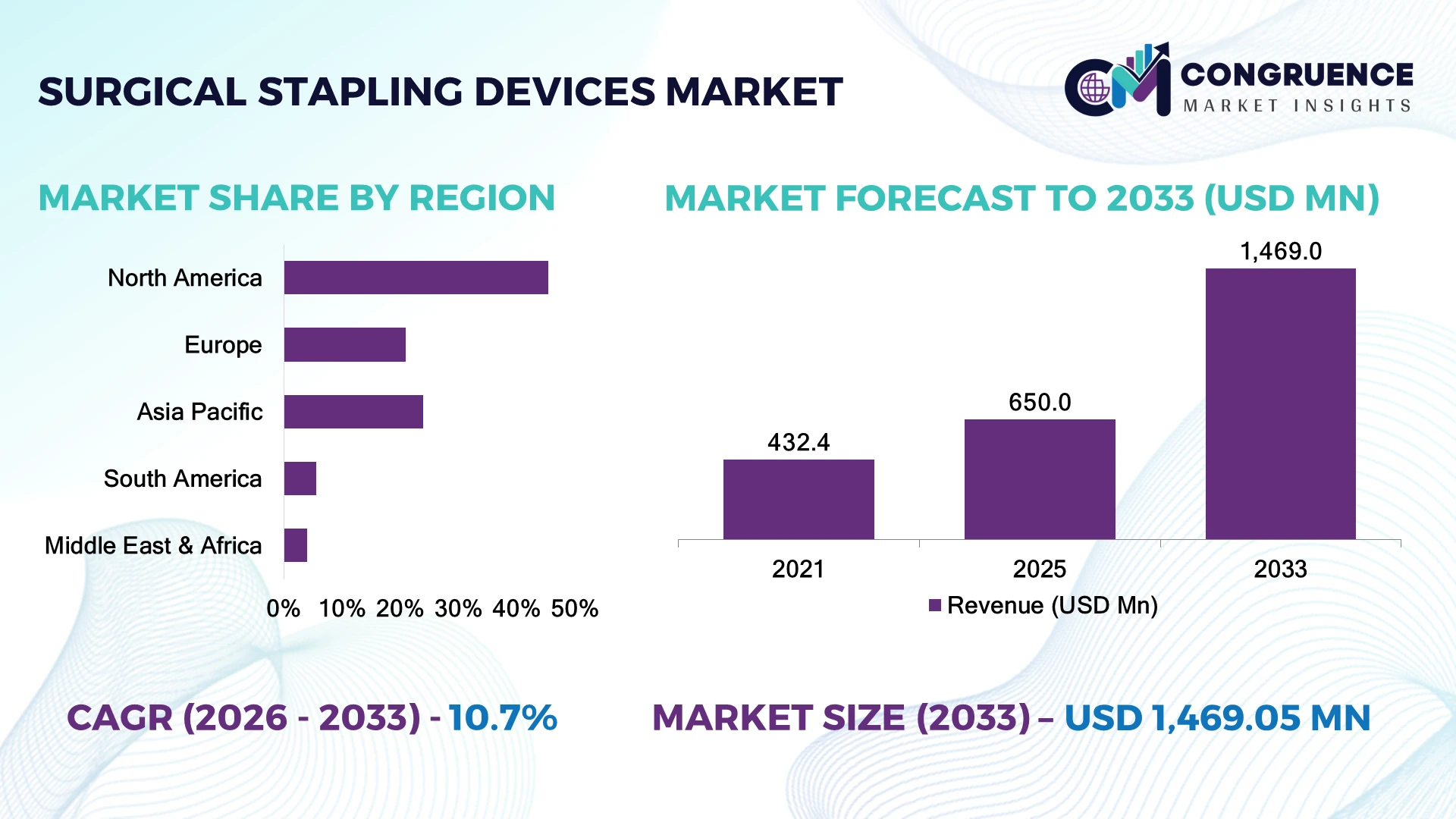
North America held a dominant 45.37% share in 2025, supported by advanced laparoscopic and robotic surgery infrastructure, while the U.S. accounted for 85.1% of the North American surgical staplers market. Hospitals and ambulatory surgical centers continue investing in precision closure technologies, with robotic-compatible staplers strengthening adoption across oncology, bariatric, thoracic, and general surgery.
The strategic priority is to combine precision, procedural efficiency, device reliability, and regulatory compliance while expanding advanced stapling technologies into high-growth healthcare markets.
Market Size & Growth: USD 650.0 Million in 2025 is projected to reach USD 1,469.0 Million by 2033 at 10.73% CAGR, driven by robotic-assisted and minimally invasive surgery adoption.
Top Growth Drivers: Minimally invasive surgery adoption at 45.37%, robotic-assisted procedure penetration at 30%+, and disposable-device utilization above 60% are strengthening advanced stapler demand.
Short-Term Forecast: By 2028, powered and robotic-compatible stapler utilization is positioned to improve procedural efficiency by approximately 10–15%, supporting faster operating-room workflows.
Emerging Technologies: AI-assisted surgical platforms, powered staplers, and advanced staple-line reinforcement are shifting competition toward precision, tissue sensing, and automated firing control.
Regional Leaders: North America is projected toward USD 0.66 billion by 2033, Europe toward USD 0.38 billion, and Asia Pacific toward USD 0.29 billion, with robotic surgery, laparoscopic procedures, and hospital modernization supporting adoption.
Consumer/End-User Trends: Hospitals and specialty surgical centers are prioritizing disposable staplers, with single-use systems representing more than 60% of purchasing preferences in infection-sensitive operating environments.
Pilot/Case Example: In 2025, FDA-cleared expansion of Intuitive Surgical’s da Vinci SP SureForm 45 platform reinforced the transition toward robotic-compatible stapling for minimally invasive procedures.
Competitive Landscape: North America represented 45.37% of the global market in 2025, with Ethicon, Medtronic, Intuitive Surgical, CONMED, and Smith+Nephew competing through powered systems, reload innovation, and robotic integration.
Regulatory & ESG Impact: FDA scrutiny is intensifying device-quality requirements; 2025 corrective actions involving Ethicon staplers demonstrate the operational importance of traceability, validated manufacturing, and safer device design.
Investment & Funding: Strategic investment is shifting toward robotic surgery ecosystems, precision instruments, and advanced reloads, with manufacturers expanding partnerships and platform compatibility rather than relying solely on conventional manual staplers.
Innovation & Future Outlook: Next-generation staplers are moving toward intelligent firing, enhanced tissue feedback, ergonomic articulation, and robotic integration, creating a competitive shift from basic closure devices toward digitally enabled surgical platforms.
Surgical stapling devices are gaining traction across bariatric, oncology, thoracic, gynecological, urological, and general procedures, where consistent staple formation and reduced operating-room time remain critical. More than 45% market concentration in North America highlights the importance of technologically mature healthcare systems, while India and China are strengthening demand through hospital modernization and minimally invasive surgery expansion. Recent FDA device actions are also pushing manufacturers toward stronger quality controls and traceable supply chains.
Surgical stapling devices are becoming strategically important because hospitals increasingly evaluate closure technologies through operating-room efficiency, procedural consistency, patient safety, and compatibility with robotic platforms. The shift from conventional manual systems toward powered and articulated staplers is changing procurement priorities, particularly in the U.S., Japan, Germany, and other markets with established minimally invasive surgery programs.
Technology differentiation is increasingly measurable: powered staplers reduce manual firing effort and improve consistency compared with conventional systems, while robotic-compatible instruments improve access and articulation in confined surgical fields. North America accounted for 45.37% of the global market in 2025, whereas Asia Pacific is positioned around infrastructure expansion and increasing adoption of advanced laparoscopic procedures.
Over the next 2–3 years, hospitals are expected to increase utilization of disposable, powered, and robotic-compatible devices as operating-room modernization accelerates. FDA actions involving Ethicon and Intuitive Surgical demonstrate why manufacturers are strengthening quality assurance, device traceability, clinician training, and post-market monitoring. Companies that combine reliable staple formation with platform compatibility, localized supply networks, and strategic hospital partnerships will secure stronger competitive positioning.
The shift toward minimally invasive and robotic surgery is the strongest structural driver for advanced stapling devices. North America represented 45.37% of the global market in 2025, while the U.S. accounted for 85.1% of North American surgical stapler demand. Powered and articulated systems address complex tissue-access requirements more effectively than conventional manual instruments. Robotic platform expansion is increasing demand for compatible reloads and precision staplers, particularly in oncology, bariatric, thoracic, and general surgery. Manufacturers are responding through platform-specific product development, surgeon partnerships, and expanded disposable portfolios. The non-obvious advantage is procurement stickiness: once hospitals standardize robotic platforms and compatible staplers, recurring reload requirements strengthen supplier relationships and increase switching costs.
High acquisition costs for powered and robotic-compatible systems remain a structural restraint, particularly in price-sensitive healthcare systems where advanced instruments compete against lower-cost manual alternatives. Premium devices can command substantially higher procurement budgets, while disposable reload requirements add recurring operating expenditure. Regulatory scrutiny further increases quality-assurance costs. In 2025, FDA action involving Ethicon’s Echelon system addressed inadvertent lockout risks, while later action involving Intuitive Surgical’s SureForm reloads followed reports of incomplete staple lines. These events increase validation, traceability, training, and inventory-control requirements. Manufacturers are reducing exposure through diversified component sourcing, stronger supplier qualification, tighter quality contracts, and localized technical support.
Intelligent stapling represents a significant opportunity as manufacturers integrate articulation, powered firing, tissue-management features, and robotic compatibility. Hospitals adopting minimally invasive systems can achieve greater procedural standardization while reducing dependence on manual firing techniques. Asia Pacific offers particularly strong expansion potential as China and India modernize surgical infrastructure and increase access to advanced laparoscopic procedures. The U.S. already demonstrates mature adoption, while emerging healthcare systems are moving from manual toward powered and disposable technologies. Manufacturers are positioning through local distribution partnerships, surgeon training programs, and R&D focused on compact robotic instruments. A key opportunity lies in interoperable ecosystems: staplers designed around multiple minimally invasive workflows can broaden hospital penetration without requiring complete operating-room replacement.
Long-term competitiveness depends on integrating stapling devices reliably into increasingly complex robotic and digital operating-room environments. Device malfunctions, reload compatibility issues, clinician training requirements, and cybersecurity considerations create execution pressure as manufacturers expand connected surgical platforms. FDA records show that recent stapler actions included incomplete staple-line formation and device lockout concerns, reinforcing the importance of validated performance and post-market surveillance. Hospitals therefore require consistent performance across high-volume procedures, while manufacturers must maintain rigorous quality systems and clinician education. The strategic challenge is not simply developing smarter staplers; it is ensuring that advanced features remain dependable across diverse surgical workflows, supply environments, and regulatory jurisdictions.
Disposable Workflow Standardization: Disposable stapling devices are gaining operational preference as hospitals prioritize single-use workflows, infection-control consistency, and faster operating-room turnover. The disposable segment held about 68% share in earlier market assessments and remains the leading type in current industry analyses. Manufacturers are expanding sterile, ready-to-use configurations and cartridge portfolios, while tighter sterilization requirements are encouraging hospitals to reduce reprocessing complexity and associated labor.
Powered Stapler Integration: Powered systems are moving from premium specialist equipment toward broader adoption in complex minimally invasive procedures. Current estimates place powered devices at nearly 65% share in some market assessments, while manual systems retain strong penetration because of lower acquisition costs. Manufacturers are responding with ergonomic firing mechanisms, rechargeable platforms, and robotic-compatible designs. The non-obvious shift is that hospitals increasingly evaluate staplers as workflow technologies rather than simple closure instruments.
Robotic Procedure Expansion: Robotic-assisted surgery is accelerating demand for compact, articulated stapling platforms that operate within restricted anatomical spaces. Laparoscopic procedures already represent roughly 44–48% of market activity in recent estimates, strengthening demand for smaller, controlled instruments. Intuitive Surgical, Medtronic, and Johnson & Johnson MedTech are expanding platform-compatible portfolios as hospitals modernize operating rooms. The transition is also reshaping procurement toward integrated instrument ecosystems rather than standalone stapler purchases.
Quality-Control Intensification: FDA device actions in 2025 and 2026 are increasing attention on staple-line reliability, cartridge compatibility, and post-market traceability. Recent corrective actions involving surgical stapler systems have pushed manufacturers toward tighter validation and quality monitoring. Hospitals are strengthening device-selection protocols and staff training, while manufacturers are increasing traceability, supplier controls, and product surveillance. This regulatory pressure is creating an operational advantage for suppliers that can demonstrate consistent device performance across high-volume procedures.
Disposable surgical stapling devices represent the leading type, accounting for approximately 46% of the market in 2025 in recent industry estimates. Their dominance reflects simplified sterile handling, elimination of reprocessing, lower cross-contamination exposure, and faster operating-room turnover. Earlier market assessments placed disposable devices at about 68%, demonstrating sustained structural preference over reusable alternatives. Reusable staplers remain relevant in cost-sensitive healthcare systems where sterilization infrastructure is established and repeated utilization improves equipment economics. Manufacturers are therefore maintaining both portfolios but directing greater product-development resources toward disposable cartridges, single-use handles, and procedure-specific configurations.
The fastest shift is occurring toward disposable systems integrated with powered and minimally invasive platforms. Cartridge consumption also creates recurring procurement opportunities because complex procedures can require multiple firings per case. Companies are strengthening hospital contracts, expanding sterile manufacturing capacity, and improving cartridge compatibility. The business implication is significant: suppliers with reliable consumable availability gain stronger account retention than manufacturers competing solely on initial device pricing. In India, expanding minimally invasive capacity and domestic medical-device manufacturing are further supporting adoption.
General Surgery represents the leading application because surgical stapling devices are used across abdominal, gastrointestinal, colorectal, bariatric, and soft-tissue procedures. The segment is estimated to command roughly 40–50% of application demand in markets with broad procedural coverage, exceeding the more specialized utilization of gynecology and urology surgery. Its breadth gives manufacturers a larger addressable procedure base and encourages development of versatile linear, powered, and articulated systems. Companies are prioritizing multipurpose devices capable of supporting both open and minimally invasive workflows rather than relying exclusively on specialty-specific instruments.
Gynecology Surgery is emerging as an important growth application as minimally invasive hysterectomy and related procedures expand, while Urology Surgery benefits from robotic and laparoscopic adoption requiring controlled tissue closure. Together, these specialized applications are increasing demand for compact instruments and procedure-specific staple configurations. Companies are responding through surgeon-training programs, robotic-platform partnerships, and targeted product launches. The strategic implication is that application diversification reduces dependence on general surgery while allowing manufacturers to capture higher-value procedures where precision and ergonomics carry greater purchasing weight.
Hospitals represent the dominant end-user group, accounting for approximately 71% of surgical stapling device demand in 2025 in recent industry estimates. Their leadership reflects higher surgical volumes, multiple operating rooms, complex procedures, and centralized procurement structures. Specialty Clinics and other focused providers remain smaller but strategically relevant as outpatient and procedure-specific surgery expands. Hospitals typically favor broad product portfolios, dependable cartridge availability, and vendor support, whereas specialty facilities place greater emphasis on compact systems, predictable procedure costs, and ease of deployment.
Specialty Clinics are positioned as the faster-shifting buyer group as minimally invasive procedures migrate toward focused and outpatient settings. Their adoption is linked to shorter workflows, standardized procedure pathways, and demand for disposable systems that reduce sterilization requirements. Companies are responding with differentiated pricing, smaller device footprints, procedure-specific configurations, and distributor partnerships. The competitive implication is a two-tier procurement model: hospitals reward platform breadth and supply reliability, while specialty clinics increasingly reward simplicity and cost transparency. Manufacturers that tailor contracting and technical support to each buyer profile can capture demand beyond traditional hospital procurement channels.
North America accounted for the largest market share at 45.4% in 2025 however, Asia-Pacific is expected to register the fastest growth, expanding at a CAGR of 11.8% between 2026 and 2033.

North America held 45.4% of the global surgical stapling devices market in 2025, maintaining a clear lead over Europe and Asia-Pacific. The U.S. represents the region's primary demand center, supported by high surgical volumes, advanced laparoscopic infrastructure, established robotic-surgery programs, and strong hospital purchasing capacity. The region's 2025 market value was reported at approximately USD 980.3 million, confirming its substantial contribution to global demand. Hospitals are increasingly standardizing powered, disposable, and articulating staplers within minimally invasive workflows. Manufacturers are responding through product launches, robotic-platform compatibility, surgeon training, and hospital contracting. The strategic shift toward integrated operating-room technologies is strengthening recurring demand for compatible cartridges and procedure-specific devices.
U.S. Market Outlook: The U.S. remains North America's principal technology and procurement hub, supported by extensive specialty-hospital networks, high minimally invasive procedure volumes, and strong adoption of robotic-assisted surgery. The country's mature medical-device ecosystem also supports rapid commercialization of advanced stapling systems. More than 9,000 da Vinci surgical systems have been installed globally, providing a substantial installed platform for compatible robotic instruments and supporting continued technology-led adoption.
Europe accounted for 21.0% of the global surgical stapling devices market in 2025, positioning it as the second-largest regional market. Germany, the U.K., France, Italy, and Spain represent important procurement centers because of established hospital infrastructure, specialist surgical capacity, and widespread minimally invasive procedures. European demand is increasingly shaped by medical-device traceability, post-market surveillance, and tighter quality requirements under the EU Medical Device Regulation. Hospitals are consequently prioritizing reliable, procedure-specific stapling systems with stronger documentation and predictable performance. Manufacturers are strengthening regulatory compliance, quality systems, and supply-chain traceability while expanding powered and robotic-compatible portfolios. The region's strategic importance lies less in basic device volume and more in premium technology adoption and stringent purchasing standards.
Germany Market Outlook: Germany is Europe's key surgical-device market, supported by more than 1,900 hospitals, extensive specialist-care infrastructure, and a strong medical-technology manufacturing base. Large university and specialist hospitals provide an established environment for advanced laparoscopic and robotic procedures. Manufacturers are focusing on clinical partnerships, technical training, and compliance-led product differentiation to secure procurement contracts in sophisticated healthcare institutions.
Asia-Pacific accounted for 24.0% of the global surgical stapling devices market in 2025, placing it ahead of Europe in the revised regional distribution and making it the largest expansion opportunity. China, Japan, India, South Korea, and Australia form the principal demand centers, with China and India gaining importance through expanding hospital infrastructure and rising surgical volumes. Independent market analysis places Asia-Pacific at approximately 25–28% in 2025, supporting its position as a major global demand center. Manufacturers are increasing local distribution, partnerships, surgeon training, and cost-optimized product development. The region's strategic advantage is its combination of large procedure volumes and increasing access to minimally invasive technologies.
China Market Outlook: China is the most strategically significant market in Asia-Pacific because of its extensive hospital network, expanding surgical capacity, and strengthening domestic medical-device manufacturing base. Local manufacturers are improving cost competitiveness while international companies are developing distribution and commercialization partnerships. China's expanding adoption of minimally invasive procedures is creating greater demand for powered, disposable, and procedure-specific stapling technologies.
South America accounted for 5.6% of the global surgical stapling devices market in 2025, with Brazil representing the principal commercial center. Demand remains concentrated in major urban healthcare hubs, particularly São Paulo and Rio de Janeiro, where private hospital networks and specialist surgical centers have stronger access to minimally invasive technologies. Brazil's large hospital base provides manufacturers with a substantial addressable customer pool, while purchasing remains more price-sensitive than in North America and Europe. Companies are responding through distributor partnerships, tiered pricing, localized technical support, and broader disposable-device portfolios. The operational opportunity is strongest where hospitals combine high surgical throughput with modern operating-room infrastructure. However, uneven healthcare investment outside major cities continues to constrain uniform deployment, making channel strategy and inventory reliability important competitive differentiators.
Brazil Market Outlook: Brazil is the region's strongest market because of its extensive private healthcare infrastructure, concentrated specialist capacity, and large surgical patient base. The country has more than 6,000 hospitals, creating a broad potential customer network for surgical stapling suppliers. São Paulo functions as a major medical-technology hub, supporting adoption of laparoscopic, robotic, and advanced tissue-closure technologies.
Middle East & Africa accounted for 4.0% of the global surgical stapling devices market in 2025. Demand is concentrated in Saudi Arabia, the United Arab Emirates, South Africa, and other major healthcare hubs where government modernization programs and private hospital investment are increasing access to advanced surgical equipment. Saudi Arabia's Vision 2030 healthcare transformation is encouraging hospital modernization and greater private-sector participation, while the UAE continues developing specialist and medical-tourism facilities. Manufacturers are targeting these high-value institutions through distributor partnerships, clinical education, premium disposable systems, and robotic-compatible technologies. Adoption remains uneven because specialist infrastructure is concentrated in major cities. Consequently, suppliers with regional service networks and dependable product availability have an operational advantage over companies relying solely on centralized exports.
Saudi Arabia Market Outlook: Saudi Arabia represents the region's most strategically significant market because of its healthcare transformation agenda, hospital modernization programs, and investment in advanced clinical infrastructure. Riyadh and Jeddah are emerging as key centers for specialist procedures and technology-enabled surgery. International manufacturers are strengthening local partnerships and distribution capabilities to support premium surgical-device deployment across newly modernized healthcare facilities.
Medtronic, Johnson & Johnson’s Ethicon, Intuitive Surgical, B. Braun, and CONMED compete as technology leaders, while Teleflex, Smith+Nephew, Purple Surgical, and regional manufacturers challenge them through specialization and cost positioning. The top five players collectively command approximately 55% of sales, creating a concentrated structure led by OEMs. Competition centers on technology, with powered and intelligent systems gaining preference, while price-sensitive markets still favor conventional devices. Product innovation contributes roughly 30% of purchasing differentiation, supply reliability influences about 20%, and customization increasingly shapes procedure adoption. Medtronic is expanding intelligent stapling, Ethicon is advancing 3D stapling, Intuitive is integrating staplers with robotic platforms, and Teleflex is targeting bariatric specialization. The competitive shift is moving from mechanical closure toward intelligent, connected, procedure-specific systems, raising entry barriers through clinical evidence, regulatory approvals, surgeon training, and installed-base relationships. Regional players counter with localized manufacturing and pricing. Winning requires validated performance, supply, platform integration, and relationships.
Medtronic
Johnson & Johnson
Intuitive Surgical
B. Braun Melsungen AG
CONMED Corporation
Smith+Nephew
Teleflex Incorporated
Stryker Corporation
3M
Becton, Dickinson and Company
Meril Life Sciences
Purple Surgical
Frankenman International Limited
Surgical stapling is shifting from mechanical firing toward powered, intelligent, and robotic-compatible platforms. Medtronic’s Signia uses tissue sensing and Adaptive Firing, while Intuitive’s SureForm uses SmartFire to monitor compression before and during firing. These systems improve staple consistency and can reduce unwanted instrument movement by more than 50% in controlled testing. Adoption is strongest in minimally invasive and robotic workflows, where precision and articulation affect operating-room control and repeatability.
Next-generation staplers are integrating tissue feedback, powered articulation, variable compression, and procedure-specific reloads. Medtronic reports up to 53% less distal tip motion with its Signia Circular system, while its reusable handle design cuts waste by up to 88% versus a competing powered circular stapler. Compared with conventional manual systems, intelligent platforms shift value from basic closure toward measurable workflow control, giving technology leaders stronger differentiation in hospitals.
From 2026 to 2028, robotic compatibility, intelligent feedback, and material-efficient designs will shape procurement. Johnson & Johnson’s ETHICON 4000 adds 3D Stapling Technology, while Intuitive extends SureForm into single-port surgery. Powered systems can command premium positioning, but cost-sensitive markets will retain manual adoption. Companies combining automation with lower waste, validated performance, and reload compatibility will gain the strongest advantage as hospitals standardize surgical ecosystems.
June 2025 — Johnson & Johnson launched the ETHICON 4000 Stapler in the U.S., using 3D Stapling Technology and 3D Reloads. Testing showed 23% fewer staple-line bleeding interventions versus traditional 2D staples, strengthening premium positioning for complex surgery. Source: jnj.com
April 2025 — Intuitive received FDA clearance for the SP SureForm 45 stapler for da Vinci SP procedures in thoracic, colorectal, and urologic surgery. SmartFire continuously monitors compression, extending intelligent stapling into single-port robotics and strengthening platform integration. Source: intuitive.com
November 2025 — Medtronic announced limited launch of the Signia Circular Stapler with Tri-Staple technology. Testing demonstrated up to 53% less distal tip motion and 88% less waste per procedure, reinforcing intelligent stapling, reusable-handle economics, and sustainability positioning. Source: medtronic.com
August 2024 — Teleflex published comparative Titan SGS Stapler evidence from 783 matched patients. Median operative time was 8 minutes shorter, while 89.6% were discharged within 24 hours versus 65.0% using multi-fire staplers, strengthening bariatric workflow differentiation further. Source: teleflex.com
The Surgical Stapling Devices Market Report evaluates the industry across type, application, end-user, technology, and geography, covering disposable and reusable systems, general surgery, gynecology surgery, urology surgery, hospitals, and specialty care settings. Regional coverage spans North America, Europe, Asia-Pacific, South America, and the Middle East & Africa, with country-level emphasis on the U.S., Germany, China, India, Brazil, and Saudi Arabia.
The report assesses powered staplers, intelligent tissue-sensing systems, robotic-compatible instruments, advanced reloads, and staple-line reinforcement technologies. It also evaluates procurement patterns, hospital deployment, specialty-clinic adoption, supply-chain positioning, regulatory requirements, and competitive strategies across leading manufacturers and emerging regional suppliers. Quantitative analysis highlights North America's 45.4% share, Asia-Pacific's 24.0% share, and the concentration of demand within hospitals. These insights support investment planning, geographic expansion, product prioritization, competitive positioning, and strategic decisions through 2033.
| Report Attribute / Metric Details | Details |
|---|---|
| Market Revenue (2025) | USD 650.0 Million |
| Market Revenue (2033) | USD 1,469.0 Million |
| CAGR (2026–2033) | 10.73% |
| Base Year | 2025 |
| Forecast Period | 2026–2033 |
| Historic Period | 2021–2025 |
| Segments Covered |
By Type
By Application
By End-User
|
| Key Deliverables | Revenue Forecast; Market Trends; Growth Drivers & Restraints; Technology Insights; Segmentation Analysis; Regional Insights; Competitive Landscape; Regulatory & ESG Overview; Recent Developments |
| Regions Covered | North America; Europe; Asia-Pacific; South America; Middle East & Africa |
| Companies Profiled | Medtronic; Johnson & Johnson; Intuitive Surgical, Inc.; B. Braun Melsungen AG; CONMED Corporation; Smith+Nephew; Teleflex Incorporated; Stryker Corporation; 3M; Becton, Dickinson and Company; Meril Life Sciences; Purple Surgical; Frankenman International Limited |
| Customization & Pricing | Available on Request (10% Customization Free) |




