
Reports
The Global Surgical Skin Antiseptic Market was valued at USD 950.7 Million in 2025 and is anticipated to reach a value of USD 1,223.2 Million by 2033 expanding at a CAGR of 3.2% between 2026 and 2033. Growth is driven by standardized surgical-site infection prevention protocols, rising procedure volumes, and broader adoption of alcohol-based chlorhexidine formulations in hospitals and ambulatory surgical centers.
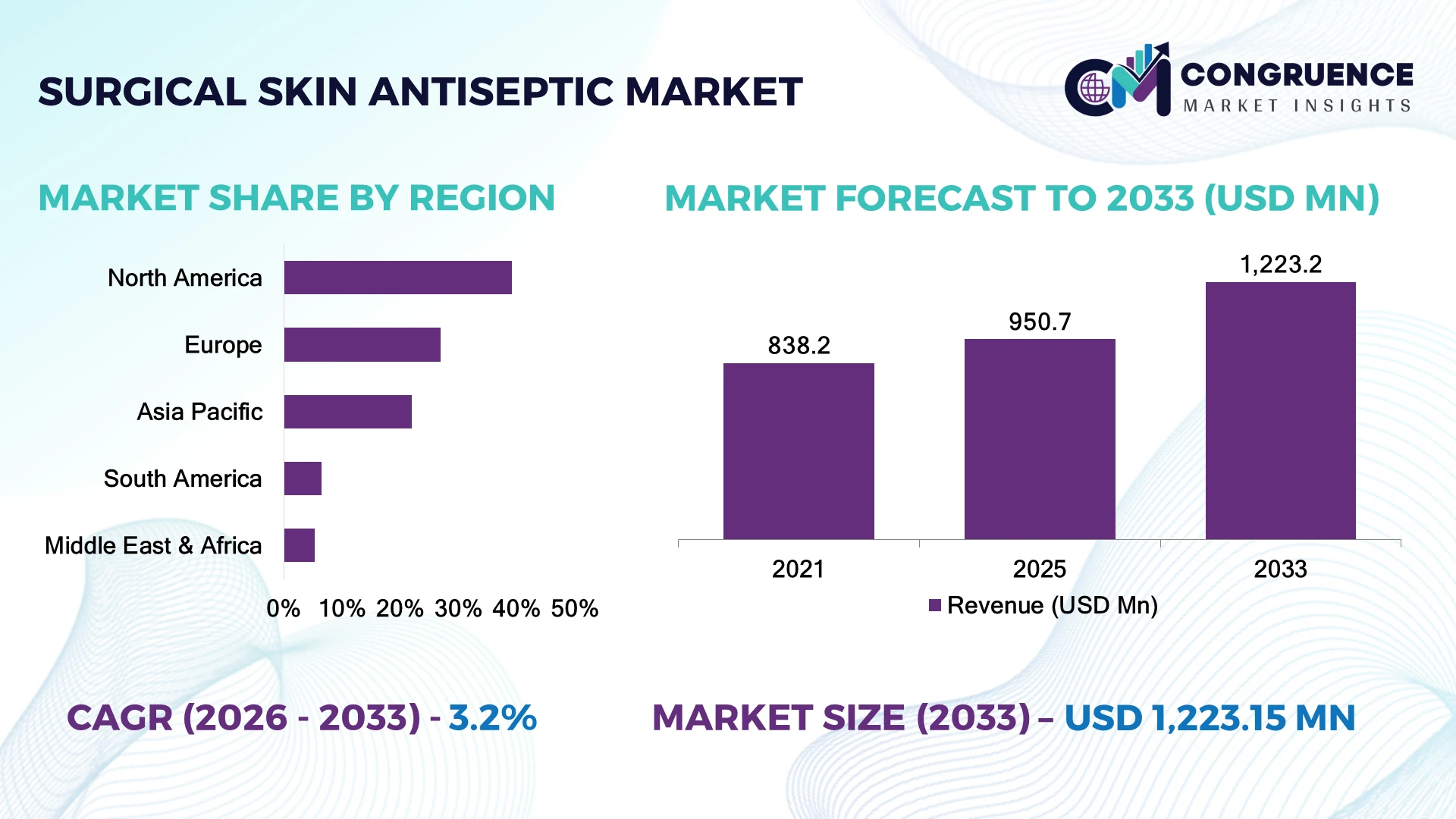
The United States represents approximately 35–38% of global surgical skin antiseptic demand, supported by high surgical volumes, established infection-control protocols, and strong hospital procurement systems. Chlorhexidine-alcohol products account for roughly 55–65% of routine preoperative antiseptic use in developed hospital settings. Germany and the United Kingdom maintain more protocol-driven procurement, while India is expanding antiseptic use alongside hospital capacity and surgical infrastructure. Global supply chains remain sensitive to pharmaceutical-grade alcohol, chlorhexidine, packaging, and sterile manufacturing inputs, particularly following geopolitical shipping disruptions.
Strategic implication: Suppliers with validated formulations, reliable sterile production, and hospital-scale distribution are positioned to secure recurring institutional contracts.
Market Size & Growth: USD 950.7 million in 2025 to USD 1,223.2 million by 2033 at 3.2% CAGR, supported by standardized surgical infection-control protocols.
Top Growth Drivers: Surgical procedures 38%, infection-prevention protocols 31%, and ambulatory surgery expansion 18%.
Short-Term Forecast: By 2028, standardized application systems can reduce preparation variability by 10–15% and improve procedure-room workflow efficiency by 5–8%.
Emerging Technologies: Alcohol-chlorhexidine formulations, applicator-based delivery, antimicrobial coatings, and digitally monitored infection-control workflows are advancing.
Regional Leaders: North America is projected near USD 470 million, Europe around USD 315 million, and Asia-Pacific approximately USD 300 million by 2033.
Consumer/End-User Trends: Hospitals account for approximately 70–75% of demand, while ambulatory surgical centers are expanding protocol-based antiseptic procurement.
Pilot/Case Example: 2026 hospital infection-control programs increasingly standardize single-use applicators, reducing preparation variation by approximately 10–15% across high-volume surgical workflows.
Competitive Landscape: 3M, BD, Mölnlycke, B. Braun, and Cardinal Health are prominent suppliers across surgical antisepsis and procedural infection-control products.
Regulatory & ESG Impact: Single-use packaging and controlled-dose applicators can reduce product wastage by approximately 5–10% compared with uncontrolled bulk application.
Investment & Funding: Manufacturers are prioritizing formulation capacity, sterile filling, applicator automation, and regional supply-chain redundancy rather than commodity-scale expansion alone.
Innovation & Future Outlook: High-concentration chlorhexidine-alcohol formulations, optimized applicators, antimicrobial delivery systems, and integrated infection-prevention protocols will shape premium procurement.
The Surgical Skin Antiseptic Market is concentrated across hospitals, ambulatory surgical centers, specialty clinics, and emergency surgical facilities, with hospitals representing approximately 70–75% of demand. Chlorhexidine-alcohol formulations remain central to preoperative preparation, while single-use applicators increasingly improve dose consistency and workflow control. Manufacturers are also refining drying characteristics, applicator ergonomics, packaging, and compatibility with different surgical procedures. In 2026, hospitals are placing greater emphasis on standardized infection-control protocols and dependable product availability as pharmaceutical and medical-device supply chains remain exposed to transportation disruptions. These changes are strengthening demand for validated, ready-to-use antiseptic systems and setting up the market's strategic shift toward higher-value procedural solutions.
Surgical skin antiseptics have become strategically important because hospitals increasingly treat preoperative skin preparation as a standardized infection-prevention workflow rather than a discretionary consumable purchase. Procurement decisions increasingly consider formulation efficacy, application consistency, drying time, packaging, and supply continuity alongside unit price. This favors suppliers capable of supporting hospital-wide protocols with validated products and dependable distribution.
Technology is improving application consistency. Single-use applicators can reduce preparation variability by approximately 10–15% compared with manually controlled liquid application, while ready-to-use formats reduce preparation steps and handling requirements. North America maintains the strongest institutional procurement infrastructure, Europe emphasizes protocol standardization and regulatory compliance, while Asia-Pacific is expanding hospital capacity and modern surgical infrastructure.
Over the next 2–3 years, suppliers will increasingly invest in automated applicator manufacturing, formulation optimization, sterile packaging, and regional inventory networks. Hospitals are also consolidating procurement around standardized product families rather than fragmented antiseptic purchasing. The practical deployment priority is high-volume operating rooms, where consistent application and rapid preparation directly influence workflow efficiency. Competitive positioning will therefore depend on formulation validation, applicator performance, regulatory readiness, manufacturing reliability, and the ability to support standardized infection-control programs across large healthcare networks.
Hospital infection-control programs are increasing adoption of standardized surgical skin preparation, with chlorhexidine-alcohol formulations representing approximately 55–65% of routine preoperative antiseptic use in developed hospital settings. Hospitals increasingly favor ready-to-use formulations and single-use applicators because standardized dosing can reduce preparation variability by 10–15%. In the United States, large hospital networks are consolidating procurement around validated antiseptic products, strengthening recurring institutional demand. Manufacturers are responding by expanding applicator production, improving drying characteristics, and developing packaging optimized for different surgical fields. The non-obvious shift is that procurement is moving from lowest unit cost toward workflow consistency and protocol compliance, giving suppliers with validated application systems stronger negotiating leverage in centralized hospital contracts.
Surgical skin antiseptic production remains exposed to pharmaceutical-grade alcohol, chlorhexidine, packaging, and sterile manufacturing inputs, with raw-material and packaging components collectively representing a significant portion of finished-product cost. Input volatility can increase manufacturing costs by approximately 5–10%, while specialized single-use applicators can add 10–20% to packaging costs versus basic liquid formats. European and U.S. manufacturers also face stringent quality documentation and product-release requirements that lengthen qualification cycles. Supply disruptions affecting alcohol, plastics, or specialty components can therefore create localized shortages even when formulation capacity is available. Companies are reducing exposure through dual sourcing, regional inventory buffers, long-term supplier contracts, and localized packaging production, protecting continuity without compromising regulatory specifications.
Next-generation applicators provide an opportunity to combine controlled-dose delivery, ergonomic design, drying-time optimization, and procedure-specific packaging. Standardized applicators can reduce preparation variability by approximately 10–15%, while optimized delivery systems can reduce product wastage by 5–10%. India, Southeast Asia, and Latin America offer additional opportunities as hospitals modernize operating rooms and expand ambulatory surgical capacity. Manufacturers are investing in applicator engineering, ready-to-use formats, and partnerships with hospital groups to integrate antiseptic preparation into standardized surgical workflows. A less obvious opportunity lies in procedure-specific kits that combine antiseptic application with other preparation components, allowing suppliers to increase procurement value per procedure while reducing nursing preparation steps and inventory complexity.
Manufacturers face increasing complexity when scaling surgical skin antiseptics across jurisdictions because formulation, labeling, applicator, flammability, and clinical-use requirements differ between markets. Regulatory documentation and validation activities can increase launch timelines by approximately 10–20%, while product changes can require additional compatibility and stability testing. Operating-room staff also require consistent application technique, creating training demands when suppliers introduce new delivery systems. In large U.S. and European hospital networks, procurement teams increasingly expect validated performance alongside traceable batch documentation. Companies must therefore strengthen quality-management systems, regional regulatory expertise, training programs, and manufacturing redundancy. The strategic challenge is achieving global product standardization without creating compliance gaps or forcing costly market-specific reformulation and packaging.
Ready-To-Use Formats Gain Ground: Hospitals are increasingly replacing manually prepared antiseptic solutions with ready-to-use bottles and applicators that standardize dosing and preparation. These formats can reduce preparation variability by approximately 10–15% and shorten nursing handling steps by 5–10%. U.S. hospital networks are increasingly incorporating standardized products into operating-room protocols, encouraging manufacturers to expand single-use packaging capacity.
Applicator Ergonomics Drives Procurement: Product design is becoming a procurement differentiator as operating-room teams prioritize grip, coverage control, drying behavior, and application speed. Improved applicator designs can reduce product wastage by approximately 5–10% while supporting more consistent coverage. Manufacturers are refining applicator head geometry and packaging, particularly for large surgical fields where uncontrolled application creates avoidable material loss.
Supply Resilience Shapes Inventory: Hospitals and distributors are increasing safety-stock planning for critical antiseptic products following disruptions affecting pharmaceutical ingredients and medical packaging. Regional inventory buffers are increasingly maintained at approximately 10–20% above routine requirements for selected high-volume products. Manufacturers are responding through dual sourcing, localized packaging, and multi-region warehousing, shifting competition toward supply reliability alongside formulation performance.
Protocol Data Gains Importance: Infection-control teams are increasingly linking antiseptic procurement with compliance monitoring, product traceability, and procedural standardization. Digital batch records can reduce manual documentation workload by approximately 15–25%, while barcode-based inventory systems improve product traceability across operating rooms. Suppliers are integrating serialization, digital inventory tools, and standardized training materials, making data visibility increasingly relevant to large hospital procurement decisions.
Chlorhexidine-alcohol leads as hospitals standardize preoperative antisepsis
Chlorhexidine-based formulations account for approximately 55–65% of the global Surgical Skin Antiseptic Market, supported by strong procedural adoption, persistent antimicrobial activity, and established hospital protocols. Povidone-iodine represents roughly 20–25%, retaining importance where chlorhexidine is contraindicated or specific procedure requirements apply, while alcohol-only and other formulations account for approximately 10–20%. Chlorhexidine-alcohol remains the mature volume segment, particularly in North America and Western Europe, whereas ready-to-use combination formulations are the fastest-shifting product category.
Manufacturers are prioritizing optimized chlorhexidine concentrations, faster-drying formulations, and applicator-based delivery. Ready-to-use formats can reduce preparation variability by approximately 10–15%, while standardized application systems can reduce product wastage by 5–10%. Companies are expanding single-use applicator manufacturing and strengthening hospital procurement partnerships. The business implication is a shift from commodity antiseptic liquids toward validated, procedure-specific products where formulation performance, application consistency, and regulatory compliance determine purchasing decisions.
CDC guidance identifies alcohol-containing chlorhexidine as a preferred skin-preparation approach in several invasive-care settings, while recognizing povidone-iodine and alcohol as alternatives when chlorhexidine is unsuitable.
Preoperative surgical preparation dominates as standardized workflows expand
Preoperative surgical skin preparation represents approximately 65–70% of global demand, making it the leading application because antiseptic preparation is embedded directly into operating-room infection-prevention protocols. Catheter and vascular-access preparation contributes roughly 15–20%, while other procedural and clinical applications account for approximately 10–15%. Surgical preparation remains the mature core application, whereas ambulatory procedures and standardized outpatient surgical workflows are the fastest-shifting demand areas.
Ready-to-use applicators and procedure-specific formats are strengthening adoption by reducing preparation steps and improving coverage consistency. Standardized application can reduce workflow variability by approximately 10–15%, while single-use formats can reduce avoidable product wastage by 5–10%. Manufacturers are responding with larger applicator sizes, optimized drying characteristics, and procedure-specific packaging. Demand is increasingly operationally critical in high-volume surgical centers because procurement teams are evaluating antiseptic products as part of standardized infection-prevention workflows rather than as standalone consumables.
CDC's 2025 infection-prevention framework applies core infection-control practices across inpatient and outpatient settings, including ambulatory surgical centers, reinforcing standardized antiseptic workflows beyond traditional hospitals.
Hospitals dominate procurement while ambulatory centers accelerate adoption
Hospitals account for approximately 70–75% of global Surgical Skin Antiseptic demand because of their high procedure volumes, centralized infection-control programs, and recurring institutional procurement. Ambulatory surgical centers represent roughly 15–20%, while specialty clinics and other healthcare facilities contribute approximately 8–12%. Hospitals remain the established buyer group, but ambulatory surgical centers are the fastest-shifting end-user segment as outpatient procedures expand and facilities standardize operating-room protocols.
Large hospital systems increasingly favor standardized product families, while ambulatory centers prioritize ready-to-use formats, compact packaging, rapid preparation, and predictable unit economics. Standardized applicators can reduce preparation variability by approximately 10–15%, while centralized procurement can improve inventory control and reduce SKU fragmentation. Manufacturers are targeting hospitals through enterprise contracts and clinical-support programs, while partnerships with ambulatory networks emphasize procedure-specific kits and flexible packaging. Competitive positioning is therefore shifting toward suppliers capable of serving both centralized hospital systems and rapidly expanding outpatient facilities.
CDC's 2024 core infection-prevention guidance explicitly covers ambulatory surgical centers alongside hospitals and other healthcare settings, reinforcing the operational importance of standardized infection-control practices across outpatient care.
North America accounted for the largest market share at 39.2% in 2025 however, Asia-Pacific is expected to register the fastest growth, expanding at a CAGR of 4.5% between 2026 and 2033.

Hospital protocol standardization strengthens demand for ready-to-use antiseptics
North America represents approximately 39.2% of the global Surgical Skin Antiseptic Market, supported by high surgical volumes, sophisticated hospital procurement, and established infection-prevention programs. The United States contributes more than 90% of regional demand, with large integrated hospital systems accounting for substantial recurring procurement. Chlorhexidine-alcohol formulations represent approximately 55–65% of routine preoperative antiseptic use in developed facilities. Single-use applicators are increasingly deployed to standardize coverage and reduce preparation variability by approximately 10–15%. Manufacturers are expanding applicator production, strengthening hospital contracts, and improving regional inventory resilience. The shift toward outpatient procedures is also broadening demand beyond conventional hospitals, particularly across ambulatory surgical networks that require compact, ready-to-use formats and standardized procedural workflows.
United States Market Outlook: The United States remains the dominant market because of its extensive hospital infrastructure, high procedural volume, and centralized infection-control procurement. Large healthcare networks increasingly standardize antiseptic products across operating rooms and ambulatory facilities. Chlorhexidine-alcohol formulations hold a substantial share of institutional usage, while ready-to-use applicators increasingly support consistent preparation and reduce nursing handling requirements.
Protocol-driven procurement strengthens formulation and applicator standardization
Europe accounts for approximately 27% of global Surgical Skin Antiseptic demand, supported by established healthcare systems, high surgical activity, and stringent infection-prevention protocols. Germany, France, the United Kingdom, Italy, and Spain represent major consumption centers. Procurement increasingly emphasizes formulation validation, traceability, packaging safety, and consistent application. Single-use applicator systems can reduce preparation variability by approximately 10–15%, encouraging hospitals to move away from less standardized application methods. European manufacturers are also strengthening regional production and distribution networks to protect supply continuity for critical medical consumables. Sustainability considerations are influencing packaging decisions, but infection-control performance and regulatory compliance remain the primary purchasing criteria.
Germany Market Outlook: Germany is a strategically significant market because of its extensive hospital infrastructure, sophisticated medical-device manufacturing base, and stringent quality-management environment. Hospitals increasingly favor validated antiseptic formulations and standardized delivery systems. Automated manufacturing and controlled packaging help suppliers maintain consistent product specifications, while centralized procurement supports larger-volume contracts across hospital networks and reduces SKU fragmentation.
Hospital modernization accelerates standardized antiseptic adoption
Asia-Pacific represents approximately 22% of the global Surgical Skin Antiseptic Market, with China, Japan, India, South Korea, and Australia forming major demand centers. China contributes approximately 35–40% of regional demand, supported by large hospital networks and expanding surgical infrastructure. India is rapidly increasing adoption as private hospitals and ambulatory surgical facilities modernize operating rooms and infection-control systems. Ready-to-use antiseptic products and single-use applicators are gaining traction in higher-tier hospitals, reducing preparation variability by approximately 10–15%. Manufacturers are expanding local packaging and distribution capacity while forming partnerships with hospital groups and medical distributors. Procurement is increasingly shifting toward standardized product portfolios rather than fragmented local formulations.
China Market Outlook: China leads Asia-Pacific demand through its extensive hospital network, large surgical base, and growing domestic medical-manufacturing ecosystem. Major hospitals increasingly implement standardized infection-control protocols, supporting demand for validated antiseptic formulations and ready-to-use delivery systems. Domestic manufacturers benefit from localized pharmaceutical and packaging supply chains, while international suppliers increasingly emphasize regulatory compliance, hospital partnerships, and regional distribution capabilities.
Brazilian hospital modernization expands standardized surgical preparation
South America represents approximately 6.5% of global Surgical Skin Antiseptic demand, with Brazil accounting for roughly 60% of regional consumption. Private hospital networks, public healthcare facilities, and ambulatory surgical centers are the principal demand channels. Brazil's concentration of major hospitals in São Paulo, Rio de Janeiro, and Minas Gerais supports recurring procurement of chlorhexidine and povidone-iodine formulations. Ready-to-use products are gaining traction as hospitals seek standardized operating-room workflows, while local distributors remain important for regional supply coverage. Manufacturers are strengthening domestic distribution agreements and localized packaging to reduce supply interruptions. Approximately 65–70% of regional demand is concentrated in hospital and surgical-care applications, keeping institutional procurement central to market development.
Brazil Market Outlook: Brazil provides the strongest South American market through its large healthcare system, expanding private hospital infrastructure, and concentration of surgical facilities in major metropolitan areas. Hospitals increasingly prioritize standardized antiseptic protocols and reliable product availability. Local distributors provide important last-mile coverage, while manufacturers can strengthen competitiveness through regional inventory, validated formulations, and hospital-network supply agreements.
Healthcare infrastructure investment strengthens institutional antiseptic procurement
Middle East & Africa represents approximately 5.5% of global Surgical Skin Antiseptic demand, with Saudi Arabia, the UAE, South Africa, Turkey, and Egypt serving as key markets. Gulf countries are investing in advanced hospitals, surgical centers, and medical-city infrastructure, creating demand for standardized infection-control consumables. Saudi Arabia and the UAE together account for approximately 45% of regional demand. Large healthcare facilities increasingly favor ready-to-use antiseptic formats and standardized operating-room protocols, while South Africa maintains an established hospital and pharmaceutical-distribution base. Manufacturers are expanding distributor networks, regional inventories, and institutional contracts to improve availability. New hospital infrastructure is increasingly designed around standardized infection-prevention workflows, supporting higher-value antiseptic products.
Saudi Arabia Market Outlook: Saudi Arabia is the region's strategically significant market because healthcare infrastructure investment and hospital modernization are expanding surgical capacity. Large medical cities and tertiary-care facilities increasingly require standardized infection-control products across multiple operating rooms. Ready-to-use antiseptic systems can reduce preparation variability by approximately 10–15%, while centralized procurement enables suppliers to establish larger institutional contracts and dedicated distribution arrangements.
The market is led by medical-supply groups including BD, 3M, Mölnlycke, Ecolab, and B. Braun, competing through CHG-alcohol formulations, sterile applicators, clinical evidence, and hospital contracts. Regional manufacturers compete on price, localized distribution, and flexible pack sizes. The top five players are estimated to represent about 45–50% of global value, leaving regional supply outside hospital networks. Competition is shifting from basic formulation toward standardized delivery systems: sterile single-use applicators can reduce preparation variability by 10–15%, while controlled dosing can lower product wastage by 5–10%. BD and 3M emphasize broad portfolios and validated applicator technology; Mölnlycke differentiates through skin-integrity and sustainability positioning; Ecolab competes through infection-prevention programs and service integration. The strongest entry barrier is regulatory validation combined with hospital qualification cycles and sterile manufacturing. Competitive pressure is increasing as regional producers add CHG/IPA applicators. Winning requires validated efficacy, dependable supply, scalable sterile production, and procurement-level customization.
Becton, Dickinson and Company (BD)
3M Company
Mölnlycke Health Care AB
Ecolab Inc.
B. Braun Melsungen AG
Cardinal Health, Inc.
Medline Industries, LP
Stryker Corporation
Schülke & Mayr GmbH
Smith+Nephew plc
PDI Healthcare
Medtronic plc
Coloplast A/S
Convatec Group plc
Current surgical skin antiseptic technology centers on sterile, single-use applicators combining chlorhexidine gluconate (CHG) with alcohol, alongside povidone-iodine alternatives for contraindicated patients. BD’s ChloraPrep uses 2% CHG/70% IPA and has sold more than 7 billion applicators, signaling deep adoption. Sterile applicators standardize coverage and can reduce preparation variability by 10–15% versus manually applied solutions.
Emerging systems emphasize wider coverage, visual tinting, controlled dosing, and skin-compatible formulations. 3M SoluPrep S offers 10.5 mL and 26 mL formats, while BD provides multiple applicator volumes. Controlled delivery can cut product wastage by 5–10% and preparation steps by 10–15%. Mölnlycke’s reformulated Hibiwash removes colour, fragrance, and soya oil, aligning antisepsis with skin-integrity and sustainability requirements.
From 2026–2028, sterile applicator platforms, optimized dosing, and integrated preoperative workflows will gain share as hospitals standardize protocols. Compared with open bottle-and-swab preparation, single-use sterile delivery can improve process consistency by roughly 10–15%. The strongest competitive advantage will favor BD, 3M, Mölnlycke, Ecolab, and B. Braun, which combine validated formulations with manufacturing scale, regulatory reach, and hospital procurement access across operating rooms and ambulatory centers during procurement cycles globally. Early investment in validated sterile delivery, automated filling, and standardized pack architecture will shorten qualification cycles and improve purchasing consistency.
April 2024 BD updated ChloraPrep Swabstick with sterile solution, retaining 2% CHG/70% IPA while sterilizing the applicator. The 1.75 mL single and 5.25 mL triple formats strengthen aseptic handling and standardize preoperative workflows across hospitals and surgical centers. Source: bd.com
2025 Mölnlycke launched Hibiwash across Europe, reformulated without colour, fragrance, and soya oil, with approval for whole-body washing in every market. The change strengthens skin compatibility and sustainability positioning within standardized preoperative antisepsis programs and hospital procurement contracts. Source: molnlycke.com
September 2025 Cambridge University Press published a review of 18 studies evaluating sterile 2% CHG/70% IPA applicators; 12 of 13 ChloraPrep studies showed significant SSI reductions, strengthening evidence-led procurement, protocol standardization, and clinical adoption of ready-to-use antisepsis. Source: cambridge.org
July 2024 Ecolab launched Disinfectant 1 Wipe, a 100% plastic-free degradable hospital disinfectant delivering one-minute disinfection. The launch strengthens lower-plastic infection-control procurement and signals sustainability pressure across healthcare consumables, hospital operations, and environmental services programs. Source: ecolab.com (Ecolab)
The Surgical Skin Antiseptic Market Report covers chlorhexidine-alcohol, povidone-iodine, alcohol-based, and other formulations across preoperative surgical preparation, vascular-access preparation, and related procedural applications. End-user analysis includes hospitals, ambulatory surgical centers, specialty clinics, and other healthcare facilities. The study evaluates regional demand across North America, Europe, Asia-Pacific, South America, and Middle East & Africa, with country-level assessment of major procurement and deployment centers. Approximately 55–65% of demand is concentrated around chlorhexidine-based formulations, while hospitals represent roughly 70–75% of end-user consumption.
The report evaluates sterile single-use applicators, controlled-dose delivery, formulation optimization, packaging, and skin-compatible technologies, alongside competitive positioning of 10–14 major participants. Quantitative segment distribution, adoption patterns, procurement structures, and emerging ambulatory applications support investment planning, geographic expansion, supplier strategy, and competitive positioning. The analysis also identifies operational priorities shaping market direction through 2026–2033.
| Report Attribute/Metric | Report Details |
|---|---|
|
Market Revenue in 2025 |
USD 950.7 Million |
|
Market Revenue in 2033 |
USD 1223.15380944589 Million |
|
CAGR (2026 - 2033) |
3.2% |
|
Base Year |
2025 |
|
Forecast Period |
2026 - 2033 |
|
Historic Period |
2021 - 2025 |
|
Segments Covered |
By Type
By Application
By End-User
|
|
Key Report Deliverable |
Revenue Forecast, Growth Trends, Market Dynamics, Segmental Overview, Regional and Country-wise Analysis, Competition Landscape |
|
Region Covered |
North America, Europe, Asia-Pacific, South America, Middle East, Africa |
|
Key Players Analyzed |
Becton, Dickinson and Company (BD), 3M Company, Mölnlycke Health Care AB, Ecolab Inc., B. Braun Melsungen AG, Cardinal Health, Inc., Medline Industries, LP, Stryker Corporation, Schülke & Mayr GmbH, Smith+Nephew plc, PDI Healthcare, Medtronic plc, Coloplast A/S, Convatec Group plc |
|
Customization & Pricing |
Available on Request (10% Customization is Free) |




