
Reports
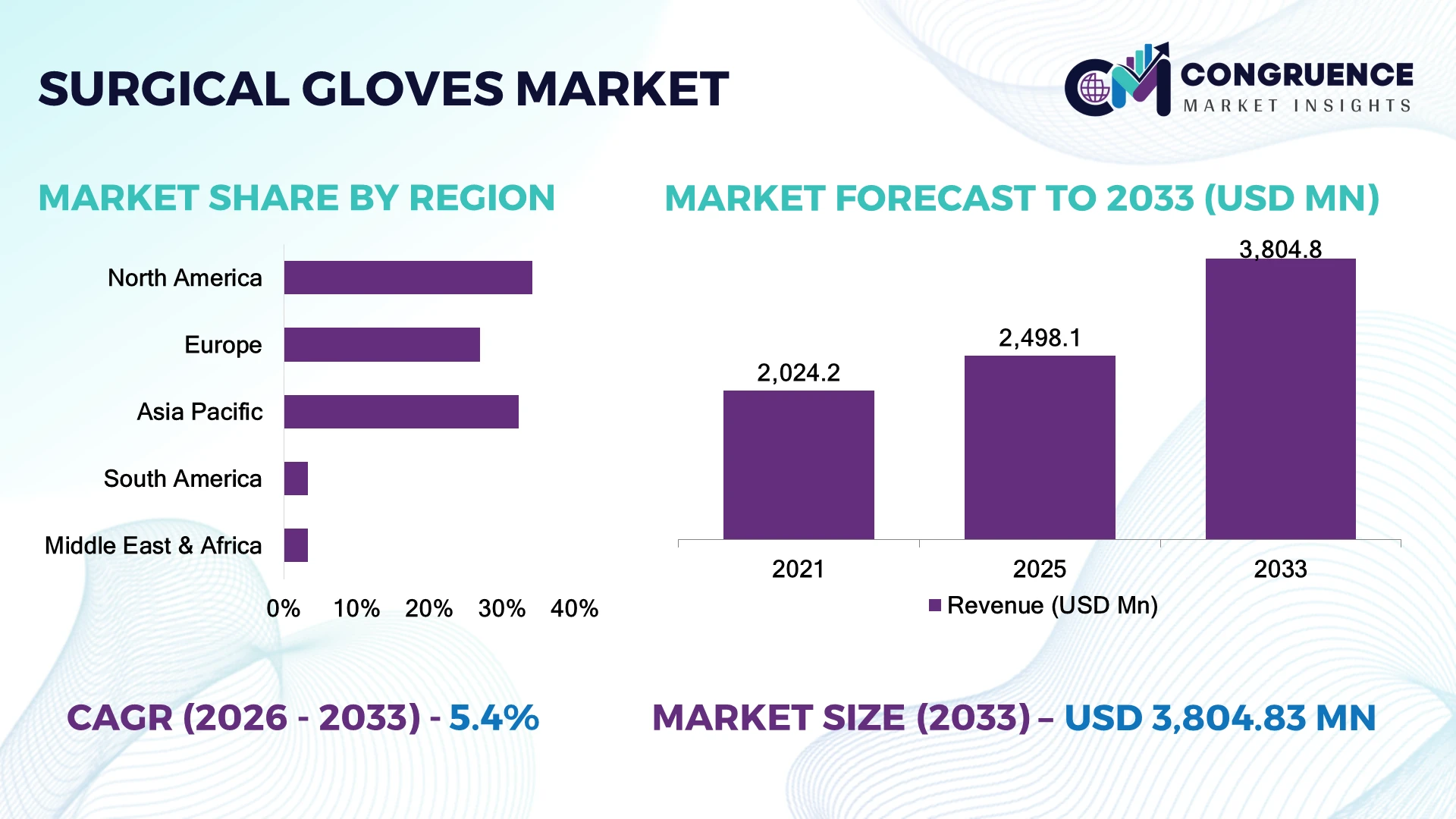
The Global Surgical Gloves Market was valued at USD 2,498.1 Million in 2025 and is anticipated to reach a value of USD 3,804.8 Million by 2033 expanding at a CAGR of 5.4% between 2026 and 2033. Growth is driven by higher surgical volumes, latex-allergy substitution toward nitrile and polyisoprene, tighter sterile-barrier requirements, and automated glove manufacturing that improves output consistency while reducing labor intensity.
Malaysia remains a dominant surgical-glove production hub, supplying about 35% of global rubber-glove output, with manufacturers operating billion-piece capacities and automation-led lines exceeding 45,000 gloves per hour. The U.S. remains a major import market, while India is expanding faster, with surgical procedures rising 10.2% between 2019 and 2023. U.S. tariffs on Chinese gloves are also reshaping sourcing.
Strategically, buyers should prioritize certified sterile quality, nitrile flexibility, dual-region sourcing, and suppliers with automated capacity and resilient logistics.
Market Size & Growth: USD 2,498.1 million in 2025 to USD 3,804.8 million by 2033 at 5.4% CAGR, supported by surgical-volume growth and sterile-barrier upgrades.
Top Growth Drivers: Nitrile substitution 8–12%; surgical-procedure growth 6–10%; automated production adoption 10–15%.
Short-Term Forecast: By 2028, automated inspection and packing can lift productivity 8–12% while reducing labor intensity 15–25%.
Emerging Technologies: AI vision inspection, robotic stripping, RFID traceability, and thinner high-tactility nitrile materials are improving consistency and material efficiency.
Regional Leaders: North America approaches USD 1.2 billion; Asia-Pacific exceeds USD 1.0 billion; Europe approaches USD 0.7 billion, with APAC expanding automation.
Consumer/End-User Trends: Hospitals represent roughly 60% of India’s surgical-glove demand, while disposable formats approach 80%, reinforcing recurring sterile procurement.
Pilot/Case Example: 2026 Malaysian automation upgrades reduced Plant 9 headcount 27% while sustaining output above 50,000 pieces per hour.
Competitive Landscape: Malaysia supplies about 35% of global rubber gloves; leading players include Top Glove, Hartalega, Kossan, Supermax, and Ansell.
Regulatory & ESG Impact: Powder-free adoption and latex-allergy controls are accelerating material shifts, while automation reduces manual handling and contamination exposure.
Investment & Funding: Hartalega allocated RM250 million for 2026 technology, automation, and AI upgrades, emphasizing productivity over greenfield capacity.
Innovation & Future Outlook: Thinner nitrile, enhanced puncture resistance, ergonomic designs, digital traceability, and lower-waste manufacturing are shifting procurement toward total cost and compliance.
The Surgical Gloves Market is increasingly shaped by sterile nitrile, polyisoprene, powder-free designs, ergonomic contours, and automated quality inspection. Nitrile substitution is strengthening, while advanced lines improve output consistency and reduce labor exposure. In 2026, tariff-driven sourcing shifts are encouraging buyers to diversify Asian supply bases and qualify regional suppliers, creating a natural transition toward strategic procurement decisions.
Surgical gloves are becoming a strategic healthcare-supply category because hospitals cannot compromise sterile-barrier performance, while manufacturers face persistent pressure on material cost, labor productivity, and delivery reliability. Procurement is shifting from lowest unit price toward total cost, qualification stability, and multi-region supply. The U.S.-China tariff environment is accelerating supplier diversification, while Asian manufacturers are investing heavily in automation.
Technology is widening the cost-performance gap. AI-assisted visual inspection and automated handling can reduce manual labor intensity by 15–25% and improve line productivity by 8–12% versus labor-heavy production. Malaysia retains major manufacturing scale, whereas India is expanding surgical volumes and domestic medical-device capacity faster, creating different investment priorities across mature and emerging markets.
During 2026–2028, manufacturers will prioritize automated inspection, thinner high-tactility nitrile, energy-efficient dipping, and digital traceability. A practical deployment involves converting inspection and packing stations to machine vision and robotic handling, reducing repetitive labor while improving defect detection. Companies are therefore directing capital toward brownfield automation, flexible lines, regional warehouses, and dual-sourcing partnerships. Competitive advantage will increasingly depend on certified quality, production flexibility, resilient logistics, and measurable productivity rather than capacity alone.
Rising surgical procedure volumes and continued migration from natural rubber latex are increasing demand for sterile nitrile and polyisoprene gloves. Nitrile penetration in hospital procurement has expanded by approximately 8–12%, while automated dipping and inspection can improve manufacturing productivity by 10–15%. India is increasing domestic medical-device production, while U.S. hospitals are tightening latex-free procurement for allergy-sensitive environments. Post-pandemic inventory normalization is also shifting buyers toward predictable contract supply rather than emergency purchasing. Manufacturers are responding by expanding nitrile lines, upgrading robotic stripping and machine-vision inspection, and securing polymer supply contracts. The non-obvious advantage is that thinner nitrile formulations can reduce material consumption by 5–10% without sacrificing required barrier performance, directly improving unit economics.
Surgical-glove manufacturing remains sensitive to nitrile-butadiene rubber, natural latex, chemicals, energy, and water costs, with raw materials typically representing more than 50% of production expenditure. Energy-intensive dipping and curing processes can account for approximately 15–20% of manufacturing costs, while latex and nitrile price movements can alter glove margins by 5–10%. Malaysian producers also face labor-cost escalation as automated factories reduce dependence on manual production. Buyers are simultaneously resisting price increases through longer procurement contracts and multi-supplier qualification. Manufacturers are mitigating exposure through vertical sourcing, energy-efficient curing, thinner glove designs, and geographically diversified production. The key constraint is margin compression: capacity expansion without corresponding material-efficiency gains can dilute returns even when utilization remains high.
Advanced automation is creating a differentiated opportunity in surgical-glove production beyond conventional capacity additions. Robotic handling can reduce direct labor requirements by 15–25%, while machine-vision inspection can increase defect-detection consistency by 10–20%. Malaysia's highly concentrated manufacturing base is therefore shifting investment toward brownfield automation, while India is emerging as an alternative production platform for healthcare consumables. AI-assisted process control, predictive maintenance, and digital batch traceability are gaining relevance as manufacturers seek lower scrap and faster qualification. Companies are expanding automated lines, partnering with equipment suppliers, and integrating quality analytics into production execution systems. A less obvious opportunity lies in premium thin-gauge nitrile: reducing material use by 5–10% while maintaining tactile performance creates simultaneous cost, sustainability, and procurement advantages.
Long-term competitiveness increasingly depends on reducing water, energy, chemical, and waste intensity without compromising sterility or barrier performance. Glove production can require substantial water volumes for former cleaning and processing, while automated plants still face 10–15% variability in selected production parameters that affects reject rates. Malaysia's mature factories are therefore confronting a different challenge from India's newer facilities: legacy plants require process retrofits, whereas greenfield operations can embed automation and resource controls from inception. Manufacturers are investing in closed-loop water systems, heat recovery, automated chemical dosing, and real-time quality monitoring. The strategic risk is stranded production efficiency; suppliers that optimize labor productivity but leave water and energy intensity unchanged will face weaker ESG credentials, higher operating costs, and greater qualification pressure from institutional healthcare buyers.
Automation Replaces Labor-Heavy Lines: Malaysian manufacturers are accelerating robotic stripping, automated packing, and machine-vision inspection, reducing direct labor requirements by 15–25% and improving line productivity by 10–15%. Rising wage pressure is making brownfield automation economically attractive, while producers increasingly prioritize flexible equipment that supports multiple glove sizes and specifications.
Thinner Nitrile Gains Procurement Share: Advanced nitrile formulations are moving toward thinner gauges while maintaining puncture resistance and tactile performance. Material consumption can decline 5–10%, supporting lower unit costs and reduced production waste. U.S. hospitals and European buyers are increasingly evaluating gloves through total material efficiency, encouraging manufacturers to invest in polymer formulation and ergonomic designs.
Supply Chains Diversify Beyond Malaysia: Procurement teams are reducing concentration risk as Malaysian producers face labor, energy, and logistics pressures. India and other Asian manufacturing hubs are receiving greater qualification attention, with dual-sourcing programs potentially reducing disruption exposure by 15–25%. Manufacturers are responding through regional warehouses, multi-country production footprints, and longer-term raw-material contracts.
Digital Quality Control Expands: Machine vision, batch analytics, and automated defect classification are becoming embedded in high-volume glove plants, improving inspection consistency by approximately 10–20% and reducing avoidable rejects by 5–10%. The non-obvious shift is toward data-based supplier qualification, allowing hospitals and distributors to compare defect performance rather than relying solely on certification.
Nitrile surgical gloves lead the market with approximately 56% share, supported by latex-free positioning, puncture resistance, chemical tolerance, and scalable automated production. Latex remains strategically relevant at around 34%, particularly where elasticity, tactile sensitivity, and established hospital procurement specifications favor natural rubber. Polyisoprene accounts for roughly 7%, while other materials contribute about 3%. Nitrile adoption is strongest in the United States and Europe, where healthcare buyers increasingly prioritize allergy management and consistent barrier performance.
Polyisoprene is the fastest-growing material category, expanding from a smaller base as premium surgical centers seek latex-like elasticity without natural-rubber proteins. Demand for advanced synthetic formulations is increasing approximately 8–12%, encouraging manufacturers to invest in thinner gauges, ergonomic shaping, and improved tear resistance. Latex producers are responding through powder-free processing and quality upgrades, while nitrile suppliers are expanding automated capacity. The investment priority is shifting from commodity volume toward differentiated synthetic gloves that deliver lower material consumption, stronger fit, and higher-value clinical performance.
In 2025, U.S. ambulatory surgery growth remained a major procurement catalyst, with 90% of surveyed hospitals planning to expand their ambulatory surgery portfolios, increasing recurring demand for sterile disposable supplies.
General surgery represents the leading application at approximately 42% of surgical-glove demand, reflecting its broad procedure base across hospitals, surgical centers, and emergency departments. Orthopedic surgery follows at about 18%, while cardiovascular surgery contributes nearly 12%. Obstetrics and gynecology, urology, ophthalmology, and other specialties collectively account for the remaining demand. High-volume procedures favor standardized sterile gloves, while specialty disciplines increasingly require enhanced tactile sensitivity and anatomical fit.
Orthopedic and cardiovascular procedures are among the fastest-changing applications, with specialized glove requirements increasing approximately 8–10% as procedure complexity and minimally invasive techniques expand. Compared with general surgery, specialty procedures place greater emphasis on grip, dexterity, and double-gloving protocols. Manufacturers are responding with anatomical designs, thinner synthetic materials, textured fingertips, and procedure-specific product ranges. The business implication is a gradual shift from standardized bulk procurement toward segmented clinical portfolios, allowing suppliers to defend margins through specialized specifications rather than competing solely on unit price.
A 2025 ambulatory-surgery leadership survey found that 57% of hospitals owned two or more ambulatory surgery centers, up from 47% in 2023, strengthening the institutional footprint of outpatient procedures and sterile-supply procurement.
Hospitals remain the leading end-user, representing approximately 61% of surgical-glove consumption because operating rooms, emergency surgery, intensive-care procedures, and inpatient interventions generate continuous sterile-glove requirements. Ambulatory surgical centers account for roughly 21%, while specialty clinics contribute about 10% and other healthcare facilities approximately 8%. Hospital procurement emphasizes contract pricing, standardized specifications, supply continuity, and latex-free options, whereas smaller facilities increasingly prioritize ready-to-use procedure-specific packs.
Ambulatory surgical centers are the fastest-growing end-user group, with procurement demand expanding approximately 9–12% as healthcare systems shift selected procedures toward lower-cost outpatient settings. Their smaller inventories make delivery reliability and SKU rationalization more important than in large hospitals. Manufacturers are therefore developing compact procedure-specific portfolios, strengthening distributor partnerships, and offering multi-site contracts to hospital networks. The strategic opportunity is to capture decentralized purchasing before it fragments: suppliers that combine consistent sterile quality, competitive pricing, and regional fulfillment can secure enterprise-wide contracts while reducing customer switching.
In 2025, 90% of surveyed hospitals planned to expand their ambulatory surgery portfolios, while 70% permitted employed physicians to invest in ambulatory surgery centers, signaling continued decentralization of procedural care.
North America accounted for the largest market share at 34.1% in 2025 however, Asia-Pacific is expected to register the fastest growth, expanding at a CAGR of 6.8% between 2026 and 2033.

Hospital Procurement Shifts Toward Resilient, Qualified Supply
North America represents approximately 34.1% of the global Surgical Gloves Market, supported by high surgical intensity, established hospital procurement systems, and strong adoption of nitrile and powder-free products. U.S. healthcare systems increasingly favor multi-year contracts and qualified secondary suppliers following pandemic-era shortages and tariff-related sourcing disruptions. Ambulatory surgery is also expanding the addressable procurement base, with 90% of surveyed hospitals planning to expand their ambulatory surgery portfolios. Manufacturers are responding through regional warehousing, automated production, and procedure-specific product portfolios. The region's strategic advantage is not manufacturing scale but purchasing sophistication: suppliers must demonstrate sterile consistency, regulatory compliance, reliable fulfillment, and competitive total cost to secure enterprise contracts.
United States Market Outlook: The United States is the region's principal demand center, driven by extensive hospital networks, ambulatory surgery centers, and high procedural volumes. Procurement increasingly emphasizes latex-free alternatives, supply continuity, and standardized sterile specifications. Expansion of outpatient surgery is particularly important because decentralized facilities require shorter replenishment cycles and smaller, procedure-specific inventories, creating opportunities for suppliers with strong distribution and contract-management capabilities.
Regulatory Qualification Raises Product-Quality Requirements
Europe represents approximately 27% of the global Surgical Gloves Market, with Germany, France, Italy, and the United Kingdom forming major demand centers. European procurement increasingly combines sterile performance with documented compliance, traceability, and sustainability requirements. In April 2025, the European Commission updated harmonized standards covering single-use medical gloves, reinforcing the importance of conformity and technical documentation under the medical-device framework. Manufacturers are therefore emphasizing powder-free synthetic materials, lower-defect production, automated inspection, and validated quality systems. The region is less dependent on rapid capacity expansion than Asia and more focused on product qualification, environmental performance, and reliable institutional supply.
Germany Market Outlook: Germany is strategically important because of its dense hospital infrastructure, advanced medical-device manufacturing ecosystem, and stringent procurement standards. Buyers increasingly evaluate glove suppliers on documentation, barrier performance, and consistency across batches. Manufacturers serving German healthcare customers are strengthening automated quality control and European distribution capabilities, while premium synthetic gloves gain relevance where latex sensitivity and procedure-specific performance influence purchasing decisions.
Manufacturing Scale Drives Automation and Supply Diversification
Asia-Pacific is the fastest-expanding market and the principal production base for surgical and examination gloves. Malaysia alone supplied approximately 35% of global rubber-glove output in 2025, exporting to more than 195 countries. Global glove demand reached about 317 billion pieces in 2025, keeping Asian factories focused on productivity despite an 11% year-on-year market decline. Malaysia's mature producers are prioritizing automation, energy efficiency, and product differentiation, while India is developing additional medical-device manufacturing capacity. The region's competitive advantage is shifting from labor availability toward automated throughput, polymer efficiency, quality consistency, and export resilience.
Malaysia Market Outlook: Malaysia remains the most strategically significant manufacturing base because of its concentrated producer ecosystem, established export infrastructure, and deep rubber-processing expertise. The country supplies gloves to more than 195 countries, giving manufacturers exceptional access to international healthcare procurement networks. Producers are increasingly investing in automation and digital quality control to offset labor pressures and improve cost competitiveness.
Brazil Anchors Healthcare Consumables Expansion
South America remains a smaller but increasingly important surgical-glove market, with Brazil representing approximately 3.3% of global market value in 2025. Hospital modernization, expanding private healthcare networks, and greater surgical outsourcing are strengthening demand for sterile disposable products. Brazil's market is also shifting toward nitrile, which leads its material mix and benefits from latex-allergy considerations. Local distributors remain important because import dependence can lengthen replenishment cycles and increase exposure to currency and freight volatility. Manufacturers are responding through distributor partnerships, regional inventories, and broader procedure-specific portfolios. The key opportunity is not simply higher consumption but improved procurement reliability, particularly for private hospital groups seeking standardized products across multiple facilities.
Brazil Market Outlook: Brazil is the region's strongest commercial market because of its large healthcare system and established medical-supply distribution network. Its surgical-glove market was approximately USD 70.3 million in 2025, with nitrile already the leading material. Suppliers are strengthening local distribution, import planning, and private-hospital relationships to capture demand while reducing stockout exposure.
Healthcare Localization Expands Sterile Supply Demand
Middle East & Africa demand is being shaped by hospital construction, healthcare localization, medical-tourism infrastructure, and rising investment in surgical capacity. Saudi Arabia is the strongest regional demand center, supported by Vision 2030 healthcare transformation and large-scale private and public hospital expansion. More than USD 33 billion in strategic healthcare investments were announced during the 2025 Global Health Exhibition, including USD 8.4 billion in hospital and infrastructure projects. This investment is increasing requirements for sterile consumables, while procurement teams are seeking dependable suppliers with local distribution and regulatory support. Manufacturers are responding through regional partnerships, distributor networks, and higher-value nitrile portfolios.
Saudi Arabia Market Outlook: Saudi Arabia offers the strongest strategic opportunity because healthcare infrastructure is expanding alongside localization initiatives. New hospital developments are increasing recurring demand for surgical consumables, while the country's investment programs are encouraging domestic medical-technology capabilities. Suppliers that establish regional warehousing, local partnerships, and compliant product registration can shorten delivery cycles and strengthen access to large hospital networks.
Top Glove, Hartalega, Ansell, Kossan Rubber, and Supermax compete as global manufacturing leaders, while emerging Indian producers challenge them on localization and responsiveness. The top five hold an estimated 38% combined share. Competition centers on price, automation, quality, and supply resilience; automated lines can improve productivity 10–15%, while thinner nitrile formulations reduce material use 5–10%. Malaysian leaders are upgrading automation and synthetic-glove portfolios, while Ansell is expanding India capacity and regional sourcing. Indian producers are adding lines and healthcare partnerships to reduce import dependence. The competitive shift is moving from volume leadership toward vertically integrated, multi-country supply networks and higher-value sterile products. Entry barriers include regulatory qualification, sterile manufacturing expertise, polymer sourcing, and hospital-contract requirements. Winners will combine certified quality, automated throughput, resilient raw-material access, regional inventory, and differentiated nitrile or polyisoprene products, converting supply reliability and clinical performance into institutional contracts worldwide.
Top Glove Corporation Bhd
Hartalega Holdings Berhad
Ansell Limited
Kossan Rubber Industries Berhad
Supermax Corporation Berhad
INTCO Medical Technology Co., Ltd.
Medline Industries, LP
Cardinal Health, Inc.
B. Braun Melsungen AG
Mölnlycke Health Care AB
Riverstone Holdings Limited
Semperit AG Holding
Wadi Surgicals
U.S. Medical Glove Company
Surgical-glove technology is shifting from labor-intensive dipping and manual inspection toward automated stripping, machine vision, robotic packing, and digital process controls. Automated lines can improve productivity by 10–15%, while machine vision reduces inspection variability by 5–10%. Adoption is strongest among Malaysian high-volume manufacturers, where labor-cost pressure is accelerating brownfield automation.
Material engineering is equally important. Advanced thin-gauge nitrile and polyisoprene formulations can reduce material consumption by 5–10% while preserving tactile sensitivity and barrier performance. Compared with conventional manual inspection, AI-assisted defect classification can improve detection consistency by approximately 10–20%. Ansell benefits from synthetic-material innovation, while Indian producers gain through flexible, localized manufacturing and shorter qualification cycles.
During 2026–2028, connected production monitoring, predictive maintenance, digital batch traceability, and lower-water dipping systems will expand across advanced facilities. Predictive controls can reduce unplanned downtime by 5–8%, improving asset utilization and delivery reliability. The competitive advantage will favor manufacturers integrating polymer science with automation, quality analytics, and multi-country capacity. Companies acting now can lower labor intensity, reduce scrap, strengthen sterile consistency, and secure hospital contracts where documented manufacturing performance increasingly influences supplier selection. These gains strengthen margins and consistency at high-volume facilities. This integration strengthens traceability, qualification readiness, and confidence across sterile supply programs.
March 2026 Ansell began first-line production at its new Tamil Nadu facility, producing approximately 60 million pairs annually. The investment strengthens Asian surgical-glove capacity, shortens customer lead times, and diversifies supply beyond Malaysia and Sri Lanka for global healthcare procurement. Source: ansell.com
May 2025 U.S. Medical Glove Company committed $200–240 million to transform a 638,000-square-foot Ohio facility, adding 18 surgical machines. Vertical integration of NBR and polyisoprene production strengthens domestic supply security, reduces Asian shipping dependence, and accelerates supply response. Source: prnewswire.com
March 2025 Ansell secured a national Premier purchasing agreement for surgeons' gloves, effective May 2025. The arrangement provides pre-negotiated pricing and terms to participating healthcare members, strengthening institutional distribution and visibility and competitive positioning across U.S. surgical facilities nationwide. Source: ansell.com
February 2025 Wadi Surgicals announced two additional Visakhapatnam production lines, each capable of one million gloves daily, alongside a planned North India facility. The expansion strengthens India's domestic nitrile supply, supports export ambitions, and positions localized manufacturing against import dependence. Source: Deccan Chronicle
The Surgical Gloves Market Report evaluates latex, nitrile, polyisoprene, and other specialty materials across general surgery, orthopedic, cardiovascular, obstetric, urological, ophthalmic, and other procedures. End-user coverage includes hospitals, ambulatory surgical centers, specialty clinics, and other healthcare facilities. Regional analysis spans North America, Europe, Asia-Pacific, South America, and Middle East & Africa, with country-level assessment of manufacturing capacity, procurement structures, regulatory requirements, and supply-chain resilience.
The report examines powder-free designs, thin-gauge nitrile, ergonomic formulations, automated inspection, robotic handling, digital traceability, and resource-efficient production. Coverage reflects hospitals at approximately 61% of demand and ambulatory surgical centers near 21%, alongside emerging decentralized procurement models. Competitive analysis evaluates major manufacturers, localized suppliers, partnerships, capacity expansion, and vertical integration. Findings support investment planning, geographic expansion, supplier diversification, product strategy, competitive positioning, and market direction through 2033.
| Report Attribute/Metric | Report Details |
|---|---|
|
Market Revenue in 2025 |
USD 2,498.1 Million |
|
Market Revenue in 2033 |
USD 3,804.8 Million |
|
CAGR (2026 - 2033) |
5.4% |
|
Base Year |
2025 |
|
Forecast Period |
2026 - 2033 |
|
Historic Period |
2021 - 2025 |
|
Segments Covered |
By Type
By Application
By End-User
|
|
Key Report Deliverable |
Revenue Forecast, Growth Trends, Market Dynamics, Segmental Overview, Regional and Country-wise Analysis, Competition Landscape |
|
Region Covered |
North America, Europe, Asia-Pacific, South America, Middle East, Africa |
|
Key Players Analyzed |
Top Glove Corporation Bhd, Hartalega Holdings Berhad, Ansell Limited, Kossan Rubber Industries Berhad, Supermax Corporation Berhad, INTCO Medical Technology Co., Ltd., Medline Industries, LP, Cardinal Health, Inc., B. Braun Melsungen AG, Mölnlycke Health Care AB, Riverstone Holdings Limited, Semperit AG Holding, Wadi Surgicals, U.S. Medical Glove Company |
|
Customization & Pricing |
Available on Request (10% Customization is Free) |




