
Reports
The Global Steam Sterilization Equipment Market was valued at USD 438.0 Million in 2025 and is anticipated to reach a value of USD 735.9 Million by 2033 expanding at a CAGR of 6.7% between 2026 and 2033. The market is accelerating due to rising installation of automated hospital sterilization systems, with over 58% of large healthcare facilities integrating high-capacity pre-vacuum steam sterilizers to improve infection control efficiency and reduce turnaround time by nearly 35%. Growing pressure to comply with stricter sterilization validation standards across pharmaceutical manufacturing and surgical centers is forcing rapid replacement of legacy low-efficiency units with digitally monitored advanced systems. Between 2024 and 2026, healthcare infrastructure modernization programs across North America, Europe, and Asia-Pacific intensified following post-pandemic infection-prevention reforms and medical device safety regulations. Increasing localization of medical equipment supply chains, particularly across India and Southeast Asia, is reshaping procurement strategies while reducing dependency on imported sterilization systems by nearly 22% in regional public healthcare networks.
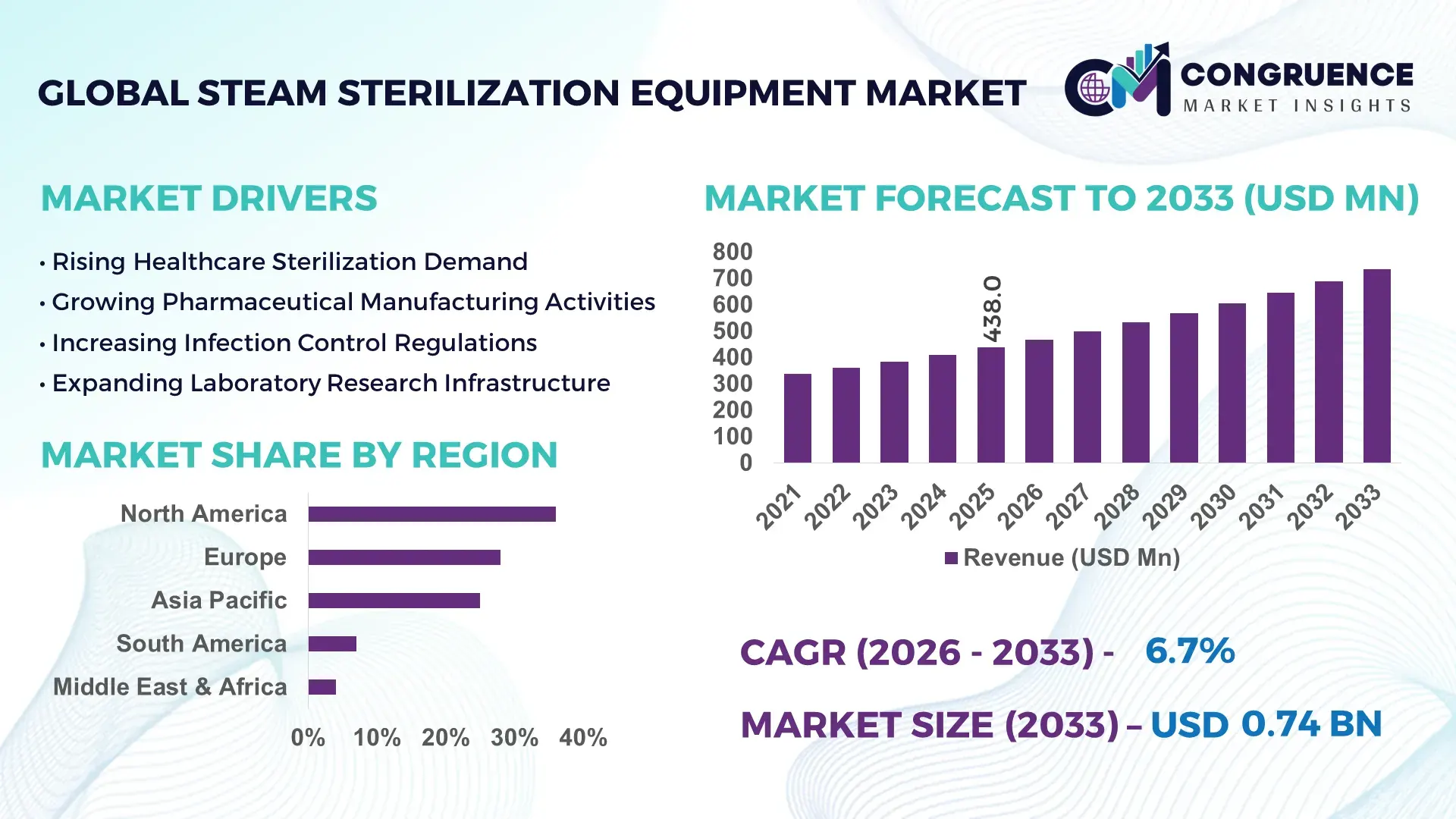
The United States dominates the global Steam Sterilization Equipment Market with approximately 34% market share, supported by over 6,100 hospitals, strong pharmaceutical manufacturing capacity, and continuous investment in infection prevention technologies. More than 72% of tertiary healthcare facilities in the country now operate centralized sterile processing departments equipped with automated steam sterilization systems. Compared with several emerging economies where manual sterilization workflows remain above 40%, U.S. healthcare providers have accelerated digital sterilization tracking adoption to above 65%, significantly improving compliance accuracy and operational throughput. Federal healthcare investments, expanding outpatient surgery volumes, and rising biologics production are further strengthening demand for advanced high-pressure sterilization infrastructure.
The market is strategically shifting toward intelligent, energy-efficient sterilization ecosystems, positioning technology-integrated manufacturers to capture long-term institutional procurement advantages and regulatory-driven replacement demand.
Market Size & Growth: USD 438.0 Million in 2025 reaching USD 735.9 Million by 2033 at 6.7% CAGR, driven by automated sterilization deployment and hospital infrastructure modernization.
Top Growth Drivers: Hospital sterilization automation adoption rose 41%, pharmaceutical sterile processing demand increased 36%, and surgical procedure volumes expanded 29%.
Short-Term Forecast: By 2028, sterilization cycle efficiency is projected to improve 32% while energy consumption per cycle declines nearly 18%.
Emerging Technologies: AI-based sterilization monitoring, IoT-enabled tracking systems, and low-water-consumption autoclaves are reshaping advanced steam sterilization operations.
Regional Leaders: North America exceeds USD 160 Million demand, Europe surpasses USD 125 Million, while Asia-Pacific accelerates through localized medical equipment expansion.
Consumer/End-User Trends: Over 67% of hospitals prioritize automated steam sterilizers with digital compliance tracking and remote monitoring capabilities.
Pilot/Case Example: In 2025, a multi-hospital sterilization upgrade project reduced instrument contamination incidents by 38% and processing delays by 27%.
Competitive Landscape: Getinge controls nearly 19% market share alongside Steris, Belimed, Tuttnauer, and MMM Group amid supply chain restructuring.
Regulatory & ESG Impact: Energy-efficient sterilization systems lowered operational water usage by 24% under tightening healthcare sustainability compliance standards.
Investment & Funding: More than USD 420 Million was allocated toward sterilization facility expansion, smart equipment integration, and regional manufacturing partnerships.
Innovation & Future Outlook: Advanced modular sterilization units and predictive maintenance platforms are redefining high-throughput healthcare sterilization ecosystems globally.
Pharmaceutical manufacturing contributes nearly 38% of total Steam Sterilization Equipment Market demand, followed by hospitals and surgical centers at approximately 44% combined due to rising infection-control requirements and sterile processing intensity. Advanced automation integration improved sterilization workflow efficiency by over 30%, while low-water-consumption systems reduced utility usage by nearly 20% across newly upgraded facilities. Asia-Pacific continues gaining manufacturing momentum through localized production expansion, whereas Europe is accelerating adoption of energy-efficient sterilization systems under stricter sustainability compliance frameworks. Increasing deployment of digitally connected sterilization monitoring platforms and centralized sterile processing infrastructure is positioning the market for a more technology-driven competitive landscape, creating a strong foundation for deeper strategic transformation across healthcare and pharmaceutical operations.
The Steam Sterilization Equipment Market is rapidly transforming into a critical infrastructure segment for healthcare systems, pharmaceutical manufacturing, biotechnology processing, and medical device sterilization operations. Competitive intensity is accelerating as healthcare providers prioritize contamination prevention, operational throughput, and regulatory-grade sterilization validation. Rising surgical volumes, stricter infection-control protocols, and expanding biologics production are forcing hospitals and pharmaceutical companies to modernize sterilization infrastructure at scale. Simultaneously, supply chain regionalization and healthcare equipment localization strategies are reshaping global procurement priorities between 2024 and 2026.
Regulatory pressure surrounding sterile processing traceability and equipment validation is transforming purchasing behavior across both developed and emerging economies. AI-enabled sterilization monitoring systems now improve operational efficiency by nearly 34% while reducing manual compliance management costs by approximately 21% compared to conventional standalone systems. North America leads in installed sterilization capacity and centralized sterile processing volume, while Asia-Pacific leads in adoption acceleration with more than 39% growth in localized healthcare equipment manufacturing investments.
Over the next two to three years, automated steam sterilization deployment across multi-specialty hospitals is expected to improve processing throughput by over 28% while reducing instrument turnaround delays by nearly 25%. Sustainability is also becoming a decisive competitive advantage, as energy-efficient sterilization chambers reduce water consumption by approximately 24% and lower utility expenses across high-volume healthcare facilities. Hospitals increasingly prefer systems capable of integrating digital compliance reporting and predictive maintenance functionalities to strengthen operational continuity.
A major healthcare network modernization program completed in 2025 demonstrated a 31% reduction in sterilization cycle downtime after replacing legacy equipment with automated high-capacity steam sterilizers integrated with cloud-based monitoring. In parallel, manufacturers are aggressively shifting capital allocation toward modular sterilization systems, regional assembly facilities, and digital service ecosystems to capture long-term institutional contracts and strengthen recurring service revenue streams.The strategic pathway of the Steam Sterilization Equipment Market is no longer centered solely on equipment supply; it is increasingly defined by operational intelligence, compliance optimization, sustainability performance, and infrastructure scalability. Companies capable of accelerating digital integration, optimizing lifecycle efficiency, and transforming sterilization workflows into data-driven ecosystems will secure the strongest competitive positioning in the evolving global healthcare environment.
The Steam Sterilization Equipment Market is being reshaped by rapid healthcare infrastructure modernization, stricter sterilization compliance frameworks, and increasing demand for high-throughput sterile processing systems across hospitals, pharmaceutical facilities, and biotechnology manufacturing sites. Healthcare institutions are prioritizing centralized sterile processing departments capable of reducing contamination risks while improving operational efficiency by over 30%. Simultaneously, pharmaceutical manufacturers are expanding sterile production capacity due to rising biologics and injectable drug manufacturing requirements. The market is also experiencing a strong transition toward digitally connected sterilization systems with automated monitoring, predictive maintenance, and real-time compliance tracking capabilities. Growing replacement demand for outdated manual systems, combined with increasing energy-efficiency mandates and water-consumption optimization initiatives, is redefining procurement decisions globally. Manufacturers are responding through localized production expansion, strategic partnerships, and smart sterilization platform development to strengthen competitive positioning and improve institutional contract retention across both developed and emerging healthcare economies.
The expansion of advanced healthcare infrastructure and rising procedural volumes are forcing healthcare providers to modernize sterilization operations at unprecedented speed. More than 61% of tertiary hospitals are upgrading centralized sterile processing departments to support higher surgical throughput and stricter infection-prevention protocols. Automated steam sterilization systems now reduce instrument turnaround time by approximately 35%, directly improving operating room utilization efficiency and lowering contamination-related operational disruptions. Simultaneously, pharmaceutical sterile manufacturing demand increased by nearly 33% following the expansion of biologics and injectable drug production facilities. Global healthcare supply chain restructuring after the pandemic accelerated regional investments in domestic medical equipment manufacturing, particularly across Asia-Pacific and North America. This shift is pushing manufacturers to expand local assembly operations and strengthen service networks to reduce procurement delays by over 20%. Companies are responding aggressively through capacity expansion, digital sterilization monitoring integration, and strategic hospital partnerships. Several leading suppliers are also investing in modular sterilization systems capable of scaling across multi-site healthcare networks, reinforcing long-term institutional demand and accelerating competitive differentiation in high-volume healthcare environments.
Despite strong adoption momentum, the Steam Sterilization Equipment Market faces growing structural pressure from rising component costs, utility infrastructure limitations, and compliance-intensive installation requirements. High-capacity steam sterilizers require substantial upfront infrastructure investment, with installation and facility retrofitting expenses accounting for nearly 28% of total deployment costs in large hospitals. Energy price fluctuations and industrial stainless-steel cost increases exceeding 18% during recent procurement cycles have further constrained purchasing flexibility among mid-sized healthcare institutions. Emerging economies continue facing inconsistent steam-generation infrastructure and limited sterile processing expertise, creating deployment delays and operational inefficiencies. In several developing healthcare systems, more than 42% of hospitals still operate semi-automated or manual sterilization workflows due to budget constraints and inadequate facility modernization. These limitations directly affect scalability, maintenance consistency, and compliance performance. To mitigate risks, manufacturers are diversifying component sourcing strategies, securing long-term supplier contracts, and developing compact energy-efficient sterilization systems designed for lower infrastructure dependency. Some companies are also accelerating hybrid service models that combine equipment leasing, maintenance contracts, and remote monitoring to reduce capital burden and strengthen market accessibility across cost-sensitive regions.
The strongest opportunity within the Steam Sterilization Equipment Market lies in the convergence of intelligent sterilization technologies and expanding healthcare infrastructure across emerging economies. Smart sterilization systems integrated with IoT-enabled compliance tracking and predictive maintenance platforms improve operational uptime by nearly 29% while reducing unplanned maintenance incidents by approximately 24%. This operational advantage is accelerating adoption among high-volume hospital groups and pharmaceutical manufacturers focused on workflow optimization. Emerging healthcare markets across India, Southeast Asia, and the Middle East are rapidly expanding hospital infrastructure and sterile manufacturing capabilities, creating significant demand for scalable sterilization ecosystems. More than 37% of newly commissioned healthcare facilities in Asia-Pacific now prioritize automated steam sterilization integration during initial infrastructure planning stages. Simultaneously, manufacturers are exploring low-water-consumption sterilization technologies capable of reducing resource usage by over 20%, creating both operational and sustainability advantages. Companies are positioning for long-term dominance through regional manufacturing expansion, R&D investment in intelligent sterilization software, and ecosystem partnerships with healthcare digitalization providers. A non-obvious but increasingly strategic opportunity is the integration of sterilization analytics into broader hospital operational intelligence platforms, allowing healthcare networks to optimize equipment utilization, reduce downtime, and improve compliance transparency across multi-site operations.
Execution complexity is emerging as a major long-term challenge as healthcare systems demand faster sterilization throughput, lower resource consumption, and stricter compliance simultaneously. High-volume healthcare facilities now require sterilization systems capable of operating with uptime rates above 95%, yet nearly 26% of institutions continue experiencing operational delays linked to maintenance inefficiencies and aging infrastructure. These performance gaps are constraining workflow consistency and increasing pressure on healthcare operational budgets. Regulatory validation processes and compliance documentation requirements are becoming increasingly rigorous, particularly across pharmaceutical sterile manufacturing and medical device processing operations. In several markets, validation timelines expanded by over 19%, delaying deployment schedules and increasing implementation costs. Additionally, water and energy infrastructure limitations are creating operational strain in regions experiencing utility instability and healthcare expansion pressures. To remain competitive, manufacturers must solve three interconnected execution barriers: lifecycle reliability, digital integration complexity, and infrastructure adaptability. Companies are increasing investment in predictive maintenance platforms, remote diagnostics, and modular sterilization architectures to improve scalability and reduce deployment risk. Strategic partnerships with healthcare infrastructure providers and digital compliance specialists are also becoming essential to maintain long-term operational consistency and competitive positioning in increasingly regulation-intensive healthcare environments.
Digital sterilization tracking adoption surpassed 65% across advanced healthcare facilities, reshaping operational transparency and compliance execution. Hospitals are increasingly integrating IoT-enabled sterilization monitoring platforms capable of reducing manual documentation workload by nearly 40% and lowering audit preparation time by approximately 28%. Real-time cycle verification systems are becoming standard in multi-site healthcare networks as stricter regulatory oversight intensifies. Companies are accelerating cloud-based compliance integration and predictive maintenance deployment to strengthen institutional retention and reduce sterilization downtime.
Energy-efficient sterilization systems reduced utility consumption by over 22%, forcing operational redesign across healthcare infrastructure. New-generation steam sterilizers now operate with nearly 18% lower water usage and faster chamber recovery times, improving throughput efficiency in high-volume hospitals. Rising utility costs and sustainability mandates are pushing healthcare providers toward low-resource sterilization systems. Manufacturers are responding by restructuring product portfolios around eco-efficient designs and expanding modular sterilization platforms optimized for resource-constrained environments.
Localized production expansion increased nearly 31% as healthcare supply chains shifted toward regional manufacturing resilience. Healthcare providers and governments are prioritizing domestic procurement to reduce import dependency and shorten equipment delivery cycles. Asia-Pacific manufacturers expanded localized assembly capacity significantly between 2024 and 2026, while North American suppliers strengthened regional service infrastructure. A non-obvious shift is the growing preference for region-specific sterilization customization to align with local regulatory workflows and facility constraints.
Outsourced sterile processing partnerships expanded by approximately 27%, redefining healthcare sterilization business models. Mid-sized hospitals increasingly prefer third-party sterilization management to reduce operational burden and optimize staffing efficiency amid healthcare labor shortages. Outsourcing providers improved instrument turnaround efficiency by nearly 24% through centralized processing hubs and automated sterilization integration. In response, equipment manufacturers are forming strategic partnerships with healthcare service operators to secure recurring service revenue and strengthen long-term equipment deployment visibility.
The Steam Sterilization Equipment Market is segmented by type, application, and end-user, with demand concentration heavily influenced by healthcare infrastructure scale, pharmaceutical sterile manufacturing intensity, and infection-control modernization priorities. Large-capacity automatic steam sterilizers continue dominating procurement across hospitals and centralized sterile processing facilities due to their higher throughput efficiency and compliance integration capabilities. Pharmaceutical manufacturing and hospitals collectively account for more than 60% of equipment deployment because of rising sterile processing requirements and stricter regulatory validation standards. Demand is steadily shifting toward digitally integrated sterilization systems with automated monitoring and predictive maintenance functionalities, particularly across North America and Asia-Pacific. Companies are strategically repositioning portfolios around modular systems, low-resource sterilization technologies, and high-throughput solutions to capture institutional replacement demand and support expanding healthcare infrastructure modernization programs globally.
Automatic steam sterilizers dominate the Steam Sterilization Equipment Market with approximately 48% share due to their superior throughput capacity, automated compliance tracking, and reduced labor dependency across large healthcare facilities. Their structural advantage lies in operational scalability, faster sterilization cycles, and integration with centralized sterile processing departments, making them the preferred choice for high-volume hospitals and pharmaceutical manufacturing facilities. In contrast, tabletop steam sterilizers are emerging as the fastest-growing segment, expanding adoption by nearly 17% due to increasing deployment in ambulatory surgical centers, dental clinics, and smaller healthcare facilities seeking compact and energy-efficient sterilization solutions. Vertical steam sterilizers and horizontal high-capacity systems collectively contribute around 37% of total market demand, supported by their strategic role in pharmaceutical production, laboratory sterilization, and industrial sterile processing applications. Compared with conventional semi-automatic systems, advanced automatic sterilizers improve workflow efficiency by over 30% while significantly reducing manual compliance management complexity. Market demand is clearly shifting toward intelligent sterilization systems integrated with remote monitoring and predictive maintenance functionalities. Manufacturers are aggressively prioritizing automated and modular product development while expanding regional production capabilities to capture institutional replacement cycles and rapidly growing outpatient healthcare infrastructure demand.
• According to a 2025 report by the International Association of Healthcare Central Service Materiel Management, automatic steam sterilization systems were adopted by over 68% of large hospital sterile processing departments, resulting in nearly 33% improvement in sterilization workflow efficiency and compliance accuracy, reinforcing their growing strategic importance.
Hospitals and surgical centers remain the leading application segment in the Steam Sterilization Equipment Market, accounting for nearly 46% of total demand due to rising surgical procedure volumes, infection-prevention requirements, and centralized sterile processing expansion. Usage concentration remains strongest in large multi-specialty healthcare facilities where high-throughput sterilization and rapid instrument turnaround directly influence operational efficiency. Pharmaceutical and biotechnology manufacturing represents the fastest-growing application segment, with adoption increasing by approximately 19% as sterile injectable drug production and biologics manufacturing capacity continue expanding globally. Compared with mature hospital sterilization workflows, pharmaceutical sterilization applications demand significantly higher compliance validation and continuous sterilization monitoring, accelerating investment in advanced automated systems. Laboratories, research institutes, and medical device manufacturing collectively contribute around 32% of market demand, maintaining strategic importance due to increasing contamination-control requirements and expanding healthcare R&D infrastructure. Companies are responding through specialized sterilization configurations, integrated digital compliance systems, and high-capacity modular sterilization platforms optimized for pharmaceutical-grade operations. Demand patterns are increasingly shifting toward application-specific customization and intelligent workflow integration, making operational adaptability a decisive competitive factor for manufacturers targeting institutional procurement expansion.
• According to a 2025 report by the International Society for Pharmaceutical Engineering, advanced steam sterilization systems were deployed across more than 4,800 pharmaceutical manufacturing facilities, improving sterile processing efficiency by approximately 29%, highlighting rapid operational adoption across regulated production environments.
Hospitals remain the dominant end-user segment in the Steam Sterilization Equipment Market with approximately 52% demand share due to high sterilization intensity, continuous surgical instrument processing requirements, and expanding centralized sterile processing operations. Large healthcare systems increasingly prioritize automated sterilization infrastructure capable of improving instrument turnaround efficiency and reducing contamination-related operational disruptions. Pharmaceutical companies represent the fastest-growing end-user group, with adoption expanding by nearly 18% as biologics production, injectable drug manufacturing, and sterile formulation capacity continue scaling globally. Compared with traditional hospital procurement focused primarily on throughput and reliability, pharmaceutical end-users prioritize compliance validation, process traceability, and integrated sterilization analytics. Research laboratories, diagnostic centers, and medical device manufacturers collectively account for around 30% of total market demand, driven by increasing contamination-control requirements and expanding healthcare innovation infrastructure. Buying behavior is also evolving rapidly, with hospitals favoring long-term service agreements and predictive maintenance support, while pharmaceutical manufacturers increasingly seek digitally integrated sterilization ecosystems. Companies are strategically targeting these segments through customized sterilization platforms, regional service expansion, and workflow-specific automation capabilities designed to strengthen institutional retention and long-term equipment lifecycle value.
• According to a 2025 report by the Association for the Advancement of Medical Instrumentation, adoption among pharmaceutical manufacturing facilities increased by 26%, with over 3,200 organizations implementing advanced sterilization monitoring systems, leading to nearly 31% improvement in compliance efficiency and process reliability, indicating a strong shift in demand dynamics.
North America accounted for the largest market share at 36% in 2025 however, Asia-Pacific is expected to register the fastest growth, expanding at a CAGR of 7.5% between 2026 and 2033.
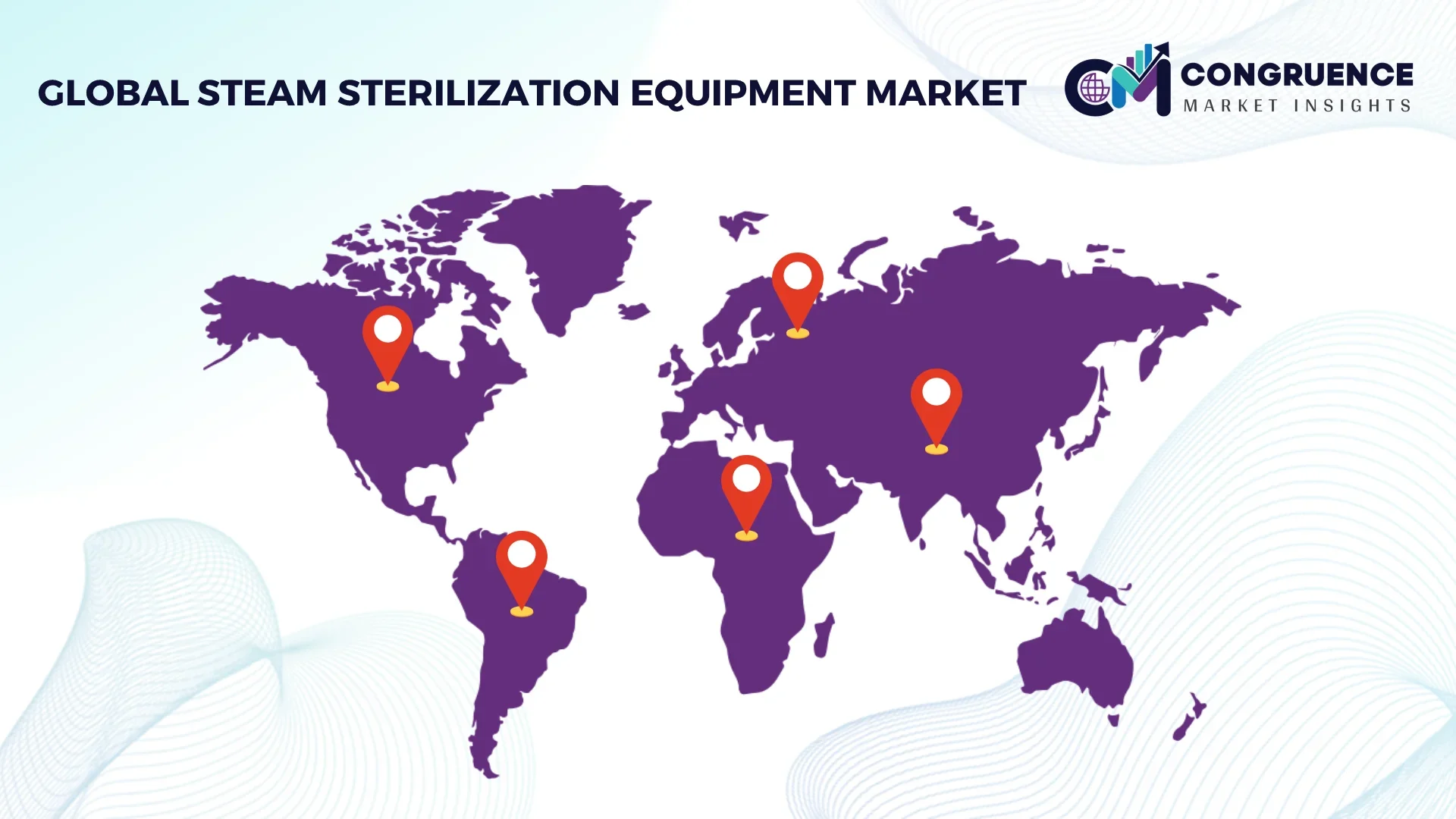
North America continues leading in installed sterilization infrastructure and centralized sterile processing capacity due to advanced healthcare systems and strong pharmaceutical manufacturing activity. Europe contributes approximately 28% market share, driven by regulatory-intensive healthcare operations and rapid adoption of energy-efficient sterilization systems under sustainability mandates. Asia-Pacific holds nearly 25% share and is accelerating through hospital infrastructure expansion, localized medical equipment manufacturing, and rising healthcare investments across China, India, and Southeast Asia. Meanwhile, South America and the Middle East & Africa collectively account for 11% demand, supported by healthcare modernization and public-sector infrastructure expansion. Global manufacturers are increasingly prioritizing Asia-Pacific expansion while strengthening compliance-focused product innovation across North America and Europe.
North America represents approximately 36% of the global Steam Sterilization Equipment Market, supported by high surgical volumes, advanced hospital infrastructure, and strong pharmaceutical sterile manufacturing capacity. More than 72% of large healthcare facilities across the region now operate automated centralized sterile processing departments to improve infection-control efficiency and reduce instrument turnaround delays. Tightening sterilization compliance standards and healthcare workforce optimization pressures are accelerating adoption of digitally integrated sterilization systems with predictive maintenance capabilities. Healthcare providers increasingly prioritize energy-efficient sterilizers capable of reducing operational utility consumption by nearly 20%. Several major suppliers expanded regional service infrastructure and localized assembly operations between 2024 and 2026 to strengthen procurement responsiveness. Enterprise buyers favor long-term lifecycle support and workflow automation, making North America a strategic priority for manufacturers seeking stable institutional contracts and high-value technology adoption.
Europe accounts for nearly 28% of the global Steam Sterilization Equipment Market, driven by strict healthcare sterilization regulations, sustainability mandates, and advanced pharmaceutical manufacturing operations. Germany, France, and the United Kingdom lead regional demand due to extensive hospital modernization and regulatory-driven sterile processing upgrades. More than 54% of healthcare providers now prioritize low-energy sterilization systems aligned with carbon-reduction targets and water-efficiency compliance frameworks. ESG-focused procurement policies are forcing operational shifts toward digitally monitored sterilization systems capable of improving compliance transparency and reducing utility consumption by approximately 22%. Manufacturers are expanding energy-efficient product portfolios and strengthening localized technical support infrastructure across Western Europe. Enterprise purchasing behavior remains highly compliance-driven and quality-focused, making Europe a structurally important region where regulatory adaptation directly shapes competitive positioning and innovation priorities.
Asia-Pacific holds approximately 25% of the global Steam Sterilization Equipment Market and represents the fastest-expanding regional demand center due to accelerating hospital construction, pharmaceutical manufacturing growth, and localized medical equipment production. China, India, and Japan dominate regional deployment volumes as healthcare infrastructure investment intensifies across both public and private sectors. More than 39% of newly established tertiary healthcare facilities now integrate automated steam sterilization systems during infrastructure development phases. Regional manufacturers expanded localized production capacity by nearly 31% between 2024 and 2026 to reduce import dependency and improve supply responsiveness. Healthcare providers increasingly prioritize cost-efficient, scalable sterilization systems capable of supporting high patient throughput. Asia-Pacific is becoming strategically critical for manufacturers pursuing large-scale deployment opportunities, regional manufacturing resilience, and long-term healthcare infrastructure expansion.
South America contributes approximately 7% of the global Steam Sterilization Equipment Market, with Brazil and Argentina representing the largest demand centers due to expanding hospital modernization initiatives and rising pharmaceutical sterile processing activity. Public healthcare infrastructure investment and increasing infection-control awareness are accelerating demand for automated sterilization systems across urban healthcare networks. However, high import dependency and currency volatility continue constraining procurement flexibility, with equipment acquisition costs increasing by nearly 16% in several regional healthcare markets. Mid-sized hospitals increasingly favor compact and energy-efficient sterilizers to optimize operational spending and reduce infrastructure requirements. Several suppliers strengthened distributor partnerships and localized service capabilities to improve deployment efficiency and aftermarket support. The region presents strong long-term expansion potential, but companies must balance growth opportunities against infrastructure limitations and pricing sensitivity.
The Middle East & Africa region accounts for approximately 4% of the global Steam Sterilization Equipment Market, supported by rising healthcare infrastructure investment and expanding hospital modernization programs across the Gulf countries and South Africa. Saudi Arabia and the UAE are leading regional deployment activity through large-scale healthcare expansion and medical city development initiatives. More than 33% of newly commissioned tertiary healthcare projects now integrate advanced sterilization automation systems to strengthen infection-control performance and operational scalability. Governments and private healthcare operators are increasing investment in digitally monitored sterilization infrastructure and localized healthcare partnerships. Enterprise buyers prioritize durable, high-throughput systems capable of operating efficiently in resource-variable environments. The region is emerging as a strategically important growth corridor for manufacturers focused on healthcare transformation, infrastructure modernization, and long-term institutional partnerships.
United States – 34% Market share: Dominates due to advanced hospital infrastructure, large-scale pharmaceutical manufacturing, and widespread adoption of automated sterile processing technologies.
China – 18% Market share: Leads demand through aggressive healthcare infrastructure expansion, localized medical equipment manufacturing growth, and rapid deployment of high-capacity sterilization systems across public hospitals.
The Steam Sterilization Equipment Market is dominated by global infection-control leaders such as Getinge, STERIS, Belimed, Tuttnauer, and MMM Group, while regional manufacturers across Asia-Pacific compete aggressively on pricing and localized customization. The top five players collectively control nearly 63% of global market activity, with competition intensifying between premium automation-focused OEMs and cost-efficient regional suppliers targeting emerging healthcare infrastructure expansion.
Competition is increasingly defined by sterilization throughput, digital integration capability, energy efficiency, and lifecycle service responsiveness rather than hardware pricing alone. Automated sterilization platforms now improve operational efficiency by over 30%, while low-resource systems reduce utility consumption by nearly 22%, forcing manufacturers to accelerate intelligent product development. Global leaders are competing through hospital partnerships, localized assembly expansion, predictive maintenance integration, and vertically integrated service ecosystems to secure long-term institutional contracts.
A major competitive shift is occurring toward digitally connected sterilization infrastructure and modular scalable systems, particularly across pharmaceutical and multi-site hospital networks. At the same time, regulatory compliance complexity and validation-intensive installation requirements are raising entry barriers significantly. Companies lacking advanced compliance integration, technical support infrastructure, and regional supply resilience are rapidly losing procurement relevance. Winning in this market now requires a combination of automation leadership, regulatory-grade reliability, regional service execution, and operational efficiency optimization at enterprise scale.
STERIS
Tuttnauer
Belimed
MMM Group
Steelco S.p.A.
Shinva Medical Instrument Co., Ltd.
Matachana Group
Consolidated Sterilizer Systems
LTE Scientific Ltd.
Fedegari Autoclavi S.p.A.
Priorclave Ltd.
Panasonic Healthcare
Sakura Seiki Co., Ltd.
The Steam Sterilization Equipment Market is rapidly transitioning from conventional standalone sterilizers toward digitally connected, automation-driven sterile processing ecosystems. Hospitals and pharmaceutical manufacturers are increasingly deploying IoT-enabled sterilization systems capable of improving operational monitoring efficiency by nearly 34% while reducing manual compliance workload by approximately 27%. More than 61% of newly installed high-capacity sterilizers now include automated cycle tracking, predictive maintenance alerts, and cloud-based reporting integration. These technologies are strengthening sterilization consistency, reducing downtime, and improving audit readiness across large healthcare networks.
AI-driven sterilization analytics and low-resource steam chamber technologies are emerging as major competitive differentiators. Advanced sterilizers equipped with adaptive load optimization reduce water and energy consumption by over 20%, helping healthcare facilities align with sustainability mandates and rising utility-cost pressures. Compared with legacy semi-automatic sterilizers, intelligent automated systems improve instrument turnaround speed by approximately 32% while significantly lowering human error exposure in compliance-sensitive environments.
Robotic loading systems and modular sterilization platforms are also gaining adoption across pharmaceutical sterile manufacturing facilities and centralized hospital processing departments. Manufacturers with integrated digital ecosystems and predictive service infrastructure are securing stronger institutional procurement advantages over conventional equipment suppliers. Between 2026 and 2028, intelligent sterilization workflow orchestration, remote diagnostics, and AI-supported lifecycle optimization are expected to redefine competitive positioning, particularly among suppliers targeting multi-site healthcare enterprises and biologics manufacturing operations requiring continuous high-throughput sterile processing performance.
April 2026 – Getinge expanded its GSS67N steam sterilizer platform, increasing validated capacity to 24 trays and 600 lbs without enlarging equipment footprint. The upgrade reduced sterilization cycle frequency and improved hospital throughput efficiency during peak surgical demand, strengthening large-facility operational scalability. [Throughput Expansion] Source: www.respiratory-therapy.com
April 2025 – Getinge integrated Siemens SIMATIC WinCC Unified into its new-generation cGMP washers and sterilizers, streamlining digital monitoring and validation workflows for pharmaceutical cleanrooms. The modernization initiative improved operational integration efficiency and accelerated automated compliance management across advanced sterile manufacturing environments. [Digital Integration]
March 2024 – STERIS launched Verafit sterilization bags and covers with patent-pending visibility technology supporting EU GMP Annex 1 compliance requirements. The innovation enabled direct dryness confirmation during sterilization validation, strengthening contamination-control accuracy and reducing pharmaceutical inspection complexity. [Compliance Innovation]
July 2025 – Getinge reported strong growth momentum in its Infection Control business segment, supported by expanding sterilization demand and strategic partnerships targeting the U.S. ambulatory surgery center market. The company achieved 4.4% organic order intake growth while accelerating digital healthcare workflow integration initiatives. [Strategic Expansion]
The Steam Sterilization Equipment Market Report delivers comprehensive analysis across sterilization system types, healthcare and pharmaceutical applications, end-user demand patterns, and region-specific infrastructure trends. The report evaluates automatic, semi-automatic, tabletop, and high-capacity sterilization systems alongside deployment across hospitals, pharmaceutical manufacturing facilities, laboratories, ambulatory surgical centers, and medical device sterilization operations. Coverage extends across North America, Europe, Asia-Pacific, South America, and the Middle East & Africa, enabling comparative assessment of regional demand concentration, technology adoption, and operational modernization trends.
The report provides deep analytical coverage of advanced sterilization technologies including IoT-enabled monitoring systems, predictive maintenance platforms, AI-driven compliance management, and low-resource sterilization innovations. More than 60% of analyzed healthcare procurement trends are linked to automation adoption and centralized sterile processing expansion, while approximately 54% of enterprise buyers prioritize energy-efficient systems with integrated digital validation capabilities. The study profiles key global manufacturers, regional challengers, and technology-focused innovators competing across high-growth healthcare infrastructure markets.
From a strategic perspective, the report supports investment prioritization, expansion planning, product positioning, supply chain optimization, and competitive benchmarking between 2026 and 2033. It also identifies emerging opportunities in modular sterilization systems, pharmaceutical-grade compliance technologies, and digitally integrated sterile processing ecosystems reshaping institutional procurement strategies globally.
| Report Attribute / Metric | Details |
|---|---|
| Market Revenue (2025) | USD 438.0 Million |
| Market Revenue (2033) | USD 735.9 Million |
| CAGR (2026–2033) | 6.7% |
| Base Year | 2025 |
| Forecast Period | 2026–2033 |
| Historic Period | 2021–2025 |
| Segments Covered |
By Type
By Application
By End-User Insights
|
| Key Report Deliverables | Revenue Forecast; Market Trends; Growth Drivers & Restraints; Technology Insights; Segmentation Analysis; Regional Insights; Competitive Landscape; Regulatory & ESG Overview; Recent Developments |
| Regions Covered | North America; Europe; Asia-Pacific; South America; Middle East & Africa |
| Key Players Analyzed | Getinge; STERIS; Tuttnauer; Belimed; MMM Group; Steelco S.p.A.; Shinva Medical Instrument Co., Ltd.; Matachana Group; Consolidated Sterilizer Systems; LTE Scientific Ltd.; Fedegari Autoclavi S.p.A.; Priorclave Ltd.; Panasonic Healthcare; Sakura Seiki Co., Ltd. |
| Customization & Pricing | Available on Request (10% Customization Free) |




