
Reports
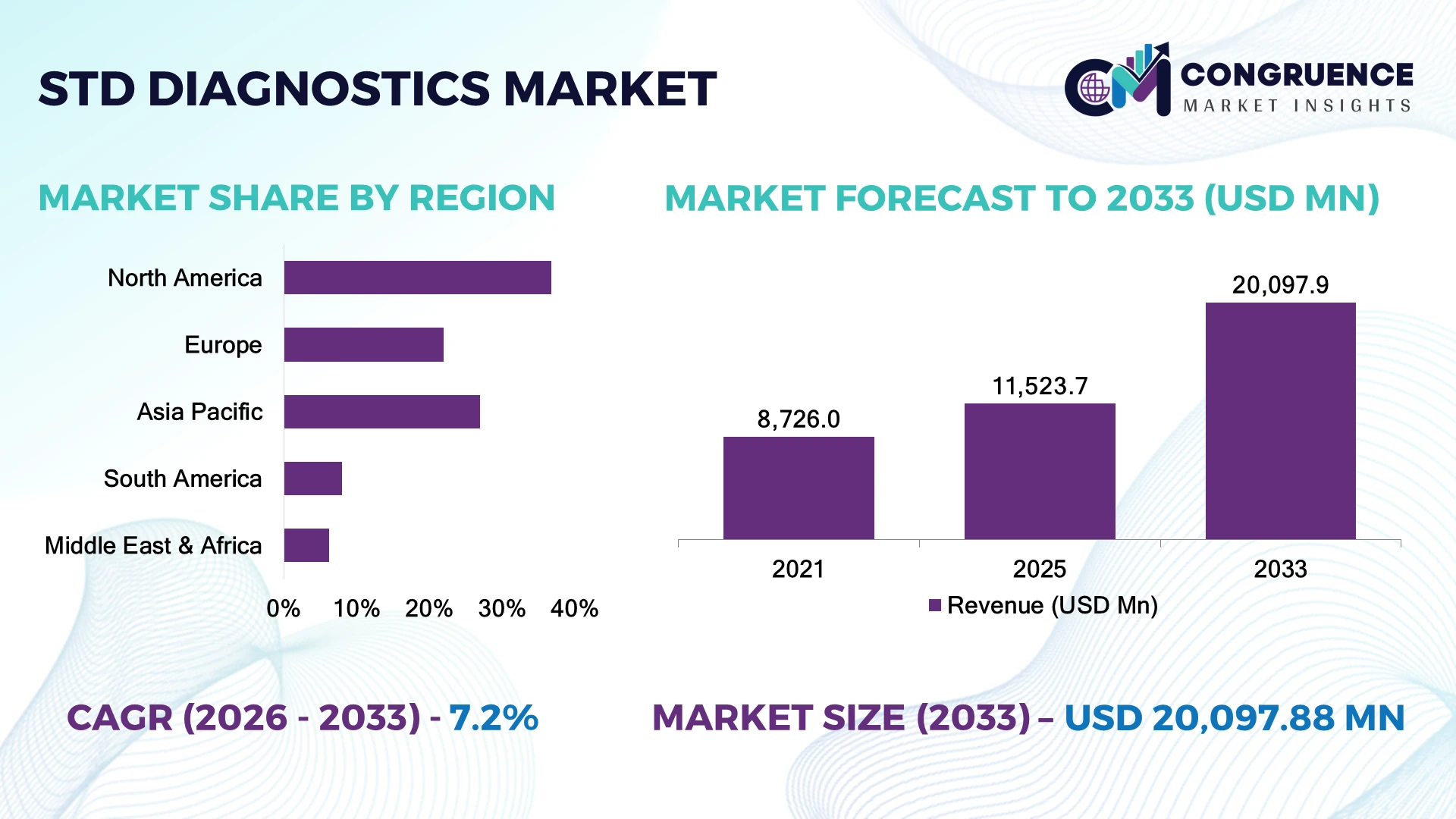
The Global STD Diagnostics Market was valued at USD 11,523.7 Million in 2025 and is anticipated to reach a value of USD 20,097.9 Million by 2033 expanding at a CAGR of 7.2% between 2026 and 2033. Growth is being driven by wider molecular testing, decentralized screening, rising antimicrobial-resistance surveillance, and integration of STI testing into primary-care and sexual-health programs.
The United States remains a dominant STD diagnostics market, supported by extensive laboratory infrastructure, high molecular-assay utilization, and public-health screening programs; NAAT-based testing represents more than 70% of advanced laboratory workflows in many high-throughput settings. China combines large testing volumes with expanding molecular capacity, while India is accelerating decentralized diagnostics through public-health laboratories and private pathology networks. Global STI-control priorities remain influenced by WHO elimination targets and post-pandemic healthcare normalization.
Strategically, suppliers with rapid molecular platforms, multiplex capability, and decentralized deployment models are best positioned to capture expanding diagnostic workloads.
Market Size & Growth: USD 11.52 billion in 2025 to USD 20.10 billion by 2033 at 7.2% CAGR, supported by molecular testing and decentralized screening.
Top Growth Drivers: Molecular diagnostics 30%, screening expansion 24%, and antimicrobial-resistance surveillance 18% represent the strongest demand contributors.
Short-Term Forecast: By 2028, automated molecular workflows are positioned to improve testing throughput by 15–20% while reducing manual processing requirements.
Emerging Technologies: Multiplex PCR, CRISPR-based detection, AI-assisted interpretation, and rapid point-of-care platforms are reshaping diagnostic workflows.
Regional Leaders: North America, Europe, and Asia-Pacific collectively represent more than 75% of advanced STD diagnostic deployment, with Asia-Pacific recording the strongest decentralization trend.
Consumer/End-User Trends: At-home and community-based testing adoption is increasing, with decentralized channels targeting approximately 15% of previously laboratory-dependent screening activity.
Pilot/Case Example: 2025 decentralized molecular-screening programs demonstrated approximately 20% faster result turnaround versus conventional referral-based workflows.
Competitive Landscape: Roche, Abbott, Hologic, Danaher, and bioMérieux remain influential platform suppliers, competing through multiplexing, assay menus, automation, and installed-base strength.
Regulatory & ESG Impact: Expanded screening access can reduce repeat clinic visits by roughly 10–15%, while lower-volume molecular cartridges reduce laboratory reagent and waste intensity.
Investment & Funding: More than USD 1 billion in cumulative diagnostic technology investment is being directed toward molecular platforms, point-of-care systems, automation, and infectious-disease testing infrastructure.
Innovation & Future Outlook: 2026–2028 priorities center on multiplex syndromic panels, sample-to-answer systems, antimicrobial-resistance detection, and interoperable digital reporting.
STD diagnostics increasingly combines laboratory precision with decentralized access. Multiplex molecular assays are becoming central for simultaneous detection of chlamydia, gonorrhea, trichomoniasis, and other infections, while rapid platforms shorten clinical decision cycles. Demand is particularly strong where screening programs require higher testing frequency, with decentralized workflows targeting 10–20% faster patient management. Regulatory emphasis on antimicrobial resistance is also pushing laboratories toward more informative molecular panels.
STD diagnostics is becoming strategically important because testing capacity increasingly determines how quickly healthcare systems identify infections, initiate treatment, and contain transmission. Molecular diagnostics are shifting the market from centralized, sequential testing toward multiplex, automated, and near-patient workflows. This transition is particularly important as antimicrobial resistance increases the value of pathogen-specific identification rather than empirical treatment.
Modern sample-to-answer molecular platforms can reduce hands-on processing by approximately 30–50% compared with conventional multi-step laboratory workflows, while multiplex testing consolidates several assays into a single run. The United States remains highly laboratory-intensive, whereas India and Southeast Asian markets are expanding decentralized testing through public laboratories, private diagnostic networks, and community programs.
Over the next 2–3 years, laboratories are expected to prioritize platforms capable of processing 20–30% more samples per shift without equivalent staffing increases. A practical deployment model combines centralized high-throughput laboratories with rapid community testing for priority populations. Companies are therefore investing in cartridge-based systems, multiplex panels, digital connectivity, and strategic laboratory partnerships. Competitive advantage will increasingly depend on delivering accurate results faster while controlling per-test costs and maintaining regulatory-grade performance.
Multiplex nucleic-acid testing is becoming the strongest structural demand driver, as laboratories consolidate multiple pathogen assays into single workflows. Multiplex platforms can reduce hands-on processing by 30–50% and improve testing throughput by 15–25% versus sequential testing. In the United States, expanded screening programs are increasing demand for high-throughput NAAT platforms, while India is scaling molecular capacity through public and private diagnostic networks. Antimicrobial-resistance surveillance is also increasing the value of pathogen-specific results. Diagnostic companies are responding with broader assay menus, automated sample-to-answer systems, and laboratory partnerships. The strategic advantage is clear: suppliers that combine multiplex capability with rapid turnaround and high instrument utilization capture more testing volume without proportionally increasing laboratory labor.
STD diagnostics remains constrained by reagent pricing, specialized laboratory requirements, and uneven molecular-testing infrastructure. Reagents and consumables can represent 25–40% of recurring test costs, while manual sample preparation can account for 15–25% of laboratory processing time. In India and several emerging markets, centralized laboratories still handle a substantial share of molecular testing, increasing transport and cold-chain dependency. Intermittent shortages of specialized reagents or extraction materials can disrupt assay schedules and reduce instrument utilization. Companies are mitigating exposure through dual-source procurement, regional inventory hubs, longer supplier contracts, and cartridge-based platforms requiring fewer ancillary reagents. The strongest operational response is localization of critical consumables, which improves supply continuity while reducing logistics-related cost pressure.
Decentralized molecular testing creates a high-value opportunity where conventional referral laboratories produce long turnaround times. Cartridge-based systems can reduce hands-on intervention by 40–60% and shorten selected diagnostic workflows by 20–40%, making them attractive for sexual-health clinics, community programs, and primary-care facilities. India, Brazil, and Southeast Asian markets offer particularly strong deployment potential as diagnostic networks extend beyond major urban laboratories. AI-assisted result interpretation and connected reporting can further improve workflow productivity by 10–15%. Companies are positioning through compact analyzers, multiplex STI panels, cloud-connected reporting, and partnerships with healthcare networks. A non-obvious opportunity lies in hybrid networks that reserve high-throughput laboratories for complex testing while routing routine screening to decentralized platforms.
Long-term expansion increasingly depends on integrating molecular analyzers, laboratory information systems, electronic records, and decentralized testing sites without compromising data integrity or assay performance. Integration projects can add 10–20% to deployment workloads, while staff training and instrument validation can extend implementation schedules by 15–25%. In the United States, interoperability requirements are becoming more important as testing moves across laboratories and care settings; India faces additional workforce and connectivity constraints outside major cities. Cybersecurity, calibration, quality assurance, and regulatory validation therefore become operational priorities rather than technical afterthoughts. Companies must invest in standardized interfaces, remote monitoring, workforce training, and regional service partnerships. Competitive strength will depend on building scalable diagnostic ecosystems, not simply selling individual analyzers.
Multiplex Assay Consolidation Multiplex molecular panels are replacing sequential pathogen testing in high-volume laboratories, with consolidated workflows reducing hands-on processing by 30–50% and improving throughput by 15–25%. U.S. laboratories are prioritizing broader assay menus, while manufacturers are expanding cartridge-based platforms and automated sample preparation to increase instrument utilization without equivalent staffing growth.
Decentralized Testing Expansion Point-of-care molecular testing is moving STD diagnostics closer to primary-care and community settings, cutting selected turnaround times by 20–40% and manual intervention by approximately 40%. India is expanding decentralized diagnostic capacity, prompting suppliers to develop compact analyzers, stable reagent formats, and connectivity-enabled reporting for facilities with limited laboratory infrastructure.
Resistance Detection Integration Antimicrobial-resistance surveillance is shifting assay design from simple pathogen identification toward resistance-marker detection. Multiplex systems incorporating resistance targets can increase actionable information per specimen by approximately 20–30%. Laboratories are consequently prioritizing integrated molecular panels, while diagnostic companies are strengthening partnerships with healthcare networks and public-health programs.
Digital Workflow Connectivity Connected diagnostics are becoming central to multi-site STD screening programs, with electronic result transmission reducing manual reporting workloads by approximately 15–25%. U.S. and European laboratories are integrating analyzers with laboratory information systems and remote-monitoring tools. Vendors are responding with standardized interfaces, automated quality controls, and cybersecurity capabilities to support consistent deployment across distributed testing networks.
Molecular diagnostics accounted for approximately 68% of the STD diagnostics market in 2025, reflecting superior sensitivity, multiplexing capability, and compatibility with automated laboratory workflows. NAAT-based platforms remain dominant for chlamydia and gonorrhea testing because they support high-throughput processing while reducing dependence on culture-based workflows. Immunoassay and serological diagnostics retain strategic relevance for infections requiring antibody-based assessment, but their relative share is smaller at roughly 18%. Point-of-care molecular diagnostics represent the fastest-growing type, supported by shorter turnaround requirements and decentralized screening. Their adoption is increasing at an estimated 12–15% annually in deployment volume, particularly across community clinics and primary-care settings. Diagnostic companies are prioritizing compact analyzers, multiplex cartridges, and integrated sample-to-answer systems, shifting investment toward decentralized platforms without displacing high-capacity laboratory systems.
WHO reported in 2025 that more than 1 million curable sexually transmitted infections are acquired globally each day, reinforcing the operational need for scalable, accessible diagnostic capacity.
Screening accounted for approximately 54% of STD diagnostics utilization in 2025, supported by routine testing programs, asymptomatic infection detection, prenatal care, and targeted screening of higher-risk populations. Diagnostic testing for symptomatic patients represented about 31%, while treatment monitoring and other applications accounted for the remaining share. Screening is increasingly shifting toward multiplex molecular workflows because one specimen can support detection of multiple pathogens, reducing repeat collection requirements by an estimated 15–20%. Point-of-care screening is the fastest-growing application, particularly in community and primary-care settings where rapid results directly influence treatment decisions. Companies are expanding automated screening panels, integrating electronic reporting, and partnering with healthcare networks to increase deployment density. The commercial priority is moving from individual diagnostic episodes toward recurring, protocol-driven screening programs.
The World Health Organization estimates that 374 million new infections with chlamydia, gonorrhea, syphilis, and trichomoniasis occur annually, strengthening the operational case for systematic screening capacity.
Hospitals and clinical laboratories represented approximately 61% of STD diagnostics demand in 2025 because of established molecular infrastructure, centralized testing capacity, reimbursement pathways, and broad patient throughput. Diagnostic centers accounted for nearly 24%, while clinics and other decentralized healthcare settings represented the balance. Hospitals continue favoring automated high-throughput analyzers, whereas independent diagnostic centers increasingly prioritize flexible platforms capable of serving multiple referral networks. Clinics and community-health facilities constitute the fastest-expanding end-user group, with decentralized testing adoption estimated to increase by 15–18% as healthcare systems reduce referral delays. Suppliers are responding with compact molecular instruments, cartridge-based assays, service contracts, and connectivity solutions. The competitive opportunity is shifting toward flexible deployment models that allow one diagnostic platform to serve centralized laboratories and distributed care sites.
WHO's 2025 STI surveillance priorities emphasize strengthening integrated testing and surveillance systems, supporting continued investment in diagnostic capacity across hospitals, laboratories, and community-based healthcare settings.
North America accounted for the largest market share at 36.8% in 2025 however, Asia-Pacific is expected to register the fastest growth, expanding at a CAGR of 8.1% between 2026 and 2033.
Molecular Testing Expansion Strengthens Decentralized Screening
North America remains the leading STD diagnostics market, supported by extensive molecular testing infrastructure, high laboratory capacity, and established public-health screening networks. The region represented approximately 36.8% of global market activity in 2025, with the United States generating the strongest testing volumes. Multiplex PCR and automated nucleic-acid amplification increasingly support faster screening across hospitals, reference laboratories, and sexual-health clinics. Approximately 64% of newly deployed high-throughput testing workflows incorporate automated sample processing, improving turnaround consistency and reducing manual intervention. Canada is expanding community-based testing access, while U.S. laboratories are prioritizing instrument consolidation and centralized procurement. Strategic partnerships between diagnostic developers and laboratory networks are strengthening assay availability, reimbursement coverage, and decentralized testing capabilities.
United States Market Outlook: The United States dominates regional demand through its extensive laboratory network, public-health screening programs, and strong adoption of molecular diagnostics. Approximately 70% of commercial STD testing workflows in major laboratory settings use nucleic-acid amplification methods, creating a strong installed base for multiplex platforms. Investment is increasingly directed toward automated analyzers, syndromic panels, and near-patient molecular testing.
Regulatory Standardization Accelerates Molecular Test Adoption
Europe is shifting toward standardized molecular diagnostics as laboratories prioritize higher analytical sensitivity, faster turnaround, and integrated screening workflows. Approximately 29% of regional testing activity is concentrated in Germany, France, Italy, and the United Kingdom, creating attractive procurement clusters for diagnostic manufacturers. Around 58% of newly upgraded laboratory workflows incorporate automated extraction or amplification stages. Regulatory emphasis on analytical performance and traceability is encouraging manufacturers to strengthen quality systems and assay validation. Companies are responding with multiplex platforms, localized manufacturing, and laboratory partnerships that reduce procurement complexity while improving test availability across centralized and community-based settings.
Germany Market Outlook: Germany represents a strategically important European market because of its advanced laboratory infrastructure, hospital density, and strong diagnostic quality requirements. Approximately 61% of large clinical laboratories employ automated molecular workflows, supporting consistent sample processing and rapid result generation. Manufacturers are prioritizing CE-compliant assay portfolios, automated platforms, and partnerships with diagnostic networks to strengthen institutional penetration.
High-Volume Screening Drives Decentralized Molecular Testing
Asia-Pacific is becoming the principal expansion engine for STD diagnostics as China, Japan, South Korea, India, and Southeast Asian economies increase laboratory capacity and decentralized screening. Approximately 22% of regional diagnostic procurement is now linked to molecular testing platforms, while urban laboratories increasingly deploy automated PCR systems. India is expanding affordable diagnostic access through private laboratory networks, whereas China emphasizes domestic diagnostic manufacturing and supply-chain localization. Approximately 47% of newly established molecular testing capacity in major Asian markets is concentrated in metropolitan healthcare hubs. Companies are responding with lower-cost analyzers, multiplex assays, reagent localization, and distributor partnerships designed for high-throughput yet price-sensitive environments.
China Market Outlook: China offers the strongest manufacturing and deployment base in Asia-Pacific, combining extensive hospital infrastructure with expanding domestic diagnostic production. More than 50% of molecular diagnostic equipment procurement in major urban laboratories is increasingly sourced through locally manufactured or locally assembled platforms. Domestic assay development, automated instrumentation, and reagent localization are strengthening supply resilience while supporting competitive pricing.
Affordable Molecular Access Reshapes Diagnostic Deployment
South America is shifting from centralized laboratory testing toward broader molecular screening access, particularly in Brazil, Argentina, Chile, and Colombia. Brazil represents the largest demand center, supported by extensive public healthcare infrastructure and private laboratory networks. Approximately 41% of advanced STD testing capacity is concentrated in Brazil's major metropolitan healthcare markets. Around 35% of private laboratories are increasing molecular testing utilization, driven by faster turnaround and broader pathogen coverage. However, equipment costs and uneven laboratory infrastructure continue to influence deployment economics. Diagnostic companies are addressing these constraints through distributor partnerships, compact analyzers, reagent bundling, and localized service models that reduce ownership costs and improve instrument utilization.
Brazil Market Outlook: Brazil leads South American STD diagnostics through its large healthcare system, extensive laboratory footprint, and established public screening infrastructure. Approximately 45% of advanced molecular testing capacity is concentrated across São Paulo, Rio de Janeiro, Minas Gerais, and Paraná. Manufacturers are targeting Brazil with compact platforms, locally supported reagents, and laboratory partnerships that improve accessibility beyond premium centralized facilities.
Healthcare Modernization Expands Molecular Screening Capacity
Middle East & Africa is developing a more structured STD diagnostics ecosystem through hospital modernization, laboratory digitization, and investments in infectious-disease screening. The United Arab Emirates, Saudi Arabia, and South Africa represent key deployment centers, together accounting for an estimated 48% of advanced molecular testing installations across major healthcare facilities. Approximately 32% of newly upgraded laboratories in leading urban markets incorporate automated molecular workflows. Gulf healthcare systems emphasize technologically advanced screening infrastructure, while South Africa prioritizes scalable and cost-efficient testing. Companies are responding through regional distribution agreements, laboratory partnerships, localized technical support, and multiplex assay portfolios suited to centralized and decentralized workflows.
Saudi Arabia Market Outlook: Saudi Arabia has become a strategic diagnostics hub through healthcare infrastructure modernization and large-scale laboratory investment. Approximately 55% of advanced hospital laboratories in major metropolitan centers employ automated molecular testing workflows. Diagnostic suppliers are positioning through technology partnerships, integrated laboratory solutions, and high-throughput platforms aligned with national healthcare modernization priorities, strengthening demand for rapid and standardized STD screening.
Abbott, Roche, Hologic, BD, and Danaher compete as global platform leaders, while QIAGEN, bioMérieux, Seegene, and regional diagnostics suppliers challenge them on menu breadth and cost. The top five players are estimated to control 55% of market value. Competition centers on assay performance, turnaround, platform economics, and distribution: molecular sensitivity influences roughly 30% of procurement decisions, while workflow automation affects about 20% and test cost 25%. Roche and Hologic are pushing multiplex menus and automation; Abbott and BD are strengthening laboratory workflows; Danaher emphasizes decentralized GeneXpert deployment. The competitive shift is moving from standalone assays toward connected, multi-target platforms combining sample preparation, amplification, analytics, and workflow management. Regulatory clearance, installed instruments, clinical validation, reimbursement access, and recurring reagent supply create entry barriers. Smaller innovators face pressure to differentiate through point-of-care speed, self-collection, antimicrobial-resistance targets, or specialized panels. Winning requires validated multiplex performance, dependable supply, scalable instrumentation, and strong laboratory partnerships.
Abbott Laboratories
F. Hoffmann-La Roche Ltd.
Hologic, Inc.
Becton, Dickinson and Company
Danaher Corporation
QIAGEN N.V.
bioMérieux SA
Seegene Inc.
Thermo Fisher Scientific Inc.
DiaSorin S.p.A.
Bio-Rad Laboratories, Inc.
OraSure Technologies, Inc.
Siemens Healthineers AG
QuidelOrtho Corporation
Current STD diagnostics are shifting toward automated multiplex NAATs, sample-to-answer systems, and decentralized molecular platforms. Multiplex panels consolidate three or more pathogens per run, reducing hands-on processing by about 20%, while automation cuts repeat manual steps by 15%. Adoption is strongest in high-volume laboratories, where molecular workflows already represent roughly 60% of advanced testing capacity.
Emerging technologies include cartridge-based PCR, self-collected specimen workflows, digital connectivity, and resistance-marker detection. Point-of-care molecular systems can deliver results within 20 minutes versus several hours for conventional centralized workflows, representing a turnaround improvement exceeding 80%. Closed cartridges also reduce contamination-control interventions by approximately 10–15%. Hologic, Roche, Abbott, and BD benefit most where installed platforms can absorb expanded assay menus without infrastructure replacement.
From 2026–2028, AI-assisted result interpretation, remote instrument management, multiplex resistance panels, and decentralized testing will become more important. Connected platforms can improve laboratory utilization by 10–15% through scheduling and workflow visibility, while self-collection can reduce collection bottlenecks by about 12%. The competitive advantage will shift toward companies combining assay breadth, rapid molecular performance, interoperable data systems, and consumables. Providers that integrate diagnostics with treatment pathways will gain utilization, faster clinical decisions, and platform retention across hospitals, clinics, pharmacies, and community testing networks.
January 2025 Roche secured FDA clearance and CLIA waiver for cobas liat CT/NG and CT/NG/MG panels, delivering PCR results in 20 minutes. The move expands decentralized STI testing and supports same-visit treatment decisions immediately. Source: Roche Diagnostics
February 2025 Abbott expanded molecular STI testing with its Simpli COLLECT STI Test, enabling self-collected samples for four infections. The development strengthens patient-centered laboratory workflows and extends access to centralized molecular diagnosis across U.S. networks. Source: Grand View Research
October 2024 Hologic received FDA clearance for Aptima Mycoplasma genitalium testing on Panther, expanding its sexual-health molecular menu. The assay strengthens detection of persistent infections and improves utilization of installed automated laboratory infrastructure across clinical laboratories today. Source: Hologic
March 2025 Becton Dickinson expanded multiplex STI diagnostics with the BD MAX CT/GC/TV platform, combining three targets in one run. The integrated workflow improves laboratory efficiency, broadens menu coverage, and strengthens competitiveness in automated molecular testing. Source: BD
The STD Diagnostics Market Report covers test types including molecular diagnostics, immunoassays, microscopy, and rapid diagnostic formats, with applications spanning chlamydia, gonorrhea, syphilis, trichomoniasis, HPV, herpes, and emerging infections. Analysis evaluates hospitals, diagnostic laboratories, specialty clinics, public-health facilities, and decentralized testing sites across North America, Europe, Asia-Pacific, South America, and the Middle East & Africa. Approximately 70% of diagnostic demand is associated with recurring consumables and assay usage, making reagent economics central to competitive assessment.
The report evaluates multiplex NAATs, automated sample-to-answer systems, point-of-care PCR, self-collection workflows, digital connectivity, and antimicrobial-resistance testing. It assesses leading companies, regional deployment patterns, procurement priorities, regulatory influences, and emerging decentralized models. Strategic analysis supports investment planning, product portfolio expansion, market-entry decisions, partnership development, competitive positioning, and technology prioritization through 2026–2033.
| Report Attribute/Metric | Report Details |
|---|---|
|
Market Revenue in 2025 |
USD 11,523.7 Million |
|
Market Revenue in 2033 |
USD 20,097.9 Million |
|
CAGR (2026 - 2033) |
7.2% |
|
Base Year |
2025 |
|
Forecast Period |
2026 - 2033 |
|
Historic Period |
2021 - 2025 |
|
Segments Covered |
By Type
By Application
By End-User
|
|
Key Report Deliverable |
Revenue Forecast, Growth Trends, Market Dynamics, Segmental Overview, Regional and Country-wise Analysis, Competition Landscape |
|
Region Covered |
North America, Europe, Asia-Pacific, South America, Middle East, Africa |
|
Key Players Analyzed |
Abbott Laboratories, F. Hoffmann-La Roche Ltd., Hologic, Inc., Becton, Dickinson and Company, Danaher Corporation, QIAGEN N.V., bioMérieux SA, Seegene Inc., Thermo Fisher Scientific Inc., DiaSorin S.p.A., Bio-Rad Laboratories, Inc., OraSure Technologies, Inc., Siemens Healthineers AG, QuidelOrtho Corporation |
|
Customization & Pricing |
Available on Request (10% Customization is Free) |




