
Reports
The Global Stable Isotope Analyzer Market was valued at USD 90.6 Million in 2025 and is anticipated to reach a value of USD 171.0 Million by 2033 expanding at a CAGR of 8.26% between 2026 and 2033. Growing deployment of laser-based isotope analyzers in environmental monitoring, climate research, precision agriculture, and life science laboratories is accelerating instrument adoption through higher analytical accuracy and faster real-time measurements.
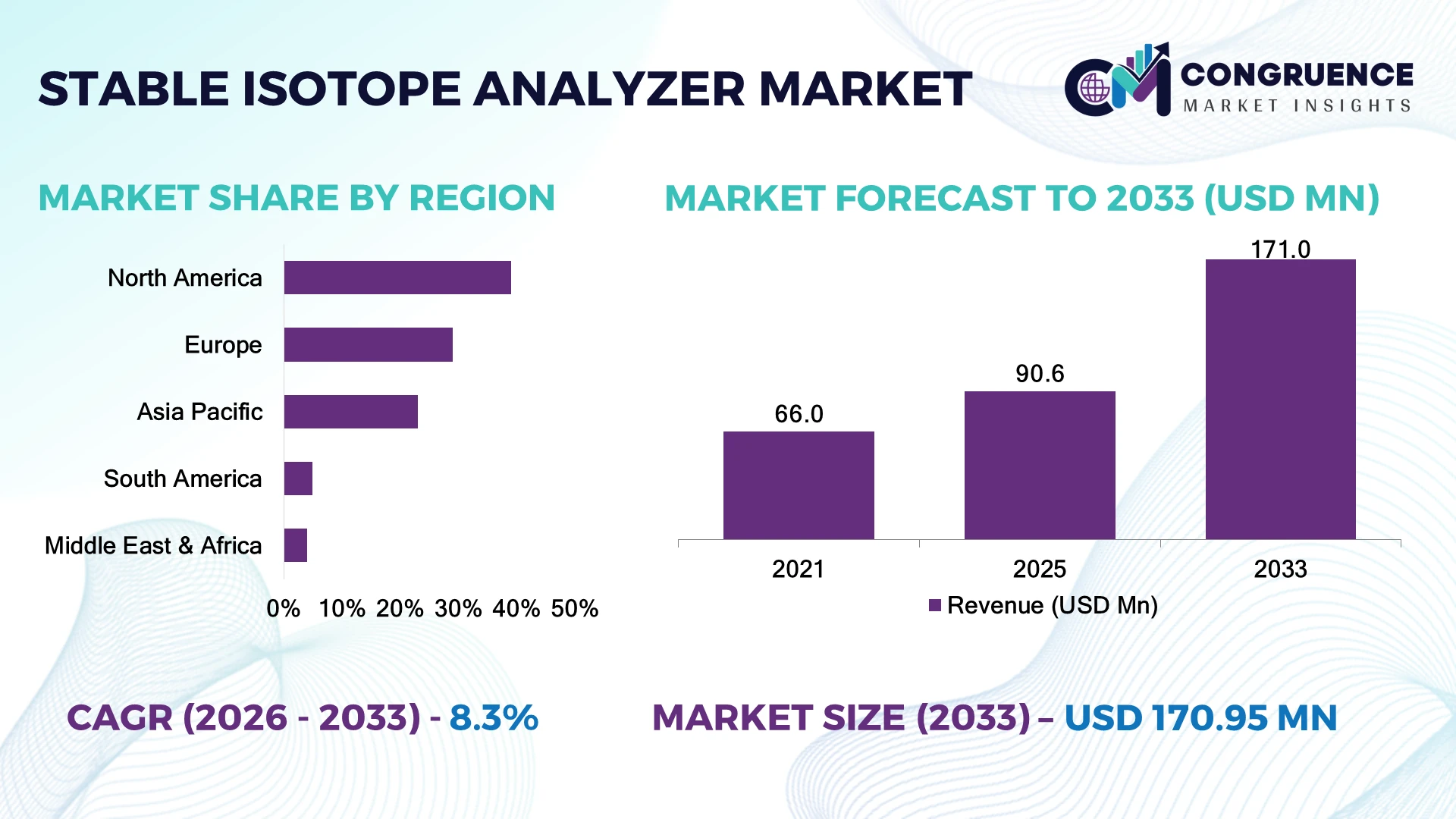
The United States leads the global market with approximately 34% share, supported by over 250 active isotope research laboratories, sustained federal climate research funding, and strong adoption across environmental science, healthcare, and food authentication. Germany follows with nearly 11% share, driven by industrial quality testing and research institutes, while U.S. laboratory automation adoption exceeds 65%, strengthening analytical throughput and scientific competitiveness.
The market's leadership in research-intensive economies reinforces investment priorities around high-precision analytical platforms, digital laboratory integration, and long-term technology partnerships.
Market Size & Growth: USD 90.6 Million in 2025, projected to reach USD 171.0 Million by 2033 at 8.26% CAGR, driven by advanced laser spectroscopy adoption.
Top Growth Drivers: Environmental monitoring (+28%), food authenticity testing (+24%), and climate research investments (+21%) remain the strongest demand catalysts.
Short-Term Forecast: By 2028, laboratory testing efficiency is expected to improve by nearly 30% through automation and digital workflows.
Emerging Technologies: AI-enabled calibration, cavity ring-down spectroscopy, and cloud-connected laboratory platforms enhance analytical precision.
Regional Leaders: North America (~USD 60 Million), Europe (~USD 48 Million), and Asia-Pacific (~USD 38 Million) benefit from expanding research infrastructure and localized manufacturing.
Consumer/End-User Trends: More than 58% of environmental laboratories prioritize continuous isotope monitoring over batch-based testing.
Pilot/Case Example: In 2024, automated isotope monitoring projects reduced analytical turnaround time by approximately 35% in environmental testing facilities.
Competitive Landscape: Thermo Fisher Scientific holds an estimated 18% market share alongside Picarro, ABB, Elementar, and Los Gatos Research.
Regulatory & ESG Impact: Carbon monitoring initiatives increased isotope-based environmental testing demand by nearly 26% across regulated industries.
Investment & Funding: More than USD 450 Million has been directed toward analytical instrumentation expansion through research partnerships and laboratory modernization.
Innovation & Future Outlook: Miniaturized analyzers, AI-assisted diagnostics, and portable field instruments are reshaping high-precision analytical deployment amid global supply-chain localization.
Stable Isotope Analyzer Market demand is expanding across environmental surveillance, hydrology, food authentication, biomedical research, and carbon-cycle studies as laboratories prioritize faster, high-precision isotope measurements. Portable laser-based systems and cloud-enabled analytical software continue improving operational productivity, while laboratory automation adoption has surpassed 60% in advanced research facilities. Expanding traceability regulations and localized instrument manufacturing are strengthening deployment across emerging scientific ecosystems, setting the stage for broader strategic market development.
Stable isotope analyzers have become strategically important because governments, research organizations, and industrial laboratories increasingly depend on precise isotopic measurements for environmental compliance, food verification, and healthcare research. Digital laboratory modernization and laboratory automation are transforming analytical workflows, while stricter carbon accounting frameworks are increasing the operational importance of isotope-based testing across multiple industries.
Modern laser-based analyzers complete measurements approximately 40% faster than many conventional isotope ratio mass spectrometry workflows for routine applications while reducing maintenance requirements by nearly 25%. The United States continues leading large-scale deployment through advanced research infrastructure, whereas China is rapidly expanding installations across environmental laboratories and agricultural research centers. During the next two to three years, automated analytical workflows are expected to exceed 70% adoption across newly commissioned research laboratories.
Companies are strengthening competitiveness through localized manufacturing, software integration, collaborative research partnerships, and expanded service networks. Field-deployable analyzers are increasingly supporting real-time groundwater monitoring, allowing faster environmental decision-making. Organizations investing in intelligent analytical ecosystems, digital calibration platforms, and application-specific innovations are establishing stronger competitive positioning while improving laboratory productivity and long-term operational resilience.
Environmental monitoring programs, food authenticity verification, and climate science initiatives continue driving sustained demand for stable isotope analyzers. More than 65% of newly established environmental laboratories now integrate automated isotope analysis into routine operations, while laser-based analytical systems improve sample throughput by approximately 35%. Government-backed carbon accounting initiatives across the United States and Europe have accelerated deployment of isotope-based monitoring technologies. Instrument manufacturers are responding through expanded production capacity, collaborative research partnerships, and software-enabled analytical platforms. A notable operational trend involves integrating isotope analyzers with laboratory information management systems, enabling streamlined reporting, improved traceability, and enhanced laboratory productivity across research-intensive organizations.
Advanced stable isotope analyzers require significant laboratory investment, specialized calibration procedures, and highly trained analytical personnel. Initial deployment expenses remain nearly 30% higher than many conventional laboratory instruments, while annual maintenance and calibration costs can account for approximately 12% of operational budgets. Semiconductor component availability and precision optical supply constraints continue affecting manufacturing schedules in several industrial economies. Companies are mitigating these pressures through localized component sourcing, long-term supplier agreements, modular product architectures, and expanded service contracts. Operational scalability increasingly depends on balancing analytical precision with affordable ownership across academic and industrial laboratories.
Portable stable isotope analyzers are creating new opportunities in environmental field studies, precision agriculture, and industrial process monitoring. AI-assisted calibration systems reduce manual intervention by nearly 30%, while cloud-enabled laboratory connectivity improves data accessibility by over 40%. Japan and South Korea continue investing in advanced scientific instrumentation supporting digital laboratory ecosystems and automated analytical workflows. Manufacturers are expanding research collaborations, developing compact analyzer platforms, and integrating predictive maintenance capabilities into next-generation instruments. An emerging strategic opportunity lies in combining portable isotope analysis with remote environmental sensing, enabling faster decision-making for distributed monitoring applications.
Maintaining analytical consistency across multi-site laboratory networks remains a major execution challenge. Inter-laboratory measurement deviations can exceed 8% without standardized calibration protocols, while approximately 45% of laboratories continue operating mixed-generation analytical infrastructure. Increasing cybersecurity requirements for cloud-connected laboratory systems add further operational complexity as digital integration expands. Companies are addressing these challenges through standardized software platforms, centralized calibration management, workforce training programs, and stronger cybersecurity frameworks. Organizations capable of delivering interoperable analytical ecosystems with consistent measurement accuracy will strengthen long-term competitiveness and support reliable deployment across expanding scientific and industrial laboratory networks.
Portable Field Testing Expansion: Portable laser-based isotope analyzers are replacing laboratory-only workflows as environmental agencies and agricultural researchers seek faster field validation. Field deployments increased by approximately 32% during the past two years, while on-site testing reduced sample transportation requirements by nearly 40% and shortened reporting cycles by around 35%. Tightened environmental monitoring programs in the United States and Europe are accelerating this transition. Manufacturers are expanding ruggedized product portfolios, strengthening regional service networks, and partnering with research institutes to support continuous field operations with lower logistical complexity.
AI-Driven Laboratory Automation: Artificial intelligence is increasingly embedded into calibration, quality assurance, and data interpretation workflows. Automated calibration routines reduce operator intervention by roughly 30%, while analytical errors decline by nearly 18% and laboratory productivity improves by approximately 25%. Workforce shortages across advanced analytical laboratories are encouraging greater software integration rather than additional staffing. Instrument suppliers are scaling cloud-enabled platforms, introducing predictive maintenance capabilities, and collaborating with laboratory information management system providers to streamline multi-site analytical operations.
Localized Manufacturing Strategies: Precision optical components and semiconductor supply-chain disruptions have encouraged manufacturers to diversify production footprints. More than 45% of leading analytical instrument suppliers have expanded regional sourcing strategies, while localized component procurement has reduced delivery lead times by approximately 22%. Germany and Japan continue strengthening precision manufacturing ecosystems to improve supply resilience. Companies are restructuring procurement networks, increasing strategic inventory levels, and establishing long-term supplier partnerships to maintain production continuity and reduce operational uncertainty.
Multi-Application Platform Development: Laboratories increasingly prefer analyzer platforms capable of supporting environmental science, food authentication, hydrology, and biomedical research using shared analytical infrastructure. Multi-application deployments have increased by nearly 28%, while instrument utilization rates improved by approximately 24% and laboratory operating costs declined by around 16%. This shift reflects tighter research budgets and greater emphasis on asset optimization rather than equipment expansion. Companies are responding through modular hardware designs, software-upgradable systems, and application-specific analytical packages that extend equipment lifecycle and strengthen customer retention.
Based on market research, the Global Stable Isotope Analyzer Market is commonly segmented into Laser-Based Stable Isotope Analyzers and Isotope Ratio Mass Spectrometry (IRMS) Systems. Laser-based stable isotope analyzers account for approximately 61% of global demand due to their rapid analysis, reduced maintenance requirements, compact design, and suitability for continuous monitoring applications. Their ability to deliver high analytical accuracy without complex sample preparation makes them the preferred choice across environmental monitoring, agriculture, and hydrology. Instrument manufacturers continue expanding software functionality, cloud connectivity, and automated calibration features to strengthen operational efficiency. In contrast, IRMS systems remain the benchmark for ultra-high precision laboratory analysis where advanced isotopic characterization is required. IRMS represents the fastest-growing segment for specialized research applications as investments in biomedical science, geochemistry, and climate research continue expanding. Around 48% of newly commissioned national research laboratories continue incorporating advanced mass spectrometry capabilities alongside laser systems to broaden analytical capacity. Companies increasingly position hybrid analytical portfolios that combine field-deployable laser instruments with laboratory-grade IRMS platforms, enabling customers to optimize both operational speed and analytical precision while supporting long-term laboratory modernization.
The market is primarily segmented by application into Environmental Monitoring, Climate Research, Food & Beverage Authentication, Agriculture, Healthcare & Biomedical Research, Hydrology & Water Studies, Oil & Gas Exploration, and Academic & Scientific Research. Environmental monitoring represents the leading application with approximately 33% market share as governments strengthen groundwater assessment, carbon-cycle monitoring, and pollution tracking programs. Continuous monitoring installations have increased by nearly 29%, while automated reporting workflows reduce analytical turnaround by around 34%. Climate research is emerging as the fastest-growing application, supported by expanding greenhouse gas observation networks and atmospheric isotope studies. Food authentication, agriculture, and hydrology continue strengthening demand as laboratories adopt isotope verification to improve traceability and resource management. Healthcare research, oil and gas exploration, and academic institutions maintain stable investment as isotope analysis supports metabolic studies, reservoir characterization, and scientific innovation. Companies continue expanding application-specific software, integrated analytical workflows, and collaborative research programs to address specialized laboratory requirements. Demand is increasingly shifting toward platforms capable of supporting multiple analytical disciplines from a single instrument architecture, improving equipment utilization and operational flexibility.
The market is broadly segmented by end user into Research & Academic Institutes, Environmental Testing Laboratories, Government Agencies, Food & Beverage Companies, Pharmaceutical & Biotechnology Companies, Energy & Industrial Enterprises, and Contract Research Organizations (CROs). Research and academic institutes account for approximately 38% of instrument deployments because they operate large analytical laboratories supporting environmental science, biomedical research, and isotope geochemistry. More than 60% of new university laboratory modernization projects include advanced isotope analysis capability. Environmental testing laboratories represent the fastest-growing buyer group as regulatory monitoring programs expand and laboratory automation becomes increasingly standardized. Companies are responding through education-focused pricing, collaborative research partnerships, and long-term service agreements to strengthen institutional relationships. Government agencies, pharmaceutical companies, food manufacturers, CROs, and industrial enterprises continue expanding adoption for compliance testing, product verification, and scientific development. Customized software packages, application-specific analytical methods, and integrated digital reporting are becoming key competitive differentiators. Vendors are increasingly tailoring instrument configurations for sector-specific operational requirements while strengthening training and technical support to improve long-term customer retention.
North America accounted for the largest market share at 39% in 2025 however, Asia-Pacific is expected to register the fastest growth, expanding at a CAGR of 9.6% between 2026 and 2033.
North America maintains the strongest position through its concentration of research laboratories, environmental monitoring programs, and life science institutions. The region contributes approximately 39% of global demand, supported by widespread deployment across climate science, food authentication, hydrology, and biomedical research. More than 65% of high-end isotope analytical installations are concentrated within government laboratories, universities, and commercial testing facilities. Continuous investment in laboratory modernization, AI-enabled analytical workflows, and digital laboratory management systems is improving productivity and sample throughput. Cross-sector collaboration between instrument manufacturers and research organizations continues expanding analytical capability, while growing carbon monitoring initiatives and environmental compliance requirements strengthen demand for precision isotope measurements across public and private sector laboratories.
United States Market Outlook: The United States remains the largest national market because of its extensive federal research infrastructure, advanced analytical laboratories, and strong environmental monitoring ecosystem. More than 250 laboratories actively utilize stable isotope technologies across environmental science, agriculture, healthcare, and geoscience applications. Continued investment in laboratory automation, digital data integration, and climate observation programs is accelerating technology deployment. Strong collaboration between universities, national laboratories, and analytical instrument manufacturers reinforces innovation while supporting the commercialization of next-generation isotope analysis platforms.
Europe represents approximately 29% of global market activity, supported by stringent environmental regulations, food authenticity requirements, and advanced scientific research infrastructure. Laboratories across environmental agencies and academic institutions continue upgrading analytical platforms to improve measurement precision and operational efficiency. More than 55% of newly installed isotope analyzers incorporate automated calibration and digital reporting functionality. Sustainability initiatives and expanding carbon monitoring programs are encouraging wider adoption across industrial testing laboratories. Collaborative research networks, government-supported scientific infrastructure, and precision manufacturing capabilities continue reinforcing Europe's leadership in analytical instrumentation while strengthening regional expertise in isotope-based environmental and industrial applications.
Germany Market Outlook: Germany serves as the region's leading market due to its internationally recognized analytical instrument manufacturing base, industrial research institutes, and strong environmental testing capacity. Approximately 30% of Europe's precision analytical instrumentation production is associated with German manufacturers and suppliers. Continuous investment in laboratory automation, university research partnerships, and industrial quality assurance programs supports steady technology deployment while strengthening export competitiveness in advanced scientific instrumentation.
Asia-Pacific accounts for approximately 23% of global market demand and continues expanding through large-scale investment in research infrastructure, environmental monitoring, and industrial laboratory development. National scientific modernization initiatives are increasing procurement of high-precision analytical instruments across government agencies, universities, and industrial laboratories. Laboratory automation adoption has increased by nearly 34% in newly commissioned research facilities. Domestic manufacturing capability for analytical instruments is also strengthening across several countries, reducing import dependence and improving equipment accessibility. Companies are expanding regional partnerships, localized technical support, and application-specific solutions to address rapidly growing scientific and industrial demand.
China Market Outlook: China leads regional deployment through substantial investment in scientific infrastructure, environmental monitoring, and agricultural research. Government-backed laboratory modernization initiatives continue expanding advanced analytical capacity across universities and public research institutes. More than 40% of newly established environmental testing laboratories have incorporated automated isotope analysis capabilities. Domestic manufacturers are strengthening product development, while international suppliers continue expanding local partnerships, technical service centers, and collaborative research programs to support long-term market expansion.
South America represents approximately 5% of global market activity, with growing adoption driven by environmental monitoring, mining research, agricultural science, and water resource management. Universities and public research organizations continue investing in analytical laboratory modernization despite budget constraints. Approximately 22% of new analytical laboratory projects now include isotope analysis capability to strengthen environmental assessment and resource management. International partnerships and technology transfer initiatives are improving access to advanced instrumentation, although specialized workforce availability and maintenance infrastructure remain operational challenges. Companies are responding through regional distributor expansion, technical training programs, and localized service capabilities that improve instrument reliability and customer support.
Brazil Market Outlook: Brazil dominates regional demand through its extensive agricultural research network, environmental conservation initiatives, and university-based scientific infrastructure. National institutions increasingly deploy isotope analyzers for ecosystem studies, food traceability, and hydrological research. Continued investment in laboratory modernization and international scientific collaboration strengthens analytical capabilities while supporting wider adoption across environmental agencies, academic institutions, and agricultural research organizations.
The Middle East & Africa contributes approximately 4% of global market demand while steadily strengthening analytical capabilities through investment in research infrastructure, environmental monitoring, and water resource management. National laboratory modernization programs and expanding university research facilities are increasing procurement of advanced isotope analysis systems. Approximately 20% of recently upgraded environmental laboratories now include high-precision isotope analytical capability. Water sustainability initiatives, climate adaptation strategies, and industrial diversification programs continue creating new deployment opportunities. Manufacturers are expanding distributor partnerships, regional technical support, and training programs to improve operational reliability and strengthen long-term customer engagement.
Saudi Arabia Market Outlook: Saudi Arabia leads regional investment through expanding scientific research infrastructure, environmental monitoring initiatives, and water resource management programs. National research organizations continue strengthening laboratory capabilities under broader economic diversification strategies. Government-backed investment in advanced analytical laboratories supports wider deployment of isotope technologies for groundwater studies, climate research, and industrial applications. International partnerships with scientific institutions and instrument manufacturers continue enhancing technical expertise while accelerating adoption of advanced analytical platforms across the country.
The competitive landscape is led by Picarro, Thermo Fisher Scientific, Elementar, ABB (Los Gatos Research), and Sercon, with AMETEK (Nu Instruments) strengthening the premium research segment. Global technology leaders compete against specialized regional analytical instrument suppliers through precision, software capability, and application breadth rather than pricing alone. The top five companies collectively control approximately 87% of the global market, creating a highly concentrated industry structure. Competition centers on analytical accuracy, automation, service responsiveness, and laboratory integration, with AI-enabled workflows improving laboratory productivity by nearly 25% and automated calibration reducing operator intervention by around 30%. Companies continue expanding through strategic partnerships with research institutes, localized service networks, application-specific product development, and integrated software ecosystems. The market is shifting toward portable laser-based analyzers and hybrid analytical platforms, increasing competitive pressure on conventional laboratory-only solutions. High R&D requirements, precision manufacturing expertise, and global service capability remain major entry barriers. Sustainable competitive advantage depends on continuous innovation, digital integration, application specialization, and comprehensive lifecycle customer support.
Thermo Fisher Scientific Inc.
Elementar Analysensysteme GmbH
ABB (Los Gatos Research)
Sercon Ltd.
Nu Instruments Ltd.
Isoprime Ltd.
Hiden Analytical Ltd.
Eurovector S.p.A.
Hanon Instruments Co., Ltd.
InProcess Instruments Gesellschaft für Prozessanalytik mbH
GreenValley International
Laser-based cavity ring-down spectroscopy remains the dominant technology, delivering rapid, high-precision isotope measurements with approximately 35% faster analytical workflows than conventional isotope ratio mass spectrometry for routine applications. More than 60% of newly installed analyzers now incorporate automated calibration, cloud connectivity, and intelligent diagnostics, enabling laboratories to reduce manual intervention by nearly 30% while improving analytical consistency. Organizations operating high-throughput environmental and food testing laboratories gain the greatest operational advantage through these integrated analytical platforms.
Emerging technologies include AI-assisted spectral interpretation, predictive maintenance, digital laboratory management systems, and compact field-deployable analyzers. AI-supported analytical workflows improve laboratory productivity by approximately 25%, while remote instrument monitoring reduces unexpected downtime by nearly 20%. Hybrid analytical ecosystems combining portable laser instruments with laboratory-grade isotope ratio mass spectrometry are becoming increasingly common, allowing organizations to balance field flexibility with reference-level analytical precision.
Between 2026 and 2028, modular analytical platforms, advanced photonic sensors, and software-defined instrument architectures are expected to accelerate technology adoption across research institutions and industrial laboratories. Companies investing in scalable automation, interoperable software, and application-specific analytical solutions will strengthen competitive differentiation, improve laboratory utilization, and respond more effectively to expanding environmental monitoring, climate science, and food authenticity requirements.
April 2025 – Picarro introduced the PI5131-i mid-infrared stable isotope analyzer for nitrous oxide, delivering δ¹⁵N and δ¹⁸O precision of 0.7‰ with simultaneous isotopomer measurements, strengthening advanced nitrogen-cycle research and laboratory productivity. Source: www.picarro.com
March 2025 – Elementar announced that its EA-IRMS portfolio complies with the new European CEN-18054 food authenticity testing method, enabling standardized isotope analysis and supporting broader regulatory adoption across food laboratories. Source: www.elementar.com
November 2024 – Elementar reported that the European authenticity standard EN 17958:2024 strengthened LC-IRMS-based honey authenticity testing, expanding standardized isotope verification capabilities and reinforcing demand for advanced analytical workflows. Source: www.elementar.com
April 2024 – Picarro launched the PI5310 Nitrous Oxide Gas Analyzer with industry-leading precision and ultra-low drift for atmospheric greenhouse gas measurements, supporting advanced climate monitoring programs and high-accuracy environmental research.
This report provides comprehensive analysis of the Stable Isotope Analyzer Market across laser-based analyzers and isotope ratio mass spectrometry systems, covering applications including environmental monitoring, climate research, food authentication, agriculture, healthcare, hydrology, industrial analysis, and scientific research. It evaluates demand across research institutes, environmental laboratories, government organizations, industrial enterprises, pharmaceutical companies, and contract research organizations. Regional assessment spans North America, Europe, Asia-Pacific, South America, and the Middle East & Africa while examining evolving deployment patterns, laboratory modernization, and technology adoption.
The study assesses competitive positioning of major manufacturers, emerging technology integration, product innovation, and strategic investment priorities between 2026 and 2033. It incorporates operational indicators such as deployment trends, laboratory automation exceeding 60% in advanced facilities, growing adoption of portable analytical platforms, and expanding AI-enabled workflows. The report supports market entry planning, product development, partnership evaluation, regional expansion strategies, competitive benchmarking, and long-term investment decisions through detailed segmentation and technology-focused business intelligence.
| Report Attribute / Metric | Details |
|---|---|
| Market Revenue (2025) | USD 90.6 Million |
| Market Revenue (2033) | USD 171.0 Million |
| CAGR (2026–2033) | 8.26% |
| Base Year | 2025 |
| Forecast Period | 2026–2033 |
| Historic Period | 2021–2025 |
| Segments Covered |
By Type
By Application
By End-User
|
| Key Deliverables | Revenue Forecast; Market Trends; Growth Drivers & Restraints; Technology Insights; Segmentation Analysis; Regional Insights; Competitive Landscape; Regulatory & ESG Overview; Recent Developments |
| Regions Covered | North America; Europe; Asia-Pacific; South America; Middle East & Africa |
| Companies Profiled | Picarro Inc.; Thermo Fisher Scientific Inc.; Elementar Analysensysteme GmbH; ABB (Los Gatos Research); Sercon Ltd.; Nu Instruments Ltd.; Isoprime Ltd.; Hiden Analytical Ltd.; Eurovector S.p.A.; Hanon Instruments Co., Ltd.; InProcess Instruments Gesellschaft für Prozessanalytik mbH; GreenValley International |
| Customization & Pricing | Available on Request (10% Customization Free) |




