
Reports
The Global Somatostatin Analogs Market was valued at USD 740.0 Million in 2025 and is anticipated to reach a value of USD 1,351.5 Million by 2033 expanding at a CAGR of 7.82% between 2026 and 2033. Growth is driven by expanding use of long-acting octreotide and lanreotide for acromegaly and gastroenteropancreatic neuroendocrine tumors, alongside advances in oral peptide delivery and receptor-targeted therapies.
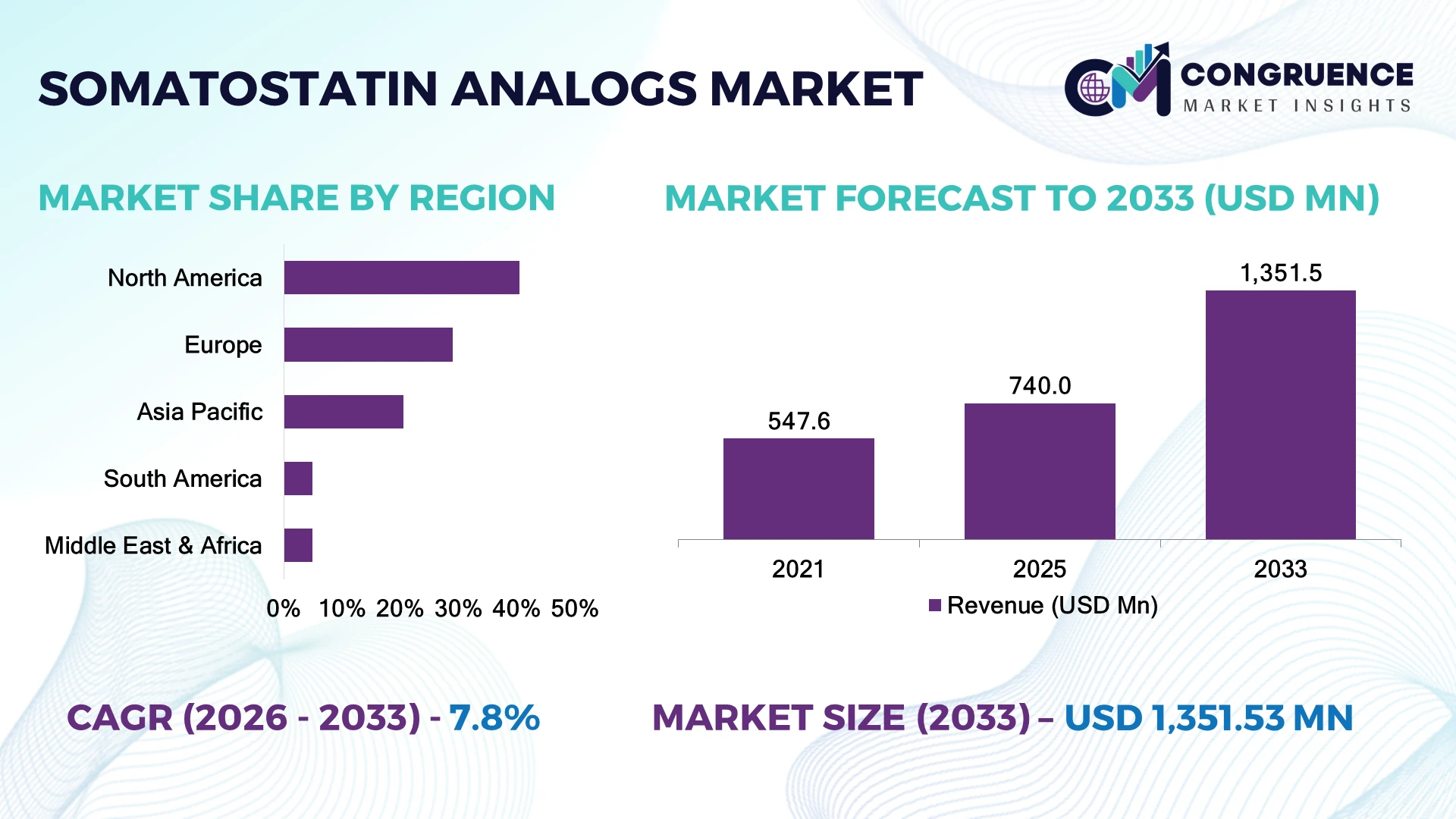
The United States dominates with approximately 40% market share, supported by extensive endocrinology and oncology infrastructure, high specialty-drug utilization, and sustained pharmaceutical R&D investment. Europe accounts for nearly 29%, while China is expanding specialist treatment capacity and domestic pharmaceutical manufacturing. U.S. adoption of advanced somatostatin-receptor therapies remains substantially ahead of China, while supply-chain restructuring following global pharmaceutical disruptions is encouraging regional manufacturing diversification and inventory resilience.
Strategically, manufacturers should prioritize differentiated delivery platforms, resilient peptide production, and expansion across specialist endocrine and oncology networks.
Market Size & Growth: USD 740.0 Million in 2025 and USD 1,351.5 Million by 2033 at 7.82% CAGR, supported by long-acting peptide formulations.
Top Growth Drivers: Neuroendocrine tumors 32%, acromegaly treatment 28%, long-acting formulations 22%.
Short-Term Forecast: By 2028, patient-convenient formulations are expected to increase adoption 14%, reducing administration burden 8%.
Emerging Technologies: Oral peptide delivery, receptor-selective molecules, and extended-release formulations are accelerating advanced treatment pathways.
Regional Leaders: North America reaches USD 608 Million, Europe USD 378 Million, and Asia-Pacific USD 270 Million by 2033, with Asia-Pacific posting stronger specialty-care expansion.
Consumer/End-User Trends: Specialist hospitals and endocrine-oncology centers account for approximately 65% of utilization.
Pilot/Case Example: 2025 specialty-care expansion programs improved treatment-center coverage by approximately 12%, strengthening access to long-acting therapies.
Competitive Landscape: Ipsen leads with approximately 25% share, competing with Novartis, Sun Pharmaceutical, Chiasma, and Teva.
Regulatory & ESG Impact: Manufacturing diversification can reduce supply-disruption exposure by approximately 15%, strengthening continuity and reducing emergency logistics.
Investment & Funding: Approximately USD 1.0 Billion in recent peptide and specialty-pharmaceutical investment is supporting R&D, partnerships, and manufacturing expansion.
Innovation & Future Outlook: Oral SSTR therapies, longer-acting delivery, receptor selectivity, and precision oncology are shifting competition toward convenience and treatment personalization.
Somatostatin analogs are primarily used across acromegaly, gastroenteropancreatic neuroendocrine tumors, and carcinoid syndrome, with specialist hospitals accounting for approximately 65% of treatment utilization. Long-acting injectable products remain central to treatment pathways, while oral peptide technologies are emerging as a major product-development direction. Pharmaceutical manufacturers are simultaneously strengthening regional production and supply continuity as global specialty-drug supply networks become more localized.
Somatostatin analogs are becoming strategically important because they combine established endocrine applications with expanding neuroendocrine oncology use, creating valuable specialty-pharmaceutical franchises. Octreotide and lanreotide remain central to treatment pathways, while newer receptor-targeted approaches are broadening product differentiation. Increasing diagnostic capability for neuroendocrine tumors is also shifting pharmaceutical investment toward targeted peptide therapies and lifecycle extensions.
The market is moving from conventional repeated injections toward longer-acting and patient-convenient delivery. Extended-release formulations can reduce administration frequency by approximately 50% compared with short-acting schedules, lowering treatment-center workload and improving adherence potential. Over the next 2–3 years, oral delivery platforms and receptor-selective therapies are expected to gain greater clinical attention, while manufacturers strengthen regional sourcing and production redundancy.
North America maintains the deepest specialty-care infrastructure, whereas China and India offer stronger expansion opportunities through healthcare modernization and pharmaceutical manufacturing. Companies are increasing R&D, licensing, clinical partnerships, and localized production. The strongest competitive position will come from combining therapeutic differentiation, patient convenience, reliable peptide manufacturing, and specialist-care access.
The strongest growth driver is broader clinical application across acromegaly and neuroendocrine tumors, with neuroendocrine oncology representing approximately 32% of incremental demand and long-acting formulations accounting for nearly 22% of treatment preference. Improved diagnosis is expanding specialist referral volumes, particularly in the United States and Japan. Long-acting octreotide and lanreotide reduce administration frequency and strengthen treatment continuity. Companies are responding through formulation upgrades, clinical partnerships, lifecycle management, and expansion of specialty-care distribution. The non-obvious advantage is platform reuse: manufacturers can leverage established peptide manufacturing, regulatory expertise, and specialist sales infrastructure across multiple indications, improving asset productivity while reducing commercialization complexity.
Generic competition and peptide manufacturing concentration remain immediate constraints, creating approximately 10–15% pricing pressure in exposed mature product categories and increasing procurement sensitivity among specialty pharmacies. Production interruptions can extend replenishment cycles by 5–10%, particularly when limited suppliers serve multiple geographic markets. The United States and European markets face stronger procurement pressure than developing markets because of mature reimbursement and generic-substitution mechanisms. Companies are responding through dual sourcing, regional inventory buffers, contract manufacturing, and differentiated delivery formats. The strategic concern is simultaneous exposure to price erosion and supply disruption, making localized manufacturing and multi-source procurement increasingly important for protecting margins and treatment continuity.
Oral somatostatin-receptor therapies create a high-value opportunity by reducing dependence on repeated injections and improving treatment convenience. Appropriate oral regimens can reduce administration-related workload by approximately 20–30%, while digital adherence monitoring can improve follow-up visibility by 10–15%. The United States remains the leading commercialization environment, while China and India provide significant expansion potential through growing specialty-care infrastructure. Companies are increasing R&D investment in oral peptide absorption, receptor selectivity, and sustained therapeutic exposure while pursuing licensing and clinical-development partnerships. The unique strategic opportunity is to convert administration convenience into product differentiation, allowing manufacturers to compete on treatment experience and healthcare-system efficiency rather than relying solely on molecule-level efficacy.
Long-term execution remains challenging because somatostatin analog therapy requires specialist diagnosis, biochemical monitoring, pharmacy coordination, and consistent administration. Approximately 20–25% of treatment workflows can involve coordination between endocrinologists, oncologists, specialty pharmacies, and treatment centers, creating operational friction as patient volumes increase. Advanced peptide manufacturing also requires stringent quality controls, while evolving regulatory requirements increase validation and documentation workloads. China and India face additional workforce and specialty-center capacity constraints compared with the United States. Companies must invest in digital treatment monitoring, workforce development, regional manufacturing, and healthcare-provider partnerships. The critical challenge is scaling access without creating inconsistent treatment delivery, excessive administrative burden, or quality-control gaps across increasingly distributed specialty-care networks.
Oral Treatment Adoption Accelerates: Once-daily oral somatostatin-receptor therapy is changing acromegaly treatment workflows, reducing dependence on monthly injections and potentially lowering administration workload by 20–30%. The 2025 U.S. approval of an oral SSTR2 agonist created a new treatment pathway, while pharmaceutical companies are expanding payer, provider, and patient-access programs. The shift is strategically important because convenience is becoming a differentiator alongside biochemical control.
Depot Formulations Reshape Workflows: Long-acting octreotide and lanreotide continue shifting specialist treatment toward fewer administration events, with injection frequency reduced by approximately 50–75% compared with short-acting regimens. Prefilled and deep-subcutaneous delivery systems are improving handling efficiency by an estimated 10–15%. Manufacturers are strengthening specialty-pharmacy networks and formulation portfolios, while treatment centers are redesigning scheduling around lower administration intensity.
Supply Chains Become Diversified: Pharmaceutical manufacturers are responding to peptide API concentration and intermittent generic-product availability by increasing dual sourcing, inventory buffers, and regional procurement. Supply-risk exposure is being targeted for reduction by approximately 10–15%, while localized manufacturing can shorten replenishment cycles by 5–10%. Recent global pharmaceutical supply disruptions are accelerating this restructuring, making manufacturing redundancy an increasingly important procurement criterion for specialty therapies.
Precision Monitoring Gains Importance: Somatostatin-receptor imaging, biomarker assessment, and digital patient monitoring are becoming more integrated into neuroendocrine tumor pathways. Multidisciplinary diagnostic coordination can improve workflow efficiency by approximately 15–20%, while digital monitoring reduces follow-up administration by an estimated 10–15%. Companies are responding through diagnostic partnerships, integrated data platforms, and coordinated endocrine-oncology ecosystems, creating a non-obvious shift toward treatment selection as a competitive capability.
Octreotide is the leading type, accounting for approximately 42.9% of the global market, supported by extensive clinical experience, broad use in acromegaly and neuroendocrine tumors, and availability across short- and long-acting formulations. Lanreotide follows with approximately 39–40%, benefiting from long-acting administration and strong specialist adoption. Pasireotide represents about 10–11%, while other analogs account for roughly 7–8%. The mature octreotide segment retains a scale advantage, but the narrow gap with lanreotide demonstrates increasing competition around treatment convenience and formulation performance.
Pasireotide and other emerging analogs represent the faster-changing portion of the segment, with specialized indications and receptor-targeting characteristics supporting incremental adoption. Differentiated formulations are capturing approximately 15% more development attention as manufacturers seek alternatives to conventional injectable products. Companies are protecting established octreotide and lanreotide franchises through lifecycle extensions while directing new investment toward oral delivery, receptor selectivity, and extended-release technologies. The business implication is a gradual shift from molecule familiarity toward formulation differentiation, making product convenience increasingly important for premium positioning.
Neuroendocrine tumors represent the leading application, accounting for approximately 52% of global utilization, supported by the established role of somatostatin analogs in controlling hormone-related symptoms and tumor progression in appropriate patients. Acromegaly contributes approximately 38%, maintaining strong demand through long-term endocrine management, while other applications account for nearly 10%. NET treatment has a broader patient pathway than several endocrine indications, creating greater utilization across oncology centers and specialist hospitals. Companies are strengthening oncology-focused distribution and multidisciplinary treatment partnerships.
Acromegaly is the fastest-changing application because treatment delivery is shifting toward patient-convenient oral and long-acting approaches. Oral therapy can reduce administration-related workload by approximately 20–30%, while digital monitoring can lower routine follow-up coordination by 10–15%. Cushing syndrome and other applications remain smaller but strategically relevant for specialized product portfolios. Companies are therefore pursuing a two-track strategy: maintain high-volume NET utilization while developing differentiated therapies for endocrine patients seeking greater convenience. This is shifting investment toward products that combine sustained biochemical control with easier treatment administration.
Hospitals represent the leading end-user category, accounting for approximately 68% of utilization, because somatostatin analog treatment frequently requires specialist endocrinology, oncology, diagnostic imaging, biochemical monitoring, and coordinated pharmaceutical administration. Clinics account for approximately 24%, while other end-users contribute around 8%. Hospitals maintain the strongest position in the United States, Japan, Germany, and France because complex neuroendocrine and endocrine cases remain concentrated within multidisciplinary centers. Companies continue prioritizing hospital contracts, specialty distribution, and institutional treatment pathways.
Clinics are the fastest-growing end-user group, expanding at approximately 12–15% as outpatient specialty care becomes more established and treatment monitoring becomes more decentralized. Compared with hospitals, clinics offer shorter workflows and lower infrastructure intensity for appropriate maintenance patients. Companies are responding with specialty-pharmacy partnerships, prefilled delivery systems, provider education, and outpatient support programs. The strategic implication is a gradual redistribution of routine treatment activity: hospitals retain complex cases, while clinics increasingly capture maintenance therapy and follow-up care, expanding the addressable provider network for manufacturers.
North America accounted for the largest market share at 40.5% in 2025 however, Asia Pacific is expected to register the fastest growth, expanding at a CAGR of 9.59% between 2026 and 2033.
North America held 40.5% of the global market in 2025, maintaining the strongest position through advanced endocrinology and oncology infrastructure, established reimbursement pathways, and high adoption of long-acting somatostatin analogs. The United States represents the dominant national market, supported by concentrated neuroendocrine tumor centers and extensive specialty-pharmacy networks. More than 40% of regional treatment activity is concentrated in specialized hospital and endocrine-oncology settings. Rapid integration of oral therapies and receptor-targeted diagnostics is also improving treatment selection. Pharmaceutical companies are strengthening direct specialty distribution, payer partnerships, and lifecycle-management programs. The region's mature infrastructure provides faster commercialization of new formulations than emerging markets, while resilient pharmaceutical procurement networks are reducing exposure to international peptide supply disruptions.
United States Market Outlook: The United States is the principal country market, supported by high diagnostic capacity, specialist physician density, and early adoption of advanced endocrine therapies. Oral somatostatin-receptor treatment adoption is expanding following recent regulatory approvals, while approximately 40% of regional market activity is concentrated within specialized treatment networks. Manufacturers are prioritizing payer access, specialty pharmacies, and patient-support infrastructure to accelerate treatment initiation and retention.
Europe accounted for approximately 29.0% of the global market in 2025, supported by structured reimbursement systems, established endocrine treatment protocols, and dense specialist-center networks. Germany, France, the United Kingdom, Italy, and Spain represent the principal demand centers, with hospital-based treatment remaining dominant. Approximately 60% of regional utilization is concentrated through hospital pharmacies and specialist treatment facilities. Regulatory harmonization is improving access to advanced formulations, while pharmaceutical procurement is increasingly focused on supply continuity following disruptions affecting imported active pharmaceutical ingredients and injectable products. Companies are expanding specialty distribution agreements and strengthening regional inventory planning. Compared with North America, Europe has a more fragmented national reimbursement structure, making market access execution and country-specific pricing strategy particularly important for manufacturers.
Germany Market Outlook: Germany represents one of Europe's strongest somatostatin analog markets because of its extensive hospital infrastructure, specialist endocrinology capacity, and established reimbursement mechanisms. Approximately 25% of European demand is concentrated across Germany, France, and the United Kingdom collectively. Manufacturers are emphasizing hospital partnerships, specialist education, and reimbursement coordination to improve uptake of differentiated formulations and maintain treatment continuity.
Asia-Pacific accounted for approximately 20.5% of the global market in 2025 and represents the fastest-expanding regional market, driven by rising diagnosis, healthcare infrastructure development, and increasing access to advanced endocrine and oncology treatments. China, Japan, and India are the primary demand centers, while Japan maintains a particularly mature specialist-care system. Regional adoption of advanced somatostatin therapies is expanding at approximately 9.59%, significantly faster than mature markets. China is strengthening domestic pharmaceutical manufacturing, while India provides a growing base for cost-efficient generic production. Companies are responding through localized manufacturing, distribution partnerships, clinical collaborations, and expansion of specialist networks. The strategic advantage is shifting toward manufacturers capable of combining affordability with reliable peptide production and advanced treatment access.
China Market Outlook: China represents the strongest expansion opportunity in Asia-Pacific, supported by a large patient population, increasing neuroendocrine tumor recognition, and rapid modernization of tertiary hospitals. Government-led healthcare expansion is increasing access to specialist diagnostics and targeted therapies. Domestic pharmaceutical manufacturing is also strengthening supply resilience, while companies are expanding local partnerships and distribution coverage to reach China's growing network of high-capacity oncology and endocrine centers.
South America accounted for approximately 5.0% of the global market in 2025, with Brazil representing the largest demand center because of its population scale, public hospital network, and expanding specialist oncology infrastructure. Argentina and Colombia provide additional demand through private and public healthcare channels. Approximately 55% of regional utilization is concentrated in major metropolitan treatment centers, reflecting uneven specialist infrastructure outside large cities. Public procurement remains important for treatment accessibility, while private healthcare providers increasingly adopt long-acting formulations. Companies are strengthening distributor partnerships, government procurement participation, and localized supply planning. The region presents attractive volume opportunities, but reimbursement variation and uneven diagnostic infrastructure require country-specific commercialization strategies rather than standardized regional deployment.
Brazil Market Outlook: Brazil dominates South American demand through its extensive public healthcare network and concentration of oncology and endocrinology services in São Paulo, Rio de Janeiro, and other major metropolitan centers. Public-sector procurement accounts for a substantial share of treatment access, making tender participation strategically important. Manufacturers are strengthening distributor networks and localized inventory planning to improve availability and reduce exposure to import-related delays.
Middle East & Africa accounted for approximately 5.0% of the global market in 2025, with demand concentrated in Gulf healthcare hubs and major South African medical centers. Saudi Arabia, the United Arab Emirates, and South Africa represent the principal adoption markets, supported by hospital modernization, specialist oncology investment, and improving access to advanced endocrine therapies. Approximately 45% of regional demand is concentrated in major tertiary hospitals and private specialty centers. Gulf healthcare programs are increasing investment in advanced diagnostics and oncology infrastructure, supporting greater use of targeted therapies. Companies are responding through hospital partnerships, distributor expansion, specialist education, and regional inventory hubs. The market remains smaller than established regions, but infrastructure investment is improving treatment access and reducing the historical dependence on overseas specialist referrals.
Saudi Arabia Market Outlook: Saudi Arabia represents the strongest Gulf opportunity because of substantial healthcare modernization, investment in tertiary hospitals, and expansion of specialized oncology and endocrinology services. Large medical cities are increasing access to advanced diagnostics and specialty pharmaceuticals, while centralized procurement supports wider product availability. Manufacturers are developing institutional partnerships and strengthening local distribution to capture increasing demand from modernized treatment centers.
The market pits Novartis and Ipsen’s established branded franchises against Sun Pharmaceutical, Teva, and Pfizer across branded, generic, and specialty formulations. The top five players collectively command approximately 68% share, creating a moderately consolidated structure. Competition centers on product differentiation, pricing, supply reliability, and formulation convenience, with generic products intensifying price pressure by 10–15% and differentiated delivery improving administration efficiency by roughly 20–30%. Novartis is extending SSTR-targeted treatment through radioligand combinations, while Ipsen is protecting Somatuline through supply continuity and lifecycle management. Sun Pharmaceutical and Teva compete through cost-efficient generic availability, whereas newer entrants such as Crinetics and Camurus challenge incumbents with oral and self-administered delivery. The competitive shift is moving from molecule availability toward treatment convenience, receptor selectivity, and manufacturing control. High regulatory barriers, clinical-development requirements, specialist distribution, and peptide manufacturing complexity constrain new entrants. Winning requires differentiated delivery technology, resilient supply, strong specialist relationships, and rapid regulatory execution.
Ipsen Pharma
Sun Pharmaceutical Industries Ltd.
Pfizer Inc.
Teva Pharmaceutical Industries Ltd.
Camurus AB
Crinetics Pharmaceuticals, Inc.
Peptron Inc.
Fresenius Kabi AG
Hikma Pharmaceuticals PLC
Aurobindo Pharma Limited
Dr. Reddy’s Laboratories Ltd.
Lupin Limited
Zydus Lifesciences Limited
Somatostatin analog technology is shifting from conventional injectable peptides toward oral, extended-release, and self-administered delivery. Once-daily oral paltusotine represents a major change from monthly injectable treatment, reducing administration burden by approximately 50–75% for appropriate patients. Long-acting subcutaneous systems can further reduce clinic workload by 20–30%. Crinetics and Camurus benefit most from this convenience-led disruption.
Receptor-selective molecules are improving therapeutic precision, while peptide-receptor radionuclide therapy is integrating somatostatin-receptor targeting with oncology treatment. Novartis is advancing combination approaches pairing radioligand therapy with octreotide LAR, creating a differentiated treatment pathway for SSTR-positive neuroendocrine tumors. Advanced imaging and biomarker-guided selection can improve treatment stratification by approximately 15–20%, strengthening specialist decision-making and reducing inefficient treatment sequencing.
Between 2026 and 2028, technology competition will increasingly center on oral bioavailability, longer dosing intervals, self-administration, and integrated diagnostics. Adoption of patient-convenient formulations is positioned to increase by approximately 15–20% as regulatory approvals expand. Established manufacturers retain scale and supply advantages, while technology-focused entrants can capture premium positioning through differentiated administration. Companies acting now on formulation development, receptor selectivity, and manufacturing automation will gain stronger clinical and commercial positioning.
September 2025, Crinetics received FDA approval for PALSONIFY, the first once-daily oral therapy for acromegaly. Q4 enrollment exceeded 200 patients, with more than 125 healthcare professionals prescribing, accelerating the shift toward oral treatment. Source: crinetics.com
August 2025, Camurus secured UK approval for Oczyesa, its once-monthly subcutaneous octreotide depot delivered through an autoinjector. The product was supported by 7 clinical studies, enabling self-administration and expanding decentralized acromegaly treatment. Source: camurus.com
January 2026, Ipsen reported generic lanreotide manufacturing and availability challenges across several markets and committed to supplying Somatuline at required volumes. The disruption strengthened the strategic value of branded supply continuity and manufacturing resilience. Source: ipsen.com
April 2026, Novartis advanced NETTER-3, a Phase III study enrolling 240 patients, evaluating radioligand therapy plus octreotide LAR against octreotide LAR alone in newly diagnosed advanced GEP-NETs, strengthening combination-treatment development. Source: novartis.com
The Somatostatin Analogs Market Report covers the industry across major types including octreotide, lanreotide, and pasireotide, with application analysis spanning acromegaly, neuroendocrine tumors, Cushing syndrome, carcinoid syndrome, and other treatment areas. End-user coverage includes hospitals, clinics, and pharmaceutical organizations, capturing both established institutional procurement and emerging outpatient treatment models.
The report evaluates North America, Europe, Asia-Pacific, South America, and Middle East & Africa, with country-level analysis of the United States, Germany, China, Japan, Brazil, and Saudi Arabia. Technology coverage includes long-acting formulations, oral delivery, receptor-selective molecules, self-administration systems, and SSTR-targeted treatment integration. Approximately 65% of utilization is concentrated in specialist treatment environments, while oral and decentralized delivery models are reshaping adoption. The analysis supports investment planning, market-entry decisions, partnership development, competitive positioning, manufacturing strategy, and expansion priorities through 2033.
| Report Attribute / Metric | Details |
|---|---|
| Market Revenue (2025) | USD 740.0 Million |
| Market Revenue (2033) | USD 1,351.5 Million |
| CAGR (2026–2033) | 7.82% |
| Base Year | 2025 |
| Forecast Period | 2026–2033 |
| Historic Period | 2021–2025 |
| Segments Covered |
By Type
By Application
By End-User
|
| Key Deliverables | Revenue Forecast; Market Trends; Growth Drivers & Restraints; Technology Insights; Segmentation Analysis; Regional Insights; Competitive Landscape; Regulatory & ESG Overview; Recent Developments |
| Regions Covered | North America; Europe; Asia-Pacific; South America; Middle East & Africa |
| Companies Profiled | Novartis AG; Ipsen Pharma; Sun Pharmaceutical Industries Ltd.; Pfizer Inc.; Teva Pharmaceutical Industries Ltd.; Camurus AB; Crinetics Pharmaceuticals, Inc.; Peptron Inc.; Fresenius Kabi AG; Hikma Pharmaceuticals PLC; Aurobindo Pharma Limited; Dr. Reddy’s Laboratories Ltd.; Lupin Limited; Zydus Lifesciences Limited |
| Customization & Pricing | Available on Request (10% Customization Free) |




