
Reports
The Global Soft Mist Inhalers Market was valued at USD 3122.45 Million in 2025 and is anticipated to reach a value of USD 4948.74 Million by 2033 expanding at a CAGR of 6.8% between 2026 and 2033. Growth is driven by propellant-free respiratory drug delivery, reusable inhaler conversion, higher pulmonary deposition, and expanding maintenance therapy for COPD and asthma.
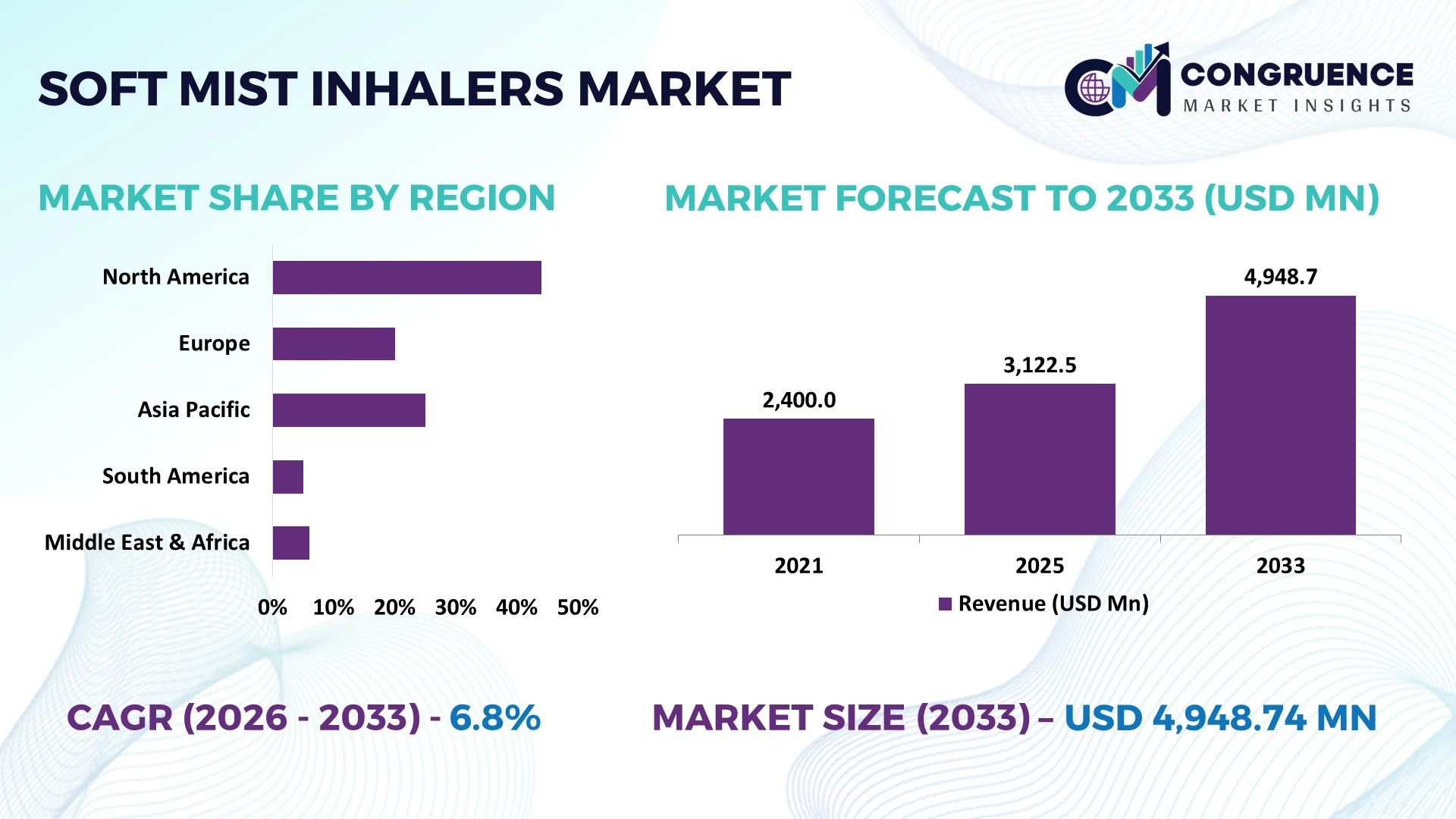
The U.S. anchors North American soft mist inhaler demand, with North America representing approximately 41–44% of global adoption and COPD affecting 7.0% of Americans aged 45+. Soft mist devices represented only 4% of 1.6 billion U.S. inhalers dispensed during 2014–2024, leaving substantial conversion headroom. Compared with the U.S., Germany benefits from earlier Respimat penetration and EU climate policy, while geopolitical pressure on HFA supply chains strengthens propellant-free device positioning.
Strategically, manufacturers should prioritize reusable platforms, combination-drug compatibility, U.S. formulary access, and localized precision-component supply to capture the transition from propellant-based respiratory delivery.
Market Size & Growth: USD 3,122.45 million in 2025 reaches USD 4,948.74 million by 2033 at 6.8%, driven by reusable propellant-free delivery.
Top Growth Drivers: Reusable devices hold approximately 58.8%, adults 77.6%, and asthma applications 54.5%, concentrating commercial demand around chronic maintenance therapy.
Short-Term Forecast: By 2027, broader reusable-device deployment can lower inhaler product carbon footprint by up to 71% across six-month refill use.
Emerging Technologies: More than 60% fine-particle output, reusable cartridges, digital adherence monitoring, and precision nozzle engineering are advancing pulmonary drug delivery.
Regional Leaders: Based on the stated global forecast and current regional positioning, North America approaches USD 2.1 billion, Europe USD 1.5 billion, and Asia-Pacific USD 1.0 billion by 2033, led by reusable-device adoption.
Consumer/End-User Trends: Adults represent approximately 77.6% of demand, while home-care adoption strengthens as chronic respiratory treatment shifts toward self-administered maintenance therapy.
Pilot/Case Example: Comparative deposition testing demonstrated 51.6% whole-lung deposition with soft mist delivery versus 28.5% for fast-flow DPI and 8.9% for pMDI.
Competitive Landscape: Boehringer Ingelheim anchors commercial soft mist technology; GSK, AstraZeneca, Novartis, and Teva intensify competition across the wider advanced inhalation ecosystem.
Regulatory & ESG Impact: Reusable Respimat configurations reduce product carbon footprint by 57% over three months and 71% over six months versus monthly disposable use.
Investment & Funding: Four manufacturers supplied 85% of U.S. inhalers historically, intensifying pharmaceutical-device partnerships and investment in precision manufacturing, refill platforms, and differentiated aerosol systems.
Innovation & Future Outlook: Soft mist systems achieve approximately 52% pulmonary deposition in comparative testing, positioning high-efficiency, propellant-free and digitally connected platforms for stronger respiratory-care adoption.
The Soft Mist Inhalers Market is increasingly centered on COPD and asthma maintenance therapy, reusable devices, combination bronchodilators, and home-based respiratory care. Soft mist technology can deliver approximately 52% of the metered dose to the lungs versus about 9% with conventional pMDI delivery in comparative testing. Precision micro-nozzles, slower aerosol velocity, refill cartridges, and emerging connected-device functions are strengthening differentiation. Meanwhile, European decarbonization initiatives and HFA-related supply-chain pressures are increasing strategic interest in propellant-free delivery, shifting competition toward efficient, reusable drug-device platforms and setting up the broader strategic discussion.
Soft mist inhalers are becoming strategically important as respiratory drug delivery shifts toward propellant-free, reusable platforms that combine high pulmonary deposition with lower lifecycle emissions. COPD affects about 10% of adults aged 40–79 in major reporting countries, sustaining maintenance-device demand. European regulation targeting high-global-warming-potential propellants is also restructuring inhaler portfolios, strengthening investment in mechanically generated aerosols and reusable cartridge systems.
Soft mist technology achieves approximately 52% lung deposition in comparative testing versus about 9% for conventional pMDIs, representing nearly sixfold higher deposition efficiency under tested conditions. The U.S. offers the largest commercial respiratory-drug base, while Germany and other European markets have stronger environmental incentives for propellant-free conversion. Through 2026–2028, reusable platforms, combination therapies, and connected adherence functions will increasingly influence formulary and procurement decisions.
Respimat demonstrates the operational model: one reusable inhaler can accept multiple medication cartridges rather than replacing the complete device monthly, reducing device material consumption and lifecycle footprint. Manufacturers are therefore investing in precision nozzle engineering, refill architecture, digital monitoring, and drug-device partnerships. Competitive leadership will depend on combining deposition performance, therapeutic compatibility, patient usability, manufacturing repeatability, and regulatory evidence within one scalable platform.
Rising long-duration COPD and asthma treatment is accelerating demand for devices that improve pulmonary delivery without requiring high inspiratory flow. COPD affects approximately 10% of adults aged 40–79 across major surveyed populations, while asthma affects roughly 8% of the U.S. population. Soft mist systems can achieve about 52% pulmonary deposition under comparative testing, materially improving drug utilization versus conventional aerosol delivery. The clinical shift toward maintenance combinations such as LAMA/LABA and triple therapy increases the value of reproducible aerosol generation. In the U.S., aging respiratory populations are reinforcing recurring prescription volumes, while Europe’s transition away from high-impact propellants strengthens propellant-free platforms. Manufacturers are responding through reusable inhalers, combination-drug development, precision nozzles, and lifecycle-management programs. Strategically, delivery efficiency increasingly determines pharmaceutical differentiation alongside the active molecule.
Soft mist inhalers require tightly controlled microfluidic components, spring mechanisms, nozzles, formulation properties, and container-closure systems, making technology transfer more complex than conventional pMDI manufacturing. Despite approximately 52% lung deposition performance, soft mist devices historically represented only around 4% of U.S. inhaler dispensing, demonstrating the commercial barrier created by established pMDI and DPI formularies. Generic substitution is also constrained because device equivalence involves aerosol characteristics, usability, and drug-device interaction rather than formulation alone. U.S. respiratory procurement remains strongly reimbursement-driven, while precision component dependence concentrates manufacturing risk. Companies are mitigating these limitations through automated assembly, dual sourcing, device-platform standardization, and longer-term component contracts. The non-obvious constraint is platform lock-in: superior deposition does not automatically generate switching when prescribers, patients, payers, and manufacturing lines are already aligned around incumbent devices.
The next opportunity is transforming soft mist inhalers from dispensing devices into reusable respiratory-management platforms. Approximately 52% pulmonary deposition provides a strong efficiency base, while reusable configurations can lower product carbon footprint by more than 50% over repeated cartridge cycles compared with replacing complete devices. Digital dose counters, adherence sensors, Bluetooth connectivity, and inhalation-pattern analytics can add medication-management functionality without changing the underlying aerosol principle. India offers particular potential as chronic respiratory disease burden intersects with expanding digital-health infrastructure and growing access to combination maintenance therapies. Manufacturers are investing in connected-device R&D, refill ecosystems, patient-support software, and pharmaceutical partnerships. A strategically overlooked opportunity is cartridge standardization: supporting multiple therapies on one validated mechanical platform can spread device-development expenditure across several drug franchises and strengthen recurring consumable economics.
Long-term scaling requires consistent aerosol performance across formulations, cartridge batches, patient handling patterns, and manufacturing sites. Soft mist platforms rely on micron-scale nozzle geometry, while deposition approaching 52% depends on maintaining controlled plume velocity and droplet characteristics. At the same time, approximately 4% historical U.S. inhaler penetration illustrates how slowly new delivery formats can displace established prescribing behavior. Adding sensors creates further requirements for electronics validation, software maintenance, data governance, and cybersecurity without compromising mechanical reliability. European environmental policy adds pressure to demonstrate lifecycle advantages rather than simply eliminating propellant. Manufacturers must invest in high-precision tooling, automated quality inspection, human-factors testing, connected-device validation, and post-market monitoring. The strategic challenge is maintaining pharmaceutical-grade consistency while increasing device complexity; companies that cannot industrialize microfluidics and digital functions together will struggle to achieve dependable multi-market deployment.
Reusable Devices Replace Disposable Hardware: Respiratory portfolios are shifting toward cartridge replacement rather than monthly disposal of complete inhalers. Reusable soft mist configurations can reduce product carbon footprint by approximately 57% after three months and 71% after six months of use. European decarbonization pressure is accelerating lifecycle assessments, while manufacturers are redesigning cartridges, packaging, and device durability to lower material consumption and strengthen refill-based patient retention.
Combination Therapies Consolidate Device Use: Soft mist platforms increasingly deliver LAMA/LABA and multi-agent maintenance therapies through one inhaler, reducing device fragmentation for chronic respiratory patients. COPD affects roughly 10% of adults aged 40–79, while adherence to long-term inhaled therapy frequently remains below 50%. Pharmaceutical companies are integrating multiple active ingredients into established device architectures, simplifying treatment routines and using platform familiarity to defend prescription continuity.
Precision Aerosols Improve Drug Utilization: Soft mist systems generate slower-moving, fine aerosol clouds that achieve approximately 52% pulmonary deposition in comparative testing versus 28.5% for fast-flow DPI and 8.9% for pMDI delivery. This changes formulation economics because more delivered medication reaches the respiratory tract. Device developers are tightening nozzle tolerances, automating microcomponent inspection, and optimizing plume duration to achieve repeatable dose performance at industrial scale.
Digital Monitoring Enters Respiratory Workflows: Connected inhalation technologies are moving beyond basic dose counters toward adherence tracking, reminders, and technique assessment. With real-world inhaler adherence often below 50%, digitally captured usage creates an operational dataset for intervention before treatment failure. U.S. pharmaceutical and digital-health developers are expanding sensor partnerships and patient-support platforms, while manufacturers increasingly design electronics as modular additions rather than rebuilding core aerosol mechanisms.
Mechanically Operated Inhalers lead with an estimated 55–60% share, reflecting the established soft-mist architecture in which stored mechanical energy generates a slow aerosol independently of propellant. This design delivers approximately 52% pulmonary deposition in comparative testing and reduces dependence on high inspiratory flow, supporting repeatable chronic-therapy administration. Multi-Dose Inhalers hold the next strategically important position because reusable devices and replaceable medication cartridges improve treatment continuity and distribute device costs across repeated doses.
Breath-Actuated Inhalers are the fastest-growing provided type as developers target synchronization errors between actuation and inhalation, an important source of incorrect technique. Capsule-Based Inhalers remain more established in dry-powder delivery than soft-mist systems, while Single-Dose Inhalers serve narrower treatment situations where dose separation and controlled administration matter. Companies are prioritizing reusable Multi-Dose platforms, automated nozzle manufacturing, dose tracking, and breath-responsive mechanisms. Investment is consequently moving toward device architectures combining mechanical reliability with adherence support rather than simply increasing aerosol output.
COPD Treatment leads with approximately 50–55% of soft mist inhaler demand because long-duration bronchodilator regimens align closely with slow-moving aerosol delivery and patients with limited inspiratory capacity. Bronchodilation is therefore a major functional application, particularly for LAMA and LAMA/LABA therapy. Maintenance Therapy accounts for an estimated 70–75% of utilization across applications because soft mist devices are designed primarily for scheduled chronic dosing rather than episodic administration. COPD prevalence approaching 10% among adults aged 40–79 in major surveyed populations sustains recurring prescription requirements.
Asthma Treatment is the fastest-growing provided application as combination maintenance strategies expand and device selection increasingly considers technique, inspiratory flow, and adherence. Rescue Therapy remains comparatively limited because established rapid-relief pMDI formats retain substantial prescribing infrastructure. Manufacturers are adapting by extending combination formulations, reusable cartridges, dose indicators, and patient-support programs. Strategically, the highest-value positioning lies in recurring maintenance prescriptions where device familiarity, refill continuity, and therapeutic persistence create stronger lifecycle economics than intermittent rescue use.
Homecare Settings lead with approximately 60–65% of end-user utilization because asthma and COPD inhalers are predominantly self-administered between clinical visits. Reusable soft mist platforms strengthen this position by supporting repeated cartridge use and scheduled maintenance dosing without healthcare-professional administration. Hospitals remain essential for therapy initiation, exacerbation management, and discharge prescribing, while Pulmonary Clinics provide spirometry, inhaler selection, technique assessment, and longitudinal COPD management. Specialty Clinics address complex respiratory cases requiring individualized therapeutic adjustment.
Homecare Settings are also the fastest-growing provided end-user as connected adherence tools, remote monitoring, and longer-duration maintenance regimens move respiratory management outside institutional facilities. With inhaler adherence frequently below 50% in real-world chronic respiratory populations, manufacturers are integrating reminders, dose tracking, patient training, and digital support around device platforms. Research Institutes remain strategically important for aerosol characterization, human-factors testing, and formulation validation. Companies are consequently targeting home users through reusable designs while partnering with hospitals and pulmonary clinics to influence initial device selection.
North America accounted for the largest market share at 42% in 2025 however, Asia-Pacific is expected to register the fastest growth, expanding at a CAGR of 8.1% between 2026 and 2033.

High-Value Maintenance Therapy Drives Deployment
North America accounts for approximately 42% of global soft mist inhaler demand, anchored by the U.S. prescription respiratory market, mature COPD treatment infrastructure, and broad access to long-acting bronchodilators. COPD affects approximately 6% of U.S. adults, creating a substantial maintenance-therapy population requiring reliable pulmonary drug delivery. Soft mist platforms benefit patients with limited inspiratory flow because mechanically generated aerosol reduces dependence on forceful inhalation. The region is also shifting toward connected adherence support, reusable delivery platforms, and combination therapies. FDA drug-device requirements create high evidence and human-factors barriers but reinforce incumbent platform advantages. Pharmaceutical companies are investing in lifecycle extensions, digital patient support, automated device manufacturing, and payer-focused evidence. Operationally, formulary access remains as important as aerosol performance because prescription coverage determines conversion from entrenched pMDI and DPI therapies.
United States Market Outlook: The U.S. combines approximately 16 million diagnosed COPD patients with extensive pulmonary-clinic, pharmacy, and homecare infrastructure. Its strategic advantage lies in high utilization of long-acting combination therapies and sophisticated reimbursement channels. Suppliers increasingly compete through adherence programs, reusable platforms, device-training support, and evidence demonstrating consistent deposition across patients with variable inspiratory capacity.
Decarbonization Restructures Inhaler Portfolios
Europe represents approximately 30% of global soft mist inhaler demand, with Germany, the UK, Italy, France, and Spain providing established respiratory-treatment infrastructure. Environmental policy is changing device economics because conventional pMDIs depend on hydrofluorocarbon propellants with materially higher climate impact than mechanically generated soft mist systems. Reusable soft mist configurations can reduce product carbon footprint by approximately 57% over three months and 71% over six months compared with repeated complete-device replacement. European healthcare systems are therefore incorporating environmental performance alongside therapeutic efficacy and acquisition cost in respiratory procurement discussions. Manufacturers are redesigning refill architectures, increasing recyclable packaging, extending device life, and preparing lower-emission portfolios. Germany remains a major deployment center for Respimat-based maintenance therapies, while UK prescribing initiatives increasingly emphasize lower-carbon inhaler selection where clinically appropriate, accelerating lifecycle-based competition.
Germany Market Outlook: Germany combines widespread statutory insurance coverage with established pulmonology infrastructure and long-standing soft mist inhaler availability. More than 6% of German adults are affected by COPD, sustaining recurring bronchodilator demand. The market rewards clinically validated reusable platforms, particularly as hospitals and insurers scrutinize device lifecycle impact, adherence, and total treatment efficiency alongside pharmaceutical performance.
Respiratory Scale Accelerates Device Modernization
Asia-Pacific accounts for approximately 19% of global soft mist inhaler demand, with China, Japan, India, Australia, and South Korea forming the principal treatment and manufacturing hubs. China and India provide substantial untreated and undertreated respiratory populations, while Japan offers mature reimbursement and specialist respiratory infrastructure. COPD prevalence among Chinese adults aged 20 years and older is approximately 8.6%, translating into a very large addressable treatment population. Device adoption is shifting from basic inhalation formats toward combination maintenance therapies, reusable delivery systems, and patient-friendly platforms requiring less inspiratory effort. Pharmaceutical companies are expanding local commercialization partnerships, physician education, and respiratory portfolios, while precision-component manufacturing capabilities across China and Japan support device supply-chain localization. The strategic advantage is scale: even modest conversion from established inhalers creates significant cartridge and maintenance-therapy demand.
China Market Outlook: China has approximately 100 million people living with COPD, making respiratory-treatment accessibility a major operational priority. Large tertiary hospitals dominate advanced inhaler initiation, but chronic-disease management is moving progressively into community healthcare. Manufacturers that combine localized device supply, physician training, affordable maintenance formulations, and reliable cartridge availability are positioned to convert disease scale into sustained soft mist utilization.
Brazil Concentrates Chronic Respiratory Demand
South America accounts for approximately 5% of global soft mist inhaler demand, with Brazil providing the largest pharmaceutical, hospital, and pulmonary-care base. COPD affects approximately 12% of Brazilian adults aged 40 years and above in major epidemiological assessments, while asthma creates additional recurring inhaler requirements. Public procurement through Brazil’s Unified Health System and private pharmacy channels produces distinct pricing and access strategies. Soft mist deployment remains constrained by reimbursement variability and established lower-cost pMDI alternatives, making therapeutic differentiation essential. Manufacturers are expanding through local distributors, physician education, combination bronchodilator positioning, and patient-assistance programs rather than relying on premium-device performance alone. Argentina and Chile provide smaller but clinically developed respiratory markets. Brazil’s domestic pharmaceutical manufacturing capacity also creates partnership potential for localized formulation, packaging, and eventual device-component sourcing.
Brazil Market Outlook: Brazil’s population exceeding 200 million, extensive SUS network, and substantial chronic respiratory burden provide the region’s strongest scale opportunity. Commercial success depends on bridging public and private channels: premium soft mist platforms require demonstrable adherence or delivery benefits, while localization, volume contracting, and respiratory-specialist engagement can reduce the access disadvantage against established lower-cost inhalers.
Healthcare Modernization Expands Respiratory Access
Middle East & Africa represents approximately 4% of global soft mist inhaler demand, with Saudi Arabia, the UAE, Israel, South Africa, and major Gulf healthcare systems concentrating advanced respiratory treatment. Saudi Arabia and the UAE are investing in specialist hospitals, digital health, and chronic-disease management, supporting wider deployment of advanced maintenance inhalers. Asthma prevalence exceeds 10% in several Gulf populations, while dust exposure, smoking, and urban air quality sustain respiratory-care requirements. Procurement remains import-dependent, making distributor capability, product registration, and uninterrupted cartridge supply decisive. South Africa provides the strongest established respiratory-treatment infrastructure in sub-Saharan Africa but faces affordability constraints across public healthcare. Manufacturers are strengthening local distribution agreements, patient education, hospital partnerships, and digital adherence programs. Gulf healthcare modernization increasingly favors reusable, clinically differentiated platforms capable of supporting structured chronic-care pathways.
Saudi Arabia Market Outlook: Saudi Arabia combines high respiratory-disease exposure with Vision 2030 healthcare modernization and expanding private-sector participation. Asthma affects approximately 10–15% of the population across published national estimates. Growing digital-health infrastructure gives manufacturers an opportunity to connect maintenance inhalers with adherence monitoring, while dependable import logistics, reimbursement access, and physician education remain essential for sustained deployment.
Boehringer Ingelheim leads soft mist inhaler competition through Respimat, while AstraZeneca, GSK, Novartis, Teva, and device-platform developers compete across adjacent advanced inhalation therapies. The top five participants account for approximately 70% of addressable branded respiratory-device activity, giving established pharmaceutical platforms strong formulary leverage. Competition centers on pulmonary deposition, reusable architecture, combination compatibility, and lifecycle cost: soft mist delivery can achieve about 52% lung deposition versus 9% for conventional pMDIs, while reusable configurations reduce product carbon footprint by up to 71% over six months. Companies defend positions through combination-drug expansion, device patents, automated precision manufacturing, digital adherence partnerships, and physician-training ecosystems. Competition is shifting from molecule-led differentiation toward integrated drug-device performance as environmental pressure challenges propellant-based formats. Regulatory equivalence, micro-nozzle manufacturing precision, clinical validation, and payer acceptance create substantial entry barriers. Winning requires scalable device engineering, differentiated formulations, dependable cartridge supply, regulatory evidence, and sustained prescriber adoption across chronic respiratory-care pathways.
Boehringer Ingelheim
AstraZeneca
GSK plc
Novartis AG
Teva Pharmaceutical Industries Ltd.
Chiesi Farmaceutici S.p.A.
Cipla Limited
Lupin Limited
Glenmark Pharmaceuticals Limited
Zydus Lifesciences Limited
Vectura Fertin Pharma
AptarGroup, Inc.
Recipharm AB
Hovione
Current soft mist technology combines mechanical energy, micro-nozzle aerosolization, reusable cartridges, and low-velocity plumes to reduce coordination and inspiratory-flow dependence. Respimat generates droplets near the respirable range, while comparative studies report lung deposition around 40–50%. Against conventional pMDIs, which can deliver roughly 10–20% to lungs, optimized soft mist delivery provides more than 100% relative deposition improvement, improving dose utilization and formulation economics.
Emerging platforms add flow restrictors, guided inhalation, haptic feedback, sensors, and formulation-tunable nozzle systems. A 2024 sensor-enabled SMI study achieved 96% loaded-movement detection and 97% inhalation-duration accuracy; successful use among elderly COPD patients improved from 59% to 89%. Development platforms are also targeting peptides, monoclonal antibodies, mRNA, and other sensitive biologics, moving soft mist beyond conventional bronchodilator delivery and creating higher-value CDMO opportunities.
Disruptive development centers on generic Respimat-compatible platforms, prefilled cartridges, digital adherence analytics, and scalable micro-molding. Hikma targets a generic Respimat submission in 2026, signaling competitive pressure on proprietary device ecosystems. Through 2026–2028, manufacturers combining precision nozzles, automated assembly, formulation services, and connected monitoring will gain development-speed and lifecycle advantages. Companies dependent on single proprietary respiratory franchises face pressure as interoperable platforms lower entry barriers and broaden molecule compatibility across both branded and generic respiratory programs.
May 2025 Hikma Pharmaceuticals disclosed advanced development of a generic Respimat soft mist inhaler with Invox, targeting submission during second-half 2026. Its respiratory pipeline contained 13 complex drug-device combinations, strengthening Hikma’s position in differentiated generic inhalation technology and manufacturing. Source: hikma.com
September 2025 Boehringer Ingelheim researchers published Respimat flow-restrictor testing showing aerosol performance remained robust across modified airflow conditions. Six restrictor inserts were evaluated, supporting device optimization for patients with different inhalation profiles and strengthening evidence for patient-adapted soft mist delivery. Source: springer.com
December 2024 Merxin and OECHSLERhealth established the SMI Powerhouse, combining MRX004 soft mist inhaler design with more than 30 years of OECHSLER manufacturing expertise. The partnership integrates development, industrialization, and assembly, reducing commercialization complexity for pharmaceutical companies entering advanced inhalation programs. Source: thesmipowerhouse.com
July 2024 IEEE researchers demonstrated a sensor-enabled soft mist inhaler achieving 96% loaded-movement detection and 97% inhalation-duration accuracy. Among elderly COPD patients, successful inhaler use increased from 59% to 89%, validating connected monitoring for technique training and adherence improvement. Source: pubmed.gov
The Soft Mist Inhalers Market Report evaluates Breath-Actuated Inhalers, Mechanically Operated Inhalers, Capsule-Based Inhalers, Multi-Dose Inhalers, and Single-Dose Inhalers across Asthma Treatment, COPD Treatment, Bronchodilation, Maintenance Therapy, and Rescue Therapy. End-user assessment covers hospitals, pulmonary clinics, specialty clinics, homecare settings, and research institutes, with mechanically operated systems representing approximately 55–60% of current deployment and homecare accounting for about 60–65% of utilization.
Geographic coverage includes North America, Europe, Asia-Pacific, South America, and Middle East & Africa with country-level assessment of respiratory infrastructure and adoption. Technology analysis examines micro-nozzles, reusable cartridges, flow control, connected sensors, biologic delivery, and generic SMI platforms. With sensor-assisted inhaler success improving from 59% to 89% in clinical testing, the report supports 2026–2033 investment prioritization, platform development, geographic expansion, partnership selection, and competitive positioning.
| Report Attribute/Metric | Report Details |
|---|---|
Market Revenue in 2025 | USD 3122.45 Million |
Market Revenue in 2033 | USD 4948.74 Million |
CAGR (2026 - 2033) | 6.8% |
Base Year | 2025 |
Forecast Period | 2026 - 2033 |
Historic Period | 2021 - 2025 |
Segments Covered | By Type
By Application
By End-User
|
Key Report Deliverable | Revenue Forecast, Growth Trends, Market Dynamics, Segmental Overview, Regional and Country-wise Analysis, Competition Landscape |
Region Covered | North America, Europe, Asia-Pacific, South America, Middle East, Africa |
Key Players Analyzed | Boehringer Ingelheim, AstraZeneca, GSK plc, Novartis AG, Teva Pharmaceutical Industries Ltd., Chiesi Farmaceutici S.p.A., Cipla Limited, Lupin Limited, Glenmark Pharmaceuticals Limited, Zydus Lifesciences Limited, Vectura Fertin Pharma, AptarGroup, Inc., Recipharm AB, Hovione |
Customization & Pricing | Available on Request (10% Customization is Free) |




