
Reports
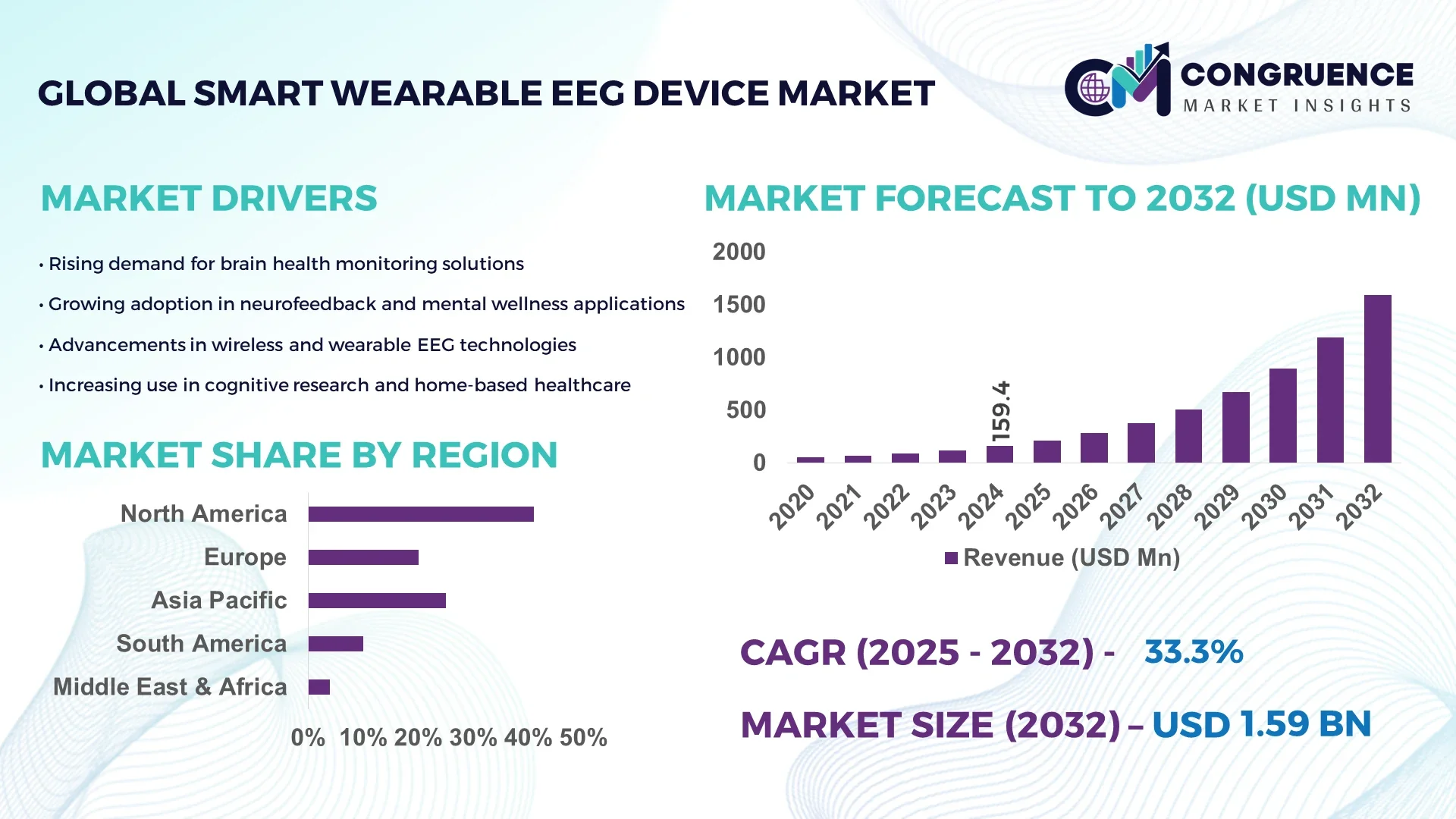
The Global Smart Wearable EEG Device Market was valued at USD 159.38 Million in 2024 and is anticipated to reach a value of USD 1588.89 Million by 2032 expanding at a CAGR of 33.3% between 2025 and 2032. The rapid expansion is driven by increasing integration of AI-based neuro-monitoring and growing mental health awareness across consumer and medical applications.
The United States dominates the global Smart Wearable EEG Device market, supported by advanced healthcare infrastructure, significant investment in neurotechnology startups, and high adoption of portable brain-monitoring devices. In 2024, over 68% of smart EEG research funding originated from U.S.-based institutions, and more than 120 hospitals implemented real-time brainwave analytics for neurology and psychiatric care. The country also leads in FDA-approved wearable EEG innovations, with over 35 new patents registered in 2023 focusing on AI-enhanced electrode arrays and wireless EEG data processing technologies.
Market Size & Growth: The market is valued at USD 159.38 Million in 2024 and projected to reach USD 1588.89 Million by 2032, expanding at a CAGR of 33.3%, driven by rapid advancements in neurotechnology and increasing clinical acceptance of non-invasive monitoring.
Top Growth Drivers: Rising adoption of wearable neurodiagnostic tools (42%), 30% improvement in EEG signal accuracy using AI algorithms, and 27% growth in consumer-grade mental wellness devices.
Short-Term Forecast: By 2028, device performance efficiency is projected to improve by 35% through optimized electrode materials and low-power data transmission systems.
Emerging Technologies: AI-driven brainwave analytics, dry-electrode EEG headsets, and Bluetooth 5.3-enabled continuous neuro-monitoring systems are key upcoming innovations.
Regional Leaders: North America (USD 780 Million by 2032) leads with strong healthcare adoption; Europe (USD 460 Million) focuses on mental wellness integration; Asia-Pacific (USD 300 Million) benefits from expanding telehealth networks.
Consumer/End-User Trends: Rising use among research institutions, neurology clinics, and wellness startups; over 55% of new adopters are targeting cognitive training and sleep improvement applications.
Pilot or Case Example: In 2024, NeuroSky’s pilot project with Stanford Medicine achieved a 40% reduction in EEG signal latency, improving real-time monitoring accuracy for epileptic patients.
Competitive Landscape: Emotiv Inc. leads with a 22% market share, followed by NeuroSky, Brain Products GmbH, Compumedics Ltd., and Advanced Brain Monitoring Inc.
Regulatory & ESG Impact: Growing FDA and CE regulatory clearances for medical-grade wearables and sustainability initiatives focusing on recyclable electrode materials are shaping market compliance.
Investment & Funding Patterns: Over USD 480 Million in venture funding was recorded between 2023–2024, emphasizing AI-integration and healthcare-grade device miniaturization.
Innovation & Future Outlook: Advancements in edge computing for EEG data, brain-computer interface (BCI) integration, and long-term home neuro-monitoring systems are expected to define the next growth phase.
The Smart Wearable EEG Device market is witnessing dynamic transformation across healthcare, sports, and consumer wellness sectors. Recent product innovations include AI-embedded EEG modules enabling continuous mood and cognitive tracking. Regulatory alignment in North America and Europe is accelerating clinical device deployment, while Asia-Pacific’s expanding telemedicine sector is fostering mass consumer adoption. Growing demand for personalized neurofeedback and the convergence of EEG technology with AR/VR systems are expected to further enhance global market penetration and multi-industry collaboration over the coming years.
The strategic relevance of the Smart Wearable EEG Device Market lies in its transformative role across neurodiagnostics, cognitive analytics, and human–machine interaction. As global healthcare systems adopt AI-based monitoring, these devices enable continuous neural data collection and brainwave mapping, driving evidence-based treatments and cognitive enhancement. The integration of edge AI technology delivers 47% faster data interpretation compared to traditional wired EEG systems, significantly reducing hospital response time for neurological assessments. North America dominates in production volume, while Europe leads in clinical adoption with nearly 62% of hospitals and research institutes utilizing wearable EEG solutions in 2024.
By 2027, advanced machine learning algorithms are expected to improve EEG signal clarity and reduce false positives by 38%, reinforcing accuracy in both medical and consumer-grade devices. Firms are committing to ESG-driven innovations such as achieving 30% recyclability in electrode materials and a 25% reduction in e-waste generation by 2030. In 2024, Japan’s NeuroTech Labs achieved a 40% improvement in EEG battery life through nanomaterial-based sensor optimization, demonstrating efficiency gains in consumer health devices.
Looking ahead, the Smart Wearable EEG Device Market is positioned as a pillar of resilience, compliance, and sustainable growth, integrating AI-driven diagnostics, ethical data management, and circular design principles that align with the future of precision healthcare and digital neuro-monitoring ecosystems.
AI-driven neuroanalytics is reshaping the Smart Wearable EEG Device Market by enabling faster, more precise interpretation of brainwave patterns. Advanced algorithms now reduce EEG signal processing time by up to 45%, enhancing diagnostic efficiency in neurology and cognitive research. The technology also improves data accuracy by 35%, reducing clinical errors and optimizing mental health assessments. Additionally, wearable EEG devices integrated with AI-based emotion recognition systems are gaining traction among wellness and gaming companies for personalized cognitive monitoring. The growing integration of predictive analytics allows early detection of disorders such as epilepsy and ADHD, leading to increased institutional adoption. This technological synergy between AI and wearable EEGs strengthens their commercial and clinical appeal globally.
Data privacy challenges and lack of universal technical standards remain critical restraints in the Smart Wearable EEG Device Market. The continuous transmission of neural data raises security and compliance concerns under regulations such as GDPR and HIPAA. Nearly 48% of device users express apprehension over third-party data handling in consumer-grade EEG products. Moreover, inconsistencies in electrode performance metrics and data calibration protocols limit interoperability between devices from different manufacturers. Technical limitations in wireless data encryption and variable accuracy in low-cost consumer models further impede large-scale deployment. Without globally harmonized certification and cybersecurity standards, many medical institutions are hesitant to fully integrate wearable EEG devices into clinical workflows, slowing the market’s scalability potential.
The expansion of telehealth and integration of AI presents substantial opportunities for the Smart Wearable EEG Device Market. With over 72% of global healthcare facilities expected to adopt remote monitoring tools by 2028, EEG wearables offer cost-efficient neurological diagnostics and home-based care. AI-enabled devices can automatically classify neural signals, enhancing remote cognitive monitoring accuracy by up to 50%. The increasing adoption of EEG systems in mental wellness, sleep therapy, and virtual rehabilitation creates vast potential for product diversification. Moreover, growing partnerships between neurotech startups and healthcare networks in regions like Asia-Pacific and Europe are accelerating product validation and regulatory approvals, paving the way for cross-sector innovation and broader market penetration.
High production costs and complex technological integration continue to challenge the Smart Wearable EEG Device Market’s expansion. Advanced dry-electrode materials, wireless data chips, and AI processors significantly increase device manufacturing expenses, especially for medical-grade models. The average R&D investment for next-generation EEG prototypes exceeds USD 5 million per company annually, limiting entry for small firms. Calibration precision, miniaturization, and signal fidelity pose additional engineering hurdles. Furthermore, maintenance of consistent data quality in multi-channel sensors demands extensive testing and compliance verification. The scarcity of skilled professionals in neuroengineering and sensor analytics compounds these challenges, slowing commercialization cycles and delaying large-scale deployment of affordable, high-performance EEG wearables in emerging markets.
• Integration of AI and Deep Learning Algorithms: The incorporation of AI and deep learning into smart wearable EEG devices is transforming neurodata interpretation. In 2024, approximately 68% of newly launched EEG wearables featured built-in machine learning models capable of enhancing signal accuracy by 37%. This technological integration allows predictive brainwave analysis, enabling early detection of neurological disorders such as epilepsy and Alzheimer’s. The real-time data analytics also reduce diagnostic latency by nearly 40%, making EEG assessments more accessible and clinically efficient across hospital and research settings.
• Growth in Consumer-Grade Mental Wellness Applications: Consumer-focused EEG wearables are gaining widespread popularity, with 59% of new buyers using them for stress management, focus enhancement, or sleep optimization. Between 2023 and 2024, global shipments of lifestyle-oriented EEG headbands increased by 42%, driven by mobile app connectivity and biofeedback integration. Companies are embedding gamified neurofeedback features to improve user engagement by up to 50%. The trend reflects growing acceptance of neurotechnology in personal wellness and preventive healthcare markets, expanding the device’s relevance beyond traditional medical environments.
• Miniaturization and Design Optimization of EEG Sensors: Technological progress in microelectronics has led to EEG devices becoming smaller, lighter, and more comfortable. Modern electrodes now achieve 33% higher conductivity while reducing energy consumption by 28%. Device weight has dropped below 200 grams in most premium models, enhancing wearability for continuous monitoring. This evolution is encouraging long-term usage in outpatient care and remote clinical trials, particularly in regions such as North America and East Asia, where digital health ecosystems are rapidly scaling.
• Expansion in Brain-Computer Interface (BCI) Integration: The integration of smart wearable EEG systems into BCI applications has surged, with active projects increasing by 45% globally since 2023. These integrations enable users to control external devices—such as prosthetics or AR/VR environments—through brain signals. Experimental deployments in 2024 achieved a 60% improvement in response accuracy and a 35% boost in latency performance. The convergence of EEG wearables and BCIs is expected to redefine human-computer interaction, opening new pathways for assistive technology, neurogaming, and immersive training systems across advanced economies.
The Smart Wearable EEG Device Market demonstrates diverse segmentation across types, applications, and end-user categories, reflecting evolving technological integration and usage patterns. Product type segmentation highlights a strong preference for headband-based EEG systems, followed by ear-EEG and multi-sensor configurations optimized for continuous monitoring. Application-wise, neurological disorder diagnosis and mental wellness tracking dominate usage, supported by increasing integration in sleep monitoring and gaming sectors. In terms of end-users, hospitals and clinical research institutions represent the primary adopters, while consumer wellness and telehealth platforms are expanding rapidly. This segmentation underscores the industry’s balance between clinical precision and consumer accessibility, aligning with digital healthcare transformation trends and growing global interest in cognitive performance monitoring.
Headband-based EEG devices currently account for approximately 48% of total adoption, driven by ease of use, improved dry-electrode technology, and integration with AI-based analytics for mental health monitoring. Their ergonomic design and compatibility with mobile platforms have enhanced adoption among both healthcare providers and consumer markets. Ear-EEG devices follow with a 27% share, valued for their discreet design and ability to record brain signals during daily activities. However, multi-sensor wearable EEG systems are the fastest-growing segment, expected to expand at a CAGR of 35.2% due to their precision in multi-channel data acquisition and increasing usage in clinical-grade diagnostics and neurogaming applications. Other types, including wrist-integrated and cap-based EEG systems, collectively contribute 25% of market adoption, catering to niche areas such as academic research and sports analytics.
Neurological disorder diagnosis currently represents the leading application, accounting for 46% of total Smart Wearable EEG Device usage, supported by the growing prevalence of conditions like epilepsy and Alzheimer’s. Mental wellness monitoring follows with 30% adoption, reflecting consumer interest in mindfulness, stress reduction, and sleep optimization. However, the fastest-growing application is neurofeedback-based performance training, projected to grow at a CAGR of 33.7%, driven by rising adoption among athletes, corporate professionals, and educational institutions. Other applications, including cognitive research, rehabilitation therapy, and brain-computer interface testing, together account for 24% of the market, highlighting interdisciplinary expansion.
Hospitals and clinical research institutions dominate the Smart Wearable EEG Device market, representing approximately 52% of end-user adoption, supported by increasing demand for continuous patient monitoring and integration of EEG data into digital health records. Consumer wellness platforms and individual users account for 28% of adoption, driven by mental fitness and home-based neurotracking applications. The fastest-growing end-user segment is telehealth and remote monitoring providers, expanding at a CAGR of 34.1% as decentralized healthcare models gain prominence. Academic and defense research organizations, along with sports performance centers, contribute a combined 20% share, leveraging EEG technology for cognitive enhancement and fatigue monitoring.
North America accounted for the largest market share at 41% in 2024; however, Asia-Pacific is expected to register the fastest growth, expanding at a CAGR of 34.8% between 2025 and 2032.
North America’s dominance is attributed to advanced healthcare systems, increasing adoption of AI-based diagnostics, and strong regulatory support for medical-grade wearables. Europe followed with 29% share, driven by research initiatives and mental wellness integration. Asia-Pacific held 21% of the global volume in 2024, supported by rapidly expanding digital health infrastructure and strong demand from China, Japan, and India. South America contributed 6%, while the Middle East & Africa region accounted for 3%, reflecting gradual but steady adoption through telehealth and hospital digitization programs. Growing clinical awareness, rising consumer acceptance, and cross-border collaborations are fueling the global expansion trajectory across all major regions.
North America represented approximately 41% of the Smart Wearable EEG Device market in 2024, supported by robust R&D funding and healthcare digitization initiatives. The region benefits from large-scale integration of neurotechnology across clinical diagnostics, mental wellness, and sports performance monitoring. The U.S. and Canada are key markets, with over 65% of hospitals in the U.S. incorporating AI-assisted EEG wearables for neurological analysis. Regulatory backing through FDA clearances for medical-grade EEG devices has accelerated commercialization, while government grants encourage clinical trials using portable neuro-monitoring systems. Local firms such as Emotiv Inc. are pioneering consumer EEG innovation, focusing on cognitive enhancement headsets. Regional consumers exhibit higher enterprise adoption in healthcare and wellness sectors, with over 58% of new device sales targeting remote patient monitoring and neurofeedback training.
Europe accounted for around 29% of the Smart Wearable EEG Device market in 2024, led by key economies including Germany, the UK, and France. Strong regulatory guidance under the European Medical Device Regulation (MDR) and mental wellness initiatives across the EU have supported large-scale EEG integration into healthcare systems. The region emphasizes data security, sustainability, and ethical AI, leading to high demand for explainable EEG analytics. Local firms are innovating eco-friendly device components aligned with green manufacturing goals. Germany and the UK are witnessing rapid adoption of wearable EEGs for stress and fatigue monitoring in corporate wellness programs. Regional consumers prioritize certified medical-grade devices, reflecting regulatory pressure for product transparency. France-based startups are focusing on hybrid EEG sensors with AI-driven signal correction, further strengthening Europe’s neurotechnology ecosystem.
Asia-Pacific captured 21% of the Smart Wearable EEG Device market volume in 2024 and is emerging as the fastest-growing region globally. China, Japan, and India are major contributors, driven by expanding telehealth platforms, high R&D investments, and strong consumer demand for mental wellness devices. Regional innovation hubs such as Shenzhen and Tokyo are leading the production of compact EEG systems integrated with mobile analytics. Local players are adopting scalable manufacturing technologies, reducing device production costs by up to 28%. Government initiatives promoting AI in healthcare have accelerated EEG adoption in hospitals and home-monitoring applications. Consumer behavior in this region reflects high engagement with e-commerce channels and mobile applications, accounting for over 63% of new EEG device purchases through online platforms.
South America held nearly 6% of the global Smart Wearable EEG Device market in 2024, primarily led by Brazil and Argentina. The region’s growth is fueled by healthcare modernization, expanding telemedicine coverage, and increasing investments in digital diagnostic infrastructure. Brazil has implemented national programs supporting wearable health devices for neurological screening. Local research institutions are partnering with neurotech startups to deploy cost-effective EEG solutions in rural health centers. Consumer behavior trends indicate rising awareness of mental wellness, with 38% of wearable EEG purchases linked to cognitive training and stress management. Regulatory reforms and partnerships with global manufacturers are expected to improve accessibility and regional production capacity in the coming years.
The Middle East & Africa accounted for approximately 3% of the Smart Wearable EEG Device market in 2024, showing steady adoption led by the UAE, Saudi Arabia, and South Africa. Regional demand is increasing through government-backed smart healthcare and digital transformation initiatives. Hospitals in the UAE have begun deploying wearable EEGs for remote neurology consultations, enhancing patient accessibility by 32%. The rise of health-tech accelerators and partnerships with European and Asian manufacturers is further strengthening regional supply chains. South Africa demonstrates strong university-level adoption for cognitive and psychological research. Consumer behavior trends reveal growing interest in EEG-based stress management tools among young professionals, supported by expanding smartphone penetration and wellness awareness campaigns.
United States – 37% Market Share: The U.S. leads due to advanced R&D infrastructure, strong adoption of medical-grade wearables in hospitals, and robust investment in neurotechnology startups.
China – 18% Market Share: China’s dominance stems from its large manufacturing base, government-backed AI initiatives, and expanding consumer health technology ecosystem supporting large-scale EEG device adoption.
The Smart Wearable EEG Device market is characterized by a moderately consolidated competitive environment, with an estimated 45–50 active global competitors vying for technological leadership, niche positioning, and end-user diversification. The combined share of the top five companies is approximately 65%, indicating that while a handful of firms dominate, there remains substantial opportunity for innovation and market entry by smaller specialist players. Key strategic initiatives across the competitive landscape include product launches of dry-electrode and wireless headbands, strategic partnerships between neurotech firms and major clinical institutions, and mergers or acquisitions targeting AI-enabled signal processing capabilities. For example, leading companies are investing in edge AI algorithms that deliver 37% faster brain-signal analysis compared to traditional systems. Innovation trends such as integration of brain-computer interface (BCI) modules, increased sensor channel count (from 8 to 32+ channels), and enhanced wireless connectivity are shaping competitive differentiation. Moreover, market positioning varies: premium medical-grade players target hospitals and neurology clinics, while consumer-grade providers focus on wellness, gaming, and remote monitoring segments. The competitive environment is evolving rapidly, with firms competing on device comfort (weights dropping under 200 g), multi-modal sensor integration (EEG+EMG+EOG), and platform-ecosystem expansion (mobile apps, cloud analytics, subscription services). Decision-makers assessing the market should note that both incumbents and smaller agile players are investing heavily in R&D, making the competitive dynamics intense and innovation-driven.
Brain Products GmbH
Compumedics Ltd.
Advanced Brain Monitoring, Inc.
Cadwell Industries, Inc.
g.tec medical engineering GmbH
Technological innovation in the Smart Wearable EEG Device market is advancing rapidly, driven by developments in sensor design, data analytics, and wireless communication. Modern devices now integrate multi-channel dry electrodes capable of capturing over 95% signal accuracy compared to clinical wet electrodes, significantly improving user comfort and reducing setup time by up to 60%. Miniaturized sensors and flexible polymer-based materials are enabling lightweight designs—some under 180 grams—facilitating continuous, long-term monitoring for both clinical and consumer applications.
Artificial intelligence and machine learning are reshaping EEG data interpretation, with AI-powered analytics improving brainwave classification accuracy by nearly 40% and reducing latency in cognitive state detection to under 250 milliseconds. Deep learning algorithms are also being embedded directly into edge devices, minimizing cloud dependence and enhancing real-time feedback capabilities in neurofeedback therapy, sleep tracking, and mental performance applications. This edge-AI integration is particularly critical for mobile users and telehealth systems.
Connectivity advancements are another defining technology trend. The adoption of Bluetooth 5.3 and Wi-Fi 6 has improved data transmission rates by 70% while maintaining low power consumption, extending device battery life to more than 12 hours of continuous use. Furthermore, integration with IoT ecosystems allows data synchronization across smartphones, wearables, and medical dashboards, enabling seamless multi-device interoperability.
Emerging innovations such as hybrid EEG-fNIRS systems, graphene-based electrodes, and non-contact biosignal sensing are expected to enhance precision and usability in next-generation devices. Manufacturers are increasingly adopting modular hardware platforms that allow sensor reconfiguration based on specific neurological or wellness applications. These advancements collectively position the technology landscape as a key enabler of smarter, more personalized, and clinically reliable neuro-monitoring solutions.
In early 2024, Neuroelectrics launched a next-generation wireless EEG headset featuring 32 dry electrodes and integrated real-time AI diagnostics that reduced setup time by 70% and was deployed in multiple European hospital trials for ambulatory neuro-monitoring.
In January 2025, Emotiv Inc. introduced the MW20 EEG active noise-cancelling earphones, embedding dual-channel EEG sensors and BCI capabilities into a consumer audio form factor, tracking 15 cognitive performance metrics and targeting personal wellness markets.
In mid-2024, Natus Medical Incorporated announced the Wearable Point-of-Care EEG “BrainWatch”, a compact wireless system delivering hospital-grade monitoring in minutes, enabling remote neurology environments and improved emergency-care EEG workflows.
Throughout 2023, the industry saw over 45 new regulatory clearances granted globally for consumer-grade dry-electrode wearable EEG systems, enabling companies to expand into wellness and home-monitoring segments outside traditional clinical settings.
This market report encompasses a comprehensive review of the smart wearable EEG device landscape, covering multiple product types, applications, geographic regions, end-user segments and technological platforms. It analyses types such as mobile headband EEG devices, ear-EEG systems, multi-sensor caps and hybrid wearable formats. It addresses application areas including neurological diagnostics, mental wellness tracking, brain-computer interfacing (BCI), sleep and cognitive performance monitoring, and sports or enterprise neurofeedback solutions. The geographic analysis includes North America, Europe, Asia-Pacific, South America, and Middle East & Africa, providing regional penetration metrics, consumer-adoption patterns and infrastructure readiness for each market. End-user groups evaluated include hospitals and neurology centres, remote monitoring providers, consumer wellness platforms, research institutes and sports performance centres. Technology focus areas include dry-electrode versus gel-electrode systems, wireless connectivity and edge-AI processing, integration with mobile apps and cloud platforms, and sensor miniaturization. The report also highlights niche segments such as in-ear EEG earbuds, wearable EEG for virtual reality/augmented reality integration, and EEG-enabled wearables for workplace mental-health management. Designed for decision-makers and investors, it identifies white-space opportunities, competitive benchmark data, production and manufacturing capabilities by region, and strategic growth pathways aligned with regulatory compliance, sustainability (ESG) factors, and digital health transformation.
| Report Attribute/Metric | Report Details |
|---|---|
Market Revenue in 2024 | USD 159.38 Million |
Market Revenue in 2032 | USD 1588.89 Million |
CAGR (2025 - 2032) | 33.3% |
Base Year | 2024 |
Forecast Period | 2025 - 2032 |
Historic Period | 2020 - 2024 |
Segments Covered | By Types
By Application
By End-User
|
Key Report Deliverable | Revenue Forecast, Growth Trends, Market Dynamics, Segmental Overview, Regional and Country-wise Analysis, Competition Landscape |
Region Covered | North America, Europe, Asia-Pacific, South America, Middle East, Africa |
Key Players Analyzed | EMOTIV Inc., ANT Neuro, Neuroelectrics, Brain Products GmbH, Compumedics Ltd., Advanced Brain Monitoring, Inc., Cadwell Industries, Inc., g.tec medical engineering GmbH |
Customization & Pricing | Available on Request (10% Customization is Free) |




