
Reports
The Global Smart Insulin Pens Market was valued at USD 904.1 Million in 2025 and is anticipated to reach a value of USD 2,232.1 Million by 2033 expanding at a CAGR of 11.96% between 2026 and 2033. Growth is being driven by Bluetooth dose logging, CGM interoperability, automated reminders, and connected insulin-management platforms that directly address missed-dose and dosing-timing gaps.
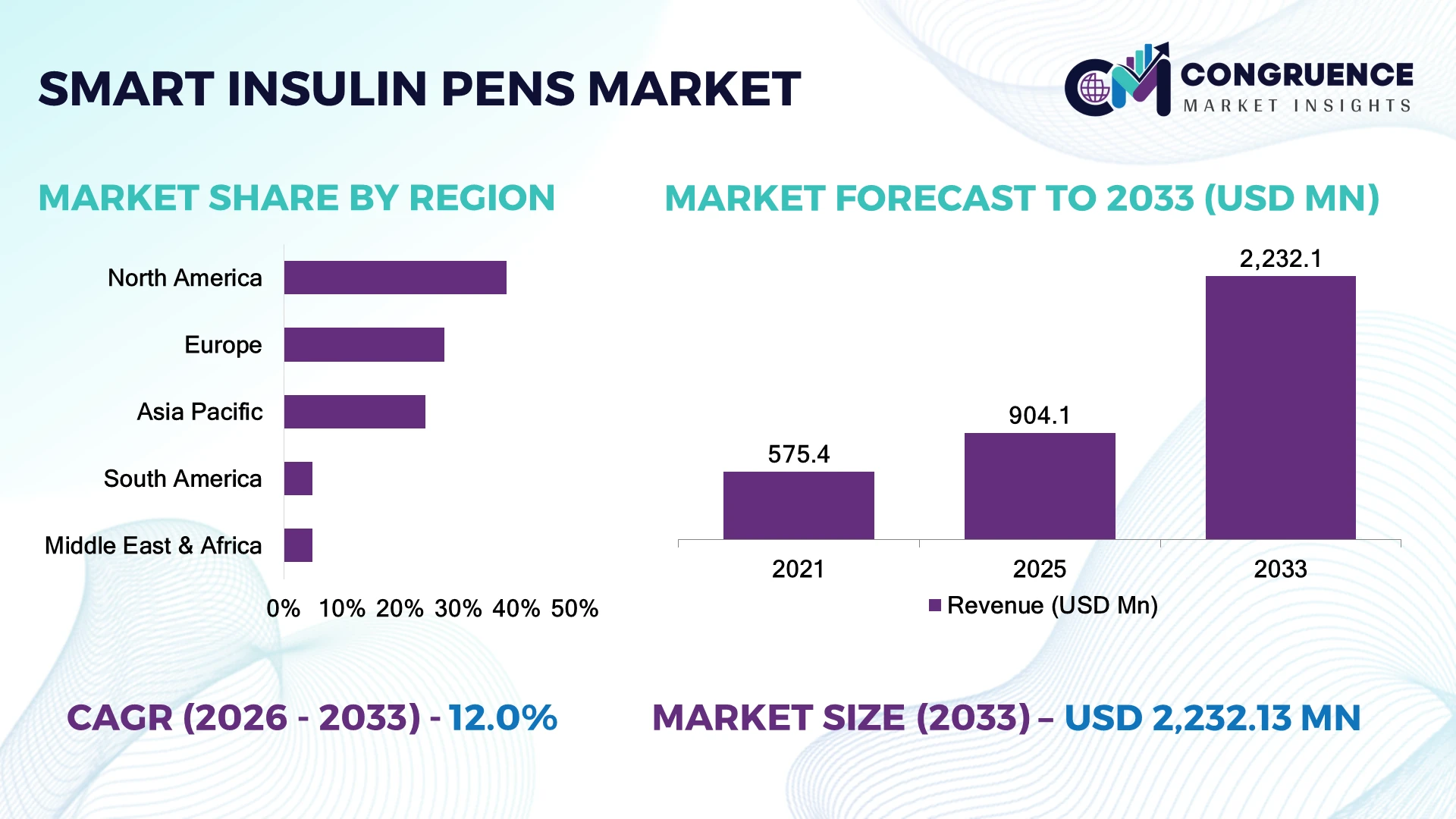
The United States dominates, with North America representing approximately 38.1% of global smart insulin pen market value in 2025, supported by established digital-health infrastructure, reimbursement pathways, and connected-device adoption. By contrast, Asia-Pacific is the fastest-growing regional market, with adoption increasingly supported by healthcare digitization in China, Japan, India, and South Korea. Bluetooth-enabled products already account for 70.62% of the market, demonstrating the central role of connected technology. Novo Nordisk's USD 4.1 billion North Carolina manufacturing investment further strengthens U.S. injectable-product capacity and supply-chain localization.
Strategic implication companies should prioritize interoperable smart-pen ecosystems, cybersecurity, CGM integration, and localized manufacturing rather than competing solely on injection-device hardware.
Market Size & Growth: USD 904.1 million in 2025 is projected to reach USD 2,232.1 million by 2033 at an 11.96% CAGR, supported by connected dosing, CGM integration, and digital diabetes-management platforms.
Top Growth Drivers: 70.62% Bluetooth connectivity, 68.12% Type 2 diabetes, and 51.72% hospitals and clinics identify the strongest technology, indication, and deployment pillars.
Short-Term Forecast: By 2028, connected dose-management workflows are positioned to improve medication visibility and reduce avoidable missed-dose events by approximately 5–10% as automated reminders and data synchronization become standard.
Emerging Technologies: AI-based dose guidance, Bluetooth/NFC connectivity, and CGM-linked analytics are transforming smart pens from passive dose-loggers into connected decision-support platforms.
Regional Leaders: North America remains the largest market, while Europe maintains a strong installed base and Asia-Pacific records the fastest 13.18% growth trajectory, driven by digital-health deployment and expanding diabetes-care infrastructure.
Consumer/End-User Trends: Hospitals and clinics represented 51.72% of end-user demand in 2025, while home-care applications are accelerating as connected monitoring moves routine insulin management outside clinical settings.
Pilot/Case Example: A 2024 real-world analysis covering 3,945 adults across 16 countries found a 17.6% probability of at least one missed basal dose over 14 days, demonstrating the measurable value of smart dose tracking.
Competitive Landscape: Novo Nordisk, Medtronic, and Abbott collectively account for approximately 65% of the market, with Biocorp, pendiq, Emperra, and Sanofi competing through differentiated connected-device platforms.
Regulatory & ESG Impact: The 2025 FDA alert places greater emphasis on smartphone compatibility, cybersecurity, and reliable notifications, pushing manufacturers toward continuous software validation and safer connected-device architectures.
Investment & Funding: Novo Nordisk committed USD 4.1 billion to expand its Clayton, North Carolina manufacturing facility, adding 1,000 jobs and strengthening U.S. production capacity for injectable treatments.
Innovation & Future Outlook: Next-generation platforms will combine AI, CGM synchronization, predictive analytics, and remote monitoring, shifting competition from standalone pens toward integrated digital diabetes ecosystems.
The Smart Insulin Pens Market is moving toward data-driven insulin management, with demand concentrated around connected dose tracking, CGM synchronization, automated reminders, and personalized therapy support. Bluetooth-enabled devices represented 70.62% of the market in 2025, while real-world evidence shows that missed insulin doses can materially reduce glucose time-in-range. Supply-chain localization is also becoming more important as major manufacturers expand U.S. production capacity, while regulatory scrutiny is pushing developers toward safer and more reliable smartphone-connected architectures.
Smart insulin pens are becoming strategically important because they transform conventional insulin delivery into a connected data-generation point within diabetes-care ecosystems. Manufacturers can differentiate through dose intelligence, adherence analytics, CGM integration, and clinician connectivity rather than hardware alone. Real-world data from 3,945 adults across 16 countries showed that missing one basal insulin dose was associated with a 2.8-percentage-point reduction in time-in-range, establishing a measurable clinical rationale for accurate dose tracking.
Technology adoption is also changing the efficiency profile of insulin management. Conventional pens require manual recording or retrospective patient reporting, whereas connected pens automatically capture dose timing and quantity, reducing documentation friction and improving clinician visibility. Bluetooth already represents 70.62% of connectivity demand, while multi-protocol platforms are emerging as the next interoperability layer.
Regional strategies differ sharply. The U.S. benefits from mature digital-health infrastructure and reimbursement mechanisms, while China and India offer larger expansion opportunities but require stronger affordability, connectivity, and distribution models. Over the next 2–3 years, companies are expected to increase partnerships linking pens with CGMs, diabetes applications, and remote-care platforms. Novo Nordisk's USD 4.1 billion North Carolina expansion demonstrates how manufacturers are simultaneously strengthening production capacity and supply-chain resilience. The strategic priority is clear: competitive advantage will increasingly depend on interoperable ecosystems, dependable data infrastructure, and scalable deployment rather than pen hardware alone.
The primary growth driver is the shift from manual insulin tracking toward automated dose intelligence. Bluetooth-enabled smart pens accounted for 70.62% of the market in 2025, while Type 2 diabetes represented 68.12%, creating a large addressable base for connected injection management. Hospitals and clinics contributed 51.72%, reinforcing institutional demand for better adherence visibility. The cause-effect mechanism is direct: automatic dose capture improves treatment visibility, which supports more informed clinical intervention and reduces dependence on patient recall. The February 2025 FDA smartphone-alert communication is further increasing emphasis on reliable connected-device architecture. Companies are responding through CGM partnerships, Bluetooth-enabled platforms, software investment, and expanded connected-device portfolios. The non-obvious advantage is data continuity, which turns each injection into a longitudinal clinical information point.
Device affordability and interoperability remain immediate barriers to broader deployment. Although Bluetooth systems command 70.62% share, fragmented software environments and varying smartphone compatibility can increase implementation complexity. The FDA reported that smartphone settings, operating-system updates, notification permissions, and connected accessories can interfere with critical diabetes-device alerts, exposing manufacturers to additional validation and support requirements. These issues increase deployment costs and can slow institutional procurement, particularly where reimbursement for connected features remains limited. In the U.S., manufacturers are responding with insurer coverage expansion and tighter software testing, while international suppliers are diversifying technology architectures. The key operational constraint is not the pen itself but the digital compatibility layer surrounding it. Companies that standardize APIs, strengthen device certification, and maintain multi-platform compatibility can reduce support costs and improve scalability.
The strongest opportunity lies in combining smart pens with AI analytics, CGM data, and personalized dose-support systems. Multi-protocol connectivity is projected to expand at 14.09%, while home-care settings are projected to grow at 14.76%, highlighting the shift toward integrated and decentralized diabetes management. A major opportunity exists in markets such as India and China, where large diabetes populations create substantial demand but affordability and access remain uneven. Companies can address this gap through lower-cost smart attachments, cloud-based monitoring, pharmacy partnerships, and localized manufacturing. AI can also extract greater value from existing injection data by identifying adherence patterns rather than simply recording doses. The non-obvious opportunity is therefore software monetization around installed hardware. Device manufacturers that establish interoperable analytics ecosystems can create recurring digital-service value while expanding the practical utility of every connected pen.
Long-term competitiveness depends on solving integration, cybersecurity, and deployment-consistency challenges across fragmented diabetes ecosystems. Real-world evidence from 3,945 users demonstrates the scale of data generated by smart-pen workflows, while the FDA's 2025 communication highlights how smartphone configuration changes can disrupt critical alerts. As smart pens increasingly interact with CGMs, mobile applications, cloud platforms, and clinician systems, cybersecurity and interoperability become persistent operational requirements rather than optional features. Companies must also maintain compatibility across rapidly changing smartphone operating systems, increasing software-validation workloads. The long-term pressure is therefore ecosystem complexity, not merely device manufacturing capacity. Manufacturers are investing in secure software development, continuous compatibility testing, platform partnerships, and standardized data interfaces. Strategic winners will be those capable of maintaining reliable data flows across the entire insulin-management chain while keeping deployment simple for patients and clinicians.
Connected Workflow Consolidation: Smart-pen ecosystems are shifting from standalone dose logging toward integrated CGM and mobile workflows, with Bluetooth-enabled devices accounting for 70.62% of the market and multi-protocol platforms advancing at 14.09%. U.S. providers are increasingly linking dose records with glucose dashboards, while manufacturers prioritize interoperability partnerships and software integration. The operational impact is stronger data continuity and less manual reconciliation; the non-obvious shift is that software compatibility is becoming a procurement criterion alongside injection accuracy.
Home-Based Care Expansion: Diabetes management is moving steadily into home settings, with hospitals and clinics still holding 51.72% share while home-care deployment records the fastest 14.76% expansion. Telehealth, remote monitoring, and pharmacy-based fulfillment are reducing dependence on routine facility visits, particularly in the U.S. and India. Manufacturers are responding with patient-support programs and connected platforms designed for decentralized workflows, improving clinician visibility without adding equivalent in-person service costs.
Smarter Dose Personalization: AI-assisted dosing, missed-dose alerts, and CGM-linked recommendations are becoming practical product features rather than experimental concepts. A real-world InPen analysis found 5.0% higher time-in-range among patients with the poorest baseline control, equivalent to 1.2 additional hours daily. Companies are therefore moving beyond simple memory functions toward algorithm-supported therapy management, increasing the clinical value captured from every injection event.
Regulatory Reliability Focus: Smartphone-dependent diabetes devices face greater scrutiny following the 2025 FDA warning concerning missed safety alerts caused by phone settings. This is accelerating validation of notification behavior, operating-system compatibility, and cybersecurity controls. Manufacturers are increasing software-testing coverage and strengthening device-app architectures, while healthcare buyers are placing greater emphasis on dependable alerts. The immediate business effect is higher development discipline and testing expenditure, but stronger reliability reduces deployment disruption and post-market support pressure.
First Generation Pens remain commercially important because they provide simpler dose-memory and connectivity functionality with lower implementation complexity, while Second Generation Pens are becoming the strategic growth engine through Bluetooth connectivity, real-time data sharing, and integration with diabetes applications. Current market assessments place First Generation Pens at roughly 60–65% in several country-level markets, while Second Generation platforms account for approximately 35–40% and are expanding faster. Saudi Arabia illustrates the mature institutional preference: First Generation platforms represented 62.67% of its product-type market in 2025, supported by centralized procurement and long battery life.
The balance is nevertheless shifting as U.S. and European providers increasingly prioritize integrated data workflows. Second Generation systems offer stronger clinical-data interoperability, although they carry higher software and connectivity requirements. Companies are consequently maintaining First Generation portfolios for cost-sensitive procurement while investing disproportionately in Bluetooth-enabled Second Generation platforms. This creates a two-tier competitive structure: reliable basic connectivity for scale and advanced integration for premium clinical workflows. The strategic implication is that manufacturers need both affordability and digital depth rather than replacing mature platforms prematurely.
Type 2 Diabetes is the leading application, representing approximately 68.12% of global smart insulin pen demand in 2025. Its dominance reflects the much larger insulin-treated patient population and increasing progression toward insulin therapy. By comparison, Type 1 Diabetes represents a smaller installed base but has more intensive smart-pen engagement because patients require frequent dosing and close glucose monitoring. Type 1 therefore remains strategically important for advanced connected platforms, with the segment positioned for faster technology-led adoption.
The distinction is increasingly shaping product positioning. Type 2 applications emphasize simplicity, adherence support, and dose reminders, while Type 1 deployments prioritize CGM synchronization, correction-dose calculations, and detailed insulin analytics. Approximately 70% Bluetooth penetration reinforces the importance of connected workflows across both applications. Manufacturers are adapting through differentiated software algorithms, CGM partnerships, and simplified onboarding. The business implication is a broader addressable market without sacrificing premium clinical applications: Type 2 delivers volume, while Type 1 drives higher digital engagement and advanced functionality.
Hospitals & Clinics remain the dominant end-user group, accounting for approximately 51.72% of market share in 2025. Their position reflects structured diabetes-management programs, specialist oversight, bulk procurement, and the role of clinicians in initiating connected insulin therapy. Ambulatory Surgical Centers represent a smaller deployment base, while Home Care Settings are expanding fastest as chronic diabetes management shifts away from facility-based care. Home-care adoption is projected to advance at approximately 14.76%, materially exceeding the established institutional growth profile.
The buying model is consequently changing. Hospitals continue prioritizing standardized platforms and clinical interoperability, whereas home-care users favor portability, automated reminders, simple interfaces, and remote clinician connectivity. The transition is particularly visible in India, where hospital-initiated connected-pen use is increasingly extending into home management. Companies are responding with remote-monitoring partnerships, patient onboarding services, pharmacy distribution, and app-based support. The strategic implication is a shift from institutional device sales toward continuity-of-care ecosystems, where the provider remains connected after the patient leaves the facility.
North America accounted for the largest market share at 38.2% in 2025 however, Asia-Pacific is expected to register the fastest growth, expanding at a CAGR of 13.18% between 2026 and 2033.
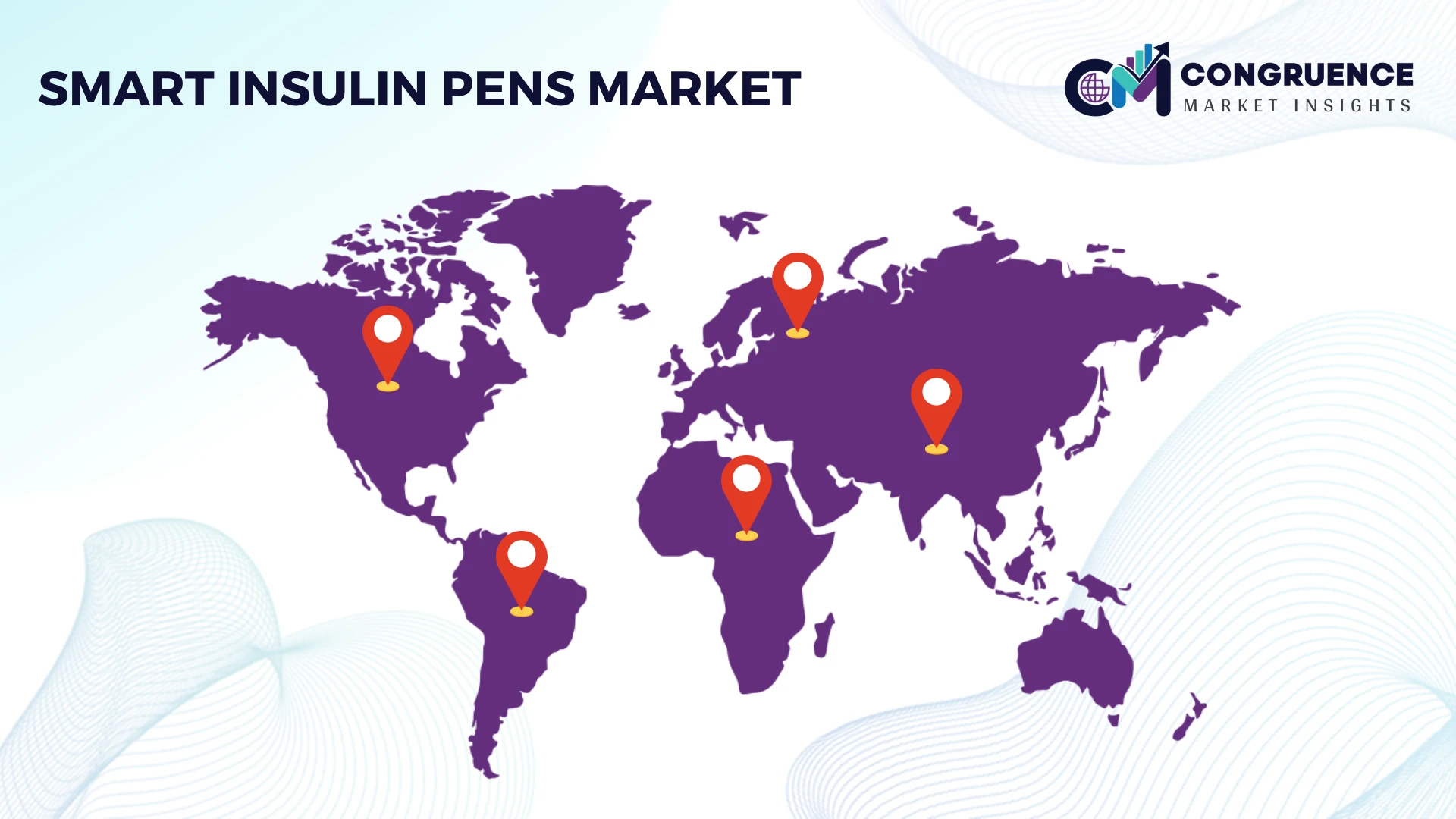
North America remains the leading smart insulin pens market, supported by concentrated deployment across U.S. endocrinology practices, integrated diabetes centers, and digitally enabled home-care programs. The region represented approximately 38.2% of global market share in 2025, with the United States accounting for the overwhelming majority of regional demand. Commercial reimbursement is becoming an important deployment catalyst as manufacturers move connected pens from specialist use toward broader outpatient prescribing. Medtronic's InPen ecosystem combines dose tracking, reminders, and glucose-data integration, while U.S. commercial-insurance coverage has expanded access. The region's advantage is increasingly shifting from device availability to reimbursement depth and interoperability, giving established manufacturers stronger recurring-patient access.
United States Market Outlook: The United States is the region's principal technology and commercialization hub, combining advanced CGM penetration, established insulin-delivery infrastructure, FDA device pathways, and strong manufacturer presence. Medtronic's InPen supports 0.5-unit dose increments and integrates with glucose-monitoring technology, while insurance-supported pricing programs are broadening access beyond early adopters.
Europe accounted for approximately 27.6% of the global smart insulin pens market in 2025, with Germany and the United Kingdom forming major national demand centers. Adoption is being shaped less by basic device availability and more by national reimbursement structures, digital-health regulation, and integration into public diabetes-care pathways. Germany's digital-health framework has created a formal route for connected diabetes applications, while the United Kingdom benefits from centralized clinical procurement and established diabetes-technology programs. The European diabetes technology landscape is also broadening: IDF Europe tracks connected smart pens alongside conventional insulin pens and pumps across national markets. This creates a commercially attractive but fragmented environment in which manufacturers must localize reimbursement strategies and clinical evidence rather than rely on a single regional launch model.
Germany Market Outlook: Germany is strategically significant because of its mature healthcare infrastructure and structured digital-health reimbursement environment. The country's Digitale Gesundheitsanwendungen framework provides an established mechanism for qualifying digital diabetes solutions to enter statutory reimbursement pathways. In 2025, reimbursement progress for connected diabetes platforms strengthened Germany's position as a European commercialization and regulatory reference market.
Asia-Pacific represents approximately 24.3% of the global market on 2025 estimates and is the strongest high-growth deployment zone, led by China, Japan, India, South Korea, and Australia. China and India provide exceptional patient-scale potential, while Japan and South Korea offer stronger technology adoption and structured healthcare infrastructure. India's smart insulin pen market was estimated at approximately USD 22.05 million in 2025, while Japan reached about USD 30.42 million, illustrating the contrast between emerging scale and mature technology adoption. Manufacturers are increasingly combining local distribution, digital-health partnerships, and affordability initiatives to penetrate fragmented healthcare systems. The strategic shift is from premium-device commercialization toward scalable connected-care models capable of serving both specialist centers and increasingly digitized home-care environments.
China Market Outlook: China is the most strategically significant APAC market because of its enormous diabetes population, expanding digital-health infrastructure, and growing domestic medical-device capabilities. China and India together represent more than one-third of the global diabetes population, creating substantial addressable demand. Manufacturers are increasingly prioritizing local regulatory registration, domestic partnerships, and price-sensitive product configurations to improve commercial scalability.
South America remains an earlier-stage smart insulin pen market represents approximately 5.0% of the global market, with Brazil serving as the principal commercial and healthcare-infrastructure hub. Adoption is concentrated in private hospitals, specialist endocrinology networks, and higher-income urban populations where connected diabetes technologies can be integrated with smartphone-based monitoring. Compared with North America and Western Europe, reimbursement fragmentation and uneven specialist coverage constrain deployment consistency, while imported electronic components expose suppliers to currency and procurement volatility. Brazil's large diabetes-care base nevertheless provides a strong platform for connected injection technologies as private providers modernize chronic-disease workflows. Companies are responding through distributor partnerships, localized clinical education, and tiered pricing rather than relying exclusively on premium direct sales. The strategic opportunity is to establish interoperable platforms through Brazil first and subsequently extend distribution into Mexico, Argentina, and other Latin American markets.
Brazil Market Outlook: Brazil offers the strongest combination of population scale, private healthcare infrastructure, specialist diabetes services, and pharmaceutical distribution capacity in South America. Its importance is reinforced by the presence of established multinational healthcare companies and expanding digital-health adoption. Manufacturers can improve penetration through partnerships with private hospital groups and regional distributors while adapting pricing to reimbursement and affordability constraints.
Middle East & Africa remains an emerging smart insulin pen market, accounting for approximately 4.9% of global market value in 2025 in one regional assessment. Adoption is concentrated in wealthier Gulf healthcare systems, particularly Saudi Arabia and the UAE, where government-backed healthcare modernization, specialist diabetes centers, and digital transformation programs support advanced device deployment. By contrast, many African markets continue to face affordability, specialist-access, and distribution constraints. This creates a two-speed market: premium connected-device adoption in Gulf countries alongside basic insulin-delivery requirements in underserved markets. Companies are therefore emphasizing hospital partnerships, distributor-led access, clinician training, and selective premium deployment rather than broad simultaneous launches. The strategic advantage lies in integrating smart pens with existing digital hospital infrastructure rather than treating them as standalone injection products.
Saudi Arabia Market Outlook: Saudi Arabia is the region's most strategically significant market because healthcare modernization is increasingly centered on advanced chronic-disease management and digitally enabled specialist care. The country's investment in healthcare infrastructure supports adoption of connected diabetes technologies in major hospitals and specialty centers. Manufacturers are positioning through institutional partnerships, clinician education, and integrated monitoring solutions, creating a stronger pathway for smart-pen deployment than fragmented retail-only models.
Medtronic, Novo Nordisk, Abbott, Eli Lilly, and Biocorp lead competition, with global insulin manufacturers competing against connected-device specialists on ecosystem depth, while regional players target affordability and customization. The top five collectively command approximately 65%, creating a concentrated market. Medtronic holds over 30%, while Bluetooth-enabled connectivity represents about 70.6% of demand, making interoperability a decisive technology battleground. Novo Nordisk differentiates through smart-pen and CGM integrations, while Medtronic combines InPen with Simplera CGM and personalized dosing guidance. Novo Nordisk has partnered with 5 leading glucose-monitoring companies, expanding data interoperability. The competitive shift is moving from standalone injection hardware toward integrated digital-care ecosystems, increasing pressure on smaller manufacturers to secure technology partnerships. High regulatory requirements, clinical validation, reimbursement access, and interoperability create significant entry barriers. Cost-focused regional suppliers retain an advantage where premium connected platforms face affordability constraints. Winning requires scalable manufacturing, interoperable software, strong clinical evidence, and partnerships spanning insulin, CGM, and digital-health ecosystems.
Novo Nordisk A/S
Abbott Laboratories
Eli Lilly and Company
Biocorp
Emperra GmbH
Digital Medics GmbH
Ypsomed AG
Roche Diabetes Care
Sanofi S.A.
Embecta Corp.
Jiangsu Delfu Medical Device Co.
Bigfoot Biomedical
Smart insulin pens are shifting from passive dose-memory devices toward connected therapy platforms. Bluetooth remains the dominant connectivity architecture at approximately 70.6%, while NFC-based systems retain value for low-power data transfer. NovoPen 6 and NovoPen Echo Plus can store 800 doses, equivalent to at least three months of injection history, while transferring data into compatible diabetes applications. This improves dose visibility versus manual logging and strengthens clinician decision-making.
AI-enabled dose guidance is becoming the disruptive layer. Medtronic's Smart MDI combines InPen with Simplera CGM to provide real-time dosing insights, including missed-dose detection. Its CGM measures glucose every 5 minutes, while the i-Port Advance system reduces needle punctures by 93% compared with conventional injections. This integration gives ecosystem leaders an advantage by combining insulin, glucose, and decision-support data rather than selling an isolated pen.
Between 2026 and 2028, interoperability, predictive analytics, and automated therapy recommendations will increasingly determine product differentiation. Novo Nordisk has established non-exclusive data exchanges with 5 major glucose-monitoring companies, demonstrating the strategic shift toward open digital ecosystems. Companies with legacy pens must add connected capabilities, while CGM and digital-health leaders gain opportunities to enter insulin-delivery workflows.
November 2024 — Medtronic received FDA clearance for its updated InPen app, enabling missed-meal-dose detection and preparing the Smart MDI combination with Simplera CGM. The system targets an estimated 1-in-3 missed-dose problem, strengthening Medtronic's connected insulin-management position. Source: medtronic.com
August 2024 — Medtronic secured FDA approval for Simplera CGM and announced a global partnership with Abbott, creating a pathway for broader connected diabetes-device interoperability. The partnership expands CGM choice while supporting future InPen integration and strengthens Medtronic's Smart MDI ecosystem. Source: medtronic.com
2025 — Novo Nordisk expanded smart-pen interoperability through integrations with glucose-monitoring platforms including Dexcom, Glooko, FreeStyle LibreLink, and mySugr. Its smart pens store 800 doses, enabling longitudinal injection tracking and supporting data-driven clinical consultations. The expansion strengthens Novo Nordisk's position across connected diabetes-management ecosystems. Source: novonordisk.com
2025 — Biocorp continued commercial deployment of Mallya, its reusable smart cap that automatically captures insulin dose, date, and time with near-100% accuracy and transfers information through Bluetooth. The device's 2-year reusable design strengthens Biocorp's differentiation by converting existing disposable pens into connected devices. Source: biocorpsys.com
The Smart Insulin Pens Market Report covers product segmentation across First Generation Pens and Second Generation Pens, applications spanning Type 1 and Type 2 Diabetes, and end-users including Hospitals & Clinics, Ambulatory Surgical Centers, and Home Care Settings. The analysis evaluates connected-device architecture, Bluetooth and NFC integration, dose-memory functionality, CGM interoperability, mobile applications, automated reminders, and emerging AI-enabled dosing capabilities.
Geographic coverage includes North America, Europe, Asia-Pacific, South America, and Middle East & Africa, with country-level assessment of the United States, Germany, China, India, Japan, Brazil, and Saudi Arabia. The report examines competitive positioning across established insulin manufacturers, diabetes-technology companies, and connected-device specialists, supporting investment planning, market-entry decisions, partnership strategy, product localization, supply-chain development, and competitive positioning through 2026–2033.
| Report Attribute / Metric | Details |
|---|---|
| Market Revenue (2025) | USD 904.1 Million |
| Market Revenue (2033) | USD 2,232.1 Million |
| CAGR (2026–2033) | 11.96% |
| Base Year | 2025 |
| Forecast Period | 2026–2033 |
| Historic Period | 2021–2025 |
| Segments Covered |
By Type
By Application
By End-User
|
| Key Deliverables | Revenue Forecast; Market Trends; Growth Drivers & Restraints; Technology Insights; Segmentation Analysis; Regional Insights; Competitive Landscape; Regulatory & ESG Overview; Recent Developments |
| Regions Covered | North America; Europe; Asia-Pacific; South America; Middle East & Africa |
| Companies Profiled | Medtronic plc; Novo Nordisk A/S; Abbott Laboratories; Eli Lilly and Company; Biocorp; Emperra GmbH; Digital Medics GmbH; Ypsomed AG; Roche Diabetes Care; Sanofi S.A.; Embecta Corp.; Jiangsu Delfu Medical Device Co.; Bigfoot Biomedical; DiabNext |
| Customization & Pricing | Available on Request (10% Customization Free) |




