
Reports
The Global Smart Inhalers Market was valued at USD 280.4 Million in 2025 and is anticipated to reach a value of USD 1,150.5 Million by 2033 expanding at a CAGR of 19.3% between 2026 and 2033. Growth is being driven by electronic adherence monitoring, connected respiratory-care pathways, inhalation-technique feedback, and integration of smart inhalers with remote clinical-management platforms.
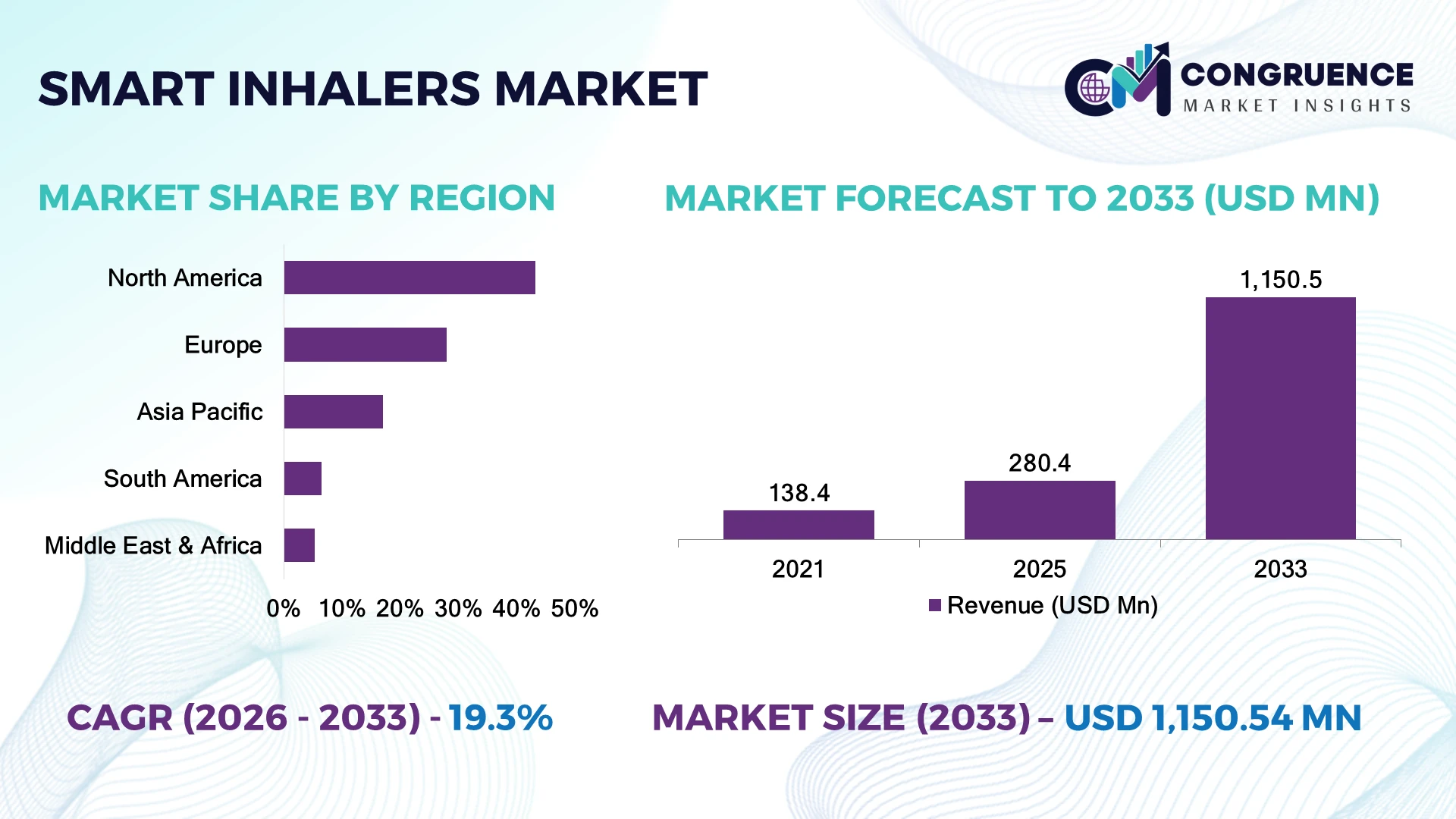
The United States remains the dominant country market, supported by advanced respiratory-care infrastructure, pharmaceutical innovation, digital-health investment, and established connected-device ecosystems. Approximately 630 million inhalers are prescribed globally each year, highlighting the scale of the addressable medication-management workflow. Europe is advancing rapidly through structured digital-health deployment, while U.S. healthcare systems maintain stronger commercialization and technology integration. Geopolitical supply-chain restructuring is also encouraging manufacturers to diversify electronic sensors, connectivity components, and device manufacturing.
Strategically, winning platforms will combine clinically validated adherence improvement with interoperable connectivity, scalable analytics, and commercially viable device integration.
Market Size & Growth: USD 280.4 million in 2025 to USD 1,150.5 million by 2033 at 19.3% CAGR, supported by connected adherence monitoring and digital respiratory care.
Top Growth Drivers: Electronic adherence monitoring 18%, remote intervention 17.8%, smartphone integration 14%.
Short-Term Forecast: By 2028, digital intervention programs are positioned to deliver 10%–18% higher adherence versus passive monitoring, strengthening measurable clinical engagement.
Emerging Technologies: Bluetooth sensors, inhalation-flow monitoring, AI adherence analytics, and app-based behavioral feedback are expanding smart inhaler functionality.
Regional Leaders: North America is projected at approximately USD 520 million, Europe at USD 310 million, and Asia-Pacific at USD 230 million by 2033, with connected respiratory-care adoption accelerating across developed healthcare systems.
Consumer/End-User Trends: 85% of evaluated COPD users considered digital platforms convenient, while 91% regarded inhaler reminders as helpful.
Pilot/Case Example: A 2025 Dutch primary-care trial recorded 71.4% medication adherence among digital-inhaler users versus 59.9% under passive monitoring.
Competitive Landscape: Leading positions are concentrated among Propeller Health, Aptar Digital Health, Adherium, Teva, and AstraZeneca, combining device, software, and pharmaceutical capabilities.
Regulatory & ESG Impact: Digital monitoring is shifting respiratory care toward remote intervention, while 14% of evaluated users reported technical issues, emphasizing usability and device reliability.
Investment & Funding: Investment is increasingly directed toward sensor miniaturization, AI analytics, clinical validation, software integration, and pharmaceutical-device partnerships.
Innovation & Future Outlook: 2026–2028 competition will center on predictive adherence analytics, inhalation-technique feedback, interoperable health-data platforms, and integrated respiratory-care ecosystems.
Smart inhalers are evolving from dose-reminder devices into connected medication-management platforms. Approximately 630 million inhalers are prescribed globally each year, creating a large operational base for electronic adherence monitoring. Clinical evidence shows that healthcare-provider intervention combined with electronic monitoring can improve adherence by about 18% versus passive monitoring, while technical usability remains a key commercialization consideration. The next strategic phase centers on converting inhaler-generated data into actionable respiratory-care interventions.
Smart inhalers are becoming strategically important because respiratory-care providers are moving from episodic medication management toward measurable adherence, technique assessment, and remote intervention. The competitive value increasingly lies in the data layer surrounding the inhaler rather than the sensor alone. This shift is strengthening partnerships among pharmaceutical companies, digital-health developers, device manufacturers, and healthcare providers.
Technology performance is becoming commercially measurable. A 2024 systematic review found that healthcare-provider interventions combined with electronic monitoring improved mean adherence by 18% compared with passive electronic monitoring. By contrast, passive monitoring primarily identifies behavior without consistently changing it. A 2025 Dutch primary-care trial recorded 71.4% adherence with active digital support versus 59.9% under passive monitoring, demonstrating the stronger value of intervention-enabled platforms.
Over the next 2–3 years, sensor miniaturization, AI-based adherence prediction, real-time inhalation-technique assessment, and interoperability with clinical systems will become increasingly important. North America is positioned around commercialization and digital-health integration, while Europe emphasizes structured clinical deployment. Companies are therefore prioritizing clinical validation, pharmaceutical partnerships, software integration, and reimbursement evidence. The strongest competitive position will belong to platforms that translate inhaler data into measurable clinical and operational outcomes at scalable cost.
Digital adherence monitoring is becoming the strongest structural driver as healthcare systems shift from episodic respiratory treatment toward measurable medication behavior. In the 2025 ACCEPTANCE trial, active digital-inhaler support produced 71.4% adherence versus 59.9% with passive monitoring, a 19.2% relative improvement. Smartphone-linked reminders and clinician dashboards are therefore moving from pilot features toward integrated respiratory workflows. In the United States, pharmaceutical and device companies are pairing sensors with established inhaler platforms to reduce development friction and accelerate commercialization. Companies are responding through software partnerships, sensor miniaturization, and combination-device development. The non-obvious advantage is data continuity: manufacturers that control longitudinal adherence data can strengthen both clinical evidence and payer negotiations.
Smart inhalers face structural pressure from incremental hardware costs, fragmented software ecosystems, and inconsistent clinical integration. Device programs can require additional sensors, connectivity components, applications, and clinician dashboards, increasing procurement complexity by roughly 10%–20% versus conventional inhaler workflows. Usability remains another constraint: the 2025 ACCEPTANCE trial recorded a strong system usability score of 80.1, but technical and behavioral friction still affected sustained engagement. Interoperability between device platforms and electronic health records remains uneven, particularly across U.S. healthcare networks. These limitations increase implementation costs and slow large-scale deployment. Manufacturers are responding with Bluetooth Low Energy architectures, retrofit sensor designs, standardized APIs, and pharmaceutical partnerships that spread development costs across established drug portfolios.
The next opportunity is converting inhaler-generated data into predictive clinical intelligence. AI models can combine dose timing, inhalation behavior, symptoms, and environmental exposure to identify adherence deterioration before treatment failure becomes clinically visible. Digital interventions have already demonstrated adherence improvements of more than 19% in controlled primary-care deployment, creating a measurable commercial basis for escalation. By 2028, predictive alerts and automated coaching could shift 15%–20% of connected-inhaler workflows toward proactive intervention rather than retrospective reporting. India, China, and other high-volume respiratory-care markets offer particularly important opportunities as smartphone-enabled monitoring expands without requiring frequent clinic visits. Companies are investing in AI analytics, cloud platforms, and localized partnerships, positioning smart inhalers as recurring digital-care infrastructure rather than standalone medical hardware.
Long-term competitiveness depends on reliably processing high-frequency device data across fragmented clinical environments. Large deployments can generate thousands of adherence and actuation records per patient annually, creating requirements for secure storage, interoperability, cybersecurity, and clinician workflow integration. Approximately 20% of pediatric participants in one 2025 smart-inhaler study demonstrated both good adherence and good inhalation technique, underscoring the difficulty of interpreting adherence data without contextual technique measurements. Regulatory expectations for connected medical devices also continue to evolve across the United States and Europe. Companies must therefore invest in validation, cybersecurity controls, clinical-data governance, and interoperable software architectures. The strategic pressure is clear: hardware scalability without scalable clinical-data infrastructure will limit deployment consistency and weaken the value proposition.
Active Intervention Replaces Passive Tracking Digital inhalers are shifting from simple dose logging toward intervention-based workflows. The 2025 ACCEPTANCE trial recorded 71.4% adherence with reminders and data feedback versus 59.9% under passive monitoring. Companies are prioritizing clinician dashboards and behavioral coaching because actionable data generates greater clinical value than monitoring alone.
Retrofit Sensors Accelerate Deployment Add-on sensor architectures are gaining traction because they connect established inhalers without redesigning the complete drug-delivery platform. Retrofit models can reduce hardware-development requirements by roughly 20%, while Bluetooth connectivity keeps power consumption low. Manufacturers are expanding compatible portfolios and partnering with pharmaceutical companies to accelerate installed-base conversion.
Technique Analytics Gains Importance Smart inhalers are increasingly measuring inhalation quality alongside adherence, addressing a hidden source of treatment failure. A controlled smart-spacer study reduced inhalation errors by 26.2% in its intervention group. Companies are integrating flow, actuation, and technique analytics to differentiate platforms beyond reminder functionality.
Homecare Becomes Data Hub Respiratory monitoring is moving closer to the patient's home as remote-care infrastructure expands. Connected platforms can capture daily medication behavior without routine clinic visits, reducing dependence on episodic assessments. By 2028, home-based workflows are positioned to account for a substantially larger share of connected monitoring activity, encouraging manufacturers to optimize apps, cloud analytics, and low-maintenance sensors.
Add-On Sensors Lead While Integrated Devices Gain Momentum
Add-on smart inhaler sensors represent the leading type, estimated at approximately 62% market share, because they can convert established pressurized metered-dose inhalers and dry-powder inhalers into connected platforms without redesigning the drug-delivery system. Their lower integration complexity, compatibility across established inhaler portfolios, and replacement flexibility support broader deployment. Integrated smart inhalers account for roughly 38% but represent the faster-moving technology segment as manufacturers pursue tighter sensor, dose-delivery, and connectivity integration. Add-on devices typically support 12–24 months of service life, while integrated systems face battery-life constraints linked to the inhaler lifecycle. Companies are therefore balancing retrofit scalability with proprietary integrated platforms.
The strategic shift is toward sensor architectures that capture not only actuation but also inhalation flow, timing, orientation, and technique. Pressure-based sensing remains mature, while acoustic and multi-parameter sensing are gaining relevance, with advanced platforms targeting approximately 15%–25% better technique-detection capability. Manufacturers are expanding compatibility, partnering with pharmaceutical developers, and investing in miniaturized electronics to improve differentiation and recurring digital-care value.
A 2025 review of commercial digital inhalers identified add-on and integrated devices as the two principal architectures, with pressure sensors commonly used for actuation and inhalation-effort monitoring while acoustic sensors increasingly assess inhalation technique.
Asthma Management Remains the Core Use Case
Asthma management is estimated to lead the smart inhalers market by application, representing approximately 58% of adoption, supported by medication-adherence monitoring, dose reminders, and inhalation-technique assessment. COPD management follows at around 30%, while other respiratory applications account for the remaining demand. The concentration reflects asthma’s large treated population and established maintenance-inhaler workflows. COPD is the fastest-growing application, driven by aging populations, recurrent exacerbations, and expanding remote chronic-care programs. Active digital intervention has demonstrated approximately 19% higher adherence than passive monitoring in clinical evaluation, strengthening the case for connected respiratory platforms. Manufacturers are integrating Bluetooth sensors, mobile applications, clinician dashboards, and automated alerts into established inhaler ecosystems.
Mature asthma deployments increasingly emphasize adherence analytics, whereas emerging COPD programs prioritize longitudinal monitoring and exacerbation-risk management. Companies are shifting investment toward interoperable software, clinical-data integration, and scalable patient-management platforms, making connected inhaler data increasingly operationally important to respiratory-care delivery.
The 2025 ACCEPTANCE randomized trial in Dutch primary care recorded 71.4% medication adherence among digital-intervention users versus 59.9% with passive monitoring, demonstrating a measurable adherence advantage from active smart-inhaler support.
Hospitals Lead as Homecare Accelerates
Hospitals and specialty respiratory-care centers are estimated to represent the leading end-user segment, accounting for approximately 48% of smart inhaler adoption. Their position reflects specialist workforce availability, electronic health-record infrastructure, structured respiratory programs, and capacity to interpret connected-device data. Home healthcare is the fastest-growing end-user group, approaching 30% of deployment as chronic respiratory monitoring moves beyond conventional clinic settings. Primary-care practices remain strategically important because they manage large asthma and COPD populations and can incorporate adherence data into routine treatment decisions.
Hospital deployments prioritize clinical integration, population monitoring, and structured intervention, while homecare emphasizes smartphone connectivity, automated reminders, patient engagement, and low-maintenance sensor architectures. Approximately 20%–25% of new platform development is increasingly oriented toward remote-care functionality. Companies are responding with modular systems that connect patient applications, clinician dashboards, and electronic records. The competitive implication is a transition from standalone device sales toward integrated respiratory-care ecosystems, with interoperability, usability, and longitudinal clinical data becoming central purchasing criteria.
A 2025 clinical study of children with uncontrolled asthma evaluated a smart inhaler across 34 participants, measuring both adherence and inhalation technique and demonstrating the expanding use of connected devices for technique-specific respiratory management.
North America accounted for the largest market share at 43.2% in 2025 however, Asia-Pacific is expected to register the fastest growth, expanding at a CAGR of 22.1% between 2026 and 2033.

Connected Respiratory Care Moves Into Routine Clinical Workflows
North America holds the largest position in the smart inhalers market, supported by advanced respiratory-care infrastructure, high digital-health penetration, pharmaceutical R&D concentration, and established reimbursement pathways. The United States represents the principal deployment center, with hospitals, specialty clinics, and technology-enabled primary-care networks increasingly incorporating adherence data into asthma and COPD management. Approximately 52% of regional demand is concentrated in the United States, reflecting its larger patient base and stronger commercialization environment. Digital inhaler programs are increasingly shifting from standalone adherence reminders toward clinician-facing analytics, remote monitoring, and inhalation-technique assessment. Companies are expanding connected-device portfolios, forming pharmaceutical-device partnerships, and integrating smart inhaler data with electronic clinical workflows. The regional competitive advantage increasingly depends on converting device-generated data into measurable clinical outcomes rather than simply adding connectivity.
United States Market Outlook: The United States remains the strategic center of smart inhaler commercialization because of its large respiratory patient population, advanced healthcare IT infrastructure, pharmaceutical ecosystem, and established digital therapeutics investment. More than 25 million Americans live with asthma, creating a substantial installed-base opportunity for connected medication management. Manufacturers are prioritizing FDA-aligned development, clinical validation, payer evidence, and integration with provider systems. The country's concentration of pharmaceutical companies and digital-health developers also supports faster partnerships between inhaler manufacturers and software providers.
Evidence-Based Digital Respiratory Management Gains Ground
Europe represents a mature smart inhaler market, with adoption concentrated across the United Kingdom, Germany, France, the Netherlands, and Nordic healthcare systems. Approximately 28% of global market demand is estimated to originate from the region, supported by structured primary-care networks and increasing emphasis on digital chronic-disease management. The Netherlands has demonstrated particularly strong clinical experimentation with connected inhalers, while Germany and the United Kingdom provide larger commercialization opportunities. European buyers increasingly evaluate usability, clinical evidence, interoperability, and health-economic outcomes alongside device performance. Companies are responding with interoperable platforms, localized clinical partnerships, and evidence-generation programs. Regulatory scrutiny around medical-device software and patient data is also pushing suppliers toward stronger cybersecurity and data-governance architectures.
United Kingdom Market Outlook: The United Kingdom is strategically important because of its centralized healthcare structure, extensive primary-care network, and established digital-health procurement mechanisms. Smart inhaler adoption benefits from the ability to connect respiratory monitoring with structured chronic-disease pathways rather than relying solely on individual physician adoption. Digital inhaler studies have demonstrated adherence improvements exceeding 10 percentage points in controlled settings, strengthening the evidence base for broader deployment. Manufacturers are increasingly targeting NHS-linked respiratory programs through clinical partnerships, interoperability, and health-economic validation.
Large Patient Pools Accelerate Connected-Care Adoption
Asia-Pacific is emerging as the fastest-expanding smart inhaler market as respiratory disease management intersects with smartphone penetration, telemedicine expansion, and healthcare digitization. China, Japan, South Korea, India, and Australia represent the principal commercialization centers, with China and Japan providing stronger technology infrastructure while India offers substantial volume potential. Approximately 17% of global smart inhaler demand is estimated to originate from the region. Smartphone-based respiratory monitoring is lowering the infrastructure threshold for connected care, particularly where specialist access remains uneven. Companies are adapting through lower-cost sensor architectures, localized applications, cloud-based monitoring, and partnerships with hospitals and pharmaceutical distributors. The strategic opportunity lies in scalable connected platforms rather than premium hardware alone.
China Market Outlook: China provides the region's strongest combination of manufacturing capability, digital-health infrastructure, pharmaceutical production, and large respiratory patient populations. Its extensive electronics supply chain supports lower-cost sensor integration and rapid hardware iteration, while widespread smartphone usage enables app-based adherence monitoring without complex standalone infrastructure. Companies are increasingly positioning localized software, compact Bluetooth-enabled sensors, and hospital partnerships for deployment. The country's manufacturing depth also creates an advantage in component sourcing and device assembly, helping suppliers pursue cost-sensitive healthcare systems across Asia.
Brazil Leads the Shift Toward Digitized Respiratory Management
South America remains an emerging smart inhaler market, with Brazil accounting for the largest commercial opportunity because of its population scale, established pharmaceutical distribution network, and expanding digital-health infrastructure. Approximately 7% of regional respiratory-care technology demand is estimated to involve connected monitoring solutions, leaving considerable headroom for smart inhaler penetration. Adoption is concentrated in major urban healthcare centers where specialist respiratory services and smartphone-enabled patient engagement are more established. Brazil's public and private healthcare systems create different procurement requirements, increasing the importance of flexible pricing and modular device architectures. Companies are emphasizing retrofit sensors, mobile applications, and partnerships with healthcare providers rather than high-cost fully integrated devices. Supply-chain localization and distributor networks remain important for maintaining affordability and deployment consistency.
Brazil Market Outlook: Brazil is the region's most strategically significant market because of its large patient population, pharmaceutical manufacturing base, expanding telehealth infrastructure, and concentration of specialist healthcare services in São Paulo, Rio de Janeiro, and other major urban centers. Digital respiratory programs can leverage high smartphone availability to reduce dependence on dedicated monitoring hardware. Manufacturers are increasingly pursuing distributor partnerships and localized patient-support models, while lower-cost add-on sensors provide a practical route into price-sensitive healthcare settings.
Healthcare Modernization Creates Premium Connected-Care Demand
The Middle East & Africa market is developing through healthcare modernization, hospital digitization, specialist-care expansion, and investment in connected medical technologies. The United Arab Emirates and Saudi Arabia represent the strongest commercial hubs, supported by advanced hospitals, digital-health programs, and comparatively high healthcare technology expenditure. Approximately 5% of regional respiratory-device demand is estimated to be connected or digitally enabled, indicating a developing but strategically important opportunity. Gulf healthcare systems are particularly suited to smart inhalers because centralized hospitals can integrate patient monitoring, medication adherence, and remote consultation workflows. Companies are responding through hospital partnerships, localized distribution, and premium connected-care platforms. The principal investment priority is interoperability with modern hospital information systems rather than standalone consumer applications.
Saudi Arabia Market Outlook: Saudi Arabia offers the strongest regional opportunity because healthcare transformation is accelerating investment in digital infrastructure, specialist hospitals, and remote patient management. Major urban centers such as Riyadh and Jeddah provide the infrastructure required for connected respiratory monitoring, while national healthcare modernization is increasing demand for digitally integrated medical devices. Smart inhalers can support medication adherence and remote follow-up without requiring frequent specialist visits. Manufacturers are therefore prioritizing hospital partnerships, Arabic-language digital interfaces, local distribution capabilities, and platforms compatible with emerging national healthcare-data infrastructure.
Aptar Pharma, Adherium, Propeller Health, Teva, and Amiko compete at the technology-led end, while H&T Presspart and FindAir target retrofit flexibility and cost-sensitive deployments. The top five players are estimated to hold a combined 45%–50% share. Competition centers on sensor accuracy, interoperability, device cost, and clinical evidence: advanced platforms command 10%–15% higher positioning, while retrofit architectures can reduce deployment complexity by 20%–30%.
Pharmaceutical companies compete through established inhaler portfolios, regulatory reach, and digital capabilities; technology specialists counter with software iteration, modular sensors, and healthcare partnerships. Adherium’s 2025 iCARE deployment of 4,000 devices illustrates scaling, while Amiko emphasizes automated sensor development. Competition is shifting from standalone hardware toward integrated data ecosystems, making interoperability the differentiator. Entry barriers remain high because clinical validation, regulatory clearance, cybersecurity, and pharmaceutical integration require specialized capital. Winning requires validated outcomes, broad inhaler compatibility, scalable data infrastructure, and partnerships that convert device data into reimbursable clinical value.
Adherium Limited
Aptar Pharma
Teva Pharmaceutical Industries Ltd.
Novartis AG
AstraZeneca plc
GlaxoSmithKline plc
Boehringer Ingelheim International GmbH
ResMed Inc. (Propeller Health)
Amiko Digital Health Limited
H&T Presspart Manufacturing Ltd.
FindAir Sp. z o.o.
Cognita Labs LLC
Current smart inhaler technology is moving from simple dose-event logging toward multi-parameter sensing. Bluetooth Low Energy, pressure sensors, acoustic sensing, and inspiratory-flow measurement capture timing, actuation, duration, and technique. Flow-enabled systems can deliver 15%–25% more actionable information than dose-only trackers, while automated data transfer reduces manual reporting workload by roughly 20%. Adoption is strongest in respiratory programs and clinical studies.
Emerging platforms integrate AI adherence analytics, predictive alerts, smartphone coaching, and electronic health-record connectivity. Amiko’s RS01X uses embedded sensing to measure inhalation duration, volume, and peak inspiratory flow, while clinical validation across 97 participants demonstrated agreement with laboratory measurements. Compared with legacy patient-reported adherence, automated sensing provides more granular behavior data and strengthens intervention timing. Technology-led suppliers benefit most because software, analytics, and sensor integration create differentiation beyond hardware.
Between 2026 and 2028, the disruptive shift will be toward inhalers functioning as continuous respiratory-data nodes. AI models will combine adherence, inhalation technique, environmental exposure, and symptom inputs to prioritize intervention. Pharmaceutical companies gain stronger real-world evidence, while healthcare providers gain remote monitoring. Manufacturers investing now in interoperable APIs, cybersecurity, low-power electronics, and validated analytics will shorten deployment cycles, improve engagement, and establish stronger platform lock-in as connected respiratory care becomes embedded.
October 2025 Adherium reported iCARE interim results after deploying 4,000 Hailie Smartinhalers across five Intermountain Health facilities, supporting up to 2,500 patients. The program strengthened evidence for adherence-focused respiratory care and expanded commercial validation of connected inhaler platforms. Source: adherium.com
July 2025 Amiko reported development of connected inhaler sensors through ARTES 4.0 and PNRR backing, achieving up to 40% shorter development time through CFD simulation and automation. The investment accelerates sensor commercialization and strengthens Italy’s respiratory-device innovation ecosystem. Source: amiko.io
November 2025 Aptar Pharma introduced its Orbital DPI platform for 100–400 mg pulmonary drug payloads, combining advanced aerosolization with digital counters and sensor integration. The platform expands connected-device opportunities for high-dose therapies, including biologics and complex respiratory formulations. Source: aptar.com
November 2025 NICE assessed digital asthma technologies including Aptar Digital Health’s respiratory platform, listing £116.42 upfront hardware cost and £187.46 patient cost. The assessment strengthens evidence-based procurement scrutiny for connected inhaler technologies in UK healthcare and adoption decisions. Source: nice.org.uk
The Smart Inhalers Market Report evaluates connected respiratory devices across Metered Dose Inhalers (MDIs) and Dry Powder Inhalers (DPIs), with application analysis covering asthma, COPD, and other respiratory indications. It assesses hospital pharmacies, retail pharmacies, online pharmacies, hospitals, homecare settings, and other relevant channels and end-user environments. Coverage extends across North America, Europe, Asia-Pacific, South America, and Middle East & Africa, with country-level analysis for major adoption centers.
The report examines sensor architectures, Bluetooth connectivity, inhalation-flow measurement, AI adherence analytics, remote patient monitoring, clinical-data interoperability, and emerging connected drug-delivery platforms. It benchmarks leading companies, technology positioning, deployment models, partnership strategies, and competitive differentiation. Quantitative analysis incorporates segment shares, adoption patterns, deployment intensity, and technology penetration indicators to support investment planning, market-entry decisions, product expansion, portfolio prioritization, partnership evaluation, and competitive positioning through 2026–2033.
| Report Attribute/Metric | Report Details |
|---|---|
|
Market Revenue in 2025 |
USD 280.4 Million |
|
Market Revenue in 2033 |
USD 1,150.5 Million |
|
CAGR (2026 - 2033) |
19.3% |
|
Base Year |
2025 |
|
Forecast Period |
2026 - 2033 |
|
Historic Period |
2021 - 2025 |
|
Segments Covered |
By Type
By Application
By End-User
|
|
Key Report Deliverable |
Revenue Forecast, Growth Trends, Market Dynamics, Segmental Overview, Regional and Country-wise Analysis, Competition Landscape |
|
Region Covered |
North America, Europe, Asia-Pacific, South America, Middle East, Africa |
|
Key Players Analyzed |
Adherium Limited, Aptar Pharma, Teva Pharmaceutical Industries Ltd., Novartis AG, AstraZeneca plc, GlaxoSmithKline plc, Boehringer Ingelheim International GmbH, ResMed Inc. (Propeller Health), Amiko Digital Health Limited, H&T Presspart Manufacturing Ltd., FindAir Sp. z o.o., Cognita Labs LLC |
|
Customization & Pricing |
Available on Request (10% Customization is Free) |




