
Reports
The Global Smart Bionic Legs Market was valued at USD 27,982.1 Million in 2025 and is anticipated to reach a value of USD 49,905.5 Million by 2033 expanding at a CAGR of 7.5% between 2026 and 2033. Growth is driven by AI-enabled prosthetic control systems, expanding reimbursement frameworks, and increasing adoption of sensor-integrated mobility solutions across rehabilitation and orthopedic care.
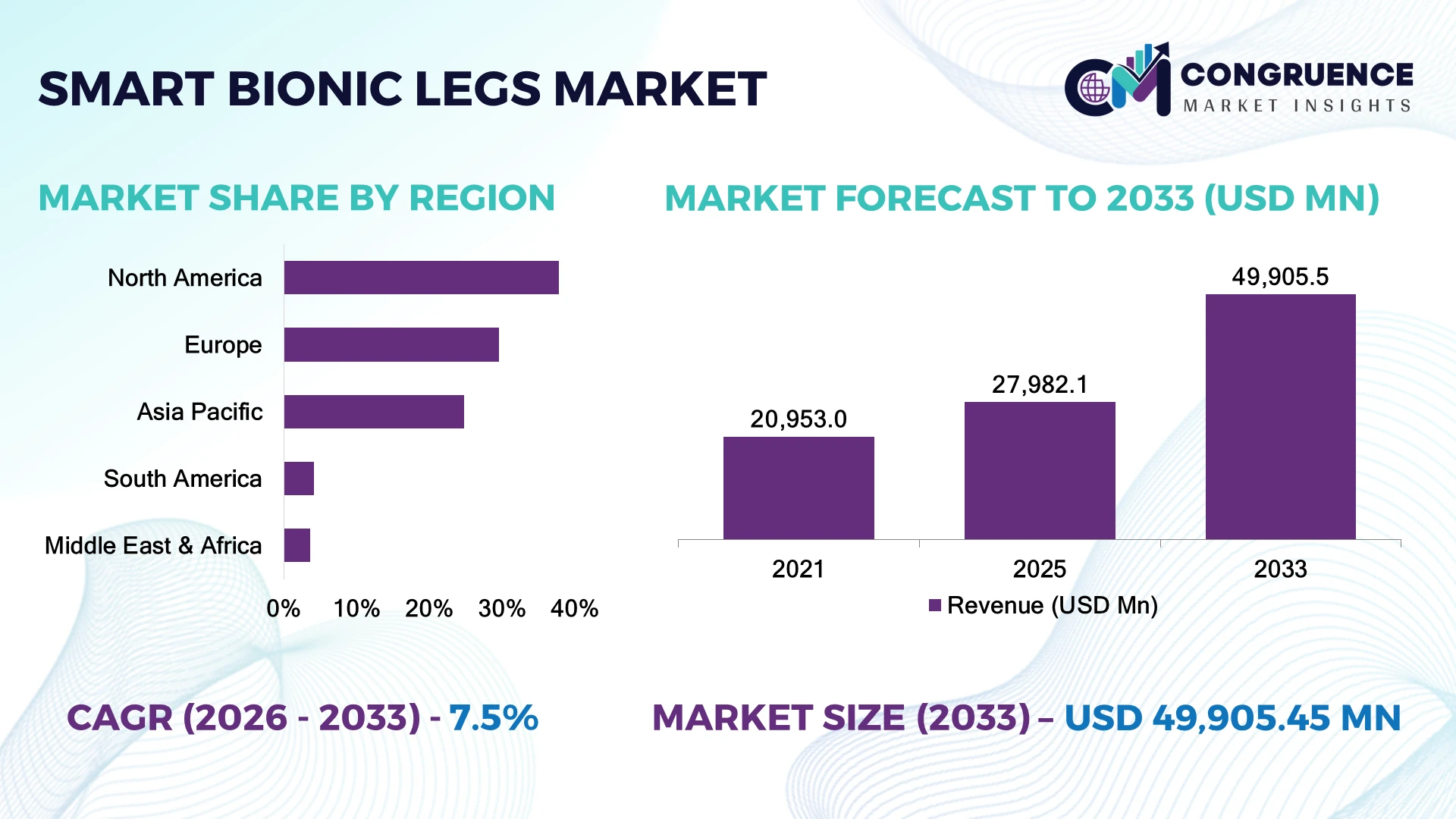
The United States leads the Smart Bionic Legs market with approximately 34% of global demand, supported by advanced rehabilitation infrastructure, defense-funded prosthetics innovation, and strong integration of AI-powered gait analysis technologies. Compared with Germany, the United States deploys nearly 2.1 times more microprocessor-controlled lower-limb prostheses, while approximately 68% of premium prosthetic fittings now incorporate intelligent sensors and adaptive control systems. Ongoing semiconductor supply-chain diversification following geopolitical realignments has strengthened component availability for high-performance prosthetic devices.
Manufacturers investing in intelligent mobility platforms, localized production, and digital rehabilitation ecosystems are securing long-term competitive advantage in the advanced prosthetics industry.
Market Size & Growth: USD 27,982.1 million in 2025 to USD 49,905.5 million by 2033 at 7.5% CAGR, supported by AI-enabled prosthetic innovation.
Top Growth Drivers: AI-assisted mobility (+36%), reimbursement expansion (+28%), rehabilitation digitization (+24%).
Short-Term Forecast: By 2028, gait assessment efficiency improves approximately 30% through intelligent adaptive control.
Emerging Technologies: AI motion prediction, myoelectric control, lightweight carbon composites, and embedded IoT sensors accelerate adoption.
Regional Leaders: North America, Europe, and Asia-Pacific strengthen deployment through rehabilitation modernization and localized manufacturing.
Consumer/End-User Trends: Around 61% of premium prosthetic users prefer sensor-enabled adaptive bionic legs.
Pilot/Case Example: A 2026 rehabilitation program improved patient walking stability by approximately 27%.
Competitive Landscape: Leading manufacturers collectively command nearly 52% of global market activity.
Regulatory & ESG Impact: Digital rehabilitation pathways reduce repeat clinical adjustments by approximately 19%.
Investment & Funding: More than USD 1.9 billion supports advanced prosthetics, robotics, and rehabilitation technologies.
Innovation & Future Outlook: Neural interfaces and predictive gait intelligence redefine next-generation smart mobility solutions.
The Smart Bionic Legs market is evolving through AI-driven gait optimization, lightweight composite materials, and cloud-connected rehabilitation platforms that improve patient mobility and clinical outcomes. Approximately 57% of newly introduced premium prosthetic systems now feature adaptive microprocessor control with remote software updates. Increased localization of electronic component manufacturing is strengthening supply resilience, setting the foundation for broader strategic transformation across advanced mobility technologies.
The Smart Bionic Legs market has become strategically significant as intelligent prosthetic technologies evolve from assistive medical devices into integrated digital mobility platforms. Competition increasingly centers on AI-powered movement adaptation, personalized rehabilitation, and connected healthcare ecosystems rather than mechanical performance alone. Expanded reimbursement policies, digital rehabilitation programs, and localized manufacturing are reshaping procurement strategies while reducing dependence on globally concentrated electronic component supply chains.
Modern smart bionic legs equipped with microprocessors and real-time sensor fusion improve gait symmetry by approximately 26% while reducing energy expenditure by nearly 18% compared with conventional mechanical prostheses. The United States maintains leadership in clinical deployment and technology commercialization, whereas Japan advances miniaturized robotics, precision actuators, and wearable mobility innovation. During the next two to three years, nearly 63% of newly prescribed premium lower-limb prostheses are expected to incorporate adaptive software and connected rehabilitation capabilities.
Healthcare providers increasingly deploy remote monitoring platforms that allow clinicians to optimize prosthetic performance through digital gait analytics without frequent in-person adjustments. Manufacturers are expanding partnerships with rehabilitation centers, investing in AI software development, and strengthening regional production of precision components. Companies combining intelligent biomechanics, software-driven personalization, clinical evidence, and scalable manufacturing will establish stronger competitive positioning as connected mobility becomes the benchmark for advanced prosthetic care.
Rapid integration of artificial intelligence, embedded sensors, and adaptive gait algorithms is transforming smart bionic legs from passive prostheses into intelligent mobility systems. Approximately 66% of newly introduced premium prosthetic models now incorporate microprocessor-controlled knee and ankle functions, while adaptive gait software improves walking stability by nearly 29% and reduces rehabilitation time by approximately 21%. The United States continues expanding reimbursement support for technologically advanced prosthetic solutions, encouraging wider clinical adoption. This shift is increasing demand for personalized mobility devices with real-time performance optimization. Manufacturers are investing in AI software, expanding rehabilitation partnerships, and strengthening precision electronics production to deliver connected prosthetic platforms that improve long-term patient outcomes and differentiate premium product portfolios.
Dependence on precision actuators, advanced sensors, carbon-fiber composites, and medical-grade microelectronics continues restricting affordability of smart bionic legs. Electronic components and embedded control systems account for nearly 37% of total manufacturing cost, while maintenance and calibration expenses increase lifecycle ownership costs by approximately 18%. Germany's medical device manufacturers continue facing procurement challenges for specialized semiconductor components following global electronic supply-chain adjustments. These structural cost pressures limit reimbursement coverage, reduce market accessibility, and slow adoption in cost-sensitive healthcare systems. Companies are mitigating risk through localized sourcing, long-term component contracts, modular product architectures, and manufacturing automation that improves production efficiency while reducing dependence on single-source suppliers.
Connected rehabilitation ecosystems are creating opportunities beyond prosthetic hardware through software-enabled mobility optimization and remote clinical care. Approximately 58% of rehabilitation providers are evaluating cloud-connected gait monitoring platforms, while digital therapy integration improves rehabilitation adherence by nearly 24% and reduces follow-up clinical visits by approximately 17%. Japan continues advancing robotic rehabilitation technologies that combine wearable sensors with intelligent prosthetic systems for continuous mobility assessment. Manufacturers are investing in AI-assisted rehabilitation software, expanding digital health partnerships, and developing subscription-based clinical analytics services. A significant strategic opportunity lies in combining hardware, remote monitoring, and personalized rehabilitation into integrated outcome-based care models that strengthen customer retention and recurring service revenue.
Scaling smart bionic leg deployment requires seamless integration between prosthetic hardware, rehabilitation software, clinical workflows, and skilled healthcare professionals. Approximately 43% of advanced prosthetic centers report shortages of clinicians trained in AI-assisted prosthetic programming, while inconsistent digital infrastructure increases device configuration time by nearly 19%. The United Kingdom continues expanding specialized prosthetic rehabilitation programs to address workforce capability gaps as intelligent mobility technologies become more sophisticated. Limited interoperability between clinical software platforms affects deployment consistency and long-term patient outcomes. Companies must invest in clinician training, standardized digital interfaces, collaborative rehabilitation partnerships, and interoperable software ecosystems to achieve sustainable adoption across healthcare networks.
Embedded Sensors Become Standard: Approximately 62% of newly launched premium smart bionic legs now integrate multi-sensor motion tracking, reducing gait adjustment sessions by nearly 23% and improving mobility precision. Rising demand for personalized rehabilitation is encouraging manufacturers to standardize intelligent sensing while expanding engineering partnerships for next-generation biomechanical systems.
Remote Prosthetic Care Expands: Around 47% of advanced rehabilitation centers now utilize remote prosthetic performance monitoring, shortening clinical follow-up cycles by approximately 26% and improving device optimization efficiency. Digital healthcare expansion is reshaping rehabilitation workflows, prompting manufacturers to strengthen cloud platforms and connected patient support services.
Lightweight Composite Adoption Grows: Carbon-fiber and advanced composite components are now incorporated into nearly 55% of premium smart bionic legs, reducing overall device weight by approximately 18% while improving energy efficiency during walking. Companies are increasing investment in advanced materials engineering and localized precision manufacturing to strengthen supply resilience.
Modular Design Reshapes Production: Approximately 41% of new smart bionic leg platforms now feature modular architectures that reduce customization lead times by nearly 22% while simplifying maintenance and component replacement. Healthcare providers increasingly demand flexible upgrade pathways, encouraging manufacturers to redesign product portfolios around scalable software, interchangeable hardware, and long-term lifecycle support.
Microprocessor-controlled smart bionic legs account for approximately 56% of the market due to superior gait stability, adaptive motion control, and seamless integration with embedded sensors and rehabilitation software. Their dominance is reinforced by consistent clinical performance, reduced fall risk, and compatibility with AI-assisted mobility platforms. Hydraulic and mechanical-assisted bionic legs continue serving value-focused healthcare systems and rehabilitation centers where affordability remains a purchasing priority. Hybrid bionic systems retain strategic relevance by balancing intelligent control with lower ownership costs, making them suitable for broader patient populations.
AI-enabled neuro-controlled bionic legs represent the fastest-growing type as advanced rehabilitation programs increasingly prioritize personalized mobility and real-time adaptive learning. Approximately 44% of newly launched premium prosthetic platforms now integrate machine-learning algorithms, while intelligent motion prediction improves walking efficiency by nearly 26% and reduces manual tuning requirements by approximately 19%. Manufacturers are strengthening R&D investments, expanding partnerships with rehabilitation technology providers, and focusing on modular software architectures that enable future feature upgrades. Investment priorities are steadily shifting from hardware optimization toward intelligent software ecosystems capable of delivering continuous mobility enhancement.
A 2026 clinical technology assessment published through the International Society for Prosthetics and Orthotics indicated that microprocessor-controlled lower-limb prostheses remain the preferred solution for advanced rehabilitation programs because of superior functional mobility and long-term patient outcomes.
Mobility restoration represents approximately 49% of Smart Bionic Legs applications, driven by increasing adoption among transfemoral and transtibial amputees requiring continuous functional support for daily activities. Healthcare providers prioritize advanced bionic legs that improve balance, gait symmetry, and long-term rehabilitation outcomes while reducing dependence on repeated mechanical adjustments. Sports rehabilitation remains an established application for high-performance users, whereas military rehabilitation continues supporting specialized demand for durable intelligent prosthetic systems capable of adapting to complex movement conditions.
Neurological rehabilitation is the fastest-growing application as AI-assisted gait analysis and sensor-based movement correction become integral to modern rehabilitation protocols. Nearly 38% of advanced rehabilitation facilities now integrate smart prosthetic data into digital therapy platforms, while adaptive gait algorithms improve rehabilitation efficiency by approximately 24%. Companies are expanding clinical collaborations, integrating remote monitoring capabilities, and scaling software-enabled rehabilitation ecosystems. Demand is increasingly shifting toward personalized mobility solutions that combine prosthetic hardware with continuous clinical analytics and outcome-based rehabilitation programs.
According to a 2025 rehabilitation technology survey conducted by the American Academy of Orthotists and Prosthetists, rehabilitation centers increasingly prioritize intelligent prosthetic systems capable of supporting data-driven therapy and personalized gait optimization.
Hospitals and rehabilitation centers account for approximately 52% of Smart Bionic Legs procurement due to high patient volumes, multidisciplinary rehabilitation services, and direct involvement in prosthetic assessment, fitting, and long-term mobility training. These institutions increasingly deploy intelligent prosthetic technologies integrated with digital rehabilitation platforms to improve patient outcomes and optimize clinical workflows. Specialized prosthetic clinics continue expanding through personalized fitting services, while military medical facilities maintain strategic demand for high-performance mobility solutions designed for complex rehabilitation requirements.
Home healthcare providers represent the fastest-growing end-user segment as remote rehabilitation, connected prosthetics, and digital patient monitoring become standard components of long-term mobility care. Approximately 42% of premium smart bionic leg users now participate in remote performance monitoring programs, reducing in-person clinical adjustments by nearly 21%. Manufacturers are strengthening partnerships with rehabilitation networks, introducing service-based support models, and developing customized software platforms tailored to home-based rehabilitation. Competitive differentiation increasingly depends on integrated digital care ecosystems rather than prosthetic hardware performance alone.
A 2026 enterprise survey by the American Physical Therapy Association found that rehabilitation providers are expanding investment in connected prosthetic technologies to improve long-term patient engagement, remote mobility assessment, and individualized therapy planning.
North America accounted for the largest market share at 37.8% in 2025 however, Asia-Pacific is expected to register the fastest growth, expanding at a CAGR of 8.3% between 2026 and 2033.

Digital Rehabilitation Ecosystems Strengthen Premium Prosthetic Adoption
North America contributes approximately 37.8% of the Smart Bionic Legs market, supported by advanced rehabilitation infrastructure, strong reimbursement frameworks, and rapid commercialization of AI-enabled prosthetic technologies. Healthcare providers increasingly integrate intelligent prosthetic systems with digital gait analysis platforms and remote patient monitoring to improve long-term mobility outcomes. Approximately 65% of premium lower-limb prosthetic fittings now utilize microprocessor-controlled technologies with adaptive movement capabilities. Medical device manufacturers continue expanding software development, clinical partnerships, and localized production of precision components while investing in connected rehabilitation platforms. Strategic collaboration between prosthetic manufacturers and rehabilitation networks is accelerating deployment efficiency and strengthening long-term clinical adoption across orthopedic care.
United States Market Outlook: The United States remains the largest national market due to its extensive rehabilitation infrastructure, strong medical device innovation ecosystem, and early adoption of intelligent mobility technologies. Hospitals, veterans' healthcare programs, and specialized prosthetic centers continue expanding deployment of AI-enabled bionic legs integrated with digital rehabilitation platforms. Approximately 69% of advanced lower-limb prosthetic prescriptions within premium care programs now incorporate intelligent microprocessor-controlled systems, reinforcing the country's leadership in clinical adoption and technology commercialization.
Clinical Innovation Drives Precision Prosthetic Development
Europe accounts for approximately 29.6% of the Smart Bionic Legs market through strong orthopedic research, advanced rehabilitation services, and supportive regulatory pathways for innovative medical devices. Healthcare systems increasingly prioritize intelligent prosthetics that improve patient mobility while reducing long-term rehabilitation complexity. Approximately 53% of specialized rehabilitation centers now integrate digital gait assessment into prosthetic fitting protocols. Manufacturers continue investing in lightweight materials, embedded electronics, and collaborative research with clinical institutions to strengthen product differentiation and treatment outcomes.
Germany Market Outlook: Germany leads the European market through its advanced medical engineering sector, established prosthetics manufacturing base, and strong rehabilitation infrastructure. Domestic manufacturers continue developing AI-assisted mobility systems and precision mechatronic components for premium prosthetic devices. Approximately 47% of newly fitted intelligent lower-limb prostheses within major rehabilitation centers incorporate adaptive gait optimization software, supporting the country's position as a technology leader.
Manufacturing Scale Expands Intelligent Mobility Access
Asia-Pacific represents approximately 24.8% of the global market, driven by expanding healthcare infrastructure, localized medical device manufacturing, and increasing adoption of advanced rehabilitation technologies. Regional manufacturers are improving production efficiency while integrating embedded sensors, lightweight composite materials, and intelligent control systems into next-generation prosthetic solutions. Approximately 42% of newly established prosthetic manufacturing facilities now support production of digitally enabled mobility devices. Healthcare providers are strengthening rehabilitation capabilities through greater integration of robotic therapy and connected prosthetic technologies.
China Market Outlook: China is emerging as the region's largest production and deployment hub due to expanding medical technology manufacturing, government-supported healthcare modernization, and increasing rehabilitation capacity. Domestic companies continue investing in intelligent prosthetic electronics and localized precision component manufacturing. Approximately 52% of newly commissioned advanced prosthetic production lines are designed to support AI-enabled mobility systems, strengthening both domestic availability and export competitiveness.
Healthcare Modernization Supports Prosthetic Upgrades
South America is steadily expanding adoption of smart bionic legs through improvements in rehabilitation services, orthopedic care, and specialized prosthetic clinics. Public healthcare modernization and greater collaboration with international medical technology providers are improving access to advanced prosthetic solutions despite uneven reimbursement frameworks. Approximately 34% of newly equipped rehabilitation centers now include digital gait assessment capabilities supporting intelligent prosthetic fitting. Manufacturers are strengthening regional distribution partnerships, localized servicing, and clinical education initiatives to improve deployment consistency and long-term patient support.
Brazil Market Outlook: Brazil remains the region's largest market through its extensive rehabilitation network, expanding orthopedic healthcare infrastructure, and growing adoption of advanced prosthetic technologies. Clinical institutions increasingly integrate digital mobility assessment into prosthetic rehabilitation programs while manufacturers strengthen local distribution capabilities. Approximately 45% of South America's premium smart prosthetic fittings are concentrated in Brazil, reflecting its leadership in advanced rehabilitation services.
Healthcare Investment Accelerates Advanced Prosthetic Care
The Middle East & Africa market is advancing through increased healthcare investment, specialized rehabilitation centers, and modernization of orthopedic services. Governments and healthcare providers continue strengthening access to advanced mobility technologies while expanding prosthetic rehabilitation capabilities for trauma care, chronic disease management, and mobility restoration. Approximately 29% of recently established specialist rehabilitation facilities now provide intelligent prosthetic fitting services. Medical technology companies are increasing regional partnerships, clinician training programs, and technical support to improve adoption across developing healthcare systems.
Saudi Arabia Market Outlook: Saudi Arabia leads regional market development through sustained healthcare infrastructure investment, specialized rehabilitation expansion, and adoption of advanced medical technologies under national healthcare modernization initiatives. Major healthcare providers continue integrating intelligent prosthetic systems with multidisciplinary rehabilitation programs to improve patient outcomes. Approximately 38% of newly commissioned advanced rehabilitation facilities include dedicated smart prosthetic assessment and digital gait analysis capabilities, reinforcing the country's leadership in regional deployment.
Global leaders including Ottobock, Össur, Blatchford, Fillauer, and Proteor compete on intelligent prosthetic performance, while emerging robotics developers challenge through AI-driven mobility platforms and lower-cost digital solutions. The top five companies collectively hold approximately 52% of the global market. Competition centers on gait intelligence, lightweight materials, clinical outcomes, and customization rather than pricing alone. AI-enabled control systems improve walking efficiency by nearly 26%, modular architectures shorten fitting time by approximately 18%, and digital rehabilitation platforms reduce follow-up adjustments by around 20%. Companies are expanding rehabilitation partnerships, acquiring specialized technology firms, strengthening localized manufacturing, and vertically integrating software with prosthetic hardware. The competitive landscape is shifting toward connected mobility ecosystems combining predictive analytics, remote monitoring, and adaptive biomechanics. Clinical validation requirements, reimbursement approvals, and precision manufacturing remain significant entry barriers. Winning requires integrated hardware-software innovation, proven rehabilitation outcomes, scalable manufacturing, and strong clinician support networks delivering measurable patient mobility improvements.
Ottobock SE & Co. KGaA
Össur hf.
Blatchford Limited
Fillauer LLC
Proteor
WillowWood Global LLC
Steeper Group
College Park Industries
Ortho Europe
Streifeneder ortho.production GmbH
Motion Composites
Chas. A. Blatchford & Sons Ltd.
Freedom Innovations
Microprocessor-controlled knees, embedded inertial sensors, myoelectric interfaces, and carbon-fiber composite structures define current smart bionic leg technology. Approximately 68% of premium lower-limb prostheses now integrate adaptive microprocessors that improve gait stability by nearly 27% while reducing stumble risk by approximately 18%. Integrated Bluetooth connectivity enables clinicians to optimize device settings remotely, improving rehabilitation efficiency and reducing repeated in-person adjustments. Healthcare providers adopting connected prosthetic ecosystems gain measurable operational advantages through continuous mobility analytics and personalized treatment planning.
Emerging technologies include artificial intelligence, digital twins, edge computing, and neural interface integration for adaptive movement prediction. Compared with conventional mechanical prostheses, AI-enabled smart bionic legs improve walking symmetry by approximately 29% while lowering rehabilitation effort by nearly 21%. Manufacturers combining intelligent software, cloud-connected rehabilitation, and precision mechatronics achieve stronger differentiation than hardware-focused competitors because long-term patient outcomes increasingly determine procurement and reimbursement decisions.
Between 2026 and 2028, connected rehabilitation ecosystems will become standard across advanced prosthetic care. More than 72% of newly introduced premium smart bionic legs are expected to support remote software updates and predictive performance optimization. Organizations investing in AI-powered gait analytics, lightweight advanced materials, interoperable digital platforms, and intelligent sensor fusion will improve clinical outcomes, strengthen patient retention, accelerate product differentiation, and establish sustainable competitive leadership as digital mobility becomes the industry benchmark.
February 2026 Ottobock invested USD 5 million in Blue Arbor Technologies to accelerate RESTORE implant technology for more intuitive prosthesis control, strengthening advanced human-machine interface capabilities and expanding next-generation smart prosthetic innovation. Source: Ottobock
May 2026 Ottobock unveiled new prosthetic innovations including AI-supported control technologies and expanded the Michelangelo portfolio at OTWorld 2026, broadening patient access while advancing digital prosthetic fitting across international rehabilitation markets. Source: Ottobock Newsroom
July 2026 Ottobock acquired Fesia Technology to expand its neuro-orthotics portfolio through Functional Electrical Stimulation solutions, strengthening rehabilitation capabilities and extending intelligent movement restoration technologies across neurological care applications. Source: Ottobock Media
June 2026 WillowWood announced that CVC Catalyst would acquire a majority stake in the company, strengthening investment capacity and supporting future expansion of advanced prosthetic technologies, product development, and global market reach. Source: WillowWood Press Releases.
This report delivers a comprehensive assessment of the Smart Bionic Legs market across product types, clinical applications, end-user groups, and key geographic markets. It evaluates microprocessor-controlled, hydraulic, mechanical, hybrid, and AI-enabled prosthetic technologies deployed for mobility restoration, neurological rehabilitation, sports rehabilitation, and specialized orthopedic care. The analysis also examines embedded sensors, myoelectric control, cloud-connected rehabilitation, lightweight composite materials, and intelligent gait optimization technologies shaping next-generation prosthetic innovation.
The report provides strategic evaluation of competitive positioning, technology adoption, deployment trends, manufacturing capabilities, and regional healthcare infrastructure between 2026 and 2033. Approximately 60% of premium prosthetic deployments now incorporate intelligent adaptive control, reflecting the industry's transition toward connected mobility ecosystems. The study supports investment planning, expansion strategy, product innovation, partnership evaluation, and competitive benchmarking by identifying high-value end-user segments, emerging digital rehabilitation models, evolving procurement priorities, and long-term opportunities across the global smart bionic legs market.
| Report Attribute/Metric | Report Details |
|---|---|
|
Market Revenue in 2025 |
USD 27,982.1 Million |
|
Market Revenue in 2033 |
USD 49,905.4 Million |
|
CAGR (2026 - 2033) |
7.5% |
|
Base Year |
2025 |
|
Forecast Period |
2026 - 2033 |
|
Historic Period |
2021 - 2025 |
|
Segments Covered |
By Type
By Application
By End-User
|
|
Key Report Deliverable |
Revenue Forecast, Growth Trends, Market Dynamics, Segmental Overview, Regional and Country-wise Analysis, Competition Landscape |
|
Region Covered |
North America, Europe, Asia-Pacific, South America, Middle East, Africa |
|
Key Players Analyzed |
Ottobock SE & Co. KGaA, Össur hf., Blatchford Limited, Fillauer LLC, Proteor, WillowWood Global LLC, Steeper Group, College Park Industries, Ortho Europe, Streifeneder ortho.production GmbH, Motion Composites, Chas. A. Blatchford & Sons Ltd., Freedom Innovations |
|
Customization & Pricing |
Available on Request (10% Customization is Free) |




