
Reports
The Global Sarcopenia Supplement Market was valued at USD 1,798.5 Million in 2025 and is anticipated to reach a value of USD 3,479.8 Million by 2033 expanding at a CAGR of 8.6% between 2026 and 2033. Growth is driven by clinical nutrition shifting toward protein-plus-creatine formulations, rising geriatric populations, resistance-training protocols, and increased focus on preserving lean mass during weight-management therapies.
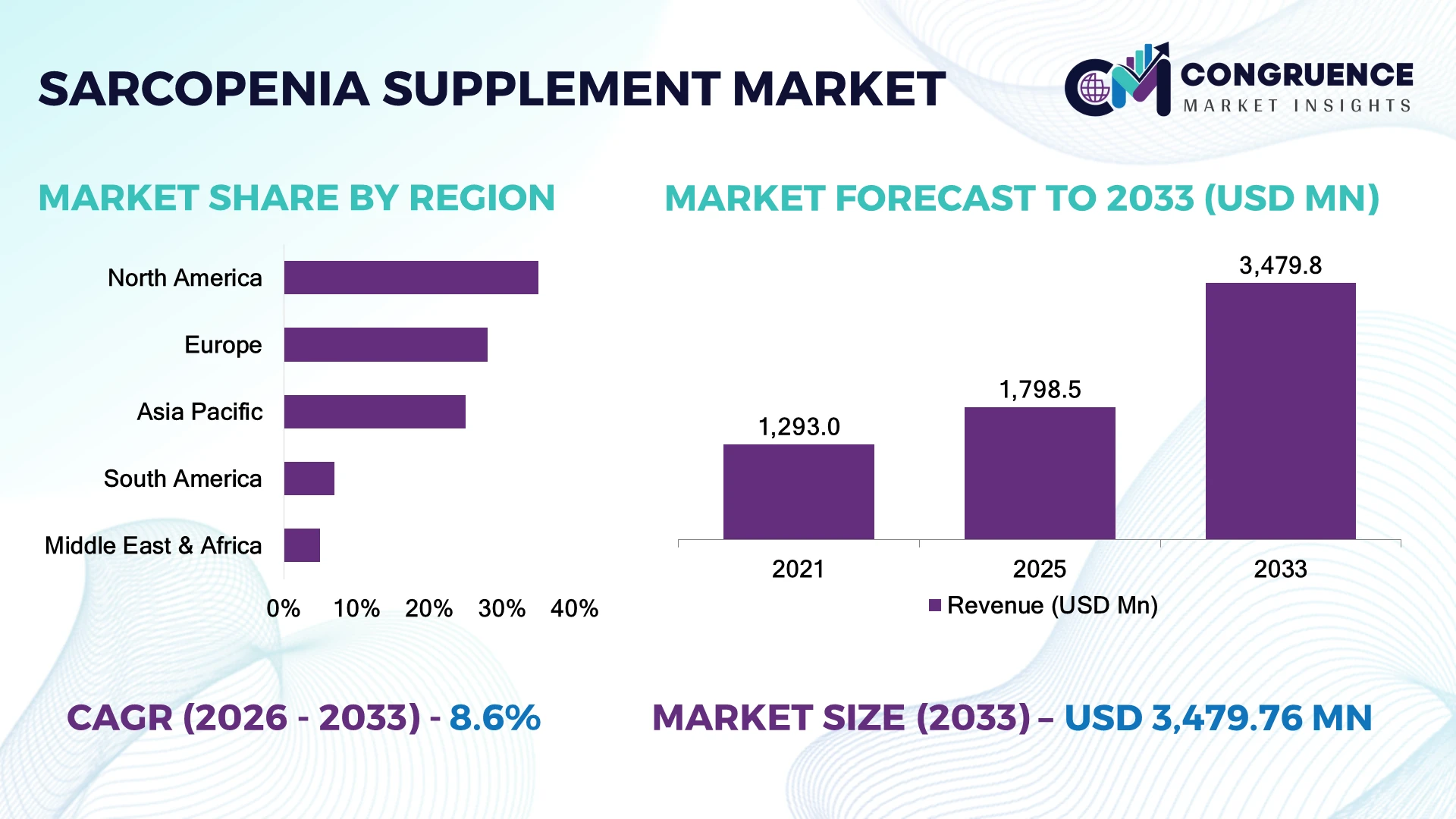
The United States remains the dominant country, accounting for approximately 33% of global sarcopenia supplement demand, supported by medical nutrition, sports nutrition, pharmaceutical, and senior-care industries. Protein-based formulations represent more than 40% of product demand, while Japan combines an older demographic base with highly developed functional-food adoption. U.S. manufacturers emphasize clinical validation and premium formulations, whereas Japan prioritizes convenient, daily-use formats. The 2026 U.S.–China trade environment is also encouraging ingredient-sourcing diversification for amino acids, proteins, and specialty nutrients.
Strategically, suppliers that combine clinically supported ingredients, scalable sourcing, and age-friendly delivery formats are positioned to capture premium demand.
Market Size & Growth: USD 1.80 billion in 2025 to USD 3.48 billion by 2033 at 8.6% CAGR, driven by clinical nutrition and advanced protein formulations.
Top Growth Drivers: Protein fortification 42%; creatine adoption 28%; healthy-aging nutrition 24%.
Short-Term Forecast: By 2028, automated formulation and batch-control systems are positioned to improve production efficiency by 10–15%.
Emerging Technologies: AI-assisted formulation, precision nutrition, microencapsulation, and faster-dissolving protein delivery are reshaping advanced sarcopenia supplements.
Regional Leaders: North America approaches USD 1.2 billion, Europe USD 0.9 billion, and Asia-Pacific USD 0.8 billion by 2033, with Asia-Pacific showing stronger functional-food adoption.
Consumer/End-User Trends: Protein-enriched products account for more than 40% of demand, while older consumers increasingly favor convenient powders, ready-to-drink products, and daily sachets.
Pilot/Case Example: 2026 clinical-nutrition programs increasingly combine protein supplementation with resistance exercise, targeting 10–15% improvements in functional-strength outcomes.
Competitive Landscape: North America leads with approximately 35% regional demand concentration; Nestlé Health Science, Abbott, Danone, Glanbia, and The Bountiful Company compete across clinical and consumer nutrition.
Regulatory & ESG Impact: Cleaner-label formulations and recyclable packaging are reducing material intensity by approximately 10–15% in selected premium product lines.
Investment & Funding: More than USD 500 million is being directed across specialized nutrition, healthy-aging products, ingredient capacity, clinical validation, and formulation partnerships.
Innovation & Future Outlook: Next-generation products are shifting toward protein-plus-creatine, vitamin D, HMB, and personalized nutrition systems, strengthening the market’s clinical positioning.
The sarcopenia supplement market is increasingly centered on high-protein nutrition, creatine-enhanced formulations, HMB, vitamin D, and personalized delivery formats. Products with rapid dissolution, improved gastrointestinal tolerance, and clinically relevant ingredient combinations are gaining attention, while more than 40% of demand remains concentrated around protein-led formulations. Ingredient sourcing diversification in 2026 is reinforcing supply-chain resilience and formulation continuity.
Sarcopenia supplementation is becoming strategically important as aging populations, preventive healthcare, and weight-management therapies increase the commercial focus on preserving muscle mass rather than simply reducing body weight. The competitive landscape is shifting from basic protein products toward clinically positioned combinations incorporating protein, creatine, HMB, vitamin D, and targeted micronutrients. This expands competition across consumer nutrition, medical nutrition, pharmaceutical-adjacent products, and specialized healthy-aging brands.
Technology is improving formulation economics. Automated blending, digital batch monitoring, and microencapsulation can reduce formulation and quality-control workloads by approximately 10–20% compared with highly manual production workflows. North America emphasizes clinical validation and premium medical-nutrition positioning, while Japan and broader Asia-Pacific favor convenient functional foods and age-friendly delivery formats.
During 2026–2028, companies are prioritizing ready-to-drink proteins, single-serve powders, personalized nutrition assessments, and partnerships with senior-care and healthcare channels. Manufacturers are also diversifying amino-acid and protein sourcing amid changing global trade conditions. The strongest competitive position will come from companies that combine clinically credible formulations with scalable manufacturing, convenient delivery, resilient ingredient procurement, and clear differentiation across active-aging and medical-nutrition applications.
Protein-centered formulations are strengthening demand as approximately 40–45% of sarcopenia supplement consumption is concentrated in protein-led products, while creatine-enhanced formulations represent roughly 25–30% of specialized active-aging offerings. Japan’s aging population is accelerating demand for convenient protein powders, beverages, and fortified foods that fit daily nutrition routines. Clinical nutrition is also moving toward multi-ingredient formulations combining protein, creatine, HMB, vitamin D, and micronutrients rather than single-nutrient products. This shift is increasing formulation complexity but improving product differentiation and premium positioning. Manufacturers are expanding ready-to-mix and ready-to-drink capacity, while ingredient suppliers are developing higher-solubility proteins and standardized specialty ingredients. The non-obvious advantage is higher formulation value per serving, allowing companies to compete beyond commodity protein pricing.
Specialty ingredients create a structural cost constraint, particularly for formulations combining high-quality protein, HMB, creatine, and micronutrients. Protein and amino-acid inputs can represent approximately 35–45% of formulation costs, while specialty active ingredients add another 10–20% in premium products. Manufacturers dependent on imported amino acids or specialized nutraceutical inputs face greater exposure to freight volatility and currency movements. China remains important for amino-acid and nutraceutical ingredient supply, while European and North American producers increasingly seek secondary sourcing. Companies are responding through multi-supplier contracts, regional warehousing, standardized formulations, and greater use of alternative ingredient grades. The key operational issue is that replacing an ingredient is not simply a procurement decision; reformulation can trigger stability, sensory, labeling, and validation requirements.
Personalized nutrition is creating an opportunity beyond conventional protein supplementation, particularly through products matched to age, activity level, dietary intake, and muscle-health status. Approximately 15–20% of premium healthy-aging product development now incorporates some form of personalization, while digital nutrition assessment can shorten formulation-selection workflows by roughly 20–30%. U.S. companies are integrating nutrition platforms with supplement subscriptions, while Japanese brands emphasize smaller daily-dose formats suited to older consumers. The next opportunity lies in combining digital assessment with protein, creatine, HMB, and micronutrient protocols rather than selling isolated ingredients. Manufacturers are developing personalized sachets, subscription programs, and healthcare partnerships. This model increases recurring purchasing potential and generates first-party consumption data, giving vertically integrated brands an advantage in product development and customer retention.
The expanding ingredient mix creates a validation challenge because approximately 20–30% of premium sarcopenia-focused formulations increasingly contain multiple functional ingredients, complicating claims substantiation, dosage optimization, and product positioning. Evidence requirements also differ across the United States, European markets, and Japan, increasing regulatory-review workloads for companies entering multiple jurisdictions. Digital personalization adds another layer through data governance and algorithm validation, particularly when consumer assessments influence product recommendations. Manufacturers must therefore strengthen clinical partnerships, quality-control laboratories, regulatory teams, and standardized testing protocols. A non-obvious pressure is maintaining consistent ingredient potency across batches when multiple specialty actives are combined. Companies investing in analytical testing, traceability, and controlled formulation systems can reduce batch variability and protect premium positioning as the category becomes increasingly evidence-driven.
Protein Delivery Formats Diversify: Ready-to-drink proteins, sachets, and fast-mixing powders are gaining traction, with convenient formats estimated to represent 25–30% of premium sarcopenia-focused launches. Manufacturers are reducing preparation friction and targeting older consumers with smaller serving sizes, improved solubility, and easier swallowing characteristics. This shifts competition from ingredient quantity toward usability and adherence.
Multi-Ingredient Blends Gain Ground: Formulations combining protein, creatine, HMB, and vitamin D increasingly account for approximately 20–30% of specialized product development. Companies are consolidating multiple muscle-health ingredients into single products to simplify daily supplementation. The non-obvious impact is stronger premium differentiation, although formulation stability and sensory optimization are becoming more important production requirements.
Japan Favors Daily Nutrition: Japanese manufacturers increasingly position muscle-health supplements within everyday functional-food routines rather than isolated sports-nutrition categories. Products designed around convenient single servings and fortified beverages are estimated to capture 15–20% higher usability preferences among older consumers. Companies are responding with smaller packs, familiar food formats, and retail-healthcare partnerships.
Traceability Moves Upstream: Ingredient traceability and supplier diversification are becoming more important as imported amino acids, proteins, and specialty nutraceuticals remain exposed to logistics and trade disruption. Companies are increasingly maintaining two or more qualified suppliers for critical actives, while digital batch monitoring can improve production traceability by approximately 10–15%. This strengthens continuity and quality assurance.
Protein-based supplements represent the leading type, accounting for approximately 45–50% of the global sarcopenia supplement market, supported by established clinical relevance, scalable whey and plant-protein supply, and broad consumer familiarity. Whey protein remains particularly important because of its high-quality amino-acid profile and formulation flexibility, while plant-based proteins account for roughly 15–20% and are gaining traction among vegetarian and lactose-sensitive consumers. Combination formulations containing protein with creatine, HMB, vitamin D, or leucine represent approximately 20–25% of specialized products and are the fastest-shifting segment as manufacturers move toward multi-nutrient muscle-health positioning.
Ready-to-drink products, powders, capsules, and fortified foods retain strategic relevance for different consumption occasions. Ready-to-drink formats are expanding faster than conventional powders because they eliminate preparation barriers for older consumers. Companies are therefore investing in improved solubility, smaller serving formats, and combination formulations, shifting investment from commodity protein toward clinically differentiated products.
A 2025 randomized controlled trial involving 97 older adults found that a daily protein-enriched formulation containing 24–30 g protein improved physical-performance measures, reinforcing demand for evidence-led protein delivery formats.
Muscle preservation and sarcopenia management represent the leading application, accounting for approximately 50–55% of demand, because products are increasingly positioned around maintaining muscle mass, strength, and physical function among older adults. Healthy aging and preventive nutrition account for roughly 25–30%, while sports and active-aging applications contribute approximately 15–20%. The fastest-changing application is integrated muscle-health management, where supplements are combined with resistance exercise and dietary monitoring rather than consumed as standalone products.
Clinical and community nutrition applications are becoming more structured, particularly in Japan, the United States, and European healthcare systems. Companies are adapting through protein-plus-active formulations, healthcare-channel partnerships, personalized nutrition programs, and convenient single-dose formats. This expands the addressable customer base beyond diagnosed sarcopenia toward older adults seeking functional longevity. The commercial implication is a shift from episodic supplement purchases toward recurring nutrition protocols.
A 2025 systematic review of 13 randomized controlled trials found that combined protein supplementation and exercise improved muscle mass and grip strength, strengthening the case for integrated nutrition-and-exercise applications.
Older adults represent the leading end-user group, accounting for approximately 55–60% of sarcopenia supplement demand, reflecting direct exposure to age-related muscle loss and greater nutritional intervention requirements. Healthcare and clinical nutrition channels account for roughly 20–25%, while active-aging consumers represent approximately 15–20%. The fastest-growing purchasing group is active-aging consumers, who increasingly adopt muscle-health products before clinically significant functional decline becomes evident.
Established demand remains concentrated among individuals aged 65 and above, but purchasing behavior is expanding toward preventive nutrition among adults aged 50–64. Healthcare providers, dietitians, senior-care organizations, and specialized nutrition retailers increasingly influence product selection, increasing the importance of clinical evidence and dosage transparency. Companies are responding with age-specific formulations, easy-to-consume formats, healthcare partnerships, and subscription models. The strategic shift favors brands capable of serving both clinical and consumer channels without weakening product credibility.
A December 2025 National Council on Aging survey found that 97% of respondents agreed lean protein is essential for older adults, while only 59% felt confident about how much protein is needed daily, highlighting a substantial education opportunity for supplement companies.
North America accounted for the largest market share at 35.0% in 2025 however, Asia-Pacific is expected to register the fastest growth, expanding at a CAGR of 10.2% between 2026 and 2033.
Clinical nutrition is shifting muscle-health supplements toward evidence-led formulations
North America represents approximately 35.0% of the global sarcopenia supplement market, supported by established medical nutrition channels, high supplement penetration, and strong sports-nutrition infrastructure. The United States drives regional demand through senior-care providers, dietitian-led nutrition programs, pharmacies, and direct-to-consumer platforms. Protein-based products account for more than 45% of regional demand, while combination formulations containing creatine, HMB, and vitamin D are expanding product differentiation. Manufacturers are increasing investment in ready-to-drink formats, single-serve powders, and clinically positioned formulations. Partnerships between nutrition companies and healthcare providers are also strengthening product credibility and patient access. The region's operational advantage lies in integrating clinical evidence with scalable consumer distribution, allowing companies to move products from specialized nutrition channels into broader healthy-aging markets.
United States Market Outlook: The United States accounts for approximately 30% of global sarcopenia supplement demand and maintains the region's strongest formulation, clinical-research, and distribution ecosystem. Large nutrition companies benefit from extensive pharmacy, hospital, senior-care, and e-commerce networks. More than 40% of U.S.-focused specialized products emphasize protein as the primary active nutritional component, while premium brands increasingly incorporate creatine and HMB to strengthen muscle-health positioning.
Evidence-based healthy aging is reshaping Europe's functional-nutrition portfolio
Europe contributes approximately 28% of global sarcopenia supplement demand, with Germany, the United Kingdom, France, Italy, and the Netherlands providing mature nutrition and healthcare channels. An aging population, preventive-health programs, and established nutraceutical manufacturing capabilities support demand for protein-rich and micronutrient-fortified formulations. Protein-led products account for roughly 40–45% of regional consumption, while clean-label and plant-based formulations represent approximately 20% of premium product development. European manufacturers are emphasizing traceable ingredients, recyclable packaging, and scientifically substantiated claims. Regulatory scrutiny around health claims is encouraging companies to invest in clinical evidence and standardized formulation protocols, making documented efficacy increasingly important for premium positioning and pharmacy-channel expansion.
Germany Market Outlook: Germany is Europe's strategically significant market because of its large older population, advanced pharmaceutical and nutraceutical manufacturing base, and extensive pharmacy distribution network. Manufacturers increasingly position sarcopenia supplements within medical and preventive nutrition portfolios. Protein-enriched products account for approximately 40% of demand, while specialized clinical-nutrition formulations are gaining distribution through healthcare professionals and institutional care settings.
Japan's aging economy is accelerating functional-food integration with muscle nutrition
Asia-Pacific represents approximately 25% of the global sarcopenia supplement market and has the strongest demographic rationale for specialized muscle-health nutrition. Japan leads regional commercialization, while China, South Korea, Australia, and India provide expanding consumer and manufacturing opportunities. Japan's functional-food infrastructure supports convenient protein beverages, fortified foods, powders, and small-dose supplements integrated into daily routines. Protein-based formulations represent approximately 40% of regional demand, while ready-to-consume formats are expanding rapidly among older consumers. Manufacturers are localizing flavors, serving sizes, and delivery formats while strengthening partnerships with nutrition retailers and healthcare channels. China's nutraceutical manufacturing base also provides regional sourcing advantages for amino acids, botanical ingredients, and specialty nutrients.
Japan Market Outlook: Japan represents the region's most developed sarcopenia-focused market, supported by a high proportion of older consumers, mature functional-food manufacturing, and strong acceptance of nutrition products designed for healthy aging. More than 25% of the population is aged 65 or above, creating sustained demand for convenient muscle-health products. Companies increasingly combine protein with vitamin D, calcium, leucine, or other functional ingredients in food-like formats.
Brazil is moving muscle-health nutrition from sports products toward active aging
South America accounts for approximately 7% of global sarcopenia supplement demand, with Brazil representing the principal commercial market. Growing fitness participation, expanding pharmacy distribution, and rising awareness of protein intake are broadening demand beyond conventional sports nutrition. Protein powders and fortified beverages account for approximately 50% of regional product demand, while active-aging formulations remain an emerging category. Brazil's established food and nutraceutical manufacturing base provides local formulation and packaging capabilities, reducing dependence on finished-product imports. Companies are expanding through pharmacy partnerships, online distribution, and localized flavor formats. However, purchasing power differences and imported specialty-ingredient exposure remain important considerations for premium products, encouraging manufacturers to balance clinical positioning with accessible formulations.
Brazil Market Outlook: Brazil provides the strongest manufacturing and distribution platform in South America, supported by a large consumer base, established protein-supplement industry, and extensive pharmacy and e-commerce networks. Protein-focused products account for roughly half of regional demand, giving domestic manufacturers an established route into muscle-health supplementation. Companies are increasingly extending sports-nutrition expertise into healthy-aging formulations using creatine, protein, and micronutrient combinations.
Premium nutrition infrastructure is creating targeted healthy-aging opportunities
Middle East & Africa represents approximately 5% of global sarcopenia supplement demand, with the United Arab Emirates, Saudi Arabia, South Africa, and Israel providing the strongest commercial infrastructure. Premium nutrition retail, private healthcare, pharmacy networks, and sports-nutrition channels support early adoption of specialized formulations. Protein-based supplements account for approximately 45% of regional demand, while ready-to-drink products are gaining relevance because of convenience and established functional-beverage consumption. Gulf countries are strengthening healthcare and wellness infrastructure, creating opportunities for companies combining clinical nutrition with preventive-aging programs. Import dependence for specialty ingredients remains significant, encouraging distributors and manufacturers to maintain diversified procurement channels and regional inventory buffers.
Saudi Arabia Market Outlook: Saudi Arabia is emerging as a strategically important market through healthcare modernization, wellness investment, and expanding sports and fitness infrastructure. The country's Vision 2030 transformation is increasing institutional attention toward preventive health and active lifestyles. Protein products represent approximately 45% of local specialized supplement demand, while pharmacy, fitness, and e-commerce channels provide scalable routes for muscle-health product distribution.
Nestlé Health Science, Abbott, Danone, Glanbia, and specialized ingredient innovators compete across clinical nutrition, consumer supplements, and functional ingredients. Global nutrition leaders compete with regional nutraceutical brands on clinical evidence, formulation breadth, price, and distribution. The top five players are estimated to represent approximately 25–30% of the market, leaving meaningful space for specialized brands. Protein-led products account for roughly 40–45% of demand, while multi-ingredient formulations capture about 20–25% of premium product development. Companies compete through clinical trials, ready-to-drink formats, ingredient partnerships, healthcare distribution, and vertically integrated formulation capabilities. Nestlé is strengthening bioactive research, Abbott is expanding age-focused nutrition in India, and Glanbia is extending protein delivery formats. The competitive shift is toward science-backed, multifunctional products rather than commodity protein. Entry barriers center on clinical substantiation, regulatory compliance, ingredient sourcing, and established healthcare channels. Winning requires validated efficacy, convenient delivery, resilient supply, and differentiated formulations that convert clinical credibility into repeat consumer adoption.
Nestlé Health Science
Abbott Laboratories
Danone
Glanbia plc
The Bountiful Company
Herbalife Ltd.
Amway
Bayer AG
Lonza Group
dsm-firmenich
IFF Health Sciences
Lallemand Health Solutions
Balchem Corporation
GNC Holdings
Precision formulation is becoming the core technology shift, combining protein, creatine, HMB, leucine, vitamin D, and bioactives according to targeted muscle-health needs. Digital formulation systems can reduce development iteration by 10–15%, while automated blending improves batch consistency by 2–5%. More than 40% of products emphasize protein-led formulations, creating a base for multi-ingredient innovation. Companies with clinical-data capabilities benefit through faster product validation.
Advanced delivery technologies are improving usability for older consumers. Microencapsulation, instantized proteins, clear-protein filtration, and ready-to-drink processing can improve dissolution and preparation efficiency by 15–25% versus conventional powder systems. Clear and liquid formats are gaining adoption as brands target convenience and adherence. Glanbia’s 2026 Clear Whey launch illustrates the shift toward lighter protein formats. The competitive advantage favors manufacturers controlling ingredient functionality and finished-product formulation.
From 2026–2028, AI-assisted personalization, digital nutrition assessment, and precision premix platforms will connect consumer data with formulation selection. AI-supported workflows can reduce recommendation and product-matching time by 20–30% versus manual assessment. Adoption remains strongest in premium nutrition and direct-to-consumer channels, while healthcare partnerships expand. Companies integrating clinical evidence, automated formulation, and traceable supply chains will gain speed, customization, and differentiation as sarcopenia supplementation moves toward personalized healthy-aging nutrition.
July 2025 Nestlé launched Muscle Repair+ under Pure Encapsulations, using nicotinamide and pyridoxine after screening more than 50,000 molecules. The innovation extends clinically positioned muscle-health nutrition into recovery, strengthening premium bioactive formulation capabilities and evidence-led differentiation. Source: nestle.com
May 2026 Abbott launched Ensure Strength Pro in India with 31 nutrients, including 30 grams of high-quality protein. The formulation targets seven health areas, broadening healthy-aging nutrition beyond muscle support and strengthening Abbott’s clinical-nutrition positioning in India. Source: abbott.com
June 2026 Glanbia expanded Optimum Nutrition with Clear Whey Protein, delivering 20 grams of whey isolate per serving. Advanced filtration creates a juice-style format with 82 calories, widening convenient protein consumption occasions and strengthening premium format innovation. Source: glanbia.com
March 2025 Lallemand Health Solutions unveiled Cerenity, a probiotic formula for healthy aging, following a clinical study in 64 adults aged 60–85. Results showed improvements in mobility and strength measures, expanding gut-muscle formulations beyond protein supplementation. Source: nutritioninsight.com
The Sarcopenia Supplement Market Report evaluates protein-based, amino-acid, creatine, HMB, vitamin, mineral, and multifunctional formulations across muscle preservation, healthy aging, clinical nutrition, and active-aging applications. End-user coverage includes older adults, healthcare channels, active-aging consumers, and specialized nutrition programs across North America, Europe, Asia-Pacific, South America, and Middle East & Africa. The analysis also addresses emerging formats such as ready-to-drink products, single-serve powders, personalized nutrition, and bioactive formulations.
The report assesses competitive positioning across major nutrition companies, ingredient specialists, and regional nutraceutical manufacturers, with attention to clinical validation, formulation technology, ingredient sourcing, healthcare partnerships, and distribution strategies. Protein-led products represent approximately 40–45% of demand, while multifunctional formulations are gaining share in premium segments. These insights support investment planning, market-entry decisions, portfolio expansion, partnership strategy, competitive positioning, and technology priorities through 2026–2033.
| Report Attribute/Metric | Report Details |
|---|---|
|
Market Revenue in 2025 |
USD 1,798.5 Million |
|
Market Revenue in 2033 |
USD 3,479.8 Million |
|
CAGR (2026 - 2033) |
8.6% |
|
Base Year |
2025 |
|
Forecast Period |
2026 - 2033 |
|
Historic Period |
2021 - 2025 |
|
Segments Covered |
By Type
By Application
By End-User
|
|
Key Report Deliverable |
Revenue Forecast, Growth Trends, Market Dynamics, Segmental Overview, Regional and Country-wise Analysis, Competition Landscape |
|
Region Covered |
North America, Europe, Asia-Pacific, South America, Middle East, Africa |
|
Key Players Analyzed |
Nestlé Health Science, Abbott Laboratories, Danone, Glanbia plc, The Bountiful Company, Herbalife Ltd., Amway, Bayer AG, Lonza Group, dsm-firmenich, IFF Health Sciences, Lallemand Health Solutions, Balchem Corporation, GNC Holdings |
|
Customization & Pricing |
Available on Request (10% Customization is Free) |




