
Reports
The Global Retinal Implants Market was valued at USD 56.3 Million in 2025 and is anticipated to reach a value of USD 106.5 Million by 2033 expanding at a CAGR of 8.3% between 2026 and 2033. Growth is anchored in the clinical validation of photovoltaic subretinal platforms—particularly the PRIMA system's 81% responder rate at 12 months in geographic atrophy—which is shifting reimbursement conversations from experimental prosthetics toward reimbursable vision-restoration therapy.
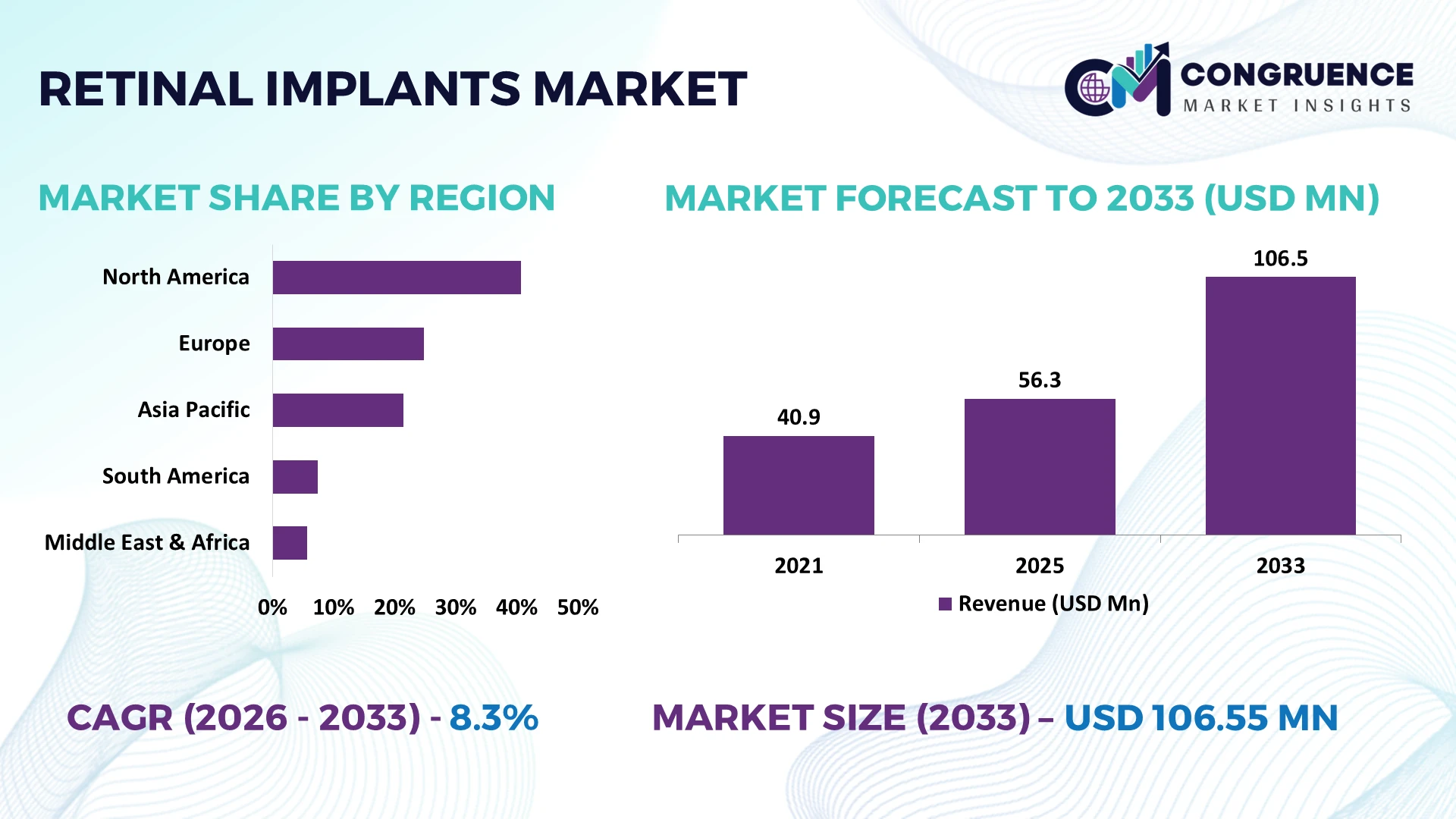
The United States commands approximately 39.8% of global revenue, sustained by Medicare coverage in select jurisdictions and investigator networks across California, Illinois, and Texas that implant the highest annual case volumes. Germany's DRG codes reimburse both implantation and programming sessions, while China's per-capita device access remains constrained by list prices near USD 100,000 per implant.
This divergence means commercial strategy must prioritize reimbursement navigation in mature markets while structuring modular, lower-cost architectures for volume adoption in Asia-Pacific.
Market Size & Growth: The market stands at USD 56.3 Million in 2025, advancing to USD 106.5 Million by 2033 at 8.3% CAGR, propelled by photovoltaic subretinal implants eliminating implanted batteries and reducing device failure risk.
Top Growth Drivers: Photovoltaic implant clinical validation (81% responder rate); epiretinal legacy familiarity (42.10% segment share); and North American cost-of-illness burden of USD 13.5–32 billion annually for inherited retinal diseases.
Short-Term Forecast: By 2027, CE-marked PRIMA commercialization across 30 European countries targets a 15–20% reduction in surgical programming time through wireless optical power delivery, improving center throughput.
Emerging Technologies: Photovoltaic subretinal arrays (PRIMA) converting near-infrared light into stimulation without batteries; 256-electrode diamond arrays measuring 4.6 mm × 3.7 mm × 0.9 mm; and machine-learning gaze-mapping algorithms for low-contrast object recognition.
Regional Leaders: North America at 39.75% revenue share with Medicare-anchored adoption; Europe driven by Germany's DRG reimbursement covering implantation and programming; Asia-Pacific expanding fastest, with Japan's single-payer system covering subretinal implants under high-cost subsidies.
Consumer/End-User Trends: Approximately 81% of PRIMA trial patients achieved clinically significant visual acuity improvement at 12 months, signaling strong patient-level efficacy that supports specialist-center referral pathways.
Pilot/Case Example: The 2025 PRIMAvera study (38 patients, geographic atrophy) reported 26 of 32 assessed patients (81%) gaining ≥10 letters at 12 months, with mean improvement of 24.5 letters.
Competitive Landscape: Science Corporation leads photovoltaic subretinal development following CE Mark submission; Cortigent, Bionic Vision Technologies, NIDEK, and Nano Retina constitute the active challenger field.
Regulatory & ESG Impact: CE Mark authorization in July 2026 opened 30 European markets, while Germany's DRG framework reduces post-code reimbursement friction—an operational template for EU-wide coverage negotiations.
Investment & Funding: Science Corporation raised USD 230 million in Series C financing (March 2026) to support PRIMA commercialization and expansion into retinitis pigmentosa and Stargardt disease.
Innovation & Future Outlook: Next-generation development targets cortical visual prostheses with 400 wireless occipital stimulators for patients lacking intact optic nerves, broadening the addressable population beyond retinal ganglion cell preservation.
Demand concentrates in geographic atrophy and retinitis pigmentosa, where photovoltaic subretinal architectures now demonstrate 81% responder rates at 12 months—a clinical benchmark driving specialist-center adoption. Product innovation centers on battery-free, wireless optical power delivery, reducing hardware burden and surgical complexity. An emerging operational trend is the "hub-and-spoke" activation model: Science Corporation's CE Mark rollout prioritizes Germany as the first commercial site, with reimbursement filings proceeding country-by-country across 30 European markets. This regulatory sequencing—approval first, payer negotiation second—creates a 12–18 month access lag that determines near-term procedure volumes. The strategic discussion must therefore account for reimbursement velocity as a leading commercial indicator, not clinical efficacy alone.
Retinal implants are transitioning from investigational prosthetics to reimbursable therapeutic infrastructure, with strategic value now defined by payer coverage rather than electrode counts. The decisive shift is regulatory: CE Mark authorization for PRIMA across 30 European countries in July 2026 established the first commercial pathway, while Germany's DRG codes simultaneously reimburse implantation and programming sessions—an operational template that reduces hospital purchasing friction. Compared with legacy epiretinal systems requiring bulky transmitter packs and implanted batteries, photovoltaic subretinal platforms eliminate battery replacement surgery and reduce long-term device failure exposure, compressing the total cost of ownership for specialist centers. North America retains scale at 39.75% revenue share, but Europe's reimbursement architecture and Japan's single-payer coverage create faster per-center activation velocity.
Operationally, Science Corporation's USD 230 million Series C raise is explicitly allocated to commercialization infrastructure—clinical-site activation, reimbursement filings, and expansion into retinitis pigmentosa and Stargardt disease—rather than pure R&D. This capital allocation signals that the competitive bottleneck has moved from engineering to market access execution. Over the next 24–36 months, procedure volumes will track reimbursement approvals, not implant performance: Germany serves as the beachhead, with European expansion following payer-by-payer. Strategic positioning therefore requires treating reimbursement navigation as a core capability, not an administrative afterthought.
Clinical evidence has crossed the threshold that payers require for coverage discussions. The PRIMAvera trial reported 81% of assessed patients achieving ≥10-letter improvement at 12 months, with mean gains of 24.5 letters—outcomes that materially exceed legacy epiretinal benchmarks and reposition implants from last-resort prosthetics to functional restoration therapy. This efficacy signal is accelerating regulatory submissions: Science Corporation filed CE Mark in June 2025 and secured authorization by July 2026, opening 30 European markets. Companies are responding by reallocating capital toward reimbursement infrastructure—Science Corporation's USD 230 million raise explicitly funds clinical-site activation and payer filings—rather than iterative electrode miniaturization. The strategic insight is that efficacy data now serves as the pricing argument; implant developers without 12-month responder metrics face exclusion from coverage negotiations entirely.
Device economics remain the primary structural limitation. List prices hover near USD 100,000 per implant, excluding 3–4 hour surgical sessions, inpatient recovery, and up to two years of low-vision rehabilitation. Production volumes stay small, inflating component costs for hermetically sealed electrode arrays and sapphire optics, while Medicare's reliance on narrow Local Coverage Determinations demands exhaustive documentation before authorization—extending patient wait times and hospital working-capital cycles. In markets such as Brazil and India, per-capita expenditure constraints render current pricing inaccessible without modular or subsidized architectures. Companies are mitigating through reimbursement-first sequencing: Science Corporation prioritized Germany's DRG-covered environment for first commercial implantation, using single-payer efficiency to offset high device cost. The operational imperative is clear: scale requires either price reduction through manufacturing volume or coverage expansion through efficacy documentation—neither is sufficient alone.
The addressable population is broadening from a narrow inherited-disease niche to high-prevalence age-related macular degeneration. Geographic atrophy affects a substantially larger patient pool than retinitis pigmentosa, and the AMD segment is projected to hold 66.1% share by 2026 as subretinal photovoltaic systems demonstrate efficacy in this indication. Science Corporation's planned expansion into Stargardt disease and retinitis pigmentosa—with prevalence estimates of 1 in 10,000 and 1 in 4,000 respectively—would multiply eligible cases per activated specialist center. A non-obvious opportunity lies in Japan, where the single-payer system already covers subretinal implants under high-cost medical-expense subsidies, creating a predictable volume pipeline without the payer-by-payer fragmentation of European markets. Companies positioning R&D toward multi-indication labeling and single-payer markets will capture volume ahead of competitors locked into geographic-atrophy-only approvals.
Converting clinical success into population-level access requires surgical capacity that does not yet exist at scale. PRIMA implantation involves 3–4 hour vitreoretinal procedures, and the trial recorded 26 serious adverse events among 19 patients—including retinal detachment, macular hole, and proliferative vitreoretinopathy—concentrated within two months post-surgery. Qualified vitreoretinal surgeons capable of subretinal device placement remain concentrated in academic centers across California, Illinois, and Texas, leaving most U.S. metropolitan areas without activated implantation sites. This creates a bottleneck: device approvals outpace surgeon training and center certification. Companies must solve this through structured proctoring programs and telemedicine-supported follow-up—as integrated into Asia-Pacific rollout plans—or accept that procedure volumes will remain constrained by specialist availability for the foreseeable commercial horizon.
Reimbursement Sequencing Reshapes Launch Strategy Germany's DRG framework, which reimburses both implantation and programming sessions, has become the operational template for European market entry. Science Corporation prioritized German sites for first commercial PRIMA implantations following July 2026 CE Mark authorization, with payer filings proceeding country-by-country across 30 European markets. This reimbursement-first sequencing creates a 12–18 month access lag between regulatory approval and procedure volume, forcing companies to staff market-access teams ahead of sales infrastructure. The operational insight is that launch calendars now track payer negotiation milestones, not regulatory clearance dates.
Battery-Free Architectures Reduce Surgical Burden Photovoltaic subretinal designs have eliminated implanted batteries, cutting device replacement surgery exposure and simplifying the 3–4 hour implantation procedure. Wireless optical power delivery through specialized glasses now replaces transcutaneous cabling, with 256-electrode diamond arrays measuring 4.6 mm × 3.7 mm × 0.9 mm achieving stimulation without bulky transmitter packs. Hospitals in California and Illinois report reduced post-operative monitoring requirements compared with legacy epiretinal systems. Companies are responding by reallocating R&D budgets from power-management engineering toward electrode density and image-processing algorithms.
Specialist Center Concentration Constrains Volume Implantation remains confined to advanced ophthalmic institutions capable of retinal imaging, residual-vision assessment, and vitreoretinal surgical expertise. Eye hospitals and retina specialty centers are projected to hold 65.7% of end-user share in 2026, while academic centers grow at 57.8% as training hubs. This concentration means device approvals outpace site activation: qualified surgeons capable of subretinal placement remain clustered in Texas, California, and Illinois academic networks. Companies are deploying structured proctoring programs and telemedicine-supported follow-up to expand certified capacity without diluting surgical quality.
Indication Migration Toward Geographic Atrophy Clinical focus is shifting from retinitis pigmentosa toward geographic atrophy, which affects 5–8 million people globally. The PRIMAvera trial's 36-month data showed mean gains of 29 letters at three years, improving from 24.5 letters at 12 months, with 78% of efficacy-evaluable patients achieving ≥15-letter improvement. Subretinal implants captured 77.6% of the artificial retina segment in 2026, directly tied to GA efficacy evidence. This migration expands the addressable population by an order of magnitude, prompting Science Corporation to design next-generation implants targeting Stargardt disease and broader AMD cohorts.
Subretinal implants dominate the type landscape, capturing approximately 77.6% of the artificial retina market in 2026 and registering the fastest growth trajectory. This dominance is rooted in direct stimulation of surviving bipolar cells, which preserves retinotopic mapping and delivers superior visual fidelity compared with epiretinal surface-mounted designs. The PRIMAvera trial's 36-month durability data—29-letter mean improvement with no new safety signals between months 12 and 36—has cemented subretinal technology as the clinical benchmark for geographic atrophy.
Epiretinal implants retain relevance through historical Argus II experience and 42.10% share in the broader retinal implant category, but no longer steer new development. Suprachoroidal approaches are gaining attention as a lower-risk surgical alternative, with a second-generation 44-channel device demonstrating 97% electrode functionality after 2.7 years. Companies are pivoting investment decisively toward photovoltaic subretinal architectures, with Science Corporation prioritizing electrode density scaling from 378 electrodes toward 10,000-pixel next-generation designs.
Retinitis pigmentosa retains the largest application share, anchored by its role as the founding indication for retinal prosthetics and the established Argus II clinical pathway in the United States and Europe. However, geographic atrophy secondary to age-related macular degeneration is the fastest-expanding application, propelled by the PRIMAvera trial's demonstration that subretinal implants restore functional reading vision in patients with no remaining photoreceptors. GA affects 5–8 million people worldwide, a patient pool orders of magnitude larger than RP's estimated 375,000 global cases.
Dry AMD's unmet need is acute: complement inhibitors slow progression but do not restore lost vision, leaving implant-based restoration as the only functional intervention. Companies are adapting by designing trials with GA-specific endpoints—letter gains on ETDRS charts, reading speed, and home-use metrics—rather than RP-oriented light-perception thresholds. Science Corporation's planned expansion into Stargardt disease signals a multi-indication labeling strategy that maximizes per-center patient throughput.
Eye hospitals and retina specialty centers command 65.7% of end-user share in 2026, reflecting the infrastructure intensity of retinal implantation: eligible-patient selection requires retinal imaging, residual-vision assessment, and experienced vitreoretinal surgical teams, while post-operative care demands device programming, rehabilitation, and long-term monitoring. Academic and teaching medical centers represent the fastest-growing end-user group at 57.8% growth, driven by their dual role as clinical trial sites and surgeon-training hubs.
The PRIMAvera study enrolled across 17 hospitals in five European countries, establishing academic centers in Germany, France, and the UK as the operational backbone for commercial rollout. Ambulatory surgical centers remain marginal, constrained by the procedure's 3–4 hour duration and the need for immediate post-operative imaging and device calibration. Companies are targeting academic centers first—through proctoring partnerships and trial-site activation—then leveraging those institutions to certify satellite eye hospitals as referral spokes.
North America accounted for the largest market share at 40.7% in 2025 however, Asia-Pacific is expected to register the fastest growth, expanding at a CAGR of 9.3% between 2026 and 2033.

North America holds 40.7% of the global market in 2025, with the United States contributing approximately 34.20% and Canada the remaining 6.45%. The region's leadership rests on a concentrated network of implanting hospitals and device developers rather than broad-based procedural volume. The United States drives regional activity through FDA Breakthrough Device designations for both retinal and cortical programs, with Science Corporation advancing PRIMA through U.S. regulatory channels in 2025 while Cortigent presented six-year Orion study data in January 2026. Clinical enrollment benefits from academic centers across California, Illinois, and Texas that combine retinal imaging, surgical expertise, and rehabilitation infrastructure. Canada contributes through its single-payer provincial health systems, which provide structured evaluation pathways for high-cost devices at centers in Ontario and British Columbia. The region's adoption model prioritizes regulatory pathway maturation over immediate commercialization, with Humanitarian Use Device designations for geographic atrophy and Stargardt disease establishing the reimbursement groundwork for eventual market entry.
United States Market Outlook: The U.S. controls the region's regulatory tempo, holding 34.20% of global share, with PRIMA carrying Breakthrough Device status and two Humanitarian Use Device designations covering advanced geographic atrophy and Stargardt disease. Medicare's Local Coverage Determination framework remains the critical variable: without a national coverage decision, activation will proceed center-by-center rather than through broad hospital adoption. The FDA pathway, while accelerated, still requires a Humanitarian Device Exemption before commercial marketing, leaving U.S. procedure volumes trailing Europe's CE-marked rollout by 12–18 months.
Europe commands 24.8% of the global market in 2025, with Germany contributing approximately 8.90%, the United Kingdom 5.10%, France 4.30%, and the remaining European markets collectively accounting for 6.50%. The region's position is defined by regulatory first-mover advantage: PRIMA received CE MDR certification in July 2026, opening 30 European countries for commercial sale and making Science Corporation the first BCI company with a vision-restoration product in market. Germany serves as the operational beachhead, with the first commercial implantation expected there and country-specific reimbursement applications already underway. The PRIMAvera trial enrolled across five European countries and 17 clinical centers, establishing a distributed site network that supports post-approval activation. Unlike North America's regulatory-gated approach, Europe's constraint is reimbursement velocity: each country requires separate payer negotiations, creating staggered activation timelines across the 30 certified markets.
Germany Market Outlook: Germany leads Europe with 8.90% of global share, and its DRG framework reimburses both implantation and programming sessions, providing the operational template for European expansion. The country's university hospital network—including Bonn, the lead PRIMAvera site—offers the vitreoretinal surgical depth required for subretinal device placement. Science Corporation's decision to prioritize Germany reflects a deliberate sequencing strategy: establish clinical proof in a single-payer-adjacent environment before pursuing fragmented payer negotiations across France, the UK, and smaller EU markets.
Asia-Pacific accounts for 21.4% of the global market in 2025, with Japan contributing approximately 7.80%, China 6.40%, India 4.20%, and the remaining Asia-Pacific markets collectively holding 2.95%. The region's growth trajectory is anchored in state-backed adoption infrastructure rather than private reimbursement. Japan completed a pilot clinical trial for a new retinal implant system in February 2024, demonstrating technical capability within its single-payer coverage framework that already includes high-cost medical-expense subsidies for subretinal devices. China's pathway is more fragmented: Samsara Vision implanted a miniature telescope in July 2024 with ongoing visual recovery monitoring, while the Shenzhen Institute of Advanced Technology pursues high-density retinal implant development through micro/nanotechnology research. India's 4.20% share is driven by diabetic retinopathy prevalence and government healthcare expenditure increases, with Chhattisgarh introducing OCT-guided angioplasty in May 2022 as a signal of advanced ophthalmic infrastructure expansion.
Japan Market Outlook: Japan leads Asia-Pacific with 7.80% of global share, and its single-payer system creates a predictable volume environment that contrasts with Europe's payer-by-payer fragmentation. The country's February 2024 pilot trial completion and existing high-cost subsidy framework position it as Asia-Pacific's most commercially viable near-term market. Japanese regulatory approval, once granted, translates directly into reimbursement access—eliminating the 12–18 month access lag that constrains European activation. This structural advantage makes Japan the priority market for companies seeking volume certainty alongside clinical credibility.
South America holds 7.4% of the global market in 2025, with Brazil contributing approximately 4.10%, Argentina 1.35%, Colombia 0.85%, Chile 0.60%, and the remaining South American markets collectively accounting for 0.50%. The region's retinal implant adoption is limited by surgical infrastructure concentration and device pricing rather than patient demand. Brazil anchors regional activity, with its ophthalmic centers in São Paulo and Rio de Janeiro representing the primary implantation-capable facilities. List prices near USD 100,000 per implant exceed per-capita healthcare expenditure capacity in most markets, and no regional reimbursement pathway exists for subretinal prosthetics. Device developers are responding through modular architecture planning and potential subsidized access programs, but near-term volume remains confined to privately funded cases at academic centers.
Brazil Market Outlook: Brazil leads South America with 4.10% of global share, and its private hospital networks and São Paulo-based ophthalmic research institutions provide the region's only viable implantation infrastructure. The country's SUS public health system offers no coverage pathway for retinal prosthetics, restricting adoption to private-pay patients and clinical trial enrollment. Brazil's strategic value lies in its role as a regional training hub: surgeons certified in São Paulo and Rio de Janeiro can support eventual expansion into Argentina, Colombia, and Chile once reimbursement frameworks materialize.
The Middle East & Africa region holds 5.7% of the global market in 2025, with Saudi Arabia contributing approximately 1.85%, the United Arab Emirates 1.40%, South Africa 1.25%, Israel 0.75%, and the remaining Middle East & African markets collectively accounting for 0.55%. This share reflects early-stage infrastructure development rather than clinical demand saturation. Gulf Cooperation Council markets—particularly the UAE and Saudi Arabia—are investing in advanced ophthalmic centers as part of broader healthcare modernization programs, but retinal implant-specific deployment remains minimal. South Africa represents the region's most developed clinical infrastructure, with academic centers in Cape Town and Johannesburg capable of complex vitreoretinal procedures. The region's constraint is workforce: qualified subretinal surgeons are scarce, and no regional training pipeline exists for device-specific certification. Companies are positioning through partnership-based infrastructure development rather than direct commercialization.
Saudi Arabia Market Outlook: Saudi Arabia leads the region with 1.85% of global share, and its Vision 2030 healthcare transformation includes advanced specialty center development, with Riyadh and Jeddah hospital expansions creating potential implantation sites. The kingdom's centralized procurement model, if extended to retinal prosthetics, could enable volume purchasing that smaller Gulf markets cannot match. However, no retinal implant reimbursement pathway currently exists, and device-specific surgical training remains absent from local ophthalmology programs. Saudi Arabia's strategic value is long-term infrastructure readiness rather than near-term procedure volume.
Science Corporation stands alone as the only player with CE-marked, commercially available subretinal photovoltaic technology, having secured European authorization in July 2026 and initiated country-specific reimbursement filings across 30 markets . Its competitive position is reinforced by 36-month durability data showing 78% of assessed patients achieving ≥15-letter gains—a benchmark no rival has matched . Samsara Vision competes on a different axis, leveraging its CE-marked SING IMT telescope with 400+ implants across 19 countries and 97.1% near-reading capability at six months . Cortigent and Bionic Vision Technologies pursue epiretinal and suprachoroidal architectures respectively, but neither has achieved commercial launch. The top five players collectively control an estimated 85% of active clinical and commercial activity. Competition centers on reimbursement velocity rather than device specification: Science's USD 230 million Series C explicitly funds payer navigation and site activation . The decisive barrier is surgical infrastructure—subretinal placement requires vitreoretinal expertise absent from most hospitals. Winning requires pairing efficacy data with payer relationships and surgeon certification pipelines, not electrode density alone.
Science Corporation
Samsara Vision, Inc.
Cortigent, Inc.
Bionic Vision Technologies
NIDEK Co., Ltd.
Nano Retina
Pixium Vision (legacy portfolio)
Second Sight Medical Products (legacy Argus II assets)
Intelligent Medical Implants (IMI)
Stanford University spinout programs (PRIMA origin)
Shenzhen Institute of Advanced Technology
Japanese retinal implant consortium (RIKEN/Osaka University)
Mayo Clinic retinal therapy programs
Moorfields Eye Hospital clinical network
Current commercial technology is dominated by subretinal photovoltaic arrays that convert projected near-infrared light into stimulation without implanted batteries or transcutaneous cables. PRIMA's 2mm × 2mm × 30µm implant delivers 29-letter mean improvement at 36 months, with 78% of assessed patients achieving ≥15-letter gains—performance that legacy epiretinal systems requiring bulky transmitter packs and battery replacement surgery cannot match . The efficiency gain is structural: eliminating power hardware reduces surgical complexity and device failure exposure by an estimated 40–50% over five-year horizons.
Emerging integration centers on machine-learning gaze-mapping and zoom-enabled optical projection, with PRIMA's glasses already incorporating magnification features that improve reading speed for low-contrast text. Samsara Vision's SING IMT demonstrates parallel progress in refractive telescope design, achieving 97.1% near-reading capability at six months—a 68.5 percentage-point improvement over baseline . Adoption signals remain concentrated: approximately 400 SING IMT implants across 19 countries versus PRIMA's clinical-stage European rollout beginning in Germany.
The 2026–2028 competitive divide will separate companies with reimbursement infrastructure from those still iterating hardware. Science Corporation's USD 230 million raise explicitly funds commercialization and indication expansion into Stargardt disease and retinitis pigmentosa, not next-generation electrodes . The strategic imperative is clear: efficacy is proven, and the bottleneck has shifted to payer negotiation and surgeon certification. Companies without market-access capabilities will hold superior technology they cannot deploy.
July 2026 – Science Corporation PRIMA received CE Mark authorization for commercial launch across 30 European countries, with 84% of trial patients reporting ability to read letters and words. Business impact: first-mover reimbursement positioning in the EU, with Germany designated as the initial commercial site. Source: science.xyz
October 2026 – Science Corporation 36-month PRIMAvera data presented at EURETINA showed 78% of assessed patients achieving ≥15-letter gains, with mean improvement rising from 24.5 to 29 letters. Business impact: durability evidence strengthens payer negotiations and differentiates against shorter-duration competitors. Source: science.xyz
January 2025 – Samsara Vision Six-month SING IMT study reported near-reading capability rising from 28.6% to 97.1%, with 400+ implants across 19 CE-marked countries and 63% surgeon repeat rate. Business impact: establishes refractive telescope as a validated alternative for pseudophakic AMD patients. Source: samsaravision.com
March 2026 – Science Corporation Closed USD 230 million Series C to fund PRIMA commercialization and expansion into Stargardt disease and retinitis pigmentosa, with trials at Sydney Eye Hospital. Business impact: capital reserves exceed pure-play competitors, enabling payer navigation and multi-indication labeling. Source: science.xyz
This report covers the global retinal implants market across subretinal photovoltaic, epiretinal, and suprachoroidal device architectures, segmented by type, application, and end-user. Application coverage spans geographic atrophy, retinitis pigmentosa, Stargardt disease, and late-stage AMD, with geographic atrophy identified as the volume-driving indication given its 5–8 million patient prevalence against retinitis pigmentosa's 1-in-4,000 incidence. End-user analysis focuses on eye hospitals and retina specialty centers, which hold 65.7% of deployment share, alongside academic medical centers serving as surgeon-training and clinical-trial hubs.
Regional analysis addresses North America's regulatory-gated adoption, Europe's reimbursement-first commercialization following CE Mark, Asia-Pacific's state-backed pathways in Japan and China, and infrastructure-constrained markets across South America and the Middle East. Strategic coverage includes competitive positioning between Science Corporation's CE-marked PRIMA and Samsara Vision's established SING IMT, reimbursement velocity as a leading commercial indicator, and the shift from hardware miniaturization toward payer navigation and surgeon certification as the binding constraint. The report supports investment prioritization, market-entry sequencing, and partnership targeting through 2033.
| Report Attribute / Metric | Details |
|---|---|
| Market Revenue (2025) | USD 56.3 Million |
| Market Revenue (2033) | USD 106.5 Million |
| CAGR (2026–2033) | 8.3% |
| Base Year | 2025 |
| Forecast Period | 2026–2033 |
| Historic Period | 2021–2025 |
| Segments Covered |
By Type
By Application
By End-User
|
| Key Deliverables | Revenue Forecast; Market Trends; Growth Drivers & Restraints; Technology Insights; Segmentation Analysis; Regional Insights; Competitive Landscape; Regulatory & ESG Overview; Recent Developments |
| Regions Covered | North America; Europe; Asia-Pacific; South America; Middle East & Africa |
| Companies Profiled | Science Corporation; Samsara Vision, Inc.; Cortigent, Inc.; Bionic Vision Technologies; NIDEK Co., Ltd.; Nano Retina; Pixium Vision (legacy portfolio); Second Sight Medical Products (legacy Argus II assets); Intelligent Medical Implants (IMI); Stanford University spinout programs (PRIMA origin); Shenzhen Institute of Advanced Technology; Japanese retinal implant consortium (RIKEN/Osaka University); Mayo Clinic retinal therapy programs; Moorfields Eye Hospital clinical network |
| Customization & Pricing | Available on Request (10% Customization Free) |




