
Reports
The Global Retail Clinics Market was valued at USD 6,704.3 Million in 2025 and is anticipated to reach a value of USD 12,876.3 Million by 2033 expanding at a CAGR of 8.5% between 2026 and 2033. Growth is being driven by pharmacy-based primary-care expansion, virtual consultation integration, preventive screening, and retailer-led healthcare delivery that shifts routine treatment away from capacity-constrained physician practices.
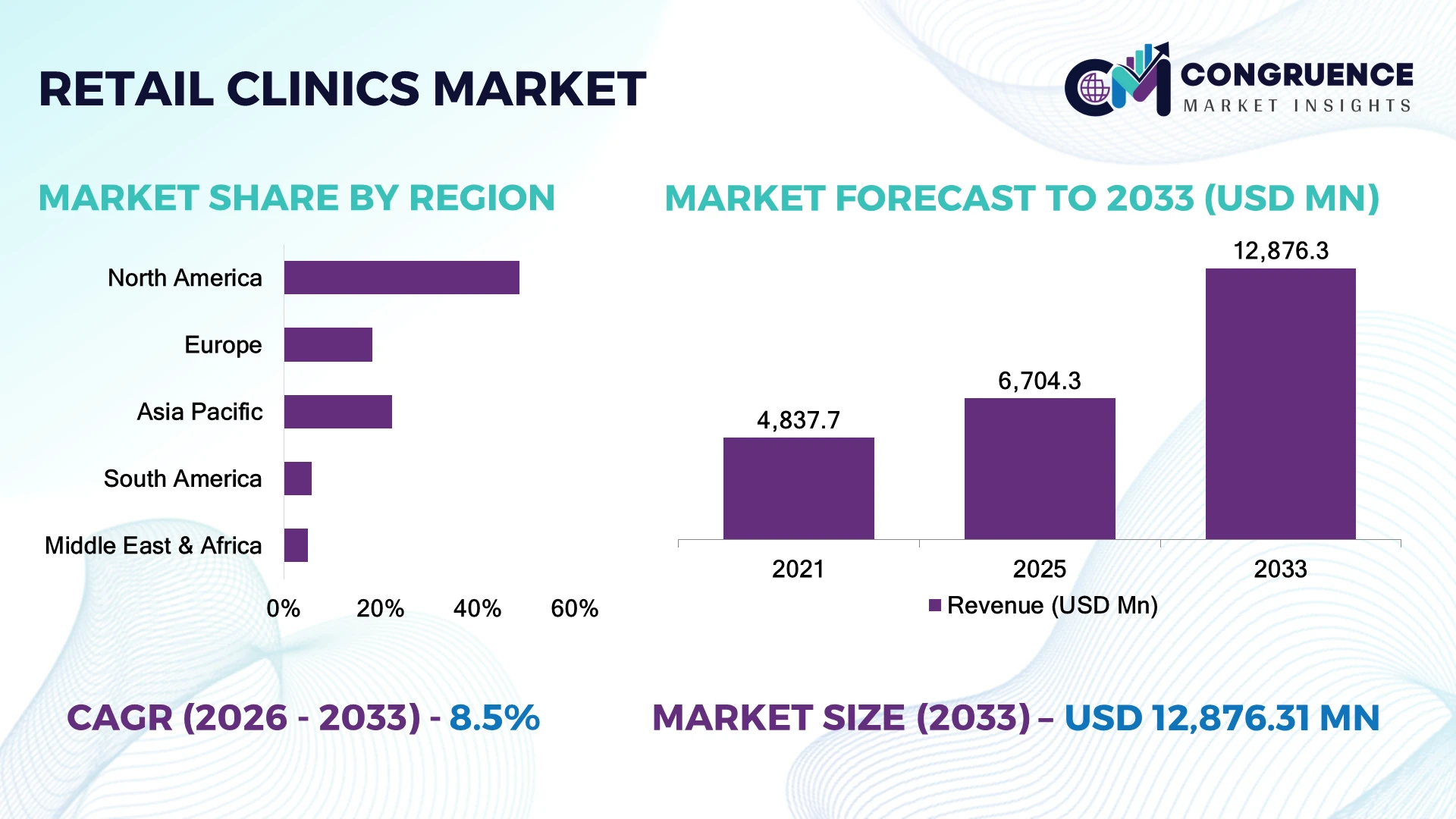
The United States remains the dominant country, supported by extensive pharmacy infrastructure and established retail-health networks, with retail clinic utilization reaching about 19% of adults in recent U.S. surveys and higher usage among older consumers. Canada has a smaller organized footprint, while U.S. operators continue investing in digital triage, connected diagnostics, and pharmacy-linked care. Geopolitical pressure on healthcare labor availability is accelerating interest in lower-intensity care settings and workflow automation.
Strategic priority is shifting toward hybrid clinic networks that combine physical access, digital care, diagnostics, and pharmacy fulfillment.
Market Size & Growth: USD 6,704.3 million in 2025 and USD 12,876.3 million by 2033, with pharmacy integration and hybrid care delivery strengthening clinic utilization.
Top Growth Drivers: Primary-care accessibility 25%; preventive services 22%; digital-health integration 18%.
Short-Term Forecast: By 2028, automated intake and scheduling can reduce administrative workload by 15% while improving clinician utilization by approximately 10%.
Emerging Technologies: AI-assisted triage, connected diagnostics, remote monitoring, and interoperable patient records are reshaping retail-clinic workflows.
Regional Leaders: North America leads organized deployment; Europe emphasizes integrated pharmacy care; Asia-Pacific accelerates digitally enabled neighborhood healthcare models.
Consumer/End-User Trends: Approximately 19% of U.S. adults reported retail-health-clinic use, with utilization reaching about 25% among adults aged 65 and older.
Pilot/Case Example: 2026 hybrid-care deployments are combining virtual consultations with physical examination points, targeting approximately 10% faster patient throughput.
Competitive Landscape: Large pharmacy-healthcare operators hold the strongest scale positions, while grocery retailers, independent clinics, insurers, and digital-health providers compete through convenience and integration.
Regulatory & ESG Impact: Expanded practitioner scope and preventive-care pathways increase accessible service capacity while reducing unnecessary use of higher-cost clinical facilities.
Investment & Funding: Major operators are prioritizing technology-enabled clinic networks, with leading platforms maintaining footprints exceeding 1,000 walk-in and primary-care locations.
Innovation & Future Outlook: AI triage, point-of-care diagnostics, chronic-care monitoring, and pharmacy-linked treatment pathways are moving retail clinics toward integrated ambulatory-care hubs.
The Retail Clinics Market is increasingly concentrated around preventive care, vaccinations, minor acute treatment, chronic-condition monitoring, diagnostic services, and pharmacy-linked consultations. Approximately 19% of U.S. adults have used retail health clinics, demonstrating that convenience-based care has developed into an established access channel. In 2026, operators are strengthening hybrid models that combine physical examination capacity with virtual clinicians, digital intake, electronic records, and prescription fulfillment. The emerging shift is toward higher-value longitudinal care rather than isolated episodic visits, creating opportunities for operators that can integrate diagnostics, patient data, and pharmacy services into one workflow.
Retail clinics are becoming strategically important because healthcare providers, pharmacy chains, retailers, and insurers are competing for routine-care encounters that can be delivered faster and closer to consumers. Their strategic value lies in converting existing retail infrastructure into healthcare access points while using digital workflows to increase utilization without proportional facility expansion. Approximately 19% of U.S. adults have used retail health clinics, establishing a meaningful consumer base for this delivery model.
The operating model is shifting from appointment-dependent care toward hybrid access. Digital registration, automated triage, electronic records, and remote clinician support can reduce administrative processing time by roughly 15% compared with fragmented manual workflows. The United States maintains the strongest organized footprint, while European markets emphasize pharmacy integration and several Asian markets prioritize digitally enabled neighborhood healthcare.
Over the next 2–3 years, leading operators are expected to prioritize connected diagnostics, chronic-care monitoring, virtual consultations, and pharmacy-linked treatment pathways. Large U.S. networks already exceed 1,000 clinic locations, providing substantial advantages in procurement, workforce allocation, technology deployment, and patient-data integration. Competitive leadership will depend on turning high-footfall locations into scalable, clinically integrated care platforms rather than operating standalone walk-in clinics.
Pharmacy-integrated primary care is strengthening retail-clinic utilization as healthcare systems face physician shortages and appointment bottlenecks. In the United States, approximately 19% of adults have used retail health clinics, while utilization among adults aged 65 and older approaches 25%. Digital scheduling and virtual consultation capabilities can increase clinician utilization by around 10%, allowing operators to serve more patients without proportional facility expansion. Scope-of-practice changes are also enabling pharmacists and advanced practitioners to deliver broader services. Operators are responding by expanding clinic footprints, embedding telehealth, integrating prescription fulfillment, and deploying connected diagnostics. The strategic shift is significant: high-footfall pharmacies increasingly function as distributed ambulatory-care infrastructure rather than simple walk-in treatment points.
Retail-clinic scalability remains constrained by clinician availability, wage pressure, and uneven healthcare infrastructure. Labor can represent more than 50% of clinic operating expenditure, while administrative activities can consume 15%–25% of clinical workflow time in fragmented environments. In the United States, higher compensation requirements for nurse practitioners and physician assistants increase the cost of maintaining extended operating hours. Smaller markets also face limited practitioner availability, making consistent staffing difficult. These pressures directly affect clinic margins, hours of operation, and geographic expansion economics. Operators are mitigating exposure through centralized scheduling, flexible staffing pools, virtual clinicians, and technology-assisted triage. A non-obvious advantage is that hybrid staffing models allow high-volume sites to preserve physical capacity while shifting selected consultations to lower-cost digital workflows.
Hybrid retail clinics create a high-value opportunity by combining physical examination, virtual consultations, pharmacy services, and point-of-care diagnostics. Automated intake can reduce administrative processing by approximately 15%, while connected diagnostic workflows can improve clinical throughput by around 10%. In the United States, pharmacy networks provide a ready-made infrastructure for scaling these services without constructing entirely new healthcare facilities. Emerging AI-assisted triage can further prioritize patients before clinician interaction, improving queue management and resource allocation. Operators are investing in digital platforms, remote-care partnerships, and compact diagnostic equipment to expand service breadth. The strongest opportunity lies beyond minor acute treatment: converting retail locations into neighborhood access hubs for preventive screening, medication management, and chronic-condition monitoring creates recurring patient relationships and higher asset utilization.
Long-term retail-clinic competitiveness depends on integrating clinical systems, pharmacy records, diagnostic devices, and payer workflows without compromising data security or care continuity. Fragmented systems can create 10%–20% additional administrative handling in multi-platform environments, while cybersecurity incidents can trigger costly operational disruption and patient-trust erosion. In the United States, interoperability requirements increasingly push operators toward standardized electronic health-record interfaces and stronger identity management. Workforce training adds another layer because clinicians must operate both conventional clinical systems and digitally enabled diagnostic platforms. Companies are responding through API-based integration, standardized data architectures, cybersecurity investment, and partnerships with healthcare technology providers. The strategic pressure is to build interoperable infrastructure before expanding aggressively; otherwise, rapid clinic rollout can amplify operational complexity faster than patient capacity.
Hybrid Care Models Expand: U.S. retail operators are combining in-person visits with virtual consultations, with digital workflows capable of reducing administrative handling by about 15% and improving clinician utilization by nearly 10%. Scope-of-practice expansion is accelerating this transition, prompting operators to redesign clinics around blended staffing and remote-care support.
Diagnostics Move Closer Patients: Point-of-care testing, connected vital-sign devices, and digital diagnostic platforms are moving beyond specialized facilities into retail settings. Deployment of connected workflows can improve processing speed by approximately 10%–15%, reducing referral friction. Operators are partnering with technology providers and expanding compact diagnostic capabilities rather than adding conventional examination rooms.
Chronic Care Gains Importance: Retail clinics are increasingly supporting medication adherence, monitoring, preventive screening, and recurring chronic-condition services. Older U.S. consumers show retail-clinic utilization approaching 25%, creating a commercially important patient segment beyond episodic minor illness. Operators are developing longitudinal care pathways and pharmacy-linked follow-up programs to increase repeat utilization.
AI Reshapes Front-End Workflows: AI-assisted symptom intake, appointment routing, documentation support, and queue prioritization are entering retail-clinic operations, with automated processes targeting 10%–20% reductions in manual administrative workload. The non-obvious shift is that AI is being deployed first around workflow coordination rather than autonomous diagnosis, allowing operators to scale clinical capacity while preserving practitioner oversight.
Retailer-Owned Clinics Lead While Hybrid Models Accelerate
Retailer-owned clinics represent the leading type, estimated at approximately 39% of the global market, benefiting from established store footprints, pharmacy integration, procurement leverage, and direct consumer traffic. Hospital-owned and independent clinics remain strategically relevant where clinical referral networks and physician-led continuity are stronger, but they generally lack the same retail-access advantages. Retailer-owned operators also achieve greater scalability because existing facilities reduce incremental site-acquisition requirements. Companies are increasingly integrating pharmacy, diagnostics, scheduling, and digital records to improve asset utilization and patient retention.
Hybrid and digitally enabled retail-clinic models are the fastest-growing format, with adoption estimated to expand toward 25% of new deployments as operators combine physical examination capacity with virtual consultations. Independent clinics remain important in underserved communities, while hospital-linked models emphasize continuity and higher-acuity referrals. The key investment shift is toward flexible formats that can add services without materially increasing real-estate intensity, making technology integration a stronger competitive differentiator than footprint alone.
The U.S. National Center for Health Statistics reported in 2026 that 19.0% of people had visited a retail health clinic during 2024, while usage was higher in large metropolitan settings, confirming the concentration advantage of established retail-access networks.
Preventive Care Establishes the Core Demand Base
Preventive care is the leading application, estimated at approximately 45% share, supported by vaccinations, routine screening, health assessments, and medication-related services that fit naturally into pharmacy and retail workflows. Acute care follows at roughly 40%, retaining strong demand for minor illnesses and uncomplicated conditions because consumers value same-day access. Diagnostic services account for approximately 15% but represent the fastest-growing application as point-of-care testing and connected devices allow clinics to complete more encounters without external referrals. Operators are therefore shifting investment toward diagnostic capability rather than simply adding examination rooms.
Chronic-condition management is increasingly integrated into preventive and diagnostic workflows, particularly where pharmacy records support medication adherence and follow-up. Acute-care demand remains mature, while preventive and diagnostic services create stronger recurring utilization. Companies are expanding connected testing, automated intake, and pharmacist-clinician collaboration to improve throughput by an estimated 10%–15%. The business implication is clear: clinics generating repeat preventive and monitoring encounters offer better utilization economics than models concentrated exclusively on episodic illness treatment.
The 2026 National Health Interview Survey found that 19.0% of people in the United States had at least one retail health clinic visit in the previous 12 months, demonstrating substantial utilization of retail-based ambulatory care.
Retail Chains Remain the Dominant Buyer Group
Retail chains represent the leading end-user group, estimated at approximately 50% share, because they control high-footfall locations, pharmacy infrastructure, procurement systems, and consumer relationships. Healthcare systems and hospital networks remain important buyers where retail clinics function as referral gateways into broader care ecosystems, while standalone operators compete through local responsiveness and lower organizational complexity. Retail chains can achieve stronger deployment density and centralized technology management, making them better positioned for multi-site expansion. Operators are increasingly bundling clinic services with pharmacy fulfillment, digital scheduling, and diagnostic capabilities to increase patient lifetime value.
Healthcare systems constitute the fastest-growing strategic end-user group, with adoption estimated to increase toward 20% of new institutional deployments as providers seek lower-cost access points for routine care and referral capture. Standalone clinics remain relevant in underserved markets, but their smaller purchasing scale limits technology investment. Companies are responding through co-location agreements, payer partnerships, shared clinical infrastructure, and standardized operating platforms. The competitive shift favors end-users capable of combining physical reach with integrated patient data, pharmacy access, and scalable clinical governance.
A 2026 National Center for Health Statistics analysis found that 19.0% of U.S. people had used a retail health clinic in 2024, while retail-clinic utilization was higher in large central and large fringe metropolitan areas, reinforcing the importance of location density and retail accessibility.
North America accounted for the largest market share at 48.6% in 2025 however, Asia-Pacific is expected to register the fastest growth, expanding at a CAGR of 10.1% between 2026 and 2033.

Integrated Pharmacy-Care Networks Reshape Access
North America remains the largest Retail Clinics market, supported by dense pharmacy networks, employer-sponsored healthcare, and established walk-in care infrastructure. The United States dominates regional deployment, with major operators integrating clinics, pharmacies, insurance, telehealth, and primary-care services into unified care platforms. CVS Health operated more than 1,000 walk-in and primary-care medical clinics across approximately 9,000 retail locations at the end of 2025, demonstrating the scale advantage of integrated healthcare ecosystems. Retail clinics are increasingly shifting toward chronic-condition monitoring, vaccinations, diagnostics, and digitally coordinated follow-up rather than episodic treatment alone. This model strengthens patient retention while improving utilization of existing retail footprints and clinical staff.
United States Market Outlook: The United States remains the strategic center of retail clinic deployment because pharmacy chains, insurers, employers, and technology providers operate within a highly developed healthcare ecosystem. CVS Health reported that its clinics served approximately 500,000 patients during 2025 across 246 centers in 27 states. This operating scale supports broader deployment of connected diagnostics, virtual consultations, and value-based care pathways.
Pharmacy-Led Primary Care Gains Structural Importance
Europe is shifting retail healthcare toward pharmacy-led access as governments seek to reduce pressure on conventional primary-care systems. The United Kingdom is particularly significant because Pharmacy First expanded pharmacist-led treatment for seven common conditions, integrating community pharmacies into formal care pathways. More than 5 million patients received support through high-street pharmacies for minor illnesses by May 2025, demonstrating substantial utilization of decentralized care delivery. Retail clinic models increasingly emphasize clinical triage, prescription access, preventive services, and digital referral interoperability, creating opportunities for pharmacy operators to expand beyond dispensing into broader ambulatory care.
United Kingdom Market Outlook: The United Kingdom has the strongest near-term institutional momentum, supported by national reimbursement and pharmacy-based clinical pathways. In May 2026, the government announced a £340 million pharmacy funding package and plans for nationwide independent prescribing from autumn 2026. Pharmacy First consultations increased 43% year over year to more than 3.3 million between March 2025 and February 2026. This policy direction strengthens the commercial case for technology-enabled retail healthcare formats.
High-Density Urban Care Accelerates Clinic Adoption
Asia-Pacific is becoming the fastest-scaling market as densely populated cities, pharmacy expansion, private healthcare investment, and digital health infrastructure create favorable conditions for neighborhood-based care. China, India, Japan, and Australia represent distinct deployment models, ranging from pharmacy-linked consultation formats to digitally enabled primary-care centers. India is particularly positioned for expansion because pharmacy networks increasingly combine diagnostics, teleconsultation, chronic-disease screening, and medicine fulfillment. Retail clinic operators are prioritizing compact formats that reduce real-estate requirements while increasing patient throughput, making technology integration a key differentiator in high-density urban markets.
China Market Outlook: China offers substantial strategic potential through its extensive urban healthcare infrastructure, expanding digital health ecosystem, and growing emphasis on community-level services. Retail-oriented providers are increasingly combining online consultations with physical diagnostic and pharmacy touchpoints, enabling hybrid care pathways. The strongest investment opportunity lies in interoperable platforms connecting patient records, diagnostics, prescriptions, and follow-up services rather than standalone walk-in clinics.
Pharmacy Networks Expand Community-Based Care
South America is developing retail clinic capacity through pharmacy chains, private healthcare operators, diagnostic providers, and digitally coordinated consultations. Brazil represents the principal commercial market because of its large urban population, extensive pharmacy footprint, and private healthcare ecosystem. Retail healthcare models increasingly combine point-of-care testing, vaccination, medication management, and teleconsultation, allowing providers to generate more clinical value from existing storefront infrastructure. However, fragmented reimbursement and uneven healthcare access continue to create differences between major cities and secondary markets. Operators are therefore favoring asset-light partnerships and pharmacy-integrated formats that require less capital than standalone medical facilities.
Brazil Market Outlook: Brazil provides the strongest platform for retail clinic expansion in South America because pharmacy networks can serve as high-frequency healthcare access points in major metropolitan areas. Providers are increasingly integrating clinical services with diagnostics and digital consultations, while private healthcare groups pursue partnerships that extend coverage without replicating hospital infrastructure. The strategic priority is improving clinical throughput while maintaining affordable service pricing across different income segments.
Preventive Care Investment Drives New Retail Formats
Middle East & Africa is moving toward digitally coordinated, preventive, and community-based healthcare delivery, with the Gulf states providing the strongest investment momentum. Saudi Arabia and the UAE are prioritizing healthcare modernization, integrated digital infrastructure, preventive screening, and private-sector participation. Saudi Arabia launched the Taakkad preventive-screening initiative across all Riyadh health clusters in December 2025, reinforcing the policy shift toward earlier intervention and accessible screening. Retail clinic operators are responding by combining diagnostics, pharmacy services, chronic-care monitoring, and digital patient engagement rather than relying solely on walk-in consultations.
Saudi Arabia Market Outlook: Saudi Arabia offers the region's strongest institutional environment for technology-enabled retail healthcare under Vision 2030 and the Health Sector Transformation Program. Healthcare clusters are being developed as interconnected networks, while specialized consultations delivered within four weeks increased from 38% to 84% under broader access reforms. This infrastructure supports retail clinics that connect preventive screening, pharmacy services, diagnostics, and referral pathways within coordinated healthcare ecosystems.
CVS Health’s MinuteClinic competes with Kroger Health’s The Little Clinic, Walgreens-linked providers, HCA Healthcare’s retail-oriented urgent-care formats, and independent pharmacy clinics, while regional operators compete on localized access and pricing. The top five operators controlled approximately 94% of U.S. retail-clinic rooftops in late 2024, with CVS alone representing 63.9%. Competition centers on footprint, clinical integration, reimbursement execution, and digital access; leading networks operate roughly 64% of capacity while smaller formats differentiate through localized services. CVS combines clinics with pharmacy, insurance, and digital workflows, whereas Walgreens has shifted toward portfolio rationalization after its VillageMD investment. Kroger emphasizes pharmacy-linked care, while independent operators prioritize customization and community coverage. The competitive structure is shifting from aggressive footprint expansion toward utilization, value-based care, and asset productivity. High clinician costs, reimbursement complexity, accreditation, and payer integration create substantial entry barriers. Winning requires dense retail access, strong clinical economics, interoperable technology, and diversified payer partnerships.
CVS Health Corporation
Kroger Co.
Walgreens Boots Alliance, Inc.
HCA Healthcare, Inc.
Target Corporation
Hy-Vee, Inc.
Meijer, Inc.
Albertsons Companies, Inc.
Publix Super Markets, Inc.
Walmart Inc.
Amazon.com, Inc.
ChenMed
VillageMD
CityMD
Retail clinics are moving from standalone appointment systems toward integrated digital-care platforms combining electronic health records, online scheduling, telehealth, e-prescribing, connected diagnostics, and automated patient communications. CVS Health reported that AI-enabled clinical tools were already supporting workflows across its healthcare businesses in 2025, while AI scribes reduced administrative burden and increased clinical capacity. Digital scheduling, automated registration, and electronic results shorten front-desk workload and improve utilization, giving scaled operators a measurable advantage over fragmented clinic models.
Artificial intelligence is becoming the key disruptive layer. AI-enabled clinical workflows can increase care-team capacity by approximately 10–15% when administrative documentation is reduced, while remote monitoring and connected diagnostics improve follow-up consistency. Nearly half of active Aetna members used its app monthly in 2025, creating a strong digital engagement channel that can direct patients toward pharmacy and clinic services.
Between 2026 and 2028, operators integrating AI, telehealth, pharmacy data, and diagnostics will outperform legacy clinics dependent on manual intake and disconnected records. The strongest competitive benefit accrues to vertically integrated retailers able to combine payer intelligence, pharmacy transactions, clinical data, and physical access. The strategic shift is from simply adding clinic locations toward maximizing clinical capacity, patient retention, and value-based outcomes per site.
April 2024 Walmart Inc. announced closure of all 51 Walmart Health centers across five states, ending its virtual-care operation after five years. The retreat redirected investment toward nearly 4,600 pharmacies and demonstrated reimbursement and operating-cost pressure. Source: walmart.com
February 2025 Walgreens Boots Alliance initiated the process of selling its VillageMD stake after investing more than $6 billion. The strategic exit reduced exposure to clinic expansion and redirected capital toward balance-sheet improvement and core pharmacy operations. Source: forbes.com
August 2025 Boots reported more than 1 million NHS Pharmacy First consultations since the January 2024 launch, demonstrating rapid pharmacy-based clinical utilization. The milestone strengthened retail pharmacy’s role in treating seven common conditions and diverting demand from traditional appointments. Source: boots-uk.com
September 2025 CVS Health expanded MinuteClinic’s primary-care model as shortages affected 75 million Americans. More than 1,000 walk-in and primary-care clinics supported the broader strategy, increasing opportunities for longitudinal care and strengthening integrated retail-health delivery. Source: cvshealth.com
The Retail Clinics Market Report evaluates the industry across clinic type, service model, application, and end-user structure, covering pharmacy-based clinics, supermarket and retail-store formats, independent facilities, primary care, preventive care, diagnostics, vaccinations, chronic-condition management, and urgent-care services. Analysis spans North America, Europe, Asia-Pacific, South America, and Middle East & Africa, with country-level assessment of deployment concentration, reimbursement structures, healthcare access, and expansion priorities.
The report also examines telehealth, AI-enabled clinical workflows, electronic health-record integration, connected diagnostics, automated scheduling, and remote patient monitoring. Competitive assessment covers major operators and emerging providers, with emphasis on footprint, partnerships, payer integration, technology adoption, and utilization. Quantitative indicators such as clinic concentration, adoption rates, service mix, and deployment patterns support investment planning, market-entry decisions, expansion strategy, partnership selection, and competitive positioning through 2026–2033.
| Report Attribute/Metric | Report Details |
|---|---|
|
Market Revenue in 2025 |
USD 6,704.3 Million |
|
Market Revenue in 2033 |
USD 12,876.3 Million |
|
CAGR (2026 - 2033) |
8.5% |
|
Base Year |
2025 |
|
Forecast Period |
2026 - 2033 |
|
Historic Period |
2021 - 2025 |
|
Segments Covered |
By Type
By Application
By End-User
|
|
Key Report Deliverable |
Revenue Forecast, Growth Trends, Market Dynamics, Segmental Overview, Regional and Country-wise Analysis, Competition Landscape |
|
Region Covered |
North America, Europe, Asia-Pacific, South America, Middle East, Africa |
|
Key Players Analyzed |
CVS Health Corporation, Kroger Co., Walgreens Boots Alliance, Inc., HCA Healthcare, Inc., Target Corporation, Hy-Vee, Inc., Meijer, Inc., Albertsons Companies, Inc., Publix Super Markets, Inc., Walmart Inc., Amazon.com, Inc., ChenMed, VillageMD, CityMD |
|
Customization & Pricing |
Available on Request (10% Customization is Free) |




