
Reports
The Global Remote Trial Data Capture Market was valued at USD 12010 Million in 2025 and is anticipated to reach a value of USD 28690.75 Million by 2033 expanding at a CAGR of 11.5% between 2026 and 2033. Growth is driven by decentralized clinical trials, electronic patient reported outcomes, wearable biosensors, electronic consent platforms, and automated clinical data integration.
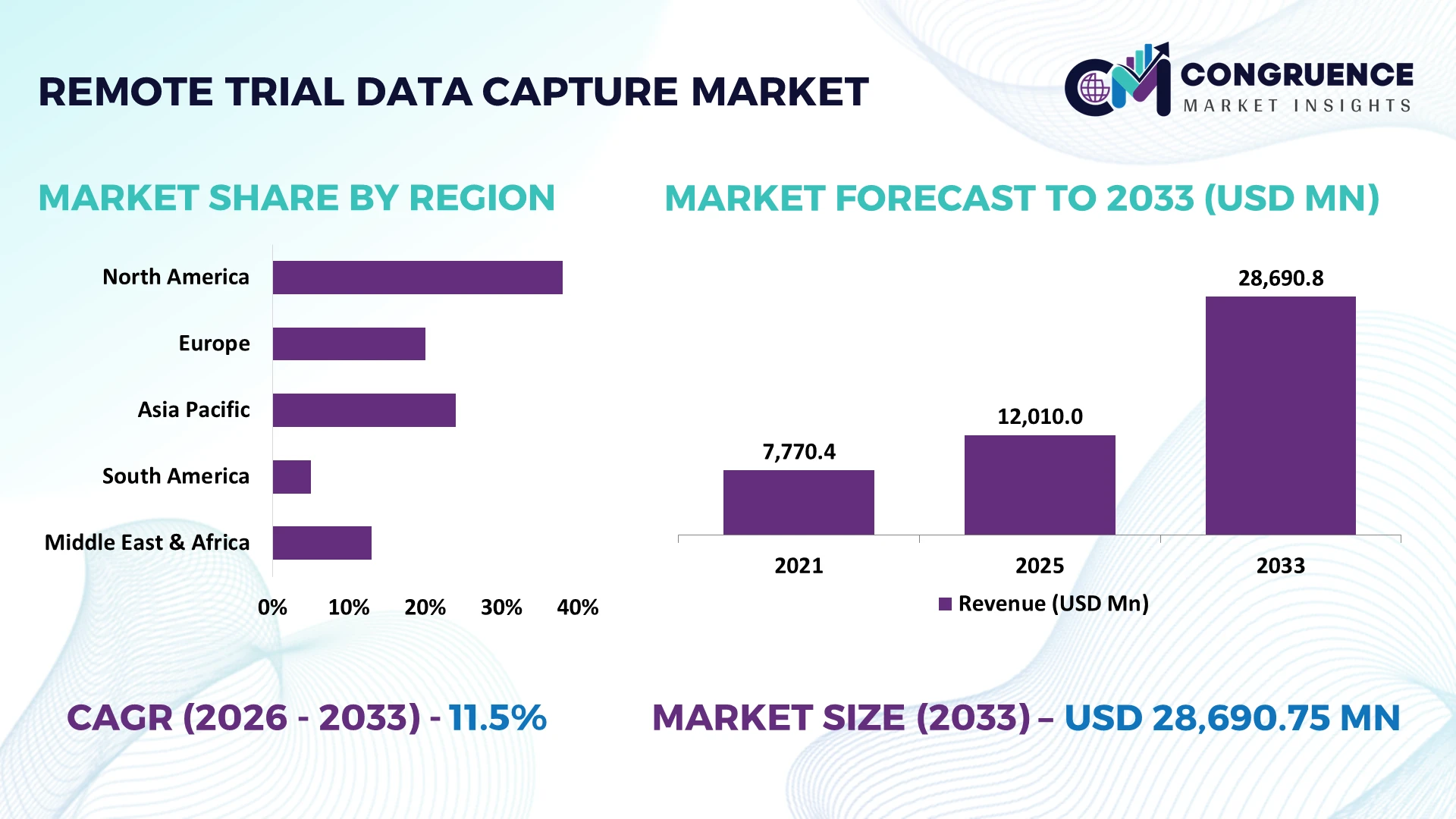
The United States leads remote clinical trial technology adoption through extensive pharmaceutical research infrastructure, contract research organizations, and digital health innovation. ClinicalTrials.gov recorded more than 500,000 registered studies globally by 2025, with substantial participation from American research institutions. The United States accounts for an estimated 40% of remote trial data capture activity, compared with approximately 10% for China. FDA guidance supporting decentralized clinical trial elements and electronic records strengthens adoption of connected monitoring devices, cloud platforms, and electronic clinical outcome assessments.
Strategically, technology providers should prioritize validated data interoperability, automated patient monitoring, and regulatory compliant platforms to strengthen clinical trial efficiency and international deployment.
Market Size & Growth: USD 12,010 million in 2025, reaching USD 28,690.75 million by 2033 at 11.5% CAGR, driven by decentralized clinical research and digital patient monitoring.
Top Growth Drivers: Electronic diaries and assessments recorded 56% adoption, patient engagement dashboards 32%, and digitally enabled recruitment 27% in surveyed clinical trials.
Short Term Forecast: By 2028, automated data validation programs target 15% to 20% faster query resolution through intelligent clinical data workflows.
Emerging Technologies: Three innovations include AI anomaly detection, connected wearable biosensors, and cloud based electronic clinical outcome assessments.
Regional Leaders: Indicative 2033 allocations place North America at USD 12,910.84 million, Europe at USD 8,033.41 million, and Asia Pacific at USD 6,312 million, reflecting digital research adoption.
Consumer / End User Trends: A multinational stakeholder survey reported 72.7% electronic clinical outcome assessment usage and 70.8% remote monitoring adoption among respondents.
Pilot / Case Example: A 2025 research analysis identified remote data collection in 1,008 decentralized trials, representing 91.9% of its examined trial sample.
Competitive Landscape: Medidata, Oracle, Veeva Systems, IQVIA, and Medable compete through integrated clinical data platforms, automation, and decentralized trial capabilities.
Regulatory & ESG Impact: FDA decentralized trial guidance supports remote participation while maintaining regulatory requirements under 21 CFR Part 11 for applicable electronic records.
Investment & Funding: Medable's USD 304 million financing round in 2021 illustrates institutional investment in decentralized clinical research infrastructure and digital patient engagement.
Innovation & Future Outlook: Continuous monitoring, automated endpoint validation, and interoperable data platforms are reshaping clinical research operations through 2033.
The Remote Trial Data Capture Market is evolving from conventional site based electronic data collection toward connected research environments integrating patient applications, wearable sensors, electronic consent, and automated clinical monitoring. A 2025 analysis of decentralized trials found that 91.9% incorporated remote data collection, highlighting its importance within digitally enabled research designs. Pharmaceutical sponsors are prioritizing electronic clinical outcome assessments and interoperable data architectures to improve participant accessibility and data traceability. FDA guidance on decentralized clinical trials is reinforcing requirements for reliable remote oversight, establishing a strategic foundation for technology investment and competitive differentiation.
Remote trial data capture is becoming strategically important as pharmaceutical sponsors replace fragmented clinical data workflows with connected platforms supporting decentralized participation, continuous monitoring, and faster evidence generation. Digital patient assessments, wearable sensors, and electronic consent reduce dependence on physical research visits while improving data accessibility. The FDA's 2024 decentralized clinical trial guidance reinforces regulatory expectations for remote procedures, participant oversight, and reliable electronic records. Technology providers are consequently investing in interoperable data architectures and validated clinical monitoring systems.
The United States leads platform innovation through established pharmaceutical research networks, while Germany emphasizes regulated clinical data management and China expands digital research infrastructure. A 2025 analysis found remote data collection in 91.9% of examined decentralized trials. Compared with periodic site assessments, continuous wearable monitoring can generate multiple daily measurements rather than isolated observations, improving endpoint visibility. Between 2026 and 2028, sponsors are prioritizing automated data reconciliation, remote quality oversight, and standardized electronic clinical outcome assessments.
In practical deployment, connected wearable devices transmit physiological measurements directly into validated clinical databases, reducing manual transcription and supporting earlier anomaly detection. Medidata, Oracle, and Medable are strengthening software integration and research partnerships. Competitive advantage increasingly depends on data integrity, participant accessibility, and measurable improvements in clinical trial execution.
Decentralized clinical trial adoption is accelerating demand for remote data capture platforms that integrate electronic assessments, wearable monitoring, and automated participant reporting. A 2025 research analysis identified remote data collection in 91.9% of examined decentralized trials, demonstrating its central role in digitally enabled study designs. Survey findings also indicated electronic clinical outcome assessment adoption of approximately 72.7% and remote monitoring usage of 70.8% among respondents. The FDA's decentralized clinical trial guidance strengthens requirements for reliable remote procedures and participant oversight. Technology providers including Medidata and Medable are expanding integrated data collection capabilities and clinical research partnerships. Sponsors benefit from reduced dependence on physical visits, improved longitudinal data availability, and more consistent monitoring across geographically distributed participants.
Remote trial data capture faces structural limitations from incompatible clinical software, fragmented patient records, and complex regulatory validation requirements. The European Union's GDPR permits administrative fines reaching 4% of worldwide annual turnover for certain serious violations, increasing the financial consequences of inadequate personal data protection. Under applicable United States requirements, electronic clinical records must satisfy 21 CFR Part 11 controls covering audit trails, system validation, and electronic signatures. Organizations targeting 99.9% platform availability must also manage infrastructure reliability and secure data transmission. These requirements increase integration expenses and extend implementation schedules, particularly for smaller research organizations. Technology suppliers are responding through standardized APIs, validated cloud environments, contractual data processing controls, and regional hosting arrangements that reduce compliance exposure.
Artificial intelligence creates opportunities to automate clinical data verification, detect unusual patient measurements, and prioritize monitoring interventions. Advanced analytics platforms can target 15% to 20% reductions in manual query processing time through automated consistency checks and intelligent exception management. Continuous wearable monitoring also enables 24 hour physiological observation, compared with intermittent measurements collected during scheduled research visits. India's expanding clinical research infrastructure provides opportunities for multilingual electronic assessments and digitally supported participant engagement. Technology providers are developing machine learning validation tools, interoperable clinical databases, and automated patient monitoring workflows. The strategic opportunity lies in converting continuous patient data into actionable quality signals, allowing sponsors to concentrate clinical monitoring resources on high risk observations rather than routine record verification.
Scaling remote clinical research requires dependable synchronization between wearable devices, patient applications, electronic data capture platforms, and clinical monitoring systems. A study collecting 10 measurements daily from 1,000 participants generates approximately 10,000 records each day, increasing validation and exception management requirements. Even a 1% missing data rate creates 100 incomplete daily observations requiring assessment. Maintaining 99.9% platform availability becomes increasingly important when participants submit time sensitive clinical measurements. Germany's regulated healthcare environment highlights the importance of secure identity management, documented consent, and controlled clinical data access. Technology providers must strengthen cybersecurity testing, automated reconciliation, device qualification, and specialist workforce training. Long term competitiveness depends on demonstrating reliable data provenance, consistent endpoint quality, and scalable oversight across complex multinational research programs.
Unified Clinical Data Workflow Integration: Pharmaceutical sponsors are consolidating electronic assessments, patient applications, and clinical databases into integrated research environments. Enterprise implementations target 15% to 20% fewer manual data transfers and 10% faster reconciliation cycles. Medidata and Oracle are strengthening platform interoperability, allowing research teams to reduce fragmented workflows and improve clinical data traceability across multinational studies.
Electronic Consent Modernization Across Research: Clinical research organizations are expanding electronic consent workflows incorporating digital signatures, multimedia explanations, and participant comprehension checks. Modern implementations target 20% faster consent documentation and 15% fewer administrative corrections. United States research institutions are adapting electronic consent processes to FDA expectations, while technology suppliers are improving multilingual interfaces and version control capabilities for geographically distributed participants.
Sensor Data Standardization Gains Priority: Clinical technology providers are standardizing wearable device metadata, measurement timestamps, and data transmission formats to improve endpoint consistency. Integration programs target 95% data completeness and 99% successful record synchronization. Pharmaceutical sponsors are strengthening device qualification partnerships and automated ingestion workflows, reducing inconsistencies between manufacturers while improving the reliability of physiological measurements collected outside research facilities.
Risk Based Remote Oversight Expansion: Research sponsors are restructuring clinical monitoring workflows around centralized dashboards, protocol deviation tracking, and automated audit documentation. Operational programs target 20% fewer routine monitoring visits and 15% faster issue escalation. Contract research organizations are expanding centralized monitoring teams and digital quality management capabilities, responding to regulatory expectations for documented oversight and improving resource allocation across complex international studies.
Electronic Clinical Outcome Assessments (eCOA) represent an estimated 32% of the Remote Trial Data Capture Market, supported by their application across standardized clinical endpoints, patient assessments, and regulated research workflows. Pharmaceutical sponsors prioritize eCOA platforms because electronic assessments improve timestamp accuracy, reduce transcription requirements, and support centralized data review. Electronic Patient Reported Outcomes (ePRO) maintain substantial adoption through symptom diaries, treatment experience reporting, and scheduled participant questionnaires. Clinical technology suppliers are strengthening multilingual assessment libraries, validated electronic instruments, and integrated clinical database connections to improve study implementation efficiency.
Wearable Data Capture represents the fastest growing product category as continuous physiological measurements become increasingly important in decentralized research. Remote Monitoring Platforms provide centralized oversight of participant information, while Mobile Data Capture enables direct submission through smartphones and connected applications. Survey findings indicating approximately 72.7% eCOA adoption among respondents demonstrate established digital assessment demand. Manufacturers are expanding device integration partnerships and automated data synchronization capabilities. Investment increasingly favors platforms combining reliable clinical endpoints with flexible participant access and reduced operational complexity.
Clinical Trials account for an estimated 40% of the Remote Trial Data Capture Market, reflecting extensive pharmaceutical research requirements for standardized patient information, electronic assessments, and regulatory compliant data management. Clinical sponsors increasingly integrate remote reporting with conventional research workflows to improve participant accessibility and reduce manual data processing. Decentralized Clinical Trials represent the fastest growing application, supported by digital enrollment, remote assessment capabilities, and distributed clinical oversight. A 2025 research analysis identified remote data collection in 91.9% of examined decentralized trials, demonstrating its importance within digitally enabled research models.
Patient Monitoring supports longitudinal physiological measurements and treatment response assessment, while Safety Data Collection focuses on adverse event reporting and timely clinical review. Real World Evidence applications extend digital data capture into broader treatment evaluation and observational research. Technology providers are developing interoperable platforms, automated quality controls, and integrated participant interfaces. Competitive investment is shifting toward solutions that support multiple clinical research workflows while maintaining consistent data integrity and regulatory documentation across geographically distributed study populations.
Pharmaceutical Companies represent an estimated 42% of the Remote Trial Data Capture Market, supported by extensive clinical development portfolios, multinational research operations, and requirements for validated digital data management. Large sponsors prioritize enterprise platforms capable of supporting multiple therapeutic programs, standardized electronic assessments, and centralized research oversight. Contract Research Organizations maintain significant demand through outsourced trial execution, clinical monitoring, and technology integration services. Approximately 70.8% remote monitoring adoption among surveyed research stakeholders illustrates the importance of digital oversight capabilities in modern clinical operations.
Biotechnology Companies represent the fastest growing end user category as emerging drug developers adopt flexible clinical technology platforms without maintaining extensive internal research infrastructure. Academic Research Institutes emphasize affordable electronic assessments and participant accessibility, while Medical Device Companies require specialized data capture for device performance and patient outcomes. Technology suppliers are introducing configurable subscription platforms, integrated research services, and specialized implementation support. Competitive differentiation increasingly depends on deployment flexibility, regulatory validation, and the ability to serve organizations with different research budgets and operational requirements.
North America accounted for the largest market share at an estimated 45% in 2025 however, Asia Pacific is expected to register the fastest growth, expanding at a CAGR of approximately 14.2% between 2026 and 2033.
Digital Clinical Research Leadership and Enterprise Platform Integration
North America commands an estimated 45% of the global Remote Trial Data Capture Market, supported by extensive pharmaceutical research infrastructure, established clinical technology providers, and advanced regulatory frameworks. The United States dominates regional demand through pharmaceutical sponsors, contract research organizations, and academic medical institutions adopting electronic clinical outcome assessments and remote patient monitoring. ClinicalTrials.gov surpassed 500,000 registered studies globally by 2025, demonstrating the scale of research activity supported by digital clinical infrastructure. FDA guidance on decentralized clinical trials strengthens expectations for reliable electronic records, remote procedures, and investigator oversight. Technology providers including Medidata, Oracle, and Medable are expanding interoperable clinical data platforms and automated monitoring capabilities. Canada's established clinical research networks provide additional opportunities for connected participant assessments. Regional competitive positioning increasingly depends on regulatory validation, enterprise integration, and dependable clinical data traceability.
United States Market Outlook: The United States maintains a strong position through pharmaceutical innovation, specialized clinical research services, and advanced digital health infrastructure. FDA regulations under 21 CFR Part 11 establish requirements for applicable electronic records and signatures, encouraging investment in validated clinical software. American research institutions increasingly integrate electronic assessments, connected medical devices, and centralized monitoring systems. Technology providers benefit from established pharmaceutical partnerships, experienced clinical operations teams, and substantial demand for secure data management across complex therapeutic development programs.
Regulatory Harmonization and Digitally Connected Clinical Research
Europe represents an estimated 28% of the global Remote Trial Data Capture Market, supported by established pharmaceutical development networks, multinational research programs, and increasingly standardized clinical trial procedures. Germany, the United Kingdom, France, and Switzerland represent important centers for digital clinical research infrastructure. The European Union Clinical Trials Regulation introduced a unified regulatory framework, while the Clinical Trials Information System supports coordinated trial applications and regulatory oversight. GDPR requirements strengthen demand for secure patient information management, controlled data access, and documented processing activities. Pharmaceutical sponsors are adopting electronic clinical assessments and centralized data platforms to improve coordination across multiple research locations. Technology suppliers are expanding regional cloud infrastructure, multilingual participant applications, and validated data integration capabilities. Competitive differentiation increasingly depends on cross border operational compatibility, regulatory compliance, and efficient coordination between clinical sites and remote participants.
Germany Market Outlook: Germany benefits from established pharmaceutical manufacturing, university hospitals, and specialized clinical research organizations. Its Medical Research Act, adopted in 2024, introduced measures intended to strengthen clinical research conditions and streamline selected regulatory procedures. German research institutions increasingly evaluate secure digital platforms supporting remote participant assessments and electronic clinical documentation. Strong data protection requirements encourage investment in regional hosting, controlled clinical information exchange, and validated software environments supporting multinational pharmaceutical research.
Clinical Research Expansion and Mobile Digital Infrastructure
Asia Pacific accounts for an estimated 22% of the global Remote Trial Data Capture Market, supported by expanding pharmaceutical research activity, digital healthcare infrastructure, and growing adoption of mobile clinical technology. China, India, Japan, and South Korea represent important research and technology deployment centers. China's pharmaceutical development ecosystem increasingly integrates electronic clinical data management and remote participant monitoring into domestic research operations. India's contract research services industry benefits from established clinical expertise and expanding digital health capabilities. Japan maintains strong regulatory oversight and advanced medical technology infrastructure, supporting validated electronic clinical assessments. Regional technology providers are developing multilingual patient applications, cloud clinical databases, and connected monitoring solutions. The expansion of smartphone connectivity improves the practicality of remote participant reporting, while international sponsors prioritize consistent data standards and secure integration across geographically distributed research networks.
China Market Outlook: China maintains substantial clinical research capacity through pharmaceutical innovation, hospital networks, and domestic technology development. The National Medical Products Administration continues to strengthen clinical research oversight and electronic data management expectations. China's internet population exceeded 1.1 billion by the end of 2024, providing extensive digital connectivity infrastructure. Pharmaceutical sponsors and research organizations are investing in electronic assessments, mobile participant engagement, and secure clinical data systems to improve research coordination and operational efficiency.
Clinical Research Modernization and Digital Patient Accessibility
South America represents an estimated 3% of the global Remote Trial Data Capture Market, with Brazil, Argentina, and Chile supporting pharmaceutical research and digitally enabled clinical studies. Brazil maintains the largest regional clinical research infrastructure through established hospitals, pharmaceutical companies, and research institutions. Remote patient assessments and electronic data collection provide operational advantages in geographically dispersed populations, reducing dependence on repeated physical research visits. Clinical technology adoption remains constrained by uneven digital infrastructure, institutional technology budgets, and differing national regulatory requirements. Research sponsors are strengthening partnerships with local contract research organizations and technology integrators to improve participant engagement and data management. Brazil's evolving clinical research regulatory environment encourages modernization of research procedures, while mobile clinical applications offer opportunities to expand participant accessibility beyond major metropolitan research centers.
Brazil Market Outlook: Brazil offers the strongest regional foundation through established pharmaceutical research institutions, major hospital networks, and expanding digital healthcare capabilities. Law 14,874, enacted in 2024, established a new legal framework governing research involving human participants. The legislation strengthens the institutional environment for clinical research operations and regulatory oversight. Pharmaceutical sponsors are evaluating electronic patient assessments, remote monitoring applications, and standardized clinical databases to improve study coordination across geographically distributed research facilities.
Healthcare Digitalization and Emerging Clinical Research Infrastructure
The Middle East and Africa account for an estimated 2% of the global Remote Trial Data Capture Market, supported by healthcare modernization programs, pharmaceutical research investment, and expanding digital medical infrastructure. Saudi Arabia and the United Arab Emirates are developing advanced healthcare technology ecosystems that support electronic clinical documentation and connected patient monitoring. South Africa maintains established clinical research capabilities, particularly in infectious diseases and public health studies. Regional deployment is influenced by differences in digital connectivity, research workforce availability, and institutional data management capabilities. Technology providers are pursuing partnerships with hospitals, pharmaceutical sponsors, and research organizations to improve clinical software implementation. Cloud based assessment platforms and mobile patient reporting offer practical advantages for distributed research populations, while secure hosting and regulatory alignment remain important procurement considerations.
Saudi Arabia Market Outlook: Saudi Arabia is strengthening its clinical research infrastructure through Vision 2030 healthcare transformation initiatives, digital health investment, and biotechnology development programs. The country's Health Sector Transformation Program supports modernization of healthcare information systems and medical service delivery. Saudi Arabia targets substantial expansion of its biotechnology capabilities under its National Biotechnology Strategy launched in 2024. Research institutions and healthcare technology providers are developing opportunities for electronic clinical assessments, connected patient monitoring, and secure research data management.
The Remote Trial Data Capture Market features competition between enterprise clinical software providers, decentralized trial specialists, and integrated research service organizations. Medidata, Oracle, and Veeva Systems compete through comprehensive clinical data platforms, while Medable and Clario emphasize patient engagement, electronic assessments, and remote monitoring capabilities. The leading five providers collectively represent an estimated 48% of market activity. Competition centers on regulatory validation, implementation speed, interoperability, and clinical data quality. Enterprise automation programs target 15% to 20% faster query resolution, while integrated monitoring workflows pursue 10% to 15% reductions in administrative processing requirements. Companies are expanding cloud infrastructure, strengthening pharmaceutical partnerships, and integrating intelligent clinical data validation. Market differentiation increasingly favors unified research platforms over fragmented software applications. Regulatory certification, cybersecurity requirements, and established sponsor relationships create significant entry barriers. Competitive success requires validated interoperability, dependable patient engagement, and scalable clinical research integration capabilities.
Medidata Solutions
Oracle Corporation
Veeva Systems Inc.
IQVIA Holdings Inc.
Medable Inc.
Clario
Signant Health
Medpace Holdings, Inc.
ICON plc
Parexel International Corporation
Castor
YPrime LLC
THREAD Research
Florence Healthcare
Current technologies combine electronic clinical outcome assessments, mobile patient applications, wearable sensors, and validated cloud databases. Electronic assessment platforms eliminate manual transcription and support timestamped responses, improving traceability across distributed studies. Surveyed research stakeholders reported approximately 72.7% electronic assessment adoption. Compared with paper questionnaires, digital collection workflows can target 20% faster data availability through immediate submission and automated completeness checks. Pharmaceutical sponsors benefit from centralized oversight and reduced administrative processing.
Emerging technologies integrate artificial intelligence, standardized device interfaces, and intelligent clinical data reconciliation. Machine learning algorithms prioritize inconsistent measurements, while interoperable application interfaces connect electronic health records with research databases. Automated validation programs target 15% fewer routine data queries and 10% faster reconciliation cycles. Contract research organizations gain operational advantages through configurable monitoring dashboards, reusable integration components, and consistent electronic endpoint management across therapeutic programs and geographically dispersed participants.
Disruptive innovation centers on continuous digital biomarkers, privacy preserving analytics, and adaptive clinical monitoring. Between 2026 and 2028, developers are prioritizing secure sensor synchronization, automated anomaly classification, and federated data processing. Systems targeting 99% successful record synchronization strengthen longitudinal endpoint reliability. Medidata, Oracle, and specialized digital trial providers compete through validated interoperability and scalable implementation. Investment decisions increasingly favor platforms demonstrating reliable data provenance, participant accessibility, and measurable clinical workflow efficiency improvements.
February 2026: Medidata expanded AI supported clinical study configuration, reporting deployment across more than 500 studies, including 120 initiated during 2025. Automated electronic data capture setup strengthens research efficiency and accelerates study preparation. Source: medidata.com
November 2024: Medable introduced AI capabilities for generating digital clinical outcome assessments. Its platform had supported over 300 decentralized and hybrid trials across 70 countries, demonstrating commercial deployment scale and strengthening automated assessment development. Source: businesswire.com
October 2025: Clario partnered with Oxford University's NeuroMetrology Lab to advance Parkinson's research using Opal wearable sensors. Its technology demonstrated up to 92% accuracy predicting falls two years ahead, strengthening digital endpoint validation. Source: clario.com
September 2024: FDA finalized decentralized clinical trial guidance covering remote research activities, including telehealth, home visits, and local healthcare providers. These 3 operational pathways support broader participation while clarifying sponsor responsibilities for participant oversight and reliable data collection. Source: fda.gov
The Remote Trial Data Capture Market Report examines Electronic Patient Reported Outcomes, Electronic Clinical Outcome Assessments, Wearable Data Capture, Mobile Data Capture, and Remote Monitoring Platforms. Application coverage includes Clinical Trials, Patient Monitoring, Safety Data Collection, Real World Evidence, and Decentralized Clinical Trials. End user analysis evaluates Pharmaceutical Companies, Biotechnology Companies, Contract Research Organizations, Academic Research Institutes, and Medical Device Companies. Geographic assessment covers North America, Europe, Asia Pacific, South America, and the Middle East and Africa.
The report evaluates 14 clinical technology providers alongside emerging digital biomarker platforms, automated endpoint validation, and connected patient monitoring technologies. Competitive analysis examines interoperability, regulatory compliance, deployment efficiency, and research partnerships. Its 2026 to 2033 outlook supports technology investment planning, geographic expansion, supplier selection, and competitive positioning across decentralized clinical research infrastructure.
| Report Attribute/Metric | Report Details |
|---|---|
Market Revenue in 2025 | USD 12010 Million |
Market Revenue in 2033 | USD 28690.75 Million |
CAGR (2026 - 2033) | 11.5% |
Base Year | 2025 |
Forecast Period | 2026 - 2033 |
Historic Period | 2021 - 2025 |
Segments Covered | By Type
By Application
By End-User
|
Key Report Deliverable | Revenue Forecast, Growth Trends, Market Dynamics, Segmental Overview, Regional and Country-wise Analysis, Competition Landscape |
Region Covered | North America, Europe, Asia-Pacific, South America, Middle East, Africa |
Key Players Analyzed | Medidata Solutions, Oracle Corporation, Veeva Systems Inc., IQVIA Holdings Inc., Medable Inc., Clario, Signant Health, Medpace Holdings, Inc., ICON plc, Parexel International Corporation, Castor, YPrime LLC, THREAD Research, Florence Healthcare |
Customization & Pricing | Available on Request (10% Customization is Free) |