
Reports
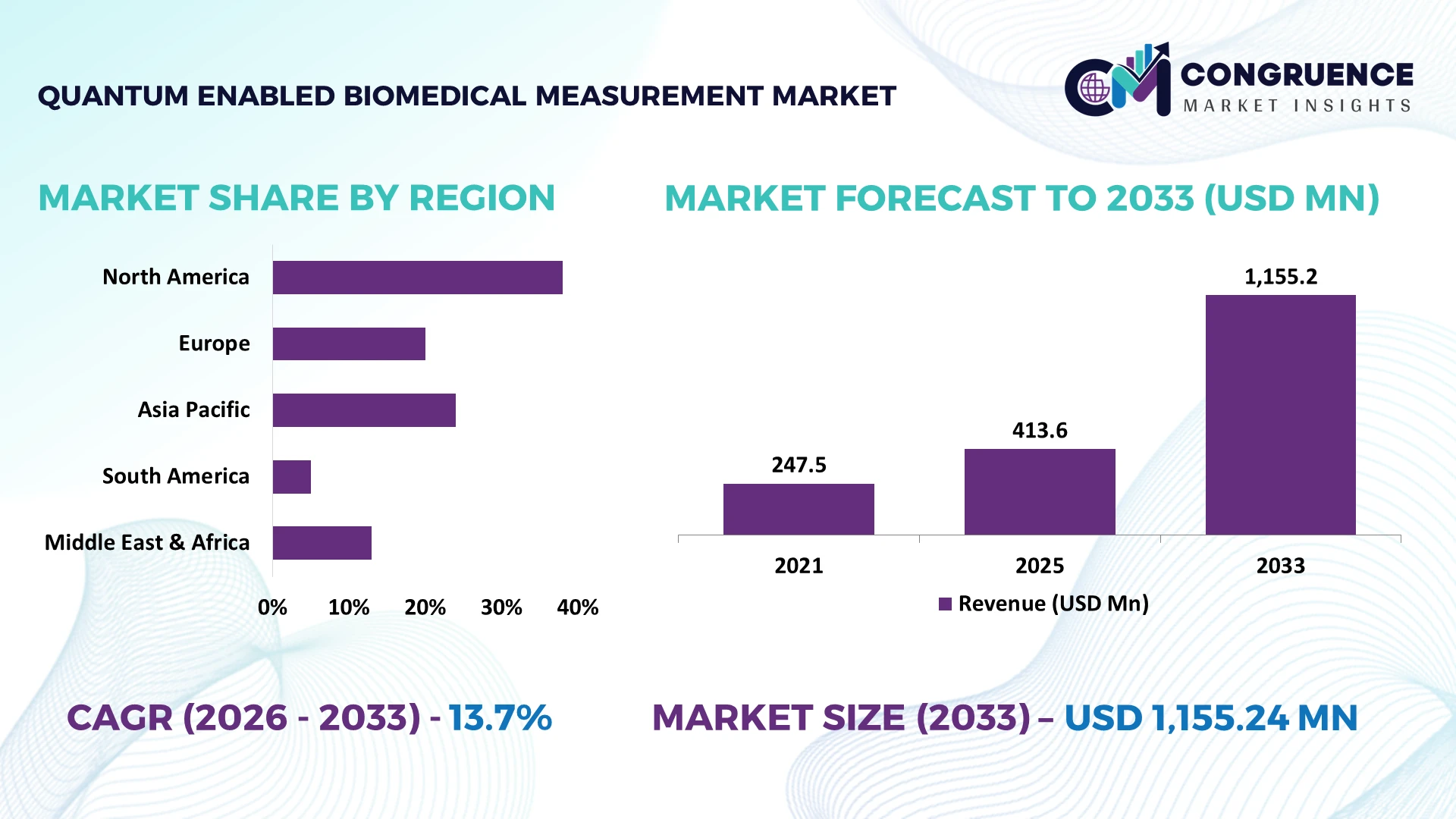
The Global Quantum-Enabled Biomedical Measurement Market was valued at USD 413.61 Million in 2025 and is anticipated to reach a value of USD 1155.24 Million by 2033 expanding at a CAGR of 13.7% between 2026 and 2033. Growth is driven by optically pumped magnetometers, nitrogen vacancy diamond sensors, wearable magnetoencephalography, and increasing investment in quantum precision diagnostics.
The United States leads the global quantum biomedical measurement ecosystem, with an estimated 30% market share, compared with approximately 8% for Germany. American companies represent 36% of identified quantum sensing specialists, supported by federal quantum research programs and university partnerships. The National Quantum Initiative authorized USD 1.275 billion over five years for broader quantum research. QuSpin and academic collaborators have demonstrated 384 channel magnetoencephalography systems, strengthening neurological imaging capabilities. Germany contributes through precision instrumentation, biomedical engineering, and European quantum technology initiatives.
Strategically, manufacturers combining femtotesla sensitivity, scalable sensor arrays, and clinical validation will capture stronger opportunities in neurological diagnostics and precision biomedical instrumentation.
Market Size & Growth: USD 413.61 million in 2025, reaching USD 1,155.24 million by 2033 at 13.7% CAGR, supported by quantum magnetometry commercialization.
Top Growth Drivers: Analytical demand allocation identifies neurological imaging at 45%, biomedical research instrumentation at 35%, and advanced biosensing at 20%.
Short Term Forecast: By 2028, integrated quantum instruments target 15% faster calibration and 10% lower maintenance costs through automated control systems.
Emerging Technologies: Three technologies dominate innovation: optically pumped magnetometers, nitrogen vacancy diamond sensors, and quantum enhanced optical sensing.
Regional Leaders: Indicative 2033 allocations place North America at USD 462.10 million, Europe at USD 346.57 million, and Asia Pacific at USD 288.81 million.
Consumer / End User Trends: Academic and clinical research institutions represent an estimated 60% of early deployments, reflecting specialized instrumentation requirements.
Pilot / Case Example: A 2025 research demonstration examined a 384 channel quantum magnetoencephalography architecture, exceeding a conventional 300 channel reference by 28%.
Competitive Landscape: QuSpin, Cerca Magnetics, Qnami, SBQuantum, and Quantum Diamond Technologies compete through sensor sensitivity, miniaturization, and specialized biomedical applications.
Regulatory & ESG Impact: European medical device regulation requires clinical evidence and conformity assessment; applicable high risk medical devices face approximately 5 year certification cycles.
Investment & Funding: The United States authorized USD 1.275 billion under its National Quantum Initiative, strengthening the broader quantum research and instrumentation ecosystem.
Innovation & Future Outlook: Sensor arrays approaching 384 measurement channels and noise floors of 10–20 femtotesla per square root hertz support advanced neurological research.
The Quantum-Enabled Biomedical Measurement Market is transitioning from specialized laboratory experiments toward portable brain imaging, biological magnetic field detection, and advanced diagnostic instrumentation. Optically pumped magnetometers deliver magnetic sensitivity near 10–20 femtotesla per square root hertz, supporting detailed neurological signal acquisition. Diamond quantum sensors extend measurement capabilities into microscopic biological environments, creating opportunities in molecular research and cellular analysis. United States research institutions are advancing wearable magnetoencephalography, while British developers are commercializing flexible sensor arrays. Clinical validation, magnetic shielding requirements, and instrument calibration remain decisive commercialization factors, shaping technology investment priorities and the next phase of competitive differentiation.
Quantum biomedical measurement is becoming strategically important as healthcare technology manufacturers transition from stationary magnetic sensing equipment toward wearable, high sensitivity diagnostic platforms. Optically pumped magnetometers enable brain activity measurements without the cryogenic cooling required by conventional superconducting magnetoencephalography systems. Research demonstrations have achieved sensor sensitivities approaching 10 femtotesla per square root hertz, strengthening opportunities for neurological imaging. Wearable sensor architectures also reduce restrictions on patient movement, creating advantages for pediatric assessment and functional brain research.
The United States leads commercialization through QuSpin and university partnerships, while the United Kingdom advances wearable magnetoencephalography through Cerca Magnetics and academic collaborations. Japan maintains expertise in superconducting quantum interference devices and precision medical instrumentation. Conventional MEG systems require superconducting sensors operating near 4 kelvin, whereas optically pumped alternatives operate without liquid helium. This technology transition shifts investment toward compact sensor manufacturing, magnetic shielding, and integrated clinical software.
Between 2026 and 2028, manufacturers are targeting 15% faster calibration workflows and 10% lower maintenance requirements through automated instrumentation. Wearable MEG research demonstrates practical deployment beyond fixed patient positioning. Companies are strengthening hospital partnerships, developing modular sensor arrays, and prioritizing clinical validation. Competitive leadership will depend on reproducible measurement performance, scalable production, and integration into established diagnostic workflows.
Wearable magnetoencephalography is accelerating quantum sensor commercialization by removing the rigid positioning requirements associated with conventional superconducting measurement systems. Optically pumped magnetometers achieve sensitivities approaching 10 femtotesla per square root hertz and operate without liquid helium cooling. Conventional superconducting MEG sensors typically require temperatures near 4 kelvin, creating substantial infrastructure requirements. United Kingdom research groups have demonstrated wearable systems capable of recording brain activity during patient movement. Manufacturers are responding through compact sensor development, modular acquisition electronics, and partnerships with neuroscience institutions. Operational development targets include 15% faster calibration and 10% fewer manual setup interventions. The strategic advantage lies in expanding neurological measurement accessibility without reproducing the full infrastructure requirements of conventional cryogenic installations.
Quantum biomedical instruments face substantial infrastructure constraints because femtotesla sensitivity requires effective suppression of environmental magnetic interference. Earth's magnetic field typically ranges between 25 and 65 microtesla, substantially exceeding the biological signals targeted by magnetoencephalography. Shielded measurement rooms, precision optical components, and specialized sensor calibration increase installation complexity. United States and European manufacturers also depend on high quality lasers, vapor cells, and precision electronics. Commercial development programs are targeting 10% lower calibration expenditure and 15% reductions in installation labor through standardized instrument architectures. Companies are introducing modular shielding configurations, qualifying alternative component suppliers, and negotiating longer procurement agreements. The central limitation is that sensor miniaturization does not automatically eliminate facility preparation costs.
Nitrogen vacancy diamond sensors create opportunities for biomedical measurement beyond conventional neurological imaging, particularly cellular magnetometry, molecular research, and localized magnetic field mapping. These sensors support optical readout of quantum spin states and can operate near room temperature. Emerging microscopy architectures are being developed for improved spatial resolution and integration with biological imaging platforms. Research teams are targeting 20% faster measurement workflows and 15% lower sample handling requirements through automated optical alignment and integrated analysis software. Germany, Japan, and the United States maintain relevant strengths in diamond materials, precision optics, and biomedical instrumentation. Companies are expanding research partnerships with microscopy laboratories and developing modular sensing components. The commercial opportunity extends to specialized laboratory instruments that complement established imaging systems rather than replace them.
Long term commercialization depends on achieving consistent quantum sensor performance across clinical environments, patient populations, and manufacturing batches. Wearable magnetoencephalography requires synchronization of multiple sensor channels, compensation for patient movement, and accurate reconstruction of neural signals. Research systems incorporating hundreds of measurement channels increase software validation and calibration complexity. Manufacturers are targeting 99% acquisition continuity, 15% faster quality assurance procedures, and 10% fewer repeat measurements through automated calibration and artifact detection. United States FDA requirements and European medical device regulations impose additional evidence obligations when instruments are marketed for clinical diagnosis. Companies must establish standardized testing protocols, cybersecurity controls, and hospital validation partnerships. The decisive challenge is converting laboratory sensitivity into reproducible clinical performance without increasing operational complexity.
Automated Sensor Calibration Gains Commercial Priority: Quantum instrumentation manufacturers are introducing software controlled calibration to improve measurement consistency across complex biomedical environments. Integrated calibration workflows target 15% faster instrument preparation and 10% fewer manual adjustments. QuSpin and specialized sensor developers are advancing compact control electronics, reducing technical staffing requirements while improving laboratory throughput and repeatability.
Quantum Imaging Software Integration Accelerates: Biomedical research institutions are connecting quantum measurement instruments with magnetic field reconstruction and neurological imaging software. Advanced acquisition systems support hundreds of synchronized measurement channels, including research architectures approaching 384 channels. Developers are targeting 20% faster signal processing and 15% shorter interpretation workflows through automated artifact correction and integrated visualization platforms.
Specialized Quantum Components Face Localization Pressure: Precision laser systems, alkali vapor cells, and magnetic shielding materials remain critical procurement inputs for quantum biomedical instruments. United States and European manufacturers are evaluating alternative component suppliers and standardized assemblies. Procurement strategies target 10% shorter component lead times and 15% lower inventory exposure, strengthening production continuity without compromising sensor sensitivity.
Clinical Instrument Validation Becomes More Structured: Medical technology developers are strengthening quality management procedures as quantum sensing systems progress toward clinical applications. European medical device requirements and United States regulatory oversight encourage standardized performance documentation. Companies are targeting 20% faster validation reporting and 10% fewer repeat calibration tests through automated records, traceable measurement protocols, and hospital research partnerships.
Quantum Magnetometers represent an estimated 42% of the Quantum-Enabled Biomedical Measurement Market, supported by established applications in magnetoencephalography, biological magnetic field detection, and neurological research. Optically pumped magnetometers offer femtotesla sensitivity without requiring superconducting sensor cooling, supporting development of wearable brain measurement platforms. Their commercial advantages include modular sensor architectures, compatibility with digital signal processing, and expanding research applications. Quantum Imaging Systems represent another important category through magnetic field visualization and specialized biomedical imaging. Quantum Spectrometers support precision measurement of molecular interactions, while Quantum Gravimeters remain a niche category because their primary applications lie outside direct biological signal measurement.
Quantum Biosensors represent the fastest growing type as nitrogen vacancy diamond technologies advance cellular magnetic sensing and molecular analysis. Analytical estimates place Quantum Biosensors at approximately 24% of market activity, compared with 42% for Quantum Magnetometers. Manufacturers are expanding diamond sensor research, optical detection systems, and integrated measurement software. Companies including Qnami and Quantum Diamond Technologies emphasize specialized sensing platforms, while QuSpin concentrates on quantum magnetometry. Investment priorities increasingly favor scalable sensor production, reproducible measurement performance, and integration with existing biomedical laboratory instruments.
Brain Activity Measurement accounts for an estimated 38% of the Quantum-Enabled Biomedical Measurement Market, reflecting the established use of quantum magnetic sensing in magnetoencephalography and neuroscience research. Optically pumped magnetometers detect extremely weak magnetic fields generated by neural activity, supporting research into brain function and neurological disorders. Research systems incorporating hundreds of synchronized channels demonstrate the technical maturity of this application. Medical Diagnostics represents another significant application as developers evaluate quantum measurement technologies for clinically relevant assessment. Molecular Detection supports investigation of biological interactions, while Biomarker Analysis focuses on sensitive measurement of disease associated biological signals.
Cellular Imaging represents the fastest growing application as diamond quantum sensors enable localized magnetic measurements in microscopic biological environments. Analytical estimates place Cellular Imaging at approximately 22% of market activity, compared with 38% for Brain Activity Measurement. Companies are developing integrated optical microscopy platforms, automated measurement workflows, and specialized biological sensing modules. Academic partnerships accelerate instrument validation, while biomedical technology manufacturers prioritize reproducible sensitivity and sample compatibility. Competitive investment increasingly shifts toward measurement capabilities that conventional imaging instruments cannot directly provide.
Academic Research Institutes represent an estimated 40% of the Quantum-Enabled Biomedical Measurement Market, supported by university laboratories developing quantum magnetometry, diamond sensing, and advanced biological measurement technologies. Their purchasing decisions prioritize measurement sensitivity, experimental flexibility, and compatibility with specialized research infrastructure. Medical Research Centers represent another important customer category through neuroscience studies and translational biomedical investigations. Hospitals maintain a smaller deployment base because clinical adoption requires established diagnostic protocols and regulatory validation. Pharmaceutical Companies use advanced measurement technologies for molecular research, while Biotechnology Companies investigate specialized biosensing applications and cellular analysis.
Biotechnology Companies represent the fastest growing end user category as commercial research programs increasingly evaluate quantum sensors for biological measurement and instrumentation development. Analytical estimates place Biotechnology Companies at approximately 20% of market activity, compared with 40% for Academic Research Institutes. Manufacturers are developing modular sensor systems, configurable optical interfaces, and application specific measurement software. Partnerships with universities help validate emerging applications before broader commercial deployment. Competitive differentiation increasingly depends on instrument reliability, technical support, and the ability to translate experimental sensing capabilities into repeatable laboratory workflows.
North America accounted for the largest market share at an estimated 40% in 2025 however, Asia Pacific is expected to register the fastest growth, expanding at a projected CAGR of 16.2% between 2026 and 2033.
Advanced Quantum Magnetometry and Biomedical Instrument Commercialization
North America represents an estimated 40% of the global Quantum-Enabled Biomedical Measurement Market, supported by specialized quantum sensor manufacturers, established neuroscience laboratories, and federal research infrastructure. The United States leads regional development through optically pumped magnetometers, nitrogen vacancy diamond sensors, and precision magnetic field measurement systems. QuSpin develops compact quantum magnetometers, while Quantum Diamond Technologies advances diamond based sensing for biological research. The National Quantum Initiative authorized approximately USD 1.275 billion over five years for broader quantum research, strengthening the technology ecosystem supporting specialized instrumentation. Canadian quantum technology developers contribute expertise in magnetic sensing, photonics, and precision measurement. Commercial deployment remains concentrated in academic laboratories and advanced research institutions, where instrumentation sensitivity and experimental flexibility determine procurement. Manufacturers increasingly prioritize modular sensor architectures, reliable component sourcing, and integration with biomedical measurement software.
United States Market Outlook: The United States accounts for an estimated 30% of global quantum biomedical measurement activity, supported by established semiconductor research, biomedical engineering, and quantum technology commercialization. QuSpin's compact optically pumped magnetometers enable advanced neurological measurement research without superconducting sensor cooling. American universities and medical research centers are advancing magnetic brain imaging and biological sensing applications. The country's competitive advantage rests on specialized sensor development, research funding, and access to clinical validation partnerships.
Wearable Brain Imaging and Precision Quantum Sensing Leadership
Europe represents an estimated 30% of the global Quantum-Enabled Biomedical Measurement Market, supported by advanced photonics manufacturing, neurological research institutions, and coordinated quantum technology initiatives. The United Kingdom leads wearable magnetoencephalography development through Cerca Magnetics and academic collaborations, while Germany contributes precision optics, sensor engineering, and biomedical instrumentation expertise. Switzerland supports diamond quantum sensing through specialized technology developers including Qnami. European research institutions are advancing optically pumped magnetometer arrays capable of detecting femtotesla magnetic fields generated by neural activity. The European Quantum Flagship established a ten year research framework with approximately EUR 1 billion in planned funding across quantum technologies. Commercial priorities include clinical research integration, standardized measurement protocols, and improved instrument portability. Manufacturers are strengthening partnerships with neuroscience laboratories and expanding application specific quantum sensing capabilities.
United Kingdom Market Outlook: The United Kingdom maintains a leading position in wearable quantum brain imaging through Cerca Magnetics and the University of Nottingham. Research teams have demonstrated optically pumped magnetoencephalography systems capable of recording neural activity during participant movement. Conventional superconducting systems require cryogenic operating temperatures near 4 kelvin, while wearable quantum magnetometers eliminate liquid helium cooling at the sensor level. This distinction strengthens opportunities for pediatric neuroscience, functional brain mapping, and specialized neurological research instrumentation.
Precision Sensor Manufacturing and Biomedical Research Integration
Asia Pacific accounts for an estimated 25% of the global Quantum-Enabled Biomedical Measurement Market, supported by semiconductor manufacturing capabilities, advanced materials research, and established biomedical instrumentation industries. Japan maintains expertise in superconducting quantum interference devices, precision magnetometry, and medical imaging technologies. China is expanding quantum sensing research through university laboratories, national research institutions, and photonics manufacturing infrastructure. South Korea contributes semiconductor fabrication and advanced optical components, while Australia maintains strengths in diamond quantum sensing and biomedical research. Regional instrument developers benefit from established electronics supply chains and specialized manufacturing capacity. Japan's conventional superconducting magnetometry expertise provides a technical foundation for emerging sensor platforms. Manufacturers are investing in quantum materials, compact optical assemblies, and integrated measurement electronics. Commercialization increasingly depends on translating laboratory performance into repeatable manufacturing processes and biomedical instrument reliability.
Japan Market Outlook: Japan combines established precision instrumentation manufacturing with advanced medical imaging research and quantum sensing expertise. Companies including Yokogawa Electric have developed magnetoencephalography technologies using superconducting magnetic sensors. These systems require cryogenic operation, creating opportunities for complementary quantum sensor technologies that simplify measurement infrastructure. Japanese universities and industrial laboratories are advancing magnetic sensing, optical measurement, and quantum materials research. The country's manufacturing strength supports precision assembly, sensor calibration, and development of specialized biomedical measurement equipment.
Academic Research Partnerships Shape Early Quantum Sensor Adoption
South America represents an estimated 3% of the global Quantum-Enabled Biomedical Measurement Market, with Brazil accounting for the largest concentration of relevant research infrastructure. Universities and public research institutions lead regional activity through quantum optics, magnetic measurement, and advanced materials research. Brazil's University of São Paulo and other academic institutions maintain capabilities in quantum physics and biomedical engineering. Commercial adoption remains concentrated in specialized laboratories because precision magnetic sensing requires controlled measurement environments and trained technical personnel. Limited domestic manufacturing of quantum sensors increases dependence on imported lasers, precision electronics, and magnetic shielding components. Research institutions are strengthening international collaborations and developing local technical expertise to reduce integration barriers. The primary commercial opportunity lies in laboratory instrumentation, research services, and specialized biomedical measurement applications rather than immediate large scale clinical deployment.
Brazil Market Outlook: Brazil maintains the strongest regional foundation through established university research networks, biomedical engineering expertise, and advanced scientific laboratories. The University of São Paulo supports quantum physics and precision measurement research, while national scientific institutions contribute materials science and optical technology capabilities. Brazil's healthcare research infrastructure creates opportunities for imported quantum sensing equipment and collaborative instrument development. Local commercialization depends on laboratory funding, specialist training, and partnerships with international sensor manufacturers.
Quantum Research Investment Strengthens Biomedical Sensing Infrastructure
The Middle East and Africa account for an estimated 2% of the global Quantum-Enabled Biomedical Measurement Market, supported by expanding quantum research programs, advanced university infrastructure, and healthcare technology investment. Israel maintains established expertise in quantum optics, diamond sensing, and precision instrumentation. The United Arab Emirates is strengthening quantum research through specialized academic institutions and technology partnerships, while Saudi Arabia is expanding advanced materials and biomedical research capabilities. South Africa contributes through university physics laboratories and quantum technology research networks. Commercial deployment remains concentrated in academic research environments rather than routine clinical diagnostics. Specialized instrument imports, technical workforce requirements, and limited local sensor manufacturing influence procurement decisions. Research organizations are prioritizing international partnerships, shared laboratory infrastructure, and application specific sensor development to improve technology access.
Israel Market Outlook: Israel offers significant quantum sensing expertise through the Weizmann Institute of Science, Hebrew University of Jerusalem, and specialized technology developers. Research programs cover quantum optics, magnetic measurement, and diamond based sensing. The country's semiconductor and photonics ecosystem supports advanced sensor development and precision electronics integration. Biomedical commercialization opportunities center on laboratory measurement systems, specialized biosensing applications, and partnerships connecting quantum researchers with medical technology developers.
QuSpin and Cerca Magnetics compete in optically pumped magnetometry, while Qnami and Quantum Diamond Technologies differentiate through diamond sensing. Yokogawa Electric and MEGIN retain established expertise in superconducting brain imaging, creating competition between cryogenic instruments and emerging wearable architectures. The five leading suppliers collectively hold an estimated 35% share of this market, reflecting fragmented research procurement. Developers target 15% faster calibration, 10% lower servicing requirements, and 20% shorter signal processing workflows; these are engineering objectives rather than verified industry averages. QuSpin emphasizes compact sensor integration, Cerca Magnetics advances wearable arrays, and diamond sensing specialists pursue microscopy partnerships. Procurement is shifting toward complete acquisition systems rather than standalone sensor sensitivity. Magnetic shielding, specialist lasers, validated software, and reproducible sensor calibration constrain new entrants. Clinical buyers demand evidence that experimental performance translates into dependable neurological measurements. Winning requires reliable instrumentation, application specific software, defensible intellectual property, and credible hospital research partnerships.
QuSpin, Inc.
Cerca Magnetics Limited
Qnami AG
Quantum Diamond Technologies Inc.
SBQuantum Inc.
MEGIN Oy
Yokogawa Electric Corporation
Bosch Quantum Sensing
QZabre AG
NVision Imaging Technologies GmbH
Current quantum biomedical instruments combine optically pumped magnetometers, magnetic shielding, and synchronized neural signal acquisition. Unlike superconducting magnetoencephalography sensors operating near 4 kelvin, optically pumped alternatives eliminate liquid helium cooling at the sensor, reducing cryogenic dependency by 100%. Research architectures now reach 384 measurement channels, demonstrating substantial deployment maturity. Automated field compensation and digital reconstruction support operational targets of 15% faster calibration, benefiting neuroscience laboratories and specialist instrument manufacturers.
Emerging diamond quantum sensors use nitrogen vacancy centers to map microscopic magnetic fields at room temperature. Widefield microscopy, integrated optical excitation, and automated image reconstruction create new workflows for cellular research and biomarker investigation. Developers are targeting 20% shorter processing cycles and 10% fewer repeat measurements through standardized optical alignment. Qnami and specialized microscopy manufacturers benefit from modular sensor integration and partnerships with biological research laboratories.
Disruptive quantum enhanced metabolic imaging uses hyperpolarization to visualize biochemical processes beyond conventional structural scans. NVision has demonstrated more than 100 hyperpolarization experiments during a three week research deployment, illustrating operational feasibility. Between 2026 and 2028, clinical translation will prioritize reproducible acquisition, validation software, and interoperable imaging workflows. Manufacturers combining dependable sensor hardware with application specific analytics will gain competitive advantage over standalone component suppliers.
June 2025: Cerca Magnetics installed a wearable quantum brain scanner at Oxford University, enabling millisecond resolution measurements during participant movement. The deployment expands research access for children and dementia patients, strengthening demand for adaptable neurological imaging instrumentation. Source: ox.ac.uk
May 2025: NVision Imaging Technologies deployed POLARIS at University College London through the CHARM standardization collaboration. Across three weeks, researchers completed over 100 hyperpolarization experiments, demonstrating reproducible metabolic imaging workflows and supporting multicenter clinical translation across participating teams. Source: nvision-quantum.com
November 2025: IIT Bombay unveiled India's first indigenous Quantum Diamond Microscope under its National Quantum Mission. The instrument supports three dimensional magnetic field mapping, creating domestic capability for neuroscience research and reducing dependence on imported precision sensing platforms. Source: pib.gov.in
November 2025: Cerca Magnetics researchers reported a 384 channel optically pumped magnetoencephalography system with phantom correlation exceeding 0.998. The peer reviewed demonstration strengthened evidence for scalable neural imaging arrays and improved spatial characterization compared with conventional channel configurations. Source: pubmed.ncbi.nlm.nih.gov
The Quantum-Enabled Biomedical Measurement Market Report examines Quantum Magnetometers, Quantum Gravimeters, Quantum Biosensors, Quantum Spectrometers, and Quantum Imaging Systems. Application coverage includes Molecular Detection, Cellular Imaging, Biomarker Analysis, Brain Activity Measurement, and Medical Diagnostics. End user analysis evaluates Hospitals, Biotechnology Companies, Pharmaceutical Companies, Academic Research Institutes, and Medical Research Centers. Regional coverage spans North America, Europe, Asia Pacific, South America, and the Middle East and Africa, assessing research infrastructure and commercialization readiness.
The report evaluates an estimated 42% Quantum Magnetometers segment share alongside emerging diamond sensing and quantum enhanced imaging technologies. Competitive assessment addresses sensor manufacturing, magnetic shielding, clinical validation, and specialized instrument integration. Its 2026 to 2033 outlook supports investment allocation, geographic expansion, technology partnerships, and competitive positioning across advanced biomedical measurement applications.
| Report Attribute/Metric | Report Details |
|---|---|
Market Revenue in 2025 | USD 413.61 Million |
Market Revenue in 2033 | USD 1155.24 Million |
CAGR (2026 - 2033) | 13.7% |
Base Year | 2025 |
Forecast Period | 2026 - 2033 |
Historic Period | 2021 - 2025 |
Segments Covered | By Type
By Application
By End-User
|
Key Report Deliverable | Revenue Forecast, Growth Trends, Market Dynamics, Segmental Overview, Regional and Country-wise Analysis, Competition Landscape |
Region Covered | North America, Europe, Asia-Pacific, South America, Middle East, Africa |
Key Players Analyzed | QuSpin, Inc., Cerca Magnetics Limited, Qnami AG, Quantum Diamond Technologies Inc., SBQuantum Inc., MEGIN Oy, Yokogawa Electric Corporation, Bosch Quantum Sensing, QZabre AG, NVision Imaging Technologies GmbH |
Customization & Pricing | Available on Request (10% Customization is Free) |




