
Reports
The Global Pulse Oximeters Market was valued at USD 1913 Million in 2025 and is anticipated to reach a value of USD 3003.31 Million by 2033 expanding at a CAGR of 5.8% between 2026 and 2033. Growth is supported by wider integration of connected patient monitoring systems, rising home-based chronic disease management, and increasing procurement of advanced wearable pulse oximeters across hospitals and ambulatory care networks.
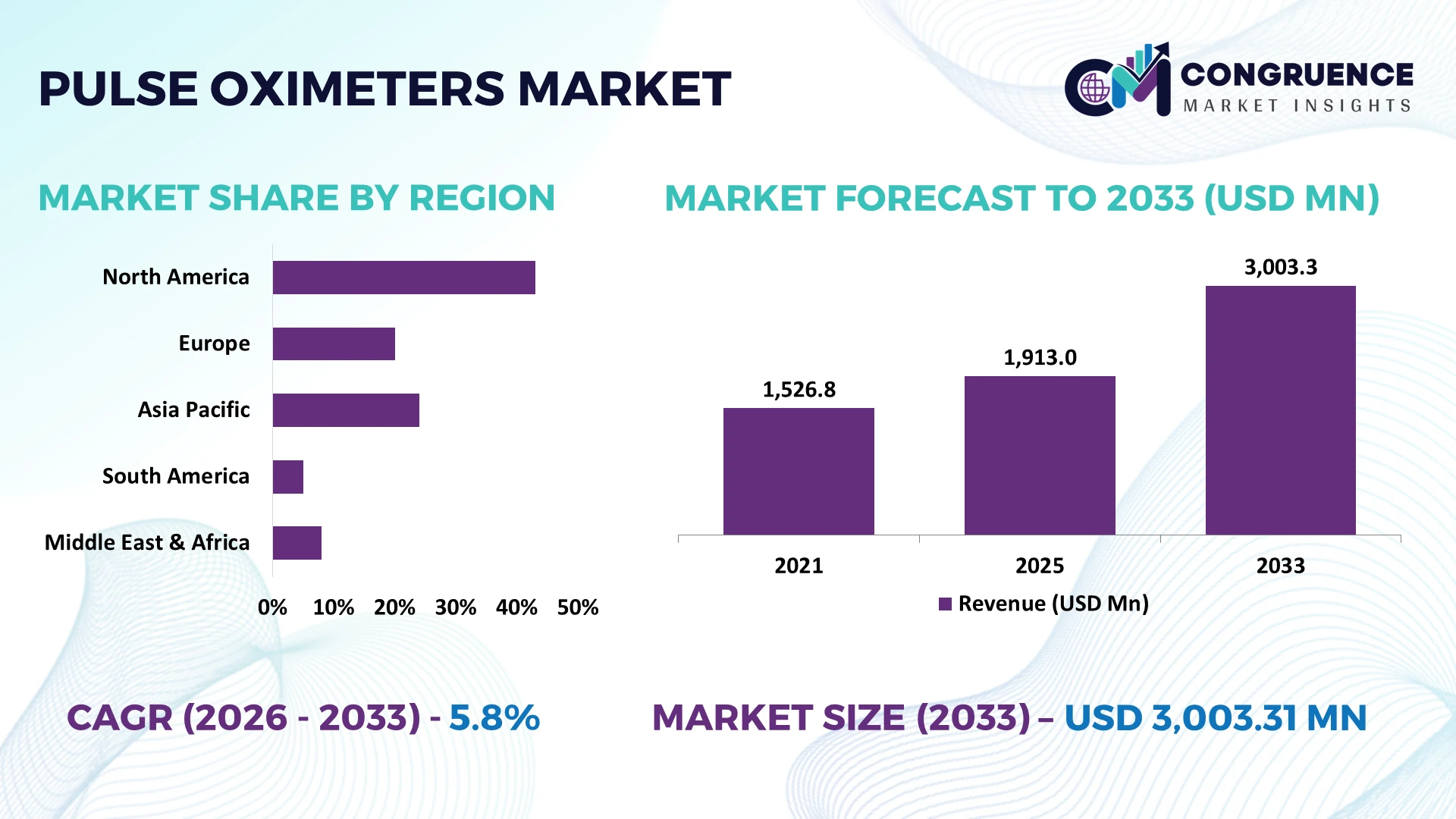
The United States accounts for approximately 34% of global demand, supported by strong hospital digitization, widespread home healthcare adoption, and sustained medical device investments exceeding USD 8 billion annually in patient monitoring technologies. In comparison, China continues expanding manufacturing capacity with over 22% of global medical device production, strengthening export competitiveness amid evolving healthcare supply-chain diversification following Red Sea shipping disruptions.
Manufacturers and investors should prioritize advanced monitoring technologies, diversified production footprints, and regulatory-ready product portfolios to strengthen long-term competitive positioning.
Market Size & Growth: USD 1913 million in 2025 reaching USD 3003.31 million by 2033 at 5.8% CAGR, driven by connected patient monitoring and home healthcare expansion.
Top Growth Drivers: Home healthcare adoption +18%, chronic disease monitoring +14%, wearable medical device utilization +16% accelerate global demand.
Short-Term Forecast: By 2028, remote monitoring efficiency improves by 22% while device servicing costs decline approximately 15% through digital diagnostics.
Emerging Technologies: AI-assisted signal processing, Bluetooth-enabled monitoring, and advanced low-power sensors improve measurement accuracy by nearly 20%.
Regional Leaders: North America exceeds USD 980 million, Europe approaches USD 760 million, Asia-Pacific surpasses USD 890 million, supported by digital healthcare adoption and manufacturing expansion.
Consumer/End-User Trends: More than 46% of home-monitoring users prefer portable fingertip and wearable pulse oximeters with smartphone connectivity.
Pilot/Case Example: In 2025, hospital remote-monitoring deployment reduced avoidable readmissions by approximately 18% through continuous oxygen saturation tracking.
Competitive Landscape: Leading manufacturers collectively hold about 42% market share, with Masimo, Medtronic, Nonin Medical, Nihon Kohden, and Koninklijke Philips maintaining broad product portfolios.
Regulatory & ESG Impact: Digital compliance programs reduced device reporting turnaround by nearly 25%, while sustainable manufacturing initiatives lowered production waste by about 12%.
Investment & Funding: More than USD 1.1 billion supported manufacturing expansion, strategic partnerships, and advanced sensor development amid regional supply-chain realignment.
Innovation & Future Outlook: Next-generation wearable, AI-enabled, and cloud-connected pulse oximeters strengthen continuous monitoring capabilities and expand decentralized healthcare delivery.
Pulse oximeters are experiencing stronger demand across hospitals, home healthcare, emergency medicine, and telehealth ecosystems as compact wireless monitoring solutions become standard clinical tools. AI-enhanced signal filtering and continuous wearable monitoring improve measurement reliability, while approximately 40% of new product launches emphasize connected platforms. Ongoing regulatory standardization and regional supply-chain localization are reinforcing product availability and supporting the market's strategic evolution.
The Pulse Oximeters Market has become strategically important as healthcare providers shift from episodic treatment to continuous patient monitoring across hospitals, ambulatory care, and home healthcare. Digital health adoption, remote clinical workflows, and supply-chain diversification are reshaping competitive positioning. Manufacturers are expanding production outside single-country sourcing models following recent logistics disruptions, while updated medical device cybersecurity and interoperability requirements are accelerating investment in connected monitoring ecosystems. This transformation is strengthening resilience and encouraging long-term partnerships between device manufacturers, healthcare providers, and digital health platforms.
Modern AI-assisted pulse oximeters equipped with motion-artifact filtering deliver approximately 20% higher signal stability than conventional standalone devices while reducing unnecessary clinical rechecks by nearly 15%. The United States leads in large-scale deployment through mature hospital digital infrastructure, whereas India is expanding adoption through public healthcare modernization and domestic medical device manufacturing initiatives. Over the next two to three years, connected pulse oximeter integration across remote monitoring programs is expected to increase by nearly 25%, supported by wider electronic health record compatibility and wireless monitoring platforms.
Healthcare systems increasingly deploy wireless pulse oximeters within hospital-at-home programs, enabling clinicians to monitor oxygen saturation continuously while reducing manual observations. Companies are responding through AI-focused product development, manufacturing expansion, software partnerships, and integrated cloud-based monitoring platforms. Organizations that combine reliable hardware, regulatory compliance, interoperable digital ecosystems, and resilient supply networks will secure stronger competitive positioning and greater operational efficiency in the evolving patient monitoring landscape.
Healthcare providers are rapidly integrating pulse oximeters into remote patient monitoring programs as chronic disease management and post-discharge observation become operational priorities. More than 48% of leading hospitals now incorporate connected monitoring devices into digital care pathways, while wearable patient monitoring adoption has increased by approximately 19% over recent years. The United States continues expanding hospital-at-home initiatives, encouraging greater deployment of wireless monitoring technologies. This structural shift improves clinical response times and reduces avoidable readmissions. Manufacturers are accelerating investment in AI-enabled sensors, strategic partnerships with digital health platforms, and localized production capacity, creating differentiated product portfolios that strengthen long-term customer retention and operational competitiveness.
Device integration remains constrained by fragmented healthcare IT infrastructure and dependence on specialized optical sensors and semiconductor components. Around 28% of healthcare facilities continue operating legacy monitoring systems with limited interoperability, while component procurement costs remain approximately 12% above pre-disruption levels in several manufacturing markets. Supply-chain adjustments following global shipping disruptions have extended procurement timelines for selected electronic components. These conditions increase deployment costs, delay product commercialization, and compress manufacturer margins. Companies are reducing exposure through supplier diversification, localized assembly operations in India and Mexico, long-term procurement agreements, and standardized communication protocols that improve compatibility across clinical monitoring ecosystems.
Next-generation wearable pulse oximeters integrated with AI analytics are creating new value across preventive care, telemedicine, and decentralized healthcare delivery. Approximately 35% of newly introduced premium monitoring devices now include cloud connectivity and predictive health analytics, while remote patient monitoring participation is projected to expand by more than 20% within the next few years. Japan and India are investing in digital healthcare infrastructure that supports continuous home-based monitoring. Companies are increasing R&D spending, partnering with software developers, and expanding subscription-based monitoring ecosystems. The strongest opportunity lies in combining clinical-grade accuracy with real-time analytics that reduce intervention delays and improve healthcare resource utilization.
Expanding connected pulse oximeter deployments requires secure data exchange, workforce readiness, and consistent interoperability across diverse healthcare environments. Nearly 31% of healthcare organizations identify device integration complexity as a primary implementation barrier, while cybersecurity compliance spending has increased by approximately 18% as connected medical devices become more widespread. The United Kingdom and Germany continue strengthening digital medical device security frameworks, increasing compliance expectations for manufacturers. Companies must invest in secure software architectures, workforce training, cloud infrastructure, and standardized communication protocols. Organizations that successfully integrate cybersecurity, interoperability, and scalable digital platforms will achieve stronger operational resilience and sustainable competitive differentiation.
AI-Enhanced Clinical Accuracy AI-powered signal processing is improving measurement reliability by nearly 20% while reducing false alarms by approximately 15% in high-motion environments. Updated medical device software requirements are accelerating algorithm validation, prompting manufacturers to integrate machine learning into premium product portfolios. Companies are expanding software partnerships and embedded analytics capabilities, enabling faster clinical decisions and lowering workflow interruptions across intensive care and emergency settings.
Connected Remote Monitoring Expansion More than 45% of newly deployed professional pulse oximeters now support wireless connectivity, while cloud-based patient monitoring installations have increased by roughly 24% across integrated healthcare systems. Hospital-at-home programs in the United States and digital health initiatives in India are accelerating deployment. Companies are scaling interoperable platforms and subscription-based monitoring services, creating recurring service models alongside traditional device sales.
Localized Manufacturing Strategies Medical device manufacturers are reducing dependence on single-country sourcing, with localized component procurement increasing by approximately 18% and inventory lead times improving by nearly 14%. Supply-chain restructuring following global shipping disruptions has encouraged production expansion across India, Mexico, and Southeast Asia. Companies are strengthening regional supplier networks, improving operational resilience, and reducing procurement volatility for essential optical and semiconductor components.
Wearable Consumer Health Integration Wrist-worn monitoring devices recorded adoption growth exceeding 21%, while smartphone-enabled health applications now support over 40% of newly launched wearable pulse oximeters. The convergence of consumer wellness platforms and clinical-grade monitoring is creating differentiated product ecosystems. Companies are investing in wearable innovation, digital partnerships, and multi-device integration, strengthening long-term customer engagement while expanding preventive healthcare applications beyond traditional hospital environments.
Fingertip pulse oximeters remain the dominant product category, accounting for approximately 47% of total market demand because of their affordability, portability, and rapid deployment across hospitals, clinics, and homecare settings. Their low maintenance requirements and ease of use support large-scale procurement by healthcare providers and public health programs. Handheld pulse oximeters continue serving emergency response and clinical monitoring applications where enhanced measurement flexibility is required. Tabletop systems retain strategic importance in intensive care environments, offering continuous monitoring and integration with hospital patient-monitoring infrastructure.
Wrist-worn pulse oximeters represent the fastest-growing segment, with adoption increasing by approximately 22% as remote patient monitoring and wearable healthcare ecosystems expand. Continuous monitoring, Bluetooth connectivity, and AI-supported analytics are encouraging wider deployment beyond acute care. Manufacturers are prioritizing wearable innovation, compact sensor development, and digital platform integration while maintaining fingertip product expansion for volume-driven markets. Investment priorities increasingly balance mature clinical demand with next-generation wearable technologies that strengthen long-term competitive differentiation.
Hospital monitoring remains the leading application, representing approximately 43% of overall demand due to continuous patient surveillance requirements across intensive care, surgical recovery, and emergency departments. Integration with centralized monitoring systems and electronic medical records supports operational efficiency and clinical responsiveness. Emergency care continues as a mature application where rapid oxygen saturation assessment is essential, while sleep studies maintain steady adoption through specialized diagnostic centers focused on respiratory disorders.
Home monitoring is the fastest-growing application, with adoption increasing by nearly 24% as healthcare providers expand remote patient management and post-discharge monitoring programs. Sports and fitness applications are also gaining momentum through wearable health technologies that enable continuous physiological tracking for consumers and professional athletes. Companies are expanding cloud-enabled platforms, strengthening telehealth integration, and introducing user-friendly monitoring devices that improve accessibility while supporting decentralized healthcare delivery models.
Hospitals remain the dominant end-user segment, accounting for approximately 49% of total deployments because of high patient volumes, critical care infrastructure, and continuous monitoring requirements. Large healthcare systems continue investing in integrated monitoring platforms that support emergency medicine, intensive care, and perioperative services. Clinics and diagnostic centers maintain consistent purchasing activity for outpatient diagnostics and routine clinical assessment, while ambulatory surgical centers increasingly incorporate portable monitoring devices to improve perioperative workflow efficiency.
Homecare represents the fastest-growing end-user segment, with adoption expanding by around 23% as aging populations and chronic disease management shift toward decentralized healthcare delivery. Manufacturers are responding through customized home-monitoring solutions, digital health partnerships, flexible pricing strategies, and cloud-enabled service ecosystems. Diagnostic centers continue upgrading equipment to improve workflow automation, while ambulatory surgical centers prioritize compact, interoperable devices that enhance operational flexibility. Competitive positioning increasingly depends on delivering tailored solutions across institutional and home-based care environments.
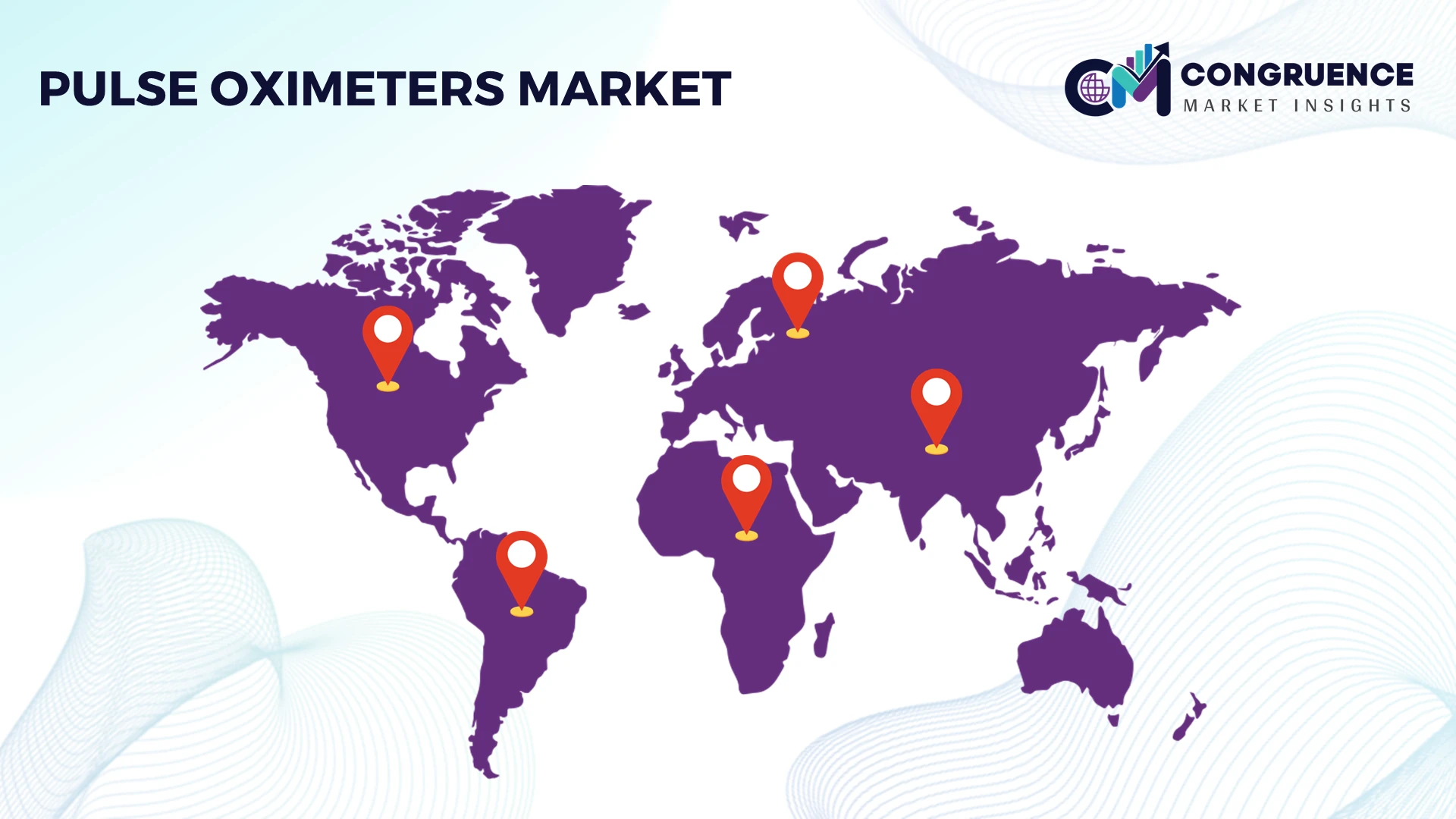
North America accounted for the largest market share at 38.4% in 2025 however, Asia-Pacific is expected to register the fastest growth, expanding at a CAGR of 7.1% between 2026 and 2033.
Advanced Digital Healthcare Infrastructure Strengthens Market Leadership
North America maintains the highest deployment concentration for pulse oximeters due to mature healthcare infrastructure, widespread remote patient monitoring adoption, and strong procurement by hospitals and integrated healthcare networks. The region represents approximately 38.4% of global demand, supported by rapid integration of connected monitoring platforms and electronic health records. More than 52% of large healthcare providers have expanded wireless patient-monitoring deployments, improving continuous clinical observation and operational efficiency. Manufacturers continue investing in AI-enabled monitoring technologies, cloud-based clinical platforms, and strategic collaborations with healthcare systems. Domestic production capabilities, established regulatory frameworks, and advanced reimbursement structures continue supporting rapid commercialization of premium pulse oximeter technologies across acute and homecare environments.
United States Market Outlook: The United States remains the largest national market due to extensive hospital infrastructure, advanced digital healthcare adoption, and strong investment in remote patient monitoring. More than half of major healthcare systems have expanded connected monitoring programs, while domestic medical device innovation supports rapid commercialization of AI-enabled pulse oximeters. Companies continue strengthening software integration, manufacturing capacity, and healthcare partnerships to improve clinical workflow efficiency and long-term patient monitoring capabilities.
Regulatory Modernization Accelerates Connected Device Adoption
Europe benefits from strong healthcare infrastructure, harmonized medical device regulations, and increasing deployment of interoperable monitoring technologies across hospitals and outpatient facilities. The region contributes approximately 28% of global market activity, supported by digital healthcare modernization and growing investment in connected patient monitoring systems. Around 44% of tertiary hospitals have expanded integrated monitoring infrastructure to improve workflow efficiency and patient safety. Manufacturers are prioritizing cybersecurity compliance, software-enabled devices, and regional production expansion to strengthen supply resilience. Sustainability initiatives are also encouraging optimized manufacturing processes and longer device life cycles across healthcare procurement programs.
Germany Market Outlook: Germany leads the European market through its advanced hospital infrastructure, engineering expertise, and strong domestic medical technology manufacturing ecosystem. Digital hospital modernization programs continue expanding connected monitoring deployments, while healthcare providers increasingly prioritize interoperable medical devices. Companies are investing in precision sensor technologies, automated manufacturing, and collaborative innovation projects that strengthen Germany's leadership in advanced patient-monitoring solutions.
Manufacturing Scale and Healthcare Expansion Drive Momentum
Asia-Pacific is emerging as the fastest-expanding regional market through large-scale manufacturing, expanding healthcare infrastructure, and increasing digital health adoption. The region contributes approximately 30% of global demand while accounting for over 45% of worldwide medical device manufacturing capacity. Government-supported healthcare modernization and rising home monitoring adoption continue strengthening deployment across both urban and secondary healthcare facilities. Manufacturers are expanding localized production, increasing export capabilities, and investing in connected monitoring technologies that improve affordability and supply-chain resilience while supporting international demand.
China Market Outlook: China remains the region's manufacturing leader with extensive production capacity, vertically integrated supply chains, and growing domestic healthcare investment. The country accounts for more than 22% of global medical device manufacturing output, enabling efficient large-scale production of pulse oximeters. Companies continue investing in automation, advanced sensor manufacturing, and export-oriented production strategies while strengthening product quality to compete in premium international healthcare markets.
Healthcare Access Expansion Supports Demand Growth
South America is experiencing gradual market expansion through healthcare infrastructure upgrades, broader public health initiatives, and increasing availability of portable patient-monitoring devices. Brazil and neighboring markets are expanding deployment across hospitals, emergency services, and primary healthcare facilities. Approximately 36% of newly procured monitoring devices are portable systems supporting decentralized healthcare delivery. Manufacturers are strengthening regional distribution partnerships and localized service networks to improve market accessibility while addressing logistical constraints and import dependency. Continued investment in hospital modernization is improving long-term deployment capacity across the region.
Brazil Market Outlook: Brazil represents the largest national market because of its extensive hospital network, expanding public healthcare programs, and increasing medical technology procurement. Healthcare providers continue upgrading patient-monitoring infrastructure to improve emergency care and chronic disease management. International manufacturers are strengthening distributor partnerships, technical support capabilities, and localized inventory management to improve delivery efficiency and expand long-term market presence.
Healthcare Infrastructure Investment Enhances Clinical Deployment
The Middle East & Africa market is advancing through healthcare infrastructure modernization, government investment programs, and increasing deployment of digital patient-monitoring technologies. Hospital expansion projects and specialized medical centers are accelerating procurement of advanced monitoring devices across major healthcare systems. Approximately 18% of new hospital equipment procurement now includes connected physiological monitoring technologies. Companies are strengthening regional partnerships, expanding technical support networks, and improving distribution capabilities to support healthcare modernization while addressing operational challenges associated with diverse healthcare infrastructure.
Saudi Arabia Market Outlook: Saudi Arabia leads regional market development through substantial healthcare modernization initiatives and investment in advanced hospital infrastructure. Large public healthcare projects continue integrating digital patient-monitoring systems across newly developed facilities. Medical device suppliers are expanding regional partnerships, local service capabilities, and workforce training programs while introducing connected pulse oximeter solutions aligned with national healthcare transformation priorities.
Major competition is concentrated among Masimo, Medtronic, Nonin Medical, Koninklijke Philips, and Nihon Kohden, while cost-focused manufacturers from China compete aggressively against premium technology leaders. The top five players collectively control approximately 48% of the global market. Premium manufacturers compete through AI-enabled monitoring, clinical accuracy, and integrated digital ecosystems, whereas regional producers emphasize pricing advantages that are typically 20–30% lower. Companies are expanding manufacturing capacity, strengthening healthcare partnerships, integrating cloud connectivity, and pursuing vertical integration to secure sensor and semiconductor supply. Faster product certification, software-enabled monitoring, and interoperability have become decisive competitive differentiators, with connected device deployments increasing by more than 25% across advanced healthcare systems. Market competition is shifting toward intelligent monitoring platforms rather than standalone hardware. Regulatory compliance, software validation, and secure supply chains create significant entry barriers. Winning requires combining clinical-grade accuracy, scalable manufacturing, interoperable digital platforms, rapid innovation, and resilient global distribution capabilities.
Masimo Corporation
Medtronic plc
Koninklijke Philips N.V.
Nonin Medical, Inc.
Nihon Kohden Corporation
Contec Medical Systems Co., Ltd.
Smiths Medical
Shenzhen Mindray Bio-Medical Electronics Co., Ltd.
ICU Medical, Inc.
Edan Instruments, Inc.
Rossmax International Ltd.
Beurer GmbH
Omron Healthcare, Inc.
BPL Medical Technologies Ltd.
Conventional pulse oximeters are rapidly evolving into intelligent patient-monitoring platforms through AI-assisted signal processing, multi-wavelength optical sensing, and wireless connectivity. Modern algorithms reduce motion-induced measurement errors by approximately 20% while improving signal stability by nearly 15% compared with legacy fixed-processing devices. Around 48% of newly introduced professional pulse oximeters now support Bluetooth or cloud connectivity, enabling seamless integration with electronic health records and remote monitoring systems. Healthcare providers benefit from faster clinical intervention, reduced manual observations, and improved workflow efficiency, while manufacturers strengthen differentiation through software-enabled monitoring ecosystems rather than standalone hardware.
Wearable pulse oximeters, edge computing, and predictive analytics represent the next stage of technology adoption. AI-enabled monitoring platforms continuously analyze oxygen saturation trends and automatically identify patient deterioration risks before traditional threshold-based systems. Compared with conventional bedside-only monitoring, connected wearable solutions reduce unnecessary bedside assessments by approximately 18% while increasing monitoring continuity by nearly 25%. Premium manufacturers, hospital technology providers, and digital health platform companies gain the greatest competitive advantage because integrated ecosystems improve customer retention and create recurring software and service opportunities beyond device sales.
Between 2026 and 2028, technology leadership will increasingly depend on interoperability, cybersecurity, and advanced sensor innovation. Multi-parameter wearable monitoring, cloud-native clinical platforms, and improved optical technologies designed for diverse patient populations will accelerate adoption across hospitals and homecare. Companies investing early in AI-driven analytics, standardized interoperability, and scalable digital monitoring infrastructure will secure stronger operational efficiency, faster regulatory readiness, and long-term competitive positioning as healthcare delivery becomes increasingly decentralized.
September 2025 Masimo expanded its multi-year strategic partnership with Philips to accelerate integration of Masimo SET pulse oximetry into Philips monitoring platforms through next-generation wearable solutions, strengthening interoperability and speeding technology deployment across clinical environments.
July 2026 Philips received FDA 510(k) clearance for its next-generation reusable SpO₂ clip sensor, achieving an ARMS accuracy of 1.6%, nearly twice as accurate as the 3% benchmark, improving measurement consistency across diverse patient populations.
August 2025 Nonin Medical launched a software platform for home overnight pulse oximetry testing, streamlining remote sleep monitoring workflows and improving operational efficiency through digital data management for homecare providers and sleep clinics. Source: (Nonin)
June 2026 Masimo received FDA 510(k) clearance for AI-enabled opioid-induced respiratory depression detection on Radius VSM, strengthening continuous patient surveillance with earlier respiratory risk identification and expanding intelligent monitoring capabilities for hospital environments. Source: (Masimo)
The report provides comprehensive analysis across fingertip, handheld, wrist-worn, and tabletop pulse oximeters while evaluating demand across home monitoring, hospital monitoring, emergency care, sleep studies, and sports & fitness applications. It further examines procurement trends among hospitals, clinics, homecare providers, ambulatory surgical centers, and diagnostic centers across North America, Europe, Asia-Pacific, South America, and the Middle East & Africa. More than 45% of current product development focuses on connected monitoring, wearable technologies, and AI-assisted clinical analytics.
The assessment delivers strategic intelligence covering competitive positioning, technology evolution, manufacturing trends, regulatory developments, digital healthcare integration, and supply-chain transformation between 2026 and 2033. It evaluates deployment patterns, enterprise expansion strategies, innovation priorities, and emerging niche opportunities supporting remote patient monitoring and decentralized healthcare. Business leaders, investors, manufacturers, distributors, and healthcare providers can leverage these insights to strengthen investment decisions, product development priorities, geographic expansion strategies, and long-term competitive positioning in an increasingly technology-driven patient monitoring landscape.
| Report Attribute/Metric | Report Details |
|---|---|
Market Revenue in 2025 | USD 1913 Million |
Market Revenue in 2033 | USD 3003.31 Million |
CAGR (2026 - 2033) | 5.8% |
Base Year | 2025 |
Forecast Period | 2026 - 2033 |
Historic Period | 2021 - 2025 |
Segments Covered | By Type
By Application
By End-User
|
Key Report Deliverable | Revenue Forecast, Growth Trends, Market Dynamics, Segmental Overview, Regional and Country-wise Analysis, Competition Landscape |
Region Covered | North America, Europe, Asia-Pacific, South America, Middle East, Africa |
Key Players Analyzed | Masimo Corporation, Medtronic plc, Koninklijke Philips N.V., Nonin Medical, Inc., Nihon Kohden Corporation, Contec Medical Systems Co., Ltd., Smiths Medical, Shenzhen Mindray Bio-Medical Electronics Co., Ltd., ICU Medical, Inc., Edan Instruments, Inc., Rossmax International Ltd., Beurer GmbH, Omron Healthcare, Inc., BPL Medical Technologies Ltd. |
Customization & Pricing | Available on Request (10% Customization is Free) |




