
Reports
The Global Protein Crystallization and Crystallography Market was valued at USD 1,598.4 Million in 2025 and is anticipated to reach a value of USD 3,092.6 Million by 2033 expanding at a CAGR of 8.6% between 2026 and 2033. Growth is being driven by structure-based drug discovery, automated high-throughput crystallization, synchrotron-enabled diffraction, and integration of AI-based protein structure prediction with experimental validation.
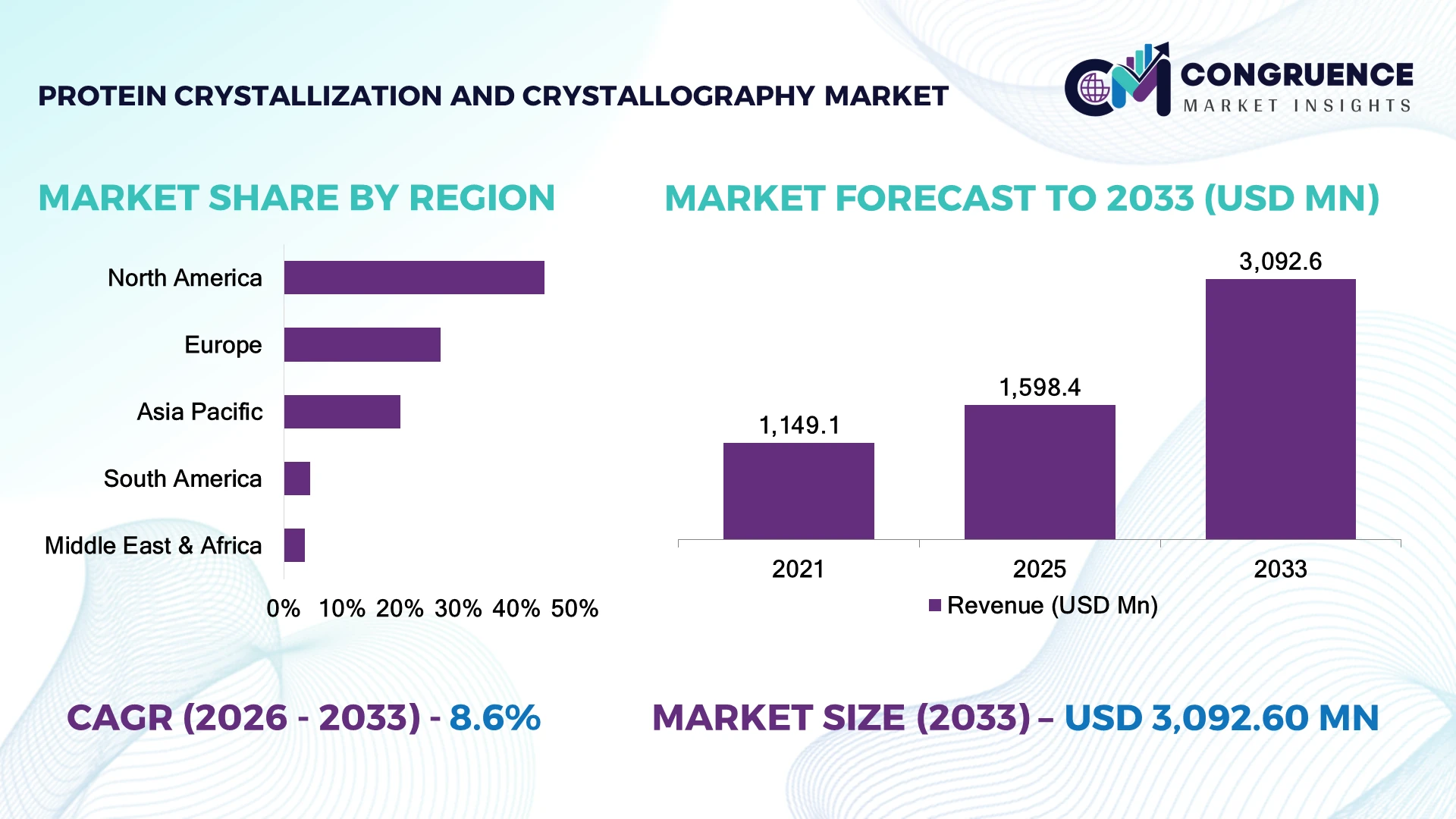
The United States dominates the market, supported by approximately 44.8% regional share, dense pharmaceutical R&D infrastructure, national synchrotron facilities, and high structural-biology investment. Germany, the UK, Japan, and China provide strong secondary research hubs, while Asia-Pacific is expanding laboratory capacity faster than mature U.S. infrastructure. X-ray crystallography accounts for more than 55% of technology demand, reinforcing its role in validated structural workflows.
Strategic implication: prioritize automated crystallization, high-throughput diffraction, AI-assisted screening, and integrated structural-biology platforms where pharmaceutical research intensity is highest.
Market Size & Growth: USD 1.60 billion in 2025 to USD 3.09 billion by 2033 at 8.6% CAGR, driven by structure-based drug discovery and automation.
Top Growth Drivers: X-ray crystallography 55.6%, pharmaceutical and biotech users 53.8%, drug discovery and development 41%.
Short-Term Forecast: By 2028, automated liquid handling and image analysis can reduce manual workflow requirements by 10–20%.
Emerging Technologies: AI crystal scoring, microfluidic screening, serial crystallography, and hybrid cryo-EM/X-ray workflows are reshaping structural biology.
Regional Leaders: North America is projected near USD 1.39 billion; Europe near USD 0.85 billion; Asia-Pacific near USD 0.65 billion by 2033.
Consumer/End-User Trends: Pharmaceutical and biotechnology companies represent approximately 54% of demand, prioritizing structure-enabled lead optimization.
Pilot/Case Example: 2026 AXIS development automates crystal identification using machine learning, addressing manual inspection across large crystallization-image datasets.
Competitive Landscape: X-ray crystallography leads above 55%; Bruker, Rigaku, Thermo Fisher Scientific, Merck, and Formulatrix compete across instruments, consumables, software, and services.
Regulatory & ESG Impact: Automated workflows reduce manual handling and experimental waste, while digital traceability strengthens reproducibility across regulated research environments.
Investment & Funding: U.S. structural-biology infrastructure continues attracting billion-dollar-scale biomedical research funding, while Asia-Pacific expands national laboratory and biotechnology capacity.
Innovation & Future Outlook: AI-guided crystallization, serial diffraction, microfluidics, and computational-experimental integration are shifting competition toward faster structure-to-decision workflows.
The Protein Crystallization and Crystallography Market is concentrated in drug discovery, structural biology, biologics development, and protein engineering, with X-ray crystallography exceeding 55% technology share. In 2026, AI-assisted crystal detection and automated liquid handling are moving laboratories toward high-throughput workflows, while microfluidic screening reduces sample consumption and accelerates experimental iteration.
Protein crystallization and crystallography are becoming strategic infrastructure for pharmaceutical companies because experimentally resolved structures increasingly complement computational prediction in target validation and lead optimization. X-ray crystallography remains the dominant technology at more than 55% share, while AI-based structure prediction is changing how researchers prioritize experiments. The commercial opportunity therefore shifts from standalone instruments toward integrated structure-to-decision workflows.
Automation is creating a measurable operational advantage. Robotic liquid handling can replace repetitive manual plate preparation and improve workflow consistency, while AI-based image classification addresses the remaining bottleneck of manually reviewing large crystallization datasets. At the Photon Factory, an AI scoring system recorded below 5% false-positive and false-negative rates across 1,440 test wells, demonstrating practical readiness for automated screening.
North America retains the strongest pharmaceutical and synchrotron infrastructure, whereas China, Japan, South Korea, and India are expanding structural-biology capacity. Through 2026–2028, laboratories are expected to prioritize robotic crystallization, cloud-based structure analysis, microfluidic screening, and serial crystallography. Companies are responding through instrument-software integration, CRO partnerships, and specialized structural-biology services. Competitive advantage will increasingly depend on reducing the time from purified protein to validated structure, not simply increasing instrument throughput.
Structure-based drug discovery is increasing demand for faster crystallization and diffraction workflows, with drug discovery applications accounting for approximately 41% of demand and X-ray crystallography exceeding 55% technology share. Automated liquid handling and machine-vision scoring are reducing manual screening requirements by roughly 10–20%. U.S. pharmaceutical laboratories are integrating robotic crystallization with computational structure prediction to prioritize experimentally validated targets. Instrument and software providers are responding through integrated platforms, higher-throughput screening modules, and partnerships with structural-biology facilities. The non-obvious advantage is workflow compression: companies that connect crystallization, diffraction, and structure analysis reduce handoffs and accelerate lead optimization without proportionally expanding specialist headcount.
High-end diffractometers, robotic crystallization systems, cryogenic infrastructure, and specialized detectors create substantial capital barriers, particularly for smaller laboratories. Instrumentation can represent more than 50% of initial structural-biology laboratory investment, while maintenance and service requirements add recurring costs. Access to synchrotron beamlines also remains constrained, with beamtime availability often determined through competitive proposal systems rather than immediate commercial scheduling. China and India are expanding domestic infrastructure, but laboratories outside major research hubs remain dependent on centralized facilities. Companies are mitigating exposure through CRO outsourcing, shared instrumentation, service contracts, and benchtop alternatives. The critical business constraint is utilization: underused high-value instruments can materially weaken laboratory economics, making flexible access models increasingly attractive.
AI-assisted crystallization imaging is creating an opportunity to automate one of the most labor-intensive stages of structural biology. Machine-learning classification can reduce manual image-review workload by approximately 70–90% in suitable workflows, while automated liquid handling can improve experimental consistency by 10–20%. Japan is advancing AI-assisted crystal evaluation alongside established synchrotron infrastructure, while U.S. pharmaceutical companies are combining prediction models with experimental validation. Instrument manufacturers are integrating machine vision, automated plate handling, and cloud-based analytics into crystallization platforms. A non-obvious opportunity lies in consumables optimization: microfluidic crystallization can reduce protein and reagent consumption by more than 50% in selected workflows, improving economics for scarce or difficult-to-express targets.
Integrating crystallization robots, imaging systems, diffractometers, laboratory information systems, and computational pipelines remains a significant execution challenge. Data-transfer and interoperability gaps can create 5–15% workflow delays when instruments use incompatible formats or disconnected software environments. Skilled structural biologists are also required to validate automated scoring, troubleshoot crystallization failures, and interpret ambiguous diffraction results. U.S. and European facilities increasingly demand standardized metadata and traceable experimental records as structural datasets become larger and more interconnected. Companies must therefore invest in interoperable APIs, standardized data architectures, automated quality controls, and specialist training. The strategic challenge is no longer instrument throughput alone; it is maintaining reproducibility across the complete protein-to-structure workflow.
Machine Vision Replaces Manual Scoring: AI-based crystal-image classification is moving laboratories away from exhaustive visual inspection, with suitable workflows achieving 70–90% reductions in manual review. Japanese structural-biology facilities are demonstrating practical deployment. Instrument companies are embedding machine vision directly into crystallization systems, shifting competitive differentiation toward software-enabled throughput rather than hardware alone.
Microfluidics Cuts Sample Consumption: Microfluidic crystallization platforms increasingly target difficult and scarce proteins, reducing sample and reagent consumption by more than 50% in selected experiments while enabling denser screening matrices. U.S. and European laboratories are adopting miniaturized workflows for challenging targets. Suppliers are responding with integrated chips, dispensing systems, and automated imaging.
Hybrid Structures Gain Workflow Value: Researchers increasingly combine X-ray crystallography with cryo-EM and computational prediction rather than treating techniques as substitutes. X-ray remains above 55% of technology demand, but hybrid workflows shorten structural validation for complex targets. Pharmaceutical teams are investing in interoperable analysis pipelines, creating demand for software that connects experimental and predicted structures.
Beamtime Becomes Strategic Capacity: Synchrotron access is becoming a planning variable as pharmaceutical and academic users compete for high-quality diffraction capacity. High-brilliance facilities can deliver datasets in minutes rather than conventional laboratory-scale hours for suitable crystals. U.S., Japanese, and European facilities are improving automation and remote access, while companies increasingly combine in-house screening with outsourced beamline measurement to protect project timelines.
X-ray crystallography remains the leading technology, accounting for approximately 55% of market demand, supported by atomic-level resolution, established workflows, extensive structural databases, and compatibility with structure-based drug design. Cryo-electron microscopy is the fastest-growing technology as pharmaceutical researchers increasingly analyze large protein complexes, membrane proteins, and conformationally dynamic targets that are difficult to crystallize. NMR spectroscopy retains strategic relevance for solution-state dynamics, while SAXS and emerging micro-electron diffraction address flexible or limited-sample structures. Companies are therefore moving from single-technique laboratories toward complementary structural-biology platforms, with cryo-EM adoption expanding particularly among advanced pharmaceutical R&D centers.
The competitive shift is toward workflow integration rather than technology replacement. Cryo-EM can eliminate crystallization for suitable targets, while X-ray remains more efficient for many small-protein and ligand-complex studies. Companies are investing in automated crystallization, high-throughput diffraction, and hybrid analysis to improve structure-generation efficiency by approximately 15–25%.
A 2026 Merck structural-biology review describes an integrated platform combining X-ray crystallography, cryo-EM, micro-electron diffraction, and cryo-electron tomography for drug discovery and development.
Drug discovery and structure-based design represent the leading application, estimated at approximately 41% of market demand, because experimentally resolved structures directly support target validation, hit identification, lead optimization, and protein-ligand interaction analysis. Academic structural biology remains a substantial mature application, while disease-mechanism studies, biologics characterization, and protein engineering represent faster-developing niches. Pharmaceutical companies increasingly connect crystallization with computational chemistry and high-throughput screening rather than treating structure determination as a standalone research step.
Structure-based design programs can generate repeated crystallography experiments around individual targets, creating sustained demand for instruments, crystallization screens, consumables, and specialized services. Automated workflows can reduce manual experimental handling by approximately 10–20%, while synchrotron access compresses diffraction turnaround. Companies are responding through CRO partnerships, dedicated structural-biology teams, and integrated data platforms. The strategic priority is increasingly rapid structure-to-design iteration, particularly for complex therapeutic targets.
A 2025 International Union of Crystallography study reported that AstraZeneca had transitioned over 20 years from mixed in-house and synchrotron collection toward a synchrotron-only model, demonstrating the operational value of high-throughput external diffraction infrastructure.
Pharmaceutical and biotechnology companies form the dominant end-user group, accounting for approximately 68% of market demand in 2025, reflecting heavy structural-biology utilization across target validation, medicinal chemistry, biologics development, and lead optimization. Pharmaceutical companies represent the larger established buyer base, while biotechnology companies are the fastest-growing segment as emerging developers increasingly outsource crystallization, diffraction, and structure-analysis workflows. Academic and government research institutes remain important users, particularly for fundamental structural biology and access to national facilities.
Enterprise buying is shifting from standalone instruments toward integrated workflows combining automation, software, consumables, and specialized services. Outsourcing can avoid major capital commitments for smaller biotechnology teams, while large pharmaceutical companies increasingly combine internal screening with synchrotron and CRO capacity. Companies are therefore tailoring commercial models around platform subscriptions, service partnerships, shared infrastructure, and application-specific consumables. The strongest opportunity lies in supporting biotech firms that require sophisticated structural capabilities without building full laboratory infrastructure.
A 2026 structural-biology review from Merck documents integration of four complementary structural methods—X-ray crystallography, cryo-EM, micro-electron diffraction, and cryo-electron tomography—illustrating how major pharmaceutical users are consolidating multiple technologies within unified discovery workflows.
North America accounted for the largest market share at approximately 44.8% in 2025 however, Asia-Pacific is expected to register the fastest growth, expanding at a CAGR of approximately 10.1% between 2026 and 2033.
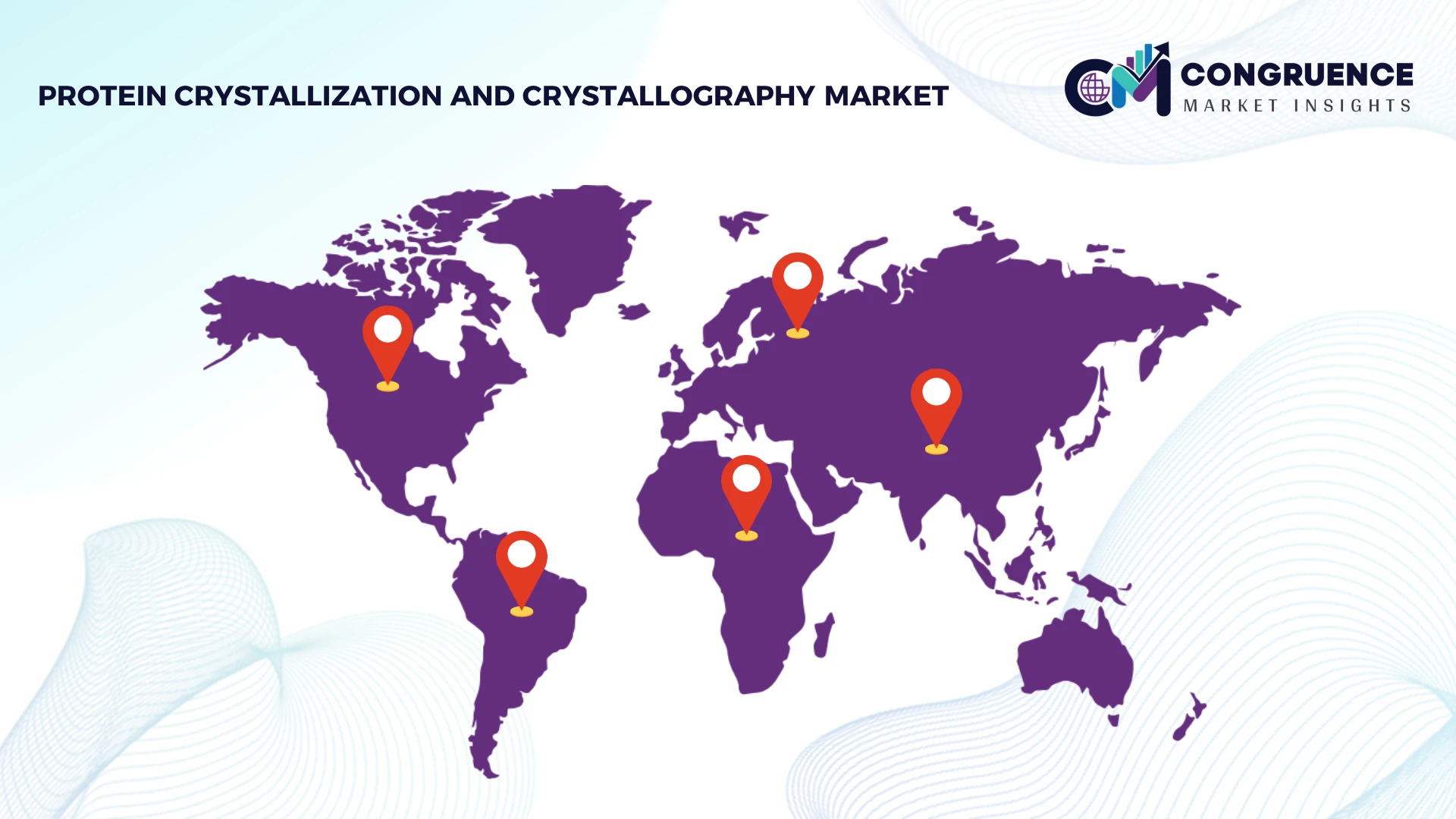
North America commands approximately 44.8% of global demand, supported by concentrated pharmaceutical R&D, major academic structural-biology centers, synchrotron access, and established instrument suppliers. The United States generates the majority of regional activity, with pharmaceutical and biotechnology companies representing more than 65% of commercial laboratory demand. Drug-discovery programs increasingly combine X-ray crystallography, cryo-EM, automated crystallization, and computational structure prediction. U.S. laboratories are also expanding robotic liquid handling to reduce manual experimental workloads by approximately 10–20%. Instrument manufacturers are responding with integrated crystallization, imaging, diffraction, and data-analysis platforms. The strategic advantage is workflow density: proximity among pharmaceutical researchers, CROs, universities, and advanced beamline facilities shortens collaboration cycles and supports faster structure-to-lead decisions.
U.S. Market Outlook: The United States remains the global technology and commercialization hub, supported by a deep pharmaceutical pipeline and extensive structural-biology infrastructure. More than 40% of global pharmaceutical R&D spending is concentrated in the U.S., sustaining demand for high-throughput crystallization, diffraction instrumentation, consumables, and specialized services. Companies increasingly combine internal screening with synchrotron and CRO capacity to manage throughput.
Europe accounts for approximately 27% of global demand, supported by established pharmaceutical research, national laboratories, universities, and shared synchrotron infrastructure. Germany, the United Kingdom, France, Switzerland, and the Netherlands form important structural-biology clusters. European laboratories increasingly use automated crystallization and hybrid X-ray/cryo-EM workflows to improve throughput and address difficult protein targets. Shared research infrastructure reduces the need for every institution to maintain complete high-cost instrumentation. Companies are responding through instrument-software integration, CRO partnerships, and specialized structural services. The region's distributed research model creates a different competitive advantage from the United States: shared infrastructure allows smaller biotechnology companies to access advanced capabilities without replicating full laboratory investment.
Germany Market Outlook: Germany represents a major European structural-biology market because of its pharmaceutical manufacturing base, university research network, and advanced laboratory infrastructure. National research facilities provide access to high-performance diffraction capabilities, while pharmaceutical and biotechnology laboratories increasingly deploy automated crystallization and computational analysis. More than 50% of German pharmaceutical R&D activity is concentrated among major research-intensive organizations, supporting sustained demand for advanced analytical platforms.
Asia-Pacific represents approximately 20% of global demand, with China, Japan, South Korea, and India driving laboratory expansion. China is increasing investment in pharmaceutical R&D and domestic analytical infrastructure, while Japan combines mature synchrotron capabilities with advanced pharmaceutical research. India is expanding structural-biology capacity through biotechnology and academic institutions. Automated crystallization and machine-vision systems are increasingly attractive because they reduce manual screening requirements by approximately 10–20%. Instrument suppliers are establishing local partnerships, technical support networks, and application centers to capture demand beyond major metropolitan laboratories. The region's strategic opportunity is capacity creation: new facilities can adopt integrated digital workflows without the legacy infrastructure constraints found in older laboratories.
China Market Outlook: China is the most strategically significant Asian market because of its large pharmaceutical R&D base, expanding biotechnology ecosystem, and increasing domestic investment in advanced laboratory infrastructure. Major research institutions are adopting high-throughput crystallization, synchrotron-based diffraction, and cryo-EM. China's pharmaceutical R&D spending has expanded substantially over the past decade, strengthening demand for locally supported instrumentation and structural-analysis services.
South America represents a smaller share of global demand, with Brazil accounting for the majority of commercial and research activity. Protein crystallography demand is concentrated around universities, public research institutes, pharmaceutical laboratories, and national scientific facilities. Brazil's synchrotron infrastructure provides an important foundation for structural biology, allowing researchers to access advanced X-ray capabilities without duplicating the full capital investment of a dedicated facility. Automated crystallization remains less widespread than in North American and European laboratories, creating an equipment modernization opportunity. Companies are prioritizing distributor partnerships, application support, and shared-service models rather than broad standalone infrastructure deployment. The most attractive commercial strategy is linking advanced instruments with local technical expertise and centralized research facilities.
Brazil Market Outlook: Brazil is the principal South American market because of its comparatively developed pharmaceutical sector, university research network, and national laboratory infrastructure. The country's Sirius synchrotron provides multiple beamlines supporting structural and biological research, strengthening demand for complementary crystallization, sample-preparation, and analytical technologies. Suppliers with local service capabilities are better positioned to convert research demand into recurring instrument and consumables sales.
Middle East & Africa remains an emerging market concentrated around Saudi Arabia, the United Arab Emirates, Israel, and South Africa. Gulf countries are investing in biotechnology, pharmaceutical localization, university research, and advanced laboratory infrastructure, creating new demand for structural-biology instrumentation. Saudi Arabia's biotechnology strategy targets substantial expansion of domestic life-science capabilities, while the UAE is developing research-focused technology clusters. Israel contributes advanced protein science and biotechnology expertise. Companies are responding through academic partnerships, distributor agreements, laboratory automation, and localized technical support. The market remains infrastructure-constrained outside major research hubs, making centralized facilities and shared instrumentation more commercially viable than broad laboratory deployment. Advanced imaging and automated crystallization offer particularly strong modernization potential.
Saudi Arabia Market Outlook: Saudi Arabia is emerging as the most strategically significant Gulf market as biotechnology localization and research infrastructure become national priorities. The country's biotechnology strategy targets a substantial increase in domestic life-science capabilities by 2040, encouraging pharmaceutical R&D, university partnerships, and laboratory modernization. Structural-biology suppliers can benefit through technology-transfer arrangements, local service networks, and research-institution collaborations.
Rigaku, Bruker, and Thermo Fisher compete as global instrument leaders, while Formulatrix and Molecular Dimensions target automation, crystallization consumables, and specialized workflows. The top five players collectively control approximately 62% of the market, creating moderate concentration across instruments, reagents, software, and services. Competition centers on detector performance, automation, throughput, price, and application support: automated workflows can improve screening efficiency 10–20%, while advanced detectors and beamline systems shorten acquisition time by 20–40%. Rigaku is expanding biopharma capabilities; Bruker integrates X-ray platforms with broader analytical systems; Thermo Fisher leverages portfolio breadth; Formulatrix advances robotic crystallization; Molecular Dimensions strengthens screening chemistry. The competitive shift is toward integrated, AI-assisted workflows connecting crystallization, imaging, diffraction, and analysis rather than standalone equipment. Entry barriers include specialized engineering, validated workflows, customer training, and established research-facility relationships. Winning requires reproducible performance, software integration, application expertise, rapid service, and scalable automation that compresses structure-to-decision timelines across major research markets.
Rigaku Corporation
Bruker Corporation
Thermo Fisher Scientific Inc.
Agilent Technologies, Inc.
FORMULATRIX
Hampton Research
Molecular Dimensions Ltd.
Jena Bioscience GmbH
MiTeGen LLC
Tecan Group Ltd.
Corning Incorporated
Greiner Bio-One International GmbH
Charles River Laboratories International, Inc.
Bio-Rad Laboratories, Inc.
Protein crystallography is moving from standalone X-ray systems toward integrated workflows combining automated crystallization, machine-vision scoring, high-throughput diffraction, and computational analysis. AI-assisted image scoring can reduce manual review by 70–90% in suitable workflows, while automated liquid handling improves experimental consistency by 10–20%. Formulatrix and similar automation specialists benefit as laboratories prioritize throughput without proportionally increasing specialist headcount.
Serial synchrotron crystallography and microfluidic crystal generation are expanding access to smaller samples and difficult targets. Diamond’s 2025 microfluidics deployment supports uniform microcrystal generation, while ESRF’s ID29 enables room-temperature serial experiments using microsecond X-ray pulses. Compared with conventional batch crystallography, serial approaches can reduce sample constraints and increase data-collection efficiency by approximately 20–40% for suitable targets. Rigaku, Bruker, and specialized beamline operators gain from integrated sample-delivery and detector demand.
Through 2026–2028, AI-guided experiment selection, automated crystal scoring, remote beamline access, and hybrid X-ray/cryo-EM workflows will increasingly define competitive laboratory architecture. The priority is interoperability: linking crystallization robots, imaging, diffraction, laboratory information systems, and structure-analysis software can reduce manual handoffs by 10–15%. Pharmaceutical companies with large structural-biology pipelines gain the strongest advantage because integrated platforms compress design-test-analyze cycles, while CROs can commercialize the same infrastructure across multiple clients and improve utilization with lower overhead.
November 2024 Rigaku opened its BioScience Lab in Cambridge, Massachusetts, deploying MoleQlyze for solution-state biomolecular analysis. The facility strengthens customer access within a major biotechnology hub and extends Rigaku’s life-science strategy across more than 90 countries. Source: rigaku.com
October 2025 Pharmaron agreed to acquire 82.54% of Biortus, strengthening integrated structural-biology, complex-protein production, and analysis capabilities. The transaction expands end-to-end drug-discovery services and adds Biortus’s structural expertise to Pharmaron’s global platform, broadening access globally for biopharma clients. Source: pharmaron.com
November 2025 Diamond Light Source demonstrated B-SPA after screening 1,876 crude reactions directly against protein crystals, solving 22 product structures. The workflow reduces purification requirements and accelerates fragment progression, strengthening crystallography for structure-based drug discovery teams at scale. Source: diamond.ac.uk
November 2025 Nuclera partnered with Solve Scientific to expand eProtein Discovery distribution across Australia and New Zealand, extending localized support into additional markets. Its workflow produces proteins for downstream testing in under 48 hours, improving access for researchers. Source: nuclera.com
The Protein Crystallization and Crystallography Market Report covers X-ray, cryo-EM, NMR, SAXS, MicroED, and emerging hybrid structural workflows across drug discovery, structural biology, protein engineering, biologics development, and related research applications. End-user analysis includes pharmaceutical companies, biotechnology companies, academic and research institutes, CROs, and specialized laboratories across North America, Europe, Asia Pacific, South America, and Middle East & Africa.
The report evaluates crystallization screens, automated liquid handling, imaging, diffractometers, detectors, synchrotron access, microfluidics, AI-assisted scoring, serial crystallography, and integrated data-analysis platforms. X-ray crystallography accounts for more than 55% of technology demand, while pharmaceutical and biotechnology users represent approximately 68% of end-user activity. The analysis supports investment planning, laboratory expansion, technology selection, partnership strategy, competitive positioning, and future structural-biology priorities through 2033, with emphasis on automation, workflow interoperability, and faster structure-to-decision cycles.
| Report Attribute/Metric | Report Details |
|---|---|
|
Market Revenue in 2025 |
USD 1,598.4 Million |
|
Market Revenue in 2033 |
USD 3,092.6 Million |
|
CAGR (2026 - 2033) |
8.6% |
|
Base Year |
2025 |
|
Forecast Period |
2026 - 2033 |
|
Historic Period |
2021 - 2025 |
|
Segments Covered |
By Type
By Application
By End-User
|
|
Key Report Deliverable |
Revenue Forecast, Growth Trends, Market Dynamics, Segmental Overview, Regional and Country-wise Analysis, Competition Landscape |
|
Region Covered |
North America, Europe, Asia-Pacific, South America, Middle East, Africa |
|
Key Players Analyzed |
Rigaku Corporation, Bruker Corporation, Thermo Fisher Scientific Inc., Agilent Technologies, Inc., FORMULATRIX, Hampton Research, Molecular Dimensions Ltd., Jena Bioscience GmbH, MiTeGen LLC, Tecan Group Ltd., Corning Incorporated, Greiner Bio-One International GmbH, Charles River Laboratories International, Inc., Bio-Rad Laboratories, Inc. |
|
Customization & Pricing |
Available on Request (10% Customization is Free) |




