
Reports
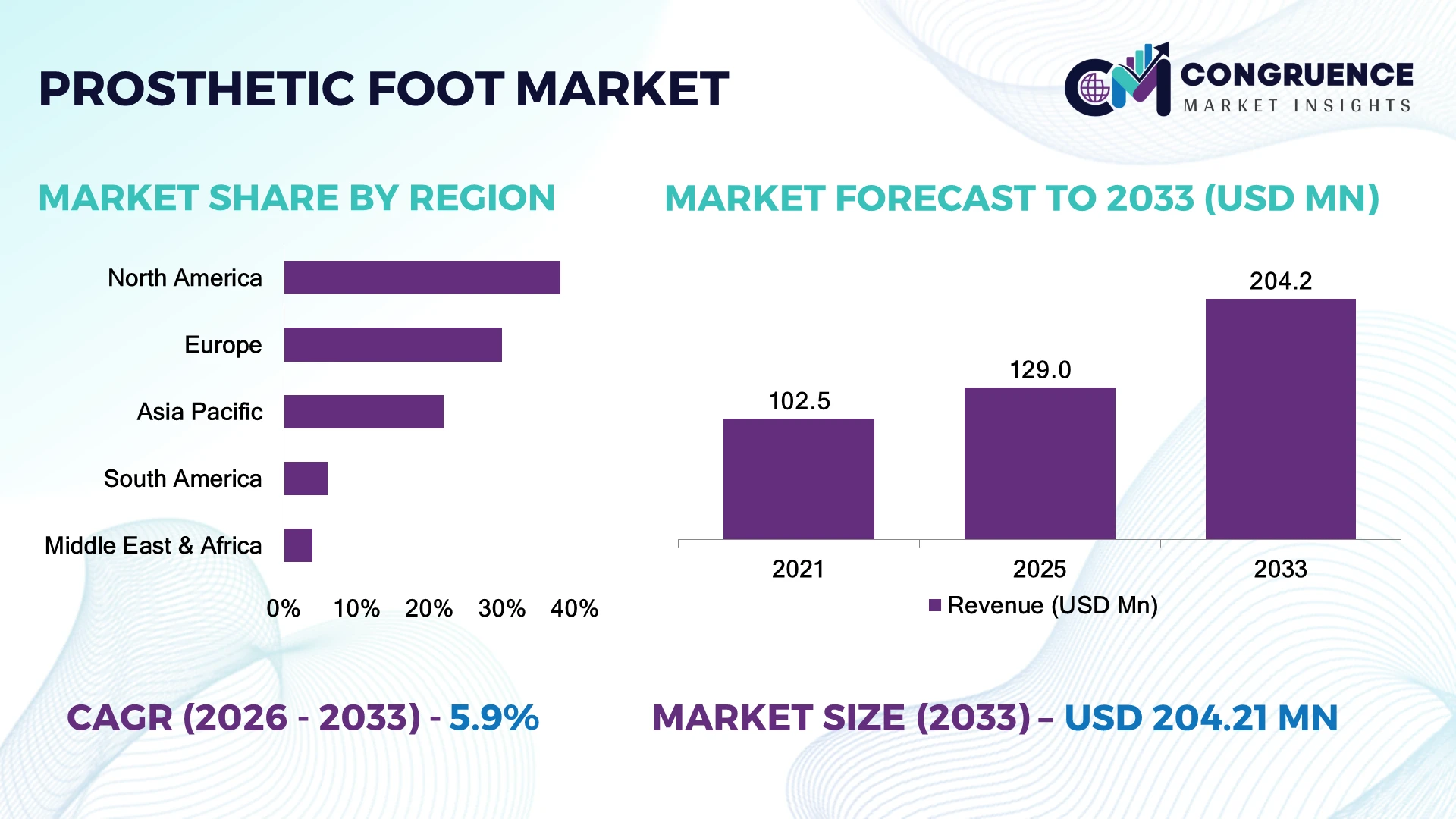
The Global Prosthetic Foot Market was valued at USD 129.0 Million in 2025 and is anticipated to reach a value of USD 204.2 Million by 2033 expanding at a CAGR of 5.91% between 2026 and 2033. Growth is driven by rising adoption of energy-return prosthetic feet, lightweight carbon-fiber designs, and digitally optimized gait technologies improving mobility outcomes for amputees.
The United States remains the dominant country market, accounting for nearly 38% of global adoption, supported by advanced rehabilitation infrastructure, Medicare coverage expansion, and strong investment in prosthetic innovation. Germany follows with around 15% share, driven by specialized orthopedic manufacturing and advanced healthcare systems. In 2025, North American facilities increased investment in customized prosthetic production by over 20%, while European manufacturers focused on precision engineering and sustainable materials. Compared with emerging Asian markets, the U.S. demonstrates faster adoption of microprocessor-enabled solutions due to higher reimbursement accessibility and clinical integration.
Strategic expansion into affordable, digitally connected prosthetic solutions will define competitive positioning.
Market Size & Growth: The market reaches USD 129.0 Million in 2025 and USD 204.2 Million by 2033 at 5.91% CAGR, driven by advanced carbon-fiber and energy-return prosthetic technologies.
Top Growth Drivers: Advanced materials adoption (35%), rehabilitation technology integration (28%), and rising trauma-related amputations (22%) are the primary growth catalysts.
Short-Term Forecast: By 2028, smart prosthetic adoption increases by 25%, improving gait efficiency and reducing fitting time by 20%.
Emerging Technologies: AI-assisted gait analysis, sensor-enabled prosthetic feet, and 3D-printed lightweight components are reshaping product development.
Regional Leaders: North America reaches approximately USD 78 Million, Europe USD 48 Million, and Asia-Pacific USD 42 Million by 2033, supported by digital rehabilitation expansion.
Consumer/End-User Trends: Over 45% of users prefer lightweight dynamic-response prosthetic feet due to improved comfort and mobility performance.
Pilot/Case Example: In 2024, rehabilitation centers using digital gait assessment platforms reported up to 30% faster prosthetic adjustment cycles.
Competitive Landscape: Leading companies hold approximately 40% combined market influence, including Ottobock, Össur, Fillauer, Blatchford, and College Park Industries.
Regulatory & ESG Impact: Sustainability initiatives are increasing recycled-material usage in prosthetic manufacturing by nearly 15% while supporting lower production waste.
Investment & Funding: More than USD 500 Million has flowed into prosthetic technology development, focusing on partnerships, robotics, and personalized healthcare solutions.
Innovation & Future Outlook: Next-generation prosthetic feet are shifting toward AI-enabled customization, connected rehabilitation platforms, and scalable manufacturing models.
The Prosthetic Foot Market is witnessing stronger demand from rehabilitation centers, sports prosthetic applications, and aging populations requiring advanced mobility solutions. Innovations in carbon composites, adaptive response mechanisms, and digital fitting platforms are improving user outcomes, with approximately 30% of new product launches incorporating smart adjustment features. Supply-chain diversification across Asia-Pacific and North America is enabling faster production of customized devices while healthcare providers increasingly prioritize patient-specific mobility solutions.
The Prosthetic Foot Market is becoming strategically important as healthcare systems shift toward personalized mobility solutions, advanced rehabilitation technologies, and outcome-based patient care. Manufacturers are competing through material innovation, digital customization, and integrated service models rather than conventional prosthetic designs. Recent supply-chain restructuring has encouraged companies to establish regional manufacturing hubs, reducing dependency on single-source component suppliers.
Advanced carbon-fiber energy-return feet demonstrate measurable advantages over traditional designs, delivering approximately 20–30% better energy efficiency during walking while reducing device weight by nearly 15%. Digital scanning and automated alignment technologies are also shortening fitting procedures compared with manual adjustment methods. North America leads in premium technology adoption due to stronger reimbursement frameworks, while Asia-Pacific is expanding rapidly through affordable manufacturing and improving rehabilitation infrastructure.
Over the next 2–3 years, companies are prioritizing connected prosthetic platforms, clinical partnerships, and localized production networks. For example, rehabilitation providers are integrating sensor-based gait monitoring systems to optimize long-term patient performance and reduce adjustment requirements. Strategic investments in smart materials, sustainable manufacturing, and healthcare collaborations will determine competitive advantage, positioning leading players to capture opportunities in an increasingly technology-driven prosthetic ecosystem.
The shift toward lightweight, energy-return prosthetic systems is accelerating market expansion as users and rehabilitation providers prioritize improved mobility outcomes. Carbon-fiber prosthetic feet now account for over 60% of premium product adoption due to durability, flexibility, and enhanced biomechanical performance. In the United States, digital gait analysis adoption has increased by nearly 25%, enabling more accurate customization and faster rehabilitation cycles. Companies such as Ottobock and Össur are expanding investments in smart alignment systems, advanced composites, and clinical partnerships. The integration of sensor-based technologies is creating a competitive advantage by reducing fitting adjustments and improving long-term patient satisfaction.
Premium prosthetic foot systems face scalability limitations due to high component costs, specialized manufacturing requirements, and uneven healthcare accessibility. Advanced carbon composite models can cost 30–50% more than conventional prosthetic designs, restricting adoption among price-sensitive users in developing markets. In countries such as India and Brazil, limited reimbursement coverage and rehabilitation infrastructure gaps affect large-scale deployment, with affordability remaining a major barrier for nearly 40% of potential users. Manufacturers are addressing these constraints through localized production, supplier diversification, and modular product architectures. Strategic cost optimization remains essential as companies balance advanced functionality with broader market accessibility.
Next-generation digital prosthetic solutions are creating new opportunities through AI-assisted fitting, 3D printing, and connected rehabilitation platforms. AI-enabled gait monitoring systems are improving adjustment accuracy by approximately 30%, while additive manufacturing reduces prototype development cycles by nearly 40%. China and India are emerging as attractive markets due to expanding rehabilitation networks, increasing healthcare investments, and rising adoption of affordable mobility technologies. Companies are strengthening their positions through partnerships with hospitals, research institutions, and rehabilitation centers. A significant opportunity lies in subscription-based service models combining prosthetic hardware, remote monitoring, and digital support, creating recurring value beyond device sales.
The industry faces execution challenges related to technology integration, clinical training requirements, and consistent performance monitoring across diverse healthcare systems. Sensor-enabled prosthetic platforms require specialized expertise, with approximately 20–30% of rehabilitation facilities lacking advanced digital assessment capabilities. In Japan and Germany, aging populations are increasing demand for precision mobility solutions while creating pressure for highly trained clinical specialists. Companies must overcome interoperability issues between prosthetic devices, software platforms, and healthcare systems through standardized interfaces and collaborative development. Long-term competitiveness depends on improving workforce capabilities, strengthening service infrastructure, and ensuring reliable device performance across different operating environments.
Smart Prosthetic Integration Rising Sensor-enabled prosthetic feet are gaining adoption as rehabilitation providers shift toward data-driven mobility management. More than 30% of newly launched premium devices now include digital adjustment features, while AI-based gait monitoring improves fitting accuracy by nearly 25%. U.S. rehabilitation networks are integrating connected platforms to reduce adjustment cycles and improve patient tracking. Companies are responding through software partnerships, cloud-based monitoring solutions, and investments in intelligent prosthetic ecosystems.
Lightweight Material Innovation Expanding Advanced carbon composites and hybrid materials are reshaping prosthetic foot manufacturing, with lightweight designs reducing device weight by approximately 15–20% compared with traditional models. Japanese and German manufacturers are increasing automation in composite production to improve consistency and reduce material waste by nearly 18%. Companies are restructuring supply chains around high-performance materials to achieve faster customization and improved production efficiency.
Digital Manufacturing Transforming Workflows 3D scanning and additive manufacturing are changing prosthetic production processes, reducing prototype development time by around 40% and improving customization speed by over 30%. Healthcare providers in the United Kingdom and United States are adopting digital workflows to shorten patient fitting timelines. Manufacturers are expanding partnerships with rehabilitation centers to integrate scanning technologies and automated design platforms.
Localized Production Networks Growing Supply-chain disruptions have accelerated regional manufacturing strategies, with companies increasing local component sourcing by approximately 20% since 2023. India and China are emerging as manufacturing hubs for affordable prosthetic components while maintaining quality standards. This shift is enabling faster delivery cycles and cost control, encouraging companies to establish regional partnerships and flexible production models.
Carbon fiber prosthetic feet represent the leading type segment, accounting for approximately 55% of global adoption due to superior energy return, lightweight construction, and durability advantages. Their ability to improve walking efficiency by nearly 20% compared with conventional designs has increased preference among active users and rehabilitation specialists. Conventional prosthetic feet continue maintaining demand in cost-sensitive markets, particularly where affordability and accessibility remain primary purchasing factors. Companies are expanding carbon composite manufacturing capabilities and improving customization platforms to strengthen premium product portfolios. Microprocessor-enabled prosthetic feet represent the fastest-growing type segment, supported by rising demand for adaptive mobility and sensor-based performance optimization. Adoption is increasing by nearly 25% annually in advanced healthcare systems as users seek automated adjustment capabilities. Hydraulic and SACH foot designs remain strategically relevant for basic mobility applications, but manufacturers are shifting investments toward intelligent systems and modular architectures to address personalized rehabilitation needs.
Lower limb rehabilitation represents the leading application segment, contributing approximately 60% of prosthetic foot utilization due to increasing demand from amputees requiring mobility restoration and long-term physical therapy support. Hospitals and rehabilitation centers account for the majority of deployments, with advanced facilities adopting digital fitting systems that reduce adjustment time by nearly 30%. Sports and recreational applications are expanding steadily as active users seek higher-performance prosthetic solutions with improved energy efficiency. Sports and lifestyle applications represent the fastest-growing segment, driven by increased participation among physically active amputees and advancements in high-performance prosthetic designs. Adoption has increased by approximately 20% as manufacturers introduce specialized solutions for running, walking, and endurance activities. Companies are responding through athlete partnerships, customized product development, and expanded rehabilitation collaborations. Other applications, including daily mobility and occupational use, continue supporting demand through affordable and durable product offerings.
Rehabilitation centers represent the leading end-user segment, accounting for nearly 45% of prosthetic foot demand due to their critical role in fitting, adjustment, and long-term mobility training. These facilities increasingly depend on advanced prosthetic technologies, with more than 35% of leading centers adopting digital gait assessment systems to improve patient outcomes. Hospitals remain major users, particularly for post-surgical rehabilitation programs and trauma-related amputations. Individual users represent the fastest-growing end-user category as direct access to advanced prosthetic solutions improves through insurance expansion, financing programs, and personalized healthcare models. Demand from active users is increasing by approximately 20%, encouraging manufacturers to develop more customizable and lightweight products. Government rehabilitation programs and specialty clinics continue supporting broader accessibility, while companies are strengthening partnerships with healthcare providers and expanding localized service networks to improve device availability.
North America accounted for the largest market share at 38% in 2025 however, Asia-Pacific is expected to register the fastest growth, expanding at a CAGR of7.2% between 2026 and 2033.
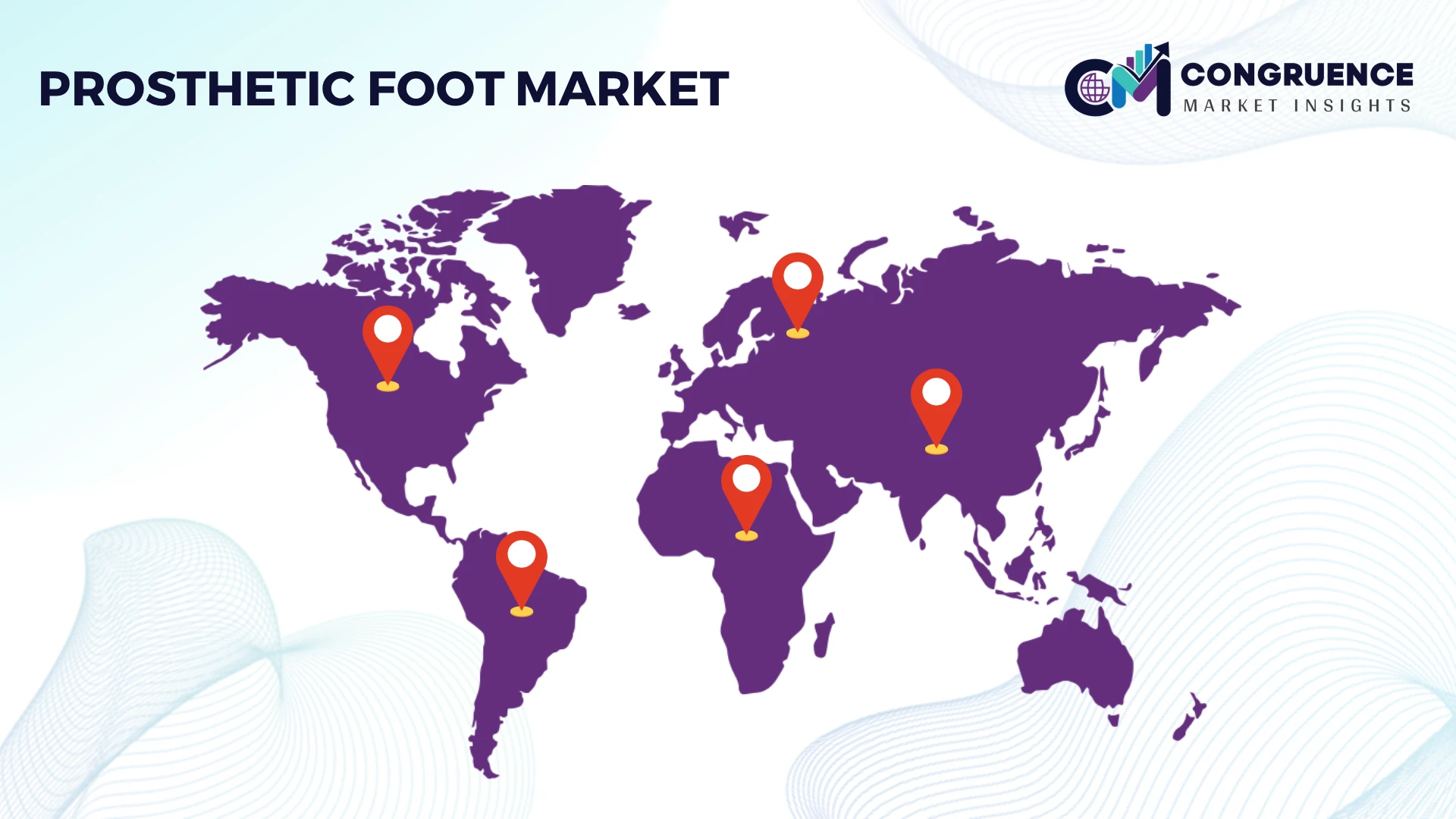
North America maintains market leadership due to advanced rehabilitation infrastructure, strong reimbursement frameworks, and early adoption of energy-return and sensor-enabled prosthetic feet. The region contributes approximately 38% of global demand, supported by the United States’ concentration of specialized clinics, orthopedic technology firms, and research institutions. More than 40% of advanced prosthetic fitting centers in the region have integrated digital gait analysis systems, improving customization efficiency and patient monitoring. Companies are expanding through hospital partnerships, localized manufacturing, and investments in connected prosthetic platforms. The increasing focus on personalized mobility solutions is shifting competition toward software-enabled devices and integrated rehabilitation services.
United States Market Outlook: The United States represents the largest national market due to its advanced healthcare infrastructure, insurance-supported rehabilitation programs, and strong presence of prosthetic technology innovators. Over 50% of premium prosthetic foot installations in North America occur through U.S.-based rehabilitation networks and specialty clinics. Manufacturers are prioritizing AI-assisted fitting systems, remote monitoring solutions, and strategic collaborations with healthcare providers to strengthen patient outcomes and operational efficiency.
Europe remains a major market, supported by advanced orthopedic manufacturing capabilities, aging demographics, and structured rehabilitation systems. Germany, the United Kingdom, and France represent key adoption centers, with Europe contributing nearly 30% of global prosthetic foot demand. Regulatory emphasis on medical device quality and sustainability is encouraging manufacturers to improve material efficiency and develop recyclable composite solutions. Over 35% of leading European rehabilitation facilities have adopted digital assessment technologies to improve prosthetic alignment and patient-specific adjustments. Companies are strengthening regional production networks and collaborating with healthcare institutions to enhance accessibility and reduce dependency on imported components.
Germany Market Outlook: Germany leads Europe’s prosthetic foot industry through advanced medical engineering, specialized manufacturing expertise, and strong rehabilitation infrastructure. The country accounts for nearly 40% of Europe’s premium prosthetic technology adoption, supported by established orthopedic manufacturers and research centers. German companies are focusing on lightweight materials, automated production systems, and sustainable manufacturing practices to improve device performance and operational scalability.
Asia-Pacific is emerging as the fastest-expanding market due to rising healthcare investments, growing rehabilitation demand, and increasing local manufacturing capabilities. China, Japan, India, and South Korea are strengthening their positions through domestic production and technology partnerships. The region contributes approximately 22% of current global demand, while local manufacturers are improving cost efficiency through automation and supply-chain localization. India has increased investment in affordable prosthetic technologies, while Japan focuses on advanced robotic and sensor-based mobility systems. Companies are establishing regional production hubs to reduce delivery timelines by nearly 20% and improve accessibility for underserved populations.
China Market Outlook: China represents the strongest manufacturing base in Asia-Pacific, supported by large-scale medical device production capabilities and expanding rehabilitation infrastructure. The country produces a significant share of cost-efficient prosthetic components and has increased adoption of digitally assisted fitting technologies across major healthcare centers. More than 25% of new domestic prosthetic initiatives emphasize lightweight materials and customized production methods to improve affordability and performance.
South America is gradually increasing prosthetic foot adoption as governments and healthcare organizations improve rehabilitation accessibility. Brazil and Argentina represent the largest demand centers due to population size, trauma-related rehabilitation requirements, and expanding orthopedic services. The region contributes approximately 6% of global demand, with adoption concentrated in urban healthcare networks. Public-private partnerships are improving access to mobility technologies, while local distributors are expanding availability of imported advanced prosthetic systems. However, limited reimbursement coverage and uneven rehabilitation infrastructure continue influencing purchasing decisions. Companies are responding through affordable product lines, regional partnerships, and simplified service models designed for cost-sensitive healthcare environments.
Brazil Market Outlook: Brazil represents the leading South American market due to its large healthcare network, rehabilitation centers, and increasing focus on mobility restoration programs. The country accounts for more than half of regional prosthetic foot demand and is expanding partnerships between hospitals and medical device suppliers. Manufacturers are targeting Brazil with modular designs and lower-cost solutions to address accessibility challenges.
The Middle East & Africa market is developing through healthcare modernization initiatives, rehabilitation infrastructure expansion, and increasing investment in advanced medical technologies. Gulf countries, particularly Saudi Arabia and the United Arab Emirates, are improving access to specialized orthopedic care through hospital modernization programs. The region represents nearly 4% of global demand, with adoption concentrated in major urban healthcare facilities. More than 20% of newly upgraded rehabilitation centers in leading Gulf markets are incorporating digital assessment and advanced prosthetic fitting capabilities. Companies are entering through partnerships with hospitals, government healthcare programs, and regional distributors to improve availability and service support.
Saudi Arabia Market Outlook: Saudi Arabia is emerging as the most strategically significant market in the region due to healthcare transformation programs, infrastructure investments, and increasing adoption of advanced rehabilitation technologies. The country is expanding specialized orthopedic facilities and integrating international medical device partnerships. Over 30% of major rehabilitation projects include upgraded mobility equipment, creating opportunities for premium prosthetic foot providers.
The Prosthetic Foot Market features competition between global leaders such as Ottobock, Össur, and Blatchford, regional manufacturers including Fillauer and College Park, and technology innovators developing sensor-enabled mobility systems. The top five companies collectively account for approximately 45% of market influence, with competition centered on advanced materials, customization, rehabilitation integration, and production efficiency. Premium players compete through digital gait solutions and carbon-fiber innovation, while cost-focused manufacturers target accessibility markets with simplified designs. Advanced prosthetic systems improve mobility performance by nearly 20–30% compared with conventional products, creating technology-driven differentiation. Companies are expanding through hospital partnerships, localized manufacturing, and vertically integrated supply networks. The market is shifting toward connected prosthetics, personalized fitting platforms, and automation-led production. High clinical expertise requirements, regulatory compliance, and manufacturing precision create strong entry barriers. Winning companies will combine innovation, affordability, and scalable healthcare partnerships.
Ottobock
Blatchford
Fillauer
College Park Industries
WillowWood
Freedom Innovations
Proteor
Trulife
ST&G Corporation
Ortho Europe
Roadrunner Foot Engineering
The Prosthetic Foot Market is advancing through carbon-fiber composites, microprocessor-controlled systems, and digital customization technologies. Carbon-fiber energy-return feet provide approximately 20% higher walking efficiency than traditional designs, while reducing device weight by nearly 15%. Sensor-based prosthetic systems are gaining adoption in advanced rehabilitation centers, enabling real-time gait monitoring and improved alignment accuracy.
Artificial intelligence and 3D scanning technologies are transforming fitting workflows by reducing adjustment cycles by around 30% and improving personalization speed. Compared with manual measurement methods, digital scanning platforms deliver faster customization and more consistent clinical outcomes. Technology-focused companies and premium manufacturers benefit most by combining hardware innovation with software-enabled services.
Between 2026 and 2028, connected prosthetic platforms, remote monitoring, and automated manufacturing will become major competitive differentiators. Companies investing in digital ecosystems, smart materials, and integrated rehabilitation solutions will gain operational advantages through lower service costs and improved patient retention. The shift from mechanical devices toward intelligent mobility systems is redefining product value and market positioning.
May 2025 — Ottobock launched the Taleo Adapt hydraulic prosthetic foot, introducing its first internally developed hydraulic foot system with an adjustable ankle joint designed for mobility-grade 3–4 users. The product expands Ottobock’s active lifestyle portfolio by improving adaptability on uneven surfaces and increasing customization options for clinicians. Source: www.corporate.ottobock.com
March 2025 — Ottobock invested in MIT spin-offs MuscleMetrix and BionicSkins to accelerate intuitive prosthetic control and digital socket technologies. The strategic investment, valued in the millions of euros, strengthens the company’s focus on human-machine interfaces and next-generation personalized prosthetic solutions. Source: www.corporate.ottobock.com
May 2025 — Össur expanded its collaboration with the Challenged Athletes Foundation (CAF), providing 92 sports prosthetic feet and knees through grants and clinics across the United States. The initiative strengthens access to high-performance mobility solutions and extends a partnership that has delivered more than 2,000 sports prosthetic devices over three decades. Source: www.ossur.com
September 2025 — Fillauer expanded its strategic distribution activities by becoming the primary U.S. distributor for Aether Biomedical’s Zeus S prosthetic hand. While focused on upper-limb prosthetics, the move demonstrates Fillauer’s broader strategy of expanding advanced prosthetic technology access through distribution partnerships and portfolio diversification.
The Prosthetic Foot Market Report covers comprehensive analysis across product types, including carbon fiber, microprocessor-controlled, hydraulic, and conventional prosthetic foot systems. The study evaluates applications such as lower limb rehabilitation, sports mobility, and daily-use solutions, along with end-users including hospitals, rehabilitation centers, clinics, and individual users. Regional assessment includes North America, Europe, Asia-Pacific, South America, and Middle East & Africa, highlighting adoption patterns and infrastructure differences.
The report analyzes emerging technologies such as AI-assisted gait analysis, sensor-enabled prosthetics, 3D manufacturing, and lightweight composite materials. It evaluates competitive strategies, innovation pipelines, supply-chain developments, and market positioning of leading companies. The analysis supports investment decisions, expansion planning, partnership strategies, and technology prioritization by identifying high-potential segments and evolving mobility solutions between 2026 and 2033.
| Report Attribute / Metric | Details |
|---|---|
| Market Revenue (2025) | USD 129.0 Million |
| Market Revenue (2033) | USD 204.2 Million |
| CAGR (2026–2033) | 5.91% |
| Base Year | 2025 |
| Forecast Period | 2026–2033 |
| Historic Period | 2021–2025 |
| Segments Covered |
By Type
By Application
By End-User
|
| Key Deliverables | Revenue Forecast; Market Trends; Growth Drivers & Restraints; Technology Insights; Segmentation Analysis; Regional Insights; Competitive Landscape; Regulatory & ESG Overview; Recent Developments |
| Regions Covered | North America; Europe; Asia-Pacific; South America; Middle East & Africa |
| Companies Profiled | Össur; Ottobock; Blatchford; Fillauer; College Park Industries; WillowWood; Freedom Innovations; Proteor; Trulife; ST&G Corporation; Ortho Europe; Roadrunner Foot Engineering |
| Customization & Pricing | Available on Request (10% Customization Free) |




