
Reports
The Global Predictive Analytics Market was valued at USD 22511.79 Million in 2025 and is anticipated to reach a value of USD 91200.2 Million by 2033 expanding at a CAGR of 19.11% between 2026 and 2033. Growth is primarily fueled by enterprise-scale AI integration, cloud-native analytics deployment, expanding real-time data ecosystems, and predictive decision automation across healthcare, financial services, manufacturing, and retail operations.
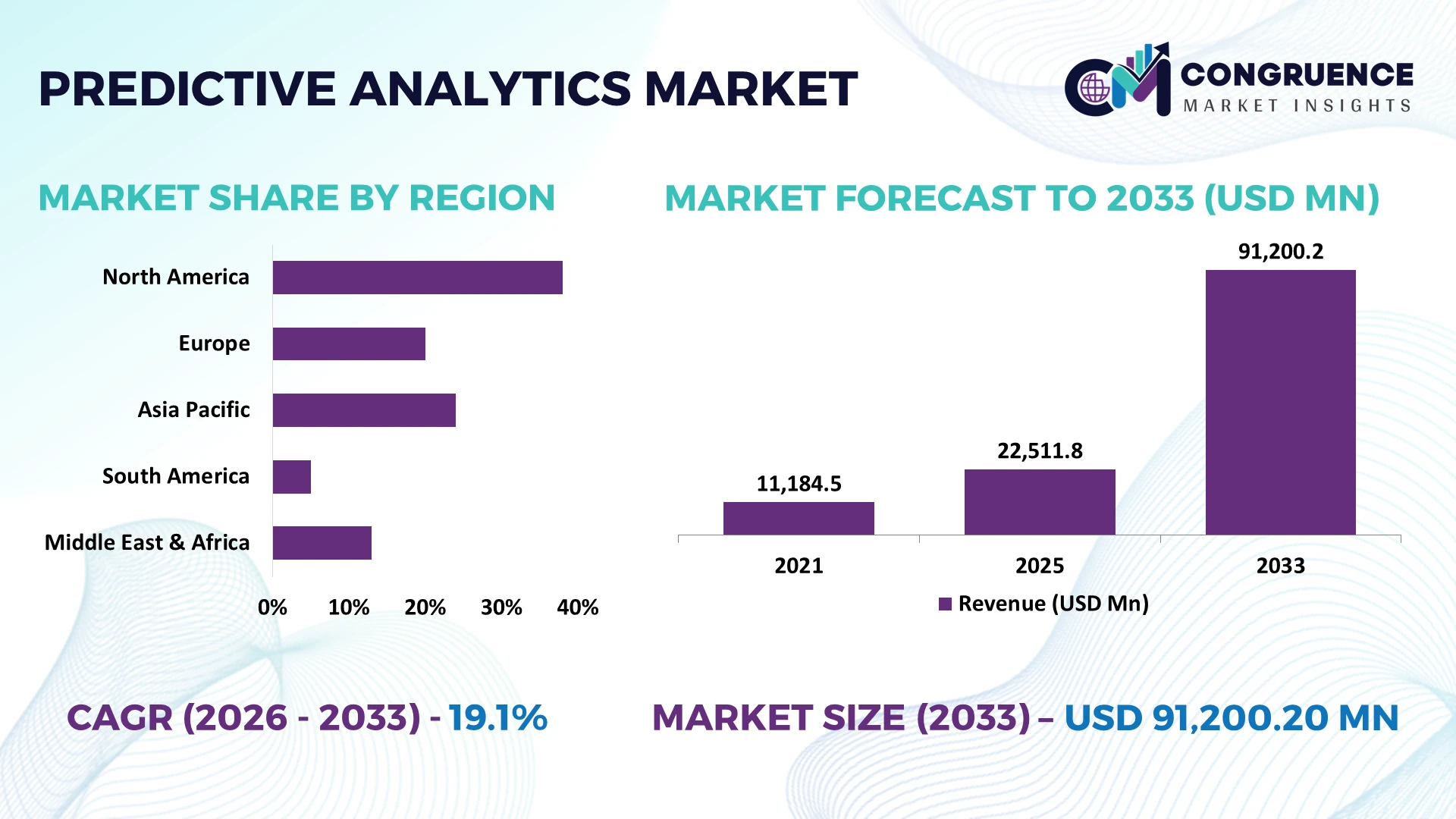
The United States accounts for approximately 37% of global predictive analytics adoption, supported by enterprise AI investments exceeding USD 70 billion, mature cloud infrastructure, and strong deployment across banking, healthcare, and defense. China follows with nearly 21% market participation, driven by industrial digitalization and smart manufacturing initiatives under national technology strategies. Compared with China, the U.S. maintains broader enterprise AI implementation, while Asia-Pacific records adoption growth above 24% across manufacturing and logistics. Ongoing AI competitiveness between major economies continues to accelerate enterprise analytics modernization in 2026.
Organizations prioritizing scalable predictive analytics platforms and industry-specific AI models are strengthening operational resilience, faster decision-making, and long-term competitive positioning.
Market Size & Growth: USD 22511.79 Million in 2025, projected to reach USD 91200.2 Million by 2033 at a CAGR of 19.11%, supported by enterprise AI integration and cloud analytics expansion.
Top Growth Drivers: AI-driven automation improves forecasting accuracy by over 30%, cloud adoption exceeds 68%, and real-time data processing enhances operational responsiveness by nearly 40%.
Short-Term Forecast: By 2028, predictive maintenance and intelligent planning reduce operating costs by approximately 22% while improving business process efficiency by 28%.
Emerging Technologies: Generative AI, AutoML, and edge analytics accelerate model deployment by nearly 35% while enabling faster enterprise-scale decision intelligence.
Regional Leaders: North America surpasses USD 34 billion, Europe exceeds USD 22 billion, and Asia-Pacific approaches USD 26 billion, supported by expanding digital transformation and regional AI investments.
Consumer/End-User Trends: More than 65% of large enterprises deploy predictive analytics across customer experience, fraud detection, and supply-chain optimization initiatives.
Pilot/Case Example: In 2026, AI-enabled predictive maintenance projects improved equipment uptime by 27% and reduced unplanned downtime by 20% in industrial operations.
Competitive Landscape: Leading providers collectively control approximately 45% of the global market, with Microsoft, IBM, SAP, SAS Institute, and Oracle maintaining strong enterprise portfolios.
Regulatory & ESG Impact: AI governance frameworks and responsible data policies improve model transparency by around 25%, supporting regulatory compliance across global operations.
Investment & Funding: Annual investments exceed USD 18 billion through strategic partnerships, AI platform expansion, and enterprise cloud modernization amid regional technology diversification.
Innovation & Future Outlook: Autonomous decision intelligence, multimodal AI, and digital twin integration improve forecasting precision by over 30%, reinforcing long-term strategic transformation across high-growth industries.
Predictive Analytics Market demand is accelerating across healthcare diagnostics, financial risk management, retail personalization, and industrial asset optimization as enterprises prioritize faster, data-driven decisions. Advanced generative AI integration and automated machine learning now shorten model development cycles by nearly 35%, while stronger AI governance requirements shape enterprise deployments. Continued supply-chain digitalization and cross-functional analytics adoption are reinforcing scalable implementation strategies, setting the foundation for broader strategic market evaluation.
Predictive analytics has become a strategic enterprise capability as organizations shift from reactive decision-making to AI-driven forecasting across operations, finance, healthcare, and manufacturing. Competitive advantage increasingly depends on converting real-time data into measurable business actions. Infrastructure modernization, stricter AI governance, and digital supply-chain transformation in 2026 are accelerating deployment priorities while encouraging organizations to standardize enterprise-wide analytics platforms.
Modern AI-enabled predictive analytics platforms process complex datasets approximately 40% faster than legacy rule-based systems while reducing manual analytical workloads by nearly 30%. The United States leads enterprise-scale deployments across financial services and healthcare, whereas India is expanding rapidly through cloud-first digital transformation and manufacturing modernization initiatives. During the next two to three years, enterprise adoption of embedded predictive models is expected to exceed 70% among large organizations, with increasing emphasis on automated forecasting, intelligent risk management, and operational optimization.
A leading automotive manufacturer, for example, integrates predictive analytics into production planning and equipment monitoring, reducing unplanned downtime by nearly 25% while improving inventory accuracy. Companies are strengthening competitive positions through AI platform partnerships, industry-specific solution development, and cloud infrastructure expansion. Organizations that combine predictive intelligence with scalable data governance and continuous model optimization will secure stronger operational resilience, faster strategic execution, and sustained competitive differentiation.
Enterprise-wide adoption of AI-powered predictive analytics is transforming operational planning, customer intelligence, and industrial optimization. More than 68% of large enterprises now prioritize predictive models within digital transformation programs, while automated forecasting improves planning accuracy by nearly 32% and reduces operational delays by approximately 24%. In the United States, manufacturing and financial institutions are expanding AI-driven analytics following increased investment in secure cloud infrastructure and responsible AI frameworks. This structural shift enables organizations to replace fragmented reporting with continuous intelligence. Companies are responding through strategic technology partnerships, industry-focused platform expansion, and proprietary AI model development, strengthening decision quality while creating scalable competitive advantages across multiple business functions.
Disparate enterprise data environments continue to restrict predictive analytics performance despite rapid technology adoption. Around 45% of organizations still operate with disconnected operational datasets, while integration costs increase implementation budgets by nearly 20%. Germany and other European markets face additional compliance requirements under evolving AI governance and data privacy regulations, extending deployment timelines for cross-border analytics projects. Inconsistent data quality also reduces prediction reliability, limiting enterprise confidence in automated decision systems. Companies are reducing these constraints by standardizing data architectures, expanding localized cloud infrastructure, establishing long-term technology partnerships, and implementing unified governance frameworks that improve interoperability while supporting regulatory compliance and operational scalability.
Sector-specific predictive analytics solutions are creating significant opportunities beyond traditional forecasting applications. Healthcare providers, manufacturers, and logistics operators report efficiency improvements exceeding 28% through AI-driven predictive maintenance, patient risk assessment, and demand planning. India is expanding digital public infrastructure, encouraging wider enterprise adoption of cloud-native analytics platforms, while Japan continues investing in industrial automation and intelligent manufacturing. Generative AI combined with digital twins and edge analytics is enabling faster simulation and decision support across mission-critical operations. Companies are increasing R&D investment, building ecosystem partnerships, and developing vertical-specific AI platforms to capture untapped enterprise demand with measurable operational outcomes and lower implementation complexity.
Scaling predictive analytics from pilot deployments to enterprise-wide implementation remains a significant execution challenge. Approximately 38% of organizations encounter model governance issues, while nearly 30% report shortages of advanced AI and data engineering talent. In the United States, rising cybersecurity threats targeting enterprise data platforms increase the need for resilient AI infrastructure and continuous monitoring. Complex integration across legacy ERP, CRM, and operational technology environments also affects deployment consistency and long-term model performance. Companies must strengthen cybersecurity investment, workforce development, explainable AI capabilities, and hybrid cloud architectures while expanding strategic partnerships to maintain reliable, scalable, and trustworthy predictive analytics across enterprise operations.
AI-Native Decision Intelligence Expansion Enterprise deployment of AI-native predictive analytics platforms has surpassed 64%, while model retraining frequency has increased by nearly 35% to support dynamic business environments. Organizations are embedding prediction engines directly into ERP and CRM workflows, reducing decision latency by approximately 28%. As generative AI adoption accelerates, technology vendors are expanding strategic alliances and integrating automated model governance to improve enterprise scalability and operational consistency.
Real-Time Supply Chain Forecasting Persistent supply-chain restructuring and inventory volatility are driving predictive demand planning across manufacturing and logistics. More than 58% of global manufacturers now utilize real-time predictive forecasting, lowering excess inventory by around 18% and improving fulfillment accuracy by 22%. Companies in Germany and the United States are strengthening cloud-connected operational networks while expanding automation partnerships to improve resilience against ongoing sourcing and transportation disruptions.
Responsible AI Governance Adoption Regulatory attention toward AI transparency has accelerated enterprise investment in explainable predictive analytics. Nearly 52% of large organizations have implemented model governance frameworks, while automated compliance monitoring reduces audit preparation time by approximately 30%. Enterprises are standardizing documentation, strengthening cross-functional AI oversight, and restructuring analytics workflows to align with evolving governance requirements without slowing deployment cycles.
Edge Analytics for Operations Edge-enabled predictive analytics is transforming industrial operations by processing operational data closer to production assets. Processing latency has declined by nearly 40%, while predictive maintenance accuracy has improved by approximately 26%. Industrial enterprises in Japan are integrating edge computing with IoT infrastructure to minimize network dependency, and solution providers are expanding hardware-software partnerships that support decentralized analytics and faster operational decision-making.
Cloud-Based solutions account for approximately 47% of the Predictive Analytics Market, supported by rapid deployment, flexible scalability, seamless AI integration, and lower infrastructure requirements. Organizations increasingly prefer cloud-native architectures because implementation time is reduced by nearly 35% while operational flexibility improves by approximately 30% compared with traditional environments. Software platforms continue to represent the core technology layer by enabling advanced forecasting, visualization, and machine learning capabilities, whereas Services remain strategically important for deployment, integration, consulting, and lifecycle optimization.
Cloud-Based platforms also represent the fastest-growing segment as enterprises modernize analytics environments and adopt hybrid AI strategies. On-Premises deployments retain relevance across government, defense, and highly regulated financial institutions requiring greater data sovereignty and infrastructure control, although new deployments are expanding more slowly. Vendors are strengthening cloud ecosystems through hyperscale partnerships, industry-specific analytics solutions, and subscription-based offerings while expanding professional services to accelerate implementation. Investment priorities increasingly favor scalable cloud ecosystems capable of supporting continuous AI innovation and enterprise-wide predictive intelligence.
Risk Management holds the largest share at approximately 31% as financial institutions, insurers, and multinational enterprises rely on predictive models for credit evaluation, operational risk, compliance monitoring, and strategic planning. Advanced predictive models improve risk identification accuracy by nearly 29% while reducing manual assessment time by approximately 24%. Customer Analytics remains a mature application, enabling personalized engagement and retention, while Sales & Marketing increasingly integrates predictive insights into campaign optimization and demand forecasting.
Fraud Detection is emerging as the fastest-growing application due to rising digital transactions and sophisticated cyber threats. Organizations report fraud detection improvements exceeding 33% through AI-enabled behavioral analytics and real-time anomaly detection. Supply Chain Management is also gaining strategic importance as predictive forecasting supports inventory optimization and logistics planning. Companies are integrating multiple applications into unified enterprise analytics platforms, expanding automation capabilities, and strengthening AI ecosystems that improve operational visibility, resilience, and business responsiveness across critical functions.
BFSI represents the leading end-user segment with an estimated 29% market share, reflecting extensive use of predictive analytics for credit scoring, fraud prevention, portfolio optimization, and regulatory compliance. Large financial institutions process vast transactional datasets, enabling predictive models to improve decision accuracy by approximately 31% while reducing manual review workloads by nearly 25%. IT & Telecommunications remains a major adopter through network optimization and customer experience management, while Retail continues expanding predictive merchandising and personalized recommendation capabilities.
Healthcare is the fastest-growing end-user segment as hospitals and healthcare providers increasingly deploy predictive analytics for clinical decision support, patient risk assessment, and resource planning. Manufacturing continues strengthening predictive maintenance and production optimization through connected industrial systems. Vendors are developing industry-specific solutions, expanding strategic partnerships with cloud providers, and introducing flexible pricing models tailored to sector requirements. Competitive differentiation increasingly depends on delivering vertical-specific analytics capabilities that address operational complexity while accelerating enterprise AI adoption across diverse industries.
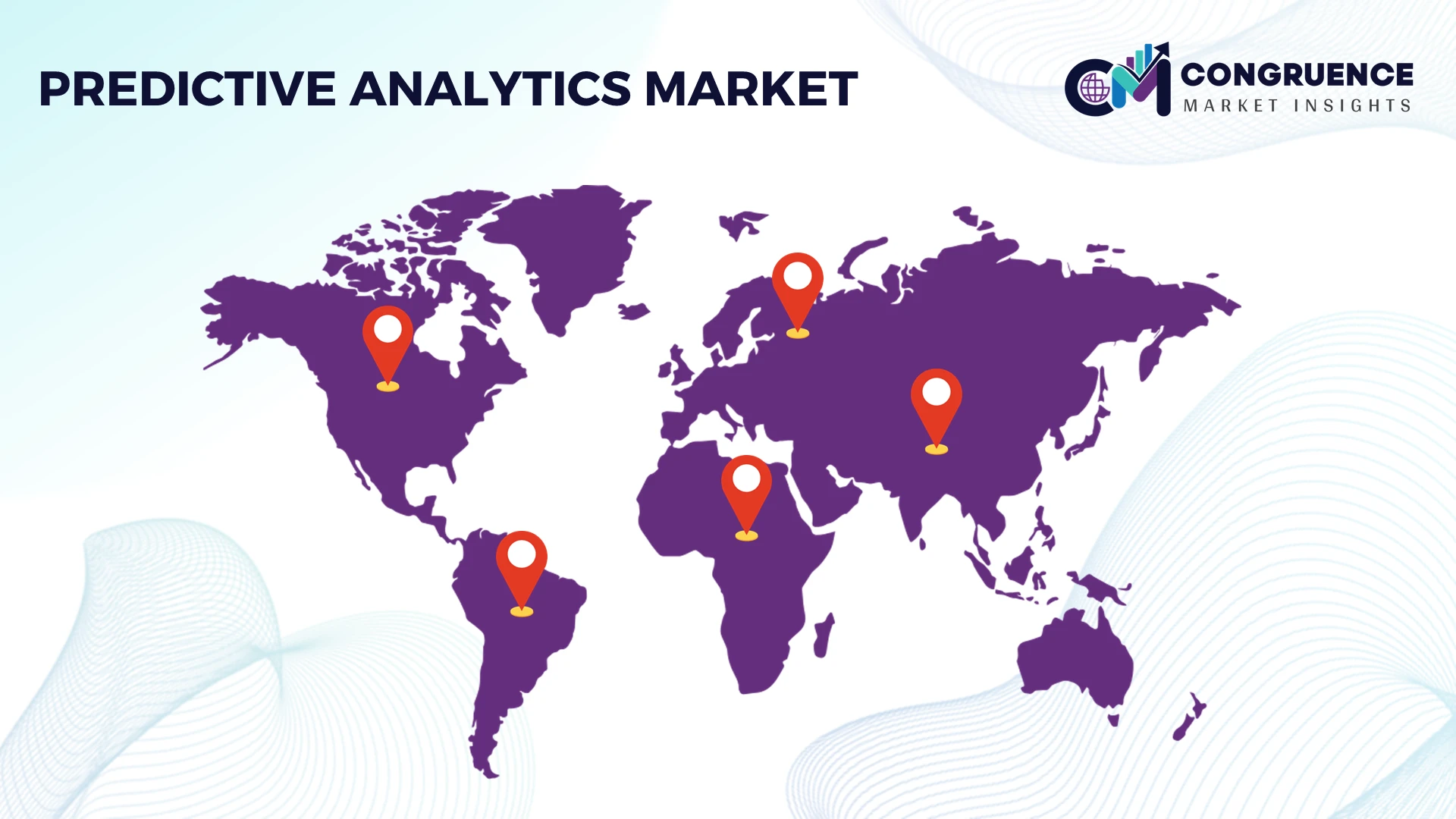
North America accounted for the largest market share at 39% in 2025 however, Asia-Pacific is expected to register the fastest growth, expanding at a 22.4% between 2026 and 2033.
Enterprise AI Platforms Drive Large-Scale Predictive Decision Making
North America maintains its leadership through mature cloud infrastructure, enterprise AI adoption, and extensive deployment across BFSI, healthcare, retail, and manufacturing. The region represents approximately 39% of global implementation activity, supported by advanced data ecosystems and strong enterprise digitization. More than 72% of large organizations have integrated predictive analytics into operational planning, customer intelligence, or risk management. Financial institutions continue expanding AI-powered fraud detection, while manufacturers increasingly deploy predictive maintenance to improve asset utilization. Strategic alliances between hyperscale cloud providers and enterprise software vendors are accelerating deployment speed, reducing implementation timelines by nearly 30%, and enabling broader integration across mission-critical business functions. Continuous investment in responsible AI governance further strengthens enterprise confidence in predictive decision platforms.
United States Market Outlook: The United States remains the regional technology leader due to extensive enterprise AI investments, advanced cloud infrastructure, and strong adoption across banking, healthcare, logistics, and public-sector organizations. More than 75% of Fortune 500 companies utilize predictive analytics in multiple operational workflows, while increasing investment in enterprise data platforms and AI governance frameworks supports scalable deployment. Technology providers continue expanding industry-specific AI partnerships, reinforcing the country's leadership in enterprise predictive intelligence.
Regulatory-Driven AI Modernization Reshapes Enterprise Analytics
Europe continues strengthening predictive analytics adoption through digital modernization, industrial automation, and responsible AI implementation. The region accounts for approximately 27% of global enterprise deployments, with financial services, automotive manufacturing, and healthcare leading implementation activity. Regulatory alignment under evolving AI governance frameworks encourages organizations to standardize analytics models and improve explainability across business operations. Around 58% of large enterprises have accelerated AI governance initiatives alongside predictive analytics deployment. Technology providers are expanding sovereign cloud capabilities and localized AI services to address compliance requirements while supporting cross-industry digital transformation. These developments improve enterprise interoperability and strengthen long-term operational resilience.
Germany Market Outlook: Germany leads the European market through its advanced manufacturing ecosystem, industrial automation leadership, and strong enterprise software adoption. Predictive analytics deployment across automotive production, engineering, and logistics continues expanding, with industrial AI implementations improving production planning efficiency by approximately 27%. German enterprises increasingly integrate predictive maintenance and digital factory solutions to strengthen operational competitiveness while meeting evolving regulatory expectations.
Digital Infrastructure Expansion Accelerates Enterprise Deployment
Asia-Pacific is emerging as the fastest-expanding market due to rapid enterprise digitalization, cloud adoption, and industrial modernization. The region contributes approximately 24% of current global deployments, supported by expanding AI infrastructure and government-backed digital transformation initiatives. More than 60% of large manufacturers are integrating predictive analytics into production planning, inventory optimization, and quality management. Enterprise cloud investments, AI innovation hubs, and expanding data center capacity continue strengthening deployment capabilities. Technology vendors are increasing regional partnerships and localized AI platform development to address rising enterprise demand while supporting large-scale digital transformation programs across manufacturing, telecommunications, and financial services.
China Market Outlook: China leads regional deployment through extensive smart manufacturing initiatives, large-scale industrial digitization, and strong enterprise AI investment. Manufacturing enterprises increasingly integrate predictive analytics with industrial IoT platforms, improving equipment utilization by nearly 30%. Domestic cloud providers and enterprise software companies continue expanding AI ecosystems, strengthening predictive decision-making across logistics, retail, and advanced manufacturing environments.
Enterprise Digitalization Strengthens Market Adoption
South America is steadily expanding predictive analytics implementation as enterprises modernize digital infrastructure across banking, retail, healthcare, and logistics. The region contributes approximately 6% of global deployment activity, with cloud-first implementation strategies improving accessibility for medium-sized enterprises. Nearly 48% of large organizations have accelerated analytics modernization initiatives to improve customer engagement and operational efficiency. Financial institutions remain the largest adopters, while logistics companies increasingly utilize predictive forecasting to improve inventory management. Technology vendors are expanding regional partnerships and managed analytics services, although infrastructure disparities and workforce development remain operational considerations for broader enterprise-scale deployment.
Brazil Market Outlook: Brazil represents the largest national market due to its expanding banking sector, growing cloud ecosystem, and strong enterprise digital transformation initiatives. Financial institutions increasingly deploy predictive analytics for fraud detection, customer intelligence, and credit risk management, improving transaction monitoring efficiency by approximately 24%. Local technology partnerships and cloud infrastructure investments continue strengthening enterprise adoption across multiple industries.
Smart Infrastructure Investments Drive AI Adoption
The Middle East & Africa market is advancing through national digital transformation strategies, smart city development, and increasing enterprise cloud adoption. The region contributes approximately 4% of global predictive analytics deployments, with governments and major enterprises prioritizing AI-enabled operational intelligence. More than 45% of large organizations have accelerated digital modernization programs supporting predictive decision platforms. Energy, healthcare, financial services, and public administration remain the primary deployment sectors. Technology providers are strengthening regional cloud partnerships, expanding AI competency centers, and investing in localized infrastructure to improve deployment capabilities while supporting long-term digital transformation objectives.
United Arab Emirates Market Outlook: The United Arab Emirates leads regional adoption through ambitious smart government initiatives, advanced digital infrastructure, and strong enterprise AI investment. Organizations increasingly deploy predictive analytics across aviation, financial services, healthcare, and public administration, improving operational planning efficiency by nearly 26%. Continued expansion of cloud infrastructure, innovation partnerships, and AI policy frameworks positions the country as a regional center for enterprise predictive intelligence.
The market is led by Microsoft, IBM, SAS Institute, SAP, and Oracle, competing against cloud-native analytics innovators and specialized AI platform providers. The top five players collectively command approximately 48% of the global market through integrated enterprise ecosystems and advanced AI capabilities. Competition centers on predictive model accuracy, deployment speed, cloud scalability, and industry-specific customization rather than price alone. AI-enabled automation shortens implementation cycles by nearly 30%, while cloud-native architectures reduce infrastructure costs by approximately 25%. Leading vendors strengthen market positions through strategic acquisitions, hyperscale cloud partnerships, vertical-specific product development, and embedded analytics integration. Regional providers compete through localized compliance features and tailored deployment services. The competitive landscape is shifting toward generative AI integration, unified data platforms, and end-to-end enterprise intelligence. High implementation complexity, data governance requirements, and enterprise integration expertise remain significant entry barriers. Success increasingly depends on delivering scalable, trustworthy, and industry-focused predictive analytics solutions with measurable operational outcomes.
Microsoft Corporation
IBM Corporation
Oracle Corporation
SAP SE
SAS Institute Inc.
Salesforce, Inc.
Alteryx, Inc.
TIBCO Software Inc.
QlikTech International AB
Teradata Corporation
Altair Engineering Inc.
DataRobot, Inc.
RapidMiner, Inc.
FICO (Fair Isaac Corporation)
Predictive analytics is rapidly evolving from traditional statistical modeling to AI-native decision intelligence powered by machine learning, cloud computing, and real-time data pipelines. Around 68% of large enterprises now deploy cloud-based predictive platforms, while automated feature engineering improves model development efficiency by nearly 35%. Integration with enterprise resource planning, customer relationship management, and industrial IoT systems enables continuous forecasting across operations, reducing planning delays by approximately 24% and strengthening enterprise-wide decision consistency.
Emerging technologies between 2026 and 2028 include generative AI, digital twins, edge analytics, and explainable AI integrated into unified enterprise platforms. Edge-enabled predictive processing lowers operational latency by nearly 40%, while explainable AI improves regulatory transparency by approximately 28% in highly governed industries. More than 55% of advanced manufacturers are integrating predictive analytics with IoT-enabled production environments, creating measurable gains in asset utilization and production scheduling. Organizations adopting digital twin simulations achieve faster operational scenario testing while improving maintenance planning and supply-chain synchronization.
Compared with legacy rule-based forecasting, AI-driven predictive analytics delivers approximately 32% higher forecasting accuracy while reducing manual analytical effort by nearly 30%. Global technology leaders, hyperscale cloud providers, and specialized analytics vendors gain the greatest competitive advantage through integrated AI ecosystems. Companies investing now in scalable predictive intelligence, governed AI, and automated model operations will strengthen enterprise resilience, accelerate strategic decisions, and establish durable competitive differentiation through 2028.
January 2025 Microsoft announced strategic AI partnerships with RailTel, Apollo Hospitals, Bajaj Finserv, Mahindra Group, and others to accelerate enterprise AI deployment across India. The initiative included AI Centres of Excellence supporting large-scale adoption across priority industries. Business impact: faster enterprise analytics deployment and ecosystem expansion.
December 2025 Microsoft committed US$17.5 billion to expand AI and cloud infrastructure in India, with new hyperscale datacenter capacity planned for 2026 and broader enterprise AI enablement. Business impact: significantly increased infrastructure supporting predictive analytics workloads.
January 2026 SAP introduced SAP-RPT-1, a predictive AI model optimized for enterprise tabular business data within SAP Business AI, simplifying predictive modeling across business processes. Business impact: improved enterprise forecasting efficiency and reduced AI model management complexity. Source: SAP News Center
May 2026 IBM and Oracle expanded their 40-year strategic partnership to modernize enterprise AI and hybrid cloud environments, helping organizations automate workflows and scale AI across operations. Business impact: stronger predictive analytics integration for enterprise modernization and operational intelligence.
This report delivers comprehensive strategic coverage of the Predictive Analytics Market across Software, Services, On-Premises, and Cloud-Based deployment models while evaluating key applications including Risk Management, Customer Analytics, Sales & Marketing, Supply Chain Management, and Fraud Detection. The analysis examines adoption patterns across BFSI, Healthcare, Retail, Manufacturing, and IT & Telecommunications, where enterprise implementation exceeds 65% among large organizations adopting AI-enabled analytics platforms.
The report provides detailed assessment of North America, Europe, Asia-Pacific, South America, and the Middle East & Africa, supported by country-level operational insights, technology adoption trends, and competitive positioning. It evaluates AI, machine learning, generative AI, edge analytics, digital twins, and cloud-native predictive platforms while profiling major industry participants and emerging innovators. Business intelligence throughout the report supports expansion planning, technology investment, competitive benchmarking, partnership evaluation, and long-term strategic decision-making across enterprise predictive analytics initiatives between 2026 and 2033.
| Report Attribute/Metric | Report Details |
|---|---|
Market Revenue in 2025 | USD 22511.79 Million |
Market Revenue in 2033 | USD 91200.2 Million |
CAGR (2026 - 2033) | 19.11% |
Base Year | 2025 |
Forecast Period | 2026 - 2033 |
Historic Period | 2021 - 2025 |
Segments Covered | By Type
By Application
By End-User
|
Key Report Deliverable | Revenue Forecast, Growth Trends, Market Dynamics, Segmental Overview, Regional and Country-wise Analysis, Competition Landscape |
Region Covered | North America, Europe, Asia-Pacific, South America, Middle East, Africa |
Key Players Analyzed | Microsoft Corporation, IBM Corporation, Oracle Corporation, SAP SE, SAS Institute Inc., Salesforce, Inc., Alteryx, Inc., TIBCO Software Inc., QlikTech International AB, Teradata Corporation, Altair Engineering Inc., DataRobot, Inc., RapidMiner, Inc., FICO (Fair Isaac Corporation), |
Customization & Pricing | Available on Request (10% Customization is Free) |




