
Reports
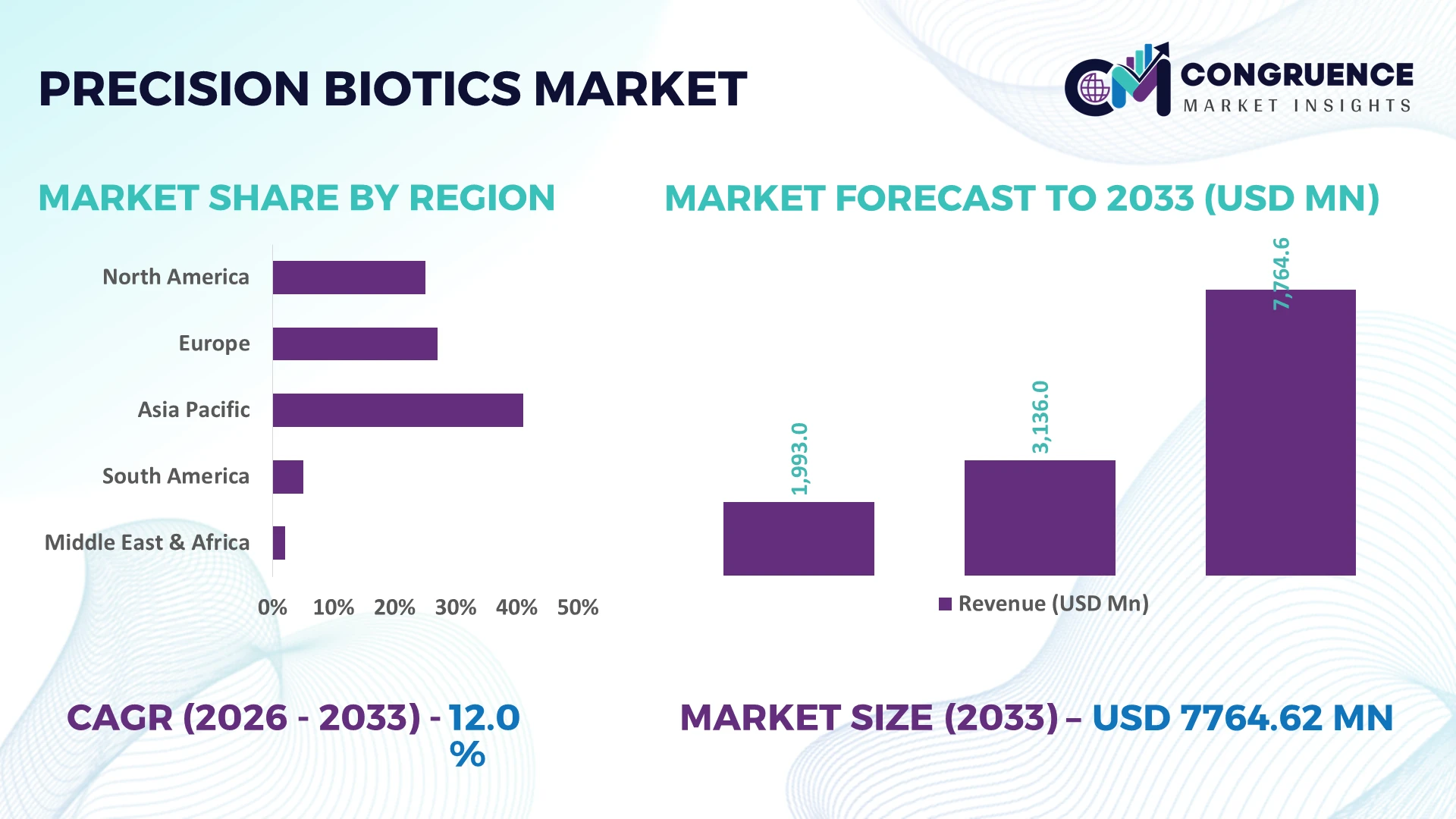
The Global Precision Biotics Market was valued at USD 3136 Million in 2025 and is anticipated to reach a value of USD 7764.62 Million by 2033 expanding at a CAGR of 12% between 2026 and 2033. Precision microbiome technologies, targeted animal nutrition solutions, and increasing integration of data-driven feed optimization across commercial livestock production are accelerating measurable improvements in feed efficiency and animal health outcomes.
The United States dominates the Precision Biotics Market with approximately 34% global share, supported by over USD 450 million in microbiome research investments, strong biotechnology commercialization, and advanced livestock nutrition manufacturing. More than 62% of large integrated animal producers utilize precision nutrition technologies, compared with China's rapidly expanding commercial feed sector, where adoption remains below the U.S. level despite higher production volumes. Continued emphasis on resilient agricultural supply chains in 2026 further reinforces demand for precision biotic solutions.
Strategic investment in scalable microbiome innovation and precision nutrition platforms will strengthen competitive positioning across global animal health and livestock production value chains.
Market Size & Growth: USD 3136 Million in 2025, projected to reach USD 7764.62 Million by 2033 at a CAGR of 12%, supported by rapid advances in microbiome science and precision livestock nutrition.
Top Growth Drivers: Feed efficiency improvement above 15%, antimicrobial reduction initiatives exceeding 20%, and precision nutrition adoption increasing by nearly 18% across commercial livestock operations.
Short-Term Forecast: By 2028, precision biotics are expected to improve feed conversion efficiency by approximately 12% while reducing nutritional input costs by nearly 9% in intensive production systems.
Emerging Technologies: AI-powered microbiome analytics, precision fermentation, and advanced microbial strain engineering reduce formulation development time by nearly 30%.
Regional Leaders: North America exceeds USD 2.6 Billion through biotechnology leadership, Europe approaches USD 2.1 Billion with sustainability-focused adoption, while Asia-Pacific surpasses USD 2.4 Billion through livestock modernization.
Consumer/End-User Trends: More than 52% of commercial livestock producers are integrating precision nutrition strategies to improve productivity, animal welfare, and sustainability performance.
Pilot/Case Example: In 2026, a commercial poultry nutrition program achieved approximately 11% improvement in feed conversion efficiency through targeted precision biotic supplementation.
Competitive Landscape: Leading companies collectively account for nearly 48% market share, with DSM-Firmenich, Cargill, Elanco, ADM, and Evonik driving product innovation and strategic expansion.
Regulatory & ESG Impact: Sustainability policies and antimicrobial stewardship programs have increased precision biotics adoption by approximately 16% across regulated livestock production systems.
Investment & Funding: More than USD 850 million has been invested globally through biotechnology partnerships, production expansion, and microbiome innovation amid ongoing supply-chain diversification.
Innovation & Future Outlook: Next-generation microbial engineering, digital nutrition platforms, and precision biological solutions are strengthening product differentiation and supporting long-term global market expansion.
Precision Biotics Market demand is expanding across poultry, swine, dairy, and aquaculture production, where targeted microbiome modulation enhances nutrient utilization and livestock performance. Recent innovation focuses on AI-assisted microbial discovery and precision fermentation technologies, while adoption of science-based feed solutions has increased by nearly 18%. Ongoing antimicrobial stewardship initiatives and agricultural supply-chain optimization continue to accelerate commercialization, leading into the strategic market assessment.
The Precision Biotics Market has become strategically important as livestock producers shift from conventional feed additives toward targeted microbiome modulation that delivers measurable productivity and sustainability outcomes. Increasing antimicrobial stewardship regulations and agricultural supply-chain restructuring are accelerating investment in precision nutrition technologies that improve production efficiency while supporting compliance with evolving food safety standards. This transition is reshaping competition as biotechnology companies strengthen proprietary microbial platforms and expand strategic collaborations with feed manufacturers.
Compared with conventional probiotic formulations, precision biotics improve feed conversion efficiency by approximately 10–15% while reducing formulation variability through targeted microbial pathway optimization. The United States continues to lead commercial deployment through advanced biotechnology ecosystems, whereas China is rapidly scaling manufacturing capacity to support intensive livestock production. Over the next two to three years, digital livestock management platforms are expected to integrate with precision nutrition programs across more than 40% of large commercial animal production facilities, enabling continuous performance monitoring and data-driven feeding strategies.
Commercial poultry operations already deploy precision biotics to improve nutrient utilization, flock consistency, and production efficiency under intensive farming conditions. Companies are expanding investments through microbiome research, strategic partnerships, and localized production capabilities to strengthen supply resilience. Organizations that combine precision biological innovation with digital farm management and scalable manufacturing will secure stronger competitive positioning and long-term operational advantage.
Precision biotics are gaining momentum as livestock producers prioritize measurable improvements in feed efficiency, animal health, and sustainable production. Commercial poultry and swine operations report feed conversion improvements of 10–15%, while precision nutrition adoption has increased by nearly 18% among integrated livestock enterprises. Regulatory pressure to reduce routine antibiotic usage is accelerating the transition toward microbiome-based nutrition, particularly in the United States and several European livestock markets. In response, biotechnology companies are expanding microbiome research, strengthening partnerships with animal nutrition manufacturers, and investing in advanced fermentation technologies. The strategic outcome is faster commercialization of targeted biological solutions that improve operational performance while supporting long-term productivity and regulatory compliance.
Differences in feed composition, livestock genetics, and production environments continue to limit standardized performance across precision biotics applications. Product validation costs have increased by approximately 14%, while manufacturing expenses for advanced microbial formulations remain 12–16% higher than conventional feed additives. China and other high-volume feed-producing countries also face inconsistent quality control across smaller manufacturing facilities, creating operational complexity for multinational suppliers. Companies are reducing these constraints through localized manufacturing, diversified raw material sourcing, and long-term supply agreements with fermentation partners. Establishing consistent product performance across diverse farming systems remains essential for improving scalability, customer confidence, and commercial profitability.
Artificial intelligence and advanced microbiome analytics are creating new opportunities to accelerate microbial strain discovery and precision nutrition development. AI-assisted biological screening has reduced formulation development time by nearly 30%, while predictive nutrition platforms improve feed optimization accuracy by approximately 20%. The United States continues to expand biotechnology research collaborations, whereas Brazil offers significant untapped opportunities through modernization of commercial livestock production. Companies are increasing R&D investment, building digital livestock ecosystems, and partnering with agricultural technology providers to deliver customized precision biotic solutions. The integration of biological science with digital decision-support platforms represents a differentiated pathway for long-term market leadership.
Achieving reliable biological performance across different species, climates, and production systems remains a critical execution challenge. Performance variation of 8–12% between commercial farms complicates product validation, while more than 35% of producers still lack advanced digital monitoring infrastructure required for precision nutrition optimization. Australia and several emerging livestock markets continue to face shortages of specialized microbiome expertise, slowing commercial implementation. Companies must invest in standardized validation protocols, digital livestock monitoring platforms, workforce development, and collaborative research programs to improve deployment consistency. Organizations that successfully integrate scientific validation with scalable operational execution will achieve stronger competitive resilience and sustained market differentiation.
Advanced Microbiome Platform Integration Precision biotics developers are integrating AI-assisted microbiome analytics into product development, reducing microbial strain screening time by nearly 30% while improving formulation precision by approximately 18%. Biotechnology companies in the United States are expanding digital R&D workflows and forming research partnerships to accelerate commercialization as livestock producers demand more predictable biological performance.
Targeted Livestock Nutrition Expansion Commercial poultry and swine producers are replacing broad-spectrum feed additives with precision microbiome solutions that improve feed conversion by 10–15% and reduce nutritional waste by nearly 12%. Increasing antimicrobial stewardship requirements are driving this operational transition, prompting feed manufacturers to expand production capacity and restructure product portfolios around targeted nutritional technologies.
Localized Manufacturing and Supply Resilience Global supply-chain disruptions have encouraged manufacturers to regionalize fermentation and microbial production, reducing procurement lead times by approximately 20% and improving inventory stability by nearly 15%. Companies are establishing localized manufacturing partnerships, particularly in China and the United States, to strengthen supply continuity while improving responsiveness to commercial livestock customers.
Digital Farm Performance Monitoring Precision biotics are increasingly deployed alongside connected livestock management platforms, enabling continuous monitoring of feed efficiency, animal health, and nutritional outcomes. More than 40% of large commercial livestock enterprises are integrating biological performance data into digital production systems, allowing companies to automate nutrition recommendations, optimize operational decisions, and strengthen long-term customer retention.
Microbiome-Based Products represent the leading segment because they deliver targeted biological activity, higher consistency, and stronger integration with precision nutrition programs. Commercial producers increasingly prefer these solutions as they improve feed conversion efficiency by approximately 12% while reducing formulation variability by nearly 15%. Probiotics continue to maintain broad commercial adoption due to established manufacturing infrastructure and lower implementation complexity. Postbiotics are emerging as the fastest-growing segment because of their superior product stability, longer shelf life, and compatibility with advanced feed formulations. Companies are increasing investments in microbial discovery, fermentation technologies, and precision biological platforms to strengthen differentiated product portfolios.
Prebiotics and Synbiotics remain strategically important by enhancing microbial balance and enabling complementary nutritional benefits across livestock and functional nutrition applications. Enterprise investment is steadily shifting toward scientifically validated microbiome technologies, while manufacturers are expanding partnerships with biotechnology firms and research organizations to accelerate commercialization. Product innovation increasingly emphasizes precision microbial functionality rather than conventional supplementation, supporting higher-value product differentiation and stronger customer retention.
Animal Nutrition accounts for the largest application segment as commercial livestock producers prioritize measurable improvements in feed efficiency, animal performance, and production sustainability. Precision biotics improve nutrient utilization by approximately 10–15%, while commercial adoption among integrated livestock operations has increased by nearly 18%. Gut Health remains a mature application supporting digestive balance across livestock and human nutrition. Dietary Supplements are emerging as the fastest-growing application as consumers increasingly seek scientifically validated microbiome-support products. Manufacturers are expanding production capacity and integrating precision biological ingredients into broader nutrition portfolios.
Immune Health applications continue to strengthen through targeted microbiome modulation, while Functional Foods are gaining momentum as food manufacturers introduce differentiated health-oriented formulations. Companies are expanding strategic partnerships with nutrition developers, investing in clinical validation, and integrating digital product development platforms to improve formulation accuracy. Demand is increasingly shifting toward multifunctional biological solutions capable of delivering measurable performance across multiple health outcomes.
Animal Feed Producers remain the dominant end-user group due to large-scale deployment across poultry, swine, dairy, and aquaculture production systems. More than 52% of integrated feed manufacturers have expanded precision nutrition programs to improve operational efficiency and product differentiation. Nutraceutical Companies represent the fastest-growing end-user segment as demand rises for microbiome-based wellness products supported by scientific validation. Companies are introducing customized formulations and expanding manufacturing capabilities to address evolving customer requirements.
Food & Beverage Companies continue incorporating microbiome-support ingredients into premium functional products, while Pharmaceutical Companies are investing in precision microbial research targeting advanced therapeutic applications. Research Institutes remain essential for validating microbial mechanisms and accelerating innovation through collaborative development programs. Manufacturers are strengthening ecosystem partnerships, adopting value-based pricing strategies, and expanding co-development agreements to improve commercialization speed and competitive positioning across multiple end-user categories.
North America accounted for the largest market share at 38% in 2025 however, Asia-Pacific is expected to register the fastest growth, expanding at a CAGR of 13.8% between 2026 and 2033.

Advanced Microbiome Commercialization Leadership
North America maintains the largest position in the Precision Biotics Market through strong biotechnology capabilities, integrated animal nutrition infrastructure, and extensive commercial livestock production. The region accounts for approximately 38% of global demand, supported by advanced microbiome research and widespread deployment of precision nutrition across poultry, dairy, and swine operations. More than 60% of large integrated livestock enterprises utilize microbiome-based feed optimization platforms to improve feed efficiency and operational consistency. Enterprise partnerships between biotechnology developers and feed manufacturers continue to accelerate commercialization, while investments in precision fermentation facilities strengthen regional production resilience and shorten product development cycles.
United States Market Outlook: The United States leads regional deployment through a mature biotechnology ecosystem, advanced feed manufacturing capacity, and extensive commercial livestock integration. More than 62% of large livestock producers have incorporated precision nutrition programs into production systems, supported by expanding microbiome research collaborations and digital livestock management technologies. Companies continue strengthening domestic manufacturing and strategic partnerships to improve biological innovation, regulatory readiness, and commercial scalability.
Sustainability-Led Feed Innovation
Europe is strengthening its market position through antimicrobial stewardship initiatives, sustainable livestock production, and science-based nutrition strategies. Precision biotics are increasingly integrated into commercial animal feeding programs to improve nutrient utilization while supporting stricter environmental and animal welfare standards. Approximately 54% of commercial feed innovation projects now include microbiome-based nutritional components, reflecting broad enterprise adoption. Collaboration among biotechnology firms, feed producers, and research institutions continues to accelerate product validation, while investments in advanced fermentation infrastructure improve manufacturing efficiency and product consistency across established livestock markets.
Germany Market Outlook: Germany represents the region's leading market through its advanced biotechnology industry, highly developed animal nutrition sector, and strong industrial research network. Commercial feed manufacturers continue expanding precision microbial product portfolios while integrating automated quality control and fermentation technologies. More than 45% of innovation partnerships within Germany's livestock nutrition sector involve microbiome-focused product development, strengthening long-term industrial competitiveness and export potential.
Large-Scale Livestock Modernization
Asia-Pacific is emerging as the fastest-expanding regional market due to rapid livestock industrialization, modernization of commercial feed production, and increasing investment in biotechnology infrastructure. Large poultry and swine production systems are adopting precision nutrition technologies to improve operational efficiency and reduce production variability. More than 20% of newly commissioned commercial feed facilities across major manufacturing economies are incorporating advanced microbial formulation capabilities. Companies are expanding regional manufacturing, strengthening distribution partnerships, and investing in localized microbiome research to meet rising enterprise demand while improving supply-chain resilience.
China Market Outlook: China remains the largest country market in Asia-Pacific because of its extensive livestock production capacity and accelerating biotechnology investment. Commercial feed manufacturers are increasing precision biotics deployment across integrated poultry and swine operations while expanding domestic microbial fermentation capabilities. More than 50% of large feed enterprises are evaluating advanced microbiome technologies to strengthen feed efficiency, reduce dependence on antibiotic-based growth promoters, and improve production consistency.
Livestock Productivity Enhancement
South America is strengthening demand for precision biotics through expansion of export-oriented livestock production and increasing focus on feed optimization. Commercial animal producers are deploying microbiome-based nutrition to improve feed utilization and production performance while responding to evolving international quality standards. Approximately 17% of commercial livestock nutrition investments are now directed toward advanced biological feed technologies. Companies are expanding regional distribution networks, strengthening local manufacturing partnerships, and improving technical support services to accelerate product adoption despite infrastructure differences across production areas.
Brazil Market Outlook: Brazil leads regional market activity through one of the world's largest poultry and cattle industries, supported by modern feed manufacturing and export-driven production systems. Precision nutrition technologies are increasingly incorporated into integrated livestock operations to improve productivity and sustainability. Large agricultural enterprises continue investing in biotechnology partnerships and localized manufacturing capacity to strengthen commercial competitiveness and meet international livestock production requirements.
Agricultural Modernization and Investment
The Middle East & Africa market is gradually expanding as governments and private enterprises invest in livestock modernization, food security initiatives, and advanced animal nutrition technologies. Precision biotics are being introduced into commercial poultry and dairy production to improve productivity under resource-constrained operating environments. Nearly 14% of new commercial livestock modernization programs include advanced nutritional technologies as part of broader efficiency improvement strategies. Companies are establishing regional partnerships, expanding technical training programs, and strengthening distribution capabilities to improve market accessibility and operational reliability.
Saudi Arabia Market Outlook: Saudi Arabia represents the leading market within the region through sustained investment in food security, commercial poultry production, and agricultural technology modernization. Large livestock enterprises continue adopting precision nutrition platforms supported by government-backed agricultural development initiatives. Commercial producers are investing in advanced feed technologies and strategic biotechnology collaborations to improve production efficiency, strengthen domestic food supply resilience, and reduce dependence on imported livestock products.
The Precision Biotics Market is led by DSM-Firmenich, Cargill, ADM, Evonik, and Elanco, while specialized microbiome innovators compete against established animal nutrition companies with broader manufacturing and distribution capabilities. The top five players collectively control approximately 48% of the global market, creating competition between technology-driven innovators and cost-efficient feed solution providers. Product differentiation depends on microbiome science, precision fermentation, formulation accuracy, and integrated customer support rather than price alone. Companies offering validated biological performance achieve nearly 15% higher customer retention, while localized manufacturing reduces delivery lead times by approximately 20% and digital formulation platforms shorten product development by almost 30%. Competition increasingly centers on strategic partnerships, biotechnology licensing, production expansion, and vertical integration across microbial strain development and commercial feed manufacturing. Proprietary microbiome databases and regulatory validation create significant entry barriers for new participants. Companies combining scientific validation, scalable manufacturing, digital nutrition platforms, and resilient supply networks will sustain competitive advantage against both global biotechnology leaders and regional feed specialists.
DSM-Firmenich
Cargill Incorporated
Archer Daniels Midland (ADM)
Evonik Industries AG
Elanco Animal Health
Novonesis
Kemin Industries
Adisseo
Alltech
Lallemand Inc.
Kerry Group
Chr. Hansen Holding A/S
Precision biotics technology is rapidly evolving from conventional microbial supplementation toward targeted microbiome modulation supported by artificial intelligence, precision fermentation, and advanced genomic sequencing. AI-assisted microbial screening reduces strain identification time by nearly 30%, while next-generation sequencing improves formulation accuracy by approximately 20%. More than 40% of commercial product development programs now integrate computational microbiome analysis, enabling faster validation and stronger biological consistency. These technologies improve decision-making and accelerate commercialization for biotechnology companies and animal nutrition manufacturers.
Emerging technologies focus on digital livestock monitoring, predictive nutrition platforms, and precision fermentation systems that optimize microbial production efficiency. Compared with conventional probiotic development, precision microbiome engineering delivers approximately 15% higher feed performance consistency while reducing formulation variability by nearly 18%. Companies integrating biological analytics with connected farm management platforms gain stronger customer retention through measurable production improvements. Large commercial feed manufacturers benefit most by combining digital performance monitoring with customized microbiome formulations tailored to species-specific nutritional requirements.
Between 2026 and 2028, automated microbial engineering, machine learning-enabled formulation design, and scalable fermentation infrastructure will reshape competitive positioning. Deployment of digital precision nutrition platforms is expected to exceed 50% among major commercial livestock enterprises, strengthening operational efficiency and reducing development cycles. Organizations investing early in integrated biotechnology platforms, advanced analytics, and proprietary microbial libraries will secure stronger product differentiation, faster innovation pipelines, and sustainable competitive advantage in precision nutrition markets.
February 2026 DSM-Firmenich announced the divestment of its Animal Nutrition & Health business to sharpen its focus on consumer nutrition while retaining a 20% equity stake in the business. The strategic restructuring strengthens capital allocation and innovation priorities across advanced health and biotics portfolios. Source: dsm-firmenich
February 2026 DSM-Firmenich confirmed the sale of its Feed Enzymes business to Novonesis for approximately €1.5 billion, marking a major portfolio optimization initiative. The transaction enables greater concentration on differentiated microbiome and nutrition innovations while accelerating strategic business transformation.
2025 DSM-Firmenich reported a significant expansion of its Humiome® portfolio, with a major Chinese health supplements company launching a multi-ingredient product containing Humiome® Post LB. The commercialization strengthens precision biotics adoption across Asia and expands science-backed microbiome product availability.
May 2026 DSM-Firmenich opened its NextGen pet-dedicated premix facility in Itatiba, Brazil, expanding specialized production capacity for advanced nutrition solutions. The new facility improves regional manufacturing responsiveness and strengthens localized supply capabilities for precision nutrition markets.
This report provides a comprehensive assessment of the Precision Biotics Market across five product types, five application areas, and five major end-user categories, supported by detailed evaluation of North America, Europe, Asia-Pacific, South America, and the Middle East & Africa. It analyzes adoption trends, deployment patterns, technology integration, competitive positioning, and operational developments influencing precision microbiome solutions. More than 45% of the assessment emphasizes emerging biological technologies, enterprise innovation, and evolving commercial deployment strategies.
The study examines manufacturing capabilities, precision fermentation, microbiome analytics, AI-enabled formulation platforms, and digital livestock nutrition technologies shaping market evolution between 2026 and 2033. It evaluates competitive strategies, investment priorities, partnership activity, regulatory developments, and regional deployment differences while highlighting high-potential niche opportunities. The report supports strategic expansion planning, product portfolio optimization, technology investment decisions, competitive benchmarking, and long-term market positioning through business-focused, data-driven analysis across the global precision biotics ecosystem.
| Report Attribute/Metric | Report Details |
|---|---|
Market Revenue in 2025 | USD 3136 Million |
Market Revenue in 2033 | USD 7764.62 Million |
CAGR (2026 - 2033) | 12% |
Base Year | 2025 |
Forecast Period | 2026 - 2033 |
Historic Period | 2021 - 2025 |
Segments Covered | By Type
By Application
By End-User
|
Key Report Deliverable | Revenue Forecast, Growth Trends, Market Dynamics, Segmental Overview, Regional and Country-wise Analysis, Competition Landscape |
Region Covered | North America, Europe, Asia-Pacific, South America, Middle East, Africa |
Key Players Analyzed | DSM-Firmenich, Cargill Incorporated, Archer Daniels Midland (ADM), Evonik Industries AG, Elanco Animal Health, Novonesis, Kemin Industries, Adisseo, Alltech, Lallemand Inc., Kerry Group, Chr. Hansen Holding A/S |
Customization & Pricing | Available on Request (10% Customization is Free) |




