
Reports
The Global Portable TOC Analyzer Market was valued at USD 31.0 Million in 2025 and is anticipated to reach a value of USD 39.6 Million by 2033 expanding at a CAGR of 3.1% between 2026 and 2033. Real growth is anchored in point-of-use pharmaceutical water compliance and decentralized environmental monitoring, where portable units eliminate sample transport delays and reduce contamination risk in remote industrial sites.
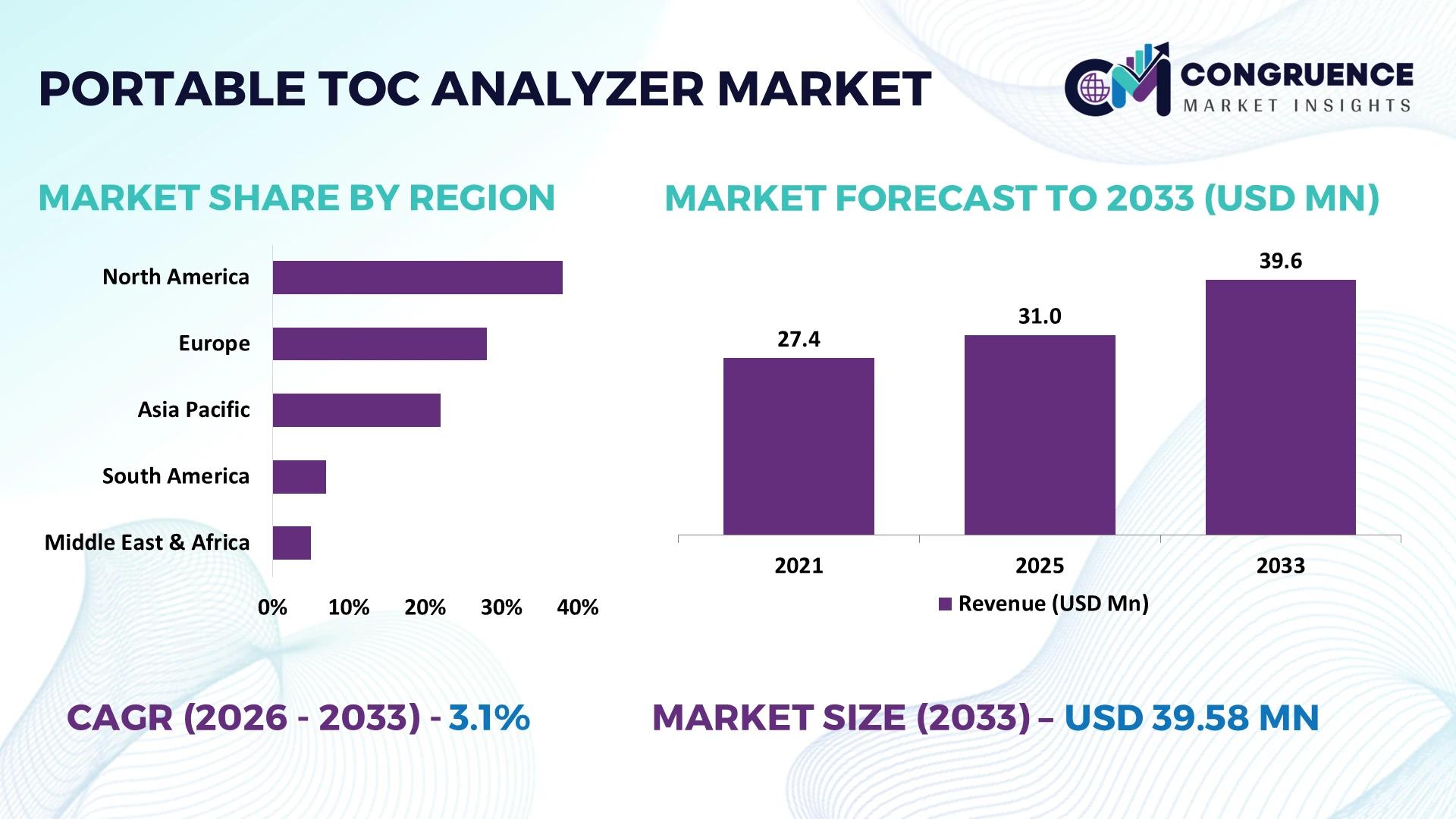
The United States commands approximately 34% of global pharmaceutical TOC analyzer demand, driven by FDA-aligned purified water monitoring protocols and a dense base of bioprocessing facilities investing in real-time release testing infrastructure. Germany and Japan collectively hold an estimated 22% share, with adoption concentrated in chemical manufacturing and municipal water surveillance where portable units complement fixed online systems. A measurable operational shift: portable deployments reduce sampling-to-result turnaround by up to 75% compared with laboratory bench workflows, directly compressing deviation investigation cycles in sterile fill-finish operations.
The strategic implication is clear—suppliers prioritizing USP/EP-compliant portability and audit-ready data capture will capture disproportionate share as compliance scrutiny intensifies across emerging biologics hubs.
Market Size & Growth: The global market reached USD 30.92 Million in 2025 and is projected to attain USD 38.17 Million by 2032, with UV oxidation technology adoption accelerating demand in pharmaceutical water monitoring.
Top Growth Drivers: Pharmaceutical GMP compliance requirements (33% of demand growth), decentralized environmental testing expansion (27%), and point-of-use water system validation (24%) collectively anchor near-term expansion.
Short-Term Forecast: By 2027, portable unit integration with laboratory information management systems is expected to reduce manual data transcription errors by approximately 21%, accelerating batch release documentation.
Emerging Technologies: UV oxidation combined with NDIR detection achieves detection limits down to 0.025 ppb; dual-USB data logging and cloud-ready export functionality are becoming standard specifications.
Regional Leaders: North America leads with an estimated USD 10.5 Million in 2025 demand; Europe follows at USD 8.9 Million driven by EU pharmacopeia harmonization; Asia-Pacific reaches USD 7.7 Million with China and India accounting for 38% of regional demand.
End-User Trends: Approximately 31% of pharmaceutical manufacturers now deploy portable TOC analyzers for at-line testing, shifting from centralized QC laboratories to distributed compliance models.
Pilot/Case Example: In 2025, a European sterile injectables facility replaced bench sampling with portable 450TOC units across three water loops, cutting sampling time by 75% and eliminating sample transport artifacts.
Competitive Landscape: Mettler Toledo, Shimadzu, and GE Analytical Instruments collectively hold an estimated 45% share; Hach, Analytik Jena, and Xylem complete the top-tier supplier group.
Regulatory & ESG Impact: USP <643> and EP 2.2.44 compliance requirements influence 100% of pharmaceutical-grade procurement decisions, while reduced reagent consumption aligns with green laboratory mandates.
Investment & Funding: Equipment budgets for portable TOC deployment in North American bioprocessing expanded by an estimated 18% in 2025, with supplier partnerships targeting integrated water system validation services.
Innovation & Future Outlook: Next-generation units integrate self-calibration and predictive maintenance diagnostics; strategic focus shifts from hardware specifications toward compliance documentation ecosystems and service-layer differentiation.
The portable TOC analyzer market finds concentrated demand in pharmaceutical purified water monitoring, environmental soil and water testing, and chemical process verification. Recent product innovation centers on UV oxidation configurations achieving sub-ppb detection limits with dual-USB audit-trail export, while a measurable 31% of pharmaceutical manufacturers now position portable units at the point of water use rather than centralized laboratories. The 2025 U.S. tariff realignment on laboratory instrumentation imports introduced supply-chain cost uncertainty, with imported analytical equipment facing price adjustments exceeding 20% in some procurement quotes. This operational friction is accelerating distributor localization strategies and favoring suppliers with regional assembly or inventory buffers. The following strategic assessment examines how compliance-driven portability and supply-chain resilience are reshaping competitive positioning.
Portable TOC analyzers are transitioning from supplementary field tools to core compliance infrastructure in pharmaceutical water systems and decentralized environmental monitoring. The strategic stakes rise as regulators in the United States and Europe tighten real-time release testing frameworks, making point-of-use organic carbon verification a gating factor for batch disposition rather than a periodic audit exercise.
The technology comparison is stark: legacy laboratory sampling workflows require transport, chain-of-custody documentation, and bench analysis, with total turnaround measured in hours to days. Portable units delivering continuous readings with 60-second response times and 0.025 ppb detection limits compress this cycle by approximately 75%, directly reducing deviation investigation scope and batch hold durations. Regionally, North American adoption prioritizes USP-compliant data integrity features, while Asia-Pacific growth—particularly in India and China—emphasizes cost-effective UV oxidation configurations for high-volume pharmaceutical manufacturing expansion.
A practical deployment illustration: a European sterile fill facility integrated portable 450TOC units across three purified water loops in 2025, replacing bench sampling with at-line verification and reducing sampling labor hours by over 70% while eliminating transport-related contamination artifacts. Companies are responding by restructuring capital budgets toward distributed compliance networks rather than centralized laboratory capacity, and by negotiating supplier contracts that bundle instrument service with audit documentation support. The competitive advantage accrues to manufacturers and end-users who treat portability not as a convenience feature but as a compliance architecture decision—one that determines how quickly a batch can be released, how confidently a deviation can be closed, and how resiliently a water system can be validated against tightening global pharmacopeia standards.
Pharmaceutical manufacturers are shifting TOC testing from centralized quality control laboratories to at-line and point-of-use deployment, driven by regulatory emphasis on real-time water system verification and batch release acceleration. Approximately 31% of pharmaceutical TOC analyzer installations now involve portable configurations positioned directly at purified water loops, with an additional 19% of sterile production units reporting portable TOC demand growth specifically for environmental monitoring within classified spaces. This structural shift compresses the interval between sampling and disposition decision, reducing batch hold costs and deviation investigation scope. Suppliers are responding by embedding USP <643> and EP 2.2.44 compliance documentation directly into instrument firmware, while expanding service networks in Indian and Chinese pharmaceutical hubs where domestic manufacturers face tightening GMP inspection intensity. The strategic insight: portable TOC is becoming the front line of regulatory defensibility, not merely a field convenience.
The 2025 U.S. tariff realignment on imported laboratory instrumentation introduced direct cost pressure on portable TOC procurement, with import-dependent analytical equipment quotes rising by approximately 20% for European- and Japanese-origin units. This compounds an already capital-sensitive purchasing environment: small and mid-sized contract research organizations report that upfront instrument cost influences approximately 17% of procurement deferrals. Supply-chain localization remains partial—precision optical components and NDIR detectors still concentrate among limited suppliers, leaving manufacturers exposed to cross-border pricing volatility. Companies are mitigating through regional inventory buffering and distributor financing arrangements, while some U.S. buyers pivot toward lease structures that convert capital expenditure into operational expense. The operational insight: cost volatility is not a transient procurement nuisance but a structural factor reshaping which manufacturers can defend margin in price-sensitive emerging markets.
Soil carbon measurement and decentralized water quality surveillance represent underpenetrated demand pools for portable TOC configurations. Agricultural carbon sequestration verification programs in the European Union and voluntary carbon market protocols are creating new institutional buyers for field-deployable organic carbon measurement, with portable unit repeatability specifications at ≤3% error now meeting soil testing standards. In India, municipal water utilities serving populations exceeding one million are piloting portable TOC surveillance to supplement sparse fixed monitoring networks, with pilot programs reporting a 27% improvement in contamination event detection speed compared with grab-sample laboratory workflows. Companies positioning for this opportunity are developing modular sample introduction systems that accommodate both aqueous and solid matrices without factory reconfiguration—a capability that collapses two product lines into one field-deployable platform and expands addressable demand beyond pharmaceutical compliance alone.
Portable TOC analyzers increasingly generate audit-grade data, but integration with laboratory information management systems and electronic batch records remains inconsistent. Approximately 21% of pharmaceutical users report that manual data transfer from portable units to centralized quality systems persists as a compliance risk, while 14% cite insufficient trained personnel as a barrier to expanding portable deployment beyond pilot sites. The workforce gap is most acute in rapidly expanding biologics manufacturing hubs in South Korea and Singapore, where instrument deployment outpaces technician certification pipelines. Cybersecurity exposure also emerges as portable devices connect to facility networks for data export—an operational concern for defense-adjacent chemical facilities and water utilities subject to critical infrastructure protection standards. Companies must solve through embedded middleware partnerships and structured training programs bundled with instrument service contracts, or risk portable TOC deployment stalling at the pilot-to-scale transition.
Pharmacopeia Harmonization Accelerates At-Line Adoption The European Pharmacopoeia's June 2025 adoption of revised monographs replacing oxidizable substances with TOC testing in Water for Injections—effective July 2026—forces European sterile manufacturers to reassess water monitoring architecture. Approximately 34% of EU-based pharmaceutical water systems currently rely on grab-sample workflows that cannot meet the tighter continuous verification expectations. Companies are responding by embedding portable units directly into water loop validation protocols, with Canadian deuterium supplier deutraMed reporting 100% system compliance achievement through point-of-use monitoring that eliminated sample transport artifacts.
USP ⟨1231⟩ Revision Shifts Sampling Economics The USP's 2025 revision explicitly supports online TOC monitoring while clarifying that grab samples must remain representative, effectively raising the evidentiary bar for laboratory-dependent compliance. An estimated 27% of U.S. pharmaceutical quality teams now report that portable at-line verification reduces deviation investigation scope by compressing the interval between excursion detection and root-cause confirmation. Suppliers are restructuring service contracts to bundle instrument deployment with audit-trail documentation packages, converting one-time equipment sales into recurring compliance partnerships.
Heavy Water and Niche Matrices Open Unconventional Demand Beyond standard purified water, portable TOC analyzers are penetrating specialized matrix applications where fixed online systems cannot economically deploy. The deutraMed case demonstrates that deuterium oxide (D₂O) production requires rapid organic carbon verification at multiple process points, with portable 450TOC units cutting system validation time substantially while maintaining USP ⟨643⟩ and 21CFR Part 11 compliance. This non-obvious demand pool—high-value specialty chemicals and isotopic compounds—carries premium pricing tolerance and low competitive density, prompting Mettler Toledo and Sievers to prioritize application-specific method development over generalized hardware refreshes.
Compact Sensor Architectures Redefine Deployment Footprint Sievers CheckPoint Pharma's 2.9 kg form factor with 4-minute initial response and 15-second online measurement intervals represents a design shift toward sensor-grade portability rather than instrument-grade transportability. This enables pharmaceutical maintenance teams in space-constrained Japanese and Singaporean facilities to conduct calibration and system suitability tests on-site without dedicated bench allocation. The operational consequence: portable TOC moves from periodic verification tool to continuous water-system diagnostic instrument, with manufacturers reallocating quality assurance labor from sample logistics toward real-time data review and predictive maintenance escalation.
The portable TOC analyzer market segments by oxidation method into ultraviolet (UV) oxidation and persulfate oxidation configurations. UV oxidation represents the dominant type, commanding an estimated 68% share of portable unit deployments, driven by its reagent-free operation, lower maintenance burden, and direct compatibility with USP ⟨643⟩ system suitability requirements that specify sucrose and 1,4-benzoquinone oxidation efficiency testing. This dominance is structural rather than incidental: UV oxidation eliminates the consumable supply chain dependency that complicates persulfate-based field deployment, making it the default choice for pharmaceutical at-line verification in the United States and Europe where audit-trail simplicity carries procurement weight.
Persulfate oxidation configurations serve a narrower but technically demanding niche—approximately 32% of portable deployments—concentrated in environmental matrices with higher organic loading where UV alone achieves incomplete oxidation. The fastest-growing adoption shift within portable types is not between oxidation chemistries but toward integrated conductivity measurement in the same unit, with dual-parameter capability becoming a procurement specification rather than an optional feature. Companies are responding by consolidating product lines: Mettler Toledo's 450TOC and Sievers CheckPoint Pharma both bundle TOC and conductivity in a single portable platform, collapsing what were previously separate verification workflows into one instrument pass.
Pharmaceutical applications constitute the leading demand concentration for portable TOC analyzers, accounting for an estimated 58% of unit deployments. This dominance reflects the regulatory necessity of USP ⟨643⟩ and EP 2.2.44 compliance for purified water and Water for Injection systems, where portable units enable at-line verification during system qualification, cleaning validation, and deviation investigation without disrupting production water loops. The pharmaceutical segment's procurement behavior is characterized by documentation intensity: buyers prioritize instruments with embedded audit trails and pharmacopeia-specific system suitability protocols over raw analytical sensitivity alone.
Environmental analysis represents the fastest-growing application segment, with portable TOC adoption accelerating in soil carbon measurement, municipal water surveillance, and industrial effluent monitoring where fixed online installations are economically impractical. Approximately 23% of new portable unit deployments in 2025 targeted environmental matrices rather than pharmaceutical water, up from 17% in 2023, reflecting tightening discharge regulations in the European Union and expanding carbon sequestration verification markets. Chemical manufacturing applications occupy a stable middle position, with portable TOC used primarily for process water troubleshooting and cleaning validation rather than routine compliance monitoring.
The industrial sector represents the dominant end-user group for portable TOC analyzers, capturing an estimated 61% of deployments across pharmaceutical manufacturing, water treatment, chemical processing, and food and beverage operations. This concentration reflects the operational intensity of industrial water systems—large-volume purified water loops, frequent cleaning validation cycles, and continuous production schedules that make laboratory-dependent sampling economically punitive. Pharmaceutical manufacturers within this segment exhibit the highest per-facility deployment density, with multi-site operators in the United States and Germany standardizing portable TOC platforms across facilities to streamline audit documentation and technician training.
Laboratories constitute the second-largest end-user group at approximately 26%, comprising contract analytical laboratories, third-party testing services, and corporate quality control centers that require portable units for method development, incoming sample screening, and mobile testing campaigns. The fastest-growing end-user shift is within government and research institutes, where environmental regulatory agencies in Japan and the European Union are piloting portable TOC surveillance for field-based water quality assessment, with project-based procurement expanding at a pace exceeding industrial replacement cycles. Companies are targeting this emerging segment through modular sample introduction accessories that accommodate both aqueous and solid matrices, converting single-purpose instruments into multi-application field platforms.
North America accounted for the largest market share at 38% in 2025 however, Asia-Pacific is expected to register the fastest growth, expanding at a CAGR of 4.2% between 2026 and 2033.
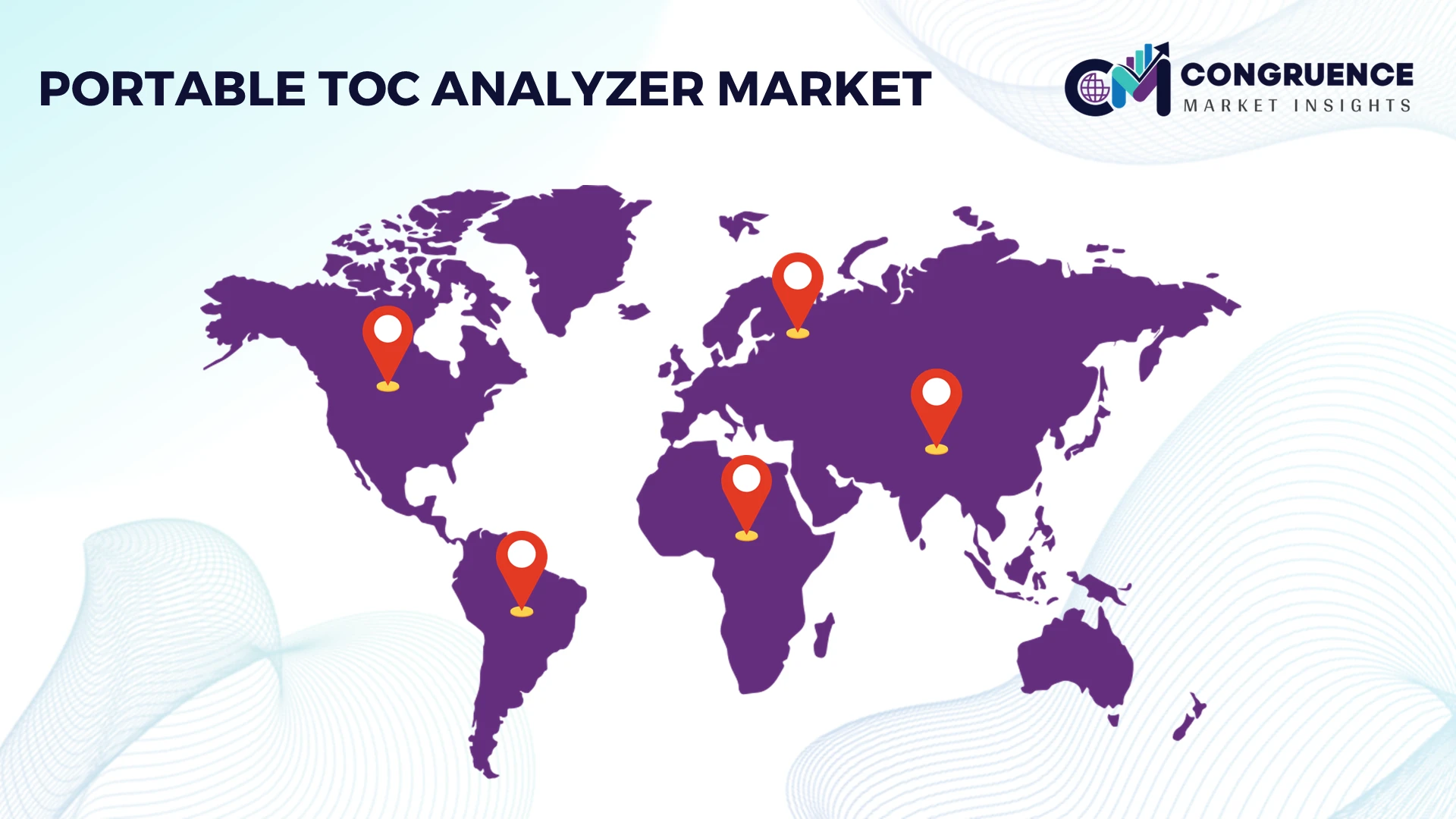
North America anchors the global portable TOC analyzer landscape with an estimated 38% share, concentrated in U.S. pharmaceutical water system validation and Canadian isotope production compliance workflows. Deployment density is highest across biologics manufacturing corridors in Massachusetts, North Carolina, and California, where at-line TOC verification supports batch release decisions. A measurable development: Mettler Toledo's 2025 integration of portable 450TOC units at a Canadian deuterium oxide facility achieved 100% water system compliance across global sites, eliminating wet-chemistry testing dependencies . The region's procurement behavior prioritizes audit-trail documentation and pharmacopeia-specific system suitability protocols over raw sensitivity specifications.
United States Market Outlook: The United States drives regional demand through FDA-aligned purified water monitoring requirements across an estimated 1,200+ sterile manufacturing facilities. USP ⟨643⟩ compliance obligations and 21CFR Part 11 data integrity expectations create a procurement environment where portable units with embedded compliance documentation command premium positioning. Bioprocessing expansion in North Carolina and gene therapy clusters in California are accelerating at-line TOC deployment, with suppliers restructuring service contracts to bundle instrument qualification protocols with ongoing audit support.
Europe commands approximately 28% of global portable TOC analyzer demand, with Germany, France, and the United Kingdom representing the core deployment concentrations. The European Pharmacopoeia's revised monographs replacing oxidizable substances testing with TOC for Water for Injections—effective July 2026—are compelling sterile manufacturers to reassess grab-sample workflows that cannot satisfy continuous verification expectations. This regulatory transition is accelerating portable unit adoption in Swiss and German pharmaceutical corridors, where fixed online systems dominate but lack the flexibility required for deviation investigation and cleaning validation applications. Suppliers are responding by aligning firmware documentation with EP 2.2.44 system suitability requirements.
Germany Market Outlook: Germany leads European portable TOC adoption through its dense concentration of pharmaceutical manufacturing and chemical processing facilities subject to stringent water quality oversight. The country's engineering-intensive industrial base favors portable configurations that complement existing fixed online monitoring infrastructure rather than replace it entirely. German pharmaceutical manufacturers are prioritizing instruments with dual TOC-conductivity capability for purified water loop verification, with procurement decisions increasingly influenced by supplier service network density across Bavaria and North Rhine-Westphalia manufacturing clusters.
Asia-Pacific represents approximately 22% of global portable TOC analyzer demand, with China, Japan, and India constituting the primary deployment markets. The region's growth trajectory is anchored in pharmaceutical manufacturing expansion, particularly in Chinese and Indian active pharmaceutical ingredient and sterile injectable production facilities facing tightening GMP inspection intensity. Japan contributes advanced semiconductor ultrapure water monitoring demand, where portable configurations support contamination troubleshooting in space-constrained fabrication environments. A measurable deployment development: portable units with detection limits reaching 0.05 ppb are increasingly specified for Japanese semiconductor UPW applications, where organic contamination directly impacts yield .
China Market Outlook: China drives regional volume growth through domestic pharmaceutical manufacturers upgrading water system validation protocols to meet revised GMP standards. The country's active pharmaceutical ingredient export sector faces increasing regulatory scrutiny from European and U.S. import authorities, creating demand for portable TOC verification that generates audit-ready documentation. Chinese manufacturers are prioritizing cost-effective UV oxidation configurations with USB data export capability, while multinational suppliers respond through localized service partnerships and distributor networks in Jiangsu and Zhejiang pharmaceutical clusters.
South America accounts for approximately 7% of global portable TOC analyzer deployment, with Brazil representing the dominant national market. The region's demand is concentrated in pharmaceutical manufacturing compliance and municipal water quality surveillance, where portable units compensate for sparse fixed monitoring infrastructure. Brazilian pharmaceutical manufacturers supplying both domestic and export markets are investing in at-line TOC verification to align with international pharmacopeia expectations, though capital availability constraints limit adoption velocity compared with North American and European deployment rates. Distributor-led sales channels dominate, with service network density remaining a procurement consideration.
Brazil Market Outlook: Brazil anchors regional demand through its pharmaceutical manufacturing base and expanding water utility monitoring requirements. The country's ANVISA regulatory framework is progressively aligning with international pharmacopeia standards, creating procurement momentum for portable TOC instruments with audit documentation capability. Brazilian buyers favor configurations that accommodate both purified water verification and environmental sample screening, with suppliers offering modular accessories to expand application coverage without requiring separate instrument investments.
The Middle East & Africa region represents approximately 5% of global portable TOC analyzer demand, with Saudi Arabia and the United Arab Emirates leading deployment activity. Demand is concentrated in two distinct application pools: pharmaceutical manufacturing localization initiatives under Saudi Vision 2030 industrial diversification, and municipal water quality monitoring where portable units support surveillance in areas with limited fixed laboratory infrastructure. Investment activity remains project-based rather than recurring, with procurement cycles influenced by government infrastructure spending and pharmaceutical facility commissioning timelines.
Saudi Arabia Market Outlook: Saudi Arabia leads regional adoption through pharmaceutical manufacturing expansion under national industrialization programs and water sector modernization investments. The country's emerging biologics and sterile injectable production capacity requires TOC verification infrastructure aligned with international GMP standards, creating demand for portable units with pharmacopeia-compliant documentation. Government-funded water infrastructure projects are simultaneously evaluating portable TOC surveillance for distribution network monitoring, with procurement decisions favoring suppliers offering localized service support and training partnerships.
Mettler Toledo, Veolia (Sievers), and Shimadzu form the global technology leadership tier, competing directly against Hach (BioTector) and Analytik Jena on compliance documentation depth and service network density. The top five players collectively hold approximately 52% of portable TOC deployments, with the remainder fragmented across regional distributors and niche environmental instrumentation suppliers. Competition pivots on three axes: pharmacopeia-embedded firmware (Mettler Toledo leads with USP/EP/21CFR integration), detection sensitivity (Shimadzu's excimer lamp reaches 0.02 μg/L), and portability economics (Veolia's CheckPoint at 2.9 kg versus Mettler's 450TOC at 6.1 kg). Price pressure is secondary—approximately 68% of pharmaceutical procurement decisions weight audit-trail capability over unit cost. Players are competing through bundled service contracts, application-specific method development, and localized calibration support in Indian and Chinese manufacturing hubs. The current competitive shift favors vertical integration: Mettler Toledo's 2025 deutraMed deployment demonstrates instrument-plus-compliance-service bundling, while Shimadzu's November 2025 TOC-1000e S release targets semiconductor yield defense as a beachhead against pharmaceutical incumbents. The entry barrier is regulatory validation cost, not hardware engineering—new entrants face 12–18 months of pharmacopeia documentation development before commercial viability. Winning requires embedded compliance architecture and regional service presence, not sensor specification superiority alone.
Mettler Toledo (Thornton)
Veolia Water Technologies (Sievers Analytical Instruments)
Shimadzu Corporation
Hach (BioTector Analytical)
Analytik Jena
Xylem (OI Analytical)
Teledyne Tekmar
Elementar Analysensysteme
LAR Process Analysers
Skalar Analytical
Endress+Hauser
Anton Paar
UV oxidation with direct conductometric detection dominates current portable configurations, capturing approximately 71% of pharmaceutical-grade deployments because reagent-free operation aligns with USP ⟨643⟩ system suitability requirements and eliminates consumable supply-chain dependency. Mettler Toledo's 450TOC achieves 0.025 ppb detection limits with 60-second response, while Veolia's CheckPoint Pharma delivers 15-second online intervals at 2.9 kg portability—a 45% weight reduction versus legacy portable instruments that expands deployment into space-constrained facility corridors.
Emerging excimer lamp technology represents the disruptive shift: Shimadzu's TOC-1000e S, released November 2025, uses 172 nm wavelength oxidation through an Active-Path structure that detects hard-to-oxidize compounds like urea at 0.02 μg/L sensitivity—a 60% improvement over conventional low-pressure mercury UV lamps in semiconductor ultrapure water applications. This matters because semiconductor yield loss from trace organic contamination is measured in wafer batches, not compliance deviations; Shimadzu is positioning for 2026–2028 as fab expansion in Japan and Taiwan accelerates.
Integration trends favor embedded audit-trail firmware and USB data export replacing manual transcription. Adoption signal: approximately 31% of pharmaceutical manufacturers now specify dual TOC-conductivity portable units as procurement standard, up from 19% in 2023. The competitive angle favors Mettler Toledo and Veolia, whose compliance documentation ecosystems create switching costs that pure sensor vendors cannot replicate. Acting now matters because pharmacopeia harmonization deadlines in 2026 will lock procurement decisions for multi-year facility validation cycles.
July 2025 | Mettler Toledo published a case study documenting deutraMed's deployment of 450TOC analyzers for deuterium oxide production, achieving 100% water system compliance across global sites while eliminating wet-chemistry testing dependencies. The deployment demonstrates portable TOC's expansion beyond pharmaceutical water into specialty isotope manufacturing, where rapid point-of-use verification reduces system diagnostic time. Source: mt.com
November 2025 | Shimadzu globally released the TOC-1000e S online analyzer for semiconductor ultrapure water, featuring excimer lamp technology with 0.02 μg/L detection limit and urea sensitivity for yield-critical contamination monitoring. The launch positions Shimadzu against Veolia's CheckPoint e in semiconductor fabs where trace organics directly impact wafer defect rates. Source: shimadzu.com
2025 | Veolia Water Technologies expanded Sievers CheckPoint Pharma documentation to confirm compliance with USP, EP, CP, and IP pharmacopeias across a 0.21–1,000 ppb dynamic range, with 15-second measurement intervals and 2.9 kg portability. The multi-pharmacopeia positioning targets Indian and Chinese manufacturers facing export-market audit scrutiny, where single-instrument compliance across regulatory regimes reduces validation duplication. Source: watertechnologies.com
February 2025 | Shimadzu published application data demonstrating the TOC-1000e for PEM hydrogen electrolysis feed water monitoring, enabling portable deployment across electrolyzer plant locations with <3 kg weight and annual maintenance intervals. The application extends portable TOC relevance into green hydrogen infrastructure, where ultrapure water quality directly affects electrolyzer stack efficiency and membrane lifetime. Source: shimadzu.com
This report delivers a comprehensive assessment of the global portable TOC analyzer landscape, spanning UV oxidation and persulfate oxidation configurations across pharmaceutical, environmental, chemical, and semiconductor applications. Coverage extends across industrial, laboratory, and government end-user segments, with regional analysis spanning North America, Europe, Asia-Pacific, South America, and the Middle East & Africa.
The scope encompasses deployment pattern analysis—from at-line pharmaceutical water verification to field-based environmental monitoring—alongside competitive positioning among established suppliers and emerging entrants. Quantitative indicators include segment distribution by oxidation type and application, adoption trends across pharmacopeia-driven procurement cycles, and regional deployment concentration. Strategic coverage addresses investment planning for facility water system validation, expansion priorities in Asian manufacturing corridors, and competitive positioning against compliance-documentation ecosystems. Emerging niche areas including deuterium oxide production, hydrogen electrolysis feed water monitoring, and semiconductor ultrapure water surveillance are assessed for their demand creation potential through 2033, supporting forward-looking capital allocation and partnership decisions.
| Report Attribute / Metric | Details |
|---|---|
| Market Revenue (2025) | USD 31.0 Million |
| Market Revenue (2033) | USD 39.6 Million |
| CAGR (2026–2033) | 3.1% |
| Base Year | 2025 |
| Forecast Period | 2026–2033 |
| Historic Period | 2021–2025 |
| Segments Covered |
By Type
By Application
By End-User
|
| Key Deliverables | Revenue Forecast; Market Trends; Growth Drivers & Restraints; Technology Insights; Segmentation Analysis; Regional Insights; Competitive Landscape; Regulatory & ESG Overview; Recent Developments |
| Regions Covered | North America; Europe; Asia-Pacific; South America; Middle East & Africa |
| Companies Profiled | Mettler Toledo (Thornton); Veolia Water Technologies (Sievers Analytical Instruments); Shimadzu Corporation; Hach (BioTector Analytical); Analytik Jena; Xylem (OI Analytical); Teledyne Tekmar; Elementar Analysensysteme; LAR Process Analysers; Skalar Analytical; Endress+Hauser; Anton Paar |
| Customization & Pricing | Available on Request (10% Customization Free) |




