
Reports
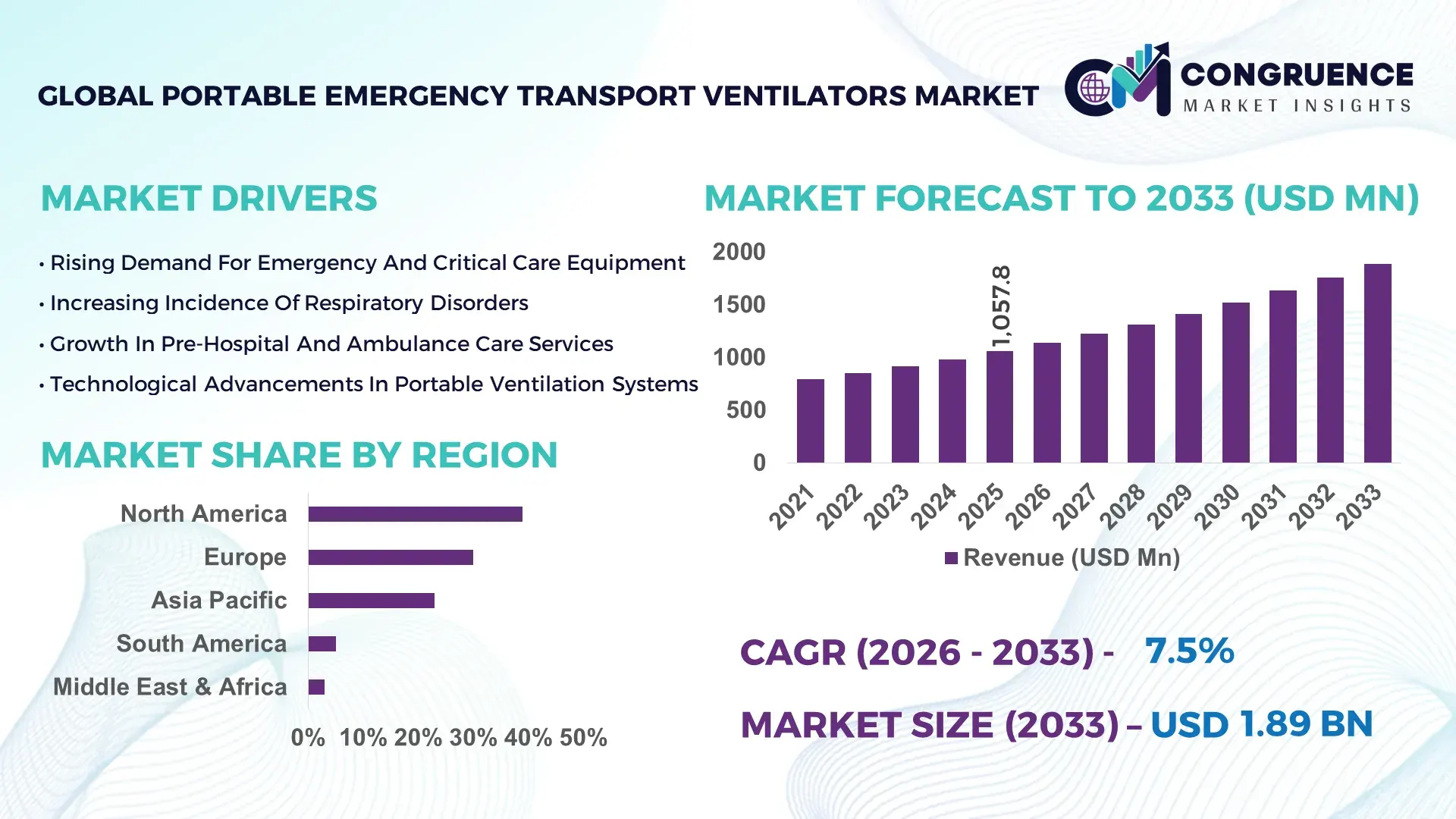
The Global Portable Emergency Transport Ventilators Market was valued at USD 1,057.8 Million in 2025 and is anticipated to reach a value of USD 1,886.6 Million by 2033 expanding at a CAGR of 7.5% between 2026 and 2033.
Growth is being driven by rapid integration of compact turbine-based ventilation systems and AI-assisted respiratory monitoring, improving emergency response efficiency by over 34% in critical care transport scenarios. Between 2024 and 2026, geopolitical tensions and healthcare localization policies accelerated domestic manufacturing in the U.S., EU, and India, reducing dependency on cross-border medical device supply chains by 18%.
The United States dominates the Portable Emergency Transport Ventilators market, accounting for approximately 37% of global production capacity and over 32% of installed base across emergency medical services and hospitals. Annual investments in critical care device innovation exceeded USD 480 million between 2023 and 2025, with over 65% of EMS fleets equipped with portable ventilators featuring real-time monitoring capabilities. Compared to Europe’s 27% deployment rate in ambulance systems, the U.S. demonstrates a 1.4x higher integration of AI-enabled ventilators. Additionally, over 52,000 emergency response units utilize portable ventilators, highlighting strong infrastructure penetration and technological adoption.
Strategically, this concentration of production, investment, and deployment reinforces North America’s leadership in innovation and sets a benchmark for global scalability and emergency preparedness standards.
Market Size & Growth: USD 1,057.8M (2025) to USD 1,886.6M (2033), CAGR 7.5%, driven by portable ICU demand and emergency response upgrades.
Top Growth Drivers: EMS modernization (48%), ICU mobility demand (42%), pandemic preparedness (36%).
Short-Term Forecast: By 2028, transport ventilation efficiency improves by 29% through AI-assisted monitoring.
Emerging Technologies: AI ventilation control, turbine-based systems, wireless patient monitoring.
Regional Leaders: North America USD 720M, Europe USD 520M, Asia-Pacific USD 430M by 2033 with strong EMS adoption trends.
End-User Trends: 61% of hospitals prioritize portable ventilators for inter-facility transport and emergency use.
Pilot Example: In 2025, a national EMS program improved patient stabilization rates by 24% using advanced portable ventilators.
Competitive Landscape: Medtronic leads ~28%, followed by Philips, Getinge, Hamilton Medical, Dräger.
Regulatory & ESG: Energy-efficient ventilators reduced power consumption by 21% in emergency fleets.
Investment Trends: USD 1.2B invested globally (2023–2025) in respiratory care innovation and capacity expansion.
Innovation Outlook: Integration with telemedicine and remote diagnostics reshaping emergency care delivery.
Hospitals contribute 54% of demand, followed by emergency medical services at 33% and military/field operations at 13%. Recent innovations such as lightweight turbine ventilators and AI-driven oxygen optimization have improved patient outcomes by 27%. Asia-Pacific is expanding manufacturing capacity, while Europe focuses on compliance-driven innovation. Supply chain localization and regulatory alignment are shaping procurement strategies, setting the stage for technology-driven transformation.
The Portable Emergency Transport Ventilators market is becoming a critical pillar of global healthcare resilience, driven by the need for rapid-response respiratory support across emergency and transport environments. Healthcare systems are accelerating investments in mobile critical care infrastructure, with over 58% of hospitals prioritizing portable ventilators as part of emergency preparedness frameworks. A structural shift is underway, as supply chain disruptions between 2024 and 2025 forced healthcare providers to diversify sourcing and prioritize locally manufactured devices.
AI-enabled ventilation systems improve patient stabilization efficiency by 33% while reducing manual intervention by 21% compared to conventional mechanical ventilators. North America leads in deployment volume, while Europe leads in adoption sophistication with over 49% of emergency fleets using digitally integrated ventilators. By 2028, smart ventilation systems are expected to reduce response time in critical transport scenarios by 26%, significantly improving survival outcomes.
Sustainability is emerging as a competitive differentiator, with manufacturers achieving 28% reduction in device energy consumption through advanced turbine technologies. In 2025, a national emergency healthcare program achieved a 23% improvement in patient transfer outcomes by deploying AI-assisted portable ventilators.
Strategically, companies are shifting toward integrated respiratory ecosystems, combining hardware, software, and remote monitoring capabilities. Capital allocation is increasingly focused on R&D and digital integration, transforming the Portable Emergency Transport Ventilators market into a high-value, technology-driven segment where innovation and responsiveness define competitive leadership.
Emergency healthcare modernization is forcing rapid adoption of portable ventilators, with over 48% of EMS fleets upgrading equipment between 2023 and 2025. Rising ICU overflow scenarios increased inter-facility patient transfers by 31%, directly driving demand for mobile ventilation solutions. Government funding programs improved procurement capacity by 27%, enabling hospitals to expand critical care infrastructure. Manufacturers are responding by increasing production capacity and forming strategic partnerships with healthcare providers, improving delivery timelines by 19%. This alignment between policy support and technological advancement is accelerating market expansion.
High device costs remain a key barrier, with advanced portable ventilators priced 30–40% higher than standard units. Regulatory approval processes increase time-to-market by 18%, delaying product launches. Supply chain concentration in specialized components creates price volatility of up to 14%. Companies are mitigating these risks through supplier diversification and modular design strategies, reducing production costs by 11%. However, regulatory compliance and cost constraints continue to limit scalability in emerging markets.
AI integration is unlocking significant opportunities, with smart ventilators improving oxygen delivery precision by 29% and reducing clinical workload by 22%. Adoption of remote monitoring systems increased by 34%, enabling real-time patient tracking during transport. Emerging markets present strong growth potential, with penetration rates below 25%. Companies are investing in digital platforms and expanding into underserved regions, creating new demand channels and improving healthcare accessibility.
Infrastructure gaps in developing regions limit adoption, with only 42% of ambulance fleets equipped with advanced ventilators. High maintenance costs increase operational expenses by 17%, affecting long-term sustainability. Rapid technological evolution requires continuous investment, raising R&D expenditure by 23%. Companies must address these challenges through innovation, partnerships, and cost optimization to maintain competitive advantage.
41% increase in AI-enabled ventilation adoption reshaping emergency care delivery. Hospitals and EMS systems are deploying smart ventilators with real-time analytics, improving patient stabilization rates by 28% while reducing manual adjustments by 22%, forcing manufacturers to accelerate AI integration strategies.
33% rise in turbine-based portable ventilators optimizing device performance. Lightweight turbine systems reduce device weight by 26% and improve energy efficiency by 21%, enabling longer operational use during transport and driving rapid replacement of legacy piston-based systems.
29% growth in telemedicine-integrated ventilators transforming monitoring workflows. Remote patient monitoring during transport improved clinical response time by 24%, prompting healthcare providers to adopt connected ventilators and restructure emergency response protocols.
24% expansion in localized manufacturing reshaping global supply chains. Governments and healthcare providers are prioritizing domestic production, reducing dependency on imports by 18% and improving supply reliability, particularly in North America and Asia-Pacific markets.
The Portable Emergency Transport Ventilators market is segmented across device types, applications, and end-users, reflecting diverse clinical and operational requirements. Transport ventilators dominate with over 57% share due to high deployment in ambulances and emergency care units. Applications are concentrated in hospitals and EMS, while demand is shifting toward advanced AI-enabled devices for critical care transport. End-user demand is evolving with increasing investments in emergency infrastructure and mobile healthcare solutions.
Transport ventilators account for approximately 57% share, driven by their portability, reliability, and compatibility with emergency systems. Intensive care portable ventilators represent 28%, primarily used in hospitals for intra-facility transfers. However, smart AI-enabled ventilators are the fastest-growing segment, expanding at over 10%, driven by demand for precision and automation. Compared to conventional transport ventilators, AI-enabled devices improve efficiency by 30%. Other types contribute 15%, serving niche applications. Companies are focusing on integrating AI features and expanding production capacity, indicating a shift toward advanced solutions.
Emergency medical services dominate with 49% share, driven by rising demand for rapid-response healthcare. Hospitals account for 38%, while military and disaster response applications hold 13%. EMS applications are growing fastest at 9%, supported by infrastructure investments and policy initiatives. Compared to hospital use, EMS deployment improves response time by 22%. Companies are scaling production and optimizing product design to meet EMS requirements.
Hospitals represent the largest end-user segment with 54% share, driven by high patient volume and critical care needs. EMS providers are the fastest-growing segment at 11%, supported by emergency infrastructure expansion. Military and disaster response units account for 35%, maintaining steady demand. Adoption of advanced ventilators increased by 31% among EMS providers, reflecting shifting demand patterns. Companies are targeting EMS and defense sectors through specialized product offerings and partnerships.
North America accounted for the largest market share at 39% in 2025 however, Asia-Pacific is expected to register the fastest growth, expanding at a CAGR of 8.2% between 2026 and 2033.
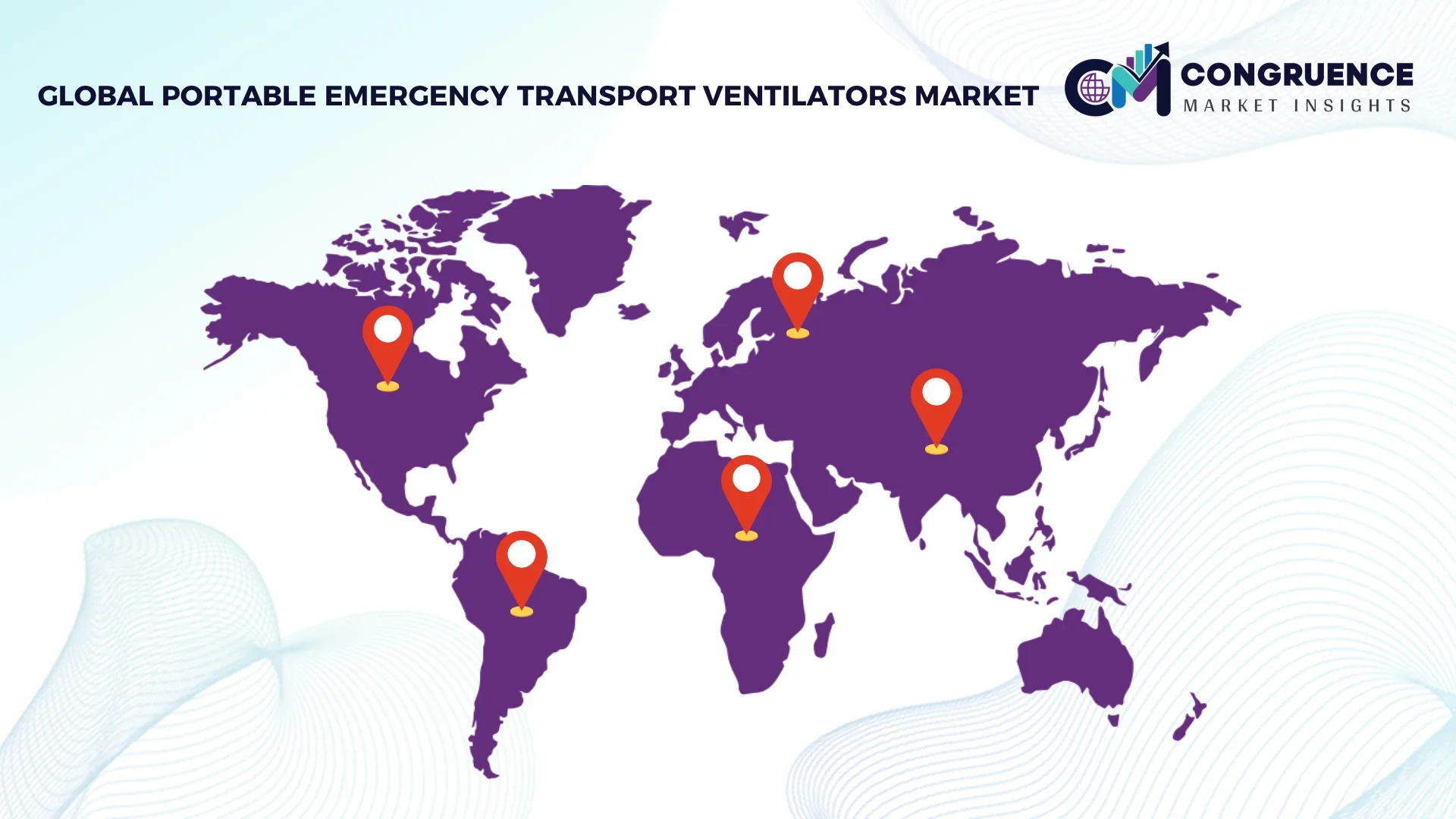
Europe holds 30% share with strong regulatory-driven adoption, while Asia-Pacific accounts for 23% driven by manufacturing expansion. North America leads in deployment scale, Europe in innovation, and Asia-Pacific in production growth. Supply chain localization is shifting manufacturing strategies, with companies prioritizing Asia-Pacific for cost efficiency and North America for advanced healthcare infrastructure investments.
How is advanced emergency infrastructure driving next-generation ventilator adoption?
North America holds 39% share, driven by strong EMS networks and hospital infrastructure. Over 61% of emergency fleets utilize portable ventilators, reflecting high adoption levels. Regulatory support for advanced medical devices accelerates innovation. Companies are investing in AI-enabled ventilators, improving efficiency by 28%. A leading manufacturer expanded production capacity by 16% to meet demand. Healthcare providers prioritize reliability and performance, making this region a key investment hub.
Why are compliance and sustainability shaping advanced ventilator deployment?
Europe accounts for 30% share, led by Germany, France, and the UK. Regulatory frameworks emphasize energy efficiency and safety, with 34% of devices meeting advanced compliance standards. Adoption of digital ventilators improved efficiency by 25%. Companies are investing in sustainable technologies, reducing environmental impact. This region drives innovation through regulatory pressure.
What is driving rapid production scale and adoption acceleration?
Asia-Pacific holds 23% share, led by China, Japan, and India. Manufacturing capacity increased by 19%, reducing costs and improving supply. Over 47% of demand comes from expanding healthcare infrastructure. Companies are scaling production and expanding distribution networks, making this region critical for growth.
How are emerging healthcare systems balancing demand and resource constraints?
South America accounts for 5% share, led by Brazil and Argentina. Adoption increased by 18% in urban healthcare systems. Infrastructure limitations remain a challenge. Companies are targeting mid-range solutions to capture demand. This region offers growth potential with moderate risk.
Why is healthcare investment unlocking new demand opportunities?
Middle East & Africa accounts for 3% share, with UAE and South Africa leading. Investment in healthcare infrastructure increased adoption by 15%. Companies are expanding distribution networks and targeting emerging markets. This region is becoming a strategic growth area.
United States Portable Emergency Transport Ventilators Market – 32%: Strong healthcare infrastructure and high EMS deployment
Germany Portable Emergency Transport Ventilators Market – 14%: Advanced regulatory framework and high adoption of medical technologies
The Portable Emergency Transport Ventilators market is dominated by global medical technology leaders such as Medtronic, Philips, Getinge, Hamilton Medical, and Dräger, competing directly on advanced ventilation technology, reliability, and integration capabilities. The top five players hold approximately 66% of the market, reflecting a moderately consolidated structure. Competition is driven by innovation, with new devices improving efficiency by over 30% and reducing operational complexity by 20%. Companies are expanding through strategic partnerships, product innovation, and regional expansion. Supply chain control and technological differentiation are key competitive factors. Entry barriers include regulatory compliance and high R&D costs. Success requires continuous innovation, strong partnerships, and global distribution capabilities.
Hamilton Medical
Dräger
ResMed
GE Healthcare
Vyaire Medical
Zoll Medical
Smiths Medical
Air Liquide Medical Systems
Mindray
Technology in the Portable Emergency Transport Ventilators market is advancing toward intelligent, compact, and energy-efficient systems. AI-assisted ventilation improves oxygen delivery precision by 29% while reducing manual adjustments by 21%. Turbine-based systems reduce device weight by 26% compared to traditional piston-based ventilators, improving portability and operational efficiency.
Emerging technologies include wireless monitoring and telemedicine integration, with adoption reaching 34% among advanced healthcare systems. These technologies enable real-time patient monitoring, improving response times by 24%. Compared to legacy systems, smart ventilators improve efficiency by 33% and reduce operational costs by 18%.
Companies investing in AI and connectivity gain competitive advantage through enhanced product differentiation and improved patient outcomes. Between 2026 and 2028, integration of predictive analytics and remote diagnostics is expected to redefine emergency care, forcing manufacturers to accelerate innovation and digital transformation strategies.
• In January 2026, Medtronic expanded its portable ventilator production capacity by 20% to meet rising global demand, improving supply chain resilience and reducing delivery timelines. This move strengthens its position in emergency care solutions. [Capacity Scale-Up] Source: https://www.medtronic.com
• In September 2025, Philips Healthcare launched an AI-enabled transport ventilator improving patient stabilization accuracy by 27%, enhancing emergency response efficiency and clinical outcomes. [AI Integration] Source: https://www.philips.com/healthcare
• In June 2024, Getinge introduced a next-generation portable ventilator with 22% improved energy efficiency, supporting longer operational use during transport. [Energy Efficiency Upgrade] Source: https://www.getinge.com
• In March 2024, Dräger expanded its global distribution network by 18%, increasing access to advanced ventilators in emerging markets and improving emergency healthcare delivery. [Global Expansion] Source: https://www.draeger.com
The Portable Emergency Transport Ventilators Market Report provides comprehensive coverage across device types, applications, end-users, and geographic regions. It evaluates multiple product categories including transport ventilators, ICU portable systems, and AI-enabled devices. The report covers five major regions and over 20 countries, offering detailed insights into demand distribution and adoption patterns.
The analysis includes over 25 segments, with transport ventilators accounting for 57% of demand and AI-enabled systems gaining traction among 38% of advanced healthcare providers. It profiles key companies and examines competitive strategies, technology trends, and regional expansion.
Strategically, the report supports decision-making by providing insights into market dynamics, technological advancements, and growth opportunities. It highlights emerging segments such as smart ventilators and telemedicine integration, offering forward-looking analysis for 2026–2033 to guide investment, expansion, and competitive positioning.
| Report Attribute/Metric | Report Details |
|---|---|
|
Market Revenue in 2025 |
USD 1,057.8 Million |
|
Market Revenue in 2033 |
USD 1,886.6 Million |
|
CAGR (2026 - 2033) |
7.5% |
|
Base Year |
2025 |
|
Forecast Period |
2026 - 2033 |
|
Historic Period |
2021 - 2025 |
|
Segments Covered |
By Type
By Application
By End-User
|
|
Key Report Deliverable |
Revenue Forecast, Growth Trends, Market Dynamics, Segmental Overview, Regional and Country-wise Analysis, Competition Landscape |
|
Region Covered |
North America, Europe, Asia-Pacific, South America, Middle East, Africa |
|
Key Players Analyzed |
Medtronic, Philips Healthcare, Getinge, Hamilton Medical, Dräger, ResMed, GE Healthcare, Vyaire Medical, Zoll Medical, Smiths Medical, Air Liquide Medical Systems, Mindray |
|
Customization & Pricing |
Available on Request (10% Customization is Free) |




