
Reports
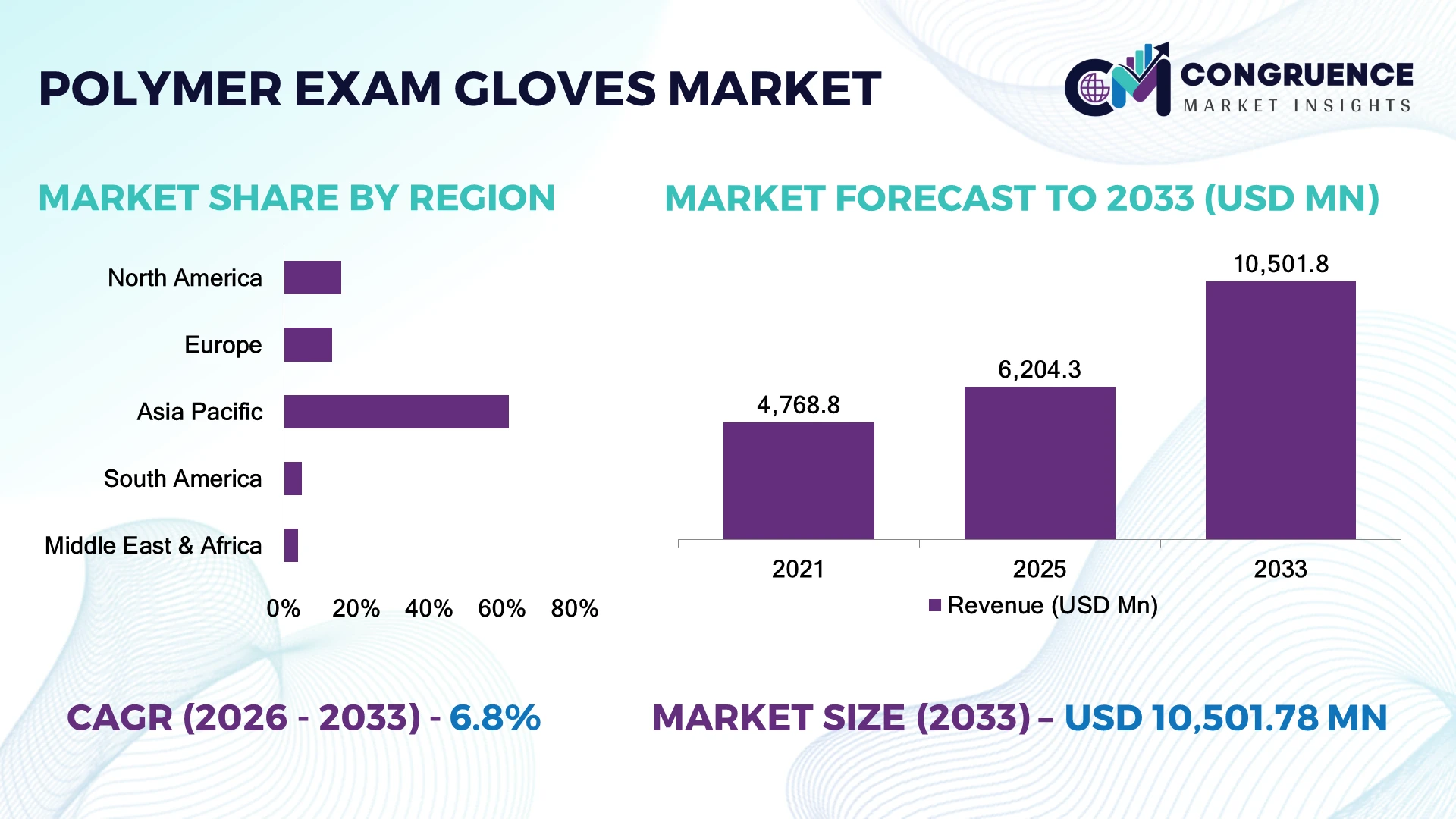
The Global Polymer Exam Gloves Market was valued at USD 6,204.3 Million in 2025 and is anticipated to reach a value of USD 10,501.8 Million by 2033 expanding at a CAGR of 6.8% between 2026 and 2033. Rising infection prevention standards, expansion of outpatient healthcare services, and accelerating adoption of nitrile-based examination gloves across healthcare, diagnostics, and life sciences continue strengthening market demand.
Malaysia remains the dominant manufacturing hub, accounting for approximately 58% of global production capacity through highly automated facilities supplying healthcare, pharmaceutical, and laboratory sectors worldwide. Production automation exceeds 72% across leading factories, improving consistency and throughput, while Thailand continues strengthening raw material integration and polymer supply chains. Following post-pandemic healthcare resilience initiatives and geopolitical diversification of medical supply sourcing, procurement is increasingly shifting toward multi-country manufacturing networks with Malaysia maintaining a clear production advantage.
This market increasingly rewards manufacturers investing in automation, premium polymer technologies, and diversified global supply chains.
Market Size & Growth: USD 6,204.3 Million in 2025 reaching USD 10,501.8 Million by 2033 at 6.8% CAGR, driven by stricter infection-control protocols.
Top Growth Drivers: Healthcare expansion +29%, diagnostic testing +24%, laboratory demand +19%.
Short-Term Forecast: By 2028, automated production improves manufacturing efficiency by 18% while defect rates decline 12%.
Emerging Technologies: AI quality inspection, robotic dipping lines, and advanced nitrile formulations improve production consistency.
Regional Leaders: Asia-Pacific leads manufacturing, North America leads consumption, Europe expands sustainable procurement initiatives.
Consumer/End-User Trends: More than 68% of healthcare buyers prioritize nitrile polymer gloves over latex alternatives.
Pilot/Case Example: 2026 automated inspection deployment reduced product rejection rates by approximately 15%.
Competitive Landscape: Top five manufacturers control nearly 56% market share through scale and automation.
Regulatory & ESG Impact: Sustainable manufacturing initiatives reduce water consumption by approximately 20%.
Investment & Funding: More than USD 900 Million supports production expansion and automation across major manufacturing hubs.
Innovation & Future Outlook: Ultra-thin polymer coatings and recyclable packaging strengthen premium product differentiation.
The Polymer Exam Gloves Market is advancing through increased demand from hospitals, diagnostic laboratories, dental clinics, and pharmaceutical manufacturing. Advanced nitrile formulations, accelerator-free polymers, and AI-enabled quality inspection are improving product consistency while reducing defect rates by nearly 16%. Supply-chain diversification beyond single-country sourcing is strengthening procurement resilience, setting the foundation for broader strategic market developments.
Polymer exam gloves have become a strategic healthcare commodity as healthcare systems prioritize infection prevention, supply security, and procurement resilience. Hospital expansion, laboratory modernization, and stricter occupational safety requirements are encouraging healthcare providers to establish long-term sourcing agreements rather than relying on spot purchasing. Manufacturing investments increasingly focus on regional distribution capabilities and automated production to improve supply continuity.
Modern AI-enabled inspection systems identify surface defects nearly 30% faster than conventional manual quality inspection while reducing material waste by approximately 14%. Asia-Pacific remains the dominant production base through integrated manufacturing ecosystems, whereas North America and Europe emphasize regulatory compliance, premium medical-grade specifications, and diversified procurement strategies. Industry participants expect automated production lines to exceed 75% deployment among leading manufacturers within the next few years.
Large healthcare procurement organizations are increasingly selecting suppliers capable of providing traceability, digital quality documentation, and stable multi-region supply. Manufacturers continue expanding production facilities, investing in advanced polymer formulations, and strengthening strategic partnerships with healthcare distributors. Companies combining manufacturing scale, consistent product quality, operational flexibility, and resilient supply-chain management will secure stronger competitive positions as healthcare procurement becomes increasingly quality-driven and strategically diversified.
Healthcare-acquired infection prevention protocols and growing diagnostic testing volumes are accelerating polymer exam glove consumption across hospitals, laboratories, and outpatient facilities. More than 70% of healthcare procurement contracts now prioritize nitrile and synthetic polymer gloves over latex alternatives, while automated manufacturing has improved production efficiency by nearly 18% and reduced defect rates by approximately 15%. The United States continues expanding strategic medical stockpiles, encouraging suppliers to maintain higher production resilience. This shift increases long-term procurement visibility, enabling manufacturers to invest in automated dipping lines, AI-based quality inspection, and regional distribution centers. Companies are expanding production capacity, strengthening distributor partnerships, and introducing accelerator-free polymer formulations to improve safety and product differentiation while securing multi-year healthcare supply agreements.
Volatility in nitrile butadiene rubber, synthetic polymer additives, and energy prices continues affecting manufacturing economics and pricing stability. Raw material expenses represent nearly 55% of total glove production costs, while energy-intensive production processes contribute approximately 18% of manufacturing expenditure. Malaysia-based manufacturers remain exposed to fluctuations in imported chemical feedstocks and logistics costs, reducing pricing flexibility during procurement negotiations. Margin pressure limits aggressive capacity expansion and affects contract profitability, particularly for commodity-grade examination gloves. Manufacturers are mitigating risk through multi-country sourcing strategies, long-term supply agreements, localized warehousing, and alternative polymer formulations that improve procurement flexibility without compromising regulatory compliance or product performance.
Next-generation manufacturing technologies are creating opportunities beyond production scale by improving quality consistency and product specialization. AI-enabled visual inspection systems can reduce defect detection time by nearly 30%, while robotic automation increases production throughput by approximately 20%. Healthcare providers increasingly prefer accelerator-free, low-allergen, and antimicrobial polymer gloves, creating higher-value product segments. India and Southeast Asia continue expanding healthcare infrastructure, opening substantial procurement opportunities outside mature markets. Manufacturers are investing in digital manufacturing platforms, sustainable production technologies, and collaborative research partnerships to commercialize thinner, stronger polymer formulations. Premium specialty gloves with improved tactile sensitivity represent a high-margin opportunity that remains underpenetrated across emerging healthcare systems.
Scaling production while maintaining consistent quality across multiple manufacturing sites remains a critical execution challenge. Automated inspection systems identify up to 96% of visible production defects, yet process variation between facilities can still affect product uniformity and certification timelines. Increasing regulatory scrutiny across North America and Europe requires comprehensive traceability, validated manufacturing controls, and continuous compliance documentation. Workforce shortages in advanced process engineering further complicate expansion of highly automated facilities. Companies must strengthen digital quality management, invest in predictive maintenance, standardize production protocols, and expand technical workforce capabilities to ensure reliable global supply while maintaining competitiveness in increasingly regulated healthcare procurement markets.
Advanced Automation Expansion Automated dipping lines now account for nearly 68% of production capacity among leading manufacturers, improving throughput by approximately 20% while reducing rejection rates by 15%. Labor shortages and rising quality expectations are accelerating factory modernization, prompting companies to deploy robotics, AI inspection systems, and digital production monitoring across manufacturing facilities.
Accelerator-Free Product Growth Healthcare providers increasingly specify accelerator-free polymer gloves, with procurement increasing by roughly 24% across premium hospital contracts. Enhanced skin compatibility and occupational safety requirements are reshaping product portfolios. Manufacturers are expanding specialty formulations and investing in advanced polymer chemistry to differentiate beyond conventional commodity examination gloves.
Regional Supply Diversification Global buyers are reducing dependence on single-country sourcing, with approximately 35% of procurement contracts now including secondary manufacturing locations. Supply-chain resilience initiatives following healthcare procurement reforms encourage producers to establish regional warehouses, localized packaging operations, and strategic distribution partnerships to improve delivery reliability and inventory flexibility.
Digital Traceability Integration Nearly 48% of premium healthcare tenders increasingly require digital batch traceability and electronic quality documentation alongside product certification. Manufacturers are integrating cloud-based quality management, barcode serialization, and automated compliance reporting to strengthen customer confidence, shorten audit cycles, and improve long-term contract retention across institutional healthcare procurement.
Nitrile polymer exam gloves accounted for approximately 69% of the global market in 2025, maintaining leadership through superior puncture resistance, chemical compatibility, latex-free composition, and scalable automated manufacturing. Their broad acceptance across hospitals, laboratories, and diagnostic facilities has made nitrile the preferred material for high-volume medical procurement. Vinyl gloves remain relevant in low-risk examinations where cost efficiency is prioritized, while neoprene gloves continue serving specialized medical environments requiring enhanced elasticity and chemical protection. Polyisoprene gloves are the fastest-growing segment, supported by rising preference for latex-like comfort without allergy risks, particularly in surgical preparation and premium healthcare settings.
Manufacturers are expanding accelerator-free nitrile production, investing in premium synthetic polymers, and introducing thinner glove formulations that improve tactile sensitivity by nearly 18% while maintaining barrier integrity. Polyisoprene demand has increased by approximately 14% as premium healthcare providers standardize higher-performance protective equipment. Business investment is increasingly shifting toward advanced polymer technologies, automated dipping systems, and differentiated product portfolios that balance performance, sustainability, and long-term procurement value.
According to a 2025 healthcare procurement assessment by the Association for Professionals in Infection Control and Epidemiology (APIC), latex-free examination gloves continue to dominate institutional purchasing policies as healthcare providers strengthen occupational safety and allergy prevention programs.
Medical examination applications represented approximately 61% of global demand in 2025, driven by routine patient care, diagnostic testing, outpatient services, and infection prevention protocols. Consistent glove utilization across hospitals, clinics, and physician practices reinforces this segment's leadership. Dental examination remains a stable application because of strict cross-contamination control requirements, while laboratory testing continues expanding alongside molecular diagnostics and pharmaceutical quality assurance. Emergency medical services represent the fastest-growing application as healthcare systems strengthen emergency preparedness and mobile healthcare capabilities.
Manufacturers are increasing production flexibility, integrating automated quality inspection, and introducing application-specific glove variants for dental, laboratory, and emergency environments. Laboratory applications have expanded by nearly 16% due to increasing clinical testing volumes, while emergency medical procurement has grown approximately 13% through national preparedness initiatives. Companies continue aligning product portfolios with specialized clinical workflows, creating stronger opportunities in premium and high-compliance healthcare segments.
A 2026 enterprise survey conducted by the American Hospital Association found that examination gloves remain among the highest-volume consumables used across outpatient, emergency, and inpatient clinical operations, reflecting continued emphasis on infection prevention and standardized protective practices.
Hospitals accounted for approximately 56% of polymer exam glove demand in 2025, supported by continuous patient care, surgical preparation, emergency services, and strict infection-control protocols. Their high purchasing volumes, centralized procurement systems, and operational intensity maintain leadership over other healthcare settings. Diagnostic laboratories represent the fastest-growing end-user segment as molecular testing, pathology services, and preventive healthcare programs continue expanding. Ambulatory surgical centers, clinics, dental facilities, and academic research institutions remain important contributors through specialized procurement and growing procedural volumes.
Manufacturers are developing customized product portfolios, strengthening long-term healthcare contracts, and expanding regional distribution networks to improve supply reliability. Diagnostic laboratory procurement has increased by approximately 15%, while ambulatory surgical center demand has expanded by nearly 12% through rising outpatient procedures. Companies increasingly differentiate through premium polymer formulations, sustainable packaging, and digital inventory support, positioning themselves for future procurement driven by healthcare specialization rather than volume alone.
A 2025 institutional purchasing assessment by the Healthcare Supply Chain Association reported that hospitals continued representing the largest category for medical consumable procurement, while diagnostic laboratories recorded the fastest expansion in examination glove purchasing as testing capacity increased.
Asia-Pacific accounted for the largest market share at 61.8% in 2025 however, North America is expected to register the fastest growth, expanding at a CAGR of 7.3% between 2026 and 2033.
Healthcare procurement prioritizes resilient medical supply chains
North America is strengthening its position through strategic healthcare procurement, domestic manufacturing initiatives, and higher adoption of premium nitrile examination gloves. Hospitals, diagnostic laboratories, and ambulatory care networks increasingly prioritize long-term supply contracts and certified quality systems over price-based purchasing. Approximately 67% of institutional procurement now favors latex-free polymer gloves because of allergy prevention and regulatory compliance. Investments in automated packaging, digital inventory management, and regional warehousing continue improving supply responsiveness. Manufacturers are expanding distribution partnerships and localized finishing operations to shorten delivery cycles while supporting healthcare systems that require uninterrupted access to high-quality medical consumables.
United States Market Outlook:
The United States dominates regional demand through its extensive hospital network, diagnostic laboratories, and centralized healthcare procurement systems. More than 72% of large healthcare organizations have adopted multi-year sourcing strategies for examination gloves to strengthen supply continuity. Domestic investment increasingly focuses on automated packaging, quality validation, and strategic inventory capabilities, allowing suppliers to improve responsiveness while meeting strict medical device and infection-control standards.
Sustainable procurement reshapes healthcare purchasing
Europe continues expanding demand through stringent healthcare quality standards, sustainability initiatives, and increasing preference for certified polymer examination gloves. Healthcare providers are emphasizing environmentally responsible manufacturing, accelerator-free materials, and transparent supply-chain documentation. Approximately 59% of public healthcare tenders now include sustainability or lifecycle assessment criteria alongside product performance requirements. Manufacturers are responding by introducing lower-emission production technologies, recyclable packaging, and digital product traceability while strengthening partnerships with regional healthcare distributors.
Germany Market Outlook:
Germany leads regional demand through its advanced healthcare infrastructure, pharmaceutical manufacturing, and laboratory network. Nearly 48% of institutional procurement emphasizes premium nitrile gloves with documented compliance and traceability. Healthcare distributors continue expanding regional inventory hubs while manufacturers strengthen technical support and quality assurance capabilities to meet evolving procurement standards across hospitals and research institutions.
Manufacturing scale drives global leadership
Asia-Pacific remains the global production center for polymer exam gloves through highly integrated manufacturing ecosystems, abundant raw material access, and advanced automation. The region contributes more than 75% of worldwide production capacity, supported by large-scale export infrastructure and specialized manufacturing expertise. Automated dipping technologies now operate across approximately 70% of leading production facilities, improving consistency and operational efficiency. Manufacturers continue expanding production lines, investing in energy-efficient equipment, and strengthening global logistics capabilities to support rising international healthcare demand.
Malaysia Market Outlook:
Malaysia remains the world's largest polymer examination glove manufacturing hub, supplying healthcare markets across North America, Europe, and Asia. More than 58% of global production capacity is concentrated within the country, supported by advanced automation, experienced workforce capabilities, and integrated supply chains. Manufacturers continue investing in AI-enabled quality inspection, premium nitrile formulations, and sustainable production technologies to strengthen international competitiveness.
Healthcare modernization expands institutional demand
South America is experiencing stable market expansion through healthcare infrastructure upgrades, increasing diagnostic capacity, and broader infection-control implementation across public and private healthcare facilities. Institutional procurement increasingly favors premium polymer gloves to improve occupational safety and regulatory compliance. Approximately 36% of recent procurement programs prioritize higher-performance nitrile products over conventional alternatives. International suppliers continue strengthening local distribution partnerships and regional warehousing to improve product availability while supporting healthcare modernization initiatives.
Brazil Market Outlook:
Brazil represents the largest regional market because of its extensive hospital network, expanding diagnostic laboratory sector, and government-supported healthcare programs. Around 43% of institutional glove procurement is now directed toward premium polymer products designed for intensive clinical use. Local distributors continue expanding inventory capacity and strategic partnerships with global manufacturers to improve supply stability across the country's healthcare system.
Healthcare investment strengthens protective equipment adoption
The Middle East & Africa market continues advancing through hospital expansion, laboratory modernization, and government investment in healthcare resilience. Demand is increasing across public healthcare systems, private hospitals, and pharmaceutical facilities seeking higher-quality infection-control products. Approximately 34% of procurement growth is linked to newly commissioned healthcare infrastructure and diagnostic facilities. Suppliers are strengthening regional logistics, local distribution agreements, and technical support capabilities to improve product availability and procurement efficiency.
Saudi Arabia Market Outlook:
Saudi Arabia leads regional demand through substantial healthcare investment, expanding hospital capacity, and modernization of diagnostic services under national healthcare transformation initiatives. Nearly 40% of new healthcare infrastructure projects incorporate centralized procurement systems emphasizing certified polymer examination gloves. Manufacturers and distributors continue strengthening local partnerships and inventory networks to support reliable supply across rapidly expanding healthcare facilities.
Global manufacturers including Top Glove, Hartalega, Kossan Rubber Industries, Ansell, and Supermax compete directly against regional glove producers and private-label OEM suppliers serving healthcare distributors. The top five companies collectively account for approximately 54% of global market share, leveraging automated production, integrated nitrile supply chains, and regulatory certifications. Competition revolves around manufacturing cost, product quality, delivery reliability, and premium polymer innovation, with automation reducing production costs by nearly 16% and AI-based inspection lowering defect rates by approximately 15%. Global leaders expand through capacity upgrades, regional warehouses, distributor partnerships, and accelerator-free product launches, while regional manufacturers compete with flexible order fulfillment and customized packaging. The competitive shift favors high-value nitrile formulations, digital quality management, and vertically integrated manufacturing over commodity-driven production. Regulatory compliance, capital-intensive automation, and large-scale production capacity remain critical entry barriers. Winning requires resilient supply networks, certified product quality, manufacturing efficiency, and differentiated premium polymer technologies.
Top Glove Corporation Berhad
Hartalega Holdings Berhad
Kossan Rubber Industries Berhad
Supermax Corporation Berhad
Sri Trang Gloves (Thailand) Public Company Limited
Semperit AG Holding
Riverstone Holdings Limited
Medline Industries, LP
Cardinal Health, Inc.
Unigloves (UK) Limited
Polymer exam glove manufacturing is rapidly advancing through AI-enabled quality inspection, robotic dipping lines, and automated packaging systems. Approximately 72% of leading production facilities now operate highly automated manufacturing lines, improving output consistency while reducing inspection errors by nearly 15%. Digital production monitoring enables manufacturers to optimize polymer consumption, reduce downtime, and improve traceability across high-volume healthcare supply chains. These technologies strengthen delivery reliability while supporting increasingly stringent regulatory requirements.
Material innovation is shifting toward accelerator-free nitrile, ultra-thin polymer formulations, and antimicrobial surface technologies. Compared with conventional nitrile production, next-generation polymer formulations improve tactile sensitivity by approximately 20% while maintaining equivalent puncture resistance and barrier protection. Around 46% of premium hospital procurement now favors low-dermatitis gloves designed for prolonged clinical use. Global manufacturers benefit from integrating advanced materials with automated manufacturing, while regional suppliers differentiate through specialty formulations and customized healthcare solutions.
Between 2026 and 2028, smart manufacturing platforms, predictive maintenance, and digital batch traceability will become standard competitive capabilities. AI-driven process optimization is expected to improve production efficiency by nearly 18% while reducing material waste by approximately 12%. Companies investing early in intelligent automation, sustainable polymer technologies, and digitally integrated quality management will strengthen procurement competitiveness as healthcare providers increasingly prioritize certified quality, operational resilience, and transparent global supply networks.
January 2025 Top Glove introduced a new accelerator-free nitrile examination glove range designed to reduce skin irritation among healthcare professionals, strengthening its premium medical portfolio and supporting higher-value clinical procurement.
February 2025 Ansell completed the acquisition of selected Kimberly-Clark personal protective equipment business assets, expanding its healthcare safety portfolio and strengthening global distribution capabilities across regulated medical markets.
April 2024 Hartalega commissioned the NGC 1.5 expansion, adding approximately 3.0 billion gloves annually with automated production and inline quality inspection, improving manufacturing efficiency and strengthening premium nitrile supply.
May 2024 The United States announced higher tariffs on Chinese medical and surgical gloves, increasing future duties to 25% by 2026 and improving competitive positioning for Malaysian glove manufacturers across major healthcare procurement markets. Source: Wall Street Journal (The Wall Street Journal)
The report provides comprehensive analysis of polymer exam gloves across nitrile, vinyl, neoprene, polyisoprene, and other synthetic materials. It evaluates applications spanning hospitals, clinics, diagnostic laboratories, ambulatory surgical centers, dental facilities, and research institutions while assessing procurement trends across public and private healthcare systems. Regional analysis covers North America, Europe, Asia-Pacific, South America, and the Middle East & Africa, supported by more than 25 operational indicators including product adoption, manufacturing concentration, distribution networks, and healthcare purchasing patterns.
The study further examines automation technologies, advanced polymer formulations, digital quality management, sustainable manufacturing practices, and healthcare supply-chain transformation. Competitive benchmarking includes leading manufacturers, product differentiation strategies, production capabilities, and technology adoption trends. The report supports investment planning, procurement strategy, capacity expansion, supplier evaluation, and competitive positioning while identifying emerging opportunities across premium medical gloves, specialty polymer technologies, and resilient healthcare supply chains between 2026 and 2033.
| Report Attribute/Metric | Report Details |
|---|---|
|
Market Revenue in 2025 |
USD 6,204.3 Million |
|
Market Revenue in 2033 |
USD 10,501.8 Million |
|
CAGR (2026 - 2033) |
6.8% |
|
Base Year |
2025 |
|
Forecast Period |
2026 - 2033 |
|
Historic Period |
2021 - 2025 |
|
Segments Covered |
By Type
By Application
By End-User
|
|
Key Report Deliverable |
Revenue Forecast, Growth Trends, Market Dynamics, Segmental Overview, Regional and Country-wise Analysis, Competition Landscape |
|
Region Covered |
North America, Europe, Asia-Pacific, South America, Middle East, Africa |
|
Key Players Analyzed |
Top Glove Corporation Berhad, Hartalega Holdings Berhad, Kossan Rubber Industries Berhad, Supermax Corporation Berhad, Ansell Limited, Sri Trang Gloves (Thailand) Public Company Limited, Semperit AG Holding, Riverstone Holdings Limited, YTY Group, Medline Industries, LP, Cardinal Health, Inc., Unigloves (UK) Limited |
|
Customization & Pricing |
Available on Request (10% Customization is Free) |




