
Reports
The Global Platelet Aggregation Devices Market was valued at USD 338.95 Million in 2025 and is anticipated to reach a value of USD 833.27 Million by 2033 expanding at a CAGR of 11.9% between 2026 and 2033. Growth is driven by antiplatelet-therapy monitoring, expanding cardiovascular intervention volumes, perioperative bleeding assessment, automated aggregometry, and rapid whole-blood platelet-function testing.
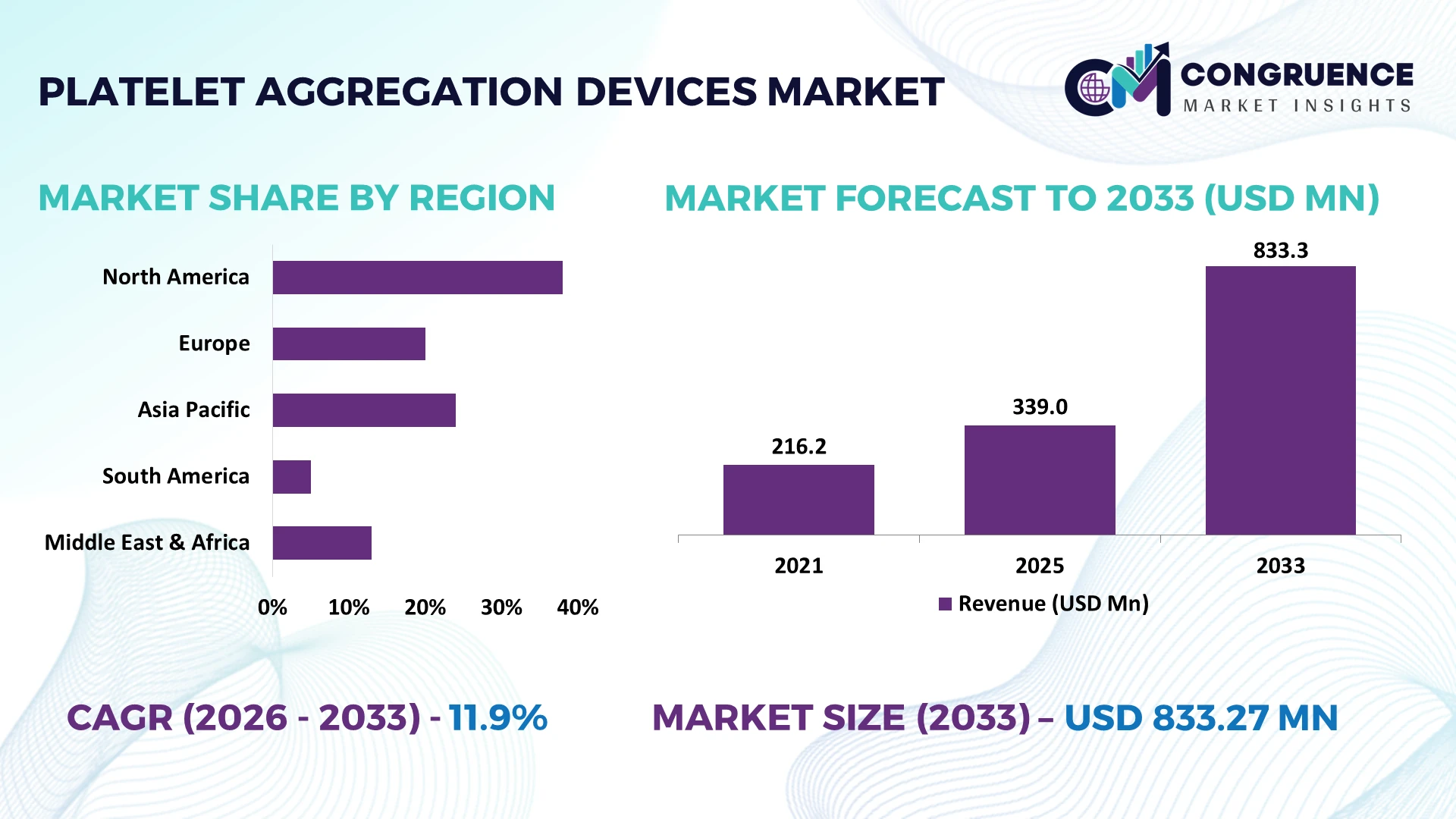
The United States represents approximately 38% of global Platelet Aggregation Devices Market demand, supported by more than 900,000 annual PCI procedures, extensive cardiovascular laboratories, and advanced coagulation-testing infrastructure. Automated impedance and optical aggregometry increasingly complement conventional laboratory workflows, while point-of-care platforms shorten assessment from hours to minutes. Germany maintains lower testing volumes but strong university-hospital adoption under standardized European diagnostic regulation. Post-pandemic reagent shortages and continuing geopolitical freight disruption have reinforced U.S. laboratory emphasis on multi-supplier consumables and localized inventory buffers.
Strategically, manufacturers should prioritize automated testing, standardized reagents, rapid turnaround, and cardiology-laboratory integration where recurring consumable utilization strengthens platform economics.
Market Size & Growth: USD 338.95 million in 2025 reaches USD 833.27 million by 2033 at 11.9% CAGR, driven by automated platelet-function testing.
Top Growth Drivers: Antiplatelet monitoring +22%, cardiovascular testing +18%, and perioperative hemostasis assessment +15% strengthen device utilization.
Short-Term Forecast: By 2028, automated sample processing targets 20% lower hands-on laboratory time through standardized testing workflows.
Emerging Technologies: Microfluidics, automated aggregometry, and AI-assisted interpretation target 15–25% improvements in workflow efficiency and result standardization.
Regional Leaders: By 2033, North America approaches USD 315 million, Europe USD 220 million, and Asia-Pacific USD 215 million as automation expands.
Consumer/End-User Trends: Hospitals and diagnostic laboratories account for approximately 75% of utilization because cardiovascular and perioperative testing requires controlled hemostasis workflows.
Pilot/Case Example: 2025 automated platelet-testing workflows reduced manual processing steps by approximately 20% compared with conventional laboratory-intensive protocols.
Competitive Landscape: Werfen holds approximately 20% share, competing with Siemens Healthineers, Helena Laboratories, Chrono-log, and Sysmex through platform and reagent integration.
Regulatory & ESG Impact: Single-use assay components exceed 50% of consumable workflows, intensifying regulated waste management and material-efficiency requirements.
Investment & Funding: More than USD 100 million in broader hemostasis diagnostics investment supports automation, assay development, digital integration, and manufacturing expansion.
Innovation & Future Outlook: Next-generation systems target 15%+ workflow gains through compact analyzers, standardized cartridges, algorithmic interpretation, and connectivity.
The Platelet Aggregation Devices Market is concentrated around cardiovascular diagnostics, antiplatelet-treatment assessment, surgical bleeding evaluation, hematology laboratories, and specialized coagulation testing. Innovation is shifting from labor-intensive light-transmission aggregometry toward automated impedance systems, cartridge-based assays, microfluidics, and digitally interpreted platelet-function testing. Hospitals and diagnostic laboratories represent approximately 75% of utilization, making turnaround time and assay standardization decisive procurement factors. Reagent availability and diagnostic supply-chain resilience have gained operational importance following global laboratory shortages, while compact testing platforms are expanding platelet assessment closer to interventional and perioperative workflows, establishing the foundation for strategic market evaluation.
Platelet aggregation testing is becoming strategically important as cardiovascular centers move from generalized antiplatelet management toward faster, patient-specific hemostasis assessment. More than 900,000 PCI procedures are performed annually in the United States, creating a substantial clinical base for platelet-function evaluation. Digital laboratory modernization is shifting purchasing toward automated analyzers, standardized reagents, connectivity, and rapid whole-blood testing rather than standalone manual aggregometers.
Automated impedance and cartridge-based systems can reduce hands-on processing by approximately 20% versus conventional light-transmission aggregometry, which requires platelet-rich plasma preparation and specialist interpretation. U.S. laboratories emphasize automation and cardiovascular integration, while India is expanding testing through tertiary hospitals and diagnostic networks. Through 2026–2028, compact analyzers, microfluidics, automated quality control, and middleware connectivity will increasingly influence laboratory procurement.
A practical deployment connects whole-blood platelet testing with laboratory information systems before high-risk cardiac procedures, accelerating result reporting and reducing manual transcription. Manufacturers are investing in reagent standardization, compact platforms, software integration, and distributor training. Competitive advantage will depend on reproducibility, turnaround speed, consumable availability, and integration into time-sensitive cardiovascular and perioperative decision pathways.
Cardiovascular intervention intensity is strengthening demand for objective platelet-function assessment, particularly where treatment response or bleeding risk requires clarification. More than 900,000 PCI procedures occur annually in the United States, while high on-treatment platelet reactivity can affect approximately 20–30% of clopidogrel-treated patients depending on population and assay methodology. Automated whole-blood platforms can reduce manual processing by roughly 20% compared with conventional laboratory-intensive workflows. The operational shift toward precision antiplatelet management is moving testing closer to catheterization and perioperative pathways. Manufacturers are responding with standardized cartridges, impedance-based analyzers, connectivity, and application-specific assays. The strategic insight is consumable pull-through: every installed analyzer creates recurring reagent demand, making test utilization and assay-menu depth more commercially important than instrument placement alone.
Platelet aggregation testing remains structurally constrained by specimen sensitivity, assay variability, reagent dependence, and limited harmonization between methodologies. Light-transmission aggregometry can require 30–60 minutes of sample preparation and testing, while platelet responses can vary by more than 20% with differences in agonist concentration, processing delay, or laboratory technique. Samples generally require rapid analysis after collection, restricting centralized testing models and increasing staffing requirements. European laboratories also face tighter diagnostic-device validation under IVDR, increasing documentation and assay-transition burdens. Suppliers are reducing exposure through standardized reagents, automated quality controls, closed cartridges, and longer-term consumable agreements. A critical operational constraint is that analytical performance depends heavily on pre-analytical discipline, so instrument automation alone cannot eliminate variability created before the sample reaches the analyzer.
Microfluidic and cartridge-based platelet testing creates an opportunity to decentralize selected assays from specialist coagulation laboratories toward cardiac, surgical, and critical-care workflows. Conventional aggregation testing can take 30–60 minutes, while rapid whole-blood platforms can deliver actionable measurements within approximately 10–15 minutes, materially shortening perioperative decision cycles. India performs more than 500,000 PCI procedures annually, creating a sizeable addressable base beyond highly specialized hematology laboratories. Through 2026–2028, automated cartridges, compact analyzers, digital result interpretation, and laboratory-information-system integration will expand deployment flexibility. Manufacturers are investing in miniaturized fluidics, simplified sample handling, distributor training, and cardiology partnerships. The non-obvious opportunity is workflow ownership: vendors connecting testing, interpretation, quality control, and consumables can capture recurring utilization without competing primarily on analyzer acquisition price.
Long-term scalability depends on converting platelet-function measurements into consistent clinical decisions across cardiology, hematology, anesthesia, and surgery. Different platforms measure distinct biological pathways, producing results that are not always interchangeable; inter-assay classification differences can exceed 20% in selected patient cohorts. Meanwhile, high on-treatment platelet reactivity thresholds vary with assay methodology and therapeutic context, complicating universal decision rules. In the United States, expanding laboratory connectivity also requires interfaces with electronic records, middleware, cybersecurity controls, and quality-management systems. Manufacturers must invest in assay harmonization, clinical-validation programs, standardized reporting, interoperability, and specialist education. The strategic challenge extends beyond analytical accuracy: suppliers that cannot translate numerical platelet responses into reproducible workflow decisions risk low test utilization even after successful analyzer placement, weakening recurring consumable economics and customer retention.
Automation Replaces Manual Preparation Steps: Laboratories are reducing dependence on labor-intensive platelet-rich plasma preparation as automated analyzers standardize pipetting, incubation, and interpretation. Conventional testing can require 30–60 minutes, while streamlined systems reduce hands-on activity by approximately 20%. U.S. hospital laboratories are consolidating coagulation workflows as skilled-labor availability tightens. Manufacturers are responding with automated quality controls, preconfigured assays, standardized reagents, and middleware connectivity that improves throughput without proportional staffing increases.
Whole-Blood Workflows Gain Clinical Ground: Whole-blood testing is gaining operational preference because it removes centrifugation and preserves cellular interactions absent from platelet-rich plasma methods. Sample-preparation steps can decline by 20–30%, while selected platforms deliver results within approximately 10–15 minutes. Cardiac and surgical centers increasingly deploy these workflows near time-sensitive procedures. Vendors are expanding cartridge formats, simplified sample handling, and compact analyzers, turning turnaround speed into a procurement differentiator.
IVDR Raises Assay Validation Standards: European laboratories are restructuring platelet-testing portfolios as IVDR requirements strengthen evidence, documentation, and post-market obligations. Laboratories handling multiple agonists and assay protocols are reducing unnecessary test variation to simplify validation. Transition workloads can increase documentation activity by more than 20% for complex diagnostic portfolios. Suppliers are consolidating validated reagent menus, strengthening regulatory teams, and improving lot traceability, favoring manufacturers capable of supporting analyzer-reagent systems throughout their lifecycle.
Digital Interpretation Gains Workflow Value: Platelet aggregation results are increasingly connected with laboratory information systems and standardized interpretation tools rather than remaining isolated instrument outputs. Automated data transfer can eliminate several manual transcription steps and reduce reporting errors by approximately 10–15%. Manufacturers are adding bidirectional connectivity, rule-based flags, remote quality monitoring, and standardized reporting. The non-obvious shift is competitive value moving from analytical hardware toward software-supported utilization and reproducibility.
Light Transmission Aggregometry accounts for approximately 35% of type-level demand, supported by its established position in specialist platelet-function laboratories and ability to evaluate responses to multiple agonists. Its extensive clinical familiarity sustains adoption despite platelet-rich plasma preparation, centrifugation, and operator dependence. Impedance Aggregometry reduces preparation requirements by measuring platelet aggregation electrically, while Whole Blood Aggregometry preserves cellular interactions and supports faster workflows. Platelet Function Analyzers provide standardized, comparatively simplified testing for routine clinical assessment.
Microfluidic Aggregometry is the fastest-growing type as laboratories pursue lower sample volumes, compact instrumentation, and more automated testing. Microfluidic designs can reduce required specimen volume by over 50% compared with conventional laboratory approaches, improving suitability for pediatric and limited-volume samples. Manufacturers are consequently directing R&D toward disposable cartridges, automated interpretation, connectivity, and miniaturized fluidics. Investment is shifting from standalone optical hardware toward integrated platforms that combine rapid processing, standardized consumables, and digital reporting, while conventional LTA remains strategically important for comprehensive specialist investigations.
Platelet Function Testing represents approximately 34% of application demand because it provides the broad analytical foundation for assessing platelet responsiveness across cardiovascular, hematological, and perioperative settings. Bleeding Disorder Diagnosis remains an established specialist application, particularly where inherited or acquired platelet dysfunction requires multi-agonist testing. Thrombosis Assessment supports evaluation of abnormal platelet activation, while Preoperative Testing is selectively deployed when bleeding history, medication exposure, or procedural complexity warrants additional hemostatic assessment.
Antiplatelet Drug Monitoring is the fastest-growing application as cardiology workflows increasingly address variable response to P2Y12 inhibitors and other antiplatelet therapies. High on-treatment platelet reactivity occurs in approximately 20–30% of clopidogrel-treated patients in selected populations, creating a defined testing opportunity. Manufacturers are expanding rapid whole-blood assays, automated reporting, standardized cutoffs, and cardiology integration. Demand is therefore shifting toward applications where turnaround time directly affects therapeutic decisions, while broader diagnostic platelet testing remains concentrated in specialized laboratories requiring comprehensive assay menus and experienced interpretation.
Hospitals account for approximately 45% of end-user demand because cardiology, cardiac surgery, hematology, anesthesia, and emergency departments generate procedure-linked platelet assessment requiring rapid laboratory support. Large hospitals can centralize analyzers while connecting results to catheterization and perioperative workflows. Diagnostic Laboratories represent another established buyer group, particularly for comprehensive aggregation panels requiring multiple agonists. Blood Banks use platelet-function assessment selectively for component-quality and research applications, while Research Institutes prioritize flexible platforms capable of detailed experimental analysis.
Specialty Clinics are the fastest-growing end-user group as cardiovascular and hematology services increasingly decentralize selected testing from tertiary hospitals. Compact whole-blood and cartridge-based systems can reduce processing time by approximately 20–30%, improving feasibility where full specialist laboratories are unavailable. Manufacturers are responding with smaller analyzers, simplified consumables, service packages, and connectivity options. Hospitals remain the volume anchor, but future placement opportunities increasingly favor settings that require rapid results without maintaining labor-intensive platelet-rich plasma workflows.
North America accounted for the largest market share at 39% in 2025 however, Asia-Pacific is expected to register the fastest growth, expanding at a CAGR of 13.5% between 2026 and 2033.
Automated Cardiovascular Testing Gains Priority
North America represents approximately 39% of global platelet aggregation device demand, supported by extensive cardiovascular intervention, hematology, coagulation, and academic laboratory infrastructure. The United States performs more than 900,000 PCI procedures annually, creating a substantial clinical base for antiplatelet-response assessment and procedure-linked hemostasis testing. Large hospital laboratories are replacing labor-intensive workflows with automated whole-blood systems, standardized reagents, connectivity, and cartridge-based assays capable of delivering selected results within 10–15 minutes. Laboratory consolidation is simultaneously increasing demand for high-throughput platforms that reduce manual processing and support centralized quality management. Manufacturers are strengthening cardiology partnerships, middleware integration, assay menus, and technical-service coverage. Competitive advantage increasingly depends on translating platelet measurements into standardized clinical workflows while maintaining reliable reagent availability across large hospital networks.
United States Market Outlook: The United States combines high PCI volumes with extensive tertiary cardiovascular and coagulation-testing infrastructure. More than 6,000 hospitals provide a broad installed base for laboratory diagnostics, while academic centers support advanced platelet research. Vendors emphasizing FDA-compliant assays, automated interpretation, connectivity, and recurring reagent supply are positioned strongly within integrated health systems.
IVDR Accelerates Diagnostic Portfolio Standardization
Europe accounts for approximately 28% of global demand, with Germany, France, the United Kingdom, Italy, and Spain concentrating advanced platelet-function laboratories. IVDR implementation is reshaping procurement by increasing clinical-evidence, traceability, quality-management, and post-market requirements for diagnostic systems and reagents. Germany's approximately 1,900 hospitals provide a substantial base for cardiovascular, surgical, and hematology testing, while university laboratories maintain strong use of light transmission aggregometry for specialist investigations. Laboratories are rationalizing assay menus and increasingly favoring analyzer-reagent ecosystems that reduce validation complexity. Automated impedance and whole-blood platforms are gaining operational relevance where rapid turnaround complements conventional reference testing. Manufacturers are strengthening regulatory teams, standardized reagent portfolios, digital quality control, and European distribution. Regulatory readiness now directly influences purchasing because unsupported legacy assays create higher laboratory validation and documentation burdens.
Germany Market Outlook: Germany combines university-hospital research capability with large cardiovascular and laboratory-diagnostics infrastructure. Hundreds of thousands of coronary interventions annually create procedure-linked testing potential, while specialist laboratories preserve demand for comprehensive aggregation panels. Suppliers benefit from offering validated reagents, automation, traceable consumables, and service structures aligned with stringent European diagnostic requirements.
Cardiac Scale Drives Testing Decentralization
Asia-Pacific represents approximately 23% of global platelet aggregation device demand, with China, Japan, India, South Korea, and Australia combining expanding cardiovascular procedures with laboratory modernization. China performs more than 1 million PCI procedures annually, providing substantial clinical scale for platelet-function assessment, while India's expanding tertiary cardiac networks are increasing access to advanced coagulation testing. Japan maintains sophisticated hospital laboratories and strong adoption of automated hematology technologies. Deployment is shifting from highly specialized reference laboratories toward compact whole-blood and platelet-function analyzers located closer to cardiovascular and surgical workflows. Manufacturers are expanding distributor training, localized reagent inventories, compact instruments, and application support. The region's strategic advantage lies in converting large procedural volumes into recurring assay utilization; success therefore depends on simplified testing and affordable consumables rather than transferring labor-intensive reference-laboratory workflows unchanged.
China Market Outlook: China combines high cardiovascular procedure volumes with more than 38,000 hospitals and rapidly expanding laboratory automation. High-tier hospitals provide the strongest environment for platelet-function analyzers linked with cardiology and perioperative pathways. Suppliers require local regulatory execution, dependable reagent availability, automated platforms, and clinical education capable of converting instrument installations into sustained testing volumes.
Centralized Laboratories Concentrate Advanced Testing
South America represents approximately 6% of global platelet aggregation device demand, led by Brazil, Argentina, Chile, and Colombia. Brazil provides the principal testing base through major cardiovascular hospitals, diagnostic networks, university laboratories, and specialized hematology centers. Cardiovascular diseases account for roughly 30% of Brazilian deaths, maintaining significant clinical pressure on thrombosis and antiplatelet-management pathways. Advanced aggregation testing remains concentrated in metropolitan centers because equipment costs, specialist expertise, reagent logistics, and sample-handling requirements constrain decentralization. Automated whole-blood platforms offer an operational route around some laboratory complexity, particularly where rapid processing is required. Manufacturers are strengthening distributor partnerships, application training, reagent inventory, and service agreements. Market access depends heavily on maintaining consumable availability because imported reagent delays can undermine analyzer utilization even when capital equipment is already installed.
Brazil Market Outlook: Brazil combines more than 7,000 hospitals with major cardiology and diagnostic clusters in São Paulo, Rio de Janeiro, and other state capitals. Private laboratories provide important automation opportunities, while university hospitals sustain specialist aggregometry. Suppliers that localize reagent inventories and technical support can reduce downtime and strengthen recurring assay utilization.
Diagnostic Modernization Concentrates Premium Adoption
Middle East & Africa represents approximately 4% of global demand, with Saudi Arabia, the United Arab Emirates, Israel, and South Africa concentrating sophisticated coagulation and cardiovascular testing. Saudi healthcare modernization is expanding specialist hospitals, laboratory automation, cardiac centers, and private-sector participation, creating stronger infrastructure for advanced platelet-function assessment. The country operates more than 500 hospitals, while cardiovascular disease remains a major clinical burden. UAE laboratories emphasize internationally standardized automated diagnostics, whereas South Africa provides the strongest sub-Saharan base through private pathology networks and tertiary academic hospitals. Elsewhere, reagent logistics, specialist shortages, and limited coagulation infrastructure constrain deployment. Manufacturers are using distributor-led service models, application training, compact analyzers, and regional reagent inventories. Successful expansion depends on ensuring consumable continuity and technical support rather than maximizing analyzer placements across low-throughput laboratories.
Saudi Arabia Market Outlook: Saudi Arabia offers a concentrated opportunity through advanced tertiary hospitals, cardiac centers, and laboratory modernization under Vision 2030. Riyadh, Jeddah, and Eastern Province facilities support sophisticated cardiovascular diagnostics. Suppliers offering automated whole-blood testing, reliable reagent logistics, clinical training, and laboratory connectivity are positioned to capture modernization-driven procurement.
Werfen, Siemens Healthineers, Sysmex, Helena Laboratories, and Chrono-log compete across automated hemostasis, platelet-function, and specialist aggregometry platforms, while niche technology suppliers challenge through compact and application-specific systems. The top five players collectively represent approximately 60% of market activity, reflecting established analyzer placements and recurring reagent relationships. Competition centers on assay reproducibility, turnaround speed, automation, connectivity, and consumable economics. Automated workflows can reduce hands-on processing by approximately 20%, while whole-blood platforms can shorten selected testing cycles by 30–50% versus preparation-intensive methods. Leading suppliers deepen hospital penetration through reagent contracts, middleware integration, application training, and broader hemostasis portfolios; specialists compete through flexible agonist testing and customization. The market is shifting toward closed analyzer-reagent ecosystems and digitally standardized interpretation. Regulatory validation, clinical evidence, reagent consistency, and specialist acceptance create substantial entry barriers. Winning requires reproducible results, rapid workflows, dependable consumables, clinical integration, and sustained technical support across cardiovascular and coagulation laboratories.
Werfen
Siemens Healthineers
Sysmex Corporation
Helena Laboratories
Chrono-log Corporation
Haemonetics Corporation
F. Hoffmann-La Roche
Sienco
Aggredyne
Bio/Data Corporation
DiaSys Diagnostic Systems
Sentinel Diagnostics
Matis Medical
SD Biosensor
Current technology centers on light-transmission aggregometry, impedance aggregometry, and automated platelet-function analyzers integrated with coagulation laboratories. High-throughput platforms can process up to 450 tests hourly, while dedicated aggregation channels standardize measurement and quality control. Compared with manual aggregometry, automated workflows can reduce hands-on processing by approximately 20–30%, improving reproducibility. Adoption is strongest in tertiary hospitals and reference laboratories where specialist platelet testing complements routine hemostasis diagnostics and cardiovascular assessment.
Emerging systems combine whole-blood testing, microfluidics, cartridge assays, barcode identification, and middleware connectivity. Rapid platforms deliver platelet-reactivity results within roughly 10–15 minutes and can eliminate centrifugation, reducing preparation steps by 20–30%. Integration with laboratory information systems also minimizes transcription and reporting delays. Manufacturers with established coagulation platforms benefit because platelet aggregation can be added to existing laboratory infrastructure, strengthening reagent utilization and customer retention.
Through 2026–2028, disruptive development will emphasize shear-sensitive microfluidics, algorithm-assisted interpretation, automated preanalytical checks, and decentralized testing. Microfluidic platforms can reduce specimen requirements by more than 50%, supporting pediatric and limited-volume applications. Digital quality management will further improve cross-site consistency by approximately 15–20%. Companies investing now gain advantages in standardized workflows, clinical scalability, and recurring consumables as purchasing shifts toward integrated platelet-testing ecosystems.
December 2024 Werfen’s Accriva Diagnostics initiated a U.S. recall of VerifyNow P2Y12 Platelet Reactivity Test lot WL1145, covering 25 units distributed without appropriate clearance. The action reinforced regulatory control over platelet-reactivity consumables and customer replacement procedures. Source: FDA.
March 2025 Werfen commercialized ACL TOP Family 70 Series hemostasis systems across North America following FDA clearance and Health Canada licensure. HemoHub integration centralizes quality management across multiple instruments, eliminating transcription errors and automating laboratory reporting. Source: PRNewswire.
July 2025 Sysmex showcased CN-6000 at ADLM 2025, extending automated hemostasis positioning into specialty platelet aggregation workflows. Its optional sampler accommodates 120 tubes, while preanalytical sample-integrity checks support laboratories seeking higher throughput, accuracy, and standardized testing operations. Source: Sysmex.
July 2026 Sysmex presented research with Gifu University assessing aspirin response using five platelet-function tests across light-transmission aggregometry and cartridge-based testing. The ISTH 2026 study strengthens evidence for cross-platform interpretation in neuroendovascular antiplatelet management workflows. Source: Sysmex Research.
The Platelet Aggregation Devices Market Report evaluates Light Transmission Aggregometry, Impedance Aggregometry, Whole Blood Aggregometry, Microfluidic Aggregometry, and Platelet Function Analyzers. Application coverage includes Platelet Function Testing, Bleeding Disorder Diagnosis, Antiplatelet Drug Monitoring, Thrombosis Assessment, and Preoperative Testing. Hospitals, Diagnostic Laboratories, Blood Banks, Research Institutes, and Specialty Clinics are assessed across North America, Europe, Asia-Pacific, South America, and Middle East & Africa.
Technology coverage includes automated aggregometry, rapid whole-blood assays, microfluidics, cartridge testing, digital interpretation, laboratory connectivity, and preanalytical quality controls. Hospitals represent approximately 45% of end-user demand, while Light Transmission Aggregometry accounts for roughly 35% of type-level activity. The 2026–2033 assessment supports instrument-platform investment, reagent strategy, geographic expansion, regulatory planning, partnership decisions, competitive benchmarking, and positioning within decentralized and integrated platelet-function testing workflows.
| Report Attribute/Metric | Report Details |
|---|---|
Market Revenue in 2025 | USD 338.95 Million |
Market Revenue in 2033 | USD 833.27 Million |
CAGR (2026 - 2033) | 11.9% |
Base Year | 2025 |
Forecast Period | 2026 - 2033 |
Historic Period | 2021 - 2025 |
Segments Covered | By Type
By Application
By End-User
|
Key Report Deliverable | Revenue Forecast, Growth Trends, Market Dynamics, Segmental Overview, Regional and Country-wise Analysis, Competition Landscape |
Region Covered | North America, Europe, Asia-Pacific, South America, Middle East, Africa |
Key Players Analyzed | Werfen, Siemens Healthineers, Sysmex Corporation, Helena Laboratories, Chrono-log Corporation, Haemonetics Corporation, F. Hoffmann-La Roche, Sienco, Aggredyne, Bio/Data Corporation, DiaSys Diagnostic Systems, Sentinel Diagnostics, Matis Medical, SD Biosensor |
Customization & Pricing | Available on Request (10% Customization is Free) |




