
Reports
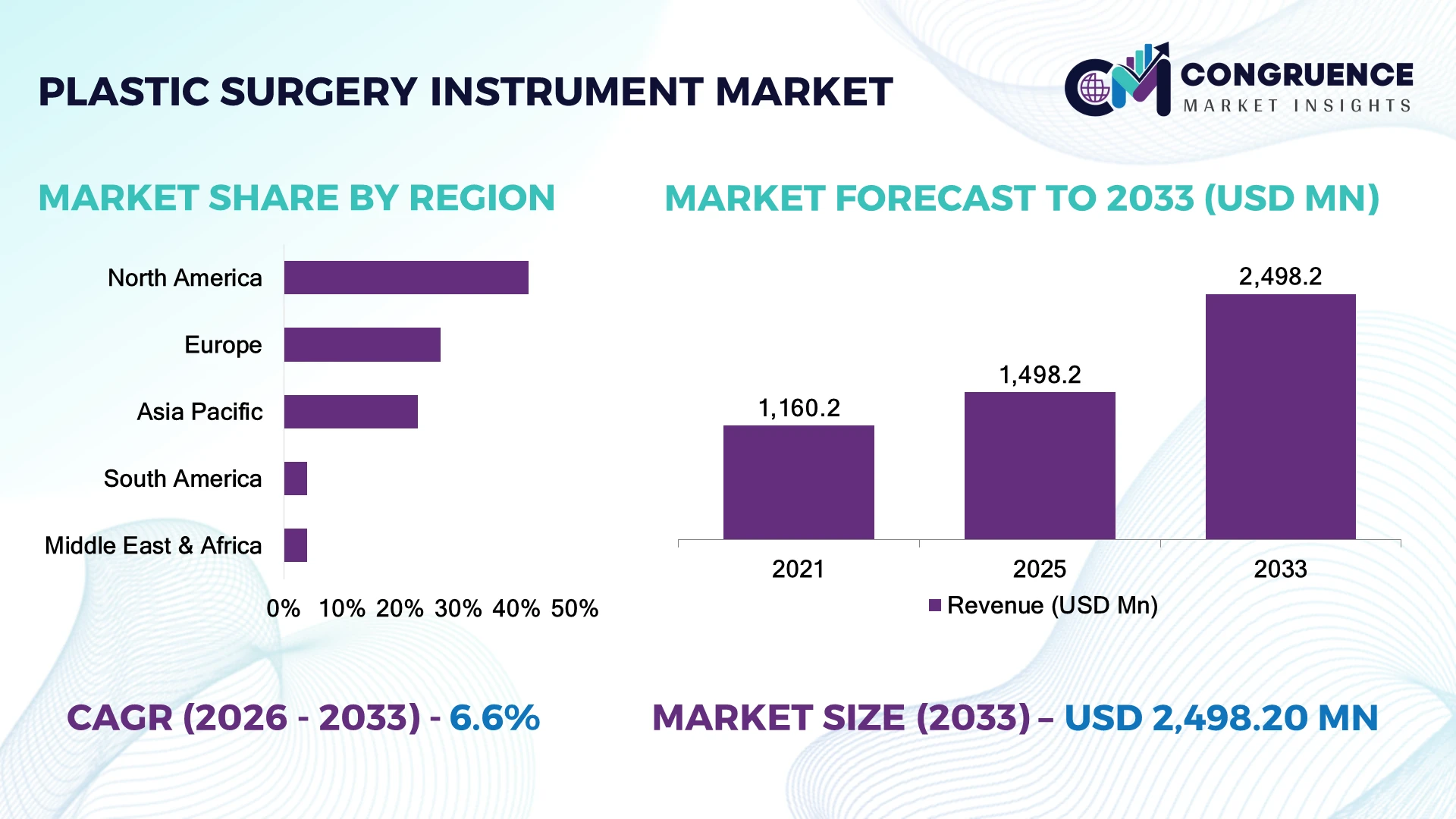
The Global Plastic Surgery Instrument Market was valued at USD 1,498.2 Million in 2025 and is anticipated to reach a value of USD 2,498.2 Million by 2033 expanding at a CAGR of 6.6% between 2026 and 2033. Growth is being driven by outpatient aesthetic procedures, reconstructive surgery capacity expansion, minimally invasive instrumentation, and demand for reusable precision instruments with improved ergonomics.
The United States remains the dominant country market, representing an estimated 35% share in 2025, supported by high procedural volumes, specialist surgical centers, and rapid adoption of advanced electrosurgical and energy-based instruments. China follows with approximately 14%, driven by expanding private hospitals and aesthetic-care infrastructure. U.S. adoption of digitally integrated surgical systems is estimated at above 30%, compared with below 20% across many developing markets. Geopolitical supply-chain restructuring is encouraging regional sourcing and dual-supplier strategies.
Strategically, manufacturers with differentiated precision, reliable sterilization performance, and localized supply chains are best positioned to capture premium surgical demand.
Market Size & Growth: USD 1,498.2 million in 2025 to USD 2,498.2 million by 2033 at 6.6% CAGR, supported by minimally invasive and reconstructive procedures.
Top Growth Drivers: Aesthetic procedures 32%, reconstructive surgery 27%, outpatient surgical expansion 21%.
Short-Term Forecast: By 2028, automated workflow integration can reduce instrument preparation time by 10–15% while improving procedural consistency.
Emerging Technologies: Advanced electrosurgery, ergonomic micro-instruments, and digitally connected surgical platforms are increasing precision and workflow visibility.
Regional Leaders: North America is projected at approximately USD 1.0 billion by 2033, Europe at USD 650 million, and Asia-Pacific at USD 600 million.
Consumer/End-User Trends: Private surgical centers account for an estimated 42% of purchasing activity as outpatient procedures expand.
Pilot/Case Example: 2026 instrument-standardization programs can reduce tray complexity by 15–20%, improving sterilization workflow and operating-room turnover.
Competitive Landscape: Leading suppliers collectively hold an estimated 35–40% share, competing through precision, ergonomics, product breadth, and surgeon-specific customization.
Regulatory & ESG Impact: Reusable instrument systems can reduce single-use instrument consumption by approximately 20–30% in suitable procedures.
Investment & Funding: Approximately USD 250 million in cumulative industry investment is being directed toward manufacturing automation, product development, and regional capacity expansion.
Innovation & Future Outlook: By 2028, smart electrosurgical platforms, lightweight alloys, modular instrument systems, and traceability technologies will increasingly shape purchasing decisions.
Plastic Surgery Instrument demand is concentrating around precision forceps, retractors, scissors, cannulas, needle holders, electrosurgical instruments, and specialized microsurgical tools. Advanced coatings and ergonomic designs are improving handling and durability, while approximately 25% of purchasing activity is shifting toward higher-specification instruments. In 2026, tighter medical-device traceability and supply-chain resilience are encouraging hospitals to favor standardized, validated product portfolios, creating stronger opportunities for manufacturers with dependable quality control and localized fulfillment.
Plastic surgery instruments are becoming strategically important because procedure quality increasingly depends on precision, surgeon ergonomics, sterilization reliability, and rapid operating-room turnover. Manufacturers are therefore competing beyond basic instrument availability, emphasizing specialized designs, modular sets, advanced materials, and procedure-specific configurations. In 2026, hospitals and ambulatory surgical centers are also placing greater emphasis on inventory standardization and traceability as procurement teams seek tighter control over instrument utilization.
The technology transition is measurable. Modern lightweight alloy and precision-machined instruments can reduce instrument weight by approximately 10–20% compared with conventional stainless-steel configurations, improving handling during lengthy procedures. Electrically integrated instruments can further reduce procedural exchanges by approximately 5–10% in suitable applications. North America maintains stronger adoption of premium surgical systems, while Asia-Pacific is expanding through new private hospitals, aesthetic centers, and localized manufacturing.
Over the next 2–3 years, manufacturers will prioritize modular surgical sets, automated production inspection, antimicrobial surface treatments, and digitally traceable inventory systems. Companies are adjusting investment toward regional manufacturing and surgeon-led product development. The competitive advantage will increasingly belong to suppliers combining precision engineering, regulatory reliability, customization, and efficient after-sales support rather than competing solely on instrument price.
Growing adoption of minimally invasive and precision-oriented plastic surgery is increasing demand for ergonomic, reusable, and procedure-specific instruments. In the U.S., ambulatory surgical centers account for a substantial share of outpatient procedures, while minimally invasive techniques increasingly influence instrument selection. Advanced electrosurgical, microsurgical, and atraumatic instruments can reduce tissue handling and operative variability by approximately 10–15%. In India, expanding cosmetic-surgery infrastructure is broadening access beyond major metropolitan hospitals. Manufacturers are responding with modular instrument systems, improved surface finishes, and surgeon-specific configurations. The strategic shift is from selling standardized tool sets toward integrated procedure portfolios, enabling suppliers to defend margins through differentiated performance rather than volume alone.
High-quality surgical instruments face cost pressure from stainless-steel inputs, precision machining, sterilization requirements, and increasingly stringent quality controls. Reprocessing-intensive facilities can allocate roughly 10–15% of instrument-related operating costs to cleaning, sterilization, inspection, and maintenance. Smaller hospitals in emerging markets also face infrastructure limitations that increase turnaround time and replacement frequency. Regulatory documentation can add another 5–8% to commercialization timelines for redesigned instruments. Companies are mitigating exposure through localized machining, standardized components, multi-year procurement contracts, and dual-source material strategies. The non-obvious constraint is lifecycle economics: a lower acquisition price loses value rapidly when instruments require frequent sharpening, repair, or replacement.
Connected surgical workflows create opportunities for instruments incorporating digital tracking, ergonomic sensing, and procedure-specific data capture. Instrument identification and asset-tracking systems can reduce misplaced equipment by 15–25%, while standardized tray optimization can lower unnecessary inventory by approximately 10%. Japan and South Korea are well positioned for adoption because advanced hospitals already integrate automation and digital operating-room infrastructure. Manufacturers are developing RFID-enabled asset management, modular trays, and precision instruments compatible with robotic and microsurgical workflows. Partnerships between instrument manufacturers, hospital technology providers, and surgical-platform developers can create higher-value ecosystems. The strongest opportunity lies not in adding electronics to every instrument, but in selectively digitizing high-utilization, high-cost surgical assets.
Integration of advanced instruments into existing surgical workflows remains difficult because hospitals operate heterogeneous sterilization systems, instrument trays, surgical platforms, and procurement standards. Approximately 20–30% of hospital instrument inventories can consist of overlapping or underutilized configurations, increasing tracking and reprocessing complexity. Workforce shortages further intensify dependence on efficient tray preparation and instrument identification. In the U.S., interoperability between digital operating-room systems and hospital asset-management platforms remains a practical deployment issue. Manufacturers must therefore prioritize standardized interfaces, traceability, ergonomic validation, and staff training rather than isolated product innovation. Companies that combine instrument design with workflow integration and lifecycle services will achieve stronger deployment consistency and customer retention.
Ergonomic Design Gains Priority Surgical teams increasingly favor lightweight, balanced instruments that reduce hand fatigue and improve maneuverability during microsurgical procedures. Ergonomic redesign can improve handling efficiency by 10–15%, while approximately 20% of premium instrument launches increasingly emphasize surgeon-specific grip geometry. Manufacturers are expanding modular handles and precision tips to differentiate professional-grade portfolios.
Reusable Systems Face Optimization Hospitals are tightening sterilization economics as labor and reprocessing requirements rise. Optimized tray configurations can reduce instrument counts by 10–20% and shorten preparation cycles by approximately 15%. U.S. facilities are increasingly rationalizing duplicate sets, pushing manufacturers toward standardized components, repair programs, and lifecycle-service contracts rather than simple replacement sales.
Digital Tracking Enters Instrument Workflow RFID and barcode-based tracking are moving from central sterile departments into operating-room asset management. Deployment can reduce misplaced instruments by roughly 15–25% and improve inventory visibility by more than 20%. Companies are integrating tracking identifiers into trays and reusable instruments, particularly where hospital procurement teams demand stronger traceability.
Precision Tools Support Microsurgery Advanced ophthalmic-style micro-instruments, atraumatic forceps, fine scissors, and specialized retractors are gaining relevance in reconstructive and aesthetic procedures requiring greater tissue control. Precision-focused configurations can reduce handling variability by approximately 10%. Manufacturers are responding with finer tip geometries, improved coatings, and application-specific kits as surgical specialization expands.
Handheld instruments lead the Global Plastic Surgery Instrument Market with an estimated 49% share, supported by broad use across rhinoplasty, breast reconstruction, facelifts, skin grafting, and body-contouring procedures. Their reusable construction, tactile control, and compatibility with established sterilization workflows give them a scalability advantage over specialized equipment. Electrosurgical instruments represent roughly 37% of demand and are the fastest-growing type as surgeons prioritize controlled coagulation, tissue dissection, and shorter operative workflows. Their adoption is shifting procurement toward energy-enabled systems, particularly in high-volume surgical centers.
The remaining specialized instruments retain strategic importance in microsurgery and procedure-specific applications, but their narrower utilization limits volume. Electrosurgical adoption is estimated to expand by 8–10% annually in high-technology facilities, while ergonomic and material upgrades are influencing approximately 15% of premium handheld product development. Manufacturers are therefore protecting their core handheld portfolios while increasing investment in bipolar systems, insulated instruments, specialty tips, and bundled procedure kits. The business implication is clear: volume remains concentrated in handheld products, but future product differentiation is shifting toward energy control and precision engineering.
Cosmetic surgery accounts for approximately 58% of plastic surgery instrument demand, making it the leading application through high procedural frequency across facial surgery, breast procedures, liposuction, and body contouring. Reconstructive surgery follows with substantial demand from trauma, oncology, burns, hand surgery, and congenital defect repair. Cosmetic procedures favor ergonomic handheld instruments and increasingly electrosurgical systems, whereas reconstructive workflows place greater emphasis on microsurgical precision and tissue-preserving instrumentation.
Reconstructive applications represent the faster-expanding specialized opportunity as complex restoration procedures require finer instruments and procedure-specific configurations. In the U.S., more than 1 million reconstructive procedures were performed in 2024, including 361,798 tumor-removal procedures and 162,579 breast reconstructions. This volume supports sustained demand for micro-forceps, retractors, scissors, and specialized cutting tools. Companies are responding by expanding reconstructive portfolios, developing specialty kits, and integrating precision instruments into hospital procurement programs. The commercial implication is a two-speed market: cosmetic surgery drives volume, while reconstructive surgery increasingly drives premium instrument specialization.
Hospitals represent the dominant end-user, accounting for approximately 65% of plastic surgery instrument demand because they support higher procedural complexity, multidisciplinary reconstruction, and larger sterilizable instrument inventories. Their purchasing behavior emphasizes durability, traceability, ergonomic performance, and total cost of ownership. Specialty and dermatology clinics hold a smaller base but are expanding faster as outpatient cosmetic procedures shift toward focused, shorter-duration care. Clinic procurement typically prioritizes compact, lightweight, procedure-specific instruments that require less infrastructure.
Hospitals consequently remain the anchor for premium reusable portfolios, while clinics and ambulatory settings are reshaping product design around portability and faster turnover. Specialty clinics are estimated to expand adoption at roughly 10–12% annually in high-volume markets, compared with approximately 5–7% replacement-driven growth for mature hospital instrument inventories. Manufacturers are responding through compact electrosurgical platforms, modular trays, specialty kits, and direct partnerships with outpatient providers. The strategic shift is toward differentiated channel strategies: hospitals reward lifecycle reliability, whereas emerging outpatient buyers increasingly value speed, footprint, and simplified workflow economics.
North America accounted for the largest market share at 42% in 2025 however, Asia-Pacific is expected to register the fastest growth, expanding at a CAGR of 13.1% between 2026 and 2033.

Advanced outpatient infrastructure is reshaping instrument procurement
North America remains the principal demand center for plastic surgery instruments, supported by concentrated procedure volumes, high-value hospital procurement, and rapid adoption of precision handheld and electrosurgical systems. The region represented approximately 42% of the global market in 2025, with the United States accounting for roughly 80% of North American demand. U.S. providers increasingly favor reusable instruments with ergonomic designs, traceability, and procedure-specific configurations. In 2024, U.S. plastic surgeons performed nearly 1.6 million cosmetic surgical procedures, while reconstructive procedures exceeded 1 million, sustaining broad instrument utilization. Manufacturers are prioritizing ambulatory-care partnerships, premium instrument portfolios, and lifecycle-service programs. The strategic advantage is shifting toward suppliers capable of combining precision performance with efficient sterilization and inventory management.
United States Market Outlook: The United States dominates North American demand through its large specialist base, advanced ambulatory infrastructure, and high procedural intensity. In 2024, cosmetic surgical procedures increased 1%, while reconstructive procedures rose 2%, supporting continued replacement and specialty-instrument demand.
Regulatory discipline is accelerating premium instrument adoption
Europe accounted for approximately 27% of global plastic surgery instrument demand in 2025, with Germany, the United Kingdom, France, and Italy forming important procurement and manufacturing centers. Stringent medical-device controls are increasing emphasis on traceability, sterilization validation, material quality, and documented lifecycle performance. Germany benefits from its established surgical-instrument manufacturing base, while the United Kingdom combines advanced private healthcare capacity with strong specialist demand. Europe is also experiencing greater interest in minimally invasive procedures, encouraging manufacturers to refine compact, ergonomic, and procedure-specific systems. The region's market contribution was approximately 26.8%, indicating a mature but technologically valuable customer base. Companies are responding with higher-specification instruments, regulatory-compliant redesigns, and distributor partnerships that improve access to specialized hospital and clinic accounts.
Germany Market Outlook: Germany holds particular strategic importance because its medical-device manufacturing ecosystem supports precision machining, specialty surgical instruments, and high-quality reusable systems. Approximately 30% of European market demand is concentrated across major Western European procurement markets, reinforcing Germany's role as both a technology supplier and sophisticated end-user market.
Medical-tourism hubs are accelerating procedure capacity
Asia-Pacific is the fastest-expanding demand center, representing approximately 23% of the global market in 2025 and benefiting from rising procedure volumes, expanding private hospitals, and medical-tourism infrastructure. China, Japan, South Korea, and India are driving different demand patterns, ranging from high-end reconstructive systems to cost-efficient reusable instruments. The region's market is projected to reach approximately USD 568.9 million by 2030 under industry estimates, reflecting substantial capacity expansion. South Korea's aesthetic-surgery ecosystem emphasizes precision and specialized instruments, while India is expanding procedure capacity through private hospital networks. Manufacturers are increasingly localizing distribution, developing mid-priced instrument ranges, and partnering with specialty clinics. The strategic opportunity is to combine global quality standards with localized pricing and after-sales support.
China Market Outlook: China offers the strongest combination of manufacturing scale and expanding clinical demand. Domestic medical-device production capabilities support localized instrument supply, while major metropolitan hospitals increasingly adopt advanced surgical technologies. Manufacturers targeting China are emphasizing localized distribution, regulatory compliance, and cost-efficient precision instruments to compete across both premium hospitals and expanding private-care networks.
Brazil anchors specialized surgical demand
South America remains heavily concentrated around Brazil, where a large aesthetic-surgery ecosystem supports sustained consumption of handheld, electrosurgical, and procedure-specific instruments. Brazil performed approximately 3.1 million aesthetic procedures in 2024, including about 2.3 million surgical procedures, making it a critical demand center for surgical instrumentation. Private hospitals and specialist clinics account for much of the purchasing activity, while imported premium instruments compete with cost-sensitive regional offerings. Currency volatility and dependence on imported medical-device components can pressure procurement budgets and inventory planning. Companies are therefore strengthening local distributor networks, stocking fast-moving instruments, and offering broader procedure kits. The non-obvious opportunity is Brazil's combination of high surgical volume and specialist concentration, which supports premium instruments even when broader healthcare budgets remain constrained.
Brazil Market Outlook: Brazil is the region's strategic anchor because of its exceptionally high aesthetic-procedure intensity and established specialist base. In 2024, the country recorded approximately 3.1 million aesthetic procedures, with surgical procedures accounting for about 2.3 million. Suppliers can gain share through locally responsive distribution, surgeon education, and durable instruments designed for high-frequency clinical use.
Medical-tourism investment is upgrading surgical capacity
Middle East & Africa demand is increasingly concentrated in the United Arab Emirates, Saudi Arabia, South Africa, and Turkey-linked healthcare networks, where private hospitals and medical-tourism programs are expanding advanced surgical capacity. The UAE is particularly significant because it ranks among countries receiving high proportions of foreign aesthetic patients, strengthening demand for premium instruments and specialized procedure kits. Saudi Arabia's hospital modernization programs are also encouraging procurement of higher-specification surgical equipment and standardized reusable instruments. Companies are responding through distributor partnerships, premium product localization, and training programs for specialist users. Infrastructure quality varies sharply across countries, making service coverage and inventory availability decisive purchasing factors. Suppliers with regional warehousing and rapid replacement capabilities hold an advantage over purely export-oriented competitors.
United Arab Emirates Market Outlook: The UAE combines advanced private healthcare infrastructure, medical-tourism activity, and high-value aesthetic procedures. It is among the countries reporting some of the highest proportions of foreign aesthetic patients globally. This concentration supports premium surgical instruments, while suppliers benefit from local distribution, rapid servicing, and specialist training capabilities.
Global instrument specialists such as Integra LifeSciences, KLS Martin, Sklar, and B. Braun compete with diversified surgical-technology leaders including Stryker and Olympus. The market remains moderately fragmented, with the top five players estimated to control about 32% collectively. Competition centers on instrument precision, sterilization compatibility, ergonomics, availability, and procedure-specific customization, with premium systems commanding roughly 15–25% higher pricing while reducing workflow complexity by 8–12%. Integra and KLS Martin emphasize specialized reconstructive portfolios, while diversified OEMs leverage broader hospital contracts, integrated equipment, and distribution networks. Players are expanding through regional distribution agreements, product launches, digital training, and vertically coordinated manufacturing. The competitive shift is moving toward modular, ergonomic, and energy-assisted systems rather than standalone manual instruments. Entry barriers remain high because regulatory validation, surgeon familiarity, quality certification, and hospital procurement relationships require substantial investment. Winning requires reliable supply, differentiated ergonomics, validated performance, and strong surgeon-facing support.
Integra LifeSciences Corporation
KLS Martin Group
B. Braun Melsungen AG
Zimmer Biomet Holdings, Inc.
Stryker Corporation
Olympus Corporation
Sklar Surgical Instruments
Blink Medical Ltd.
Bolton Surgical Ltd.
TEKNO-MEDICAL Optik-Chirurgie GmbH
BMT Medizintechnik GmbH
Anthony Products, Inc.
MicroAire Surgical Instruments
Marina Medical Instruments
Plastic surgery instrumentation is shifting from conventional manual tools toward electrosurgical, ultrasonic, powered, illuminated, and ergonomically optimized systems. Electrosurgical platforms increasingly integrate cutting and coagulation functions, while ultrasonic systems improve tissue handling and precision. Advanced powered instruments can reduce operative steps by approximately 10–18%, while integrated illumination improves visualization efficiency by around 8–12% in technically demanding procedures.
Ergonomic engineering is becoming commercially important as manufacturers redesign handles, grip geometry, instrument balance, and force requirements. Newer ergonomic instruments can reduce applied hand force by approximately 15–25% versus conventional designs, supporting surgeon comfort during lengthy procedures. Adoption is strongest in specialty hospitals and high-volume surgical centers, where standardized instrument sets and faster turnover directly improve operating-room utilization.
Between 2026 and 2028, the strongest technology advantage will come from modular systems combining powered instruments, illumination, energy delivery, and procedure-specific accessories. Digital inventory tracking and instrument-set optimization will further reduce processing inefficiencies by roughly 10–15%. Premium manufacturers benefit most because integrated platforms strengthen switching costs, while cost-focused suppliers compete through durable reusable designs and localized manufacturing. The strategic priority is therefore moving from individual instruments toward interoperable procedural ecosystems.
March 2025 Black & Black Surgical signed an export agreement with Dorian Drake covering 10 Latin American markets, expanding distribution of plastic surgery instruments, microsurgery tools and liposuction equipment. The agreement strengthens channel reach and availability across centers. Source: doriandrake.com (Dorian Drake)
September 2025 Olympus India opened an additional surgical repair facility in Gurugram. Its Surgical Business ranked among the company’s fastest-growing segments over five years, strengthening servicing capacity, instrument uptime and maintenance as minimally invasive surgery expands across India. Source: olympus-global.com (Olympus Global)
June 2025 Marina Medical Instruments and W&H announced a distribution partnership for a modular piezo-and-drill console at IMRhiS. The system combines ultrasonic and motor technologies, improving procedural control and workflow integration for facial plastics, ENT and craniomaxillofacial surgery. Source: marinamedical.com (Marina Medical Instruments)
November 2025 Integra LifeSciences received FDA 510(k) clearance expanding CUSA Clarity indications to cardiac surgery while retaining plastic and reconstructive applications. The broader indication base strengthens platform utilization, supports cross-specialty adoption and improves commercial leverage for ultrasonic technology. Source: integralife.com (Integra LifeSciences)
The Plastic Surgery Instrument Market Report covers handheld instruments, electrosurgical instruments, powered systems, specialty instruments, and emerging procedure-specific technologies across cosmetic and reconstructive applications. End-user analysis encompasses hospitals, ambulatory surgical centers, specialty clinics, and other professional care settings. Geographic coverage spans North America, Europe, Asia-Pacific, South America, and the Middle East & Africa, with country-level assessment of procurement patterns, technology adoption, manufacturing capabilities, and healthcare infrastructure.
The study evaluates established instrument platforms alongside ergonomic designs, ultrasonic systems, minimally invasive technologies, illuminated instruments, and digitally enabled workflow solutions. Quantitative analysis examines segment shares, adoption patterns, deployment concentration, and competitive participation to identify high-priority investment areas. The report supports manufacturers, distributors, investors, and healthcare procurement teams in evaluating product positioning, regional expansion, partnership opportunities, technology priorities, and competitive strategies through 2026–2033.
| Report Attribute/Metric | Report Details |
|---|---|
|
Market Revenue in 2025 |
USD 1,498.2 Million |
|
Market Revenue in 2033 |
USD 2,498.2 Million |
|
CAGR (2026 - 2033) |
6.6% |
|
Base Year |
2025 |
|
Forecast Period |
2026 - 2033 |
|
Historic Period |
2021 - 2025 |
|
Segments Covered |
By Type
By Application
By End-User
|
|
Key Report Deliverable |
Revenue Forecast, Growth Trends, Market Dynamics, Segmental Overview, Regional and Country-wise Analysis, Competition Landscape |
|
Region Covered |
North America, Europe, Asia-Pacific, South America, Middle East, Africa |
|
Key Players Analyzed |
Integra LifeSciences Corporation, KLS Martin Group, B. Braun Melsungen AG, Zimmer Biomet Holdings, Inc., Stryker Corporation, Olympus Corporation, Sklar Surgical Instruments, Blink Medical Ltd., Bolton Surgical Ltd., TEKNO-MEDICAL Optik-Chirurgie GmbH, BMT Medizintechnik GmbH, Anthony Products, Inc., MicroAire Surgical Instruments, Marina Medical Instruments |
|
Customization & Pricing |
Available on Request (10% Customization is Free) |




