
Reports
The Global Plasma for Fractionation Market was valued at USD 11,046.2 Million in 2025 and is anticipated to reach a value of USD 19,121.8 Million by 2033 expanding at a CAGR of 7.1% between 2026 and 2033. Growth is being driven by rising plasma collection volumes, immunoglobulin manufacturing requirements, expanded fractionation capacity, and government-led efforts to strengthen domestic plasma supply following recent global supply-chain disruptions.
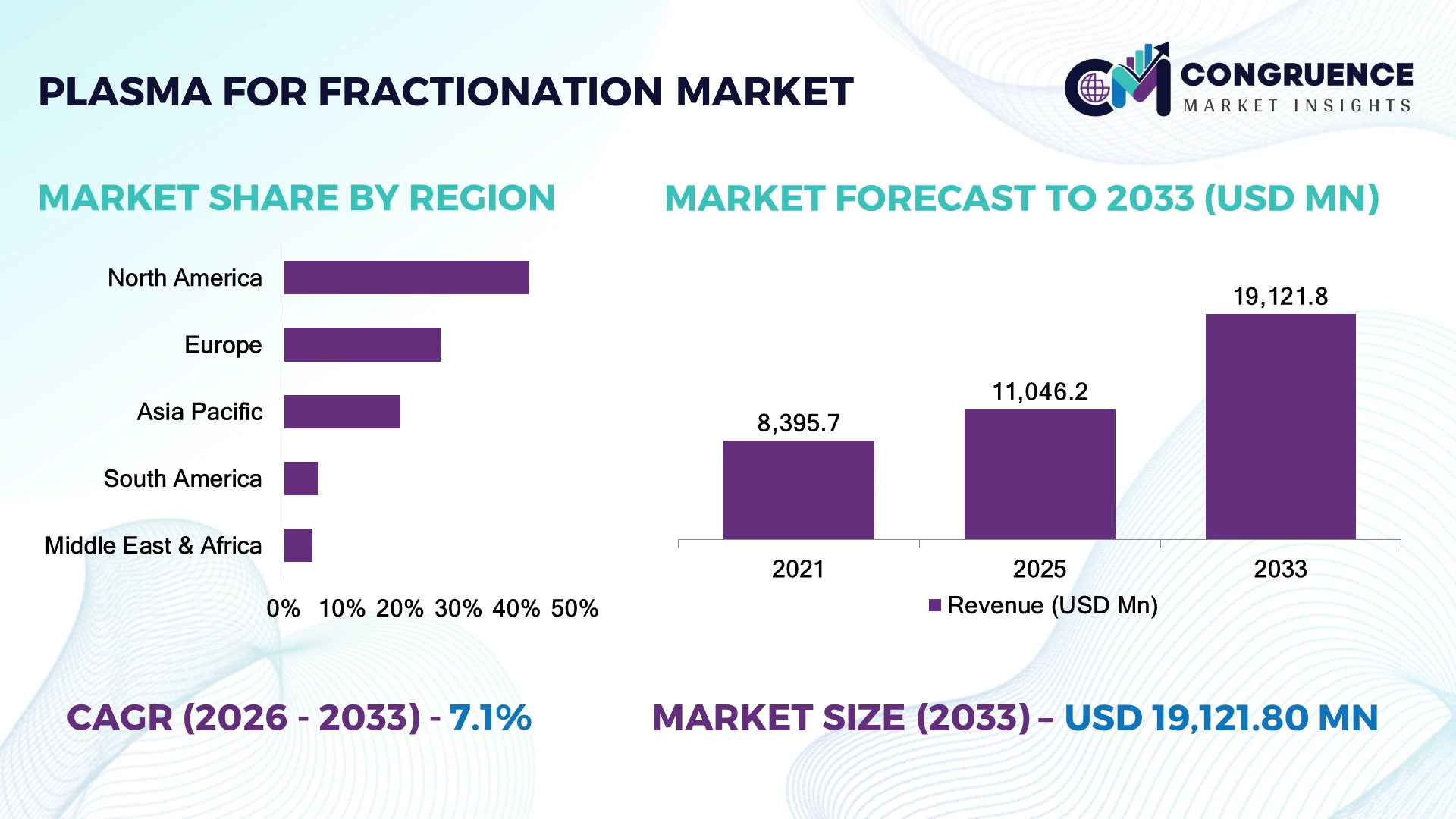
The United States dominates plasma for fractionation, accounting for approximately 65–70% of globally sourced source plasma, supported by more than 1,000 plasma collection centers and highly integrated fractionation infrastructure. European collection remains comparatively constrained, with stricter donor frameworks and greater dependence on imported plasma. U.S. fractionators continue investing in collection networks, automated separation, and higher-yield purification, while geopolitical supply-security concerns in 2026 are accelerating regional capacity planning.
Strategically, securing plasma supply and improving liters-to-product yield are becoming more important than simply expanding downstream fractionation capacity.
Market Size & Growth: USD 11.05 billion in 2025 to USD 19.12 billion by 2033 at a 7.1% CAGR, driven by immunoglobulin demand and expansion of fractionation infrastructure.
Top Growth Drivers: Immunoglobulins ~40%, albumin ~22%, and coagulation factors ~16% of downstream plasma-derived demand.
Short-Term Forecast: By 2028, automated fractionation and process-control systems are positioned to improve operational efficiency by 8–12% and reduce manual intervention.
Emerging Technologies: Continuous fractionation, advanced chromatography, automated process monitoring, and AI-assisted yield optimization are reshaping high-throughput plasma processing.
Regional Leaders: North America is projected near USD 8.0 billion, Europe around USD 5.2 billion, and Asia-Pacific approximately USD 4.0 billion by 2033, with Asia-Pacific expanding domestic collection and fractionation infrastructure.
Consumer/End-User Trends: Pharmaceutical and plasma-derived therapy manufacturers account for approximately 65–70% of fractionation-related demand, prioritizing secure supply and higher plasma utilization.
Pilot/Case Example: Advanced chromatography and automated purification projects are targeting 5–10% higher protein recovery while reducing batch variability across large-scale fractionation operations.
Competitive Landscape: CSL Behring leads the integrated plasma ecosystem with an estimated 15–20% share of global plasma-derived activity, competing with Grifols, Takeda, Octapharma, and Kedrion.
Regulatory & ESG Impact: Improved plasma traceability, pathogen-reduction controls, and energy-efficient processing can reduce selected process-resource intensity by approximately 5–10%.
Investment & Funding: More than USD 2 billion in recent capacity, collection, and manufacturing investments is reinforcing regional supply resilience and vertically integrated plasma networks.
Innovation & Future Outlook: Next-generation fractionation combines continuous processing, digital batch control, predictive maintenance, and regional plasma partnerships, shifting competition toward supply security and liters-to-product yield.
Plasma for fractionation is increasingly centered on high-purity immunoglobulins, albumin, coagulation proteins, and specialty plasma-derived therapies. Immunoglobulins represent roughly 40% of downstream demand, keeping collection capacity and fractionation yield strategically important. In 2026, manufacturers are strengthening multi-region sourcing and local processing as geopolitical and logistics risks reshape plasma supply strategies. This supply-security focus is creating a stronger foundation for the market's strategic transformation.
Plasma for fractionation is becoming a strategic asset because plasma availability directly constrains the production of immunoglobulins, albumin, and coagulation therapies. The competitive advantage is shifting upstream: companies with reliable donor networks, diversified collection infrastructure, and high-yield fractionation gain greater control over production continuity. In 2026, geopolitical trade uncertainty and regional medicine-security policies are accelerating investment in domestic plasma capabilities.
Technology is reinforcing this advantage. Modern chromatography and automated process control can improve protein recovery by approximately 5–12% compared with less optimized legacy workflows, while digital monitoring reduces batch deviations and manual quality checks. North America remains structurally advantaged through extensive collection infrastructure, whereas Europe is prioritizing supply resilience and Asia-Pacific is expanding domestic fractionation capabilities.
Over the next 2–3 years, companies are expected to prioritize collection-center expansion, automated purification, predictive maintenance, and dual-source plasma procurement. Integrated operators are also strengthening partnerships across donor collection, fractionation, and specialty pharmaceutical manufacturing. A 5% improvement in recovery can translate into materially greater therapeutic output from the same plasma pool, making yield optimization a direct competitive lever. Long-term positioning will therefore depend on controlling plasma access, maximizing liters-to-product conversion, and maintaining validated, geographically resilient manufacturing networks.
Rising immunoglobulin requirements are increasing pressure on plasma collection and fractionation capacity, with immunoglobulins representing approximately 38–40% of downstream plasma-derived demand and specialty immunology applications accounting for a growing share of fractionation output. Automated fractionation and chromatography can improve protein recovery by 5–12%, allowing operators to increase output without proportional growth in plasma volumes. In the United States, vertically integrated plasma operators are expanding collection networks and purification capacity, while European manufacturers are strengthening supply arrangements. The non-obvious shift is that plasma yield, rather than collection volume alone, is becoming the primary productivity lever. Companies are therefore prioritizing higher-yield purification, automated process control, and long-term plasma procurement agreements.
Plasma collection remains the largest upstream cost pressure, with donor acquisition, compensation, testing, and cold-chain activities collectively representing approximately 30–40% of the fractionation supply chain cost base. Collection productivity differences of 10–15% between mature and developing networks directly affect liters available for manufacturing. Europe also faces tighter plasma-collection capacity than the United States, increasing reliance on imported source plasma and exposing manufacturers to logistics disruption. These constraints limit rapid capacity scaling even when downstream fractionation plants have available utilization. Companies are responding through multi-country sourcing, longer-term procurement contracts, collection-center optimization, and localized processing. A critical business implication is that adding fractionation capacity without securing upstream plasma creates underutilized assets rather than incremental supply.
Continuous fractionation and advanced chromatography create an opportunity to increase protein recovery by approximately 5–12% while reducing selected processing cycle times by 10–20%. Digital process monitoring and predictive analytics can further reduce unplanned equipment intervention by approximately 10–15%. China, India, and Saudi Arabia are increasingly relevant for localized plasma-processing infrastructure as healthcare systems prioritize domestic availability of essential biological medicines. Companies are positioning through technology partnerships, regional manufacturing investments, and integrated collection-to-purification platforms. A less obvious opportunity lies in extracting greater value from existing plasma pools: even a 5% recovery improvement can generate additional therapeutic output without requiring equivalent expansion of donor recruitment. Investment is therefore shifting toward process intensification, automated chromatography, and digital batch optimization.
Fractionation requires tightly coordinated collection, infectious-disease screening, freezing, transportation, purification, quality control, and final manufacturing, with individual process deviations capable of extending batch release by 10–15%. Skilled technical labor shortages can add another 5–10% pressure to specialized manufacturing operations, particularly for advanced purification and validation activities. Digitalization also introduces connectivity and cybersecurity requirements across laboratory information systems, manufacturing execution systems, and automated equipment. Companies must integrate predictive maintenance, electronic batch records, workforce training, and standardized data architectures while maintaining stringent biological-product controls. The strategic challenge is no longer simply increasing capacity; operators must maintain consistent yield and quality across geographically distributed facilities, making standardized technology platforms and cross-site process harmonization critical for long-term competitiveness.
Plasma Yield Optimization Accelerates: Fractionators are prioritizing chromatography optimization and automated process control, targeting 5–12% higher protein recovery and 8–10% better equipment utilization. U.S. operators are increasingly linking collection data with manufacturing planning, allowing plasma pools to be allocated according to downstream yield potential rather than volume alone.
Regional Supply Networks Diversify: European and Asian manufacturers are strengthening local plasma procurement and processing as supply-security concerns intensify. Multi-source procurement is expanding, with companies targeting 10–20% reductions in dependence on individual collection geographies. The shift is moving investment toward regional partnerships rather than purely centralized manufacturing models.
Automation Reduces Batch Variability: Advanced sensors, automated chromatography controls, and digital batch records are entering larger fractionation facilities, reducing selected manual quality-control activities by 10–15%. Manufacturers are prioritizing automation where repetitive intervention creates variability, particularly in high-volume purification stages and multi-product plasma-processing lines.
Specialty Proteins Gain Priority: Fractionators are optimizing plasma pools for higher-value immunoglobulins, coagulation factors, and specialty proteins, with immunoglobulins representing roughly 38–40% of downstream demand. This is encouraging portfolio-level yield optimization, where companies evaluate each plasma pool according to recoverable protein value rather than treating all source plasma as operationally equivalent.
Immunoglobulins represent the leading plasma-derived product type, accounting for approximately 38–40% of global fractionation output by value, supported by broad use across primary immunodeficiencies, autoimmune disorders, neurology, and other immune-mediated conditions. Albumin follows at roughly 20–25%, supported by critical-care, liver-disease, and fluid-management applications, while coagulation factors contribute around 15–18%. Other plasma proteins remain strategically relevant for specialty indications and portfolio diversification. Immunoglobulins also require substantial plasma volumes, making collection security and purification yield central investment priorities.
The fastest-shifting category is specialty immunoglobulin formulations, including subcutaneous delivery formats, as manufacturers pursue improved administration convenience and outpatient treatment. Advanced chromatography and process automation can improve selected protein recovery by approximately 5–12%, strengthening economics across established product categories. U.S. fractionators emphasize scale and vertically integrated plasma sourcing, while European and Asian operators increasingly prioritize supply diversification and regional processing. Companies are responding with collection expansion, higher-yield purification, product-line optimization, and partnerships designed to secure plasma feedstock.
WHO reported in 2026 that only 49 of 168 reporting countries produce plasma-derived medicinal products through fractionation of domestically collected plasma, underscoring the strategic importance of expanding qualified plasma-processing capacity.
Therapeutic applications represent approximately 70–75% of plasma fractionation demand, with immunoglobulin therapies forming the largest application pool because of their use across immune deficiencies and autoimmune and neurological conditions. Albumin-based critical-care applications account for roughly 15–20%, while coagulation management contributes approximately 8–12%. The concentration reflects the established clinical infrastructure surrounding plasma-derived medicines, although specialty indications are increasingly influencing fractionation portfolio decisions.
Immunology and neurological applications represent the fastest-shifting demand areas as expanded diagnosis and treatment increase utilization of immunoglobulin therapies. Subcutaneous administration and outpatient treatment models are also changing product requirements, encouraging manufacturers to optimize purity, concentration, and formulation characteristics. Companies are expanding purification capacity and tailoring production toward higher-demand therapeutic proteins rather than maximizing undifferentiated plasma throughput. The business implication is significant: fractionators increasingly evaluate plasma pools according to recoverable therapeutic value, with process optimization capable of improving selected recovery rates by 5–12% and strengthening output without equivalent increases in collection volume.
WHO's 2026 blood-safety reporting identifies immunoglobulins, albumin, and coagulation factors as essential plasma-derived medicinal products while highlighting persistent supply gaps across countries, reinforcing the importance of therapeutic fractionation capacity.
Pharmaceutical and plasma-derived therapeutics manufacturers represent the dominant end-user group, accounting for approximately 65–70% of plasma fractionation demand because they operate large-scale purification, formulation, quality-control, and fill-finish infrastructure. Hospitals and specialty healthcare providers represent roughly 20–25% through their consumption of immunoglobulins, albumin, and coagulation products, while blood establishments and contract fractionation organizations contribute approximately 10–15%. Manufacturing organizations remain the most operationally intensive buyers because plasma availability directly determines production continuity.
Contract fractionation and regional blood-service organizations represent the fastest-shifting end-user group as countries seek to convert domestically collected plasma into essential therapies without building complete downstream manufacturing ecosystems. WHO's 2025 policy guidance specifically strengthened the framework for cross-border and toll fractionation, supporting new operating models. Companies are responding through long-term plasma-processing agreements, capacity-sharing partnerships, localized fractionation projects, and vertically integrated collection networks. The strategic shift favors suppliers capable of offering validated processing capacity, traceability, flexible batch arrangements, and dependable plasma utilization, rather than organizations competing solely on processing price.
WHO reported in 2026 that 119 of 168 reporting countries either import all plasma-derived medicinal products or reported no use, highlighting the substantial role that contract fractionation and regional manufacturing partnerships can play in improving domestic supply.
North America accounted for the largest market share at 42.0% in 2025 however, Asia-Pacific is expected to register the fastest growth, expanding at a CAGR of 8.1% between 2026 and 2033.
Vertical plasma integration is strengthening North America's supply advantage
North America contributes approximately 42% of the global plasma for fractionation market, supported by extensive source-plasma collection, vertically integrated fractionators, specialized manufacturing facilities, and mature cold-chain infrastructure. The United States accounts for the overwhelming majority of regional activity and supplies an estimated 65–70% of globally collected source plasma used for fractionation. More than 1,000 plasma collection centers support a highly industrialized donor-to-product ecosystem. Large operators are investing in collection-center expansion, automated purification, chromatography, and digital batch controls to improve plasma utilization. Recent capacity investments have increasingly focused on adding collection volume alongside downstream purification rather than expanding fractionation alone. The region's principal advantage is operational integration: collection, testing, fractionation, purification, and specialty-product manufacturing are closely coordinated.
United States Market Outlook: The United States is the global center of source-plasma collection and fractionation, supported by a dense commercial collection network and sophisticated manufacturing infrastructure. U.S. operators account for approximately two-thirds of globally sourced plasma, providing a major feedstock advantage over European producers. High-throughput fractionation plants increasingly deploy automated chromatography, digital process monitoring, and predictive maintenance to improve protein recovery and maintain consistent batch quality.
Supply resilience is reshaping Europe's fractionation infrastructure
Europe represents approximately 27% of the global plasma for fractionation market, supported by established pharmaceutical manufacturing, advanced plasma-derived medicine production, and strong quality-control infrastructure. Germany, France, Austria, Italy, and Spain remain important processing and consumption centers, but domestic source-plasma availability is structurally lower than in the United States. This imbalance is driving greater emphasis on collection expansion, cross-border sourcing, and strategic manufacturing capacity. European fractionators are increasingly upgrading chromatography, automation, and pathogen-safety systems, with selected process improvements capable of raising recovery by 5–10%. Supply-security concerns following global logistics disruptions are also encouraging longer-term plasma procurement agreements and regional production investments.
Germany Market Outlook: Germany represents one of Europe's most important pharmaceutical and plasma-processing markets, supported by sophisticated biopharmaceutical manufacturing, hospital infrastructure, and stringent quality systems. The country's fractionation ecosystem increasingly emphasizes high-purity protein recovery, automated process control, and supply-chain traceability. German manufacturers also benefit from proximity to major European pharmaceutical markets, supporting efficient distribution of albumin, immunoglobulins, and coagulation products.
Domestic fractionation capacity is becoming a strategic healthcare priority
Asia-Pacific accounts for approximately 20% of the global plasma for fractionation market and represents the fastest-shifting production landscape, led by China, Japan, South Korea, India, and Australia. China has established substantial plasma collection and fractionation infrastructure, while India and other markets are expanding capabilities to reduce dependence on imported plasma-derived therapies. Regional manufacturers are investing in automated purification, higher-yield chromatography, cold-chain infrastructure, and domestic collection networks. Selected modernization projects are targeting approximately 5–12% improvements in protein recovery and process efficiency. The strategic shift is particularly important as governments increasingly prioritize essential-medicine security and localized biopharmaceutical manufacturing.
China Market Outlook: China is the region's largest fractionation market, supported by established plasma collection networks and a growing domestic biological-products manufacturing base. Leading operators are expanding collection infrastructure while upgrading purification and quality-control systems. Increasing automation and standardized processing can improve manufacturing consistency by approximately 5–10%, strengthening China's position in albumin, immunoglobulin, and other plasma-derived therapeutic production.
Brazil is strengthening domestic plasma utilization and processing capability
South America represents approximately 6% of the global plasma for fractionation market, with Brazil accounting for the largest share of regional activity. The market is supported by extensive blood-collection infrastructure, public healthcare demand, and increasing emphasis on domestic availability of plasma-derived therapies. Brazil's fractionation ecosystem remains less vertically integrated than the U.S. model, creating opportunities for improved plasma utilization, contract processing, and technology modernization. Investments in cold-chain management, plasma logistics, and purification infrastructure are becoming more important as healthcare systems seek to increase domestic value capture. Automated processing can reduce selected manual interventions by approximately 10–15%, improving consistency and labor productivity. Companies are therefore exploring partnerships between blood services, pharmaceutical manufacturers, and specialized fractionation operators.
Brazil Market Outlook: Brazil is the principal South American market because of its large population, extensive blood-collection network, and substantial demand for plasma-derived medicines. The country's strategic priority is improving conversion of collected plasma into locally available therapeutic products. Modern fractionation and purification technologies can improve protein recovery by approximately 5–10%, creating opportunities for capacity optimization without relying solely on additional donor collection.
Healthcare localization is driving investment in plasma-processing infrastructure
Middle East & Africa represents approximately 5% of the global plasma for fractionation market, with Saudi Arabia, the United Arab Emirates, South Africa, and Egypt emerging as important healthcare infrastructure markets. Most countries remain dependent on imported plasma-derived products, creating a strong policy rationale for localized collection, processing, and pharmaceutical manufacturing. Saudi Arabia and the UAE are investing in advanced healthcare and biopharmaceutical infrastructure, while Egypt has substantial experience with large-scale plasma collection and hepatitis-focused public-health programs. Regional operators are increasingly evaluating fractionation partnerships, contract manufacturing, and specialized cold-chain infrastructure. Localization initiatives can reduce selected import and logistics exposure by approximately 10–20%, while automated purification can improve processing productivity by 5–10%.
Saudi Arabia Market Outlook: Saudi Arabia represents the region's strongest strategic investment market, supported by healthcare localization programs, modern hospital infrastructure, and growing pharmaceutical manufacturing ambitions. Investment is increasingly directed toward domestic production of essential biological medicines and stronger supply-chain resilience. Advanced plasma-processing facilities incorporating automated purification, digital quality systems, and controlled cold-chain logistics can establish a more integrated domestic supply model while reducing dependence on imported finished products.
CSL Behring, Grifols, Takeda, Octapharma, and Kedrion compete across plasma collection, fractionation scale, purification depth, and geographic reach. CSL and Grifols compete through vertically integrated U.S. plasma networks; Takeda and Octapharma challenge on manufacturing scale and product breadth, while Kedrion competes through advanced fractionation and regional partnerships. The top five are estimated to control about 60–65% of plasma-fractionation activity. Competition centers on plasma access, yield, quality, and capacity: advanced purification can improve recovery by 5–12%, automation can reduce manual intervention by 10–15%, and diversified sourcing can reduce single-geography exposure by 10–20%. Players are expanding collection centers, modernizing plants, signing toll-fractionation agreements, and integrating digital batch controls. The competitive shift is toward supply security and higher liters-to-product conversion rather than capacity alone. Entry barriers include donor networks, validated facilities, regulatory approvals, and skilled workforce. Winning requires secured plasma, superior yield, integrated manufacturing, and geographically resilient operations.
CSL Limited
Grifols, S.A.
Takeda Pharmaceutical Company Limited
Octapharma AG
Kedrion Biopharma Inc.
LFB S.A.
ADMA Biologics, Inc.
Sanquin
SK Plasma Co., Ltd.
Shanghai RAAS Blood Products Co., Ltd.
Hualan Biological Engineering Inc.
Kamada Ltd.
Continuous fractionation, advanced chromatography, and automated process control are becoming the core technologies for plasma-processing plants. Automated chromatography can improve protein recovery by 5–12% versus less optimized legacy purification, while inline sensors reduce manual interventions by 10–15%. Adoption is strongest among high-volume operators in the United States and Europe, where digital batch records and process analytics are increasingly integrated across manufacturing stages.
AI-assisted yield optimization and predictive maintenance are moving from pilot programs toward production deployment. Predictive analytics can reduce unplanned equipment intervention by 10–15%, while automated deviation detection can shorten selected quality-review activities by 5–10%. The business advantage is higher plant utilization and more consistent protein recovery from each plasma pool. CSL, Grifols, Takeda, and Octapharma benefit most because their vertically integrated networks provide the process data needed for optimization.
From 2026–2028, smart-factory integration will connect collection forecasts, plasma-pool characterization, fractionation, purification, quality control, and inventory planning. Compared with fragmented legacy workflows, integrated digital manufacturing can reduce selected manual processing steps by 15–25%. Single-use components and advanced filtration will further support flexible production. The competitive priority is shifting from adding liters of capacity to extracting more therapeutic protein from every liter, making automation and data integration decisive investment areas.
June 2024 Takeda invested USD 230 million to expand plasma-derived therapy production at its Los Angeles site, adding more than 125 positions. The expansion strengthens fractionation capacity and supply resilience for immunoglobulin and bleeding-disorder therapies at scale. Source: takeda.com
February 2025 Octapharma opened expanded Vienna facilities after a EUR 200 million investment, increasing production volumes by 50% and creating 160 jobs. The project expands packaging, logistics, and manufacturing capacity, strengthening overall European supply of plasma-derived medicines. Source: octapharma.com
June 2026 Grifols broke ground on its Lliçà de Vall facility after committing EUR 160 million. The plant will add three million liters of annual European fractionation capacity and create 400 jobs, reinforcing regional supply resilience for European plasma-derived therapies. Source: grifols.com
March 2026 CSL broke ground on a USD 1.5 billion Kankakee expansion incorporating Horizon 2 yield-enhancing technology. The project will create 300 jobs and increase protein yield per gram of plasma, strengthening U.S. manufacturing efficiency. Source: fiercepharma.com (Fierce Pharma)
The report evaluates plasma for fractionation across source-plasma categories, fractionation applications, therapeutic protein outputs, and end-user groups including plasma-derived pharmaceutical manufacturers, blood establishments, contract fractionators, and healthcare organizations. Coverage spans North America, Europe, Asia-Pacific, South America, and Middle East & Africa, with country-level assessment of collection infrastructure, processing capacity, supply dependency, and localization initiatives.
Technology analysis covers plasma collection, cold-chain logistics, automated fractionation, chromatography, pathogen-reduction processes, digital batch management, predictive maintenance, and yield optimization. The competitive assessment covers 12 major participants and evaluates vertical integration, plasma access, manufacturing scale, purification efficiency, and regional partnerships. The report supports capacity planning, investment allocation, geographic expansion, sourcing strategy, technology selection, partnership development, and competitive positioning through 2026–2033.
| Report Attribute/Metric | Report Details |
|---|---|
|
Market Revenue in 2025 |
USD 11,046.2 Million |
|
Market Revenue in 2033 |
USD 19,121.8 Million |
|
CAGR (2026 - 2033) |
7.1% |
|
Base Year |
2025 |
|
Forecast Period |
2026 - 2033 |
|
Historic Period |
2021 - 2025 |
|
Segments Covered |
By Type
By Application
By End-User
|
|
Key Report Deliverable |
Revenue Forecast, Growth Trends, Market Dynamics, Segmental Overview, Regional and Country-wise Analysis, Competition Landscape |
|
Region Covered |
North America, Europe, Asia-Pacific, South America, Middle East, Africa |
|
Key Players Analyzed |
CSL Limited, Grifols, S.A., Takeda Pharmaceutical Company Limited, Octapharma AG, Kedrion Biopharma Inc., LFB S.A., ADMA Biologics, Inc., Sanquin, SK Plasma Co., Ltd., Shanghai RAAS Blood Products Co., Ltd., Hualan Biological Engineering Inc., Kamada Ltd. |
|
Customization & Pricing |
Available on Request (10% Customization is Free) |




