
Reports
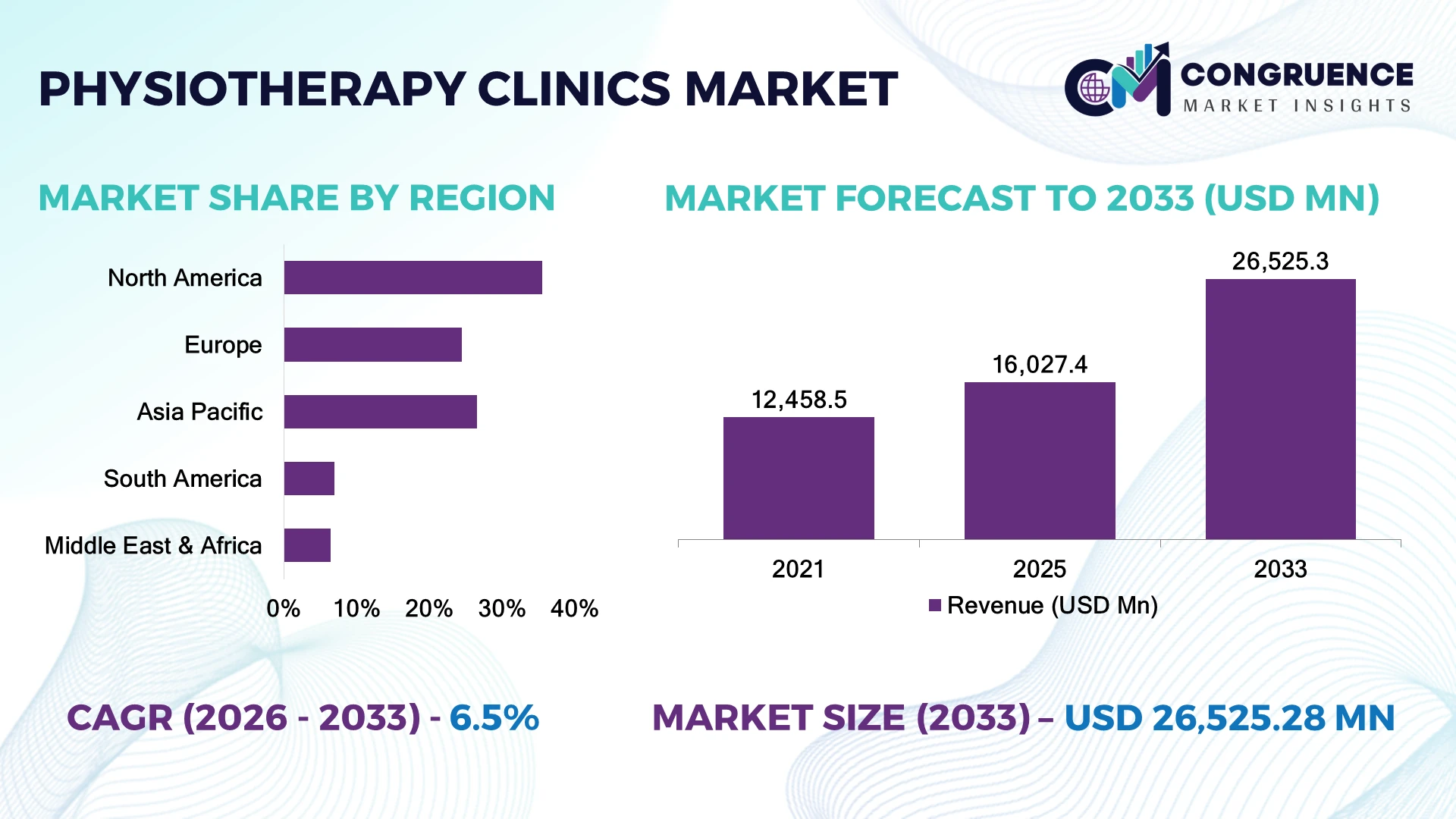
The Global Physiotherapy Clinics Market was valued at USD 16,027.4 Million in 2025 and is anticipated to reach a value of USD 26,525.3 Million by 2033 expanding at a CAGR of 6.5% between 2026 and 2033. Growth is driven by aging populations, rising musculoskeletal disorders, outpatient rehabilitation expansion, sports-injury management, and increasing adoption of digitally enabled physiotherapy services.
The United States accounts for approximately 32% of global physiotherapy clinic demand, supported by a large outpatient rehabilitation network, private insurance coverage, sports medicine infrastructure, and technology-enabled therapy. More than 60% of U.S. clinics increasingly use electronic patient records, remote monitoring, or digital scheduling tools, compared with materially lower adoption across many emerging markets. India has a larger addressable population but substantially lower organized-clinic penetration, creating a significant capacity gap. U.S. providers are also investing in robotic rehabilitation, therapeutic exercise platforms, and AI-assisted assessment as healthcare systems emphasize shorter recovery pathways.
The strategic priority is shifting toward technology-enabled outpatient models that combine clinical capacity, remote monitoring, and measurable rehabilitation outcomes.
Market Size & Growth: USD 16,027.4 million in 2025 is projected to reach USD 26,525.3 million by 2033 at a 6.5% CAGR, driven by outpatient rehabilitation and musculoskeletal-care demand.
Top Growth Drivers: Musculoskeletal disorders contribute approximately 35% of demand momentum, aging populations 25%, and sports rehabilitation 15%.
Short-Term Forecast: By 2028, digital scheduling, automated documentation, and remote monitoring can improve clinic productivity by 10–15%.
Emerging Technologies: AI-assisted movement assessment, robotic rehabilitation, wearable sensors, and virtual physiotherapy are expanding technology-enabled treatment pathways.
Regional Leaders: North America approaches USD 9.0 billion by 2033, Europe approximately USD 6.5 billion, and Asia-Pacific around USD 7.0 billion, with digital rehabilitation adoption accelerating.
Consumer/End-User Trends: Outpatient clinics account for approximately 55–60% of organized physiotherapy utilization, while hybrid physical-digital care models are gaining traction.
Pilot/Case Example: In 2025, technology-enabled rehabilitation programs demonstrated approximately 15–20% reductions in selected administrative and monitoring workloads through automated documentation and remote patient tracking.
Competitive Landscape: Select Medical holds an estimated 8–10% position among large organized U.S. outpatient rehabilitation networks, competing with ATI Physical Therapy, Upstream Rehabilitation, Athletico, and H2 Health.
Regulatory & ESG Impact: Virtual follow-up and remote monitoring can reduce unnecessary clinic visits by approximately 10–20% for appropriate rehabilitation pathways, lowering travel-related resource use.
Investment & Funding: More than USD 2 billion in cumulative investment is supporting outpatient clinic expansion, rehabilitation technology, digital platforms, and provider consolidation.
Innovation & Future Outlook: Next-generation clinics are shifting toward AI-supported assessment, wearable motion tracking, robotic assistance, and outcome-based care models that connect therapy intensity with measurable recovery.
The Physiotherapy Clinics Market is increasingly concentrated around musculoskeletal rehabilitation, orthopedic recovery, neurological therapy, sports medicine, and geriatric care. Outpatient facilities represent approximately 55–60% of organized utilization, while technology-enabled monitoring is becoming a practical differentiator for multi-site operators. In 2026, clinics are prioritizing hybrid care models that combine in-person treatment with remote exercise supervision, digital assessments, and automated patient engagement.
The Physiotherapy Clinics Market is becoming strategically important as healthcare systems shift rehabilitation away from prolonged hospital stays toward lower-cost outpatient and community-based care. Aging populations, musculoskeletal conditions, post-surgical rehabilitation, and chronic pain management are increasing the clinical workload, while providers face pressure to demonstrate measurable functional outcomes. In 2026, clinic operators are increasingly treating digital infrastructure, therapist productivity, and patient retention as interconnected investment priorities.
Technology is reshaping clinic economics. AI-assisted movement assessment and automated documentation can reduce selected administrative workloads by 15–25% compared with manual workflows, allowing therapists to redirect time toward patient interaction. Wearable motion sensors and remote exercise monitoring further extend clinical oversight beyond the clinic. North America leads in organized outpatient networks and technology adoption, while India and Southeast Asia offer substantial expansion opportunities through lower-cost clinics and digitally supported rehabilitation.
Over the next 2–3 years, hybrid physiotherapy models, remote monitoring, robotic rehabilitation, and AI-supported clinical assessment will become increasingly integrated into multi-site operations. A clinic can use wearable data to identify adherence problems between appointments and trigger therapist intervention before progress deteriorates. Operators are therefore investing in centralized scheduling, shared clinical platforms, therapist training, and technology partnerships. Competitive advantage will increasingly depend on combining clinical quality with measurable outcomes, high therapist utilization, patient convenience, and scalable digital infrastructure.
The shift from hospital-based rehabilitation toward outpatient and community physiotherapy is strengthening clinic utilization, with outpatient settings accounting for approximately 55–60% of organized therapy activity. Musculoskeletal conditions represent roughly 35–40% of treatment demand, while orthopedic and sports rehabilitation contribute another 20–25%. In the United States, providers are expanding multi-site networks and integrating digital scheduling, remote monitoring, and outcome tracking to increase therapist productivity by 10–15%. The strategic shift is significant: clinics are no longer competing solely on therapist availability but on throughput, patient retention, and measurable recovery outcomes. Operators are responding through acquisitions, satellite clinics, centralized administrative platforms, and partnerships with orthopedic, primary-care, and sports-medicine providers.
Therapist availability remains a structural constraint, particularly for clinics seeking rapid geographic expansion. Personnel typically represent approximately 55–70% of clinic operating costs, while therapist utilization below 70–75% can materially weaken site-level profitability. In emerging markets such as India, fragmented provider networks and uneven access to specialized rehabilitation professionals further limit organized-clinic penetration. Wage inflation, recruitment costs, and continuing-education requirements increase the cost of maintaining specialist teams. Operators are reducing exposure through centralized scheduling, standardized treatment protocols, assistant-supported workflows, and selective use of remote follow-up. A non-obvious pressure is that adding treatment rooms without solving therapist utilization can dilute returns, making workforce productivity more important than physical capacity alone.
Hybrid physiotherapy creates an opportunity to expand clinical capacity without proportionally increasing physical infrastructure. Remote exercise supervision, wearable motion tracking, and digital patient engagement can shift approximately 10–20% of suitable follow-up interactions away from clinic visits, while automated documentation can reduce administrative workload by 15–25%. India, Southeast Asia, and secondary U.S. cities provide attractive expansion environments where therapist access remains uneven. Advanced clinics are integrating app-based exercise programs with therapist dashboards and connected assessment tools. Companies are responding through technology partnerships, centralized virtual-care teams, and subscription-based rehabilitation programs. The non-obvious opportunity is extending therapist oversight across larger patient populations while reserving in-person capacity for assessment, complex rehabilitation, and high-value interventions.
Multi-site physiotherapy operators face increasing difficulty maintaining consistent clinical quality as networks expand across locations and therapist experience levels. Treatment protocols can vary by approximately 15–25% between clinicians without standardized pathways, while fragmented patient records can increase administrative workload by 10–20%. U.S. operators are increasingly consolidating clinical documentation, outcome measurement, scheduling, and patient engagement into centralized platforms, but integration with legacy practice-management systems remains complex. Clinics must also protect sensitive rehabilitation data as remote monitoring expands. Companies are investing in standardized clinical pathways, therapist training, interoperable electronic records, and outcome dashboards. The strategic challenge is scaling locations without allowing variations in assessment, treatment intensity, or patient adherence to undermine brand consistency and reimbursement performance.
Hybrid Care Becomes Operational: Clinics are moving selected follow-up sessions into digitally supported pathways, with approximately 10–20% of suitable interactions increasingly managed through remote monitoring or virtual consultations. Multi-site operators are integrating therapist dashboards with exercise applications, allowing clinicians to monitor adherence between appointments while reserving physical capacity for complex assessments and hands-on treatment.
Centralized Operations Gain Traction: Larger clinic networks are consolidating scheduling, billing, documentation, and patient engagement functions, reducing selected administrative workloads by 15–25%. This restructuring is particularly relevant in U.S. multi-site networks, where centralized back-office infrastructure improves therapist utilization and allows individual clinics to focus on treatment delivery rather than administrative processing.
Wearables Enter Routine Therapy: Motion sensors and connected rehabilitation devices are moving beyond pilot programs into orthopedic, sports, and neurological therapy. Selected deployments can capture 20–30% more movement-performance data than periodic manual assessments, helping therapists identify adherence or progression issues earlier. Providers are partnering with technology companies to integrate wearable data into existing clinical workflows.
Outcome Tracking Shapes Procurement: Clinics are increasingly evaluating technologies based on measurable functional outcomes rather than equipment specifications alone. Digital outcome collection can reduce manual assessment documentation by approximately 20%, while standardized dashboards improve visibility across multi-location networks. Insurers, healthcare partners, and clinic groups are strengthening demand for platforms that connect treatment intensity with documented patient progress.
Outpatient physiotherapy clinics represent the leading type, accounting for approximately 55–60% of the global market, supported by lower facility costs, strong referral networks, shorter treatment pathways, and growing preference for rehabilitation outside hospitals. Hospital-based physiotherapy contributes around 20–25%, while specialty and sports rehabilitation centers account for approximately 15–20%. Outpatient models retain the strongest scalability because operators can standardize treatment protocols, centralize scheduling, and operate multiple locations with shared administrative infrastructure.
Hybrid physical-digital clinics represent the fastest-shifting model, particularly among established outpatient operators. Remote monitoring, digital exercise programs, and wearable assessment can reduce selected follow-up visits by 10–20% and administrative workloads by 15–25%. Hospitals continue prioritizing complex neurological, post-surgical, and acute rehabilitation, while specialty clinics focus on sports, orthopedic, and performance-oriented care. Companies are expanding through satellite locations, acquisitions, technology partnerships, and centralized clinical platforms. Investment is increasingly directed toward scalable outpatient networks rather than high-cost standalone facilities, making therapist utilization, patient throughput, and measurable outcomes critical determinants of site-level economics.
The American Physical Therapy Association reported in 2025 that outpatient physical therapy remained the dominant practice setting for U.S. physical therapists, while digital and technology-enabled care continued expanding across rehabilitation workflows.
Musculoskeletal rehabilitation represents the leading application, accounting for approximately 35–40% of global physiotherapy clinic demand, supported by back pain, joint disorders, mobility limitations, and workplace injuries. Orthopedic rehabilitation contributes approximately 20–25%, while sports rehabilitation represents around 15–20%. Neurological, geriatric, pediatric, and cardiopulmonary rehabilitation collectively account for the remaining demand. Musculoskeletal therapy remains the mature volume segment because treatment protocols are standardized and widely delivered through outpatient clinics.
Sports and orthopedic rehabilitation represent the fastest-shifting applications as wearable motion tracking, gait analysis, robotic assistance, and digital exercise monitoring become more accessible. Technology-enabled assessment can increase measurable movement-data capture by approximately 20–30% compared with periodic manual assessment. U.S. clinic networks are expanding sports and orthopedic partnerships, while Indian providers increasingly combine physiotherapy with orthopedic and rehabilitation centers. Companies are responding with specialized therapist teams, connected assessment systems, and integrated referral partnerships. The commercial opportunity is shifting toward higher-value rehabilitation pathways where measurable functional improvement supports patient retention, clinician productivity, and referral relationships.
The World Health Organization's 2025 rehabilitation agenda continued emphasizing musculoskeletal conditions as a major source of rehabilitation need, reinforcing the importance of outpatient physiotherapy capacity and integrated rehabilitation pathways.
Independent and outpatient physiotherapy clinics account for approximately 50–55% of global end-user demand, reflecting their extensive geographic presence, direct patient access, and flexibility in treating musculoskeletal and orthopedic conditions. Hospital rehabilitation departments contribute approximately 25–30%, while sports organizations, corporate wellness providers, and specialty rehabilitation centers account for roughly 15–20%. Independent clinics remain dominant in fragmented markets such as India, whereas organized multi-site networks hold greater influence in the United States and Western Europe.
Hospital systems remain important for complex post-surgical, neurological, and acute rehabilitation, but multi-site outpatient networks represent the fastest-growing organized buyer group. Centralized scheduling, standardized clinical pathways, and shared digital platforms can improve therapist utilization by approximately 10–15%. Companies are targeting organized networks through enterprise software, technology partnerships, equipment bundles, and centralized service contracts. Independent operators increasingly form referral partnerships with orthopedic practices, sports organizations, and insurers to compete with larger chains. Future demand is therefore shifting toward scalable provider ecosystems that combine local clinical access with centralized technology and administrative capabilities.
U.S. Bureau of Labor Statistics projections published in 2025 continued to show strong employment demand for physical therapists through 2034, reinforcing workforce availability as a central capacity consideration for expanding clinic networks.
North America accounted for the largest market share at 35.5% in 2025 however, Asia-Pacific is expected to register the fastest growth, expanding at a CAGR of 7.0% between 2026 and 2033.

Outpatient networks and workforce optimization reshape clinic expansion
North America represents approximately 35.5% of the global physiotherapy clinics market, supported by extensive outpatient infrastructure, direct-access models, established payer systems, and high adoption of digital practice-management platforms. The United States accounts for the overwhelming majority of regional demand, with organized outpatient networks increasingly expanding through multi-site models and acquisitions. Workforce availability remains a key operating constraint: APTA's 2024 outpatient benchmark covered 5,113 clinics and 28,725 employees, while the reported vacancy rate reached 9.5%.
Operators are therefore prioritizing therapist productivity, centralized scheduling, standardized protocols, and technology-enabled follow-up rather than relying solely on adding physical locations.
United States Market Outlook: The U.S. combines the region's deepest outpatient infrastructure with broad direct patient access. APTA reported in 2025 that all 50 states, Washington, D.C., and the U.S. Virgin Islands provide either provisional or unrestricted direct access to physical therapists, supporting decentralized clinic utilization.
Aging populations accelerate structured rehabilitation demand
Europe accounts for approximately 24–25% of the global physiotherapy clinics market, with Germany, the United Kingdom, France, Italy, and Spain representing major organized-care markets. Public healthcare systems, aging populations, post-operative rehabilitation, and chronic musculoskeletal conditions sustain demand, while outpatient and community-based delivery is increasingly integrated with hospital discharge pathways. Digital documentation, remote consultations, movement assessment, and centralized scheduling are improving clinic utilization. Germany's strong rehabilitation infrastructure and established statutory health-insurance system provide a substantial institutional base, while Western European providers increasingly invest in multidisciplinary rehabilitation facilities and outcome measurement.
Germany Market Outlook: Germany represents a major European rehabilitation hub, supported by extensive statutory health insurance coverage and established inpatient and outpatient rehabilitation pathways. Its healthcare infrastructure supports multidisciplinary physiotherapy delivery across hospitals, rehabilitation centers, and private practices, while demographic aging is increasing demand for mobility restoration and chronic-condition management.
Urban rehabilitation capacity expands alongside private healthcare investment
Asia-Pacific accounts for approximately 26–27% of global physiotherapy clinic demand and represents the fastest-expanding regional market as rehabilitation services broaden beyond major hospitals. China, Japan, South Korea, Australia, and India provide the largest demand pools, while Southeast Asian markets are adding private outpatient capacity. Urbanization, orthopedic procedures, sports participation, aging populations, and rising private healthcare spending are encouraging standalone and hospital-linked physiotherapy centers. India remains highly fragmented, creating opportunities for branded clinic networks, franchise models, tele-rehabilitation, and standardized clinical protocols. Technology adoption is also progressing from basic digital scheduling toward wearable-supported assessment and remote exercise monitoring.
China Market Outlook: China benefits from its large hospital network and expanding rehabilitation capacity, with physiotherapy increasingly incorporated into post-operative, neurological, orthopedic, and chronic-disease pathways. Providers are moving toward dedicated rehabilitation departments and specialized facilities, while digital assessment and connected rehabilitation equipment support higher patient throughput and standardized treatment delivery.
Private outpatient capacity grows amid uneven rehabilitation access
South America represents approximately 7–8% of the global physiotherapy clinics market, with Brazil accounting for the largest share because of its population scale, extensive healthcare infrastructure, and established physiotherapy profession. Demand is concentrated in orthopedic rehabilitation, chronic musculoskeletal conditions, post-surgical recovery, sports medicine, and elderly care. Private clinics and hospital-linked rehabilitation departments remain important delivery channels, while public systems face capacity and geographic-access constraints. Brazil's professional rehabilitation infrastructure provides opportunities for clinic consolidation, specialized centers, and technology-enabled home-based therapy. Government-supported vocational rehabilitation programs also reinforce institutional demand for rehabilitation services and assistive mobility solutions.
Brazil Market Outlook: Brazil dominates regional demand through its population scale and comparatively developed rehabilitation ecosystem. The country's public and private healthcare systems support physiotherapy across hospitals, outpatient clinics, sports facilities, and occupational rehabilitation. Government rehabilitation programs also address return-to-work needs, creating additional institutional demand beyond conventional outpatient therapy.
Healthcare modernization drives specialized rehabilitation investment
Middle East & Africa accounts for approximately 7% of the global physiotherapy clinics market, with demand concentrated in Saudi Arabia, the UAE, South Africa, and other major urban healthcare centers. Gulf countries are expanding specialized rehabilitation infrastructure alongside broader healthcare transformation programs, while private providers are introducing digitally enabled therapy, multidisciplinary rehabilitation, and premium outpatient services. Saudi Arabia is particularly active in rehabilitation infrastructure, with 2025 health projects including specialized rehabilitation centers and expanded outpatient facilities. The region's principal constraint remains uneven access outside major metropolitan areas, encouraging centralized specialty centers alongside satellite and digitally supported models.
Saudi Arabia Market Outlook: Saudi Arabia represents the region's strongest institutional investment opportunity, supported by the Health Sector Transformation Program under Vision 2030. In 2025, the Ministry of Health reported new healthcare projects including two specialized rehabilitation centers, while broader healthcare investments announced at Global Health Exhibition 2025 exceeded USD 33 billion.
Select Medical, Upstream Rehabilitation, ATI Physical Therapy, Athletico, and H2 Health compete as U.S. outpatient network operators, while Sword Health challenges them through digitally delivered AI rehabilitation. The top five clinic operators hold an estimated 3–5% combined global share, reflecting a fragmented market. Competition centers on geographic access, therapist capacity, payer relationships, outcomes, and technology: networks command 10–20% operating-efficiency advantages from centralized scheduling and procurement, while digital platforms target 15–25% lower administrative workload. Select Medical and H2 Health are expanding through acquisitions and health-system partnerships; ATI is strengthening workforce pipelines; Athletico combines clinic expansion with physician partnerships; Sword differentiates through AI-enabled remote care. The competitive shift is toward consolidation plus hybrid delivery, increasing pressure on independent clinics. Entry barriers include therapist recruitment, payer contracting, referral networks, compliance, and reputation. Winning requires dense referral ecosystems, outcomes, efficient operations, and technology that extends clinician capacity without sacrificing quality.
Select Medical Corporation
Upstream Rehabilitation
ATI Physical Therapy
Athletico Physical Therapy
H2 Health
U.S. Physical Therapy, Inc.
Confluent Health
Ivy Rehab Network
PT Solutions Physical Therapy
CORA Physical Therapy
FOX Rehabilitation
FYZICAL Therapy & Balance Centers
Sword Health
AI movement analysis, computer vision, and wearable motion sensors are becoming tools for assessment, with automated measurement improving documentation efficiency by roughly 5–8% and reducing assessment work. Adoption is strongest in outpatient networks, where connected platforms integrate exercise tracking, scheduling, and clinician dashboards. Robotic rehabilitation and sensor-assisted gait systems remain concentrated in neurological and post-surgical centers, improving therapy-session consistency by 3–6%.
Generative AI and ambient documentation are emerging workflow technologies. Automated note generation can reduce documentation time by approximately 10–15%, while AI-supported triage and patient messaging can lower administrative workload by 8–12%. Compared with manual video assessment, computer-vision systems can capture movement metrics 20–30% faster, improving therapist throughput without requiring staffing increases. Integration with EHR and remote-monitoring platforms is becoming a competitive differentiator.
From 2026–2028, providers with interoperable ecosystems will gain visibility into adherence, outcomes, and therapist utilization. Large networks benefit first because they can spread technology costs across sites and standardize protocols. Independent clinics face pressure to adopt scheduling, remote exercise monitoring, and AI documentation through partnerships rather than building systems. The competitive priority is shifting from devices toward integrated platforms connecting assessment, treatment, documentation, and follow-up while keeping clinical decision-making with therapists.
May 2026 Select Medical and Carilion Clinic formed a joint venture to build a 50-bed inpatient rehabilitation hospital in Virginia. The project expands rehabilitation capacity, strengthens health-system integration, and supports broader referral capture through multidisciplinary therapy delivery. Source: selectmedical.com
April 2026 H2 Health acquired Advanced Physical Therapy, adding six Arkansas locations and entering a new state. The transaction expands outpatient coverage, increases referral density, and creates a platform for clinic expansion through H2’s acquisition-led growth model. Source: h2health.com
February 2025 ATI Physical Therapy and Tufts University School of Medicine launched a workforce collaboration, offering scholarships to up to 45 ATI employees. The program strengthens therapist supply and expands clinical-rotation access across ATI’s 850-plus outpatient clinics. Source: atipt.com
July 2025 Sword Health launched Sword Intelligence using AI Care Manager agents for enrollment and triage. Built from workflows supporting more than 500,000 members, the platform shifts competition toward automation and digital rehabilitation operations at scale. Source: swordhealth.com
The Physiotherapy Clinics Market Report evaluates organized and independent rehabilitation providers across outpatient clinics, hospital-based centers, specialty rehabilitation facilities, and hybrid physical-digital models. Coverage spans musculoskeletal, orthopedic, sports, neurological, geriatric, pediatric, and cardiopulmonary applications, alongside independent clinics, hospitals, rehabilitation networks, sports organizations, and corporate wellness providers. Regional analysis covers North America, Europe, Asia-Pacific, South America, and Middle East & Africa, with country-level assessment of major demand centers.
The report examines AI movement assessment, wearable monitoring, robotic rehabilitation, tele-rehabilitation, digital documentation, scheduling platforms, and connected outcome-management systems. It evaluates segment concentration, clinic-network expansion, therapist utilization, referral patterns, technology adoption, and partnership activity, including organized operators and emerging digital providers. Strategic analysis supports investment planning, geographic expansion, technology selection, partnership development, competitive positioning, and capacity planning, while identifying operational shifts shaping market direction from 2026 through 2033.
| Report Attribute/Metric | Report Details |
|---|---|
|
Market Revenue in 2025 |
USD 16,027.4 Million |
|
Market Revenue in 2033 |
USD 26,525.3 Million |
|
CAGR (2026 - 2033) |
6.5% |
|
Base Year |
2025 |
|
Forecast Period |
2026 - 2033 |
|
Historic Period |
2021 - 2025 |
|
Segments Covered |
By Type
By Application
By End-User
|
|
Key Report Deliverable |
Revenue Forecast, Growth Trends, Market Dynamics, Segmental Overview, Regional and Country-wise Analysis, Competition Landscape |
|
Region Covered |
North America, Europe, Asia-Pacific, South America, Middle East, Africa |
|
Key Players Analyzed |
Select Medical Corporation, Upstream Rehabilitation, ATI Physical Therapy, Athletico Physical Therapy, H2 Health, U.S. Physical Therapy, Inc., Confluent Health, Ivy Rehab Network, PT Solutions Physical Therapy, CORA Physical Therapy, FOX Rehabilitation, FYZICAL Therapy & Balance Centers, Sword Health |
|
Customization & Pricing |
Available on Request (10% Customization is Free) |




