
Reports
The Global Pharmaceutical Lab Equipment Market was valued at USD 1,231.0 Million in 2025 and is anticipated to reach a value of USD 1,737.2 Million by 2033 expanding at a CAGR of 4.4% between 2026 and 2033. Growth is driven by accelerated adoption of automated chromatography, high-throughput screening, laboratory information management, and digitally integrated quality-control systems for complex biologics and precision medicines.
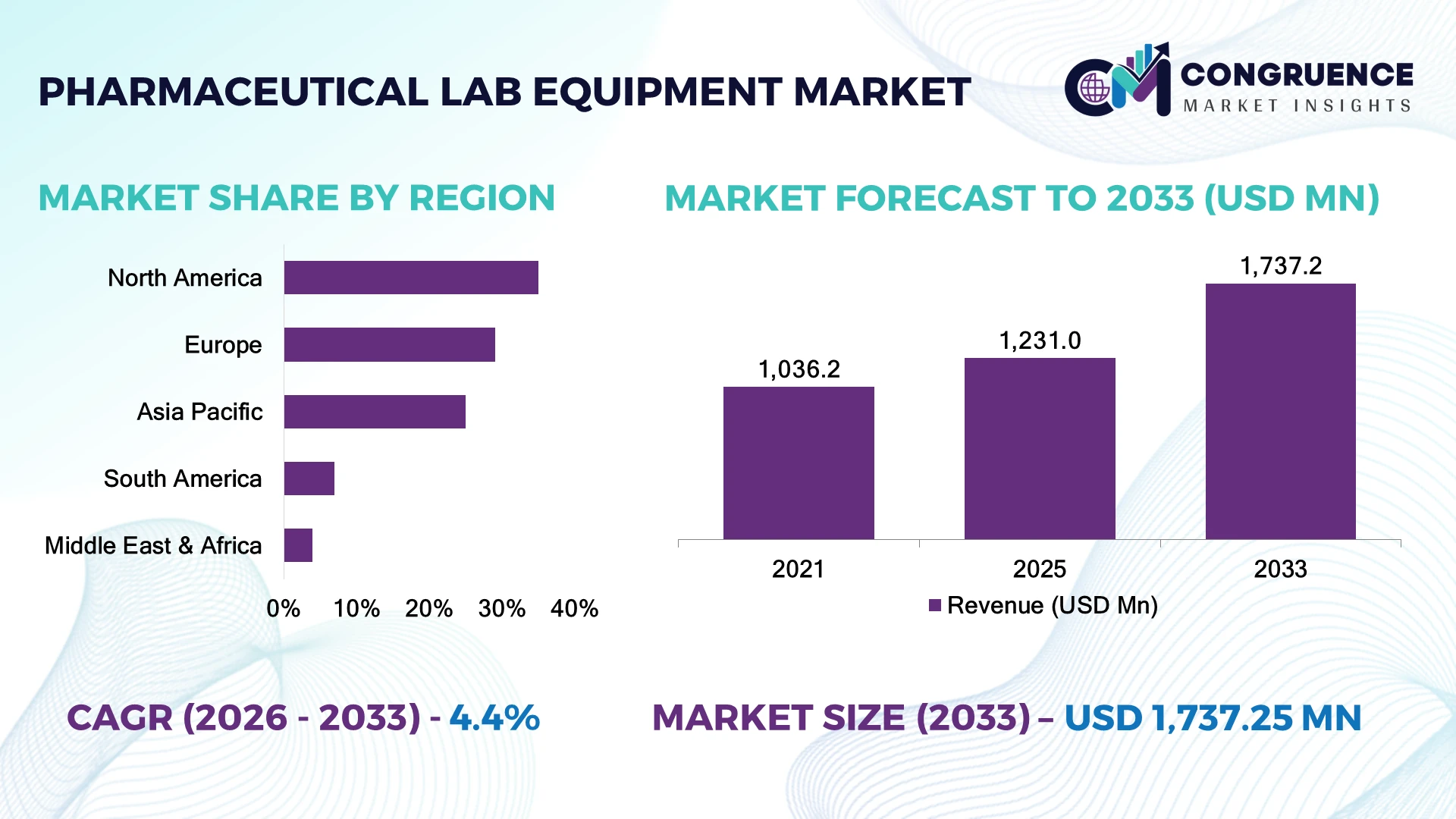
The U.S. dominates pharmaceutical laboratory equipment adoption, accounting for approximately 39% of global laboratory technology purchases and supporting more than 12,000 pharmaceutical laboratories. North America represents about 35% of the global market, while China and India are expanding laboratory and biopharmaceutical manufacturing capacity through localization investments. U.S. adoption remains ahead of India, where automation is rapidly penetrating new facilities.
Strategic implication, suppliers prioritizing automated, compliant, interoperable systems and localized service networks will secure the strongest competitive positions.
Market Size & Growth: The market reaches USD 1,737.2 million by 2033 from USD 1,231.0 million in 2025, expanding at 4.4% CAGR as automation and advanced analytical testing accelerate laboratory modernization.
Top Growth Drivers: Automation adoption at 31%; high-throughput workflows above 75%; biologics-related laboratory investment increasing by approximately 18%.
Short-Term Forecast: By 2028, automated workflows are expected to improve laboratory processing efficiency by 20–25%, while manual sample-handling requirements decline by roughly 15%.
Emerging Technologies: AI-assisted analytics, robotic sample preparation, and cloud-connected laboratory systems are reshaping high-throughput testing and real-time quality monitoring.
Regional Leaders: North America approaches USD 608 million with 35% share and high digital adoption; Europe exceeds USD 400 million through compliance-led modernization; Asia-Pacific approaches USD 390 million as China and India expand biopharma capacity.
Consumer/End-User Trends: More than 31% of newly installed equipment incorporates automation or digital controls, reflecting stronger adoption among pharmaceutical manufacturers and contract research organizations.
Pilot/Case Example: In 2024, automated laboratory workflows delivered approximately 20% faster sample processing and reduced repetitive manual intervention by nearly 15% in high-throughput environments.
Competitive Landscape: GE Healthcare, Agilent Technologies, Waters, Danaher, and Thermo Fisher Scientific collectively command approximately 50% of the market, with competition centered on automation, analytical precision, service coverage, and integrated platforms.
Regulatory & ESG Impact: Data-integrity and laboratory-compliance requirements are accelerating digital equipment adoption, while energy-efficient systems can reduce laboratory power consumption by approximately 10–15%.
Investment & Funding: More than 19,000 biopharmaceutical companies globally invested in laboratory-system upgrades in 2023, strengthening partnerships, capacity expansion, and automation-led capital allocation.
Innovation & Future Outlook: AI-enabled analytics, modular automation, connected instruments, and predictive maintenance will shift purchasing toward integrated laboratory ecosystems rather than standalone equipment.
Pharmaceutical lab equipment demand is concentrating around chromatography, spectroscopy, automated sample preparation, bioreactors, and digital quality-control platforms, with more than 31% of new equipment incorporating automation or digital controls. U.S. laboratories lead adoption, while China and India are expanding domestic capacity as pharmaceutical supply chains diversify following U.S.–China trade tensions. This creates a strategic transition toward connected, compliant, locally supported laboratory infrastructure.
Pharmaceutical laboratory equipment is becoming a strategic asset because drug-development timelines, analytical precision, and regulatory data integrity increasingly determine competitive performance. Pharmaceutical companies are replacing fragmented laboratory workflows with automated analytical platforms that connect instruments, sample management, and data systems. More than 31% of newly deployed equipment now incorporates automation or digital controls, accelerating the shift from standalone instruments toward integrated laboratory ecosystems.
Technology economics are strengthening this transition. Automated sample preparation can reduce repetitive manual handling by roughly 15–25% while improving processing consistency compared with conventional workflows. North America retains the largest installed base, with approximately 35% market share, whereas China and India are prioritizing capacity expansion, localization, and biopharmaceutical manufacturing infrastructure.
Over the next 2–3 years, automated workflows are positioned to penetrate a larger share of newly commissioned laboratories, particularly among contract research organizations and biologics manufacturers. A practical deployment model combines robotic sample preparation with chromatography and laboratory information management systems, enabling faster batch release and stronger traceability. Companies are therefore increasing investment in integrated platforms, service partnerships, and regional technical support. Competitive advantage will increasingly depend on equipment interoperability, validated digital workflows, and lifecycle service capability.
Automation is becoming the primary structural driver as more than 31% of newly installed pharmaceutical laboratory equipment incorporates digital controls or automated functions. High-throughput screening and automated sample preparation are already embedded in more than 75% of new drug-development workflows, increasing demand for robotics, chromatography, spectroscopy, and integrated data systems. The expansion of biologics manufacturing in the U.S., China, and India further increases requirements for repeatable analytical testing. U.S.–China supply-chain restructuring is also encouraging pharmaceutical manufacturers to diversify laboratory and production infrastructure. Equipment manufacturers are responding through connected platforms, automated sample handling, and software partnerships. The strategic advantage is clear: automation converts laboratory capacity from labor-intensive processing into scalable, data-driven operations while improving reproducibility and reducing manual intervention.
High acquisition costs remain a significant barrier, particularly for laboratories operating outside established pharmaceutical hubs. Advanced chromatography, mass spectrometry, and automated systems can represent a substantial portion of laboratory capital budgets, while installation, validation, and maintenance can add 10–20% to initial deployment costs. Imported components also expose buyers in countries such as India and Brazil to currency volatility, shipping delays, and replacement-part dependency. Geopolitical trade restrictions and semiconductor supply disruptions have reinforced procurement uncertainty for digitally enabled equipment. Companies are mitigating exposure through multi-year procurement contracts, regional service centers, supplier diversification, and localized component sourcing. The operational insight is that equipment price alone increasingly understates total ownership cost; uptime, validation support, software compatibility, and spare-parts availability are becoming decisive purchasing criteria.
Connected laboratory ecosystems create an important opportunity as pharmaceutical manufacturers seek measurable productivity gains. More than 31% of new equipment already features automation or digital control, leaving substantial room for broader adoption of AI-assisted analytics, predictive maintenance, and cloud-connected instruments. India and China present particularly strong opportunities as domestic pharmaceutical and contract research capacity expands. Advanced platforms combining robotic sample preparation with real-time analytical monitoring can reduce manual intervention by approximately 15–25% while improving workflow consistency. The growing use of biologics also increases demand for specialized bioreactors, analytical testing systems, and cleanroom-compatible equipment. Manufacturers are positioning through R&D partnerships, software integration, and localized service networks. A non-obvious opportunity lies in retrofitting existing laboratories with modular automation rather than replacing complete equipment fleets.
Integration complexity is becoming a larger execution challenge as laboratories deploy increasingly connected equipment. Approximately 20–25% of laboratory modernization effort can involve workflow integration, validation, software configuration, and staff training rather than physical equipment installation. Cybersecurity requirements also increase as instruments connect to laboratory information management systems and cloud platforms. In emerging pharmaceutical hubs, skilled personnel capable of operating advanced analytical and automated systems remain unevenly distributed, creating productivity gaps between newly commissioned facilities and mature laboratories. Regulatory expectations for electronic records and data integrity add further implementation pressure. Companies must address these constraints through standardized interfaces, cybersecurity-by-design, operator training, remote diagnostics, and partnerships with specialized integrators. Long-term competitiveness will depend less on equipment availability and more on the ability to deploy, validate, and continuously operate integrated laboratory infrastructure consistently.
Connected Laboratory Workflows: Pharmaceutical laboratories are moving from isolated instruments toward connected systems, with 34% of R&D organizations already reaching a connected maturity stage and 59% planning further modernization over the next 2–3 years. LIMS, electronic laboratory notebooks, cloud data management, and instrument connectivity are improving traceability and reducing reconciliation work. Companies are prioritizing interoperable platforms rather than replacing every instrument, creating a retrofit-led modernization model.
AI-Enabled Analytical Operations: AI and machine learning are shifting from experimental pilots toward practical laboratory analytics, with 38% of organizations planning to embed AI into laboratory operations and automate repetitive processes. Predictive analytics is increasingly applied to instrument performance, anomaly detection, and experimental prioritization. This reduces manual review and accelerates decision cycles, while pharmaceutical companies are partnering with software specialists to integrate AI into validated workflows rather than deploying standalone tools.
Flexible Bioprocess Infrastructure: Single-use systems, modular bioreactors, and automated liquid handling are gaining traction as manufacturers seek faster facility configuration and reduced cleaning requirements. Bioprocessing equipment is expanding at roughly 7–10% annually, compared with 4–6% for mature analytical instrumentation. Capacity expansion in China and India is reinforcing this shift as companies diversify supply chains and build localized biologics capabilities.
Energy-Efficient Lab Operations: Sustainability requirements are influencing equipment procurement, particularly for refrigeration, freezers, incubators, and high-energy analytical platforms. Energy-efficient systems can reduce equipment electricity consumption by approximately 10–15%, while remote monitoring cuts unnecessary operating cycles. Regulatory scrutiny of laboratory data and environmental performance is encouraging pharmaceutical companies to combine ESG targets with operational modernization, making lifecycle efficiency a stronger purchasing criterion.
Analytical Equipment remains the leading type, accounting for approximately 38.5% of the pharmaceutical laboratory equipment market in 2025. Its dominance reflects mandatory requirements for chromatography, mass spectrometry, spectroscopy, elemental analysis, purity testing, and compound characterization across pharmaceutical workflows. General Equipment follows as a mature category supporting routine preparation and laboratory operations, while Specialty Equipment captures demand from cell biology, microscopy, flow cytometry, and advanced bioanalytical applications. Support Equipment remains strategically essential for refrigeration, incubation, sample preservation, and controlled laboratory environments.
Specialty Equipment is emerging as the fastest-growing type, supported by biologics, cell-based research, and increasingly complex analytical workflows, with adoption expanding around 6–8% annually in advanced laboratories. Analytical platforms are increasingly integrated with automation and laboratory software, improving throughput by approximately 20% in high-volume environments. Companies are therefore prioritizing modular analytical systems, automated sample handling, and software-enabled instruments.
Drug Discovery represents the leading application, accounting for approximately 32.1% of pharmaceutical laboratory equipment demand. High-throughput screening, compound-library management, target identification, and advanced analytical characterization require sophisticated equipment and integrated workflows, concentrating investment in this application. Drug Development follows closely as pharmaceutical companies expand formulation, preclinical, and process-development capabilities. Quality Control remains a mature, recurring-use application because batch release, stability testing, and impurity profiling require validated laboratory systems.
Clinical Testing is the fastest-growing application, supported by increasing analytical complexity and the expansion of precision-oriented pharmaceutical development. Automated workflows can reduce repetitive sample-handling requirements by approximately 15–25%, while integrated analytics improve processing consistency and shorten review cycles. Companies are increasingly deploying shared laboratory platforms across discovery and development teams to improve equipment utilization.
Pharmaceutical Companies represent the dominant end-user group, accounting for approximately 38% of demand because of their extensive laboratory infrastructure, continuous quality-control requirements, drug-development pipelines, and compliance obligations. These organizations typically operate multiple laboratories spanning discovery, formulation, analytical development, manufacturing support, and batch release. Research Laboratories form another important buyer group, particularly for advanced analytical and specialty systems, while Academic Institutions maintain demand for foundational equipment and specialized research platforms.
Contract Research Organizations are the fastest-growing end-user group, with adoption expanding approximately 7–9% annually as pharmaceutical companies increasingly outsource analytical testing, preclinical research, and specialized development activities. CROs prioritize equipment utilization, rapid turnaround, and multi-client workflow flexibility, making automation particularly valuable. Academic Institutions remain more price-sensitive, while pharmaceutical companies increasingly emphasize validated interoperability and lifecycle service. Companies are responding with configurable systems, leasing and service models, application-specific packages, and partnerships with CRO networks.
North America accounted for the largest market share at 35% in 2025 however, Asia-Pacific is expected to register the fastest growth, expanding at a CAGR of 6.2% between 2026 and 2033.
North America holds approximately 35% of the global pharmaceutical lab equipment market, supported by dense pharmaceutical manufacturing, advanced research infrastructure, and extensive adoption of automated analytical platforms. The U.S. accounts for roughly 80% of regional demand, concentrating procurement across biopharmaceutical hubs in California, Massachusetts, New Jersey, and North Carolina. More than 40% of large U.S. pharmaceutical laboratories have integrated automated sample preparation or digital laboratory management into core workflows. Investment is increasingly shifting toward connected chromatography, mass spectrometry, laboratory robotics, and data-integrity systems. Partnerships between equipment manufacturers, software providers, and pharmaceutical enterprises are accelerating deployment, while reshoring of selected pharmaceutical supply chains is reinforcing domestic laboratory capacity. The regional opportunity increasingly centers on upgrading installed equipment rather than simply adding laboratory capacity.
U.S. Market Outlook: The U.S. remains the strategic center of North American pharmaceutical laboratory equipment demand because of its extensive biopharmaceutical manufacturing base, advanced clinical research infrastructure, and sophisticated quality-control requirements. Major pharmaceutical clusters maintain high utilization of chromatography, spectroscopy, automated liquid handling, and laboratory informatics. Approximately 40% of large laboratories have adopted connected or automated workflows, creating sustained demand for interoperable systems, predictive maintenance, and validated digital platforms.
Europe represents approximately 29% of global pharmaceutical laboratory equipment demand, supported by established pharmaceutical manufacturing in Germany, Switzerland, France, Italy, and the United Kingdom. Regulatory emphasis on electronic records, data integrity, product quality, and environmental performance is accelerating replacement of aging laboratory infrastructure. Approximately 30% of European pharmaceutical laboratories are prioritizing digitalization or automation projects, with demand concentrating on analytical instruments, laboratory information management, and energy-efficient equipment. Germany and Switzerland retain strong positions in precision pharmaceutical manufacturing and research, while Ireland continues to attract advanced manufacturing investment. Sustainability is becoming a procurement criterion alongside analytical performance, particularly for refrigeration, sterilization, and environmental-control systems. Equipment suppliers are responding with lower-energy instruments, remote diagnostics, modular platforms, and compliance-oriented software integration. Europe therefore presents a replacement-driven opportunity centered on modernization, validation, and operational efficiency.
Germany Market Outlook: Germany is Europe's leading industrial laboratory equipment hub, supported by a large pharmaceutical and chemical manufacturing ecosystem, specialized analytical laboratories, and strong engineering capabilities. Pharmaceutical manufacturers increasingly deploy automated quality-control systems and digitally connected instruments to strengthen batch-release workflows. More than 30% of laboratory modernization projects increasingly incorporate digital monitoring or automation, supporting demand for precision analytical equipment and integrated laboratory platforms.
Asia-Pacific accounts for approximately 25% of the global pharmaceutical laboratory equipment market and is the fastest-expanding deployment base, supported by manufacturing expansion in China, India, Japan, South Korea, and Singapore. China and India together represent more than 55% of regional demand, reflecting large generic-drug, vaccine, biosimilar, and contract-development ecosystems. Pharmaceutical manufacturers are increasing local laboratory capacity alongside new production facilities, reducing dependence on centralized testing infrastructure. Automated analytical systems, laboratory informatics, and high-throughput screening are gaining traction as facilities move toward internationally aligned quality standards. Investment in biopharmaceutical and CDMO infrastructure is also increasing equipment requirements across analytical development and quality control. Suppliers are responding through localized manufacturing, application centers, distributor partnerships, and regional technical-service networks. The strategic opportunity is strongest where laboratory localization accompanies pharmaceutical manufacturing expansion.
China Market Outlook: China is the region's largest pharmaceutical laboratory equipment market, supported by extensive domestic drug manufacturing, expanding biologics capabilities, and continued investment in laboratory infrastructure. Pharmaceutical companies are increasingly upgrading analytical laboratories to support complex formulations and biosimilar development. More than half of China's major pharmaceutical manufacturing clusters are concentrated in coastal industrial provinces, creating dense demand for analytical instruments, automated testing systems, and laboratory software.
South America contributes approximately 7% of global pharmaceutical laboratory equipment demand, with Brazil accounting for nearly 60% of regional consumption. Demand is concentrated around pharmaceutical manufacturing, generic medicines, vaccines, clinical laboratories, and quality-control facilities. São Paulo and Rio de Janeiro remain important laboratory and pharmaceutical manufacturing centers, while Argentina maintains specialized capabilities in biotechnology and pharmaceutical research. Approximately 25% of larger pharmaceutical laboratories are increasing automation or digital equipment deployment, although imported instrumentation remains important for advanced analytical applications. Currency volatility and lengthy equipment procurement cycles continue to influence capital allocation, encouraging manufacturers and distributors to maintain broader inventory and service coverage. Companies are increasingly using regional partnerships and local technical support to shorten maintenance cycles and improve equipment utilization. Brazil's combination of manufacturing scale and laboratory modernization makes it the principal entry point for international suppliers.
Brazil Market Outlook: Brazil dominates South American pharmaceutical laboratory equipment demand because of its extensive pharmaceutical manufacturing base, regulatory testing requirements, and concentration of research infrastructure. São Paulo represents the country's strongest pharmaceutical and laboratory cluster, supporting demand for analytical instrumentation, quality-control systems, and automated sample processing. Local manufacturers and international suppliers increasingly emphasize technical service partnerships to improve equipment uptime and shorten replacement cycles.
The Middle East & Africa region accounts for approximately 4% of global pharmaceutical laboratory equipment demand, with Saudi Arabia, the United Arab Emirates, South Africa, and Egypt representing the principal deployment markets. Pharmaceutical localization initiatives and healthcare infrastructure modernization are strengthening demand for analytical instruments, quality-control equipment, and laboratory automation. Saudi Arabia is expanding domestic pharmaceutical manufacturing under its industrial diversification agenda, while the UAE is developing advanced healthcare and life-sciences infrastructure. Approximately 20% of newly commissioned pharmaceutical and healthcare laboratories in leading markets incorporate automated or digitally monitored equipment. International suppliers are responding through distributor agreements, regional service centers, training programs, and localized technical support. The principal operational constraint remains uneven laboratory infrastructure outside major urban hubs, making service availability and equipment reliability critical purchasing factors. Suppliers offering integrated deployment and maintenance packages are gaining an advantage over equipment-only vendors.
Saudi Arabia Market Outlook: Saudi Arabia is the region's most strategically significant pharmaceutical laboratory equipment market because pharmaceutical localization is increasing demand for domestic quality-control, analytical-development, and manufacturing-support infrastructure. Riyadh and Jeddah are emerging as major pharmaceutical and healthcare investment centers. New manufacturing projects increasingly require internationally compliant analytical laboratories, creating demand for chromatography, spectroscopy, laboratory automation, and digital data-management systems.
Thermo Fisher Scientific, Danaher, Agilent Technologies, Waters, and Shimadzu compete as global technology leaders, while regional distributors and specialist OEMs compete on price, customization, and service responsiveness. The top five players collectively account for approximately 50% of market value, creating a moderately concentrated structure. Competition increasingly favors technology, workflow integration, supply reliability, and lifecycle support: automated platforms can raise throughput 15–25%, reduce manual intervention 20%, while localized service can shorten response times 20–30%. Players are expanding application centers, forming software and AI partnerships, launching connected instruments, and integrating consumables, instruments, and informatics to lock in workflows. The competitive shift is moving from standalone equipment toward integrated laboratory ecosystems, increasing switching costs and favoring vendors with validated software, cybersecurity, and global service networks. Entry barriers remain high because pharmaceutical customers require validation, regulatory compliance, installed-base compatibility, and technical support. Winning requires superior analytical performance, interoperable automation, localized support, and continuous innovation.
Thermo Fisher Scientific Inc.
Danaher Corporation
Agilent Technologies, Inc.
Waters Corporation
Shimadzu Corporation
Bruker Corporation
PerkinElmer, Inc.
Sartorius AG
Bio-Rad Laboratories, Inc.
Mettler Toledo International Inc.
Eppendorf SE
Merck KGaA
Hamilton Company
AI-enabled laboratory automation is moving from pilot projects into routine workflows. Robotic liquid handling, machine-vision inspection, and predictive analytics can improve throughput by 15–25% and reduce repetitive manual intervention by 20%. Connected LIMS and electronic batch records strengthen traceability, while adoption is highest in high-throughput labs. Thermo Fisher, Agilent, and Danaher are integrating software, robotics, and analytical instruments, giving integrated vendors an advantage in workflow orchestration.
Advanced analytical platforms are replacing conventional systems where sensitivity, speed, and data integrity affect release decisions. New-generation LC-MS and high-resolution mass spectrometry can deliver 20–50% faster analytical workflows than legacy configurations, while automated sample preparation reduces handling variability by roughly 15%. Around one-third of modernized laboratories are incorporating connected or automated equipment. Companies adopting modular instruments gain faster method transfer, easier validation, and higher utilization without rebuilding laboratories.
From 2026–2028, the disruptive shift will center on AI-native instruments, autonomous experimentation, digital twins, and interoperable laboratory ecosystems. AI-assisted method development can shorten optimization cycles by 10–20%, while predictive maintenance can reduce unplanned downtime by approximately 10%. Early adopters gain faster release testing and better data governance. Suppliers with open interfaces and AI benefit most, while equipment-only vendors face pressure to add software and lifecycle services.
December 2025 — Agilent opened its India Refurbishment Center in Manesar, offering certified pre-owned instruments and factory-grade restoration. The LEED Platinum facility expands affordable access to advanced laboratory technology, supporting Indian pharmaceutical laboratories while strengthening sustainable equipment lifecycle management and service networks. Source: agilent.com
January 2026 — Thermo Fisher announced a strategic collaboration with NVIDIA to apply AI across scientific instrumentation and laboratory automation. The initiative connects instruments, infrastructure, data, and AI software, targeting faster workflows and improved accuracy while accelerating connected laboratory operations. Source: thermofisher.com
November 2025 — Beckman Coulter Life Sciences and Integrated DNA Technologies partnered to automate customizable NGS assays on the Biomek i3 Benchtop Liquid Handler. The collaboration targets oncology workflows, improving scalability, precision, and reproducibility while expanding automated sequencing capabilities. Source: danaher.com
April 2025 — Waters expanded its Alliance iS Bio HPLC platform with photodiode-array detection, delivering up to 80-times greater sensitivity, over threefold better reproducibility, and up to 40% fewer user errors. The upgrade strengthens pharmaceutical QC workflows through integrated detection. Source: waters.com
The Pharmaceutical Lab Equipment Market report covers Analytical Equipment, General Equipment, Specialty Equipment, and Support Equipment across Drug Discovery, Drug Development, Quality Control, and Clinical Testing applications. End-user analysis includes Pharmaceutical Companies, Research Laboratories, Academic Institutions, and Contract Research Organizations. The study evaluates North America, Europe, Asia-Pacific, South America, and Middle East & Africa, with country-level emphasis on major pharmaceutical manufacturing and research hubs.
The report assesses laboratory automation, chromatography, mass spectrometry, spectroscopy, robotics, laboratory informatics, connected instruments, AI-enabled analytics, and advanced sample-preparation technologies. Approximately one-third of modernized laboratories are incorporating connected or automated systems, while CRO adoption is strengthening equipment utilization and outsourcing-led demand. The analysis supports investment planning, market-entry decisions, capacity expansion, product positioning, partnership development, and competitive benchmarking through 2026–2033, with attention to emerging biopharma hubs and specialized testing environments.
| Report Attribute / Metric | Details |
|---|---|
| Market Revenue (2025) | USD 1,231.0 Million |
| Market Revenue (2033) | USD 1,737.2 Million |
| CAGR (2026–2033) | 4.4% |
| Base Year | 2025 |
| Forecast Period | 2026–2033 |
| Historic Period | 2021–2025 |
| Segments Covered |
By Type
By Application
By End-User
|
| Key Deliverables | Revenue Forecast; Market Trends; Growth Drivers & Restraints; Technology Insights; Segmentation Analysis; Regional Insights; Competitive Landscape; Regulatory & ESG Overview; Recent Developments |
| Regions Covered | North America; Europe; Asia-Pacific; South America; Middle East & Africa |
| Companies Profiled | Thermo Fisher Scientific Inc.; Danaher Corporation; Agilent Technologies, Inc.; Waters Corporation; Shimadzu Corporation; Bruker Corporation; PerkinElmer, Inc.; Sartorius AG; Bio-Rad Laboratories, Inc.; Mettler Toledo International Inc.; Eppendorf SE; Merck KGaA; Hamilton Company |
| Customization & Pricing | Available on Request (10% Customization Free) |




