
Reports
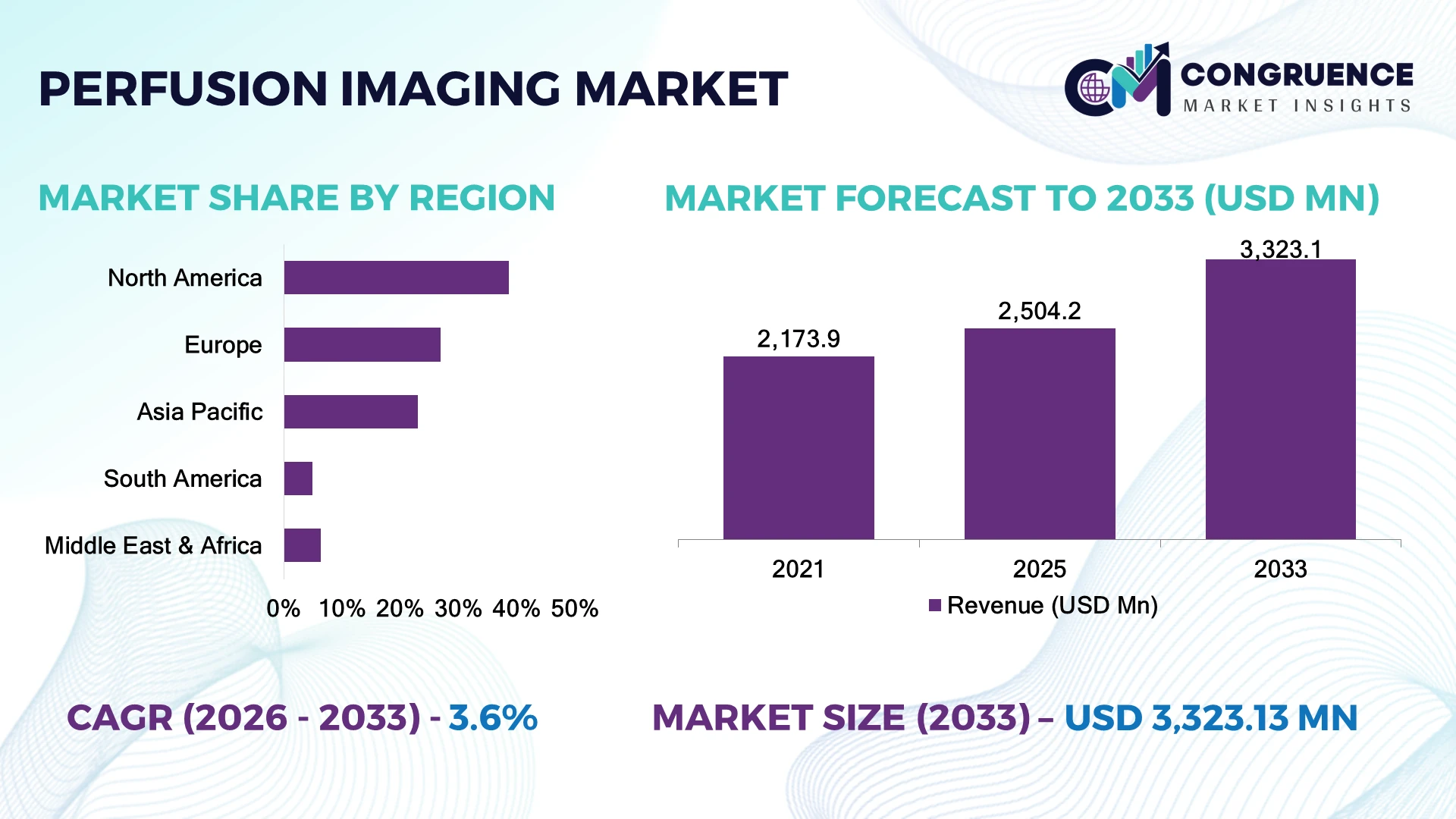
The Global Perfusion Imaging Market was valued at USD 2,504.2 Million in 2025 and is anticipated to reach a value of USD 3,323.1 Million by 2033 expanding at a CAGR of 3.6% between 2026 and 2033. Growth is being driven by wider CT/MR perfusion deployment for stroke triage, myocardial ischemia assessment, and AI-assisted quantitative interpretation, particularly as advanced imaging becomes more tightly integrated into time-critical clinical workflows.
The United States remains the dominant country, supported by a large installed base of CT, MRI, PET, and SPECT systems, high neurovascular procedure volumes, and rapid AI integration; advanced perfusion protocols are estimated to represent more than 35% of specialized stroke-imaging workflows. China is expanding capacity faster through tertiary-hospital modernization, while U.S. adoption remains approximately 15 percentage points higher in advanced quantitative perfusion use.
The 2026 U.S. stroke-care environment, shaped by broader endovascular-treatment eligibility, reinforces the strategic value of rapid perfusion analysis.
Investment priorities should favor integrated imaging platforms, automated post-processing, and workflow interoperability rather than standalone scanners.
Market Size & Growth: USD 2,504.2 million in 2025 to USD 3,323.1 million by 2033 at 3.6% CAGR, supported by AI-assisted stroke and cardiac perfusion workflows.
Top Growth Drivers: AI-enabled interpretation 12%, advanced CT deployment 9%, cardiovascular imaging demand 8%.
Short-Term Forecast: By 2028, automated perfusion analysis is positioned to reduce interpretation time by 20–30% in high-volume imaging centers.
Emerging Technologies: AI segmentation, automated perfusion maps, photon-counting CT, and quantitative PET are advancing precision by approximately 10–18%.
Regional Leaders: North America is projected near USD 1.2 billion, Europe near USD 0.9 billion, and Asia-Pacific near USD 0.8 billion, with AI-supported workflows expanding fastest in tertiary hospitals.
Consumer/End-User Trends: Approximately 40% of advanced stroke centers increasingly incorporate quantitative perfusion assessment into complex treatment-selection pathways.
Pilot/Case Example: 2025 stroke-imaging workflows using automated lesion analysis demonstrated approximately 20% faster image interpretation in optimized emergency settings.
Competitive Landscape: Siemens Healthineers leads with an estimated 18% share, followed by GE HealthCare, Philips, Canon Medical Systems, and United Imaging.
Regulatory & ESG Impact: AI validation and standardized imaging protocols are reducing repeat examinations by an estimated 5–8%, improving resource utilization.
Investment & Funding: More than USD 1 billion is being directed across advanced imaging, AI diagnostics, and hospital modernization programs, favoring integrated platform partnerships.
Innovation & Future Outlook: 2026–2028 adoption will shift toward multimodal imaging, automated quantitative biomarkers, cloud-connected analysis, and faster emergency decision support.
The Perfusion Imaging Market is strengthening across acute ischemic stroke, coronary artery disease, oncology, and neurovascular assessment, with CT perfusion remaining particularly important where rapid quantitative tissue evaluation is required. AI-based segmentation and automated perfusion maps are gaining traction, with specialized workflows achieving approximately 15–20% faster interpretation. In 2026, hospitals are prioritizing interoperable imaging platforms that connect acquisition, post-processing, PACS, and clinical decision support, creating a clear transition toward integrated perfusion intelligence.
Perfusion imaging is becoming strategically important because clinical decisions increasingly depend on tissue physiology rather than anatomical imaging alone. In acute ischemic stroke, CT perfusion and MR perfusion help identify viable tissue and support treatment selection in selected extended-window cases. The 2026 expansion of endovascular-treatment eligibility further increases the value of rapid, standardized imaging workflows.
Technology differentiation is shifting toward automation. AI-assisted perfusion processing can reduce manual segmentation and interpretation workload by approximately 15–25% compared with conventional review, while integrated CT platforms shorten the transition between acquisition and quantitative analysis. North America leads in advanced emergency deployment, whereas China and other Asian markets are expanding tertiary-hospital imaging capacity and AI-enabled infrastructure.
Over the next 2–3 years, hospitals are expected to prioritize automated quantitative analysis, multimodal CT/MR integration, and cloud-enabled collaboration, with advanced centers targeting 20% faster interpretation and greater protocol standardization. Practical deployment is strongest in comprehensive stroke centers, where perfusion data feeds directly into thrombectomy selection and neurointerventional workflows. Companies are therefore investing in software integration, AI partnerships, detector technology, and workflow orchestration. Competitive advantage will increasingly depend on delivering reliable perfusion intelligence at clinical speed rather than simply improving image resolution.
AI-assisted perfusion analysis is accelerating adoption as stroke centers prioritize rapid tissue characterization, with automated segmentation reducing interpretation workload by approximately 20–25% and processing times by 15–20%. In the United States, wider use of extended-window thrombectomy protocols is increasing the operational value of CT perfusion in emergency pathways, while advanced hospitals increasingly connect perfusion software with PACS and clinical decision systems. The shift from manual region-of-interest analysis toward automated quantitative maps improves consistency and reduces dependence on highly specialized interpretation. Imaging companies are responding through AI partnerships, integrated software platforms, and algorithm-enhanced CT/MR workflows. The non-obvious advantage is workflow scalability: hospitals can increase perfusion utilization without proportionally expanding specialist staffing, strengthening the business case for integrated platforms.
Perfusion imaging remains constrained by protocol standardization, equipment intensity, and uneven advanced-imaging infrastructure. Approximately 20–30% of hospitals in developing healthcare systems lack consistent access to high-end CT or MRI capabilities required for sophisticated perfusion workflows, while protocol variability can increase repeat examinations by 5–10%. In the United States, reimbursement and clinical pathway requirements also influence utilization across institutions. These constraints increase acquisition costs, training requirements, and workflow friction, limiting deployment beyond tertiary centers. Vendors are reducing exposure through scalable software, cloud-based post-processing, equipment upgrades, and partnerships with hospital networks. A key operational pressure is that software availability alone does not solve infrastructure gaps; companies increasingly package analytics with implementation, training, and interoperability support.
The strongest opportunity lies in combining CT, MRI, and AI-derived perfusion biomarkers into unified emergency decision workflows. Automated analysis can deliver approximately 15–25% faster interpretation, while integrated protocols can reduce manual processing steps by 20% or more. China and India offer significant expansion potential as tertiary hospitals modernize neurovascular imaging capacity and adopt digitally connected radiology infrastructure. Photon-counting CT, quantitative perfusion mapping, and cloud-enabled specialist collaboration are emerging technology pathways that can improve tissue characterization without requiring separate diagnostic workflows. Companies are positioning through AI development, hospital partnerships, and interoperability investments. A less obvious opportunity is deployment in mid-tier hospitals through centralized remote interpretation, allowing advanced perfusion capabilities to extend beyond major academic centers without duplicating specialist infrastructure.
Long-term expansion depends on integrating perfusion data reliably across scanners, PACS, electronic health records, and AI decision-support platforms. Approximately 25–35% of advanced imaging workflows can involve manual data-transfer or protocol-adjustment steps, while algorithm performance differences of 5–15% across datasets can complicate clinical standardization. Workforce shortages further pressure radiology departments as perfusion interpretation requires specialized expertise. In 2026, cybersecurity and validation requirements are also becoming more consequential as cloud-connected imaging expands. Companies must invest in interoperable APIs, standardized biomarkers, multicenter validation, cybersecurity architecture, and clinician training. The strategic challenge is not simply deploying better algorithms; vendors must demonstrate reproducible outputs across institutions, scanners, patient populations, and clinical protocols to achieve durable enterprise adoption.
Automated Perfusion Processing Scales: AI-based segmentation and quantitative mapping are reducing interpretation workloads by 20–25% and processing time by 15–20%. U.S. stroke centers are integrating automated analysis into emergency workflows, while vendors are expanding algorithm partnerships and PACS connectivity. The operational shift favors standardized decision support over specialist-dependent manual measurements.
Photon-Counting CT Gains Momentum: Advanced detector architectures are improving spatial resolution and quantitative imaging performance by roughly 10–15% in specialized workflows. Adoption remains concentrated in tertiary hospitals, but 2026 equipment replacement cycles are accelerating evaluation. Manufacturers are pairing detector upgrades with perfusion software, creating integrated platforms rather than standalone hardware purchases.
Remote Imaging Collaboration Expands: Cloud-based image sharing is reducing specialist access delays by approximately 15–20% in distributed hospital networks. India and China are increasing remote radiology connectivity as tertiary expertise remains concentrated in major cities. Vendors are responding with secure collaboration platforms, centralized post-processing, and subscription-based analytics that extend advanced perfusion interpretation to smaller facilities.
Workflow Integration Becomes Critical: Interoperability between CT, MRI, PACS, and clinical decision systems is increasingly determining deployment success, with integrated workflows targeting 10–15% faster emergency processing. Hospitals are prioritizing single-interface orchestration as labor constraints intensify. Companies are therefore investing in standardized APIs, cybersecurity controls, and cross-modality workflow automation rather than isolated imaging applications.
CT Perfusion is estimated to lead the global perfusion imaging market with approximately 48% share, supported by rapid acquisition, broad CT availability, and established stroke workflows. Its operational advantage is strongest in emergency departments, where CT-based protocols can be completed faster than MRI-intensive pathways. MRI Perfusion accounts for roughly 27%, while PET and SPECT collectively represent about 25%, retaining importance in oncology, cardiology, and specialized functional imaging. Companies are prioritizing integrated CT platforms and automated post-processing to improve throughput by 15–20%.
MRI Perfusion is the fastest-growing type, expanding as hospitals seek higher tissue characterization and multiparametric neurological assessment. Its adoption is particularly strong in comprehensive centers, where advanced MRI infrastructure supports complex neurovascular and oncology pathways. Vendors are investing in faster sequences, AI reconstruction, and multimodal interoperability, shifting capital toward premium platforms rather than standalone systems.
A 2025 nationwide survey of thrombectomy-capable centers in Korea found perfusion imaging use reached 86.0% for 6–16-hour stroke presentations and 88.1% for 16–24-hour cases, with CT Perfusion used by approximately 65–68% of centers using advanced perfusion imaging.
Neurological applications lead the perfusion imaging market with an estimated 51% share, driven by acute ischemic stroke assessment, tissue viability analysis, and treatment-selection workflows. Cardiovascular applications follow at approximately 29%, supported by myocardial perfusion assessment and ischemia evaluation, while oncology and other applications account for about 20%. Stroke imaging carries disproportionate operational importance because minutes directly influence treatment eligibility. Companies are therefore integrating automated perfusion maps with CT angiography, PACS, and emergency decision-support systems, targeting 15–25% faster interpretation and greater protocol consistency.
Cardiovascular perfusion is the fastest-growing application, supported by expanding multimodality assessment and greater integration of PET, SPECT, CT, and cardiac MRI. Oncology remains strategically important for tumor vascularity and treatment-response evaluation, although deployment is more concentrated in specialized centers. Vendors are expanding application-specific software, workflow automation, and cross-modality analytics to increase utilization of existing imaging infrastructure rather than relying solely on new scanner installations.
The 2025 ACC/AHA/ASE/ASNC/SCCT/SCMR advanced cardiovascular imaging training statement identifies PET myocardial perfusion imaging as generally more accurate than SPECT and emphasizes integration of information across imaging modalities for patient-management decisions.
Hospitals account for an estimated 64% of perfusion imaging demand, reflecting their concentration of emergency departments, comprehensive stroke centers, cardiac services, and advanced imaging infrastructure. Diagnostic imaging centers contribute approximately 21%, while specialty clinics and research or academic institutions represent the remaining 15%. Hospital purchasing is increasingly platform-oriented, favoring CT/MRI systems bundled with AI post-processing, PACS integration, and service contracts. Vendors are responding with enterprise agreements and workflow customization to increase utilization across multiple departments.
Diagnostic imaging centers represent the fastest-growing end-user group as outpatient imaging expands and advanced post-processing becomes more accessible through centralized software. Their purchasing behavior differs from hospitals: utilization rates, turnaround time, equipment economics, and interoperability carry greater weight than comprehensive clinical integration. Companies are responding with modular software, cloud-enabled analysis, and flexible deployment models. Research institutions retain strategic importance for validation and algorithm development, while specialty clinics increasingly adopt focused perfusion workflows where cardiovascular and neurological imaging volumes justify dedicated capabilities.
A 2025 survey of thrombectomy-capable centers found advanced perfusion imaging was used in every late-window case by 67.0% of comprehensive stroke centers versus 33.7% of primary stroke centers, demonstrating how infrastructure intensity continues to concentrate advanced deployment in higher-acuity institutions.
North America accounted for the largest market share at 38.6% in 2025 however, Asia-Pacific is expected to register the fastest growth, expanding at a CAGR of 4.4% between 2026 and 2033.

AI-Integrated Stroke Imaging Becomes the Regional Priority
North America maintains the leading position in perfusion imaging through extensive CT and MRI infrastructure, high stroke-center concentration, and rapid adoption of automated post-processing. The United States represents the principal demand center, with AI-enabled stroke imaging increasingly integrated into comprehensive neurovascular workflows. A U.S. stroke-center assessment found CT perfusion was used in initial acute-stroke protocols by 32.37% of AI-enabled centers versus 4.55% of non-AI centers, highlighting the operational link between AI deployment and perfusion utilization. Medicare coverage policy revisions effective September 2025 further reinforce the role of automated CT perfusion analysis for selected acute ischemic stroke pathways. Vendors are consequently prioritizing AI partnerships, automated quantitative maps, and PACS-integrated platforms.
United States Market Outlook: The United States remains the region's strongest market because comprehensive stroke centers combine advanced CT/MR infrastructure with established thrombectomy pathways. CMS coverage specifically recognizes automated CT perfusion analysis for selected large-vessel-occlusion patients, strengthening institutional incentives for deployment. The strategic advantage lies in converting existing scanner capacity into faster quantitative decision support rather than relying exclusively on new hardware.
Standardization and Multimodal Cardiac Imaging Drive Adoption
Europe is characterized by mature imaging infrastructure and increasingly standardized perfusion workflows across neurological and cardiovascular applications. Germany, France, the United Kingdom, and Italy remain important deployment markets, while clinical centers increasingly combine CT perfusion, MRI, PET, and SPECT according to indication. Germany's 2024 myocardial perfusion SPECT survey analyzed 128,707 patient examinations, demonstrating substantial operational scale across hospitals and university centers. European imaging policy is also emphasizing radiation optimization and appropriate modality selection, encouraging vendors to improve quantitative performance without adding unnecessary acquisition burden. Companies are responding with AI-assisted interpretation, dose-efficient protocols, and multimodality software integration.
Germany Market Outlook: Germany combines a large hospital network with established nuclear cardiology and advanced radiology capabilities. In the latest national survey, 198 institutions participated and 128,707 myocardial perfusion SPECT examinations were analyzed, providing a substantial installed workflow base for technology modernization. Vendors are increasingly targeting automated quantification, attenuation correction, and cross-platform interoperability to improve utilization across hospitals and specialist practices.
Hospital Modernization Accelerates Advanced Perfusion Deployment
Asia-Pacific is shifting from concentrated tertiary-center deployment toward broader adoption as China, Japan, South Korea, and India expand advanced imaging capacity. China provides the strongest scale opportunity through large tertiary hospitals and increasing neurovascular intervention capabilities, while India is strengthening private and public diagnostic infrastructure. A 2025 study from Nanjing Medical University evaluated 309 patients using CT-based stroke imaging, reflecting expanding clinical investigation of perfusion techniques beyond conventional applications. Hospitals are prioritizing automated analysis because specialist radiology capacity remains uneven. Vendors are responding with modular AI software, faster CT protocols, and partnerships that extend advanced interpretation across distributed hospital networks.
China Market Outlook: China offers the strongest combination of hospital scale, imaging investment, and neurovascular case volume in Asia-Pacific. Research institutions are actively evaluating CT perfusion across additional stroke presentations, including lacunar infarction, demonstrating expansion beyond traditional large-vessel-occlusion pathways. The 2025 Nanjing study included 309 patients, reinforcing the depth of clinical evaluation supporting technology refinement. Equipment suppliers are positioning automated post-processing and integrated CT workflows for high-throughput tertiary hospitals.
Tertiary-Center Concentration Shapes Deployment Priorities
South America remains concentrated around advanced hospitals and private diagnostic networks, with Brazil representing the principal deployment market. Perfusion imaging is particularly relevant to stroke centers where CT angiography, CT perfusion, and neurointerventional services operate as connected pathways. Brazilian clinical research continues to evaluate perfusion-derived biomarkers, including collateral-status assessment using CT angiography and perfusion source images. Adoption remains constrained by uneven access to high-end scanners and specialist interpretation outside major cities. Providers are therefore favoring software-enabled expansion, centralized reporting, and upgrades to installed CT systems rather than extensive greenfield infrastructure.
Brazil Market Outlook: Brazil provides the strongest South American opportunity because São Paulo and other major urban centers concentrate advanced hospitals, diagnostic networks, and neurovascular expertise. Clinical research institutions are actively integrating perfusion imaging into stroke assessment, supporting broader protocol development. Vendors targeting Brazil are emphasizing retrofit-compatible analytics, remote interpretation, and service partnerships that reduce the need for every facility to maintain dedicated perfusion specialists.
Advanced Hospital Infrastructure Creates Premium Demand
Middle East & Africa demand is increasingly concentrated in technologically advanced hospitals, particularly in Saudi Arabia, the United Arab Emirates, Israel, and major Gulf healthcare hubs. Large medical-city developments and specialist centers are supporting adoption of advanced CT, MRI, PET, and SPECT workflows. Saudi Arabia is strategically important because centralized healthcare modernization favors high-end diagnostic infrastructure and integrated clinical pathways. Deployment remains uneven, however, with resource limitations restricting sophisticated perfusion imaging outside major metropolitan centers. The Brain Attack Coalition's 2026 recommendations emphasize feasibility across different resource levels, noting that perfusion imaging is strongly recommended but not mandatory at all primary stroke centers. Vendors are consequently developing scalable AI and remote-analysis models.
Saudi Arabia Market Outlook: Saudi Arabia combines substantial healthcare modernization with concentrated investment in tertiary and specialist hospitals, creating favorable conditions for premium perfusion imaging systems. The country's centralized procurement environment supports integrated CT/MR platforms, automated analysis, and enterprise-level service agreements. Vendors can gain stronger positioning by combining equipment, AI post-processing, training, and workflow integration rather than selling standalone imaging systems.
GE HealthCare, Siemens Healthineers, Philips, Canon Medical Systems, and AI specialists such as RapidAI and Viz.ai compete across integrated imaging and software layers. Imaging OEMs compete on installed-base access, while AI specialists challenge them with faster, vendor-neutral stroke analytics. The top five players are estimated to control about 58% collectively, indicating moderate concentration. Competition centers on workflow speed, algorithm performance, interoperability, and service economics: automated processing can reduce interpretation time 15–25%, while integrated protocols can cut manual workflow steps 20%. OEMs are expanding through AI partnerships and software bundling; specialists are pursuing hospital contracts and cross-vendor integration. The competitive shift is moving from scanner performance toward decision-support ecosystems, with software validation becoming a stronger purchasing criterion. Entry barriers remain high because clinical validation, regulatory clearance, installed-base integration, and hospital procurement cycles require substantial capital and evidence. Winning requires quantitative outputs, rapid deployment, interoperability, and measurable workflow gains across clinical settings.
GE HealthCare
Siemens Healthineers
Philips
Canon Medical Systems
Fujifilm Healthcare
United Imaging Healthcare
Koninklijke Bruker
RapidAI
Viz.ai
Brainomix
Cercare Medical
Nicolab
Aidoc
Lunit
Current perfusion imaging is shifting from standalone CT and MRI post-processing toward automated, integrated platforms. AI-based segmentation, motion correction, tissue classification, and quantitative mapping can reduce interpretation workload by 15–25%, while automated protocols improve repeatability. Adoption is strongest in comprehensive stroke centers, where software is increasingly connected to PACS, emergency alerts, and treatment pathways. This favors vendors with broad hardware and software ecosystems.
Emerging systems are combining photon-counting CT, dual-energy acquisition, deep-learning reconstruction, and vendor-neutral perfusion analytics. Compared with conventional CT workflows, advanced reconstruction and automation can improve image quality or workflow efficiency by roughly 10–20% while supporting lower-dose protocols. Cone-beam CT perfusion is particularly disruptive because it brings perfusion assessment into angiography suites, reducing transfers during thrombectomy. Imaging OEMs benefit from integration, while specialist AI companies gain leverage through cross-vendor compatibility.
During 2026–2028, generative AI, contrast-free perfusion mapping, cloud orchestration, and multimodal biomarkers will reshape deployment priorities. Research already demonstrates automated generation of perfusion parameters from non-contrast CT, potentially reducing dependence on conventional contrast-enhanced acquisition. Hospitals will prioritize technologies that shorten decision cycles by 15–20%, integrate across CT, MRI, and angiography, and maintain consistent quantitative outputs. The competitive advantage will move toward validated workflow ecosystems rather than isolated algorithms.
May 2026 Siemens Healthineers partnered with Cercare Medical to integrate cone-beam CT perfusion into angiography suites, enabling tissue viability assessment during thrombectomy. The platform supports up to 10 CBCT angiography phases, reducing patient transfers and accelerating stroke workflows. Source: siemens-healthineers.com
November 2025 Nicolab secured FDA clearance for StrokeViewer LVO Triaging and CT Perfusion algorithms after multicenter validation involving 384 patients. The clearance expanded automated stroke decision support in U.S. hospitals, strengthening remote triage and rapid clinical treatment workflows. Source: nicolab.com
March 2024 Wipro GE HealthCare announced investment exceeding INR 8,000 crore in manufacturing output and local R&D over five years. The program expands Indian production of PET/CT and CT components, strengthening supply resilience and supporting advanced imaging deployment. Source: gehealthcare.com
2025 Philips and Nicolab expanded stroke-imaging collaboration in India by integrating cloud-based StrokeViewer CT Perfusion analysis with Philips Azurion. The workflow provides AI-generated results and centralized imaging communication, improving treatment coordination and extending perfusion decision support. Source: philips.com
The Perfusion Imaging Market Report evaluates CT Perfusion, MRI Perfusion, PET, and SPECT across neurological, cardiovascular, oncology, and other specialized applications. Coverage assesses hospitals, diagnostic imaging centers, specialty clinics, and research institutions across North America, Europe, Asia-Pacific, South America, and Middle East & Africa. The study distinguishes mature stroke workflows from emerging quantitative and multimodal applications.
The report analyzes AI-assisted post-processing, automated tissue segmentation, photon-counting CT, cloud-based image collaboration, multimodal integration, and emerging contrast-free perfusion techniques. It evaluates segment adoption, deployment concentration, workflow automation, technology positioning, enterprise purchasing priorities, regulatory readiness, clinical validation, interoperability, and service models, alongside 10+ major market participants. Strategic analysis supports investment planning, technology selection, geographic expansion, partnership development, competitive positioning, and infrastructure modernization through 2026–2033.
| Report Attribute/Metric | Report Details |
|---|---|
|
Market Revenue in 2025 |
USD 2,504.2 Million |
|
Market Revenue in 2033 |
USD 3,323.1 Million |
|
CAGR (2026 - 2033) |
3.6% |
|
Base Year |
2025 |
|
Forecast Period |
2026 - 2033 |
|
Historic Period |
2021 - 2025 |
|
Segments Covered |
By Type
By Application
By End-User
|
|
Key Report Deliverable |
Revenue Forecast, Growth Trends, Market Dynamics, Segmental Overview, Regional and Country-wise Analysis, Competition Landscape |
|
Region Covered |
North America, Europe, Asia-Pacific, South America, Middle East, Africa |
|
Key Players Analyzed |
GE HealthCare, Siemens Healthineers, Philips, Canon Medical Systems, Fujifilm Healthcare, United Imaging Healthcare, Koninklijke Bruker, RapidAI, Viz.ai, Brainomix, Cercare Medical, Nicolab, Aidoc, Lunit |
|
Customization & Pricing |
Available on Request (10% Customization is Free) |




