
Reports
The Global Patient Isolation Room Market was valued at USD 150.0 Million in 2025 and is anticipated to reach a value of USD 267.5 Million by 2033 expanding at a CAGR of 7.5% between 2026 and 2033. Growth is driven by rising installation of negative-pressure isolation systems, modular healthcare infrastructure upgrades, and stricter infection-control standards after global outbreaks.
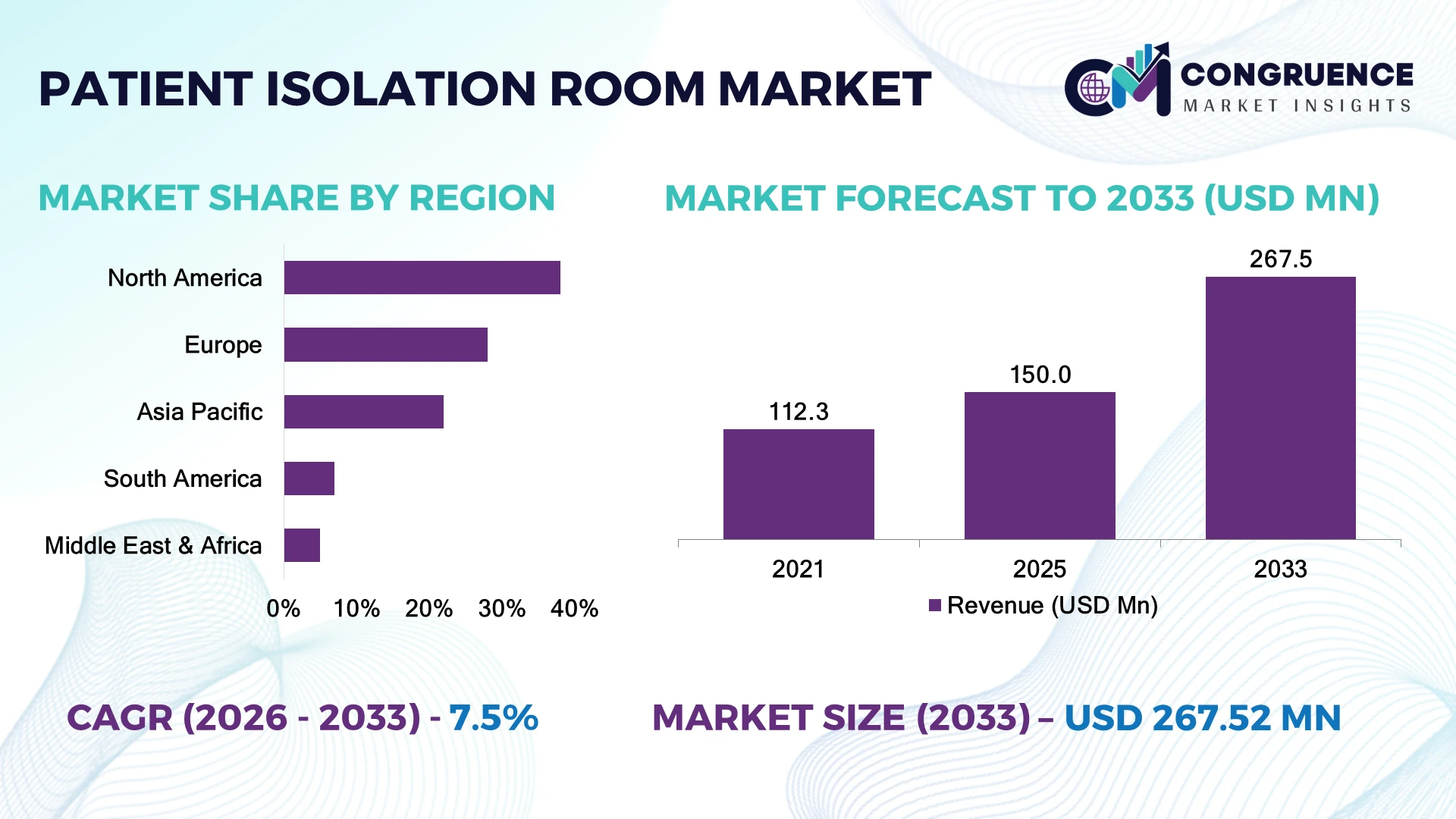
The United States dominates with approximately 38% market share, supported by hospital modernization programs, over 6,000 healthcare facilities adopting advanced isolation capabilities, and increased investments in airborne infection-control infrastructure. China follows with nearly 22% share, driven by large-scale hospital expansion and smart healthcare projects. The U.S. market shows higher adoption of AI-enabled monitoring systems, while China focuses on rapid modular room deployment.
Strategic investments in scalable isolation infrastructure will determine long-term competitive advantage.
Market Size & Growth: USD 150.0 Million in 2025 to USD 267.5 Million by 2033 at 7.5% CAGR, driven by advanced infection-control infrastructure and modular healthcare construction.
Top Growth Drivers: Infection prevention standards (35%), hospital modernization (28%), and modular healthcare adoption (22%) are accelerating deployments.
Short-Term Forecast: By 2028, smart monitoring integration improves operational efficiency by 25% and reduces maintenance costs by 15%.
Emerging Technologies: AI-based air quality monitoring, automated pressure controls, and antimicrobial materials are reshaping isolation room designs.
Regional Leaders: North America reaches USD 102 Million with digital hospital adoption; Asia-Pacific reaches USD 78 Million with modular expansion; Europe reaches USD 56 Million with regulatory upgrades.
Consumer/End-User Trends: Over 60% of new hospital projects prioritize advanced isolation facilities for infectious disease preparedness.
Pilot/Case Example: In 2024, modular isolation projects reduced installation timelines by 40% compared with conventional hospital construction.
Competitive Landscape: Market leaders hold nearly 30% combined share, with key players including Johnson Controls, Siemens Healthineers, Schneider Electric, ABM Industries, and Getinge.
Regulatory & ESG Impact: Energy-efficient isolation systems reduce facility energy consumption by up to 20% while supporting healthcare sustainability targets.
Investment & Funding: Healthcare infrastructure investments exceeded USD 2 billion globally in infection-control upgrades, emphasizing partnerships and expansion.
Innovation & Future Outlook: Next-generation isolation rooms integrate IoT, automation, and predictive analytics to strengthen hospital resilience.
Patient isolation rooms are becoming critical components of modern healthcare facilities, especially for infectious disease management, emergency preparedness, and high-risk patient care. Demand is increasing for modular systems, advanced ventilation technologies, and digitally monitored environments, with over 45% of hospitals prioritizing upgraded isolation capacity. Supply-chain localization and stricter healthcare infrastructure regulations are accelerating adoption across emerging markets.
The Patient Isolation Room Market is becoming strategically important as healthcare systems prioritize infection-control resilience, hospital modernization, and rapid-response infrastructure. Rising regulatory emphasis on airborne disease prevention and post-pandemic facility upgrades is shifting investments toward modular, digitally integrated isolation environments.
Healthcare providers are replacing conventional isolation setups with smart negative-pressure systems that improve monitoring accuracy by nearly 30% and reduce operational intervention compared with manual ventilation controls. Countries such as the United States are focusing on advanced automation and AI-based monitoring, while India and China emphasize scalable modular healthcare construction to expand capacity faster.
Hospitals deploying prefabricated isolation units have reduced installation timelines by approximately 35%, enabling faster capacity expansion during health emergencies. Companies are strengthening partnerships with healthcare contractors, ventilation technology providers, and automation specialists to improve deployment efficiency.
Over the next few years, competitive positioning will depend on technology integration, supply-chain flexibility, and the ability to deliver cost-efficient isolation solutions that support long-term healthcare infrastructure transformation.
Healthcare infrastructure modernization is the primary driver as hospitals increase investment in advanced isolation environments. More than 70% of newly constructed tertiary hospitals in developed markets include dedicated isolation capacity, while demand for negative-pressure systems has increased significantly after global infectious disease events. The World Health Organization’s continued focus on airborne infection management has accelerated facility upgrades. Companies are expanding modular room portfolios, investing in smart ventilation technologies, and partnering with hospital developers to meet evolving requirements. The strategic shift toward flexible isolation infrastructure enables healthcare systems to improve emergency readiness while optimizing long-term operational efficiency.
High capital requirements remain a major limitation for widespread adoption, particularly in developing healthcare systems. Advanced isolation rooms can require 20–40% higher installation investment compared with standard patient rooms due to specialized HVAC systems, monitoring equipment, and structural modifications. Supply dependency for filtration components and medical-grade ventilation systems creates additional cost pressure. Countries with limited hospital infrastructure face slower deployment due to budget constraints and skilled workforce shortages. Manufacturers are reducing risks through localized production, long-term supplier agreements, and standardized modular designs that lower installation complexity and improve cost control.
Digital transformation creates new opportunities through AI-enabled monitoring, IoT sensors, and automated environmental controls. Smart isolation systems can improve airflow management accuracy by nearly 30% while reducing manual inspection requirements. Emerging markets including India, Brazil, and Southeast Asian countries are increasing healthcare infrastructure spending, creating demand for scalable solutions. Companies are developing connected isolation platforms that integrate real-time pressure monitoring, predictive maintenance, and remote diagnostics. Strategic partnerships between technology providers and healthcare construction firms are enabling faster deployment of intelligent isolation environments and improving lifecycle efficiency.
Integration complexity remains a significant challenge as hospitals require isolation systems compatible with existing infrastructure, digital platforms, and regulatory standards. Approximately 40% of healthcare facilities operate with aging ventilation systems that require upgrades before advanced isolation solutions can be installed. Cybersecurity concerns are also increasing as connected monitoring platforms become more common. Workforce training gaps and evolving healthcare regulations create additional operational pressure. Companies must invest in interoperable technologies, cybersecurity frameworks, and specialized training programs to ensure reliable deployment and maintain competitive differentiation in the evolving healthcare infrastructure landscape.
Smart Monitoring Integration Hospitals are increasingly deploying IoT-enabled isolation rooms with real-time pressure, airflow, and contamination monitoring. Adoption of connected systems has increased by nearly 35%, while automated alerts reduce manual inspection workloads by around 25%. Healthcare providers in the United States and Germany are integrating digital monitoring platforms to improve response speed. Companies are expanding partnerships with automation firms and investing in cloud-based facility management solutions to improve operational visibility.
Modular Room Deployment Growth Prefabricated isolation rooms are gaining traction as healthcare operators seek faster capacity expansion amid construction labor shortages. Modular deployments reduce installation timelines by 30–40% and require approximately 20% fewer on-site resources. Hospitals in China and India are adopting factory-built isolation units for emergency preparedness programs. Manufacturers are restructuring supply chains toward localized production hubs to improve delivery reliability and reduce project delays.
Energy-Efficient Ventilation Shift Healthcare facilities are upgrading isolation room HVAC systems with energy-saving filtration and airflow technologies. Advanced ventilation solutions improve energy efficiency by 15–25% while maintaining strict infection-control performance. Rising sustainability requirements in European healthcare projects are accelerating adoption. Companies are redesigning systems with heat recovery, smart controls, and optimized airflow management to balance safety with operating costs.
AI-Based Predictive Operations Artificial intelligence is moving isolation room management from reactive maintenance toward predictive operations. AI-enabled platforms improve equipment fault detection by nearly 30% and reduce unexpected downtime by 20%. Hospitals are adopting predictive analytics after increased pressure on facility teams and technical staff shortages. Technology providers are developing integrated solutions combining sensors, analytics, and automated maintenance workflows.
Negative pressure isolation rooms represent the leading type segment, accounting for approximately 55% of the market due to their critical role in airborne infection containment, regulatory compliance, and hospital safety protocols. Their dominance is supported by strong integration with advanced HVAC systems, continuous airflow monitoring, and suitability for infectious disease management. Positive pressure isolation rooms hold around 25% share and remain important in protecting immunocompromised patients, particularly in oncology and transplant facilities. Standard isolation rooms account for the remaining share and continue serving cost-sensitive healthcare environments.
Smart negative pressure systems are the fastest-growing type, expanding as hospitals prioritize automation, remote monitoring, and operational efficiency. Adoption of digitally controlled systems has increased by nearly 30%, enabling hospitals to reduce manual checks and improve response times. Companies are focusing investments on IoT-enabled ventilation, modular designs, and integrated monitoring platforms to capture demand from modern healthcare infrastructure projects.
Infectious disease management is the leading application segment, representing approximately 60% market share due to increasing hospital focus on airborne pathogen containment and emergency preparedness. Demand concentration is highest among tertiary hospitals and government healthcare facilities requiring dedicated isolation capacity. Intensive care applications contribute nearly 25% share as critical-care units integrate isolation capabilities for high-risk patients.
Emergency response facilities represent the fastest-growing application area, supported by modular healthcare expansion and rapid deployment requirements. Adoption of temporary and scalable isolation infrastructure has increased by approximately 35% since global health emergencies highlighted capacity limitations. Pharmaceutical research centers and specialized medical facilities are also expanding usage for controlled environments. Healthcare organizations are adapting through modular construction partnerships, automated environmental monitoring, and flexible room designs. Companies are developing application-specific solutions that support faster installation, improved workflow efficiency, and compliance with evolving healthcare standards.
Hospitals represent the dominant end-user segment with approximately 70% market share, driven by large-scale infrastructure requirements, infection-control mandates, and continuous patient care demand. Large public and private hospital networks account for the majority of deployments due to higher operational intensity and greater investment capacity. Diagnostic centers and specialty clinics contribute nearly 15% share, focusing on controlled treatment environments and outpatient infection management.
Research institutions and pharmaceutical facilities represent the fastest-growing end-user group as demand increases for controlled environments supporting advanced medical studies and biotechnology development. Adoption among research facilities has grown by approximately 25%, driven by investments in specialized containment infrastructure and laboratory-linked healthcare spaces. Companies are targeting hospitals through customized solutions, long-term maintenance agreements, and integrated facility partnerships, while research-focused users are driving demand for technologically advanced isolation platforms. Emerging buyers increasingly prioritize energy efficiency, automation, and lifecycle cost management when selecting isolation room systems.
North America accounted for the largest market share at 38% in 2025 however, Asia-Pacific is expected to register the fastest growth, expanding at a CAGR of 9.2% between 2026 and 2033.
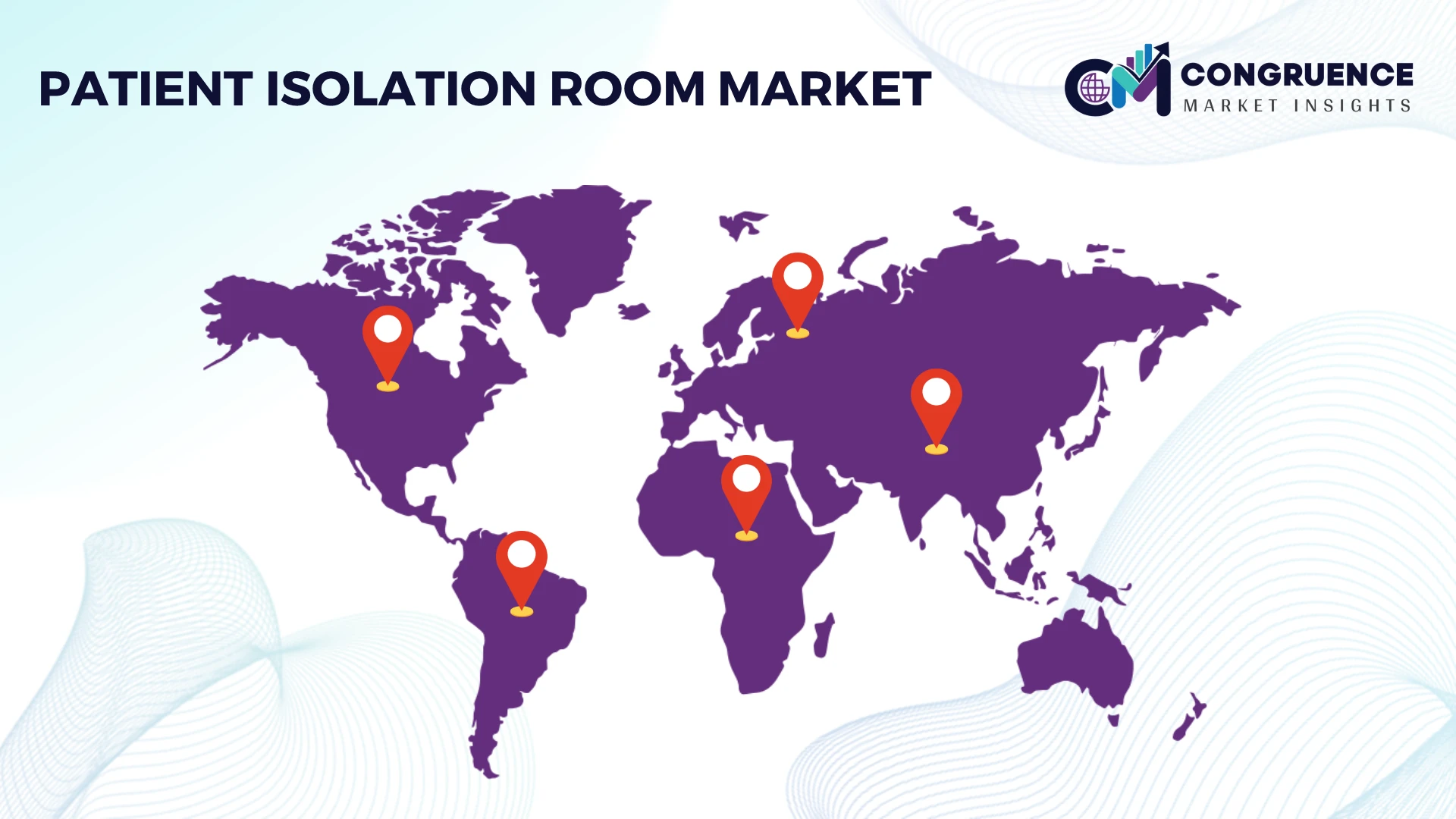
North America leads the Patient Isolation Room Market due to strong healthcare infrastructure, high adoption of advanced ventilation systems, and strict infection-control requirements. The region contributes approximately 38% of global demand, supported by large hospital networks, government healthcare investments, and rapid deployment of smart isolation technologies. The United States represents the largest deployment base, with hospitals increasingly integrating AI-enabled monitoring and automated airflow management systems. More than 65% of newly planned critical-care facilities in major healthcare systems include dedicated isolation capabilities. Companies are expanding through hospital partnerships, modular construction solutions, and connected facility management platforms to improve operational efficiency and compliance.
United States Market Outlook: The United States remains the regional technology leader, supported by advanced hospital infrastructure and strong adoption of negative-pressure isolation systems. Over 6,000 healthcare facilities have implemented specialized infection-control upgrades, while leading healthcare networks are investing in digitally monitored isolation environments. Manufacturers are prioritizing smart HVAC integration, lifecycle services, and scalable modular solutions to support long-term hospital resilience.
Europe is experiencing strong adoption of patient isolation rooms due to stringent healthcare safety standards, energy-efficiency regulations, and modernization of aging medical infrastructure. The region accounts for nearly 28% of global demand, with Germany, the United Kingdom, and France representing major deployment markets. Hospitals are increasingly adopting energy-efficient HVAC systems, antimicrobial materials, and automated monitoring platforms to meet sustainability and infection-control objectives. More than 50% of major European hospital renovation projects incorporate upgraded isolation capabilities. Companies are responding through partnerships with healthcare engineering firms and investments in low-energy ventilation technologies that reduce operational costs while maintaining safety performance.
Germany Market Outlook: Germany represents the strongest European market due to its advanced healthcare infrastructure, engineering capabilities, and focus on sustainable hospital modernization. Over 70% of large public hospitals have implemented upgraded infection-control systems, supporting demand for high-performance isolation rooms. Manufacturers are targeting German healthcare providers with automation-enabled solutions and energy-efficient designs aligned with national healthcare sustainability goals.
Asia-Pacific is the fastest-growing market, driven by expanding hospital infrastructure, increasing healthcare investments, and rising adoption of modular medical facilities. The region contributes approximately 22% of current market demand, with China, India, Japan, and South Korea leading deployment activity. Large-scale hospital construction programs and emergency preparedness initiatives are accelerating demand for prefabricated isolation rooms. Modular solutions can reduce installation timelines by nearly 40%, enabling faster capacity expansion in developing healthcare systems. Companies are strengthening regional manufacturing networks, forming construction partnerships, and introducing cost-efficient isolation solutions to address diverse healthcare requirements across urban and emerging markets.
China Market Outlook: China is the largest Asia-Pacific contributor due to extensive hospital expansion programs, domestic manufacturing capacity, and smart healthcare investments. More than 30% of newly developed healthcare infrastructure projects prioritize infection-control facilities. Chinese manufacturers are increasing production of modular isolation units and integrating automated monitoring systems to support rapid healthcare capacity development.
South America is gradually expanding adoption of patient isolation rooms as healthcare systems focus on improving infectious disease preparedness and upgrading hospital infrastructure. The region contributes approximately 7% of global demand, with Brazil, Argentina, and Chile representing key deployment markets. Public healthcare modernization programs and international partnerships are supporting installation of advanced isolation facilities, although budget limitations and infrastructure gaps continue affecting deployment speed. Brazil has increased investments in hospital upgrades, with more than 25% of major healthcare projects incorporating improved infection-control environments. Companies are addressing market challenges through modular solutions, localized partnerships, and flexible financing models.
Brazil Market Outlook: Brazil dominates the South American market due to its large healthcare network and increasing investment in public hospital modernization. More than 1,000 healthcare facilities have undergone infection-control improvements in recent years, creating demand for scalable isolation room technologies. Companies are focusing on affordable modular systems and maintenance partnerships to expand adoption across public and private healthcare sectors.
The Middle East & Africa market is expanding through healthcare infrastructure transformation, government-led modernization programs, and increased investment in advanced medical facilities. The region accounts for nearly 5% of global demand, with Saudi Arabia, the United Arab Emirates, and South Africa driving adoption. Large hospital developments and medical city projects are incorporating advanced isolation environments with automated ventilation and monitoring capabilities. Healthcare infrastructure investments in Gulf countries have accelerated deployment of high-standard isolation facilities, with some projects reducing construction timelines by nearly 30% through modular approaches. Companies are entering strategic partnerships with hospital developers and regional contractors to strengthen market presence.
Saudi Arabia Market Outlook: Saudi Arabia is the leading Middle East market due to Vision 2030 healthcare expansion initiatives and large-scale hospital development projects. The country is investing heavily in advanced healthcare facilities, with more than 40% of new medical infrastructure projects emphasizing digital healthcare systems and infection-control readiness. Companies are targeting the market through integrated isolation solutions, local partnerships, and technology-driven facility upgrades.
The Patient Isolation Room Market features competition between global healthcare infrastructure leaders, specialized containment solution providers, and regional modular construction companies. Key players include Johnson Controls, Siemens Healthineers, Getinge, Schneider Electric, and regional HVAC engineering firms competing across technology depth, customization, and deployment speed. The top five companies collectively account for approximately 35% of market share, reflecting a moderately fragmented structure. Competition is shifting toward smart ventilation, automated monitoring, and integrated hospital solutions, with digital systems improving operational efficiency by 20–30%. Global leaders compete through R&D, strategic partnerships, and vertical integration, while regional suppliers compete on pricing and faster localization. Companies are expanding manufacturing networks and developing modular isolation platforms to address healthcare infrastructure demand. High certification requirements, engineering expertise, and supply-chain reliability create entry barriers. Winning players must combine advanced technology, scalable production, customization capability, and strong healthcare partnerships to outperform established competitors.
Siemens Healthineers
Getinge AB
Schneider Electric
Honeywell International Inc.
Philips Healthcare
Steris Corporation
ABM Industries Incorporated
Atlas Copco AB
Daikin Industries Ltd.
Trane Technologies plc
Carrier Global Corporation
Patient isolation rooms are increasingly adopting smart ventilation systems, IoT sensors, and automated environmental monitoring platforms. Advanced negative-pressure systems improve airflow control accuracy by nearly 30% compared with conventional manual systems, while connected monitoring reduces inspection workload by approximately 25%. Hospitals are integrating real-time dashboards to improve infection-control response and operational visibility.
Artificial intelligence and predictive maintenance technologies are emerging as competitive differentiators, enabling facilities to detect equipment issues earlier and reduce unexpected downtime by nearly 20%. Around 40% of newly upgraded healthcare facilities are incorporating digital monitoring capabilities. Compared with older isolation infrastructure, automated systems improve operational efficiency by 20–35% through optimized airflow, energy management, and remote diagnostics.
From 2026 to 2028, technology adoption will accelerate as healthcare operators prioritize resilient infrastructure, energy efficiency, and workforce optimization. Global equipment manufacturers and technology providers benefit by offering integrated platforms combining HVAC controls, analytics, and facility management. Companies acting early on connected isolation solutions will gain advantages through lower lifecycle costs, faster deployment, and stronger hospital partnerships.
May 2026 Johnson Controls highlighted its CE360 Critical Environment Display for hospital isolation rooms, enabling real-time room status alerts, pressure monitoring, and environmental visibility. The system supports critical environments with multi-room monitoring capability, strengthening infection-control operations through digital controls and automated response workflows. Source: Johnson Controls
March 2025 Daikin Applied announced an investment in Poppy to advance smart HVAC and indoor air quality technologies. Field trials across 70 sites in 10 geographies showed 65% were over-ventilated, supporting optimization strategies that improve healthcare facility efficiency and air-management performance. Source: Daikin
February 2025 Schneider Electric reported continued healthcare digitalization with Circle Health Group, connecting more than 75% of hospital sites through digital infrastructure solutions. AI and remote monitoring resolved 81% of maintenance tickets remotely, improving operational continuity and supporting smarter healthcare environments. Source: Schneider Electric
July 2025 Getinge announced a strategic partnership with Zimmer Biomet to provide integrated healthcare solutions for ambulatory surgery centers. The collaboration combines infection-control expertise and surgical technologies, expanding access to coordinated medical infrastructure solutions across more than 22.5 million annual ASC procedures. Source: Getinge
The Patient Isolation Room Market Report covers comprehensive analysis across major types, applications, end-users, and geographic markets from 2026 to 2033. The study evaluates negative-pressure rooms, positive-pressure rooms, and advanced isolation systems across hospitals, specialty clinics, research facilities, and emergency healthcare environments. Regional coverage includes North America, Europe, Asia-Pacific, South America, and Middle East & Africa, highlighting deployment patterns and infrastructure priorities.
The report examines key technologies including automated ventilation, IoT-based monitoring, modular construction, and digital healthcare integration. It provides strategic insights into competitive positioning, investment priorities, expansion opportunities, and adoption trends. With analysis of leading companies, emerging solutions, and evolving healthcare infrastructure requirements, the report supports business planning, market entry decisions, partnership strategies, and long-term positioning in a rapidly transforming healthcare environment.
| Report Attribute / Metric | Details |
|---|---|
| Market Revenue (2025) | USD 150.0 Million |
| Market Revenue (2033) | USD 267.5 Million |
| CAGR (2026–2033) | 7.5% |
| Base Year | 2025 |
| Forecast Period | 2026–2033 |
| Historic Period | 2021–2025 |
| Segments Covered |
By Type
By Application
By End-User
|
| Key Deliverables | Revenue Forecast; Market Trends; Growth Drivers & Restraints; Technology Insights; Segmentation Analysis; Regional Insights; Competitive Landscape; Regulatory & ESG Overview; Recent Developments |
| Regions Covered | North America; Europe; Asia-Pacific; South America; Middle East & Africa |
| Companies Profiled | Johnson Controls; Siemens Healthineers; Getinge AB; Schneider Electric; Honeywell International Inc.; Philips Healthcare; Steris Corporation; ABM Industries Incorporated; Atlas Copco AB; Daikin Industries Ltd.; Trane Technologies plc; Carrier Global Corporation |
| Customization & Pricing | Available on Request (10% Customization Free) |




