
Reports
The Global Patient-controlled Analgesic Pump Market was valued at USD 534.3 Million in 2025 and is anticipated to reach a value of USD 867.1 Million by 2033 expanding at a CAGR of 6.24% between 2026 and 2033. Growth is driven by rising postoperative surgical volumes, expanding multimodal pain management protocols, and increasing adoption of smart infusion technologies across acute care facilities.
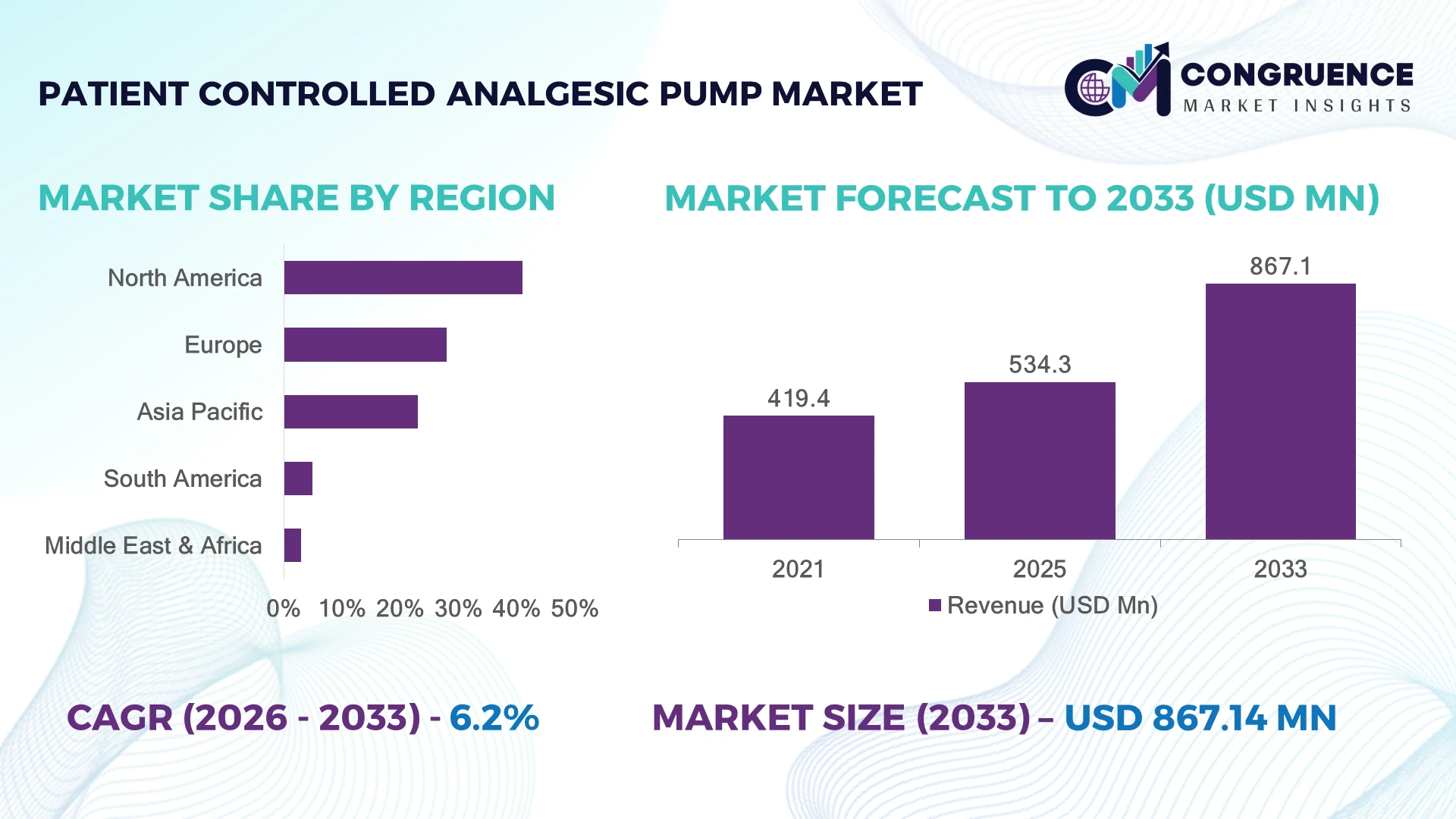
The United States dominates the global Patient-controlled Analgesic Pump Market with approximately 41% market share, supported by more than 6,000 hospitals, high adoption of digital infusion systems, and sustained investments in advanced healthcare infrastructure. Compared with Germany, where hospital modernization continues to accelerate under national digital health initiatives, the U.S. maintains broader deployment of connected pain management devices and stronger integration with electronic medical records.
Manufacturers focusing on connected infusion platforms, hospital partnerships, and regulatory-compliant product innovation are best positioned to strengthen long-term competitive advantage.
Market Size & Growth: USD 534.3 Million in 2025, reaching USD 867.1 Million by 2033 at 6.24% CAGR, supported by expanding smart infusion systems and enhanced postoperative pain management protocols.
Top Growth Drivers: Rising surgical procedures (+12%), smart infusion device adoption (+18%), and ambulatory surgery expansion (+15%) continue accelerating market momentum.
Short-Term Forecast: By 2028, connected pump deployment is expected to improve medication administration efficiency by nearly 20% while reducing programming errors by approximately 15%.
Emerging Technologies: AI-enabled dosing analytics, wireless connectivity, cybersecurity-enhanced infusion platforms, and cloud-based monitoring are transforming advanced pain management systems.
Regional Leaders: North America (~USD 330 Million), Europe (~USD 215 Million), and Asia-Pacific (~USD 185 Million by 2033) lead through hospital digitalization, healthcare modernization, and regional manufacturing expansion.
Consumer/End-User Trends: More than 65% of large hospitals increasingly prefer programmable electronic PCA pumps with integrated safety alarms and digital monitoring capabilities.
Pilot/Case Example: In 2024, smart infusion implementation across tertiary hospitals reduced medication administration errors by approximately 24% through integrated clinical workflow automation.
Competitive Landscape: Baxter holds approximately 22% market share alongside B. Braun, Fresenius Kabi, ICU Medical, and Smiths Medical competing through technology upgrades and global expansion.
Regulatory & ESG Impact: Updated infusion safety standards improved compliance rates by nearly 19%, while energy-efficient electronic systems support healthcare sustainability initiatives.
Investment & Funding: More than USD 420 Million has been invested globally in infusion technologies through partnerships, manufacturing expansion, and digital healthcare integration.
Innovation & Future Outlook: Next-generation interoperable PCA platforms with predictive analytics and remote monitoring are strengthening hospital efficiency and expanding precision pain management worldwide.
Patient-controlled Analgesic Pump Market demand continues to strengthen across hospitals, ambulatory surgery centers, and oncology care as healthcare providers prioritize safer, personalized pain management. Recent innovations include wireless-enabled infusion pumps, integrated electronic health record connectivity, and predictive dosing software. Nearly 35% of newly installed systems now feature advanced connectivity functions, while evolving medical device regulations and component sourcing diversification continue shaping procurement strategies and accelerating modernization across healthcare networks.
The Patient-controlled Analgesic Pump Market has become strategically important as healthcare systems prioritize safer medication delivery, digital hospital transformation, and standardized postoperative pain management. Increasing deployment of connected medical devices, combined with stricter infusion safety regulations, is encouraging manufacturers to redesign products around interoperability, cybersecurity, and workflow automation. Hospitals are increasingly selecting integrated infusion platforms that reduce manual intervention while improving patient safety and operational efficiency.
Modern programmable PCA pumps deliver approximately 20% faster clinical programming than conventional standalone devices while reducing medication administration errors by nearly 15% through automated safety checks and electronic health record integration. North America leads in large-scale deployment because of mature digital healthcare infrastructure, whereas Asia-Pacific records faster implementation across newly expanded hospitals and specialty surgical centers supported by healthcare infrastructure modernization and domestic manufacturing investments.
Healthcare providers are deploying smart PCA systems across surgical wards, intensive care units, and cancer treatment centers to improve patient outcomes while reducing clinician workload. Manufacturers are strengthening competitive positioning through software partnerships, localized production, expanded service networks, and connected device ecosystems that support long-term hospital procurement strategies. Organizations investing in interoperable, digitally enabled pain management solutions are establishing stronger operational resilience and sustainable competitive differentiation over the next several years.
The transition toward connected infusion systems and standardized postoperative pain management protocols is strengthening adoption of patient-controlled analgesic pumps across advanced healthcare facilities. Nearly 68% of large hospitals now prioritize smart infusion platforms with integrated safety software, while medication administration errors decline by approximately 20% through dose-error reduction technology. In the United States, updated infusion safety initiatives and wider electronic health record integration are accelerating procurement of interoperable devices. This operational shift enables faster clinical workflows, improved patient monitoring, and stronger compliance with hospital quality benchmarks. Manufacturers are responding by expanding software-enabled pump portfolios, investing in wireless connectivity, and forming technology partnerships with digital healthcare providers. A notable strategic trend is the integration of predictive analytics that enables proactive maintenance, reducing equipment downtime and improving fleet utilization across hospital networks.
Capital-intensive procurement and inconsistent interoperability continue to limit wider deployment of advanced patient-controlled analgesic pumps, particularly across mid-sized healthcare facilities. Connected infusion systems typically increase acquisition costs by 25–35% compared with conventional models, while software integration accounts for nearly 18% of implementation expenditure. In Japan and several European healthcare systems, strict medical device certification requirements extend product approval timelines and delay commercial rollout. Component sourcing for precision sensors and semiconductor-based control modules also creates supply-chain pressure during production planning. Manufacturers are mitigating these constraints through localized assembly, multi-supplier sourcing agreements, and standardized software architectures that simplify integration with existing hospital information systems. Operational flexibility has become a decisive factor for maintaining deployment consistency and protecting long-term profitability.
The convergence of digital health platforms with intelligent infusion technologies is creating new opportunities beyond traditional postoperative care. More than 40% of newly developed infusion devices now incorporate wireless monitoring capabilities, while remote clinical surveillance can improve therapy compliance by nearly 22%. China continues expanding smart hospital infrastructure through nationwide digital healthcare initiatives, supporting broader adoption of connected pain management technologies. Companies are accelerating investment in cloud-enabled device management, AI-assisted dosing optimization, and cybersecurity-enhanced software platforms to strengthen clinical decision support. An emerging opportunity lies in subscription-based device management services that reduce hospital maintenance costs while ensuring continuous software updates, creating recurring value beyond hardware sales and strengthening long-term customer relationships.
Expanding connected patient-controlled analgesic pump deployments across diverse healthcare environments requires overcoming integration, cybersecurity, and workforce challenges. Approximately 32% of healthcare organizations identify interoperability with legacy clinical systems as a primary deployment obstacle, while connected medical devices experience nearly 30% more cybersecurity monitoring requirements than standalone equipment. In Germany, hospitals modernizing digital infrastructure must simultaneously comply with evolving cybersecurity and medical device regulations, increasing implementation complexity. Limited availability of biomedical engineers and clinical IT specialists further slows large-scale deployment and ongoing system optimization. Companies must strengthen secure software development, invest in workforce training, and establish long-term technology partnerships that support standardized integration frameworks. Organizations solving these execution barriers will secure stronger operational resilience and sustained competitive differentiation in connected healthcare environments.
Smart Connected Pump Deployment Connected patient-controlled analgesic pumps are becoming standard across tertiary hospitals, with nearly 48% of newly procured systems supporting wireless connectivity and electronic health record integration. Automated dose verification has reduced programming errors by approximately 18%, improving medication safety and clinical workflow efficiency. Following stricter infusion safety regulations in the United States, manufacturers are accelerating software validation, expanding interoperability partnerships, and scaling cloud-enabled device management platforms.
Disposable Systems Gain Momentum Disposable PCA pumps now account for roughly 32% of new pain management device installations, supported by infection-control priorities and reduced maintenance requirements. Healthcare providers have reported up to 20% lower servicing workloads after adopting single-use infusion technologies. Companies are restructuring production networks, expanding localized manufacturing capacity, and strengthening component sourcing to improve supply continuity while reducing logistics complexity.
Digital Workflow Optimization Expands More than 55% of large hospitals are integrating infusion data into centralized clinical monitoring platforms, reducing documentation time by nearly 25% and improving treatment traceability. Growing healthcare workforce shortages are accelerating automation across medication management processes. Manufacturers are investing in AI-assisted software, remote diagnostics, and predictive maintenance capabilities that improve equipment utilization while minimizing unplanned service interruptions.
Outpatient Pain Management Evolution Ambulatory care providers are increasing deployment of lightweight programmable PCA pumps, with outpatient utilization expanding by approximately 16% over recent years. Faster patient discharge protocols and minimally invasive surgical procedures continue reshaping device requirements. Companies are responding through compact product designs, extended battery performance, and strategic partnerships with ambulatory healthcare providers to strengthen operational flexibility and broaden clinical adoption.
Electronic PCA Pumps remain the leading segment, accounting for approximately 56% of total installations because of advanced dose programming, integrated safety alarms, and seamless compatibility with hospital information systems. Large healthcare facilities increasingly prioritize electronic platforms that improve medication accuracy and reduce manual intervention by nearly 20%. Disposable PCA Pumps continue strengthening their position through simplified operation, lower maintenance requirements, and infection-control advantages, particularly in high-turnover surgical environments. Manufacturers are expanding software-enabled electronic portfolios while improving usability and cybersecurity to support long-term hospital procurement strategies. Ambulatory PCA Pumps represent the fastest-growing segment as healthcare providers expand outpatient surgery programs and home-based recovery pathways. Their portability, compact design, and extended battery life support greater patient mobility without compromising pain management quality. Companies are increasing investment in lightweight platforms, wireless monitoring, and remote device management while maintaining Disposable PCA Pumps for short-duration therapies and cost-sensitive healthcare settings. The market is steadily shifting toward flexible, connected infusion technologies that balance clinical performance with operational efficiency.
Postoperative Pain Management dominates the market with approximately 61% of device utilization, driven by rising surgical procedures and hospital protocols emphasizing patient-controlled analgesia. Digital monitoring and standardized dosing workflows have improved clinical efficiency by nearly 18%, making PCA systems an integral component of perioperative care. Trauma Care also maintains stable demand in emergency medicine, where rapid pain management and controlled opioid administration remain operational priorities. Manufacturers continue enhancing programmable interfaces and integrating pumps with digital clinical workflows to improve treatment consistency. Cancer Pain Management is the fastest-growing application as personalized pain control and long-term therapy management become increasingly important in oncology practice. Hospitals are expanding dedicated oncology infusion services while adopting connected PCA technologies for enhanced monitoring and individualized dosing. Labor Pain applications continue benefiting from patient-centered obstetric care, whereas specialized trauma treatment centers prioritize durable, easy-to-deploy infusion platforms. Companies are strengthening application-specific product development, clinician training programs, and software integration to address evolving therapeutic requirements across multiple care settings.
Hospitals remain the dominant end-user segment, representing approximately 72% of overall demand due to high surgical volumes, intensive care requirements, and comprehensive pain management infrastructure. Large healthcare networks increasingly deploy interoperable PCA platforms integrated with electronic medical records, improving medication administration efficiency by nearly 20%. Specialty Clinics support targeted pain management services and chronic care programs, while hospitals continue investing in connected infusion ecosystems that enhance patient safety and operational productivity. Home Care Settings are emerging as the fastest-growing end-user segment as healthcare systems promote earlier discharge and remote patient management. Ambulatory Surgical Centers are also expanding procurement following increased adoption of minimally invasive procedures requiring efficient postoperative pain control. Manufacturers are introducing portable devices, flexible pricing models, and remote monitoring capabilities while forming partnerships with home healthcare providers and outpatient surgical networks. Competitive strategies increasingly focus on customized deployment models that address diverse clinical environments while improving long-term service support.
North America accounted for the largest market share at 41.0% in 2025 however, Asia-Pacific is expected to register the fastest growth, expanding at a 7.6% CAGR between 2026 and 2033.

North America maintains the largest share of the Patient-controlled Analgesic Pump Market due to advanced hospital infrastructure, widespread adoption of smart infusion technologies, and strong compliance with medication safety standards. More than 70% of tertiary hospitals utilize programmable PCA systems integrated with electronic health records, enabling standardized pain management workflows and improved clinical monitoring. Healthcare providers continue replacing legacy infusion equipment with connected platforms that enhance interoperability and reduce manual programming. Strategic collaborations between device manufacturers and healthcare software providers are accelerating digital integration, while hospital modernization programs continue expanding deployment across surgical centers and critical care units. Continuous investment in cybersecurity, clinical analytics, and interoperability strengthens operational efficiency and reinforces the region's leadership in advanced pain management technologies.
United States Market Outlook: The United States remains the region's largest contributor, supported by an extensive network of more than 6,000 hospitals and strong adoption of connected medical technologies. Approximately 75% of major healthcare systems are integrating smart infusion platforms into digital clinical workflows to improve medication safety and operational efficiency. Domestic manufacturers continue expanding software capabilities, cybersecurity investments, and enterprise partnerships with hospital networks, reinforcing the country's leadership in advanced patient-controlled analgesia deployment and healthcare technology innovation.
Europe continues strengthening its position through hospital modernization, stringent medical device regulations, and expanding adoption of digitally connected infusion technologies. The region accounts for approximately 28% of global deployment, with healthcare systems prioritizing standardized medication delivery and interoperable clinical infrastructure. Digital transformation initiatives are encouraging replacement of conventional infusion devices with programmable PCA platforms featuring advanced safety functions and centralized monitoring. Medical Device Regulation implementation continues driving investments in product quality, traceability, and cybersecurity compliance. Manufacturers are expanding localized service capabilities, strengthening software validation, and increasing collaboration with healthcare institutions to improve deployment consistency while supporting long-term operational resilience across public healthcare systems.
Germany Market Outlook: Germany leads the European market through advanced hospital infrastructure, engineering expertise, and strong medical technology manufacturing capabilities. Nearly 68% of large hospitals continue investing in digitally integrated infusion systems as part of broader healthcare modernization initiatives. Domestic manufacturers emphasize software validation, cybersecurity compliance, and precision engineering while collaborating with clinical institutions to accelerate innovation and improve operational reliability across acute care environments.
Asia-Pacific is emerging as the fastest-expanding market due to rapid healthcare infrastructure development, increasing surgical procedures, and broader investment in smart hospital technologies. The region represents approximately 23% of global market activity, with healthcare providers expanding digital infusion capabilities to improve clinical efficiency. Government-supported hospital modernization programs and domestic medical device manufacturing continue strengthening procurement across both metropolitan and secondary healthcare facilities. Local manufacturers are increasing production capacity, improving supply-chain resilience, and introducing competitively priced programmable PCA systems that support wider clinical adoption. Expanding outpatient surgery networks and digital healthcare initiatives further accelerate operational deployment across diverse healthcare settings.
China Market Outlook: China remains the most influential market in Asia-Pacific because of extensive healthcare infrastructure investment and rapidly expanding domestic medical device manufacturing. More than 60% of newly constructed tertiary hospitals incorporate intelligent clinical equipment procurement strategies, including connected infusion technologies. Domestic enterprises continue increasing automation, localized component production, and software development while partnering with healthcare providers to strengthen technology adoption and improve national supply-chain resilience.
South America continues advancing through healthcare infrastructure improvements, increasing surgical capacity, and greater investment in modern pain management technologies. The region contributes approximately 5% of global market activity, with leading healthcare institutions prioritizing programmable infusion systems that improve medication safety and operational consistency. Private hospital groups are accelerating deployment of digital medical equipment while public healthcare systems continue phased modernization initiatives. Equipment distributors are strengthening regional service networks, expanding technical training, and improving after-sales support to increase clinical confidence and deployment reliability despite budgetary constraints and import dependency.
Brazil Market Outlook: Brazil represents the region's largest market due to its extensive hospital network, expanding private healthcare sector, and growing adoption of advanced medical technologies. Around 58% of large private hospitals are increasing investment in connected infusion equipment to improve clinical efficiency and medication management. Companies are strengthening local distribution partnerships, expanding maintenance capabilities, and improving clinician education programs to support sustainable deployment across major healthcare facilities.
The Middle East & Africa market is progressing through sustained healthcare investment, hospital expansion, and adoption of advanced medical technologies across major healthcare hubs. The region accounts for approximately 3% of global market activity, with governments prioritizing modernization of surgical facilities and critical care infrastructure. Smart hospital projects are increasing procurement of programmable infusion technologies, while healthcare providers focus on improving medication safety and digital interoperability. International manufacturers are expanding regional partnerships, establishing technical support centers, and strengthening distributor networks to improve deployment quality and long-term service capabilities across emerging healthcare markets.
Saudi Arabia Market Outlook: Saudi Arabia leads regional adoption through large-scale healthcare transformation programs, investment in smart hospitals, and continuous expansion of specialized medical centers. Approximately 65% of newly commissioned tertiary healthcare facilities incorporate advanced digital medical equipment procurement strategies, including connected infusion technologies. Global manufacturers are increasing local partnerships, technical training initiatives, and clinical support services to align with national healthcare modernization objectives while improving long-term operational performance.
Competition is led by Baxter International, B. Braun Melsungen AG, Fresenius Kabi, ICU Medical, and Smiths Medical, with global technology leaders competing against regional cost-focused manufacturers and specialized infusion device suppliers. The top five participants collectively control approximately 69% of the market through broad product portfolios and established hospital relationships. Competition centers on technology integration, clinical safety, and service capability, with smart connectivity influencing nearly 58% of hospital purchasing decisions and interoperability reducing implementation time by about 20%. Cost-focused manufacturers compete through localized production and customized service contracts, while premium suppliers emphasize software-enabled infusion platforms and cybersecurity. Companies are expanding manufacturing capacity, strengthening software partnerships, investing in wireless connectivity, and vertically integrating digital health capabilities to secure long-term procurement contracts. Regulatory compliance and clinical validation remain significant entry barriers. Success increasingly depends on delivering interoperable, secure, clinically validated infusion ecosystems supported by responsive service networks and continuous software innovation.
B. Braun Melsungen AG
Fresenius Kabi AG
ICU Medical, Inc.
Smiths Medical
Moog Inc.
Avanos Medical, Inc.
Arcomed AG
Micrel Medical Devices S.A.
ACE Medical Co., Ltd.
Zhejiang Kelly Med Co., Ltd.
Hospira Infusion Systems (commercial product portfolio)
Healthcare providers are rapidly replacing conventional standalone patient-controlled analgesic pumps with connected smart infusion platforms that integrate directly with electronic health records and centralized monitoring systems. Approximately 62% of newly installed hospital infusion devices now support digital interoperability, improving medication administration efficiency by nearly 18%. Integrated drug libraries, automated programming verification, and wireless software updates reduce manual intervention while strengthening medication safety and regulatory compliance. Hospitals adopting these technologies achieve faster clinical workflows and improved asset utilization across perioperative and critical care environments.
Emerging innovation focuses on AI-assisted dosing analytics, predictive maintenance, remote device diagnostics, and cybersecurity-enhanced infusion platforms. Compared with legacy standalone pumps, intelligent connected systems reduce programming errors by approximately 22% while decreasing maintenance downtime by nearly 17%. Global manufacturers with established software ecosystems benefit most because healthcare providers increasingly prioritize interoperable platforms over isolated hardware solutions. Cloud-based fleet management further strengthens operational visibility and simplifies lifecycle management across multi-hospital networks.
Between 2026 and 2028, predictive clinical decision support, digital twin-based device monitoring, and secure Internet of Medical Things integration will reshape competitive positioning. Companies investing in scalable software architecture, cybersecurity certification, and cloud-enabled analytics will strengthen hospital partnerships, accelerate procurement decisions, and establish durable operational advantages within connected pain management ecosystems.
February 2025 – Baxter announced all manufacturing lines at its North Cove facility returned to pre-hurricane production levels while advancing the Novum IQ infusion platform, strengthening supply continuity and restoring critical production capacity for hospital customers. Source: www.baxter.com
July 2025 – Baxter issued an Urgent Medical Device Correction for the Novum IQ Large Volume Pump, identifying under-infusion risks during high-rate transitions and implementing customer actions while software and hardware corrections were developed, reinforcing patient safety programs. Source: www.baxter.com
July 2025 – ICU Medical/Smiths Medical submitted a documented FDA MAUDE report concerning a CADD PCA Pump following a reported infusion failure event, supporting ongoing post-market surveillance and corrective quality monitoring across installed hospital devices.
July 2024 – Smiths Medical recorded multiple FDA MAUDE submissions involving CADD Legacy PCA pumps, reinforcing continuous post-market performance evaluation and device reliability monitoring to support long-term product quality improvements across healthcare providers.
This report provides comprehensive analysis of the Patient-controlled Analgesic Pump Market across Electronic PCA Pumps, Disposable PCA Pumps, and Ambulatory PCA Pumps, together with key applications including postoperative pain management, cancer pain management, trauma care, and labor pain. End-user assessment covers hospitals, ambulatory surgical centers, home care settings, and specialty clinics across North America, Europe, Asia-Pacific, South America, and the Middle East & Africa. More than 70% of current demand is concentrated within hospital-based deployments, while connected infusion technologies continue expanding across outpatient environments.
The study evaluates competitive positioning, technology evolution, digital infusion platforms, interoperability trends, wireless monitoring, and cybersecurity integration alongside regional deployment dynamics and enterprise adoption patterns. Strategic insights support product development, investment prioritization, expansion planning, partnership evaluation, and procurement decisions between 2026 and 2033 by identifying operational trends, emerging deployment models, innovation priorities, and evolving customer requirements shaping the global competitive landscape.
| Report Attribute / Metric | Details |
|---|---|
| Market Revenue (2025) | USD 534.3 Million |
| Market Revenue (2033) | USD 867.1 Million |
| CAGR (2026–2033) | 6.24% |
| Base Year | 2025 |
| Forecast Period | 2026–2033 |
| Historic Period | 2021–2025 |
| Segments Covered |
By Type
By Application
By End-User
|
| Key Deliverables | Revenue Forecast; Market Trends; Growth Drivers & Restraints; Technology Insights; Segmentation Analysis; Regional Insights; Competitive Landscape; Regulatory & ESG Overview; Recent Developments |
| Regions Covered | North America; Europe; Asia-Pacific; South America; Middle East & Africa |
| Companies Profiled | Baxter International Inc.; B. Braun Melsungen AG; Fresenius Kabi AG; ICU Medical, Inc.; Smiths Medical; Moog Inc.; Avanos Medical, Inc.; Arcomed AG; Micrel Medical Devices S.A.; ACE Medical Co., Ltd.; Zhejiang Kelly Med Co., Ltd.; Hospira Infusion Systems |
| Customization & Pricing | Available on Request (10% Customization Free) |




