
Reports
The Global Particle Size Analyzer Market was valued at USD 469.9 Million in 2025 and is anticipated to reach a value of USD 768.4 Million by 2033 expanding at a CAGR of 6.34% between 2026 and 2033. Growth is driven by pharmaceutical quality-control requirements, battery-material characterization, and the shift toward automated inline particle measurement across advanced manufacturing.
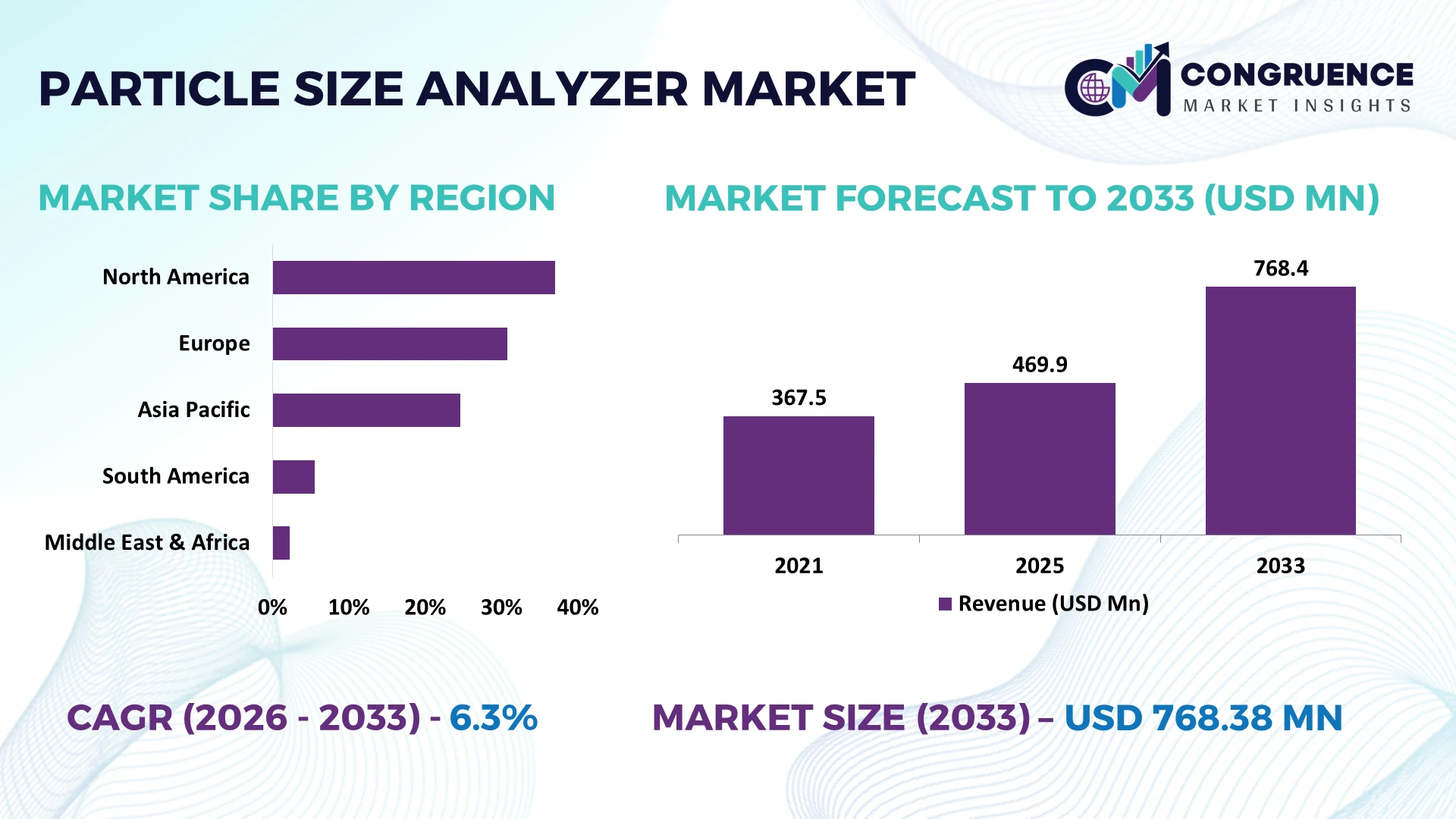
The United States remains the dominant country market, supported by pharmaceutical manufacturing, biotechnology, specialty chemicals, and advanced-materials R&D, while China is accelerating deployment across lithium-ion battery and pharmaceutical production. North America represented approximately 37.8% of 2025 demand, while Asia Pacific is expanding faster at 7.27%, supported by industrial modernization and domestic analytical-instrument production.
Strategically, suppliers should prioritize validated automation and inline monitoring in mature U.S. markets while expanding cost-efficient platforms and service networks across China's battery and pharmaceutical manufacturing hubs.
Market Size & Growth: USD 469.9 Million in 2025 to USD 768.4 Million by 2033 at a 6.34% CAGR, driven by automated quality control and advanced material characterization.
Top Growth Drivers: Pharmaceutical quality control at 37.91%, battery materials at 7.66% growth, and nanoparticle tracking analysis at 7.69% growth are key demand accelerators.
Short-Term Forecast: By 2028, automation-led workflows are positioned to reduce manual sampling and operator intervention by approximately 20%, improving laboratory throughput and measurement consistency.
Emerging Technologies: AI-enabled imaging, dynamic light scattering, and nanoparticle tracking analysis are strengthening automated characterization, with NTA advancing at 7.69%.
Regional Leaders: North America generated approximately USD 190.6 Million in 2025, Europe USD 157.0 Million, and Asia Pacific USD 125.8 Million, with Asia Pacific supported by battery, semiconductor, and pharmaceutical expansion.
Consumer/End-User Trends: Pharmaceutical and biopharmaceutical users represented 37.91% of 2025 demand, reflecting increasing reliance on particle-size control for formulation and batch-quality verification.
Pilot/Case Example: In 2025, AI-assisted particle monitoring demonstrated real-time size-distribution control during pharmaceutical pellet processing, supporting faster production feedback and automated quality decisions.
Competitive Landscape: Major participants include Malvern Panalytical, HORIBA, Agilent Technologies, Beckman Coulter, and Microtrac, with competition increasingly centered on automation, measurement range, software, and service coverage.
Regulatory & ESG Impact: FDA and EMA particle-size specifications are strengthening validated measurement requirements, while inline monitoring reduces material waste by enabling earlier process correction.
Investment & Funding: Capital deployment is shifting toward automated instruments, software integration, and regional service infrastructure as manufacturers prioritize digital quality-control systems and localized technical support.
Innovation & Future Outlook: Next-generation platforms are combining AI, automated sample preparation, nanoparticle tracking, and multi-technique analysis, shifting the market from standalone measurement toward connected process intelligence.
Particle Size Analyzer Market demand is concentrating across pharmaceuticals, battery materials, chemicals, semiconductors, food processing, and advanced materials. Laser diffraction held 32.74% of 2025 technology demand, while offline laboratory systems represented 64.18%, creating a clear transition opportunity toward automated and inline analysis. The shift is particularly relevant as manufacturers in China, the United States, Japan, and South Korea tighten process controls and modernize production infrastructure.
Particle size measurement is becoming a strategic manufacturing-control capability because particle distribution directly affects drug performance, battery-material behavior, catalyst efficiency, and product consistency. Pharmaceutical manufacturers increasingly require validated particle characterization, while battery producers are integrating measurement closer to production to control material specifications and reduce process variability.
The technology shift is measurable: laser diffraction represented 32.74% of 2025 technology demand because of its broad measurement range and rapid analysis, while nanoparticle tracking analysis is advancing at 7.69% as biologics and advanced-material applications require finer characterization. Inline systems are also expanding at 6.89%, reducing reliance on periodic laboratory sampling.
Over the next 2–3 years, manufacturers will increasingly connect analyzers with laboratory information systems, manufacturing execution systems, and automated process controls. North America will retain strong replacement and pharmaceutical demand, while China, Japan, South Korea, and India will expand deployment alongside battery, semiconductor, and pharmaceutical capacity. Companies investing in integrated software, local service networks, and automated workflows will strengthen operational consistency and competitive positioning.
Automated quality control is accelerating particle analyzer adoption across pharmaceutical, battery, and advanced-material plants. Laser diffraction represented 32.74% of 2025 technology demand, pharmaceuticals accounted for 37.91% of end-user demand, and inline real-time analysis is projected to grow at 6.89%. FDA quality requirements in the United States are reinforcing validated particle-size measurement across drug manufacturing. Companies are responding with automated sample handling, inline probes, software integration, and service contracts. The non-obvious advantage is faster process correction: manufacturers can detect particle-distribution changes closer to the production stage instead of waiting for laboratory results, improving batch consistency and reducing operator dependency.
High capital and maintenance costs constrain adoption among smaller laboratories and low-throughput manufacturers. Premium particle-size analyzers can exceed USD 100,000 per unit, while method requalification can add substantial consulting and validation expenditure. These economics lengthen replacement cycles and make advanced platforms difficult to justify where testing frequency is limited. India and Southeast Asian laboratories are therefore increasingly evaluating leasing, refurbished equipment, modular upgrades, and localized service agreements. Vendors are responding with financing programs, tiered configurations, and service packages. The key operational limitation is utilization: manufacturers need sufficiently high testing volumes to justify advanced automation, while suppliers must reduce ownership barriers without compromising instrument accuracy or recurring service revenue.
AI-integrated particle characterization is opening a high-value opportunity across pharmaceuticals, battery materials, and nanotechnology. Nanoparticle tracking analysis is advancing at 7.69%, while inline real-time analysis is projected to grow at 6.89%; energy and battery materials are expanding at 7.66%. AI-assisted imaging is moving particle measurement toward continuous monitoring and automated anomaly detection. Companies are positioning through machine-learning software, automated sample preparation, cloud-connected data systems, and partnerships with process-equipment manufacturers. The strongest opportunity is combining particle size, particle shape, concentration, and process data within a single workflow. This enables manufacturers to move from detecting specification failures to identifying process conditions that cause them.
Integration with manufacturing execution systems, laboratory information systems, and quality platforms remains a major execution challenge. Offline laboratory systems represented 64.18% of 2025 demand, demonstrating that most users still operate outside continuous production feedback loops. Pharmaceutical facilities also require stringent audit trails, validation, access controls, and reproducible measurement methods. Companies must therefore invest in standardized interfaces, cybersecurity, validated software, operator training, and automated workflows. U.S. pharmaceutical facilities face particularly strong requirements for traceable analytical data, while Asian battery and semiconductor plants prioritize throughput and real-time process control. The strategic challenge is no longer measurement accuracy alone; companies must ensure reliable data transfer, system interoperability, and consistent analytical performance across increasingly connected production environments.
Inline Monitoring Gains Ground: Inline real-time analysis is gaining traction as manufacturers reduce dependence on offline testing, which still represented 64.18% of demand in 2025. Deployment is expanding across pharmaceutical and battery plants to shorten feedback cycles and reduce process-adjustment delays. Companies are integrating analyzers with production-control systems and automated sampling, turning particle measurement into a continuous operational checkpoint rather than a separate laboratory activity.
AI-Based Analysis Accelerates: AI-enabled imaging and automated classification are moving particle characterization beyond basic size measurement, with nanoparticle tracking analysis advancing at 7.69% and imaging gaining adoption in complex material workflows. Manufacturers are using automated image interpretation to identify morphology variations and abnormal distributions faster. The non-obvious shift is toward software-led differentiation, as analyzer vendors increasingly compete on analytics, connectivity, and automated decision support rather than optics alone.
Battery Materials Reshape Workflows: Battery-material applications are expanding as manufacturers tighten particle-size tolerances for cathode and electrolyte materials, with energy and battery materials recording approximately 7.66% growth. Chinese battery plants are increasing automated measurement around milling, classification, and mixing stages to limit specification deviations. Suppliers are responding with faster analyzers, inline probes, and integration partnerships, while procurement increasingly prioritizes throughput and process compatibility alongside measurement accuracy.
Regulation Drives Redundant Testing: Pharmaceutical manufacturers are increasing analytical redundancy as validation and data-integrity requirements become more demanding. Pharmaceuticals represented 37.91% of 2025 demand, while wet analysis accounted for 53.89%, reinforcing the importance of reproducible measurements for suspensions and formulations. U.S. and European compliance pressures are encouraging dual-instrument configurations, automated audit trails, and standardized methods. Companies are therefore shifting investment toward validated platforms and service agreements that reduce inspection and batch-release disruption.
Laser Diffraction leads the type segment with approximately 40.0% share in 2025, supported by broad measurement ranges, rapid testing, and compatibility with wet and dry samples. For example, pharmaceutical manufacturers use laser diffraction to measure API particle distribution and maintain dissolution consistency, while cement producers use it to monitor grinding fineness. Dynamic Light Scattering holds approximately 19.8%, mainly serving nanoparticles, colloids, and biopharmaceutical formulations. Imaging technologies account for around 15.1%, where particle shape and morphology are important alongside size.
Dynamic Light Scattering is the fastest-growing type, supported by increasing nanoscale testing in biotechnology and advanced-material laboratories. Nanoparticle Tracking Analysis (NTA) represents approximately 10.1%, with examples including extracellular-vesicle characterization and nanoparticle concentration measurement. Coulter Principle and Sieve Analysis each contribute around 5.0%, while Other Technologies account for approximately 5.0%. Companies are expanding multi-technique platforms, automated sample preparation, and integrated software to cover both conventional and nanoscale analysis.
Particle Size Distribution leads applications with approximately 38.0% share in 2025 because particle dimensions directly influence product performance and manufacturing consistency. For example, pharmaceutical companies measure API particle distribution to control dissolution rates, while mining operators analyze crushed ore to optimize grinding and classification. Morphology Analysis represents approximately 22.0%, supporting applications where particle shape affects flowability, dispersion, compaction, and material handling. Companies are deploying automated imaging systems to evaluate size and morphology simultaneously, reducing manual interpretation.
Subvisible Particle Counting accounts for approximately 17.0%, particularly in injectable pharmaceutical and biotechnology manufacturing. Zeta Potential represents around 13.0%, supporting colloidal stability testing, while Molecular Weight accounts for approximately 10.0%. For example, biologics laboratories use subvisible particle counting to identify formulation-related particulate contamination, whereas coating manufacturers use zeta-potential analysis to improve dispersion stability. Companies are increasingly adopting integrated analytical platforms that consolidate multiple particle-characterization measurements.
Healthcare is the dominant end-user, accounting for approximately 41.5% share in 2025, supported by pharmaceutical formulation, biotechnology research, and quality-control requirements. For example, pharmaceutical manufacturers use particle-size analyzers to verify API and excipient distributions during formulation development and batch testing, while biotechnology laboratories characterize nanoscale biological materials. Academic Institutions account for approximately 20.0%, reflecting research in nanotechnology and advanced materials. Chemicals & Petroleum represents around 15.0%, where particle measurement supports catalysts, powders, and process-material characterization.
Pharmaceutical & Biotechnology Companies represent the strongest specialized buying group within healthcare, while Cosmetic Industry and Food & Beverage Industry each account for approximately 7.5%. Mining, Minerals and Cement Industry contributes around 7.6%, with examples including cement fineness testing and mineral-grinding optimization. Public & Private Institutions and Other Industries contribute the remaining demand. Companies are responding with application-specific instruments, automated workflows, modular configurations, and service packages. The strongest investment shift is toward high-sensitivity platforms capable of supporting pharmaceutical, biotechnology, and advanced-material applications.
North America accounted for the largest market share at 37.8% in 2025 however, Asia-Pacific is expected to register the fastest growth, expanding at a CAGR of 7.27% between 2026 and 2033.

North America holds 37.8% of the global Particle Size Analyzer Market, supported by established pharmaceutical, biotechnology, chemicals, advanced materials, and mining operations. The United States represents the dominant national market, with approximately 85% of regional demand, while Canada contributes through mining, minerals, and pharmaceutical applications. Mature laboratory infrastructure is shifting purchasing toward automated sample preparation, software-connected analyzers, and replacement systems rather than first-time installations. Pharmaceutical manufacturers are increasing measurement redundancy to support quality-control documentation, while battery-material plants are adding inline particle monitoring to production workflows. Suppliers are responding through service contracts, software upgrades, application-specific configurations, and local technical support. The strategic shift is from standalone laboratory measurement toward connected quality-control infrastructure, creating recurring opportunities in instrument upgrades, calibration, validation, and analytical software.
United States Market Outlook: The United States dominates North American demand through its large pharmaceutical, biotechnology, semiconductor, and advanced-material manufacturing base. Approximately 85% of regional demand is concentrated in the country, giving suppliers access to dense clusters of laboratories and production facilities. FDA-driven analytical validation also strengthens demand for traceable particle characterization, while expanding battery and specialty-material production is creating additional opportunities for inline systems.
Europe represents approximately 30.7% of the global market, supported by pharmaceutical manufacturing, specialty chemicals, food processing, materials science, and industrial research. Germany accounts for approximately 34% of European demand, making it the region's principal industrial hub for advanced analytical instrumentation. The region's mature regulatory environment favors validated measurement systems, reproducible analytical methods, and documented quality-control workflows. European manufacturers are increasingly replacing conventional laboratory procedures with automated particle characterization and integrated data management. Sustainability initiatives are also increasing attention to powder utilization, formulation efficiency, and process waste reduction. Companies are responding with energy-efficient instruments, automated sample handling, software connectivity, and application-specific partnerships. The key shift is toward measurement systems that simultaneously support product quality, process efficiency, and regulatory documentation.
Germany Market Outlook: Germany represents approximately 34% of European demand, supported by its pharmaceutical, chemicals, machinery, automotive-materials, and research infrastructure. Dense industrial clusters around Bavaria, North Rhine-Westphalia, and Baden-Württemberg provide strong demand for particle characterization. Manufacturers increasingly prioritize high-throughput analyzers and automated workflows for powders, coatings, ceramics, pharmaceuticals, and specialty chemicals, strengthening Germany's role as Europe's primary industrial deployment center.
Asia-Pacific represents approximately 24.6% of global demand and is the fastest-growing regional market, driven by China's battery, pharmaceutical, chemical, electronics, and materials industries. China accounts for approximately 41% of Asia-Pacific demand, while Japan and South Korea maintain strong positions in precision manufacturing and semiconductor-related applications. Regional manufacturers are increasingly integrating particle analysis into production lines rather than restricting testing to central laboratories. China's lithium-ion battery ecosystem is particularly important, with particle-size control supporting cathode, anode, slurry, and powder-processing operations. Domestic analyzer manufacturers are also expanding mid-range offerings, increasing price competition against imported systems. Companies are responding through localized production, distributor partnerships, automated instruments, and application-specific systems. The region's major advantage is the combination of manufacturing scale and rapidly expanding analytical infrastructure.
China Market Outlook: China accounts for approximately 41% of Asia-Pacific demand and remains the region's most strategically important market because of its large-scale battery, pharmaceutical, chemical, electronics, and advanced-material production. Domestic instrument manufacturers are expanding mid-priced analyzer portfolios, while battery producers increasingly require tighter particle-size control during powder processing and slurry preparation. This combination is strengthening local procurement and accelerating deployment across manufacturing facilities.
South America accounts for approximately 5.5% of the global market, with demand concentrated in Brazil and Argentina across mining, minerals, pharmaceuticals, chemicals, food processing, and cement production. Brazil represents the largest national opportunity because of its extensive mining and industrial-processing base. Particle-size analysis is increasingly used to optimize grinding, classification, powder consistency, and raw-material quality. However, imported equipment, limited specialist service coverage, and longer procurement cycles remain important operational constraints. Companies are addressing these limitations through distributor partnerships, regional service centers, refurbished systems, and multipurpose instruments that can support several applications. Mining remains a particularly important demand driver because particle distribution directly affects separation efficiency and downstream material recovery. The strategic opportunity is therefore concentrated in application-specific systems rather than broad laboratory replacement programs.
Brazil Market Outlook: Brazil is the region's principal market because its mining, cement, chemicals, food processing, and pharmaceutical industries generate recurring requirements for particle characterization. Mining operators use analyzers to evaluate ore and mineral distributions during grinding and classification, while cement manufacturers monitor powder fineness. Expanding industrial laboratories and stronger local technical-support networks are improving the practicality of advanced analyzer deployment.
Middle East & Africa represents approximately 2.2% of global demand, with adoption concentrated in Saudi Arabia, the United Arab Emirates, South Africa, and Egypt. Demand is increasingly connected to mining, minerals, cement, chemicals, pharmaceuticals, food processing, and large industrial modernization projects. Saudi Arabia and the UAE together account for approximately 48% of regional demand, supported by industrial diversification, pharmaceutical capacity development, and laboratory modernization. South Africa adds demand from mining and mineral-processing operations, where particle distribution influences crushing, grinding, and separation performance. Companies are responding through distributor-led deployment, localized technical services, modular instruments, and partnerships with industrial laboratories. The region remains more project-driven than mature markets, making procurement timing and service availability critical competitive factors.
Saudi Arabia Market Outlook: Saudi Arabia represents approximately 26% of Middle East & Africa demand, supported by industrial diversification, mining development, pharmaceutical manufacturing, and laboratory modernization. Particle analyzers are increasingly relevant to mineral processing, cement, chemicals, and pharmaceutical quality control. Investments in new industrial capacity are encouraging laboratories to adopt more standardized analytical workflows, while suppliers are strengthening local distribution and technical-support capabilities to reduce installation and maintenance delays.
Malvern Panalytical, HORIBA, Beckman Coulter, Agilent Technologies, and Microtrac compete as global technology-led players, while Sympatec and Bettersize challenge through specialized platforms and cost-competitive systems. The top five players collectively account for approximately 48% of the market, creating a moderately concentrated structure. Competition centers on measurement accuracy, automation, software integration, application coverage, pricing, and service responsiveness. Automated platforms can reduce measurement time by up to 50%, while integrated imaging can improve particle-characterization efficiency by approximately 20–30%. Leading companies are expanding multimodal systems, strengthening application partnerships, and integrating analytical software with laboratory workflows. Regional suppliers counter premium pricing through localized manufacturing and technical support. The competitive shift is moving from standalone instruments toward automated, connected, multimodal platforms. High entry barriers include proprietary measurement technology, calibration expertise, regulatory validation, and established service networks. Winning requires differentiated measurement performance, dependable supply, application-specific customization, integrated software, and responsive technical support.
Malvern Panalytical Ltd.
HORIBA Ltd.
Beckman Coulter, Inc.
Agilent Technologies, Inc.
Microtrac Inc.
Anton Paar GmbH
Brookhaven Instruments Corporation
FRITSCH GmbH
Shimadzu Corporation
Sympatec GmbH
Bettersize Instruments Ltd.
IZON Science Limited
CILAS
Jinan Winner Particle Instrument Stock Co., Ltd.
Laser diffraction remains the core technology because it provides broad particle-size coverage with rapid analysis. Automated systems can complete measurements within seconds, improving laboratory throughput by approximately 10–20%. Adoption is strongest across pharmaceutical, chemical, mineral, cement, and food-processing laboratories, where repeatable particle-size distribution measurements directly support quality control.
Dynamic light scattering, nanoparticle tracking analysis, and dynamic imaging are expanding into higher-value applications. Imaging can reduce manual microscopy workload by approximately 20–30%, while NTA provides concentration and particle-by-particle information for nanoscale materials. Multimodal systems increasingly combine size, shape, concentration, and surface-characterization measurements, reducing repeat testing and improving analytical consistency.
AI-assisted interpretation, automated sampling, and inline monitoring represent the disruptive technology shift for 2026–2028. New integrated workflows can reduce measurement time by up to 50% compared with conventional manual procedures. Inline systems enable continuous process monitoring rather than periodic sampling, benefiting pharmaceutical, battery, semiconductor, and specialty-chemical manufacturers. Companies integrating analyzers with laboratory information systems and process controls gain faster release decisions and lower operator dependence. The competitive advantage is shifting from instrument accuracy alone toward connected automation, predictive analysis, and workflow integration.
July 2025 Malvern Panalytical joined IPAC-RS as an Associate Member to support aerosol science and regulatory standards for inhaled products. The company’s particle-analysis portfolio includes Mastersizer and Zetasizer platforms, strengthening pharmaceutical analytical support and regulatory positioning. Source: malvernpanalytical.com
March 2026 HORIBA expanded its particle-analysis technology portfolio through new developments presented around its analytical instrumentation offering, including laser-diffraction and dynamic-light-scattering platforms. The development strengthens multimodal characterization capabilities for research and quality-control applications. Source: horiba.com
2025 Bettersize expanded its particle-characterization portfolio around the BeNano 180 Zeta Max, which supports nanoparticle sizing, zeta-potential measurement, and sedimentation-based particle-size analysis. The platform broadens measurement coverage across pharmaceutical, battery, chemical, mining, and advanced-material applications. Source: bettersizeinstruments.com
2026 Microtrac continued expanding its particle-characterization portfolio with the new SYNC series and CAMSIZER X2+, emphasizing shorter measurement times and improved optical resolution. Its global technical network spans Germany, the U.S., Japan, and France, strengthening international application and service coverage. Source: microtrac.com
The Particle Size Analyzer Market Report covers major technologies including laser diffraction, dynamic light scattering, imaging, nanoparticle tracking analysis, Coulter principle, sieve analysis, and other emerging analytical approaches. Applications include molecular weight, morphology analysis, particle size distribution, subvisible particle counting, and zeta potential. End-user coverage spans healthcare, pharmaceutical and biotechnology companies, public and private institutions, academic institutions, cosmetics, chemicals and petroleum, mining, minerals and cement, food and beverage, and other industries.
Geographic analysis covers North America, Europe, Asia-Pacific, South America, and Middle East & Africa, with country-level assessment of manufacturing concentration, laboratory infrastructure, deployment activity, and technology adoption. The scope also evaluates automated, multimodal, imaging-enabled, inline, and nanoscale systems, including emerging applications in batteries, advanced materials, semiconductors, and biopharmaceuticals. These insights support investment planning, geographic expansion, technology selection, competitive positioning, supplier assessment, and strategic market planning through 2026–2033.
| Report Attribute / Metric | Details |
|---|---|
| Market Revenue (2025) | USD 469.9 Million |
| Market Revenue (2033) | USD 768.4 Million |
| CAGR (2026–2033) | 6.34% |
| Base Year | 2025 |
| Forecast Period | 2026–2033 |
| Historic Period | 2021–2025 |
| Segments Covered |
By Type
By Application
By End-User
|
| Key Deliverables | Revenue Forecast; Market Trends; Growth Drivers & Restraints; Technology Insights; Segmentation Analysis; Regional Insights; Competitive Landscape; Regulatory & ESG Overview; Recent Developments |
| Regions Covered | North America; Europe; Asia-Pacific; South America; Middle East & Africa |
| Companies Profiled | Malvern Panalytical Ltd.; HORIBA Ltd.; Beckman Coulter, Inc.; Agilent Technologies, Inc.; Microtrac Inc.; Anton Paar GmbH; Brookhaven Instruments Corporation; FRITSCH GmbH; Shimadzu Corporation; Sympatec GmbH; Bettersize Instruments Ltd.; IZON Science Limited; CILAS; Jinan Winner Particle Instrument Stock Co., Ltd. |
| Customization & Pricing | Available on Request (10% Customization Free) |




