
Reports
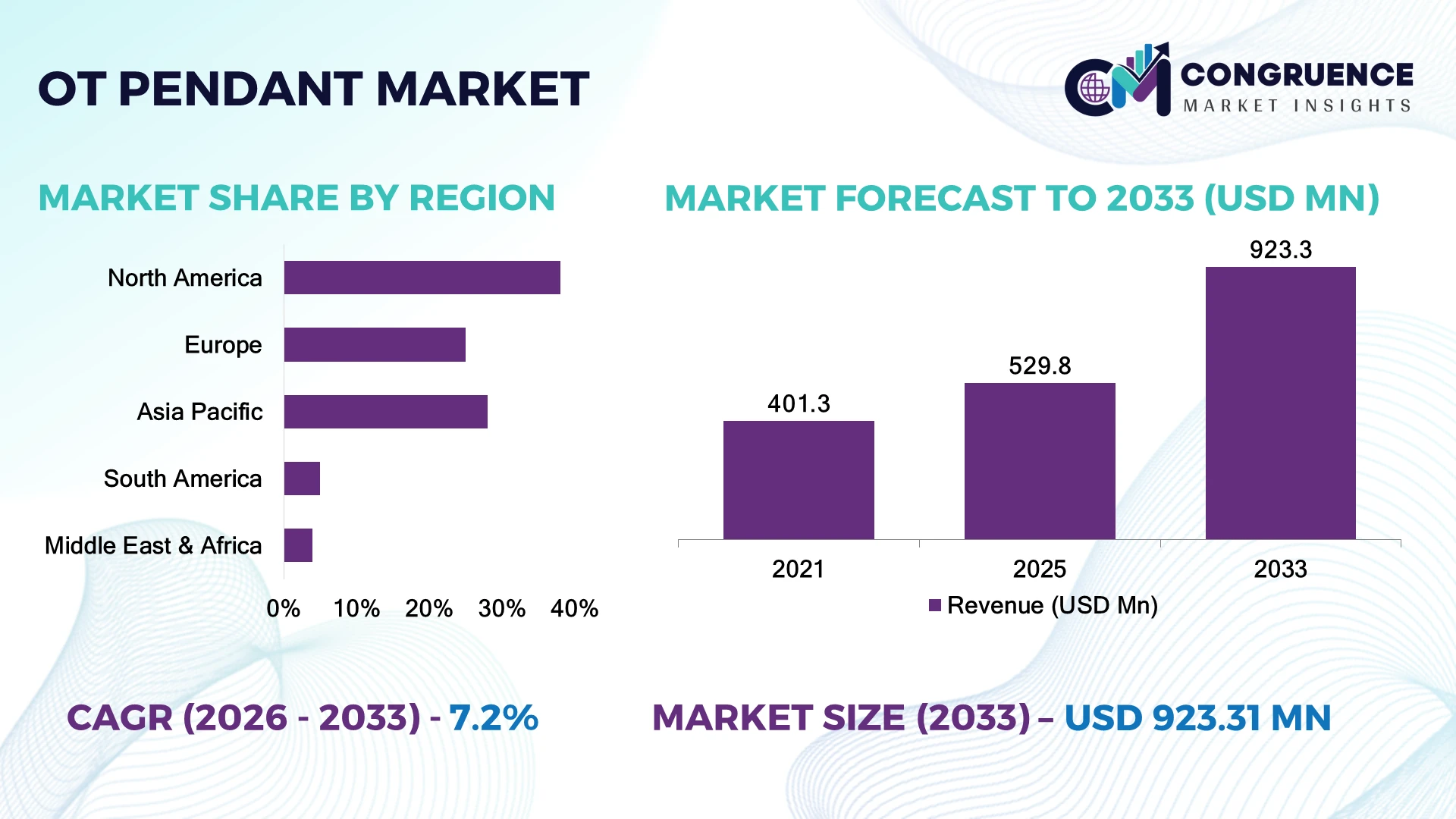
The Global OT Pendant Market was valued at USD 529.8 Million in 2025 and is anticipated to reach a value of USD 923.3 Million by 2033 expanding at a CAGR of 7.19% between 2026 and 2033. Growth is driven by modular operating room infrastructure, integration of ceiling-mounted surgical systems, and rising adoption of digitally connected OT environments.
The United States accounted for nearly 35% of global OT pendant installations in 2025, supported by advanced hospital infrastructure, robotic surgery expansion, and investments in smart operating rooms exceeding USD 100 billion annually across healthcare facilities. Germany and Japan followed with strong adoption in high-precision surgical centers, while China recorded over 20% year-on-year growth in hospital modernization projects. U.S. installations remain more technology-intensive, with higher integration of automation and imaging connectivity compared with emerging Asian markets. Healthcare providers are prioritizing intelligent OT layouts to improve surgical efficiency, safety, and long-term asset utilization.
Strategic implication Manufacturers with connected, modular, and energy-efficient OT pendant solutions are positioned to capture premium hospital modernization programs worldwide.
Market Size & Growth: USD 529.8 Million (2025) to USD 923.3 Million (2033) at 7.19% CAGR, driven by smart operating room infrastructure upgrades and digital surgical integration.
Top Growth Drivers: Smart hospital adoption (35%), minimally invasive surgery expansion (28%), and modular OT investments (22%) accelerate global demand.
Short-Term Forecast: By 2028, connected OT systems reduce workflow delays by 20% and improve equipment accessibility efficiency by 25%.
Emerging Technologies: AI-assisted surgical workflows, automated positioning systems, and IoT-enabled medical pendants reshape advanced operating rooms.
Regional Leaders: North America reaches USD 330 Million with robotic surgery adoption; Europe reaches USD 250 Million with hospital modernization; Asia-Pacific reaches USD 260 Million with new healthcare infrastructure.
Consumer/End-User Trends: Over 60% of newly built premium hospitals prioritize integrated ceiling-mounted OT solutions over traditional mobile equipment systems.
Pilot/Case Example: In 2024, smart OT deployments in European hospitals achieved approximately 18% improvement in equipment management efficiency.
Competitive Landscape: Leading suppliers hold around 40% combined market influence, including Getinge, Steris, Skytron, Trumpf Medical, and Dräger.
Regulatory & ESG Impact: Energy-efficient OT infrastructure reduces operational energy consumption by nearly 15% while supporting green hospital certification goals.
Investment & Funding: Healthcare infrastructure investments surpassed USD 120 billion globally in 2025, increasing partnerships for smart surgical environments.
Innovation & Future Outlook: Next-generation OT pendants integrate AI diagnostics, automated movement control, and cloud-connected hospital management platforms.
The OT Pendant Market is evolving beyond equipment support systems into intelligent surgical infrastructure, with hospitals increasingly demanding ergonomic designs, integrated medical gas management, and digitally optimized workflows. More than 55% of new operating room projects emphasize flexible ceiling solutions to support changing surgical requirements. Supply-chain localization and advanced manufacturing investments are becoming important as healthcare providers seek reliable equipment availability and faster installation cycles.
The OT Pendant Market is becoming strategically important as hospitals transition from conventional operating rooms toward digitally connected surgical ecosystems. Increasing healthcare infrastructure modernization in countries such as India, China, and Saudi Arabia is accelerating demand for modular operating environments that improve workflow control and patient safety.
A major market shift is the restructuring of medical equipment supply chains, with manufacturers expanding regional production networks to reduce dependency on single-source suppliers. Advanced motorized OT pendants provide improved positioning accuracy and operational flexibility compared with manual systems, reducing setup time by nearly 30% while improving surgical team efficiency.
North America maintains leadership through high adoption of robotic surgery and integrated operating theaters, while Asia-Pacific demonstrates faster deployment through large-scale hospital construction programs. China’s healthcare modernization initiatives and India’s expansion of private hospital networks are increasing demand for scalable OT infrastructure.
Hospitals are deploying ceiling-mounted pendants in hybrid operating rooms where imaging systems, anesthesia equipment, and surgical devices require optimized space utilization. Companies are responding through strategic partnerships, localized manufacturing, and software-enabled solutions. Competitive advantage increasingly depends on delivering connected, reliable, and adaptable operating room platforms.
Growing adoption of advanced surgical infrastructure is the primary driver for OT pendant demand, supported by smart hospital investments and increasing surgical automation. More than 35% of newly constructed premium operating rooms incorporate integrated ceiling-mounted equipment systems, while robotic-assisted procedures have expanded by over 25% in major healthcare markets. The United States and Germany are accelerating investments in digitally connected operating rooms to improve surgical workflow efficiency. Companies are responding by developing modular pendants with integrated data connectivity, medical gas systems, and automated positioning features. The shift toward flexible operating room layouts is creating demand for solutions that maximize space utilization and reduce equipment management complexity.
High capital requirements and complex installation procedures restrict adoption among smaller hospitals and developing healthcare facilities. Advanced OT pendant systems can increase operating room infrastructure costs by 20–30% compared with traditional equipment arrangements. Countries with limited healthcare modernization budgets face challenges related to skilled installation teams, maintenance availability, and imported component dependency. Supply-chain disruptions affecting precision mechanical parts and medical-grade electronics continue to pressure procurement timelines. Manufacturers are reducing these barriers through localized production, long-term service contracts, and standardized modular designs that lower installation complexity and improve lifecycle cost management.
The expansion of digital healthcare ecosystems creates significant opportunities for intelligent OT pendant manufacturers. IoT-enabled surgical equipment adoption is increasing by more than 30% in advanced hospitals, creating demand for connected ceiling systems capable of supporting real-time data exchange. Emerging markets including India, Brazil, and Southeast Asian countries are investing heavily in new surgical facilities and private hospital networks. Artificial intelligence integration, automated equipment tracking, and predictive maintenance platforms are opening new value streams. Companies are positioning through R&D partnerships, software integration, and ecosystem development to transform OT pendants from passive infrastructure into active surgical management platforms.
Long-term market expansion faces challenges from interoperability requirements, cybersecurity risks, and increasing complexity of connected medical environments. Nearly 40% of hospitals implementing digital surgical systems identify integration between devices and hospital networks as a major operational concern. The growing use of IoT-enabled medical equipment increases exposure to cybersecurity threats and requires stronger data protection frameworks. Healthcare providers in the United States and Europe are demanding compliance-ready solutions with secure connectivity features. Companies must invest in cybersecurity architecture, workforce training, and standardized communication protocols to maintain deployment reliability and competitive differentiation in increasingly digital operating rooms.
Motorized Workflow Optimization: Hospitals are increasingly deploying motorized OT pendants with automated positioning, reducing equipment adjustment time by 25% and improving surgical preparation efficiency by nearly 20%. Large healthcare networks in the United States are integrating ceiling-mounted systems into hybrid operating rooms to manage complex procedures. Companies are responding by scaling automation capabilities, adding remote-control functions, and partnering with digital surgical platform providers to improve operating room productivity.
Integrated Digital Connectivity: Connected OT pendants are gaining traction as hospitals prioritize real-time equipment monitoring, with IoT-enabled medical infrastructure adoption increasing by more than 30% in advanced healthcare facilities. Germany and Japan are expanding smart hospital programs where data-enabled surgical environments improve asset tracking and workflow visibility. Manufacturers are restructuring product portfolios around network compatibility, cybersecurity features, and centralized control systems.
Modular Infrastructure Expansion: Flexible operating room designs are becoming a key procurement focus, with modular OT solutions accounting for over 45% of new premium surgical facility installations. Healthcare developers in India and China are adopting scalable pendant configurations to support changing surgical requirements. This shift is reducing renovation costs by approximately 15% and encouraging manufacturers to develop customizable platforms with faster installation capabilities.
Supply Chain Localization Shift: Medical equipment supply disruptions have accelerated regional manufacturing strategies, with more than 20% of suppliers expanding local assembly or component sourcing initiatives since 2024. Hospitals are prioritizing shorter delivery cycles and reliable maintenance support, especially for critical surgical infrastructure. Companies are responding through supplier diversification, regional partnerships, and inventory optimization programs to strengthen operational resilience.
Motorized OT pendants represent the leading type segment, accounting for approximately 55% of the market due to superior positioning accuracy, ergonomic benefits, and compatibility with digitally integrated operating rooms. Their ability to support complex surgical workflows, including robotic-assisted procedures and hybrid operating environments, has increased adoption among large hospitals. Manual and fixed OT pendant systems continue serving cost-sensitive facilities, particularly in emerging healthcare markets, but their growth is constrained by limited flexibility. Motorized systems are also the fastest-growing segment, supported by demand for automated movement control and improved surgical efficiency. Adoption has increased by nearly 30% in premium hospitals, while automated positioning features reduce equipment handling requirements by around 20%. Companies are prioritizing R&D investments, expanding smart pendant portfolios, and developing software-connected systems to capture demand from modern surgical infrastructure projects.
Hybrid operating rooms represent the leading application segment, capturing nearly 45% market share due to increasing demand for integrated imaging, surgical equipment, and anesthesia management systems. These environments require advanced OT pendants capable of optimizing space utilization and supporting multidisciplinary procedures. Conventional operating rooms remain a significant application area, especially in hospitals upgrading existing infrastructure, while specialized surgical centers are emerging as the fastest-growing segment. Advanced surgical centers are increasing adoption of intelligent pendant systems by more than 35% as minimally invasive procedures expand. Companies are adapting through customized solutions, integration partnerships, and installation services designed for complex clinical workflows. Emergency and outpatient surgical applications are also gaining relevance as healthcare providers seek flexible equipment configurations and faster procedure turnover.
Hospitals account for the largest end-user segment with approximately 65% market share, driven by high procedure volumes, operating room expansion programs, and demand for integrated surgical infrastructure. Large public and private hospitals prioritize OT pendant systems due to their ability to improve workflow organization and reduce equipment congestion. Ambulatory surgical centers represent the fastest-growing end-user category, with adoption increasing by nearly 30% as outpatient procedures expand globally. Research institutions and specialty clinics maintain steady demand through advanced surgical research and specialized treatment programs. Companies are targeting hospitals through long-term service contracts, customized installation packages, and technology partnerships, while ambulatory centers are being addressed with compact and cost-efficient solutions. Future demand is shifting toward healthcare facilities requiring flexible, scalable, and digitally connected operating environments.
North America accounted for the largest market share at 38% in 2025 however, Asia-Pacific is expected to register the fastest growth, expanding at a CAGR of 8.1% between 2026 and 2033.

North America accounted for 38% of the global OT pendant market in 2025, supported by advanced healthcare infrastructure, high surgical procedure volumes, and rapid adoption of digitally connected operating rooms. The United States represents the largest deployment hub due to extensive hospital modernization programs, robotic surgery expansion, and strong demand for hybrid operating environments. More than 60% of premium operating rooms in major healthcare systems are integrating advanced ceiling-mounted equipment management solutions. Hospitals are prioritizing ergonomic layouts, automation, and improved workflow control, while manufacturers are expanding partnerships with healthcare networks and investing in intelligent pendant systems.
United States Market Outlook: The United States remains the most influential country market due to its advanced healthcare ecosystem, strong medical technology adoption, and concentration of large hospital networks. More than 70% of advanced surgical facilities are prioritizing operating room technology upgrades, creating demand for automated OT pendant solutions, connected equipment platforms, and integrated surgical infrastructure.
Europe accounted for approximately 25% of the global OT pendant market in 2025, supported by hospital renovation programs, strict healthcare infrastructure standards, and increasing demand for efficient surgical environments. Germany, France, and the United Kingdom represent major deployment centers, with Germany maintaining a strong position due to its medical equipment manufacturing capabilities and engineering expertise. Nearly 50% of newly upgraded operating rooms in Western Europe emphasize modular surgical infrastructure and flexible equipment configurations. Sustainability requirements, energy-efficient hospital designs, and regulatory compliance are influencing procurement strategies. Companies are strengthening regional manufacturing capabilities, expanding service networks, and developing customized OT pendant systems aligned with modern healthcare facility requirements.
Germany Market Outlook: Germany leads European adoption through its advanced healthcare infrastructure, precision manufacturing ecosystem, and strong medical technology industry. More than 40% of hospitals implementing advanced surgical upgrades are focusing on integrated operating room solutions, supporting demand for automated, durable, and digitally connected OT pendant systems.
Asia-Pacific accounted for approximately 28% of the global OT pendant market in 2025 and is positioned as the fastest-expanding market due to healthcare infrastructure development, rising surgical demand, and increasing investment in modern hospitals. China, India, Japan, and South Korea are driving regional deployment, with China contributing through large-scale hospital construction and domestic medical equipment manufacturing. More than 30% of newly planned hospitals in developing Asian economies include advanced operating room infrastructure requirements. Local production expansion and supply-chain localization are improving product availability and reducing dependency on imported systems. Companies are increasing manufacturing capacity, forming distribution partnerships, and developing cost-efficient solutions tailored to emerging healthcare providers.
China Market Outlook: China represents the largest Asia-Pacific country market due to extensive hospital development, domestic medical equipment production, and government-backed healthcare modernization programs. More than 20% annual growth in advanced hospital infrastructure projects is increasing demand for integrated OT solutions and encouraging manufacturers to expand intelligent pendant production capabilities.
South America accounted for approximately 5% of the global OT pendant market in 2025, with demand concentrated in Brazil, Argentina, and Chile. The market is supported by private hospital expansion, surgical facility upgrades, and increasing adoption of advanced operating room systems in major urban centers. Brazil represents the primary deployment hub due to its large healthcare network and growing private healthcare sector. Approximately 15% of newly upgraded private hospitals in key metropolitan areas are incorporating advanced operating room equipment solutions. However, import dependence and infrastructure limitations affect deployment speed across smaller healthcare facilities. Companies are addressing these challenges through regional distributors, localized maintenance support, and flexible procurement models.
Brazil Market Outlook: Brazil remains the most strategically significant South American market due to its healthcare scale, private hospital investments, and expanding surgical infrastructure. More than 10% of premium healthcare facilities in major cities have adopted advanced operating room equipment systems, creating opportunities for manufacturers offering scalable and service-supported OT pendant solutions.
Middle East & Africa accounted for approximately 4% of the global OT pendant market in 2025, supported by healthcare modernization programs, new hospital construction, and investments in advanced medical facilities. Gulf countries, particularly Saudi Arabia and the United Arab Emirates, represent the strongest demand centers due to smart healthcare initiatives and high-end surgical infrastructure development. More than 25% of new hospital projects in leading Gulf markets incorporate advanced operating room technologies. African markets are gradually improving adoption through international healthcare partnerships and infrastructure development programs. Companies are expanding regional presence through project-based deployments, strategic collaborations, and customized solutions designed for large healthcare developments.
Saudi Arabia Market Outlook: Saudi Arabia represents the leading Middle East & Africa country market due to healthcare transformation initiatives, hospital expansion projects, and investment in advanced surgical facilities. The country’s healthcare development programs include more than 100 major hospital projects, increasing demand for automated OT systems, integrated surgical infrastructure, and advanced equipment management solutions.
The OT pendant market features competition between global medical equipment leaders such as Getinge, Steris, Dräger, and Trumpf Medical against regional manufacturers competing through cost efficiency and customization. OEMs focus on advanced motorized systems, integration capabilities, and service networks, while local suppliers compete through faster delivery and localized support. The top five players collectively account for approximately 40% of market share, creating a moderately consolidated structure. Competition is driven by technology differentiation, with automated positioning systems improving workflow efficiency by 20–30%, while modular designs reduce installation complexity by nearly 15%. Companies are expanding through hospital partnerships, regional manufacturing, and integrated operating room platforms. The market is shifting toward connected surgical ecosystems, increasing pressure on traditional equipment suppliers. High certification requirements, technical expertise, and hospital procurement relationships create entry barriers. Winning requires combining automation, customization, reliable supply chains, and strong clinical integration capabilities.
STERIS plc
Drägerwerk AG & Co. KGaA
Trumpf Medical
Skytron LLC
KLS Martin Group
Ondal Medical Systems GmbH
Brandon Medical Co Ltd
BeaconMedaes
Merivaara Corp
Surgiris SAS
Mindray Medical International Limited
The OT pendant market is moving from conventional fixed systems toward motorized, digitally connected, and automation-enabled platforms. Motorized pendants improve positioning accuracy by nearly 30% compared with manual systems, while IoT-enabled solutions support real-time equipment monitoring across more than 40% of advanced operating room projects. These technologies improve workflow coordination, reduce setup delays, and strengthen surgical environment management.
Artificial intelligence integration, automated movement control, and cloud-based hospital connectivity are emerging technologies shaping future operating rooms. AI-assisted workflow systems can improve equipment utilization efficiency by approximately 20%, while predictive maintenance platforms reduce unexpected downtime by nearly 15%. Compared with traditional equipment management approaches, connected OT infrastructure provides faster operational visibility and improved resource allocation.
From 2026 to 2028, competitive advantage will shift toward manufacturers offering integrated surgical ecosystems rather than standalone pendants. Global OEMs benefit from technology leadership and hospital partnerships, while regional suppliers gain opportunities through cost-efficient customization. Companies investing in cybersecurity, interoperability, and automation capabilities will strengthen their position as healthcare providers prioritize intelligent operating room transformation.
October 2025 Getinge partnered with Philips to introduce an integrated anesthesia workstation combining anesthesia delivery and patient monitoring technologies for operating rooms. The solution improved connectivity and reduced workflow complexity through real-time clinical insights. The development strengthened Getinge’s strategy toward integrated surgical ecosystems. Source: www.getinge.com
December 2024 Getinge supported the development of two advanced multi-modality hybrid operating rooms at ASST Sette Laghi Hospital in Italy through collaboration with Siemens Healthineers. The installation included Maquet Moduevo ceiling supply units and digital integration systems, expanding hybrid OR capabilities. Source: www.news.cision.com
May 2025 Dräger India collaborated with Breach Candy Hospital to introduce state-of-the-art modular operation theatres, expanding advanced surgical infrastructure deployment. The project strengthened adoption of integrated medical technology solutions and supported modernization of hospital operating environments through modular healthcare design. Source: www.draeger.com
January 2025 TRUMPF introduced a VCSEL-based optoacoustic medical imaging solution with iThera Medical, reducing light-source-related cost, volume, and power consumption by up to 100 times compared with existing systems. The innovation highlighted TRUMPF’s expansion into compact medical technology applications.
The OT Pendant Market Report covers comprehensive analysis across product types, applications, end-users, regional markets, technology trends, competitive positioning, and strategic growth opportunities. The study evaluates motorized, fixed, and modular pendant systems across operating rooms, hybrid surgical environments, specialty centers, and healthcare facilities. It analyzes adoption patterns among hospitals, ambulatory surgical centers, research institutions, and specialty clinics.
The report provides regional insights across North America, Europe, Asia-Pacific, South America, and Middle East & Africa, highlighting deployment concentration, infrastructure development, manufacturing trends, and emerging opportunities. It examines connected operating room technologies, automation, IoT integration, and intelligent workflow solutions while assessing competitive strategies of key industry participants. The analysis supports investment planning, expansion decisions, partnership strategies, and long-term positioning in the evolving surgical infrastructure ecosystem.
| Report Attribute / Metric | Details |
|---|---|
| Market Revenue (2025) | USD 529.8 Million |
| Market Revenue (2033) | USD 923.3 Million |
| CAGR (2026–2033) | 7.19% |
| Base Year | 2025 |
| Forecast Period | 2026–2033 |
| Historic Period | 2021–2025 |
| Segments Covered |
By Type
By Application
By End-User
|
| Key Deliverables | Revenue Forecast; Market Trends; Growth Drivers & Restraints; Technology Insights; Segmentation Analysis; Regional Insights; Competitive Landscape; Regulatory & ESG Overview; Recent Developments |
| Regions Covered | North America; Europe; Asia-Pacific; South America; Middle East & Africa |
| Companies Profiled | Getinge AB; STERIS plc; Drägerwerk AG & Co. KGaA; Trumpf Medical; Skytron LLC; KLS Martin Group; Ondal Medical Systems GmbH; Brandon Medical Co Ltd; BeaconMedaes; Merivaara Corp; Surgiris SAS; Mindray Medical International Limited |
| Customization & Pricing | Available on Request (10% Customization Free) |




