
Reports
The Global Orthopedic Surgical Power Tools Market was valued at USD 162.0 Million in 2025 and is anticipated to reach a value of USD 199.4 Million by 2033 expanding at a CAGR of 2.63% between 2026 and 2033. Growth is driven by rising adoption of battery-powered surgical systems, minimally invasive orthopedic procedures, and advanced precision tools that improve surgical accuracy and operating room efficiency.
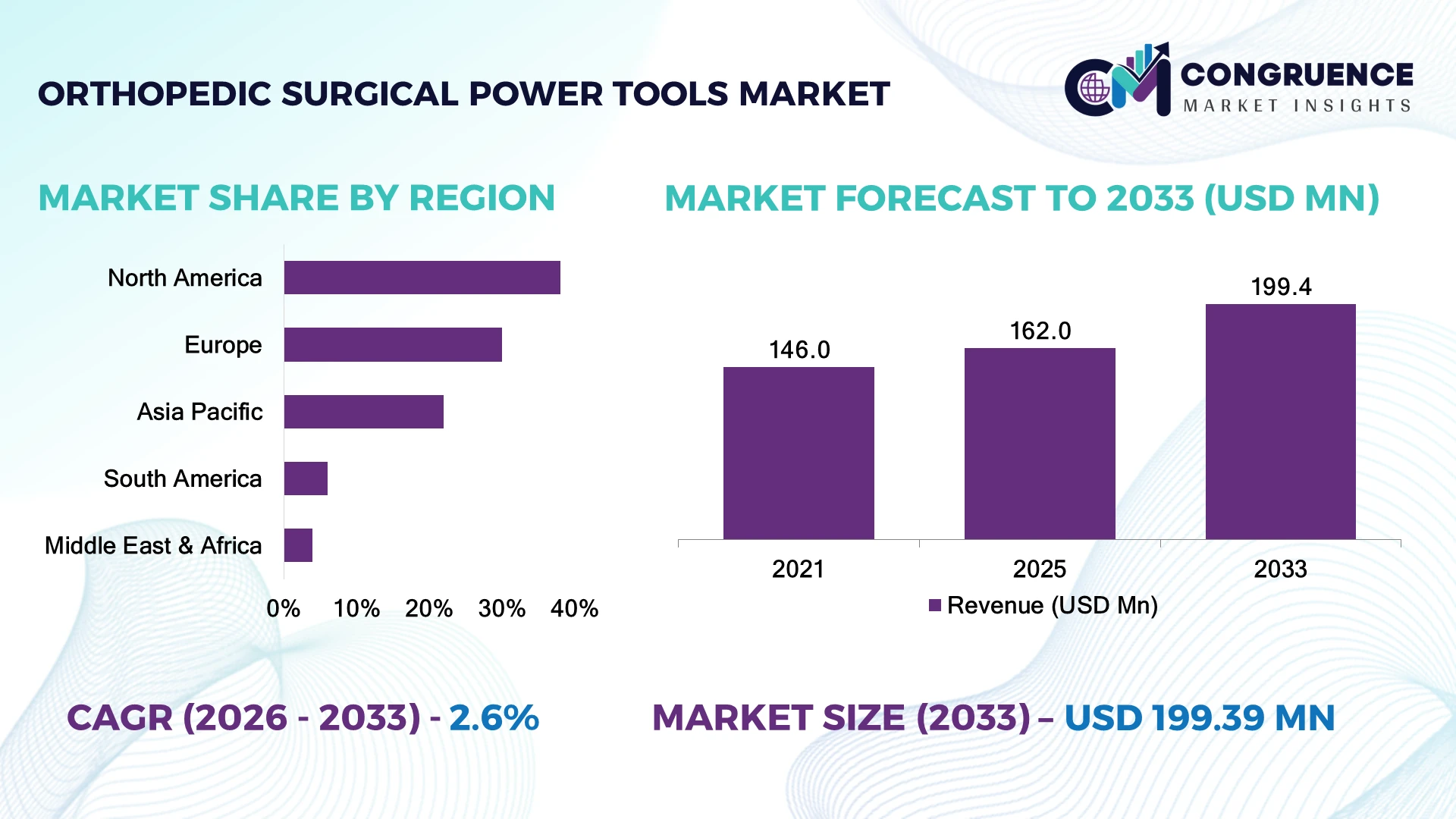
The United States dominates the market with approximately 38% share, supported by strong orthopedic infrastructure, high surgical volumes, and investments in robotic-assisted procedures. The country performs over 1 million joint replacement surgeries annually, while China is accelerating adoption through hospital modernization programs and domestic medical device expansion. U.S. adoption of advanced surgical equipment remains nearly 25% higher than emerging markets, strengthening its technology leadership.
Strategic investments in intelligent surgical platforms and localized manufacturing will define competitive positioning.
Market Size & Growth: USD 162.0 Million in 2025 to USD 199.4 Million by 2033 at 2.63% CAGR, driven by battery-powered systems and precision surgical technologies.
Top Growth Drivers: Minimally invasive procedures (35%), orthopedic trauma cases (28%), and robotic-assisted surgery adoption (22%).
Short-Term Forecast: By 2028, advanced power tools reduce procedure time by 15% and improve surgical workflow efficiency by 20%.
Emerging Technologies: AI-assisted surgical navigation, cordless power systems, and lightweight composite materials are reshaping orthopedic procedures.
Regional Leaders: North America reaches USD 75 Million with robotic adoption; Europe reaches USD 55 Million with digital operating rooms; Asia-Pacific reaches USD 50 Million with hospital modernization.
Consumer/End-User Trends: Over 60% of orthopedic surgeons prefer ergonomic and cordless systems for improved procedural control.
Pilot/Case Example: In 2024, hospitals adopting automated surgical workflows reported up to 18% reduction in operating room preparation time.
Competitive Landscape: Stryker leads with approximately 25% share, followed by Zimmer Biomet, DePuy Synthes, Medtronic, and CONMED.
Regulatory & ESG Impact: Energy-efficient devices and reusable systems reduce medical waste by nearly 20% under sustainability-focused hospital policies.
Investment & Funding: More than USD 500 Million invested globally in orthopedic technology partnerships, automation, and surgical device innovation.
Innovation & Future Outlook: Next-generation smart drills, connected surgical platforms, and AI-enabled assistance systems will strengthen long-term competitive differentiation.
Orthopedic surgical power tools are becoming essential components of modern operating rooms as hospitals prioritize precision, efficiency, and digitally integrated surgical environments. Demand is increasing across joint reconstruction, trauma fixation, and spinal procedures, with cordless systems achieving more than 30% adoption growth in advanced healthcare facilities. Supply-chain localization strategies following global medical device disruptions are encouraging manufacturers to expand regional production and strengthen component availability, creating a transition toward more resilient orthopedic technology ecosystems.
The Orthopedic Surgical Power Tools Market is becoming strategically important as healthcare providers shift toward precision-driven surgery, advanced instrumentation, and digitally connected operating rooms. Hospitals are increasing investments in ergonomic, battery-operated, and intelligent surgical systems to improve workflow consistency and reduce procedure complexity.
Supply-chain restructuring after global medical equipment shortages is accelerating regional manufacturing and supplier diversification. Modern cordless orthopedic systems provide approximately 15–20% better operating efficiency compared with traditional wired systems by reducing setup requirements and improving surgeon mobility. The United States continues leading innovation through high-value orthopedic centers, while India and China are expanding adoption through healthcare infrastructure upgrades and domestic device manufacturing initiatives.
Over the next 2–3 years, companies are prioritizing partnerships, localized production, and AI-supported surgical platforms. For example, hospitals integrating advanced orthopedic equipment are improving operating room utilization through faster instrument preparation and standardized procedures. Strategic positioning will depend on manufacturers’ ability to combine surgical precision, digital connectivity, supply resilience, and cost-effective deployment models.
Growing adoption of precision orthopedic procedures is accelerating demand for advanced power tools. Minimally invasive orthopedic surgeries account for more than 40% of procedure innovation initiatives, while cordless device adoption has increased by nearly 30% across developed healthcare systems. Regulatory emphasis on safer surgical technologies and improved infection control is encouraging hospitals to upgrade equipment. Companies are responding through investments in lightweight designs, battery efficiency improvements, and partnerships with orthopedic implant manufacturers. The shift toward digitally integrated operating rooms is creating demand for connected surgical platforms that provide better procedural control and operational visibility.
High acquisition costs and maintenance requirements limit adoption among smaller hospitals and developing healthcare facilities. Advanced orthopedic power systems can require 20–30% higher investment compared with conventional instruments, affecting procurement decisions. Dependence on specialized components and global supply networks creates additional cost pressure, particularly after medical device supply disruptions. Companies are reducing risks through regional manufacturing, long-term supplier agreements, and modular product designs. Strategic pricing models and service-based equipment offerings are becoming important approaches for expanding accessibility without reducing technology quality.
Integration of digital technologies creates significant opportunities for orthopedic power tool manufacturers. AI-assisted navigation, robotic surgery compatibility, and connected instrumentation are gaining traction, with digital operating room adoption increasing by more than 25% in leading healthcare markets. Countries such as Japan and Germany are expanding smart hospital infrastructure, creating demand for advanced surgical ecosystems. Companies are investing in software-enabled tools, research partnerships, and automated workflow solutions. The strongest opportunity lies in combining hardware precision with data-driven surgical intelligence to improve outcomes and strengthen long-term customer relationships.
Deployment complexity remains a key challenge as hospitals require skilled personnel, infrastructure readiness, and interoperability with existing surgical systems. Nearly 30% of healthcare facilities in emerging markets face equipment integration barriers due to limited technical resources. Increasing cybersecurity requirements for connected medical devices add additional operational pressure. Companies must address these challenges through surgeon training programs, simplified interfaces, cybersecurity investment, and stronger service networks. Long-term competitiveness will depend on creating reliable technology ecosystems that support consistent performance across diverse healthcare environments.
Cordless System Adoption Growth: Hospitals are accelerating the shift toward battery-powered orthopedic tools, with cordless system usage increasing by nearly 30% in advanced surgical centers. Improved mobility, reduced setup time by approximately 15%, and fewer cable-related workflow disruptions are driving adoption. Companies are expanding rechargeable platforms and forming hospital partnerships to improve surgical efficiency and equipment reliability.
Smart Surgical Integration: Digital connectivity is reshaping orthopedic workflows as more than 25% of newly installed surgical platforms incorporate navigation, data tracking, or automated assistance features. The transition toward connected operating rooms, supported by healthcare digitization programs in countries such as Germany and Japan, is improving procedural accuracy and inventory management. Manufacturers are investing in software-enabled instruments and integrated surgical ecosystems.
Supply Chain Localization Shift: Medical device manufacturers are restructuring supply networks after global component shortages affected equipment availability. More than 20% of leading orthopedic device companies have expanded regional sourcing strategies to improve component security and production flexibility. Companies are increasing manufacturing partnerships in the United States and Asia to reduce dependency risks and maintain faster delivery cycles.
Ergonomic Design Transformation: Surgeon preference is shifting toward lightweight and ergonomic instruments, with approximately 40% of orthopedic professionals prioritizing improved handling and reduced fatigue. Labor shortages among specialized surgical teams are increasing demand for easier-to-operate systems. Manufacturers are responding through advanced materials, compact designs, and automation-focused product development to enhance operating room productivity.
Battery-powered orthopedic surgical power tools represent the leading type segment, accounting for approximately 45% of the market due to superior mobility, reduced operating room constraints, and improved procedural flexibility. Cordless systems are increasingly preferred in trauma and joint reconstruction procedures, with adoption rising by nearly 30% among hospitals upgrading surgical infrastructure. Electric-powered systems continue maintaining relevance because of reliability and established clinical acceptance, while pneumatic systems remain important in specialized applications requiring consistent power delivery. The fastest-growing segment is advanced battery-operated platforms integrated with digital monitoring capabilities. Demand is increasing as hospitals prioritize workflow optimization, with nearly 20% improvement in equipment handling efficiency reported in modern surgical environments. Companies are focusing on longer battery life, lightweight designs, and compatibility with smart surgical platforms to strengthen competitive positioning. Investment priorities are shifting toward intelligent, ergonomic systems rather than conventional standalone equipment.
Joint reconstruction applications lead the orthopedic surgical power tools market with approximately 40% share, supported by high procedure volumes for hip and knee replacement surgeries. Demand concentration is driven by aging populations, rising orthopedic disorders, and increasing adoption of precision instruments. Trauma fixation remains a significant application, while spinal procedures and sports medicine applications are expanding through technology-enabled surgical approaches. The fastest-growing application is minimally invasive orthopedic surgery, supported by increasing adoption of navigation-assisted procedures and smaller surgical access techniques. Hospitals are targeting efficiency improvements, with advanced applications reducing instrument preparation requirements by nearly 15%. Companies are adapting through specialized tool development, surgeon training programs, and partnerships with orthopedic implant providers. Emerging markets are increasing investment in orthopedic infrastructure, creating new deployment opportunities for advanced surgical equipment.
Hospitals represent the dominant end-user segment with approximately 55% market share due to higher surgical volumes, advanced infrastructure, and greater investment capacity. Large healthcare systems and academic medical centers account for a significant portion of equipment purchases because of their focus on complex orthopedic procedures and technology upgrades. Ambulatory surgical centers are gaining importance as outpatient orthopedic procedures expand and healthcare providers seek lower-cost treatment models. The fastest-growing end-user group is ambulatory surgical centers, with adoption increasing by nearly 25% as healthcare systems shift selected orthopedic procedures away from traditional hospitals. These facilities prioritize compact, efficient, and easy-to-maintain surgical tools. Companies are responding through flexible pricing models, service agreements, and customized equipment packages. Manufacturers are also strengthening partnerships with healthcare networks to support broader deployment and long-term device utilization.
North America accounted for the largest market share at 38% in 2025 however, Asia-Pacific is expected to register the fastest growth, expanding at a CAGR of 4.1% between 2026 and 2033.
North America holds the leading position in orthopedic surgical power tools due to extensive hospital infrastructure, high orthopedic procedure volumes, and rapid adoption of advanced surgical equipment. The region contributes approximately 38% of global demand, supported by strong purchasing capacity among hospitals and ambulatory surgical centers. The United States represents the primary deployment hub, with more than 1 million joint replacement procedures performed annually. Increasing integration of robotic-assisted surgery and cordless surgical systems is encouraging manufacturers to expand partnerships with healthcare networks. Companies are focusing on ergonomic designs, digital compatibility, and service-based equipment models to strengthen long-term adoption.
United States Market Outlook: The United States remains the largest country market due to advanced healthcare infrastructure, strong medical device manufacturing capabilities, and high surgeon adoption of precision technologies. More than 60% of major orthopedic hospitals are investing in upgraded surgical equipment platforms to improve workflow efficiency. Strong regulatory frameworks and continuous innovation from leading device manufacturers support sustained technology deployment across hospitals and specialty centers.
Europe maintains a strong position in orthopedic surgical power tools through advanced healthcare systems, strict medical device standards, and increasing modernization of operating rooms. The region accounts for nearly 30% of market demand, with Germany, France, and the United Kingdom representing key adoption centers. Sustainability initiatives and healthcare efficiency programs are encouraging hospitals to select durable, energy-efficient, and reusable surgical technologies. More than 25% of European hospitals have expanded digital operating room investments, supporting demand for connected surgical instruments. Companies are strengthening regional partnerships, improving product compliance, and expanding localized service networks to address evolving healthcare requirements.
Germany Market Outlook: Germany leads European adoption due to its advanced medical technology sector, strong hospital infrastructure, and focus on precision-based surgical solutions. The country has one of the highest orthopedic procedure volumes in Europe, with over 300,000 joint replacement procedures performed annually. Strong research capabilities and collaboration between hospitals and device manufacturers continue supporting innovation in surgical power systems.
Asia-Pacific represents the fastest-expanding market due to healthcare infrastructure development, rising orthopedic procedure volumes, and increasing investment in advanced surgical equipment. The region contributes approximately 22% of current market demand, with China, Japan, India, and South Korea driving adoption. Hospital modernization programs and domestic medical device manufacturing initiatives are increasing accessibility to orthopedic technologies. China has expanded medical equipment production capacity, while India is improving specialty healthcare infrastructure through private hospital investments. Companies are responding by establishing local manufacturing, distribution partnerships, and cost-optimized product portfolios. Adoption of battery-powered systems has increased by nearly 25% across leading hospitals in major Asian markets.
China Market Outlook: China represents the largest Asia-Pacific market due to expanding healthcare infrastructure, domestic device production, and increasing orthopedic surgery demand. The country has more than 3,000 tertiary hospitals supporting advanced surgical equipment deployment. Government-backed healthcare modernization programs and local manufacturing expansion are improving access to precision orthopedic technologies.
South America is experiencing gradual adoption of orthopedic surgical power tools as private healthcare networks expand and hospitals upgrade surgical capabilities. Brazil and Argentina account for the majority of regional demand, supported by increasing orthopedic procedures and improving medical infrastructure. The region represents nearly 6% of global demand, with adoption concentrated in urban hospitals and specialty surgical centers. Limited reimbursement coverage and equipment financing challenges continue affecting smaller facilities. Companies are addressing these barriers through distributor partnerships, flexible procurement models, and localized service support. Brazil’s private healthcare sector is increasingly adopting advanced surgical tools, creating opportunities for technology providers.
Brazil Market Outlook: Brazil remains the leading country market in South America due to its large healthcare network, growing orthopedic surgery demand, and expanding private hospital sector. The country has more than 200 million people, creating substantial demand for trauma and joint reconstruction procedures. Manufacturers are strengthening distribution channels and training programs to improve surgical technology adoption.
Middle East & Africa is developing as an emerging market through healthcare modernization projects, private hospital expansion, and government investment in advanced medical infrastructure. The region contributes approximately 4% of global demand, with adoption concentrated in Gulf countries and major urban healthcare centers. Countries such as Saudi Arabia and the UAE are investing in advanced surgical facilities and technology-driven healthcare systems. More than 20% of newly developed premium hospitals in Gulf markets incorporate advanced operating room technologies. Companies are expanding through regional partnerships, training initiatives, and specialized distribution networks to support deployment.
Saudi Arabia Market Outlook: Saudi Arabia represents the most strategically significant market in the region due to healthcare transformation initiatives, hospital modernization, and increasing investment in surgical technology. The country’s healthcare infrastructure expansion includes hundreds of new and upgraded medical facilities under national development programs. Rising orthopedic procedure demand and technology-focused healthcare investments are strengthening opportunities for advanced surgical power tool manufacturers.
The orthopedic surgical power tools market features global leaders such as Stryker, Zimmer Biomet, and DePuy Synthes competing with specialized manufacturers including CONMED and Medtronic. Global OEMs compete against regional suppliers through technology differentiation, surgeon support, and distribution strength. The top five players collectively account for approximately 55% of market share, reflecting moderate consolidation. Competition is driven by cordless innovation, instrument durability, pricing strategies, and service networks, with advanced systems improving workflow efficiency by 15–20%. Companies are expanding through hospital partnerships, product launches, and vertical integration of instruments and accessories. The market is shifting toward connected surgical platforms, battery-powered systems, and customized procedural solutions. High regulatory requirements, clinical validation needs, and established hospital relationships create entry barriers. Winning companies must combine surgical innovation, reliable supply chains, competitive pricing, and strong surgeon-focused ecosystems.
Zimmer Biomet Holdings, Inc.
DePuy Synthes (Johnson & Johnson MedTech)
Medtronic plc
CONMED Corporation
Smith+Nephew plc
Arthrex, Inc.
B. Braun Melsungen AG
Aesculap AG
MicroAire Surgical Instruments, LLC
Adeor Medical AG
Nouvag AG
Orthopedic surgical power tools are transitioning from conventional wired systems toward cordless, intelligent, and digitally connected platforms. Battery-powered systems improve surgeon mobility and reduce preparation delays by approximately 15%, while adoption has increased nearly 30% in advanced hospitals. Companies benefiting most are those integrating ergonomic design, longer battery life, and smart monitoring capabilities into surgical workflows.
AI-assisted navigation and connected operating room technologies are emerging as competitive differentiators. These systems improve procedural accuracy by nearly 20% compared with traditional manual approaches and enable better instrument tracking, workflow analysis, and surgical planning. Hospitals adopting digital platforms are strengthening operational efficiency while reducing equipment management complexity.
Between 2026 and 2028, automation, robotic compatibility, and advanced materials will reshape product strategies. Lightweight composite instruments reduce handling fatigue by approximately 25% compared with older designs. Global leaders are investing in software-enabled ecosystems, while regional manufacturers are competing through cost-efficient production and localized support. Companies acting early on connected surgical technology will gain stronger positions in hospital modernization programs.
June 2026 – Stryker launched the TPX HD® power tool for complex orthopedic procedures, including revisions and minimally invasive surgeries. The system delivers up to 296% more torque and 40% faster performance than TPX Micro Drill, strengthening precision-focused surgical workflows. Source: www.stryker.com
February 2026 – Smith+Nephew announced first clinical cases using the CORI® XT Handheld Robotics Platform across knee and shoulder arthroplasty. The platform expands handheld robotics capabilities across multiple orthopedic applications, improving digital surgical integration and supporting broader hospital adoption strategies. Source: www.smith-nephew.com
October 2025 – Zimmer Biomet completed the acquisition of Monogram Technologies to expand AI-driven orthopedic robotics and navigation capabilities. The transaction strengthened its autonomous technology portfolio and created a broader pathway toward advanced robotic-assisted orthopedic procedures. Source: www.investor.zimmerbiomet.com
August 2025 – CONMED launched BioBrace®RC, an arthroscopic delivery system designed to streamline rotator cuff repair procedures. The technology enables complete augmentation workflows in under 10 minutes, improving surgical efficiency and supporting advanced orthopedic repair techniques.
The Orthopedic Surgical Power Tools Market Report covers comprehensive analysis across product types, applications, end-users, and major geographical markets. The segmentation includes battery-powered systems, electric systems, pneumatic systems, joint reconstruction, trauma procedures, spinal applications, hospitals, ambulatory surgical centers, and specialty clinics. The report evaluates adoption patterns, technology integration, supply-chain developments, and competitive positioning across North America, Europe, Asia-Pacific, South America, and Middle East & Africa.
The study provides strategic insights into digital surgery adoption, cordless instrument deployment, automation trends, and emerging niche opportunities. With analysis of leading companies, technology advancements, and operational shifts, the report supports investment planning, market expansion strategies, partnership decisions, and competitive positioning from 2026 to 2033. It highlights evolving demand patterns and innovation priorities shaping the future orthopedic surgical technology landscape.
| Report Attribute / Metric | Details |
|---|---|
| Market Revenue (2025) | USD 162.0 Million |
| Market Revenue (2033) | USD 199.4 Million |
| CAGR (2026–2033) | 2.63% |
| Base Year | 2025 |
| Forecast Period | 2026–2033 |
| Historic Period | 2021–2025 |
| Segments Covered |
By Type
By Application
By End-User
|
| Key Deliverables | Revenue Forecast; Market Trends; Growth Drivers & Restraints; Technology Insights; Segmentation Analysis; Regional Insights; Competitive Landscape; Regulatory & ESG Overview; Recent Developments |
| Regions Covered | North America; Europe; Asia-Pacific; South America; Middle East & Africa |
| Companies Profiled | Stryker Corporation; Zimmer Biomet Holdings, Inc.; DePuy Synthes (Johnson & Johnson MedTech); Medtronic plc; CONMED Corporation; Smith+Nephew plc; Arthrex, Inc.; B. Braun Melsungen AG; Aesculap AG; MicroAire Surgical Instruments, LLC; Adeor Medical AG; Nouvag AG |
| Customization & Pricing | Available on Request (10% Customization Free) |




