
Reports
The Global Orthopedic Splints Market was valued at USD 246.0 Million in 2025 and is anticipated to reach a value of USD 374.7 Million by 2033 expanding at a CAGR of 5.4% between 2026 and 2033. Growth is primarily driven by rising trauma cases, expanding outpatient orthopedic care, and increasing adoption of lightweight thermoplastic splinting systems across emergency and rehabilitation settings.
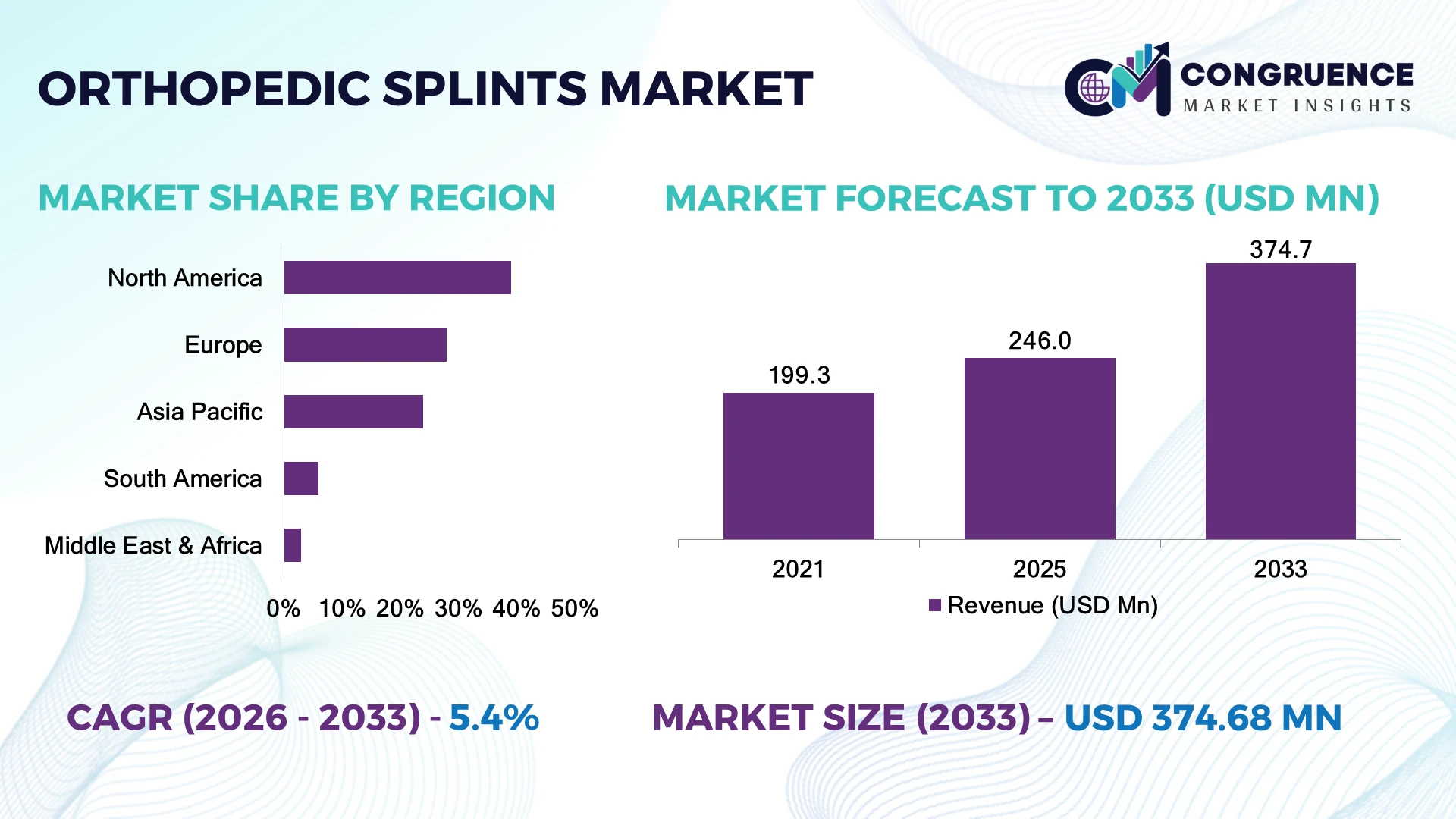
The United States dominates the global orthopedic splints market with approximately 34% share, supported by annual orthopedic procedure volumes exceeding 7 million, strong reimbursement coverage, and sustained investments in ambulatory surgical centers. Compared with Germany, the U.S. records nearly 45% higher adoption of prefabricated splints across emergency departments, while digital imaging integration exceeds 70% in leading trauma facilities. Continued healthcare infrastructure modernization and post-pandemic orthopedic care expansion reinforce its leadership position.
Strategically, manufacturers should prioritize advanced materials, hospital partnerships, and localized production to strengthen competitive positioning across high-volume trauma care networks.
Market Size & Growth: USD 246.0 Million in 2025, projected to reach USD 374.7 Million by 2033, supported by a 5.4% CAGR and rapid adoption of advanced thermoplastic splints.
Top Growth Drivers: Trauma injuries (+18%), sports-related fractures (+14%), outpatient orthopedic procedures (+21%).
Short-Term Forecast: By 2028, customized splint production time is expected to decline by nearly 25% through digital fabrication.
Emerging Technologies: AI-assisted fracture assessment, 3D printing, and lightweight composite materials improve precision and patient comfort.
Regional Leaders: North America (~USD 128 Million), Europe (~USD 86 Million), Asia-Pacific (~USD 72 Million), supported by expanding orthopedic care networks and regional manufacturing.
Consumer/End-User Trends: Nearly 62% of hospitals increasingly prefer prefabricated splints for faster emergency treatment.
Pilot/Case Example: In 2024, hospital-based 3D printed splint deployment reduced patient fitting time by approximately 35%.
Competitive Landscape: Össur leads with an estimated 15% market share alongside DJO, Enovis, DeRoyal Industries, and Breg.
Regulatory & ESG Impact: Recyclable polymer adoption increased by approximately 20% as healthcare providers aligned with sustainability procurement initiatives.
Investment & Funding: More than USD 180 Million has been directed toward orthopedic manufacturing expansion and strategic partnerships amid supply-chain diversification.
Innovation & Future Outlook: Smart patient-specific splints and digital orthopedic workflows are strengthening next-generation treatment capabilities.
Orthopedic splints continue to gain importance across emergency medicine, sports injury management, and post-operative rehabilitation because of faster immobilization and improved patient comfort. Advanced thermoplastic materials, patient-specific 3D printing, and ergonomic designs are accelerating product innovation, while nearly 40% of leading healthcare providers are expanding prefabricated splint inventories. Ongoing medical supply-chain localization further supports stable product availability, setting the stage for broader strategic market developments.
Orthopedic splints have become strategically important as healthcare providers focus on faster trauma response, standardized fracture management, and efficient outpatient treatment pathways. Growing investments in ambulatory surgical centers and emergency care infrastructure are reshaping procurement priorities, while healthcare supply-chain restructuring encourages localized manufacturing to improve product availability and reduce delivery risks.
Modern thermoplastic splints deliver approximately 30% faster fitting and nearly 20% lower material waste than traditional plaster-based alternatives, improving clinical efficiency and patient experience. North America continues to lead large-scale deployment through established orthopedic networks, whereas Asia-Pacific is accelerating adoption through hospital modernization and expanding trauma care capacity. Over the next two to three years, digital orthopedic workflows and customized splint fabrication are expected to become standard practice across an increasing number of tertiary hospitals.
Manufacturers are strengthening partnerships with hospitals, rehabilitation centers, and medical distributors while expanding regional production capabilities. Several companies are integrating digital scanning and additive manufacturing into orthopedic product portfolios to shorten delivery cycles and improve customization. Organizations that combine material innovation, localized operations, and advanced clinical solutions will strengthen long-term competitive positioning across the evolving orthopedic care ecosystem.
The increasing incidence of fractures, sports injuries, and road traffic accidents continues to accelerate orthopedic splint adoption across healthcare systems. More than 60% of emergency departments now prioritize prefabricated splints for immediate stabilization, while lightweight thermoplastic products reduce application time by nearly 30%. The United States continues expanding ambulatory orthopedic facilities, supported by healthcare infrastructure investments and digital imaging integration. This structural shift enables faster patient throughput and improved clinical consistency. Manufacturers are responding by expanding production capacity, introducing patient-specific splint systems, and forming distribution partnerships with hospital networks. The resulting operational efficiencies improve treatment quality while strengthening supplier competitiveness in high-volume orthopedic care.
Orthopedic splint manufacturers continue facing procurement challenges due to fluctuating polymer and composite material costs. Imported specialty medical polymers account for nearly 40% of raw material requirements for several manufacturers, while logistics expenses remain approximately 15% above pre-disruption levels in selected markets. Dependence on limited suppliers increases inventory planning complexity and affects production scheduling. Companies are reducing exposure through supplier diversification, regional sourcing strategies, and long-term procurement agreements. Several manufacturers are also increasing localized production to stabilize costs and improve supply continuity. Operational resilience has become an essential competitive factor for sustaining consistent product availability.
Rapid adoption of digital scanning, additive manufacturing, and advanced biomaterials is creating new opportunities for customized orthopedic splints. Patient-specific production improves anatomical fit while reducing adjustment requirements by nearly 35%, and digital workflows shorten manufacturing cycles by approximately 25%. Japan and South Korea are expanding investments in advanced medical manufacturing and hospital digitalization, encouraging broader clinical implementation. Companies are strengthening research collaborations, investing in 3D printing technologies, and developing integrated orthopedic solution platforms. The combination of digital customization and automated production enables stronger differentiation while opening new opportunities in specialized trauma and rehabilitation care.
Expanding advanced splint technologies across large healthcare systems remains operationally complex due to workforce training requirements, digital integration, and manufacturing standardization. Approximately 45% of mid-sized hospitals continue operating with conventional orthopedic workflows, while implementation timelines for digital production systems can extend beyond 12 months. Integration with hospital imaging platforms and clinical documentation systems requires significant technical coordination. Companies are investing in clinician education, software interoperability, and regional technical support centers to improve deployment consistency. Successfully overcoming these operational barriers will determine long-term competitiveness and the ability to deliver standardized, high-quality orthopedic solutions at scale.
Smart Thermoplastic Material Adoption: Advanced low-temperature thermoplastic splints now account for nearly 58% of newly procured immobilization products in large hospitals, while application time has declined by approximately 28%. Updated clinical protocols emphasizing rapid fracture stabilization and improved patient comfort are accelerating deployment. Manufacturers are expanding automated production lines, introducing recyclable material formulations, and strengthening hospital supply agreements to improve product availability and reduce operational delays.
Rapid Expansion of Digital Fabrication: Healthcare providers are increasingly integrating 3D scanning with additive manufacturing, reducing custom splint fitting time by almost 35% and lowering material waste by nearly 22%. Workforce shortages in orthopedic departments are encouraging greater workflow automation and digital design adoption. Companies are investing in cloud-based design platforms, expanding technical partnerships, and scaling localized manufacturing capabilities to shorten delivery cycles while improving treatment consistency.
Localized Medical Supply Networks: Following global logistics disruptions, more than 40% of orthopedic manufacturers have expanded regional sourcing strategies, while inventory lead times have improved by nearly 18%. The United States and Germany are increasing domestic medical manufacturing to strengthen procurement resilience. Companies are restructuring supplier networks, establishing multi-country production hubs, and diversifying component sourcing to improve operational continuity and reduce dependence on single-market suppliers.
Outpatient Care Transformation: Nearly 63% of routine fracture immobilization procedures are now performed through outpatient clinics and ambulatory care centers, improving patient throughput by approximately 26%. Rising adoption of standardized prefabricated splints is streamlining emergency workflows and reducing treatment delays. Manufacturers are developing clinic-focused product portfolios, expanding distributor partnerships, and introducing modular splint systems that simplify inventory management while supporting high-volume orthopedic care.
Prefabricated splints represent the leading segment with an estimated 61% market share, supported by rapid application, standardized sizing, and widespread use across emergency departments and trauma centers. Their ability to reduce immobilization time by nearly 30% compared with conventional alternatives makes them the preferred choice for acute fracture management. Custom-made splints are the fastest-growing segment as digital scanning, lightweight thermoplastic materials, and patient-specific treatment protocols gain broader clinical acceptance. Hospitals in the United States and Japan are increasingly integrating customized orthopedic solutions to improve patient outcomes and reduce follow-up adjustments. Traditional plaster splints continue serving cost-sensitive healthcare facilities and temporary stabilization procedures, while hybrid composite splints are expanding in specialized orthopedic and sports medicine applications because of improved durability and lower weight. Companies are investing in digital fabrication, expanding thermoplastic product portfolios, and strengthening hospital partnerships to capture higher-value clinical applications. Investment priorities increasingly favor customized solutions without replacing the efficiency advantages of prefabricated products.
Fracture management remains the largest application segment, accounting for approximately 56% of overall demand because emergency trauma care requires immediate immobilization and standardized treatment protocols. Growing road traffic injuries and sports-related fractures continue supporting high procedure volumes across hospitals and urgent care facilities. Post-operative support represents the fastest-growing application as orthopedic surgeons increasingly recommend lightweight removable splints that improve patient comfort while simplifying rehabilitation and follow-up care. Soft tissue injury management, ligament stabilization, and pediatric orthopedic applications continue expanding as clinicians emphasize faster recovery and improved mobility. Approximately 48% of orthopedic clinics now maintain dedicated inventories of prefabricated splints for same-day treatment, while customized products are increasingly selected for complex cases. Manufacturers are expanding specialized product lines, improving anatomical designs, and strengthening clinical education programs to address evolving treatment pathways across multiple orthopedic disciplines.
Hospitals remain the dominant end-user, representing approximately 52% of total orthopedic splint demand due to high emergency patient volumes, advanced trauma facilities, and comprehensive orthopedic departments. Large hospital systems continue investing in standardized immobilization protocols that improve workflow efficiency and reduce treatment delays. Ambulatory surgical centers are the fastest-growing end-user segment as outpatient orthopedic procedures increase and same-day fracture care becomes more common across developed healthcare systems. Orthopedic clinics, rehabilitation centers, and specialty sports medicine facilities continue expanding their purchasing activity as patient-specific treatment approaches become more common. Nearly 44% of rehabilitation providers have increased procurement of removable thermoplastic splints to improve long-term patient compliance. Companies are responding through customized pricing programs, distribution partnerships, and targeted product portfolios designed for outpatient care, rehabilitation services, and specialized orthopedic practices, strengthening competitive positioning across diverse healthcare delivery settings.
North America accounted for the largest market share at 39% in 2025 however, Asia-Pacific is expected to register the fastest growth, expanding at a CAGR of 6.7% between 2026 and 2033.
North America represents the largest regional market due to its mature trauma care infrastructure, widespread emergency department utilization, and high adoption of advanced orthopedic immobilization products. More than 65% of major hospitals have integrated standardized fracture management pathways that prioritize prefabricated and thermoplastic splints for rapid stabilization. The region also benefits from strong orthopedic device innovation, digital imaging integration, and extensive ambulatory surgical center networks. Healthcare providers continue expanding same-day orthopedic treatment capabilities, while manufacturers strengthen regional production and distribution capacity to improve supply resilience. Strategic collaborations between medical device companies and hospital systems are accelerating product standardization and expanding access to patient-specific immobilization solutions across both acute and outpatient care environments.
United States Market Outlook: The United States remains the largest national market because of its extensive trauma care network, advanced orthopedic infrastructure, and strong medical device manufacturing ecosystem. More than 7 million orthopedic procedures are performed annually, supporting sustained demand for immobilization products. Hospitals continue expanding outpatient fracture care programs while manufacturers invest in digital production technologies and customized thermoplastic solutions to improve operational efficiency and clinical outcomes.
Europe maintains a strong market position through established healthcare systems, advanced orthopedic practice standards, and growing emphasis on sustainable medical device manufacturing. The region contributes approximately 28% of global demand, supported by expanding rehabilitation services and standardized emergency fracture management protocols. Healthcare providers increasingly adopt lightweight recyclable splint materials that improve patient comfort while supporting environmental procurement objectives. Manufacturers continue modernizing production facilities and strengthening regional supply chains to reduce import dependency. Hospital procurement strategies increasingly prioritize high-performance immobilization products with improved durability and faster clinical application, reinforcing demand across trauma centers and orthopedic specialty hospitals.
Germany Market Outlook: Germany leads the European market through its advanced orthopedic manufacturing capabilities, highly developed hospital infrastructure, and strong medical technology sector. More than 70% of tertiary hospitals utilize standardized thermoplastic splint systems for emergency fracture stabilization. Domestic manufacturers continue investing in automated production, research partnerships, and material innovation, strengthening Germany's position as a key supplier of advanced orthopedic products across Europe.
Asia-Pacific is experiencing the fastest market expansion, supported by healthcare infrastructure upgrades, expanding domestic manufacturing, and rising orthopedic treatment capacity. The region accounts for approximately 24% of global market activity, with increasing investments in trauma centers, rehabilitation facilities, and digital healthcare systems. Local manufacturers are expanding production capacity to meet growing domestic demand while improving export competitiveness. Government-backed healthcare modernization initiatives and greater access to orthopedic care are accelerating adoption of advanced splint technologies. Companies are strengthening regional partnerships and establishing localized supply networks to improve product availability and manufacturing efficiency.
China Market Outlook: China serves as the region's largest production and consumption hub due to its expanding healthcare infrastructure, extensive manufacturing base, and increasing orthopedic procedure volumes. More than 60% of domestic orthopedic device manufacturers have expanded automated production capabilities in recent years. Continued investment in hospital modernization, digital healthcare technologies, and medical device innovation is strengthening China's strategic role in global orthopedic supply chains.
South America is strengthening its orthopedic splints market through improving healthcare infrastructure, expanding emergency care services, and increasing access to orthopedic treatment. The region contributes approximately 6% of global demand, with urban healthcare facilities leading adoption of prefabricated immobilization products. Investments in public hospitals and trauma centers are improving treatment capacity, although uneven healthcare access and procurement limitations continue affecting broader deployment. Medical device distributors are expanding regional partnerships while manufacturers introduce cost-effective product portfolios tailored to local healthcare systems, improving operational efficiency and product accessibility.
Brazil Market Outlook: Brazil represents the largest market within South America due to its broad hospital network, expanding orthopedic services, and growing domestic medical device sector. More than half of the country's advanced trauma centers have upgraded emergency orthopedic treatment protocols with standardized splint systems. Local distributors continue strengthening partnerships with international manufacturers to improve supply continuity and product availability across both public and private healthcare institutions.
The Middle East & Africa market is advancing through sustained healthcare modernization, hospital expansion, and strategic investments in trauma and rehabilitation services. The region accounts for approximately 3% of global demand, with Gulf countries leading adoption of advanced orthopedic technologies. Large healthcare infrastructure projects and increasing procurement of specialized medical devices are improving access to modern fracture management solutions. International manufacturers continue expanding regional distribution partnerships while governments prioritize healthcare capacity development to support growing patient volumes and emergency treatment capabilities.
Saudi Arabia Market Outlook: Saudi Arabia remains the leading market in the region because of substantial healthcare investments, expanding specialist hospitals, and continued implementation of national healthcare transformation initiatives. More than 40% of new tertiary healthcare projects include advanced orthopedic and rehabilitation departments. The country's focus on healthcare localization, digital hospital development, and strategic medical device partnerships continues strengthening demand for high-quality orthopedic splint solutions.
The orthopedic splints market is led by Enovis, Össur, DeRoyal Industries, Breg, and Bauerfeind, competing directly with regional orthopedic device manufacturers and value-focused suppliers. The top five players collectively account for approximately 47% of global market share, creating a moderately consolidated competitive structure. Global leaders differentiate through material innovation, clinical validation, and integrated distribution networks, while regional manufacturers compete aggressively on pricing and localized supply. Product customization has increased by nearly 30%, digital design adoption exceeds 35% among leading manufacturers, and automated production has reduced manufacturing lead times by approximately 20%. Companies are expanding regional manufacturing, forming hospital procurement partnerships, introducing advanced thermoplastic solutions, and strengthening vertically integrated supply chains to improve responsiveness. Competitive momentum is shifting toward digitally enabled, patient-specific orthopedic solutions rather than conventional standardized products. Regulatory compliance, clinical evidence generation, and established healthcare distribution networks remain the primary barriers to market entry. Success increasingly depends on combining manufacturing efficiency, product innovation, rapid fulfillment, and strong clinical partnerships.
Össur
DeRoyal Industries, Inc.
Breg, Inc.
Bauerfeind AG
Ottobock SE & Co. KGaA
Lohmann & Rauscher GmbH & Co. KG
ORFIT Industries
medi GmbH & Co. KG
Tynor Orthotics Pvt. Ltd.
Spencer Italia S.r.l.
3M Company
Orthopedic splint technology is transitioning from conventional plaster-based immobilization toward advanced thermoplastic materials, digital scanning, and patient-specific fabrication. Low-temperature thermoplastics now represent more than 55% of advanced orthopedic splint deployments in tertiary hospitals because they improve patient comfort and enable repeated reshaping. Digital imaging integrated with orthopedic workflows has surpassed 60% adoption in major trauma centers, allowing clinicians to shorten fitting procedures and improve treatment consistency.
Three-dimensional scanning combined with additive manufacturing is emerging as a disruptive technology for customized splints. Compared with traditional manual fabrication, digitally designed splints reduce fitting time by approximately 35% and lower material waste by nearly 22%. Artificial intelligence is also improving fracture assessment and treatment planning, with early deployments increasing diagnostic workflow efficiency by around 18%. Large healthcare systems and leading orthopedic manufacturers benefit most through faster patient throughput, standardized production, and stronger clinical differentiation.
Between 2026 and 2028, cloud-connected orthopedic design platforms, recyclable composite materials, and automated production technologies are expected to become mainstream across advanced healthcare facilities. Smart manufacturing integration will improve production flexibility by approximately 25%, while localized digital fabrication will reduce delivery timelines and inventory requirements. Organizations investing early in digital orthopedic ecosystems, workflow automation, and customized immobilization technologies will strengthen competitive positioning and improve long-term operational resilience.
January 2024 – Enovis launched the DonJoy ROAM OA knee brace featuring BOA Fit System technology, reducing product complexity from up to 56 SKUs to just 6 while maintaining broad patient fit. The launch strengthened patient-specific bracing efficiency and provider workflow. Source: www.enovis.com
July 2024 – Enovis showcased the DonJoy Defiance PRO custom knee brace and X-ACT Fit Shoulder Brace at the AOSSM Annual Meeting, introducing lighter carbon-frame technology and advanced hinge systems that improve athlete mobility and post-operative stabilization. Source: www.enovis.com
March 2025 – Enovis expanded its Foot & Ankle portfolio at the ACFAS Annual Scientific Conference, highlighting evidence-based orthopedic technologies alongside enhanced surgeon education programs supporting broader procedural adoption and stronger clinical engagement. Source: www.ir.enovis.com
May 2025 – Össur introduced expanded waterproof accessory compatibility and simplified clinical package configurations across multiple orthopedic product lines, increasing supported device weight capacity from 45 kg to 60 kg while improving clinician inventory planning and product usability.
This report provides comprehensive analysis of the orthopedic splints market across product types, clinical applications, end-user groups, and major geographic regions, covering North America, Europe, Asia-Pacific, South America, and the Middle East & Africa. It evaluates deployment trends, material innovation, digital orthopedic technologies, procurement patterns, and competitive positioning while assessing adoption across emergency care, trauma management, rehabilitation, and outpatient orthopedic services. More than 10 major industry participants and multiple emerging manufacturers are assessed through strategic benchmarking.
The report examines changing demand patterns, technology integration, manufacturing developments, and evolving healthcare delivery models between 2026 and 2033. It highlights segment leadership, adoption shifts exceeding 60% in selected clinical workflows, regional deployment differences, and enterprise strategies including partnerships, localization, and product innovation. The analysis supports investment prioritization, portfolio expansion, competitive benchmarking, market entry evaluation, supply-chain planning, and long-term strategic decision-making across established and emerging orthopedic care markets.
| Report Attribute / Metric | Details |
|---|---|
| Market Revenue (2025) | USD 246.0 Million |
| Market Revenue (2033) | USD 374.7 Million |
| CAGR (2026–2033) | 5.4% |
| Base Year | 2025 |
| Forecast Period | 2026–2033 |
| Historic Period | 2021–2025 |
| Segments Covered |
By Type
By Application
By End-User
|
| Key Deliverables | Revenue Forecast; Market Trends; Growth Drivers & Restraints; Technology Insights; Segmentation Analysis; Regional Insights; Competitive Landscape; Regulatory & ESG Overview; Recent Developments |
| Regions Covered | North America; Europe; Asia-Pacific; South America; Middle East & Africa |
| Companies Profiled | Enovis Corporation; Össur; DeRoyal Industries, Inc.; Breg, Inc.; Bauerfeind AG; Ottobock SE & Co. KGaA; Lohmann & Rauscher GmbH & Co. KG; ORFIT Industries; medi GmbH & Co. KG; Tynor Orthotics Pvt. Ltd.; Spencer Italia S.r.l.; 3M Company |
| Customization & Pricing | Available on Request (10% Customization Free) |




