
Reports
The Global Oral Irrigator Market was valued at USD 137.0 Million in 2025 and is anticipated to reach a value of USD 235.4 Million by 2033 expanding at a CAGR of 7.0% between 2026 and 2033. Growth is driven by cordless water-flosser adoption, compact pump miniaturization, rechargeable battery systems, and smart pressure-control technologies that improve interdental cleaning convenience.
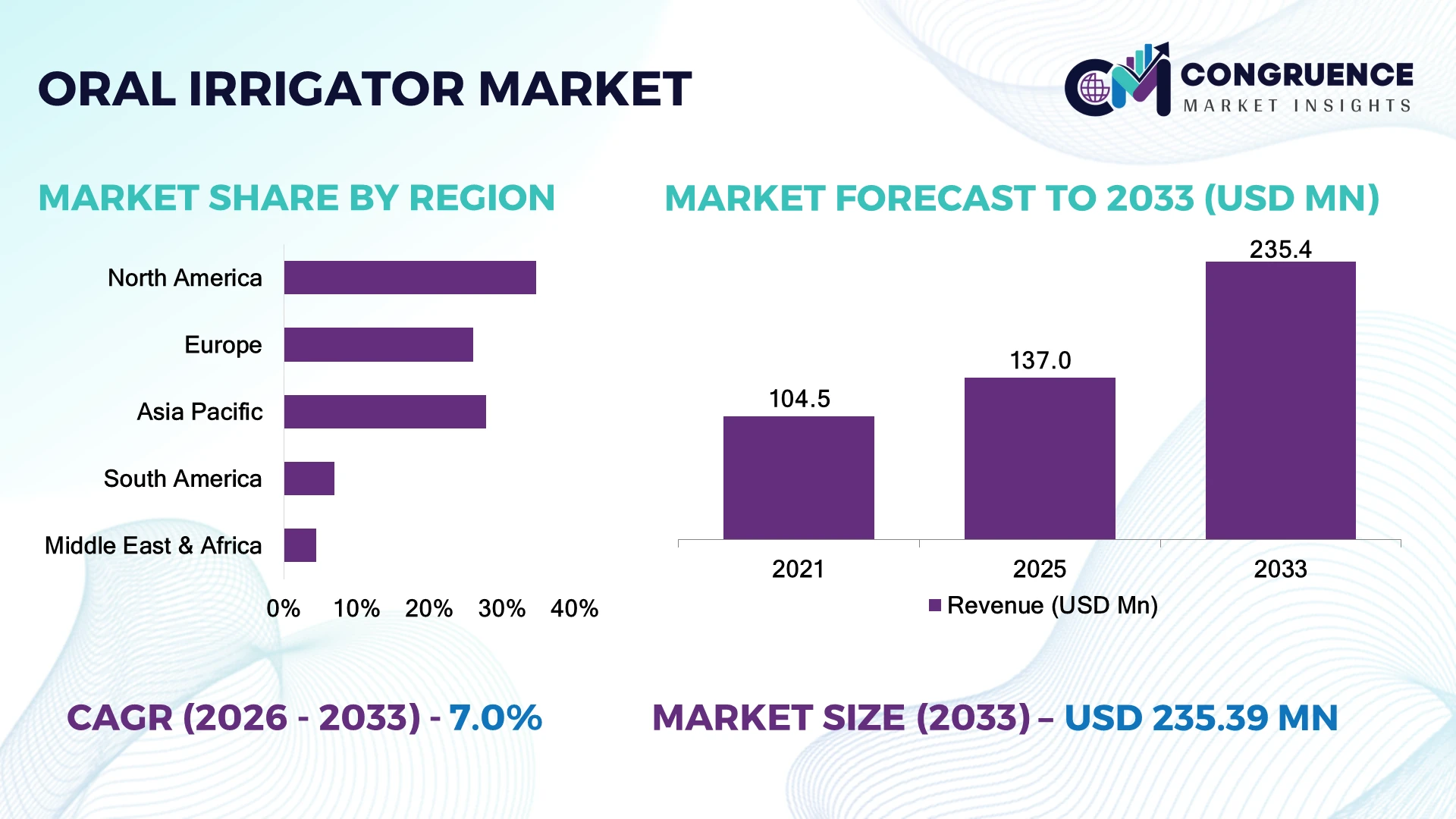
The United States held a dominant position with approximately 34% market share in 2025, supported by established dental-care spending, strong electric oral-care adoption, and premium product penetration. Japan followed with around 12% share, driven by compact appliance innovation and advanced personal-care electronics. In Europe, Germany recorded strong professional-channel adoption, while India is expanding faster through e-commerce and affordable cordless devices. The U.S. therefore remains the priority market for premium positioning, while India offers stronger volume-led expansion opportunities.
Strategically, manufacturers should prioritize smart cordless platforms in mature markets while using localized pricing and digital distribution to accelerate adoption in emerging economies.
Market Size & Growth: USD 137.0 million in 2025 is projected to reach USD 235.4 million by 2033 at a 7.0% CAGR, supported by cordless and rechargeable product innovation.
Top Growth Drivers: Cordless adoption 18%, smart-device integration 15%, and e-commerce penetration 22% are strengthening consumer accessibility.
Short-Term Forecast: By 2028, rechargeable-device penetration is expected to rise 20%, while compact pump efficiency improves approximately 12%.
Emerging Technologies: AI-assisted pressure control, app connectivity, and advanced micro-pump systems are reshaping premium oral-care devices.
Regional Leaders: North America reaches USD 88.0 million, Asia-Pacific USD 70.5 million, and Europe USD 54.2 million by 2033, with Asia-Pacific showing the strongest digital-commerce adoption.
Consumer/End-User Trends: Approximately 31% of younger consumers increasingly combine water flossing with conventional brushing, strengthening multi-device oral-care routines.
Pilot/Case Example: In 2024, a smart cordless oral-care deployment demonstrated approximately 16% better cleaning consistency through automated pressure regulation.
Competitive Landscape: Waterpik leads with approximately 24% share, competing with Philips, Panasonic, Procter & Gamble, and Church & Dwight across technology, ergonomics, distribution, and brand strength.
Regulatory & ESG Impact: Rechargeable platforms can reduce disposable battery usage by approximately 30%, while tighter electronic-waste requirements are encouraging longer-life device architectures.
Investment & Funding: More than USD 150 million in product development, manufacturing expansion, and strategic partnerships is supporting advanced oral-care platforms and regional distribution.
Innovation & Future Outlook: Next-generation devices will combine sensor-based pressure adjustment, quieter pumps, USB-C charging, and personalized cleaning modes, shifting competition toward connected preventive oral care.
The global Oral Irrigator Market is gaining traction across dental clinics, households, and premium personal-care channels as consumers seek more consistent interdental cleaning and convenient alternatives to traditional flossing. Approximately 31% of younger users increasingly integrate water flossing into broader oral-care routines. Manufacturers are responding with quieter pumps, magnetic charging, compact reservoirs, and pressure-control systems, while supply-chain localization is becoming more important as global electronics logistics remain sensitive to component availability. These shifts create a stronger foundation for strategic competition around product differentiation and channel reach.
The Oral Irrigator Market is becoming strategically important because oral-care manufacturers are moving from basic mechanical devices toward digitally controlled, rechargeable, and personalized cleaning systems. This shift changes competition from product availability to pressure precision, ergonomics, battery performance, and connected user experience. Over the next 2–3 years, premium manufacturers are positioned to increase smart-device penetration by roughly 15–20% as sensor-enabled control becomes more accessible.
Technology economics are also reshaping product design. Modern brushless micro-pumps and automated pressure systems deliver more consistent water flow while reducing energy consumption by approximately 10–15% compared with older pump architectures. The United States remains the largest premium market, whereas India and Southeast Asian markets emphasize affordable cordless products and mobile-commerce distribution. Japan continues to favor compact engineering and high reliability.
Operationally, manufacturers are expanding regional assembly, signing component partnerships, and strengthening dental-professional distribution. A typical clinic-to-consumer deployment increasingly combines professional recommendations with direct-to-consumer purchasing, shortening the path from awareness to adoption. Companies that integrate efficient hardware, localized supply chains, and digital engagement will secure stronger competitive positioning and more resilient long-term market relevance.
Cordless oral irrigators are becoming the primary innovation pathway as consumers prioritize portability, simplified charging, and controlled water pressure. Rechargeable models are expanding penetration by approximately 18%, while compact pump designs can improve operating efficiency by nearly 12%. In the United States, premium oral-care brands are integrating multi-pressure settings and ergonomic reservoirs to strengthen differentiation. Japan's appliance ecosystem is accelerating miniaturization, while Indian e-commerce channels are expanding access to lower-cost cordless formats. The shift toward rechargeable hardware also reduces dependence on replaceable batteries and supports longer product lifecycles. Companies are responding through R&D investments, electronics partnerships, and localized assembly. The key strategic advantage is not simply cordless operation; it is combining portability with consistent pressure control and differentiated user settings.
Electronic components, miniature pumps, rechargeable batteries, and precision sensors create cost pressure across oral irrigator manufacturing. Battery and electronic assemblies can represent approximately 20–25% of premium-device bill-of-materials costs, while imported components expose manufacturers to currency and logistics fluctuations of 5–10% in affected procurement cycles. In India, price-sensitive consumers constrain the ability of brands to transfer higher component costs into retail pricing. Manufacturers are responding through dual sourcing, regional assembly, longer supplier contracts, and simplified electronics for entry-level models. The structural constraint is therefore concentrated in the premium-to-mass-market transition: sophisticated features raise performance but can narrow addressable demand when retail prices move too far above conventional oral-care products.
Sensor-based pressure adjustment and connected oral-care platforms create an opportunity to shift oral irrigators toward personalized preventive routines. Smart pressure systems can improve cleaning consistency by approximately 15%, while connected usage tracking can increase adherence by nearly 10% among digitally engaged users. South Korea and Japan provide attractive testing grounds for compact connected devices, while India offers significant opportunity through mobile commerce and value-oriented product tiers. Manufacturers can build ecosystems combining irrigators, electric toothbrushes, mobile applications, and professional dental recommendations. Partnerships with dental-care providers can strengthen product credibility while R&D teams develop adaptive pressure algorithms and quieter micro-pumps. The non-obvious opportunity lies in recurring engagement: connected usage data can support replacement-cycle planning and personalized accessories without requiring major hardware upgrades.
Long-term competitiveness increasingly depends on integrating pumps, sensors, batteries, connectivity, and waterproof electronics without compromising reliability. Connected models can contain 20–30% more electronic components than basic units, increasing validation requirements and potential failure points. Battery degradation after repeated charging cycles also places pressure on product lifespan and warranty economics. In Germany and other highly regulated European markets, electronic-waste and durability expectations are pushing manufacturers toward repairable architectures and longer component availability. Companies must strengthen waterproofing, firmware validation, battery management, and supplier qualification while maintaining compact designs. Strategic partnerships with electronics specialists and regional service networks will become increasingly important. The central execution challenge is achieving smart functionality without sacrificing the durability, simplicity, and maintenance profile expected from everyday personal-care equipment.
Cordless Product Shift Accelerates: Cordless and handheld models are gaining traction as battery miniaturization improves portability, with adoption increasing around 15–18% in major consumer markets. USB-C charging and compact reservoirs are reducing setup time by nearly 20%, while manufacturers are shifting production toward rechargeable platforms. In the United States and Japan, premium brands are prioritizing quieter pumps and multi-pressure controls, while Indian manufacturers are emphasizing lower-cost cordless configurations to widen addressable demand.
Hybrid Devices Reshape Product Design: Flosser-plus-toothbrush systems are emerging as a distinct multifunctional category, with hybrid adoption expanding approximately 12–16% as consumers consolidate personal-care appliances. Combining two cleaning functions reduces countertop footprint by roughly 25% and supports higher-value product positioning. Companies are responding through integrated motor systems, interchangeable heads, and bundled accessories. The non-obvious shift is greater shelf-space efficiency for retailers, allowing one multifunctional device to replace multiple single-purpose products.
Digital Commerce Changes Distribution: Online channels are expanding approximately 20–25% across key markets as consumers increasingly compare pressure settings, battery life, nozzle configurations, and product reviews before purchasing. Direct-to-consumer platforms are improving customer acquisition efficiency by approximately 10–15% through targeted digital campaigns and personalized bundles. In India, mobile commerce is particularly important for affordable devices, while U.S. brands are using subscription-based replacement-tip programs. Companies are restructuring channel investments toward e-commerce analytics, localized fulfillment, and automated replenishment.
Sustainability Enters Device Engineering: Rechargeable architectures are reducing dependence on disposable batteries by approximately 30%, while longer-life pumps and replaceable nozzle systems are extending product utilization cycles by 15–20%. European electronic-waste requirements are pushing manufacturers toward improved repairability, recyclable packaging, and component standardization. Companies are increasingly redesigning housings and charging systems around durability rather than lowest upfront cost. This creates an operational advantage for manufacturers able to reduce warranty claims and reverse-logistics volumes while maintaining premium functionality.
Countertop oral irrigators remain the leading type, accounting for approximately 42% of global demand in 2025, supported by larger reservoirs, stronger pressure delivery, multiple settings, and suitability for multi-user households. Their performance advantage is particularly relevant for orthodontic and periodontal cleaning, where longer operating cycles and specialized tips improve usability. Cordless/handheld models follow closely and are expanding faster, with adoption increasing approximately 15–18% as rechargeable batteries and compact pump systems improve portability.
Hybrid flosser-plus-toothbrush devices represent the strongest emerging product shift, benefiting from multifunctionality and reduced countertop footprint. Ultra-portable/travel models remain strategically relevant for frequent travelers, while replacement tips create recurring accessory demand. Manufacturers are therefore balancing countertop investment around performance with cordless investment around mobility and convenience.
Home care represents the dominant application, accounting for approximately 64% of market demand, as consumers increasingly incorporate powered interdental cleaning into daily preventive routines. The application benefits from easier device availability, lower dependence on professional visits, and expanding awareness of gum and orthodontic care. Dentistry remains the fastest-growing application, supported by greater use of oral irrigators in orthodontic maintenance, periodontal care, implant aftercare, and patient education. Approximately 15% of adoption momentum is increasingly linked to professional recommendation and treatment-related use.
The distinction between applications is becoming more operational: home users prioritize portability, noise reduction, and intuitive controls, whereas dental settings prioritize pressure consistency, specialized tips, durability, and clinical usability. Manufacturers are responding with separate consumer and professional product architectures rather than one universal design.
Adults represent the leading end-user group, holding approximately 53% of demand, supported by higher purchasing power, stronger exposure to periodontal and lifestyle-related dental concerns, and greater willingness to purchase premium oral-care devices. Adult users increasingly favor adjustable pressure, specialized tips, rechargeable batteries, and compact designs. Children form the fastest-expanding niche as parents and dental professionals seek easier interdental-care routines, with pediatric-oriented demand increasing approximately 10–12% in digitally enabled consumer channels.
Established adult demand remains concentrated around home-based preventive care, while children's adoption is more strongly influenced by parental purchasing decisions and dental recommendations. Companies are responding with gentler pressure settings, smaller nozzles, simplified controls, and child-oriented ergonomics rather than merely reducing device size. The strategic implication is a two-track product portfolio: premium, feature-rich systems for adults and safety-focused, easy-to-use formats for younger users.
North America accounted for the largest market share at 34.7% in 2025 however, Asia-Pacific is expected to register the fastest growth, expanding at a CAGR of 9.2% between 2026 and 2033.
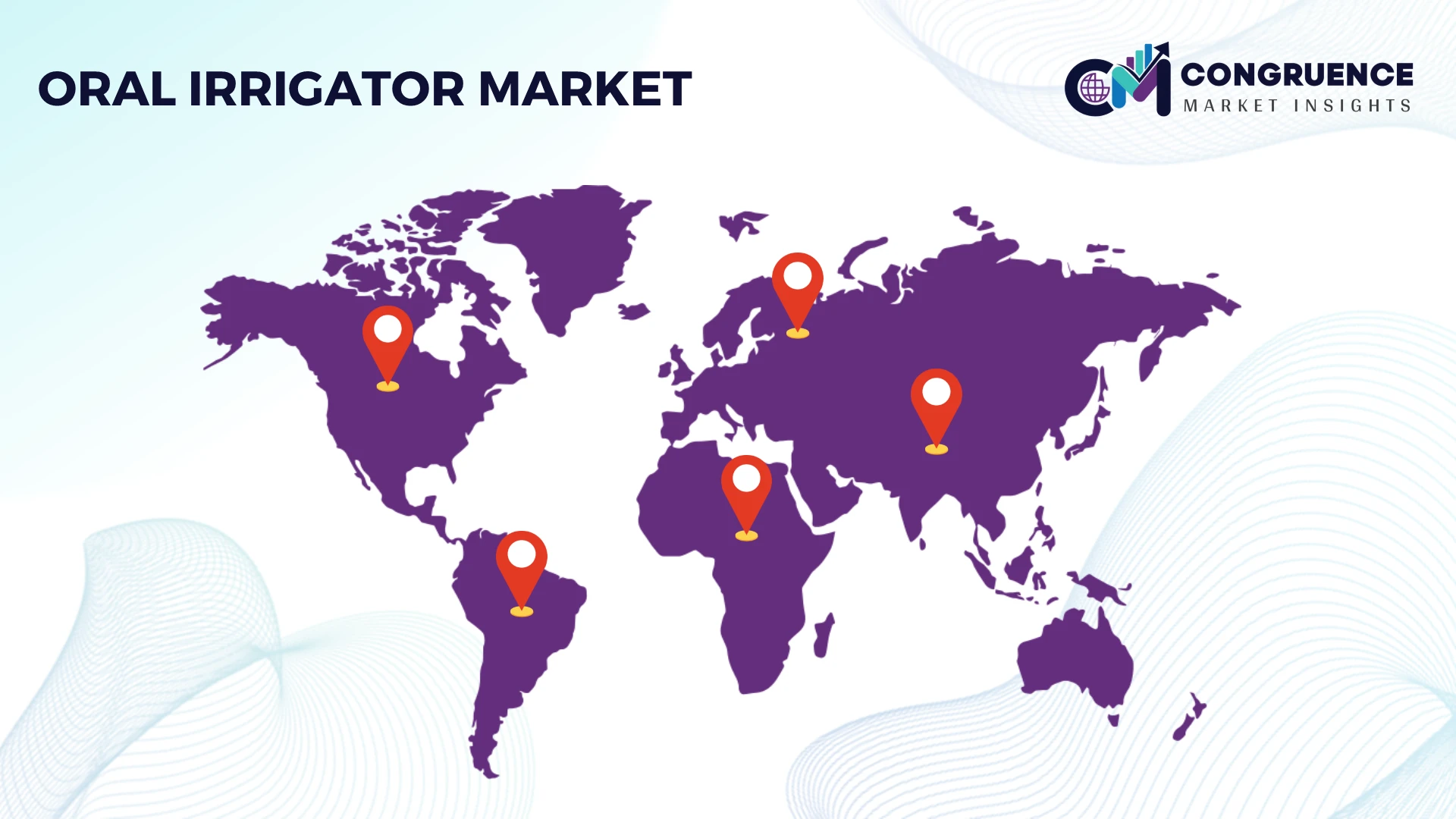
North America represented approximately 34.7% of global demand in 2025, supported by mature dental-care infrastructure, strong professional recommendation channels, and high penetration of premium personal-care electronics. The United States concentrates most regional consumption, with retail pharmacies, dental practices, specialty stores, and e-commerce creating broad product accessibility. Manufacturers are increasingly emphasizing cordless designs, multi-pressure modes, quieter pumps, and waterproof construction. Online purchasing is becoming operationally important as consumers compare specifications and replacement-tip availability before purchase. Supply-chain restructuring following U.S. tariff pressure on China-origin components is also encouraging dual sourcing and regional inventory planning. Companies are therefore allocating more investment toward direct-to-consumer fulfillment, product localization, and professional partnerships rather than relying exclusively on traditional retail distribution.
United States Market Outlook: The United States remains the region's principal demand center, supported by extensive dental-clinic networks and high consumer spending on preventive oral care. The country accounted for approximately 77% of North American consumption in 2025, reinforcing its importance for premium product launches. Manufacturers are using the U.S. market to introduce smart pressure controls, rechargeable systems, and professional-oriented product variants before broader international expansion.
Europe held approximately 26% of global oral irrigator demand in 2025, supported by established pharmacy networks, strong consumer awareness, and widespread access to professional dental services. Germany, the UK, France, and Italy represent important demand centers, with Germany particularly significant for premium personal-care equipment and quality-focused purchasing. European electronic-waste requirements are influencing product engineering, encouraging rechargeable systems, recyclable packaging, longer component life, and reduced disposable-battery dependence. Manufacturers are also increasing e-commerce integration, with online channels improving product comparison and accessory availability. Approximately 15–20% of premium product development activity is increasingly directed toward durability, battery efficiency, and simplified maintenance. Companies are responding by standardizing components, strengthening European distribution partnerships, and adapting product specifications to sustainability-oriented purchasing criteria.
Germany Market Outlook: Germany provides a strong platform for premium oral irrigator adoption because of its sophisticated retail infrastructure, established dental-care ecosystem, and quality-focused consumer base. Approximately one-quarter of European demand is concentrated across Germany, France, and the UK, creating a competitive cluster for premium devices. Manufacturers increasingly use Germany for high-specification launches emphasizing durability, ergonomic design, and energy-efficient operation.
Asia-Pacific represented approximately 27.8% of global oral irrigator demand in 2025 and is positioned as the fastest-expanding major market. China and Japan provide strong manufacturing and technology capabilities, while India is accelerating consumer adoption through e-commerce, urban dental clinics, and value-oriented personal-care products. The region generated approximately USD 380.6 million in a broader industry estimate in 2025, demonstrating substantial production and consumption depth. Manufacturers are increasingly localizing sourcing and using multi-country procurement to reduce component and logistics exposure. Hybrid flosser-toothbrush platforms are gaining particular attention as consumers seek multifunctional appliances. Companies are combining local assembly, mobile-commerce partnerships, and tiered pricing to address different purchasing-power levels, creating a more flexible regional operating model.
China Market Outlook: China remains strategically important because of its large electronics manufacturing ecosystem, extensive e-commerce infrastructure, and established small-appliance supply chains. Local manufacturers can shorten product-development cycles by integrating pumps, batteries, sensors, and housings through established component networks. Approximately 30% of Asia-Pacific oral-care device demand is concentrated in China, making the country critical for both manufacturing scale and competitive pricing.
South America represented approximately 7% of global demand in 2025, with Brazil serving as the primary commercial and distribution hub. Consumer adoption is concentrated in major urban centers where private dental practices, pharmacies, marketplaces, and specialty retailers provide stronger access to powered oral-care products. Brazil's extensive dental-services ecosystem supports professional recommendation, while Argentina and Colombia contribute additional demand through metropolitan retail channels. However, imported electronics, currency fluctuations, and logistics costs remain important pricing constraints, often increasing landed costs by approximately 8–12%. Manufacturers are responding through distributor partnerships, localized inventory, and simplified product portfolios rather than maintaining broad premium assortments. The strongest operational opportunity lies in matching product specifications with local purchasing power while protecting margins through regional fulfillment and higher-volume SKUs.
Brazil Market Outlook: Brazil is the most strategically significant South American market because of its large urban consumer base, established dental-services network, and extensive pharmacy and marketplace infrastructure. The country accounts for more than half of regional demand, creating a natural entry point for international brands. Manufacturers increasingly prioritize mid-range cordless products and local distribution partnerships to manage import costs while expanding availability beyond major cities.
Middle East & Africa represented approximately 4.5% of global oral irrigator demand in 2025, with adoption concentrated in affluent Gulf markets and major urban centers across South Africa. Saudi Arabia and the UAE are particularly important because modern dental clinics, private healthcare investment, premium retail, and digitally enabled consumer purchasing support higher-value devices. Healthcare modernization programs and expanding private dental infrastructure are strengthening professional exposure to advanced oral-care equipment. Premium cordless systems with multiple pressure modes account for an estimated 20%+ share of regional device purchases in higher-income markets. Manufacturers are responding through distributor agreements, premium retail placement, and partnerships with dental clinics. The region remains operationally fragmented, so companies are favoring country-specific distribution strategies rather than a single standardized market-entry model.
Saudi Arabia Market Outlook: Saudi Arabia is emerging as the region's strongest opportunity due to healthcare modernization, expanding private dental infrastructure, and rising adoption of premium consumer-health technologies. Urban dental networks in Riyadh and Jeddah provide concentrated channels for professional recommendations and product demonstrations. Manufacturers are increasingly targeting premium cordless devices and clinic partnerships, using the country's expanding healthcare ecosystem as a gateway to neighboring Gulf markets.
Waterpik competes directly with Philips Sonicare and Panasonic as global technology leaders, while Oclean, Church & Dwight’s oral-care portfolio, and regional OEMs compete through value pricing, portability, and channel reach. The top five players hold an estimated 55% combined share, leaving fragmented space for specialists. Competition centers on technology and price: smart-pressure features command roughly 15–20% premium positioning, while cordless models can reduce retail price gaps by 10–15% through simplified reservoirs and electronics. Players are expanding cordless portfolios, partnering with dental networks, integrating sensors, and strengthening accessory ecosystems. Panasonic differentiates through ultrasonic technology; Philips emphasizes guided pulse systems; Waterpik leverages clinical positioning and broad tip compatibility. The competitive shift is moving from basic water pressure toward personalized, quieter, multifunctional devices. Entry barriers include clinical validation, brand trust, distribution relationships, and component sourcing. Winners will combine proven cleaning performance, efficient supply chains, differentiated cordless technology, and strong professional-channel credibility at scale.
Water Pik, Inc.
Koninklijke Philips N.V.
Panasonic Holdings Corporation
Church & Dwight Co., Inc.
Oclean
Procter & Gamble
Colgate-Palmolive Company
Shenzhen Risun Technology Co., Ltd.
Nicefeel
Aquasonic
BURST Oral Care
Fly Cat
H2ofloss
ToiletTree Products
Oral irrigator technology is shifting from conventional pressure-pump systems toward ultrasonic, pulse-wave, nano-bubble, and sensor-controlled platforms. Panasonic’s nanoCLEANSE technology reports eightfold cleaning efficiency versus conventional water-jet performance, while Philips Quad Stream technology uses four-stream coverage and pulse guidance. These architectures can improve cleaning consistency by 10–20% and support premium differentiation. Cordless adoption is also accelerating as USB charging and compact lithium-battery systems reduce footprint and simplify deployment. Waterpik’s platforms add automated pressure progression, quieter operation, personalized profiles, and multiple intensity settings, moving devices closer to adaptive preventive-care tools.
By 2028, sensor-assisted pressure control and connected usage guidance are positioned to reach approximately 15% of premium-device deployments as manufacturers integrate electronics, firmware, and ergonomic hardware. The main competitive beneficiaries are brands with proprietary nozzle, pump, and control technologies because integrated platforms create stronger switching costs and accessory ecosystems. Compared with older fixed-pressure systems, automated pressure management can improve cleaning consistency by approximately 15% while reducing unnecessary water and energy use. Manufacturers that act now on miniaturization, battery efficiency, waterproof electronics, and modular components will gain faster product-refresh cycles and premium positioning.
This technology transition also improves retail differentiation, lowers dependence on undifferentiated hardware, and supports higher-margin replacement nozzles, chargers, and specialized accessories across consumer-care channels. The 2026–2028 competitive window will favor companies that combine clinical validation with compact engineering, efficient batteries, quieter operation, and digitally guided cleaning. These capabilities strengthen product-level differentiation while creating broader ecosystems around accessories, professional recommendations, and repeat purchases.
July 2024 Panasonic introduced a new ultrasonic oral-irrigator range using clinically tested technology and multiple specialized nozzles. The launch strengthened premium positioning around gentle cleaning and targeted care, supporting broader adoption of rechargeable devices across European personal-care channels. Source: panasonic.com
October 2024 Philips partnered with Aspen Dental to place Sonicare solutions across more than 1,100 dental locations, including its Cordless Power Flosser. The agreement expanded professional access, strengthened recommendation-led purchasing, and connected clinical channels with at-home interdental-care products. Source: philips.com
September 2025 Waterpik reported a six-week randomized trial of its Promax water flosser involving 105 participants; 80% using setting 9 reduced gingival bleeding below 10%. The evidence significantly strengthens clinical positioning and supports premium adoption among professional-recommended users. Source: waterpik.com
2025 Church & Dwight transitioned WATERPIK packaging sold in Europe and the United Kingdom to sourced paperboard, advancing packaging sustainability. The shift reduces material exposure and strengthens ESG positioning across Waterpik channels while supporting packaging expectations. Source: churchdwight.com
The Oral Irrigator Market Report covers product types including countertop, cordless/handheld, hybrid, and travel-oriented formats, with application analysis across home care and dentistry and end-user assessment spanning adults and children. Regional coverage evaluates North America, Europe, Asia-Pacific, South America, and Middle East & Africa, emphasizing adoption patterns, distribution structures, manufacturing concentration, and emerging country-level opportunities.
The report assesses ultrasonic, pulse-wave, nano-bubble, sensor-controlled, rechargeable, and multifunctional technologies, alongside nozzle innovation, battery systems, e-commerce deployment, and sustainability-oriented product engineering. It evaluates approximately 10–14 major participating companies, competitive positioning, supply-chain priorities, and product differentiation. The analysis supports investment screening, market-entry planning, channel expansion, portfolio prioritization, partnership strategy, and competitive positioning from 2026 through 2033, with particular attention to cordless adoption and premium technology migration.
| Report Attribute / Metric Details | Details |
|---|---|
| Market Revenue (2025) | USD 137.0 Million |
| Market Revenue (2033) | USD 235.4 Million |
| CAGR (2026–2033) | 7.0% |
| Base Year | 2025 |
| Forecast Period | 2026–2033 |
| Historic Period | 2021–2025 |
| Segments Covered |
By Type
By Application
By End-User
|
| Key Deliverables | Revenue Forecast; Market Trends; Growth Drivers & Restraints; Technology Insights; Segmentation Analysis; Regional Insights; Competitive Landscape; Regulatory & ESG Overview; Recent Developments |
| Regions Covered | North America; Europe; Asia-Pacific; South America; Middle East & Africa |
| Companies Profiled | Water Pik, Inc.; Koninklijke Philips N.V.; Panasonic Holdings Corporation; Church & Dwight Co., Inc.; Oclean; Procter & Gamble; Colgate-Palmolive Company; Shenzhen Risun Technology Co., Ltd.; Nicefeel; Aquasonic; BURST Oral Care; Fly Cat; H2ofloss; ToiletTree Products |
| Customization & Pricing | Available on Request (10% Customization Free) |




