
Reports
The Global Optical Lenses Market was valued at USD 1,959.0 Million in 2025 and is anticipated to reach a value of USD 4,057.9 Million by 2033 expanding at a CAGR of 9.53% between 2026 and 2033. Growth is driven by high-index and free-form lens adoption, myopia-management products, precision optical manufacturing, and AI-enabled smart-eyewear integration.
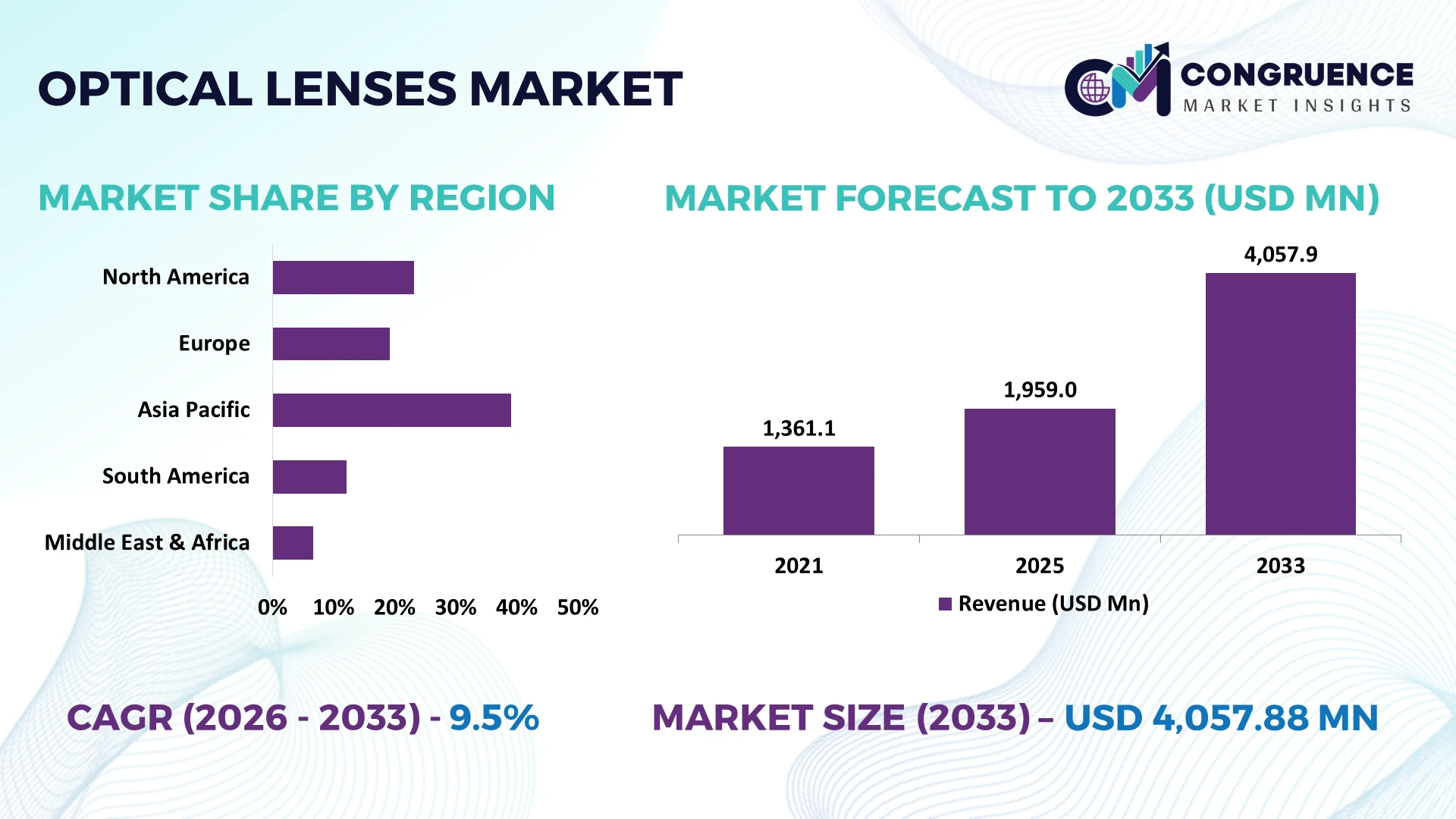
China anchors the global optical-lens supply ecosystem through concentrated manufacturing, precision optics, and expanding ophthalmic demand. Asia Pacific accounted for approximately 40.7% of the global optical-lens market in 2025, while ZEISS has accumulated nearly RMB 4.1 billion in Guangzhou investments and directed 15% of revenue toward R&D during the latest two fiscal years. Compared with mature Western markets, China's manufacturing depth supports faster product localization and high-volume customization. The U.S.-China technology trade environment is also accelerating supplier diversification and regionalized optical production.
Strategically, manufacturers should prioritize China-linked production capabilities while expanding differentiated coatings, myopia-control lenses, and intelligent optical platforms.
Market Size & Growth: USD 1,959.0 million in 2025 is projected to reach USD 4,057.9 million by 2033 at a 9.53% CAGR, supported by advanced lens materials and digital optical systems.
Top Growth Drivers: Myopia-management adoption at up to 80–90% among young adults in several Asian markets, 68.1% anti-reflective-coating share, and 40% spectacle-lens share of global eyewear value strengthen premiumization.
Short-Term Forecast: By 2028, digital free-form surfacing and automated personalization are positioned to reduce manual processing requirements by roughly 15–20% across high-volume laboratories.
Emerging Technologies: AI-guided free-form surfacing, high-index plastics, multifunction coatings, waveguides, and AI-enabled smart lenses are reshaping premium optical design.
Regional Leaders: Asia Pacific is benchmarked at USD 1.65 billion, North America at USD 936.2 million, and Europe at USD 778.8 million by 2033 using their 2025 regional mix; APAC emphasizes manufacturing scale, North America premiumization, and Europe regulated personalization.
Consumer/End-User Trends: Prescription lenses represented 68.2% of spectacle-lens usage in 2025, while online channels increasingly support customized prescription fulfillment.
Pilot/Case Example: In 2025, the Thondar Zhongshan precision-optics project committed RMB 1.5 billion and targets 1.5 million pairs of myopia-prevention glasses annually at full operation, demonstrating China's shift toward integrated optical production.
Competitive Landscape: EssilorLuxottica maintains a leading position in value-added lenses, supported by Transitions and Varilux, while HOYA, Carl Zeiss Vision, Safilo, and other established manufacturers intensify premium lens competition.
Regulatory & ESG Impact: EU Regulation 2025/1920 introduced Master UDI-DI rules for spectacle lenses, reducing excessive identifier proliferation and requiring manufacturers to update traceability systems.
Investment & Funding: Meta invested approximately USD 3.5 billion for a stake of just under 3% in EssilorLuxottica, reinforcing capital flows toward AI-enabled eyewear and optical technologies.
Innovation & Future Outlook: AR waveguides, lightweight optical stacks, AI glasses, and advanced coatings are moving lens manufacturers toward integrated hardware-software ecosystems rather than conventional corrective optics.
The Optical Lenses Market is increasingly centered on myopia management, premium progressive designs, anti-reflective and UV coatings, high-index materials, and digitally personalized prescriptions. Anti-reflective lenses represented 68.1% of spectacle-lens revenue in 2025, while AI-enabled eyewear is opening a new optical-computing category. EU traceability requirements and Asia-led manufacturing expansion are simultaneously pushing producers toward automated, localized, and digitally controlled operations.
Optical lenses are becoming strategically important as ophthalmic correction converges with precision manufacturing, digital personalization, and intelligent eyewear. The competitive basis is shifting from basic prescription fulfillment toward high-index materials, progressive designs, multifunction coatings, myopia management, and connected optical platforms. Spectacle lenses already represent about 40% of global eyecare and eyewear retail value, giving lens innovation substantial influence over industry economics.
Digital surfacing and automated prescription workflows reduce manual intervention and improve repeatability versus conventional laboratory processing, while AI-guided free-form technologies enable increasingly individualized lens geometries. China combines manufacturing scale with expanding R&D infrastructure, whereas North America emphasizes premium optical products and technology integration. Over the next 2–3 years, suppliers are positioned to increase automation, digital ordering, and customized production as optical retailers demand shorter turnaround times.
A practical example is the Zhongshan precision-optics investment, which targets 1.5 million pairs of myopia-prevention glasses annually. Companies are consequently directing capital toward localized manufacturing, technology partnerships, and vertically integrated distribution.
AI-guided free-form surfacing and digitally controlled lens production are accelerating premium optical personalization, with progressive lenses and multifunction coatings gaining commercial importance. Progressive lenses represented the fastest-growing spectacle-lens category at a forecast 4.72% CAGR, while anti-reflective coatings held 68.1% of 2025 revenue. Manufacturers are responding through automated surfacing, software integration, and R&D partnerships. The launch of AI-powered smart eyewear is extending optical expertise beyond corrective vision into wearable computing. EssilorLuxottica and Applied Materials' 2026 collaboration specifically targets lightweight AR optical stacks, indicating that lens suppliers are increasingly competing on optical engineering rather than material volume alone.
High-performance optical materials, coatings, and precision-molding equipment increase production costs and expose manufacturers to specialized supply dependencies. Plastic lenses accounted for approximately 60% of the broader optical-lens market in 2025, increasing the strategic importance of resin quality, high-index materials, and coating compatibility. Trade restrictions affecting advanced optical technologies are also encouraging procurement diversification. U.S.-China restrictions have prompted buyers to reconsider concentrated sourcing, while manufacturers are responding through regional supplier qualification, longer-term material contracts, and localized finishing capacity. The non-obvious pressure is that supply-chain resilience increasingly determines customization economics: highly individualized lenses require dependable material availability because substitution can disrupt both optical specifications and automated production parameters.
Myopia-control lenses represent a high-value opportunity as prevalence among young adults approaches 80–90% in several major Asian markets. China is particularly attractive because manufacturers can combine large clinical demand with domestic precision-optics capabilities. ZEISS has developed MyoCare lenses using C.A.R.E. technology to address axial-elongation management, while new production investments are targeting dedicated myopia-prevention capacity. Companies can capture this opportunity by combining ophthalmologist partnerships, school-screening ecosystems, digital prescription platforms, and localized manufacturing. The strongest strategic opportunity lies beyond selling lenses: integrated myopia-management programs can create recurring clinical and replacement demand while differentiating products from conventional single-vision correction.
The transition toward intelligent lenses and AR optical systems introduces integration requirements beyond conventional lens manufacturing. Waveguides, lightweight optical stacks, electronics, coatings, and frame geometries must operate together without compromising optical clarity or wearability. The challenge is amplified by privacy and regulatory requirements surrounding AI-enabled eyewear; smart glasses represented only about 2% of global sales in 2025, despite contributing more than four percentage points to EssilorLuxottica's recent sales growth. Companies therefore need multidisciplinary R&D, semiconductor and materials partnerships, and stronger compliance engineering. The strategic issue is not simply scaling production but establishing repeatable optical-electronic integration without increasing defect rates or compromising consumer trust.
AI-Driven Optical Inspection: AI-assisted metrology and automated optical inspection are moving into high-volume lens production, reducing manual inspection requirements by 15–20% and improving defect detection consistency. Manufacturers in China and Japan are integrating machine vision with precision grinding and coating workflows, while skilled-labor shortages are accelerating automation. The non-obvious shift is that inspection data is increasingly becoming a production-control input rather than a final quality checkpoint.
AR/VR Optics Scaling: AR/VR and mounted-display systems are increasing demand for compact, lightweight optical assemblies, with the segment accounting for approximately 20% of 2025 application demand and positioned as the fastest-changing specialty use case. Companies are restructuring optical designs around thinner elements, improved light transmission, and tighter alignment tolerances. Partnerships between lens specialists and electronics companies are shortening development cycles as wearable-device architectures become more integrated.
Localized Production Networks: Supply-chain restructuring is pushing manufacturers toward localized precision optics, particularly across China, India, Japan, and Southeast Asia. Automated molding and digital surfacing can reduce processing requirements by approximately 18%, while regional production helps shorten lead times by 10–15% for standardized optical components. Tariff pressure and geopolitical trade restrictions are encouraging dual sourcing, local supplier qualification, and longer-term material contracts rather than dependence on single-country production.
Advanced Coating Workflows: Multifunction coatings are shifting from premium differentiation toward standard product engineering, with anti-reflective solutions representing more than 68% of spectacle-lens demand and photochromic technologies gaining adoption in premium eyewear. Manufacturers are expanding automated coating lines to improve consistency and throughput while integrating scratch resistance, UV protection, and blue-light filtering. Regulatory traceability requirements are also forcing tighter batch documentation, making digital production records increasingly important for optical manufacturers.
Converging lenses represent the leading type, supported by broad use across ophthalmic correction, imaging systems, microscopy, and precision optical assemblies. Their established manufacturing base, predictable optical performance, and broad focal-length range give them a substantial scale advantage, with demand estimated at more than 55% of type-based consumption. Diverging lenses remain strategically important for corrective and specialized optical systems but occupy a narrower application base. Manufacturers continue to prioritize automated grinding, precision polishing, and standardized production for converging designs, while investing selectively in customized diverging configurations where performance requirements justify higher production complexity.
Diverging lenses are gaining relevance in specialized optical systems as manufacturers pursue thinner assemblies and application-specific optical correction. Approximately 20–25% of new precision optical-system designs increasingly incorporate customized lens geometries, strengthening demand for digitally controlled fabrication. The business implication is a gradual shift from standardized volume production toward mixed production environments that can efficiently handle both high-volume converging lenses and lower-volume precision diverging designs.
Imaging is the leading application, accounting for approximately 40% of global optical-lens demand in 2025. Its dominance reflects extensive deployment across cameras, medical diagnostics, machine vision, and industrial inspection, where repeatable image quality and standardized optical configurations support large production volumes. Camera applications follow at approximately 30%, while AR/VR and mounted-display systems represent about 20%. Manufacturers are responding by expanding precision multi-element assemblies, autofocus-compatible optics, and digitally optimized lens designs.
AR/VR and mounted-display applications represent the fastest-changing application group as wearable computing moves toward thinner optical architectures and improved visual fidelity. Companies are increasing investment in compact optical assemblies and alignment automation, while medical-surgery applications retain a specialized position because reliability and precision outweigh volume considerations. The implication is a two-speed market: imaging and cameras prioritize manufacturing scale, whereas AR/VR and medical systems increasingly reward engineering specialization and integration capability.
Consumer electronics represents the leading end-user group, supported by smartphones, cameras, displays, imaging modules, and emerging wearable devices. The segment captures approximately 45% of optical-lens demand in high-volume optical-glass applications, reflecting the enormous production scale of electronic-device manufacturing. Healthcare follows with approximately 15%, while industrial, defense, and life-science applications prioritize precision, durability, and specification compliance over unit volume. Companies serving electronics manufacturers are therefore emphasizing miniaturization, automated assembly, and high-throughput quality control.
Life sciences and healthcare are becoming increasingly technology-intensive buyers as medical imaging, surgical visualization, and diagnostic equipment require tighter optical tolerances. Defense applications remain specification-driven, while industrial users increasingly integrate optical systems into machine-vision and inspection workflows. Approximately 25% of advanced optical-system demand is increasingly associated with specialized imaging, medical, industrial, and defense requirements, encouraging manufacturers to diversify beyond consumer electronics. Companies are responding through application-specific engineering, OEM partnerships, localized production, and higher-value optical assemblies.
Asia Pacific accounted for the largest market share at 39.0% in 2025 however, Asia Pacific is expected to register the fastest growth, expanding at a CAGR of 7.4% between 2026 and 2033.

North America represents approximately 23.1% of the global optical lenses market, supported by advanced medical imaging, defense optics, semiconductor inspection, automotive vision, and professional imaging. The U.S. concentrates most regional activity, with specialized optical systems commanding higher-value demand than standardized consumer products. Precision imaging and automated inspection are strengthening requirements for tighter tolerances and digitally optimized lens assemblies. In 2025, U.S. buyers also faced higher landed costs for China-linked optical components, encouraging supplier diversification and nearshoring. Companies are responding by expanding domestic manufacturing, qualifying alternative suppliers, and strengthening long-term procurement agreements. The region's strategic advantage is therefore shifting from pure consumption scale toward high-specification optics, where performance, reliability, and application engineering support stronger margins.
U.S. Market Outlook: The U.S. remains North America's principal optical-lens market, supported by extensive healthcare infrastructure, aerospace and defense programs, semiconductor manufacturing, and professional imaging activity. More than 6,000 hospitals use precision optical systems across diagnostic imaging, ophthalmology, and endoscopy applications. Domestic manufacturers and distributors are increasingly prioritizing resilient sourcing and specialized optical assemblies.
Europe accounts for approximately 19.2% of global optical-lens demand, with Germany, France, Italy, and the U.K. forming the principal industrial base. Demand is concentrated in precision engineering, medical optics, automotive imaging, industrial inspection, scientific instruments, and premium ophthalmic products. Germany's manufacturing ecosystem provides an important advantage through established optical engineering capabilities and specialized research infrastructure. ZEISS operates approximately 30 production locations globally and maintains around 40 R&D sites, reinforcing Europe's role in advanced optical technology development. Regulatory requirements are also increasing traceability and documentation across optical-device production. European manufacturers are responding with digital production controls, higher-value optical designs, and partnerships linking optics with semiconductor and industrial technology.
Germany Market Outlook: Germany is Europe's most strategically significant optical-engineering hub, supported by established precision manufacturing, scientific research, medical technology, and industrial automation capabilities. ZEISS maintains approximately 3,500 employees at its Jena site and continues investing heavily in optical and photonics technologies. This concentration of engineering expertise supports complex lens development, high-precision manufacturing, and technology-intensive enterprise applications.
Asia Pacific leads the global optical-lens market with approximately 39.0% share, supported by dense manufacturing networks across China, Japan, South Korea, Taiwan, and India. Consumer electronics, automotive sensing, smartphones, medical devices, and industrial imaging generate substantial production volumes. China and Japan remain major precision-optics hubs, while India and Southeast Asia are attracting additional electronics and optical-component manufacturing as companies diversify supply chains. The region's advantage is reinforced by vertically integrated procurement and proximity to large electronics OEMs. Manufacturers are increasing automation, expanding localized finishing capacity, and developing hybrid plastic-glass optical assemblies. This production concentration allows suppliers to combine high-volume manufacturing with increasingly customized optical designs.
China Market Outlook: China remains the region's largest manufacturing center for optical lenses, supported by extensive electronics production, automotive-component manufacturing, precision optics, and domestic healthcare demand. Major optical manufacturers operate within integrated supply ecosystems that shorten component lead times and support high-volume customization. China's position is particularly important for smartphone imaging, industrial cameras, automotive sensing, and emerging machine-vision applications.
South America contributes approximately 12.1% of global optical-lens demand in the referenced market structure, with Brazil representing the principal commercial and healthcare center. Demand is concentrated in ophthalmic correction, medical imaging, industrial inspection, surveillance, and consumer imaging, while domestic precision manufacturing remains less developed than in Asia. Brazil's large healthcare network and expanding digital diagnostic infrastructure are increasing requirements for imaging components and ophthalmic optics. Import dependence continues to influence product availability, pricing, and inventory planning. Companies are responding through distributor partnerships, localized assembly, broader inventory buffers, and selective regional sourcing. The key operational opportunity lies in combining established imported optical technology with stronger local service and after-sales capabilities rather than attempting immediate full-scale manufacturing.
Brazil Market Outlook: Brazil provides the strongest commercial base in South America because of its population scale, healthcare infrastructure, optical-retail network, and industrial concentration. Ophthalmic demand remains particularly important, while industrial and medical imaging applications create additional opportunities for precision optics. Companies are increasingly using local distribution and technical-support partnerships to reduce lead times and improve availability for specialized optical products.
Middle East & Africa represents approximately 6.6% of global optical-lens demand, with Saudi Arabia, the UAE, and South Africa providing the most important demand centers. Healthcare modernization, diagnostic imaging, security systems, smart-city infrastructure, and premium eyewear are increasing requirements for advanced optical components. Saudi Arabia is strengthening its position through healthcare infrastructure development and expanding ophthalmic services, while the UAE is developing technology-intensive healthcare and commercial ecosystems. Saudi Arabia's prescription-lens market is projected to reach approximately USD 617.5 million by 2030, highlighting the scale of specialized vision-care demand. Companies are responding through distributor expansion, hospital partnerships, localized service networks, and premium product portfolios rather than large-scale lens manufacturing.
Saudi Arabia Market Outlook: Saudi Arabia offers the region's strongest combination of healthcare investment, population growth, ophthalmic demand, and infrastructure modernization. Its prescription-lens market is projected to reach approximately USD 617.5 million by 2030, with progressive lenses identified as the fastest-growing category. Optical companies are strengthening clinical partnerships, retail coverage, and premium lens distribution to capture increasingly sophisticated vision-care demand.
EssilorLuxottica competes with HOYA, ZEISS, Nikon Lenswear, and regional prescription-lens manufacturers across premium ophthalmic, customized, and high-volume segments. The top five players collectively command an estimated 45% of global optical-lens value, while regional suppliers compete primarily on price, delivery speed, and localized customization. Technology differentiation centers on AI-enabled personalization, advanced coatings, and myopia-management solutions, with premium products achieving approximately 10–20% higher selling values than conventional designs. Supply-chain localization is reducing lead times by roughly 10–15% for selected high-volume products. EssilorLuxottica is strengthening vertical integration, ZEISS is expanding specialty vision capabilities, and HOYA continues emphasizing optical engineering. The competitive shift is moving from standardized corrective lenses toward digitally personalized, application-specific products. High capital requirements, proprietary lens-design software, coating know-how, clinical validation, and established optician networks remain major entry barriers. Winning requires scalable precision manufacturing, differentiated optical technology, resilient supply networks, and strong professional distribution relationships.
EssilorLuxottica
HOYA Corporation
Carl Zeiss AG
Nikon Corporation
Rodenstock GmbH
Tokai Optical Co., Ltd.
SEIKO Optical Products Co., Ltd.
Younger Optics
Vision Ease
Shamir Optical Industry Ltd.
GKB Optic Technologies
Chemi S.p.A.
Jiangsu Hongchen Optical Co., Ltd.
AI-enabled lens design is becoming a core production technology, combining biometric measurements, prescription parameters, frame geometry, and pupil behavior to create individualized optical profiles. Dynamic and free-form surfacing can improve personalization efficiency by approximately 10–15% versus conventional standardized designs. Adoption is strongest among premium progressive and digitally ordered prescription workflows, where customization improves differentiation and reduces manual design intervention.
Advanced coating systems are simultaneously improving durability, cleanability, UV protection, and light management. New multifunction coatings can deliver approximately 20–30% faster cleaning performance than previous-generation formulations, while automated coating lines improve batch consistency and reduce rework. High-index polymers, thinner substrates, and digitally optimized aspheric geometries are gaining traction because they reduce lens thickness and weight while preserving optical performance.
Between 2026 and 2028, myopia-control optics, AI-personalized progressives, AR waveguides, and smart-lens architectures will increasingly converge with digital eye-care platforms. Myopia-management lenses already have measurable clinical adoption, while AI-designed premium lenses are expanding among high-value prescriptions. Technology leaders such as EssilorLuxottica, ZEISS, HOYA, and Nikon benefit most because proprietary optical-design platforms and clinical validation create barriers that low-cost manufacturers cannot easily replicate.
May 2025 — EssilorLuxottica inaugurated its French Excellence Laboratory, combining automation and AI across 104 manufacturing machines. The 16,000 m² facility can produce up to 20,000 corrective lenses daily and raises French prescription-lens capacity by 40%, strengthening localized high-value production and faster customization. Source: EssilorLuxottica
June 2025 — ZEISS agreed to acquire Brighten Optix, taking 100% ownership of the Taiwan-listed specialty-lens company. The transaction expands ZEISS’s myopia-management portfolio and adds orthokeratology capabilities across Greater China and Southeast Asia, strengthening specialty vision-care integration and regional clinical reach. Source: ZEISS
September 2025 — EssilorLuxottica received FDA De Novo authorization for Essilor Stellest spectacle lenses, the first U.S.-authorized spectacle lens indicated to slow pediatric myopia progression. Clinical evidence showed 71% average reduction in myopia progression over two years, expanding clinically differentiated pediatric lens adoption. Source: EssilorLuxottica
December 2025 — ZEISS expanded MyZEISS Vision into a centralized digital vision platform supporting prescription storage, reminders, service activation, and consumer engagement. The platform includes a one-year warranty extension, strengthening optical-store relationships and shifting lens businesses toward connected, lifecycle-based customer services. Source: ZEISS
The Optical Lenses Market report evaluates the industry across lens types, applications, and end-user groups, covering converging and diverging lenses alongside imaging, camera, AR/VR, medical-surgery, and related optical applications. End-user analysis includes consumer electronics, healthcare, industrial, defense, and life-science requirements, enabling assessment of volume-driven and precision-oriented demand patterns.
Geographically, the report covers North America, Europe, Asia Pacific, South America, and Middle East & Africa, with country-level analysis of manufacturing concentration, technology adoption, healthcare infrastructure, and supply-chain positioning. Coverage also addresses free-form surfacing, AI-assisted lens design, advanced coatings, high-index materials, myopia-management optics, and emerging smart-optical systems. Competitive analysis examines major global manufacturers and regional suppliers, supporting investment planning, localization decisions, partnership strategies, capacity expansion, technology prioritization, and competitive positioning through 2033.
| Report Attribute / Metric | Details |
|---|---|
| Market Revenue (2025) | USD 1,959.0 Million |
| Market Revenue (2033) | USD 4,057.9 Million |
| CAGR (2026–2033) | 9.53% |
| Base Year | 2025 |
| Forecast Period | 2026–2033 |
| Historic Period | 2021–2025 |
| Segments Covered |
By Type
By Application
By End-User
|
| Key Deliverables | Revenue Forecast; Market Trends; Growth Drivers & Restraints; Technology Insights; Segmentation Analysis; Regional Insights; Competitive Landscape; Regulatory & ESG Overview; Recent Developments |
| Regions Covered | North America; Europe; Asia-Pacific; South America; Middle East & Africa |
| Companies Profiled | EssilorLuxottica; HOYA Corporation; Carl Zeiss AG; Nikon Corporation; Rodenstock GmbH; Tokai Optical Co., Ltd.; SEIKO Optical Products Co., Ltd.; Younger Optics; Chemi S.p.A.; Jiangsu Hongchen Optical Co., Ltd. |
| Customization & Pricing | Available on Request (10% Customization Free) |




