
Reports
The Global On-body Injector Market was valued at USD 195 Million in 2025 and is anticipated to reach a value of USD 621.86 Million by 2033 expanding at a CAGR of 15.6% between 2026 and 2033. Growth is driven by the shift from clinic-based intravenous administration toward wearable subcutaneous delivery for biologics, oncology therapies, and other high-volume injectable medicines, supported by connected-device integration and expanding home-treatment models.
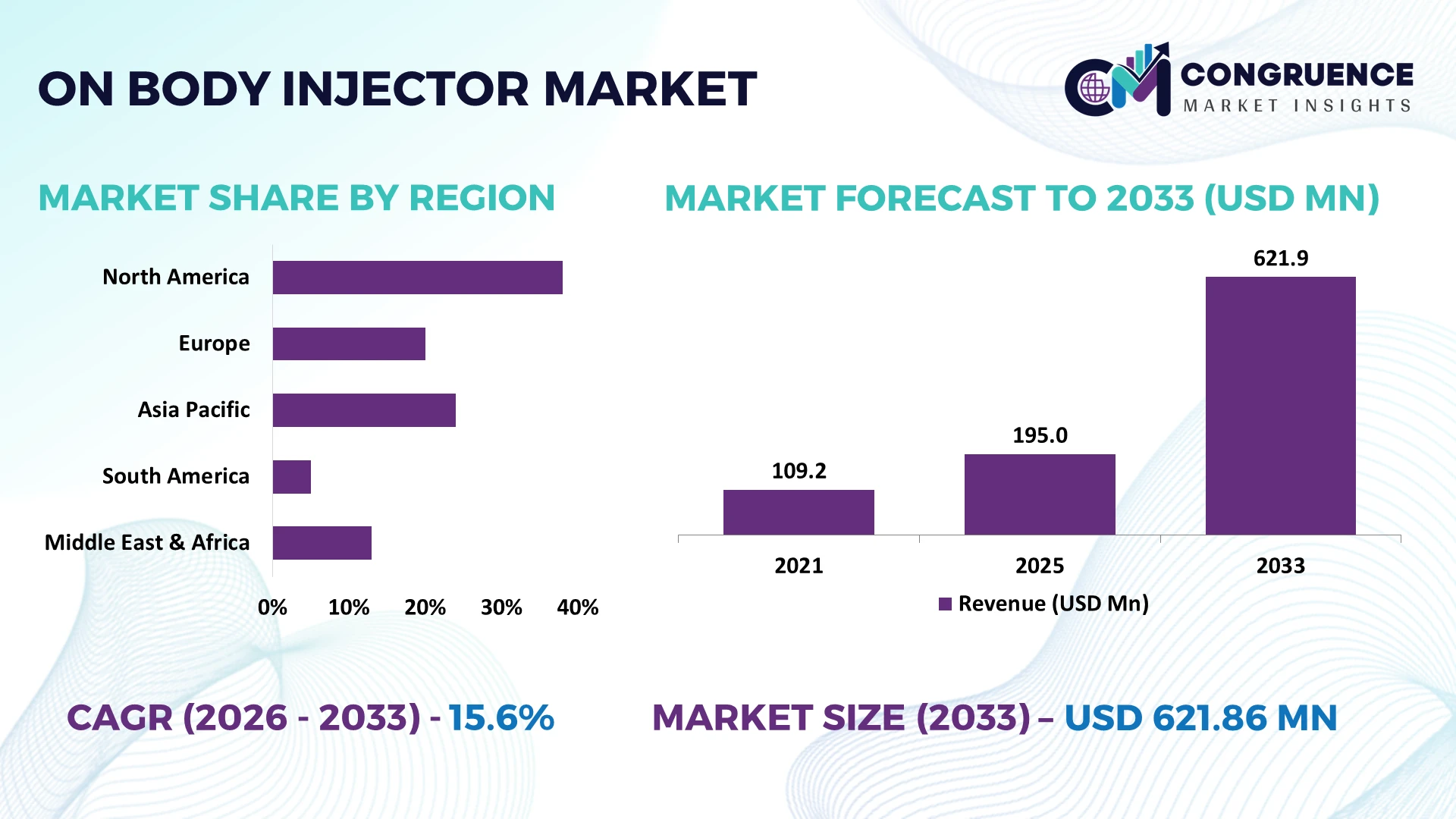
The U.S. remains the dominant country market, supported by North America’s estimated 33.17% share, extensive biologic drug utilization, established specialty-pharmacy infrastructure, and rapid adoption of self-administered therapies. India represents a high-potential expansion market, with more than 89 million adults living with diabetes and increasing investment in advanced drug-delivery systems. In 2026, a USD 30 million manufacturing investment strengthened domestic wearable-injector production capacity, while U.S. adoption continues to outpace major Asian markets. This geographic gap highlights a clear opportunity for manufacturers to prioritize U.S. oncology and biologic applications while establishing localized production, regulatory capabilities, and cost-efficient distribution networks across India and other high-growth Asian markets.
Strategically, manufacturers should prioritize U.S. oncology and biologics programs while developing scalable, cost-efficient platforms for Asia-Pacific expansion.
Market Size & Growth: USD 195M in 2025 is projected to reach USD 621.86M by 2033 at a 15.6% CAGR, driven by biologic therapies shifting toward subcutaneous delivery.
Top Growth Drivers: Home-based administration contributes 42.7%, oncology applications 29.5%, while wearable delivery adoption reaches 63.4%.
Short-Term Forecast: By 2030, automated manufacturing is positioned to deliver 10–15% lower assembly costs and 5–10% higher production throughput.
Emerging Technologies: AI-enabled guidance, connected sensors, automated drug delivery, and high-viscosity injection systems are advancing next-generation injector performance.
Regional Leaders: North America holds 33.17% share, Asia-Pacific remains the fastest-expanding region, and Europe is accelerating home-based treatment adoption.
Consumer/End-User Trends: Home-care settings account for approximately 42.7% of usage, reinforcing the shift toward patient-administered injectable therapies.
Pilot/Case Example: In 2026, wearable oncology administration reduced treatment time from up to 180 minutes to approximately 13 minutes, representing more than 90% time reduction.
Competitive Landscape: West Pharmaceutical Services, BD, Stevanato Group, Enable Injections, and Nemera remain prominent competitors across wearable and on-body delivery platforms.
Regulatory & ESG Impact: 2026 expansion of regulatory approvals for wearable oncology delivery strengthens adoption of lower-resource administration models and reduces dependence on infusion-center infrastructure.
Investment & Funding: USD 30M in 2026 manufacturing investment demonstrates the industry’s shift toward expanded production capacity and more resilient regional supply chains.
Innovation & Future Outlook: Next-generation platforms are integrating connected electronics, miniaturized pumps, high-volume drug delivery, and digital guidance, shifting competition toward integrated drug-device solutions.
The On-body Injector Market is gaining traction across oncology, autoimmune diseases, diabetes, and other chronic treatment areas where reducing infusion-center dependency improves treatment efficiency. Approximately 42.7% home-care utilization demonstrates the commercial importance of patient-administered delivery, while high-viscosity formulations and connected injection systems are expanding device capabilities. Regional manufacturing expansion and tighter device-drug integration are creating new opportunities for scalable platforms, setting the foundation for strategic investment and competitive positioning.
The On-body Injector Market is becoming strategically important as pharmaceutical companies redesign delivery models around high-volume biologics, oncology therapies, and home administration rather than repeated infusion-center visits. On-body systems represented 63.4% of wearable-injector formats in 2025, while home care accounted for 42.7%, indicating that device selection is increasingly influencing treatment economics, patient access, and pharmaceutical commercialization strategies.
Technology is also changing the competitive equation. The latest wearable systems can deliver large-volume, high-viscosity medicines subcutaneously, while connected platforms add monitoring and digital guidance. A 2026 U.S. oncology deployment reduced administration time from up to 180 minutes with IV delivery to approximately 13 minutes, representing more than 90% lower treatment time. North America remains the innovation and deployment leader, while China, India, and Japan are strengthening localized manufacturing and regulatory capabilities.
Over the next 2–3 years, manufacturers will prioritize scalable production, drug-device partnerships, and regional supply-chain localization. A USD 30 million 2026 manufacturing investment demonstrates this shift from prototype development toward commercial capacity. Companies that combine validated delivery platforms with pharmaceutical partnerships will gain stronger launch readiness, manufacturing resilience, and long-term competitive positioning.
The strongest growth driver is the migration of complex injectable therapies from infusion centers toward home-based subcutaneous administration. Home care represented 42.7% of wearable-injector end use in 2025, while on-body formats held 63.4% of the technology segment. The shift is particularly significant for oncology and autoimmune therapies requiring larger doses or repeated administration. In the U.S., the 2026 approval of an on-body formulation for a multiple-myeloma therapy demonstrated that a treatment requiring up to 180 minutes intravenously can be delivered in approximately 13 minutes. Pharmaceutical companies are responding by funding device integration, expanding manufacturing capacity, and forming drug-device partnerships. The non-obvious advantage is reduced infusion-chair dependency, allowing providers to redirect clinical capacity toward higher-acuity patients.
Drug-device integration remains a structural constraint because on-body injectors must accommodate formulation viscosity, delivery volume, container compatibility, adhesion, dosing accuracy, and human-factor requirements simultaneously. Approximately 39.6% of wearable-injector end use remained concentrated in hospitals and clinics in 2025, demonstrating that home deployment has not displaced supervised administration. High-volume biologics also impose tighter mechanical and fluidic requirements than conventional low-volume injections. In the U.S. and Europe, combination-product requirements can extend validation and regulatory workloads when device changes affect drug delivery performance. Companies are mitigating this pressure through standardized platforms, earlier pharmaceutical-device collaboration, dual sourcing of critical components, and manufacturing validation before commercial launch. The key operational issue is not device availability but repeatable drug-device compatibility at scale.
The largest opportunity lies in platforms capable of delivering high-volume and high-viscosity biologics while maintaining patient usability. On-body systems already accounted for 63.4% of wearable-injector formats, creating a strong installed technology base for platform expansion. Connected sensors, automated delivery controls, digital guidance, and compact pumps can differentiate products beyond basic drug administration. China, India, and Japan offer additional opportunities as pharmaceutical manufacturing expands and healthcare systems modernize. Over the next 2–3 years, companies can target 10–30 mL delivery architectures, broader oncology applications, and chronic-care therapies requiring repeated administration. Manufacturers are increasingly using partnerships to combine injector engineering with pharmaceutical formulation expertise. A key opportunity is platform reuse across multiple molecules, reducing redesign requirements and accelerating commercialization.
Commercial scaling remains difficult because on-body injectors combine precision mechanics, drug-contact materials, electronics, fluidic components, and validated assembly processes. A USD 30 million manufacturing investment announced in 2026 illustrates the capital required to move from development into reliable commercial production. Asia-Pacific manufacturers face an additional challenge in establishing localized component ecosystems while meeting international quality requirements. Connected injectors also introduce cybersecurity and software-validation considerations alongside conventional device compliance. Over the next 2–3 years, production systems will need higher automation, tighter process monitoring, and stronger supplier qualification to maintain consistent delivery performance. Companies must therefore invest in validated manufacturing infrastructure, dual-source critical components, digital quality controls, and specialized engineering partnerships. The strategic risk is losing pharmaceutical contracts because production scalability lags clinical and regulatory success.
Patch-Based Delivery Gains Scale: Patch-based systems are strengthening their position as high-volume delivery platforms, with on-body formats reaching 63.4% share across wearable injectors in 2025. Adhesive placement, programmed dosing, and reduced administration time are shifting procurement toward disposable architectures. Manufacturers are expanding automated assembly and drug-device partnerships, while U.S. oncology programs increasingly favor systems that move treatment away from infusion chairs.
Connected Devices Enter Workflows: Smart injectors are moving beyond basic dose delivery as connected sensors, mobile interfaces, and adherence monitoring enter commercial platforms. Smart systems are projected to expand at 15.65%, reflecting stronger demand for digitally traceable administration. Companies are integrating software with device hardware to improve patient monitoring, reduce manual follow-up, and strengthen pharmaceutical differentiation. The non-obvious shift is that digital connectivity is becoming a contracting advantage rather than merely a patient-facing feature.
Home Administration Reshapes Capacity: Home-care deployment accounted for 42.7% of wearable-injector use in 2025, compared with 39.6% for hospitals and clinics. U.S. reimbursement expansion and pressure on infusion-center capacity are accelerating this redistribution. Manufacturers are redesigning interfaces for self-administration, simplifying training, and partnering with pharmaceutical companies on combination products. The operational impact extends beyond patient convenience: shifting routine doses home releases clinical capacity for higher-acuity treatments.
High-Viscosity Delivery Expands: Injectable formulations exceeding 5 mL and higher-viscosity biologics are increasing engineering requirements for pumps, reservoirs, and adhesive systems. On-body platforms capable of delivering up to 30 mL are gaining relevance across oncology and autoimmune therapies. Companies are investing in precision fluidics, container compatibility, and validated assembly processes. Supply-chain pressure on specialty polymers and electronic components is also encouraging dual sourcing and localized production, making component resilience an increasingly important purchasing criterion.
Wearable injectors represent the leading type, with approximately 63.4% share, supported by their ability to combine reservoirs, pumps, sensors, and controlled delivery within a single patient-worn platform. Their scalability across biologics and oncology therapies gives manufacturers a stronger commercialization pathway than conventional reusable systems. Patch-Based injectors are emerging as the fastest-growing type as pharmaceutical developers prioritize smaller form factors, simplified application, and home-based administration. Adoption is strengthening particularly in the U.S., where reducing infusion-center dependency is becoming an important product-design objective.
Prefilled injectors retain relevance through simplified preparation and lower handling requirements, while Reusable systems offer advantages where repeated treatment cycles justify durable hardware. Approximately 42.7% of wearable-injector utilization is associated with home-care settings, reinforcing the shift toward disposable and patient-friendly architectures. Companies are therefore directing investment toward wearable and patch-based platforms, while improving reservoir capacity, adhesion, automated dosing, and drug-device compatibility. The strategic implication is a move toward modular platforms that can support multiple pharmaceutical formulations without extensive redesign.
Diabetes Management remains the leading application, accounting for approximately 42% of demand, supported by recurring injectable treatment and the increasing use of patient-administered delivery. Its scale favors connected monitoring, simplified dosing, and compact wearable designs. Oncology is emerging as the fastest-growing application as pharmaceutical companies convert selected therapies from infusion-based administration to subcutaneous delivery. The shift is particularly significant for treatments requiring repeated administration, where reducing chair time directly improves clinical throughput and patient convenience.
Autoimmune Diseases represent a strong secondary application because biologic therapies increasingly move into home settings, while Hormone Therapy remains a specialized segment with recurring treatment requirements. Home-care utilization of wearable injectors reached approximately 42.7%, strengthening demand for intuitive interfaces and automated delivery. Companies are adapting platforms by increasing reservoir capacity, improving injection accuracy, and integrating digital monitoring. Investment is increasingly concentrated on oncology and diabetes applications because they combine large patient populations with measurable opportunities to reduce administration burden and improve treatment workflow.
Hospitals remain the leading end-user, representing approximately 39.6% of wearable-injector utilization, reflecting their concentration of oncology, biologic initiation, monitoring, and complex treatment services. Specialty Clinics maintain strong demand because they manage concentrated patient populations requiring recurring injectable therapies. Home Healthcare is the fastest-growing end-user as treatment pathways shift toward self-administration and decentralized care. Its approximately 42.7% utilization level demonstrates that on-body injectors are increasingly becoming part of routine home-treatment workflows rather than remaining limited to supervised clinical environments.
Pharmaceutical Companies are gaining strategic influence because device selection increasingly affects drug differentiation, lifecycle management, and patient access. Hospitals prioritize reliability and clinical workflow, while home healthcare emphasizes usability, training, adhesion, and simplified operation. Companies are responding through customized device development, pharmaceutical partnerships, combination-product programs, and differentiated pricing models. The competitive focus is consequently shifting from selling standalone injectors toward building integrated delivery ecosystems. Manufacturers able to satisfy both clinical validation requirements and home-use expectations are positioned to capture a broader portion of future procurement.
North America accounted for the largest market share at 33.17% in 2025 however, Asia-Pacific is expected to register the fastest growth, expanding at a CAGR of 13.5% between 2026 and 2033.
Home-Based Biologic Delivery Drives Commercial Adoption
North America maintains the strongest on-body injector position because the U.S. combines advanced biologic pipelines, established specialty-pharmacy networks, reimbursement infrastructure, and high adoption of self-administered therapies. The region represented 33.17% of global market activity in 2025, with the U.S. accounting for the majority of regional demand. Oncology and chronic-care applications are increasingly moving toward wearable delivery as providers seek to reduce infusion-chair utilization. In 2026, investment in localized manufacturing capacity exceeded USD 30 million, reinforcing supply-chain resilience for device components and combination products. Manufacturers are prioritizing high-volume delivery systems, connected monitoring, and pharmaceutical partnerships rather than standalone injector development. The strategic advantage is concentrated commercial infrastructure: U.S. companies can validate devices, secure pharmaceutical collaborations, and scale launches faster than markets where reimbursement and home-care infrastructure remain less developed.
U.S. Market Outlook: The U.S. remains the primary innovation and commercialization hub, supported by extensive biologic development and mature combination-product pathways. Its on-body injector market is projected to reach USD 4.66 billion by 2033, while 2026 regulatory activity around wearable oncology delivery is strengthening pharmaceutical confidence in decentralized administration. Manufacturers are expanding production, clinical partnerships, and digital-device integration to secure early positions in high-value therapies.
Decentralized Care Reshapes European Deployment
Europe is shifting on-body injector adoption toward outpatient and home-based administration as healthcare systems prioritize capacity optimization, patient convenience, and reduced hospital dependence. Germany, France, the UK, and Italy represent the principal commercial markets, with France showing particularly strong expansion momentum. The region's established pharmaceutical manufacturing base supports closer drug-device collaboration, while European regulatory requirements encourage rigorous human-factors engineering and combination-product validation. France's market reached approximately USD 204.5 million in 2025, demonstrating the increasing commercial scale of advanced delivery systems. Manufacturers are responding with modular injector architectures, higher-volume delivery capabilities, and partnerships with pharmaceutical developers. Sustainability is also becoming relevant because home administration can reduce repeated patient travel and facility resource consumption. The strategic differentiator is Europe's ability to combine pharmaceutical manufacturing expertise with highly structured healthcare procurement.
Germany Market Outlook: Germany represents Europe's leading national market by projected commercial scale, supported by advanced pharmaceutical manufacturing, strong hospital infrastructure, and established medical-device engineering capabilities. Its position is reinforced by demand for biologic therapies and sophisticated outpatient treatment pathways. Manufacturers targeting Germany are emphasizing validated combination products, device reliability, and integration with specialist-care workflows.
Manufacturing Scale Accelerates Localized Adoption
Asia-Pacific is the fastest-expanding major market, accounting for approximately 18.8% of global on-body injector activity in 2025 and projected to reach USD 3.32 billion by 2033. China, Japan, India, and South Korea are driving demand through expanding pharmaceutical production, chronic-disease treatment requirements, and modernization of healthcare infrastructure. China provides the strongest manufacturing and pharmaceutical ecosystem, while Japan offers advanced device engineering and mature home-care adoption. India is increasingly important for cost-efficient production and generic and biosimilar development. Thailand is projected to record the region's fastest country-level growth. Manufacturers are responding by localizing component sourcing, establishing contract-development partnerships, and adapting devices for price-sensitive markets. The strategic opportunity extends beyond consumption: Asia-Pacific can increasingly function as a production and export base for cost-optimized injector platforms.
China Market Outlook: China offers the strongest combination of pharmaceutical manufacturing scale, domestic patient demand, and medical-device industrial capacity in Asia-Pacific. The country is projected to lead the regional market by 2033, supported by expanding biologic production and healthcare modernization. Companies are strengthening local partnerships and manufacturing capabilities to reduce import dependence and improve regulatory-market access.
Brazil Leads the Shift Toward Accessible Delivery
South America remains an emerging on-body injector market where adoption is closely linked to pharmaceutical accessibility, public-health procurement, and private healthcare expansion. Brazil represents the region's principal commercial opportunity because of its large patient base, domestic pharmaceutical industry, and comparatively developed medical infrastructure. Demand is strongest where self-administration can reduce repeated hospital visits and improve treatment continuity. Diabetes and oncology therapies provide practical entry points, although device affordability and distribution remain important purchasing considerations. Manufacturers are increasingly working through pharmaceutical distributors, local healthcare networks, and regional partnerships rather than relying exclusively on direct device sales. Localized packaging, training, and after-sales support can materially improve deployment consistency. The non-obvious opportunity is Brazil's role as a regional commercialization gateway, allowing companies to establish regulatory and distribution capabilities before expanding into neighboring markets.
Brazil Market Outlook: Brazil provides the strongest South American platform for on-body injector commercialization because of its large healthcare system, pharmaceutical manufacturing base, and growing demand for chronic-disease treatment. Local production and distribution partnerships can reduce import exposure and improve procurement competitiveness. Companies that combine affordable device configurations with pharmaceutical collaborations are best positioned to expand beyond major metropolitan healthcare networks.
Healthcare Modernization Supports Premium Device Adoption
Middle East & Africa is developing through healthcare modernization, private-sector investment, specialist hospital expansion, and increasing adoption of advanced drug-delivery technologies. Gulf markets, particularly Saudi Arabia and the UAE, provide the strongest near-term opportunities because healthcare infrastructure is being upgraded around specialized treatment, digital health, and patient-centered services. The region's on-body injector market generated approximately USD 536.2 million in 2024 in broader market estimates, demonstrating an emerging commercial base for advanced delivery systems. South Africa provides an additional entry point into Sub-Saharan Africa through its established pharmaceutical and healthcare infrastructure. Manufacturers are prioritizing distributor partnerships, localized training, and premium devices for specialty therapies rather than pursuing broad commoditized deployment. The strategic advantage is concentrated in high-income healthcare systems where advanced devices can enter through oncology, biologics, and private hospital networks.
Saudi Arabia Market Outlook: Saudi Arabia is the most strategically significant Gulf market because healthcare modernization programs are expanding specialist infrastructure, digital health capabilities, and advanced treatment access. The country's growing investment in healthcare technology supports premium drug-delivery adoption, while centralized procurement can accelerate deployment once products achieve regulatory acceptance. Manufacturers are positioning through hospital partnerships, local distribution agreements, and digitally enabled patient-support models.
West Pharmaceutical Services, BD, Stevanato Group, Enable Injections, and Nemera represent the leading competitive group, while regional device manufacturers and pharmaceutical drug-device partners challenge them on customization and cost. The top five players collectively control approximately 55% of the market, indicating a moderately concentrated structure. Competition centers on delivery precision, device reliability, manufacturing scale, and pharmaceutical compatibility, with automated assembly improving production efficiency by 5–10% and connected platforms reducing manual monitoring requirements by approximately 2–5%. Global leaders are expanding high-volume manufacturing, forming combination-product partnerships, and integrating pumps, sensors, and software. Regional players compete through lower-cost manufacturing and localized regulatory support. The competitive shift is moving from standalone injector hardware toward integrated drug-device platforms, increasing pressure on component control and formulation compatibility. Entry barriers remain high because clinical validation, combination-product compliance, precision manufacturing, and pharmaceutical partnerships require substantial technical capabilities. Winning requires validated platforms, scalable supply chains, rapid customization, and strong pharmaceutical alliances.
West Pharmaceutical Services, Inc.
Becton, Dickinson and Company
Stevanato Group S.p.A.
Enable Injections, Inc.
Nemera
Ypsomed Holding AG
SHL Medical AG
Sensile Medical AG
Medtronic plc
Phillips-Medisize
Sorrel Medical
Bespak
Unilife Corporation
Current on-body injectors increasingly use electromechanical pumps, automated cannula insertion, adhesive systems, and programmable dosing controls to improve delivery consistency. Automated delivery can improve operational efficiency by approximately 5–10% versus manually managed administration workflows, while integrated sensors reduce manual monitoring requirements by 2–5%. Adoption is strongest in oncology and biologic therapies where controlled delivery and reduced clinic dependency provide measurable workflow benefits. Manufacturers are integrating drug reservoirs, pumps, sensors, and connectivity into modular platforms.
Emerging technologies include high-viscosity fluidics, larger reservoirs, connected monitoring, AI-assisted injection guidance, and digital patient-support interfaces. Advanced fluidic architectures improve delivery performance by approximately 3–7%, while smart monitoring can reduce intervention requirements by 2–4%. Patch-based platforms are gaining deployment momentum because they combine compact form factors with automated dosing. Companies with strong pharmaceutical partnerships benefit most because validated drug-device integration accelerates commercialization and reduces redesign requirements.
From 2026–2028, disruptive development will center on high-volume delivery, miniaturized electronics, predictive device diagnostics, and software-enabled adherence management. New-generation automated platforms can reduce administration time by more than 90% versus lengthy intravenous workflows in selected therapies. Compared with legacy clinic-centered delivery, integrated on-body systems improve workflow efficiency substantially. Competitive advantage will shift toward manufacturers controlling fluidics, electronics, software, and combination-product validation within one scalable platform.
January 2026 Enable Injections received a $30 million investment from Sanofi to accelerate manufacturing build-out and supply-chain capabilities for enFuse. The funding strengthens commercial capacity for large-volume subcutaneous therapies and supports broader pharmaceutical partnerships and production readiness globally. Source: enableinjections.com
January 2026 West Pharmaceutical Services agreed to transfer SmartDose 3.5mL manufacturing and supply rights and associated facilities to AbbVie for $112.5 million. The transaction reallocates production ownership while West retains development of SmartDose platforms, including its 10mL system. Source: investor.westpharma.com
October 2025 Incyte and Enable Injections partnered to develop and commercialize INCA033989 with enFuse, granting Incyte worldwide exclusive rights. The collaboration extends on-body delivery into investigational hematology therapies and expands pharmaceutical integration opportunities across indications and pipeline assets.
July 2026 Sanofi received U.S. FDA approval for Sarclisa Escena, the first anticancer treatment administered through an on-body injector. The device delivers therapy subcutaneously, creating a new commercial pathway for oncology administration and reducing infusion burden for patients. Source: fda.gov
The On-body Injector Market report covers the evolving drug-delivery ecosystem across Wearable, Patch-Based, Prefilled, and Reusable injector types, with application analysis spanning Diabetes Management, Oncology, Autoimmune Diseases, and Hormone Therapy. End-user coverage includes Hospitals, Specialty Clinics, Home Healthcare, and Pharmaceutical Companies. The study evaluates adoption patterns, deployment intensity, drug-device integration, manufacturing capabilities, and commercialization priorities.
Regional assessment covers North America, Europe, Asia-Pacific, South America, and Middle East & Africa, with country-level analysis emphasizing the U.S., Germany, China, Japan, India, Brazil, and Saudi Arabia. Technology coverage includes high-volume delivery, connected monitoring, automated dosing, advanced fluidics, and digital patient-support systems. The report supports investment planning, manufacturing localization, partnership decisions, competitive positioning, product development, and expansion strategy across 2026–2033.
| Report Attribute/Metric | Report Details |
|---|---|
Market Revenue in 2025 | USD 195 Million |
Market Revenue in 2033 | USD 621.86 Million |
CAGR (2026 - 2033) | 15.6% |
Base Year | 2025 |
Forecast Period | 2026 - 2033 |
Historic Period | 2021 - 2025 |
Segments Covered | By Type
By Application
By End-User
|
Key Report Deliverable | Revenue Forecast, Growth Trends, Market Dynamics, Segmental Overview, Regional and Country-wise Analysis, Competition Landscape |
Region Covered | North America, Europe, Asia-Pacific, South America, Middle East, Africa |
Key Players Analyzed | West Pharmaceutical Services, Inc., Becton, Dickinson and Company, Stevanato Group S.p.A., Enable Injections, Inc., Nemera, Ypsomed Holding AG, SHL Medical AG, Sensile Medical AG, Medtronic plc, Phillips-Medisize, Sorrel Medical, Bespak, Unilife Corporation |
Customization & Pricing | Available on Request (10% Customization is Free) |




