
Reports
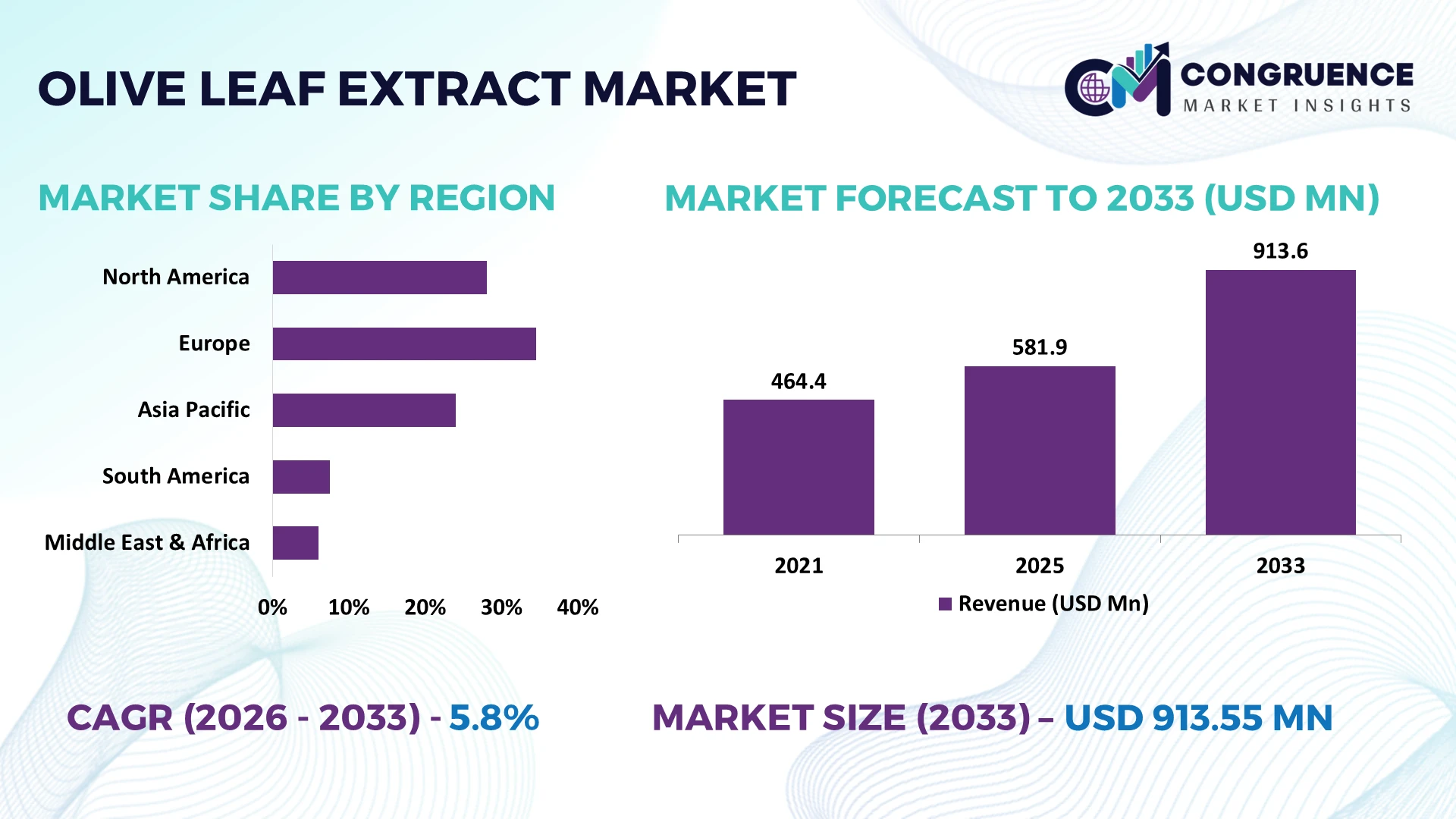
The Global Olive Leaf Extract Market was valued at USD 581.9 Million in 2025 and is anticipated to reach a value of USD 9,13.6 Million by 2033 expanding at a CAGR of 5.8% between 2026 and 2033. Growth is driven by the commercialization of oleuropein-rich botanical ingredients, standardized polyphenol extraction technologies, and increasing incorporation of olive leaf bioactives into nutraceuticals, functional foods, and natural cosmetic formulations.
Spain maintains a strategic position in the global olive leaf extract supply chain, accounting for approximately 40–45% of European Union olive oil production in a typical production year, compared with Italy's approximately 10–15%. Spain's extensive olive-growing infrastructure supports industrial leaf collection and polyphenol extraction. The European Union's sustainability policies further encourage agricultural by-product valorization, supporting investments in traceable botanical ingredient processing.
Manufacturers prioritizing Spanish sourcing partnerships, standardized oleuropein concentrations, and integrated extraction infrastructure are positioned to strengthen supply reliability and differentiation in the global olive leaf extract industry.
Market Size & Growth: Valued at USD 581.9 Million in 2025 and projected to reach USD 913.6 Million by 2033, registering 5.8% CAGR, supported by standardized botanical extract adoption.
Top Growth Drivers: Three demand catalysts include nutraceutical formulation expansion, clean-label ingredient adoption, and agricultural by-product valorization, with percentage contributions varying by application.
Short-Term Forecast: By 2028, extraction automation and improved solvent recovery are expected to strengthen processing efficiency, with plant-level improvements dependent on equipment configuration.
Emerging Technologies: Membrane filtration, ultrasound-assisted extraction, and supercritical fluid processing are advancing polyphenol recovery, purity, and production consistency.
Regional Leaders: Europe leads agricultural sourcing, Asia Pacific expands nutraceutical manufacturing, and North America strengthens standardized supplement distribution; regional revenue allocations remain unverified.
Consumer/End-User Trends: Demand increasingly favors standardized oleuropein concentrations, transparent botanical sourcing, and clean-label supplements with documented quality specifications.
Pilot/Case Example: Industrial research into ultrasound-assisted olive leaf extraction demonstrates shorter processing cycles and improved mass transfer compared with conventional maceration.
Competitive Landscape: Euromed, Naturex/Givaudan, Indena, Bio-Botanica, and Frutarom/IFF represent established botanical ingredient suppliers; olive leaf-specific market shares remain unverified.
Regulatory & ESG Impact: European sustainability initiatives encourage olive biomass utilization, while botanical ingredient manufacturers face strict requirements for safety, traceability, and substantiated health claims.
Investment & Funding: Capital deployment increasingly targets extraction modernization, laboratory standardization, and agricultural processor partnerships; a verified global investment total is unavailable.
Innovation & Future Outlook: High-purity oleuropein extracts, encapsulated polyphenols, and solvent-efficient extraction systems are strengthening premium ingredient positioning.
The Olive Leaf Extract Market is evolving through expanding nutraceutical applications, botanical skincare innovation, and industrial utilization of olive-processing residues. Advanced extraction technologies improve recovery of oleuropein and hydroxytyrosol while supporting ingredient consistency. Spain's extensive olive cultivation infrastructure and European agricultural sustainability initiatives reinforce raw-material availability. These developments establish a foundation for evaluating competitive positioning, processing economics, and emerging commercialization pathways.
Olive leaf extract is becoming strategically important as nutraceutical, functional ingredient, and personal care manufacturers seek standardized botanical compounds with traceable agricultural origins. The industry is transitioning from fragmented botanical processing toward integrated extraction networks linking olive growers, ingredient processors, and formulation companies. European agricultural sustainability initiatives reinforce this transition by encouraging commercial utilization of olive cultivation residues.
Technology differentiation increasingly determines processing economics. Ultrasound-assisted extraction accelerates polyphenol release compared with conventional maceration, while membrane filtration improves extract concentration and separation efficiency. Spain and Italy benefit from established olive cultivation and ingredient processing infrastructure, whereas India and China provide expanding opportunities for nutraceutical formulation and contract manufacturing. Standardized oleuropein concentrations, commonly specified at 10–20% in commercial extracts, enable manufacturers to target differentiated product categories.
Between 2027 and 2029, investment priorities will increasingly emphasize automated extraction, analytical verification, and controlled raw-material sourcing. A practical deployment model involves partnering with olive oil mills to collect leaves, establish traceable processing batches, and produce standardized botanical ingredients. Companies integrating agricultural sourcing with validated extraction processes will gain stronger cost control, product consistency, and competitive positioning.
Increasing incorporation of oleuropein-rich ingredients into dietary supplements and functional formulations is strengthening commercial demand for olive leaf extract. Commercial botanical ingredients commonly feature oleuropein standardization levels of 10%, 20%, and 40%, allowing formulators to select concentrations according to product specifications. Spain's established olive cultivation infrastructure supports industrial extraction and agricultural by-product utilization, reducing dependence on dedicated botanical cultivation. The growing preference for traceable, plant-derived ingredients is encouraging manufacturers to introduce standardized extracts with verified polyphenol profiles. Companies are expanding extraction capacity, investing in high-performance liquid chromatography testing, and developing partnerships with agricultural processors. Consistent active-compound specifications increasingly determine supplier qualification and long-term procurement relationships.
Olive leaf extract production faces structural constraints arising from seasonal leaf availability, variable phytochemical composition, and processing costs. Commercial oleuropein specifications can range from 10% to 40%, requiring manufacturers to manage substantial differences in feedstock quality and extraction intensity. Leaf maturity, cultivation conditions, and drying methods influence polyphenol concentration, complicating standardized production. In Spain and Italy, competition for agricultural processing capacity and energy-intensive drying operations adds pressure to manufacturing economics. Producers must maintain analytical testing, moisture control, and batch segregation to satisfy nutraceutical ingredient requirements. Companies are reducing exposure through diversified agricultural contracts, controlled drying infrastructure, and optimized extraction protocols. Securing consistent bioactive content is more commercially important than maximizing raw leaf procurement volumes.
High-purity botanical ingredients present opportunities for manufacturers moving beyond conventional olive leaf extract formulations. Commercial extracts standardized to 20% and 40% oleuropein support differentiated product development, while advanced purification enables specialized hydroxytyrosol-rich ingredients. Encapsulation technologies offer additional opportunities to improve ingredient stability, taste masking, and compatibility with functional food applications. India presents an attractive formulation and contract manufacturing opportunity as nutraceutical producers diversify botanical ingredient portfolios. Emerging applications include combination antioxidant formulations, premium skincare products, and specialized functional nutrition ingredients. Companies are investing in membrane separation, analytical characterization, and formulation partnerships to develop application-specific extracts. Suppliers capable of delivering reproducible active-compound profiles can capture greater value through technical ingredient differentiation rather than competing primarily on bulk extract pricing.
Scaling olive leaf extraction while maintaining reproducible polyphenol profiles represents a significant operational challenge. Products standardized to 10%, 20%, and 40% oleuropein require different purification intensities, analytical controls, and process validation procedures. Industrial extraction must also address compound degradation during drying, solvent recovery, concentration, and storage. European botanical ingredient suppliers face evolving expectations regarding contaminant testing, traceability, and substantiation of product claims. Translating laboratory extraction performance into commercial production requires careful control of temperature, residence time, and solvent composition. Companies must invest in validated processing equipment, qualified analytical personnel, and documented quality management systems. Long-term competitiveness depends on achieving consistent ingredient specifications across production batches without compromising processing efficiency, regulatory compliance, or environmental performance.
Traceability Reshapes Botanical Procurement Workflows: Olive leaf extract manufacturers are strengthening batch-level traceability as ingredient buyers demand consistent phytochemical profiles and documented agricultural origins. Commercial oleuropein specifications commonly range from 10% to 40%, creating distinct testing requirements. Spanish processors are integrating digital batch records, moisture monitoring, and supplier qualification systems. Companies are restructuring procurement contracts and investing in analytical laboratories to reduce batch rejection risks and improve manufacturing consistency.
Solvent Recovery Gains Operational Priority: Extraction facilities are optimizing ethanol-water processing systems to improve solvent utilization and reduce waste-handling requirements. Ethanol concentrations between 50% and 80% are frequently investigated for polyphenol extraction, depending on processing conditions. Equipment manufacturers are integrating closed-loop solvent recovery, automated temperature controls, and improved filtration systems. These upgrades strengthen process repeatability and reduce operational exposure to solvent procurement volatility.
Multi-Compound Quality Testing Becomes Standard: Botanical ingredient buyers increasingly assess oleuropein, hydroxytyrosol, and total phenolic content rather than relying on a single marker compound. Standardized extracts containing 10% or 20% oleuropein require reliable chromatographic verification. Italian and Spanish processors are expanding laboratory capabilities and adopting high-performance liquid chromatography workflows. Multi-marker testing improves formulation consistency and enables suppliers to distinguish genuine extract quality from nominal concentration claims.
Agricultural Residue Logistics Become Integrated: Olive processors are coordinating leaf collection with pruning schedules and olive oil production cycles. Spain and Italy maintain substantial olive cultivation infrastructure, while pruning cycles commonly extend across 1–2 years depending on orchard management. Ingredient manufacturers are establishing collection agreements, decentralized drying arrangements, and biomass sorting systems. Integrating residue logistics reduces feedstock handling losses and improves supply planning without expanding dedicated cultivation acreage.
The solid segment leads the global Olive Leaf Extract Market, accounting for approximately 70% of product volume, supported by widespread utilization in dietary supplements, pharmaceutical formulations, and functional food ingredients. Solid extracts offer advantages in storage stability, transportation efficiency, precise dosing, and compatibility with established capsule and tablet manufacturing infrastructure. Standardized powder formulations containing 10–20% oleuropein are commonly used in nutraceutical production. Manufacturers are strengthening spray-drying capabilities, optimizing particle characteristics, and expanding bulk ingredient distribution networks to support industrial formulation requirements.
Liquid extracts represent approximately 30% of product volume and are gaining traction in botanical tinctures, functional beverages, and personal care formulations. Their compatibility with liquid processing systems supports flexible formulation and direct incorporation into finished products. Companies are developing concentrated liquid extracts, improving filtration processes, and expanding alcohol-free formulations to serve differentiated consumer preferences. Solid products retain manufacturing advantages, while liquid formats offer opportunities for application-specific innovation.
Nutraceuticals represent a leading application category in the global Olive Leaf Extract Market, supported by demand for standardized botanical supplements and antioxidant formulations. Food, nutraceutical, and supplement applications collectively account for approximately 65% of reported extract volume in selected industry estimates. Manufacturers incorporate oleuropein-rich extracts into capsules, tablets, and powdered dietary formulations, with commercial concentrations commonly ranging from 10% to 20%. Established supplement manufacturing infrastructure in the United States and Germany supports consistent ingredient procurement and standardized product development.
Cosmetics and personal care represent a rapidly developing application, supported by botanical skincare formulations and interest in plant-derived antioxidant ingredients. Cosmetics account for approximately 35% of extract volume in certain market assessments. Pharmaceutical applications remain important for phytochemical research and specialized formulation development, while food and beverages utilize olive leaf ingredients in functional drinks and botanical products. Companies are expanding formulation testing, developing application-specific extracts, and partnering with ingredient distributors to strengthen commercialization.
Healthcare represents a leading end-user category in the global Olive Leaf Extract Market, supported by established dietary supplement manufacturing, botanical ingredient procurement, and standardized formulation requirements. Pharmaceutical and nutraceutical manufacturers prioritize consistent oleuropein concentrations, analytical documentation, and reliable ingredient supply. Commercial extracts standardized at 10%, 20%, and 40% provide formulation flexibility across different product specifications. Healthcare buyers maintain strong procurement relationships with botanical ingredient processors, particularly in the United States and Germany, where supplement manufacturing infrastructure supports specialized ingredient integration.
Personal care represents an expanding end-user segment as cosmetic manufacturers incorporate olive-derived polyphenols into skincare and antioxidant formulations. Food and beverage manufacturers are developing botanical beverages and functional ingredients, while animal feed producers are investigating olive leaf bioactives for specialized nutrition applications. Companies are adapting extraction specifications, offering customized ingredient concentrations, and developing technical partnerships with formulators. Healthcare remains commercially established, while personal care and food processing create opportunities for diversified product portfolios and specialized supply agreements.
Europe accounted for the largest market share at 34.5% in 2025 however, Asia-Pacific is expected to register the fastest growth, expanding at a CAGR of 7.2% between 2026 and 2033.
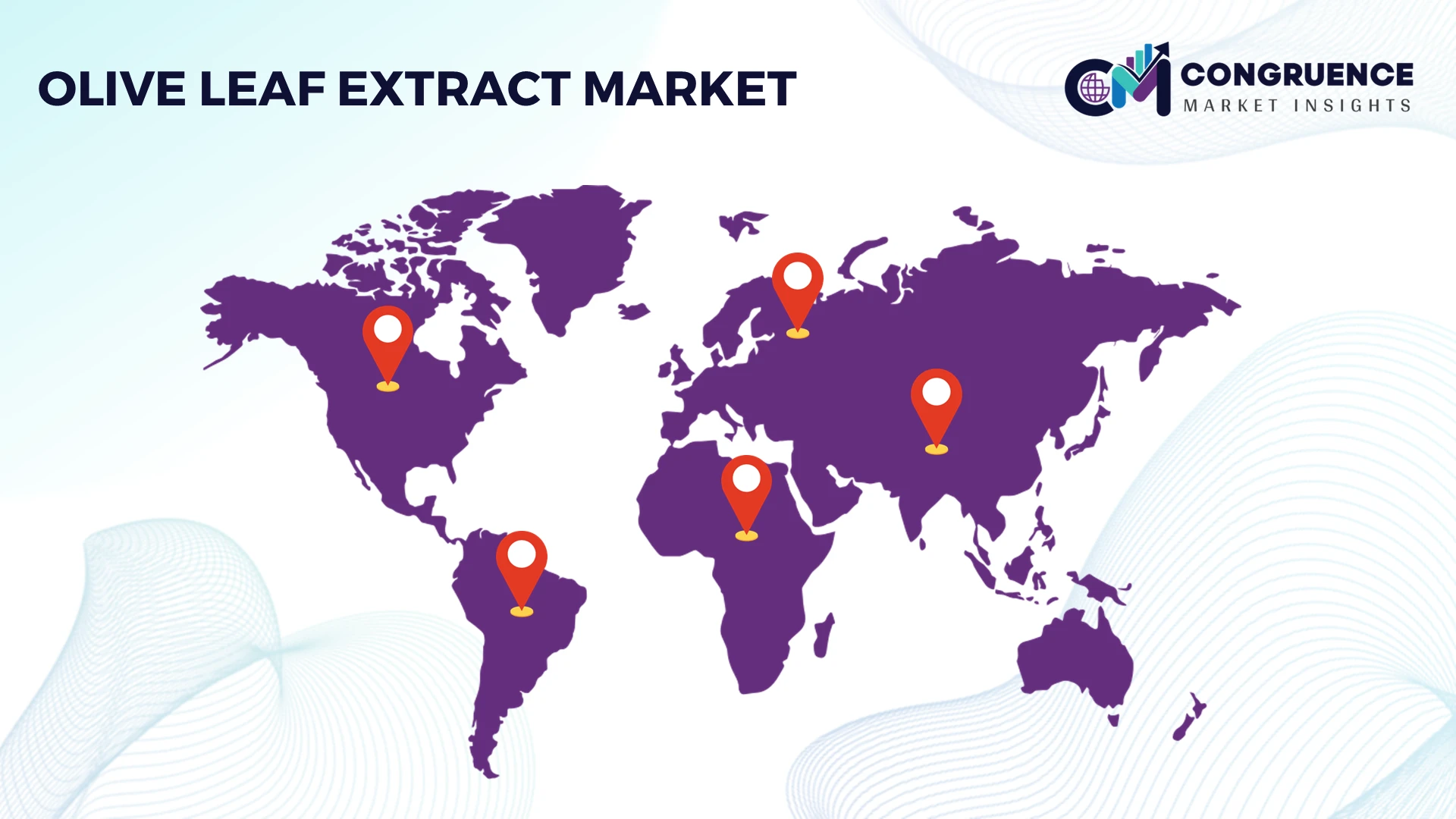
North America accounted for approximately 28.0% of the global Olive Leaf Extract Market in 2025, supported by established dietary supplement manufacturing, botanical ingredient distribution, and functional nutrition product development. The United States dominates regional consumption through nutraceutical manufacturers, contract formulators, and specialty ingredient distributors. Commercial demand increasingly favors standardized oleuropein extracts, particularly formulations containing 10–20% active compounds. Advanced analytical testing, ingredient traceability, and controlled extraction specifications influence procurement decisions across healthcare and personal care industries. Canada contributes through natural health product manufacturing and botanical supplement distribution, while Mexico offers opportunities for contract manufacturing and ingredient processing. Companies are strengthening supplier qualification programs, expanding botanical ingredient portfolios, and integrating analytical verification systems to improve formulation consistency. Regulatory oversight of dietary supplements reinforces demand for documented ingredient identity, purity, and manufacturing quality.
United States Market Outlook: The United States represents the primary commercial center for olive leaf extract consumption in North America, supported by established nutraceutical manufacturing and specialized botanical ingredient distribution. Dietary supplement producers utilize standardized extracts in capsules, tablets, and combination antioxidant formulations. The FDA's dietary supplement current good manufacturing practice requirements under 21 CFR Part 111 encourage manufacturers to maintain ingredient specifications, identity testing, and documented quality controls. Companies are investing in formulation development, third-party analytical testing, and distribution partnerships to strengthen product differentiation.
Europe held approximately 34.5% of the global Olive Leaf Extract Market in 2025, reflecting its extensive olive cultivation infrastructure, established botanical extraction capabilities, and mature nutraceutical manufacturing ecosystem. Spain, Italy, and Greece provide substantial agricultural feedstock availability, supporting commercial utilization of olive leaves generated through harvesting and pruning activities. The European Union accounts for a major proportion of global olive oil production, creating opportunities for integrated agricultural residue processing. Manufacturers increasingly combine solvent extraction, membrane filtration, and chromatographic analysis to improve polyphenol consistency. European sustainability initiatives encourage agricultural by-product valorization, while food safety and botanical ingredient regulations strengthen traceability requirements. Ingredient processors are developing agricultural sourcing agreements, improving extraction efficiency, and expanding standardized product portfolios. Germany and France contribute through supplement manufacturing, pharmaceutical ingredient distribution, and premium personal care formulation activities.
Spain Market Outlook: Spain maintains a strategic advantage through its extensive olive cultivation and industrial olive oil processing infrastructure. The country accounts for approximately 40–45% of European Union olive oil production in a typical production year, creating substantial potential for olive leaf collection and processing. Andalusia serves as a major agricultural and processing hub, supporting access to feedstock, drying facilities, and established logistics networks. Spanish ingredient manufacturers are positioned to strengthen oleuropein extraction capabilities, agricultural partnerships, and high-value botanical ingredient exports.
Asia-Pacific represented approximately 24.0% of the global Olive Leaf Extract Market in 2025, supported by expanding nutraceutical manufacturing, functional food innovation, and botanical ingredient processing capabilities. China, India, Japan, and South Korea contribute through dietary supplement production, pharmaceutical formulation, and specialized ingredient distribution. China maintains an established botanical extraction industry with capabilities in solvent processing, purification, and standardized phytochemical manufacturing. India benefits from its pharmaceutical contract manufacturing ecosystem and expanding nutraceutical formulation capabilities. Japan and South Korea emphasize product quality, functional nutrition, and premium skincare applications. Commercial extracts containing 10–20% oleuropein support formulation flexibility across supplements and personal care products. Companies are expanding contract manufacturing relationships, improving analytical testing infrastructure, and developing region-specific botanical formulations. Ingredient standardization and efficient distribution increasingly influence supplier selection across major manufacturing centers.
China Market Outlook: China represents a strategically important botanical ingredient manufacturing center, supported by established plant extraction infrastructure, chemical processing capabilities, and international ingredient distribution networks. Manufacturers utilize ethanol-based extraction, filtration, and chromatographic testing to produce standardized phytochemical ingredients. Commercial oleuropein specifications ranging from 10% to 40% support differentiated product requirements. Chinese processors are strengthening quality assurance systems, expanding purification capabilities, and developing export-oriented botanical ingredient portfolios to serve nutraceutical and personal care manufacturers.
South America accounted for approximately 7.5% of the global Olive Leaf Extract Market in 2025, supported by established olive cultivation activities and developing botanical ingredient manufacturing capabilities. Argentina, Chile, and Brazil represent important markets through agricultural processing, dietary supplement consumption, and functional ingredient distribution. Argentina and Chile maintain commercial olive cultivation operations, providing opportunities to utilize agricultural residues for polyphenol extraction. Brazil contributes through its nutraceutical manufacturing sector and established distribution channels for botanical ingredients. Regional processors are exploring integrated leaf collection, drying, and extraction operations to improve agricultural resource utilization. However, specialized purification infrastructure, analytical testing capacity, and fragmented feedstock logistics constrain large-scale commercialization. Companies are strengthening agricultural partnerships, evaluating localized extraction facilities, and developing distribution agreements with international ingredient suppliers. Processing integration remains important for improving product consistency and commercial competitiveness.
Brazil Market Outlook: Brazil represents a significant downstream market for olive leaf extract through its dietary supplement, pharmaceutical, and personal care manufacturing industries. The country's established consumer health product distribution infrastructure supports commercialization of standardized botanical formulations. ANVISA's regulatory framework influences ingredient eligibility, labeling, and product compliance requirements. Brazilian manufacturers are developing partnerships with international botanical ingredient suppliers while evaluating opportunities for localized formulation and packaging. Access to commercial extracts standardized at 10–20% oleuropein supports product development across specialized supplement categories.
The Middle East & Africa region represented approximately 6.0% of the global Olive Leaf Extract Market in 2025, supported by established olive cultivation industries and developing botanical ingredient processing infrastructure. Tunisia, Morocco, Türkiye, and South Africa contribute through agricultural production, ingredient processing, and nutraceutical distribution. Tunisia and Morocco maintain substantial olive cultivation operations, creating opportunities to convert agricultural residues into standardized polyphenol extracts. Regional producers increasingly recognize the commercial potential of olive leaves as feedstock for nutraceutical and cosmetic ingredients. Industrial development priorities include controlled drying facilities, solvent extraction equipment, analytical laboratories, and export-oriented processing systems. Limited specialized purification infrastructure and variable agricultural logistics constrain commercial scaling. Companies are evaluating partnerships with European ingredient manufacturers, strengthening agricultural collection networks, and introducing quality management systems to improve export readiness and ingredient consistency.
Tunisia Market Outlook: Tunisia represents a strategically important olive-producing country with established agricultural processing and international olive oil export capabilities. Its olive cultivation infrastructure provides access to leaf biomass generated through pruning and harvesting activities. The country has approximately 2 million hectares of olive groves, supporting substantial agricultural feedstock availability. Tunisian processors can leverage existing olive oil industry infrastructure to develop integrated botanical extraction operations. Investment in controlled drying, oleuropein standardization, and laboratory testing would strengthen opportunities for higher-value ingredient exports and agricultural residue utilization.
The global olive leaf extract market features competition between established botanical ingredient suppliers, specialized phytochemical manufacturers, and regional extraction processors. Euromed, Indena, Bio-Botanica, Givaudan, and IFF compete through ingredient standardization, technical expertise, and international distribution, while Mediterranean processors emphasize agricultural integration and competitive pricing. The leading five suppliers collectively represent an estimated 30–40% market share, although verified concentration data remains unavailable. Commercial extracts containing 10%, 20%, and 40% oleuropein create distinct competitive tiers based on purity, analytical verification, and formulation compatibility. Companies strengthen market positions through extraction modernization, agricultural partnerships, product innovation, and vertically integrated sourcing. Competition increasingly shifts toward traceable feedstocks, multi-compound characterization, and consistent batch quality rather than commodity pricing alone. Regulatory documentation, specialized extraction infrastructure, and validated quality systems create meaningful entry barriers. Winning requires dependable agricultural sourcing, differentiated bioactive specifications, efficient processing, and credible technical support for global ingredient buyers.
Euromed S.A.
Indena S.p.A.
Bio-Botanica Inc.
Givaudan SA
International Flavors & Fragrances Inc. (IFF)
Martin Bauer Group
Sabinsa Corporation
Nature's Answer
NOW Foods
Swanson Health Products
Gaia Herbs
Nature's Way Products LLC
Applied Food Sciences Inc.
Xi'an Lyphar Biotech Co., Ltd.
Conventional solvent extraction remains widely used in olive leaf processing because ethanol-water systems provide established compatibility with industrial botanical ingredient production. Commercial formulations commonly target oleuropein concentrations between 10% and 40%. Modern extraction facilities increasingly integrate automated temperature regulation, solvent recovery, and high-performance liquid chromatography. These technologies improve process repeatability, reduce manual handling, and support standardized ingredient specifications. Mediterranean processors benefit from combining established agricultural collection networks with controlled industrial extraction infrastructure.
Ultrasound-assisted extraction and microwave-assisted extraction represent important alternatives to conventional maceration. Under optimized laboratory conditions, ultrasound processing can reduce extraction times by more than 50%, although industrial performance depends on equipment configuration and feedstock characteristics. Membrane filtration and adsorption technologies further support polyphenol concentration and selective purification. Manufacturers adopting integrated extraction and separation systems gain advantages in processing speed, solvent utilization, and formulation flexibility. Specialized ingredient suppliers benefit particularly from differentiated high-purity botanical products.
Between 2026 and 2028, technological investment will emphasize continuous extraction, automated analytical monitoring, and digitally documented production batches. Advanced encapsulation technologies will support ingredient stability and application compatibility across nutraceuticals and cosmetics. Companies integrating extraction optimization with validated quality controls will strengthen manufacturing consistency, technical differentiation, and long-term supply relationships with international formulation businesses.
In 2024, IFF markets Benolea®, a standardized olive leaf extract containing 16–24% oleuropein. Its EFLA HyperPure processing supports ingredient purity and stability, strengthening differentiation in cardiovascular wellness formulations. Source: iff.com.
In 2026, Euromed lists olive leaf dry extract within its botanical ingredient portfolio. Its presence alongside other standardized phytochemical ingredients supports business-to-business formulation supply, although no recent capacity expansion or launch was confirmed. Source: euromedgroup.com.
In 2026, Gaia Herbs markets an olive leaf supplement sourced from cooperative farms in southern Spain, including trees exceeding 200 years in age. The sourcing model supports agricultural traceability and product differentiation. Source: gaiaherbs.com.
In 2026, IFF's CitrOlive formulation combines olive leaf and bitter orange extracts, standardized to at least 18% oleuropeosides and 12% flavonoids. The formulation demonstrates multi-botanical ingredient differentiation for metabolic wellness applications. Source: iff.com.
The Olive Leaf Extract Market Report provides comprehensive analysis of industry structure, competitive dynamics, technological advancements, and commercial opportunities between 2026 and 2033. Segmentation covers solid and liquid extracts by type; nutraceuticals, pharmaceuticals, cosmetics and personal care, and food and beverages by application; and healthcare, food processing, personal care, and animal nutrition by end-user. Geographic coverage includes North America, Europe, Asia-Pacific, South America, and Middle East & Africa, with analysis of country-level manufacturing and sourcing capabilities.
The report evaluates extraction technologies, oleuropein standardization, agricultural supply chains, regulatory requirements, and emerging formulation applications. It examines commercial extracts containing 10–40% oleuropein, competitive differentiation, supplier integration, and industrial processing strategies. These insights support investment planning, market entry, geographic expansion, product portfolio development, and long-term competitive positioning across established and emerging botanical ingredient markets.
| Report Attribute / Metric | Details |
|---|---|
| Market Revenue (2025) | USD 581.9 Million |
| Market Revenue (2033) | USD 9,13.6 Million |
| CAGR (2026–2033) | 5.8% |
| Base Year | 2025 |
| Forecast Period | 2026–2033 |
| Historic Period | 2021–2025 |
| Segments Covered |
By Type
By Application
By End-User
|
| Key Report Deliverables | Revenue Forecast; Market Trends; Growth Drivers & Restraints; Technology Insights; Segmentation Analysis; Regional Insights; Competitive Landscape; Regulatory & ESG Overview; Recent Developments |
| Regions Covered | North America; Europe; Asia-Pacific; South America; Middle East & Africa |
| Key Players Analyzed | Euromed S.A.; Indena S.p.A.; Bio-Botanica Inc.; Givaudan SA; International Flavors & Fragrances Inc. (IFF); Martin Bauer Group; Sabinsa Corporation; Nature's Answer; NOW Foods; Swanson Health Products; Gaia Herbs; Nature's Way Products LLC; Applied Food Sciences Inc.; Xi'an Lyphar Biotech Co., Ltd. |
| Customization & Pricing | Available on Request (10% Customization Free) |




