
Reports
The Global Neurology Diagnostics Devices Market was valued at USD 12,298.7 Million in 2025 and is anticipated to reach a value of USD 23,103.5 Million by 2033 expanding at a CAGR of 8.2% between 2026 and 2033. Rising deployment of AI-assisted neuroimaging, expansion of stroke-ready healthcare infrastructure, and increasing adoption of minimally invasive neurological diagnostics are accelerating market advancement.
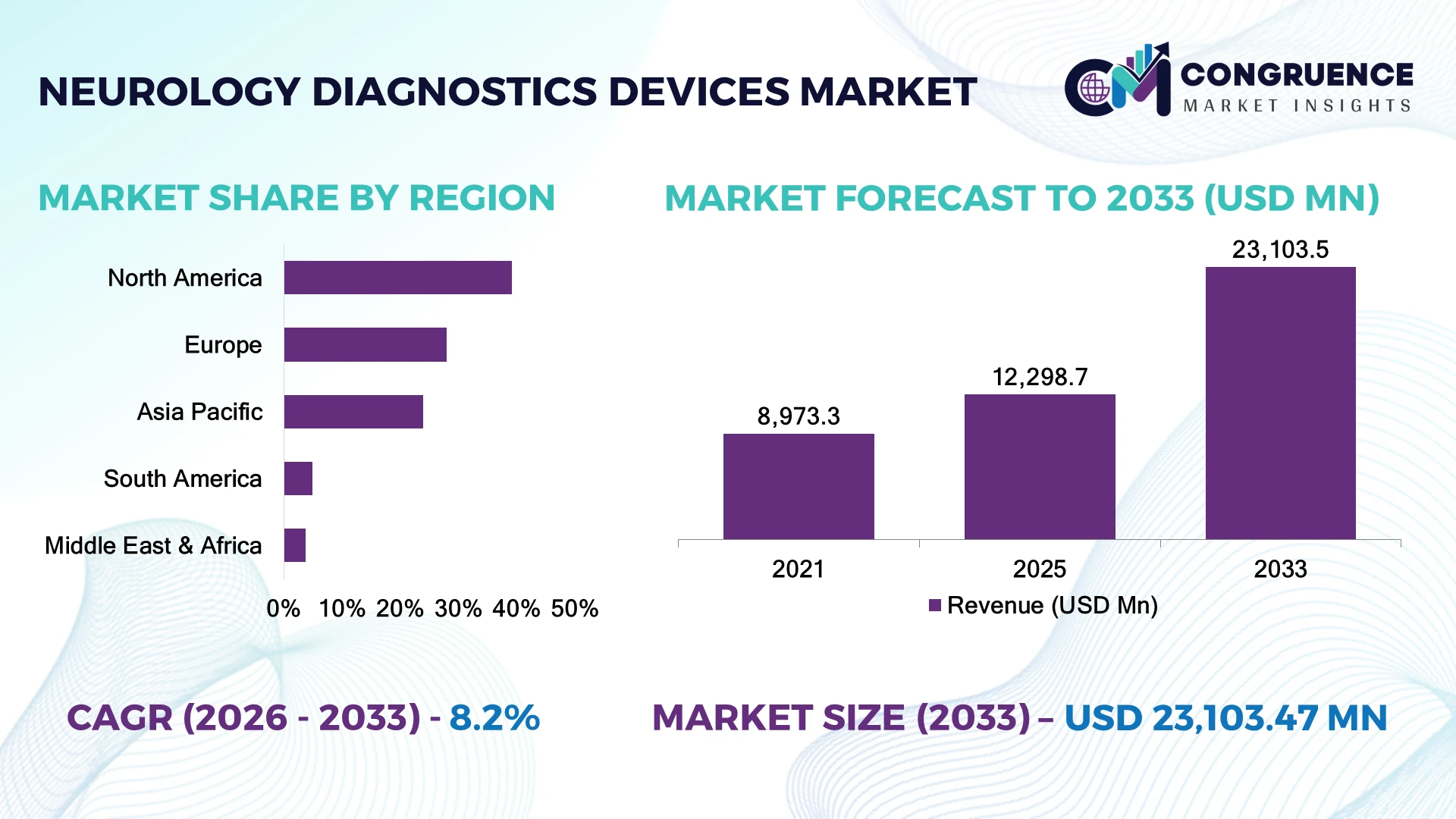
The United States leads the global neurology diagnostics devices market with approximately 34% of advanced neurodiagnostic installations, supported by over USD 2 billion in annual neuroscience research investments and widespread adoption across stroke centers and academic hospitals. Compared with Japan, where aging demographics drive strong diagnostic demand, the U.S. records nearly 40% higher utilization of AI-assisted brain imaging systems. Continued healthcare digitalization and geopolitical emphasis on resilient domestic medical technology manufacturing further reinforce national leadership.
Strategic investment should prioritize AI-integrated neurodiagnostic platforms and scalable imaging ecosystems within mature healthcare markets while expanding into rapidly modernizing neurological care networks.
Market Size & Growth: USD 12,298.7 Million (2025) to USD 23,103.5 Million (2033) at 8.2% CAGR, driven by AI-enabled neurological diagnostics.
Top Growth Drivers: AI imaging 32%, stroke screening 29%, aging population diagnostics 27%.
Short-Term Forecast: By 2028, diagnostic workflow efficiency improves by 24% through automation.
Emerging Technologies: AI analytics, portable EEG, and advanced functional MRI accelerate diagnostic precision.
Regional Leaders: North America USD 8.1 billion, Europe USD 5.6 billion, Asia-Pacific USD 6.3 billion with expanding hospital modernization.
Consumer/End-User Trends: Around 58% of tertiary hospitals prioritize integrated neurodiagnostic platforms.
Pilot/Case Example: 2026 AI-assisted stroke imaging reduced reporting time by 35% in multi-center deployments.
Competitive Landscape: Top players hold nearly 46% share through imaging innovation and integrated software.
Regulatory & ESG Impact: Digital health compliance improves data interoperability by approximately 30%.
Investment & Funding: More than USD 3 billion supports imaging innovation, partnerships, and manufacturing expansion amid supply-chain diversification.
Innovation & Future Outlook: Cloud-connected diagnostics and predictive neurology platforms strengthen precision medicine adoption.
Neurology diagnostics devices are increasingly deployed across stroke management, epilepsy diagnosis, neurodegenerative disease assessment, and critical care monitoring. AI-enhanced imaging and cloud-enabled neurological data platforms improve diagnostic confidence, while approximately 45% of new hospital procurement emphasizes integrated digital workflows. Ongoing healthcare infrastructure modernization and localized manufacturing initiatives continue strengthening supply resilience, setting the foundation for broader strategic market transformation.
Neurology diagnostics devices have become strategically important as healthcare providers prioritize earlier detection of neurological disorders, faster clinical decision-making, and precision treatment pathways. Expanding stroke care networks, digital hospital transformation, and increasing neurological disease prevalence are reshaping investment priorities. Healthcare systems are strengthening diagnostic capabilities through integrated imaging platforms and AI-assisted interpretation, while localized manufacturing strategies reduce dependence on complex global medical device supply chains.
AI-enabled neuroimaging platforms process complex neurological scans approximately 35% faster than conventional interpretation workflows while improving diagnostic consistency by nearly 25%. North America continues leading advanced deployment through extensive hospital digitization, whereas Asia-Pacific is expanding rapidly through healthcare infrastructure modernization and large-scale investments in tertiary neurological centers. Over the next two to three years, AI-supported neurological diagnostics are expected to exceed 50% adoption across newly commissioned comprehensive neuroscience facilities in leading healthcare markets.
Manufacturers are expanding collaborations with hospitals, research institutions, and software developers to integrate imaging, electrophysiology, and cloud-based clinical analytics into unified diagnostic ecosystems. Portable EEG systems, AI-driven MRI interpretation, and connected neurodiagnostic platforms are improving operational efficiency while supporting faster clinical interventions. Companies combining intelligent diagnostics, workflow automation, and interoperable digital infrastructure will secure stronger competitive positioning as neurological care increasingly shifts toward data-driven precision medicine.
AI-assisted neuroimaging and integrated neurological diagnostics are becoming the primary catalyst for market expansion as hospitals prioritize earlier disease detection and faster clinical decisions. More than 58% of newly procured high-end MRI and CT systems now include AI-based neurological analysis, while automated image interpretation reduces reporting time by approximately 35% and improves diagnostic consistency by nearly 25%. The United States continues expanding certified comprehensive stroke centers, accelerating demand for advanced diagnostic platforms. This structural shift enables faster intervention for stroke, epilepsy, and neurodegenerative disorders. Manufacturers are responding through AI software integration, strategic hospital collaborations, and investment in cloud-connected diagnostic ecosystems. A key competitive advantage now lies in combining imaging hardware, clinical analytics, and workflow automation into unified neurological diagnostic platforms.
Advanced neurology diagnostics require significant investment in imaging systems, specialized software, and skilled clinical personnel, creating barriers for healthcare providers. Approximately 42% of mid-sized hospitals postpone premium neurodiagnostic upgrades because of capital expenditure constraints, while interoperability challenges increase implementation timelines by nearly 28%. Germany and several emerging healthcare markets continue facing delays integrating legacy hospital information systems with modern diagnostic platforms. These limitations reduce deployment speed, increase operating costs, and complicate enterprise-wide digital transformation. Manufacturers are mitigating risk through modular software architecture, localized service networks, long-term maintenance agreements, and financing programs that reduce acquisition burdens. Organizations capable of simplifying integration while lowering ownership costs gain stronger access to underserved healthcare facilities.
Precision medicine is creating substantial opportunities for advanced neurology diagnostics through AI, cloud analytics, digital biomarkers, and remote neurological assessment. Around 47% of new neuroscience investment programs emphasize integrated digital diagnostic ecosystems, while predictive analytics improves patient risk stratification by approximately 30%. Japan continues expanding digital neurological screening for its aging population, encouraging broader deployment of intelligent diagnostic platforms. Companies are strengthening competitiveness through AI algorithm development, hospital partnerships, software-as-a-medical-device innovation, and multimodal imaging integration. A notable opportunity lies in combining neuroimaging, electrophysiology, and wearable neurological monitoring into unified clinical decision platforms, enabling continuous patient assessment rather than isolated diagnostic events.
Expanding intelligent neurology diagnostics across diverse healthcare environments remains operationally complex because advanced imaging, AI software, cybersecurity, and clinical workflows must function seamlessly together. Nearly 37% of healthcare providers identify interoperability and cybersecurity as primary barriers to enterprise deployment, while shortages of trained neuroimaging specialists reduce utilization efficiency by approximately 22%. The United Kingdom continues expanding digital health governance requirements, increasing compliance complexity for AI-enabled diagnostic systems. Companies must invest in standardized software architecture, clinician training, cybersecurity resilience, and interoperable data frameworks to maintain deployment consistency. Long-term market leadership depends on delivering scalable neurological diagnostic ecosystems that integrate securely across hospitals, research centers, and remote care networks.
AI-Driven Imaging Expansion AI-assisted neuroimaging adoption has increased by nearly 34%, reducing diagnostic turnaround time by approximately 35% while improving reporting consistency by 24%. Hospitals are embedding AI directly into MRI and CT workflows to accelerate stroke assessment. Manufacturers are expanding software partnerships and continuously updating clinical algorithms as healthcare systems prioritize standardized neurological diagnostics.
Portable Neuromonitoring Adoption Portable EEG and wearable neurological monitoring devices have recorded adoption growth exceeding 28%, while remote neurological assessments improve patient follow-up efficiency by approximately 30%. Rising demand for decentralized healthcare and outpatient neurology services is reshaping procurement strategies. Companies are scaling compact diagnostic platforms and integrating cloud-based neurological data management to support continuous patient monitoring.
Integrated Digital Neuroscience Platforms More than 55% of tertiary neuroscience centers now prioritize integrated imaging, EEG, EMG, and clinical analytics platforms. Unified diagnostic ecosystems reduce duplicate testing by nearly 20% and improve interdisciplinary clinical coordination. Healthcare providers are responding to digital transformation initiatives by investing in interoperable software platforms and enterprise-wide neurological information management systems.
Advanced Functional Imaging Growth Functional MRI, diffusion tensor imaging, and AI-enhanced PET analysis are experiencing adoption increases of approximately 26% for neurodegenerative disease evaluation. Precision neurology programs and expanding cognitive disorder screening initiatives are accelerating deployment. Equipment manufacturers are strengthening competitive positioning through automation, software innovation, and collaborative research programs supporting earlier neurological disease detection.
Neuroimaging systems account for approximately 43% of the neurology diagnostics devices market due to their indispensable role in stroke diagnosis, brain tumor assessment, traumatic brain injury evaluation, and neurodegenerative disease detection. MRI and CT-based neurological imaging dominate because of superior diagnostic accuracy, advanced AI integration, and compatibility with digital hospital infrastructure. Electroencephalography (EEG) systems represent the fastest-growing segment, supported by expanding epilepsy diagnosis, portable monitoring solutions, and increasing adoption of AI-assisted waveform interpretation. Electromyography (EMG), cerebral Doppler ultrasound, and cerebrospinal fluid diagnostic systems continue serving specialized neurological investigations while strengthening comprehensive diagnostic pathways.
Manufacturers are expanding AI-enabled imaging software, portable EEG platforms, and multimodal diagnostic ecosystems to improve workflow efficiency and clinical accuracy. Approximately 58% of newly commissioned neuroscience centers prioritize integrated neuroimaging capabilities, while nearly 35% of procurement investments target intelligent diagnostic software. This investment shift reinforces long-term demand for scalable imaging technologies alongside rapidly growing neurophysiology solutions.
According to findings published by the Radiological Society of North America (RSNA) during 2025, AI-assisted neuroimaging reduced stroke image interpretation time by approximately 30%, accelerating emergency neurological diagnosis and supporting broader adoption across advanced stroke centers.
Stroke diagnosis represents the largest application, accounting for nearly 36% of global demand because rapid neurological imaging directly influences emergency treatment decisions and patient outcomes. Comprehensive stroke centers increasingly integrate AI-supported CT and MRI systems to reduce diagnosis delays and improve intervention speed. Neurodegenerative disease diagnosis is the fastest-growing application as Alzheimer's disease, Parkinson's disease, and cognitive impairment screening expand across aging populations. Epilepsy diagnosis continues generating strong demand through portable EEG technologies, while traumatic brain injury assessment and neuromuscular disorder evaluation remain strategically important across emergency medicine and specialized neurology practices.
Healthcare providers are expanding integrated diagnostic workflows that combine imaging, electrophysiology, and AI-assisted analytics. Around 41% of new neurological diagnostic investments focus on early disease detection platforms, while automated workflow integration improves diagnostic productivity by nearly 25%. Companies continue strengthening application-specific software, clinical decision support, and enterprise interoperability to address increasingly specialized neurological care requirements.
A 2025 enterprise assessment by the World Stroke Organization highlighted that AI-assisted imaging deployment across certified stroke centers improved emergency diagnostic workflow efficiency by more than 25%, reinforcing continued investment in advanced stroke diagnostic technologies.
Hospitals remain the dominant end-user, representing approximately 61% of total demand because they perform the highest volume of neurological imaging, emergency stroke diagnosis, neurosurgical planning, and comprehensive neurophysiology testing. Large tertiary hospitals continue investing in integrated MRI, CT, EEG, and AI-supported diagnostic ecosystems to improve clinical efficiency. Diagnostic imaging centers are the fastest-growing end-user segment as outpatient neurological assessments increase and healthcare providers expand decentralized diagnostic capacity. Specialty neurology clinics and academic research institutes continue adopting advanced diagnostic technologies for precision medicine, clinical trials, and neurological disease research.
Manufacturers increasingly tailor product portfolios through enterprise software integration, service agreements, AI upgrades, and flexible procurement models for different healthcare settings. Approximately 52% of new enterprise contracts include long-term digital support services, while nearly 38% of imaging center investments prioritize AI-enabled neurological diagnostics over conventional standalone systems. Competitive positioning increasingly depends on delivering scalable, interoperable diagnostic ecosystems across multiple care environments.
According to a 2026 enterprise survey conducted by the European Academy of Neurology, hospitals remained the leading adopters of integrated neurodiagnostic platforms, with more than 60% of responding institutions prioritizing AI-supported neurological imaging and electrophysiology solutions for comprehensive patient management.
North America accounted for the largest market share at 39.2% in 2025 however, Asia-Pacific is expected to register the fastest growth, expanding at a CAGR of 10.1% between 2026 and 2033.
AI-Integrated Neurodiagnostics Strengthen Clinical Leadership
North America maintains its leadership through advanced hospital infrastructure, rapid AI integration, and high deployment of neuroimaging systems across comprehensive stroke and neuroscience centers. The region accounts for nearly 39.2% of global demand, supported by widespread adoption of MRI, CT, PET, EEG, and intraoperative neurophysiology technologies. More than 65% of tertiary neurological hospitals now operate integrated imaging and digital workflow platforms, improving diagnostic speed and multidisciplinary collaboration. Medical device manufacturers continue expanding software capabilities through AI-enabled image interpretation and cloud-based neurological analytics. Strategic collaborations between healthcare providers and technology developers are accelerating deployment of precision neurology platforms, while growing investments in digital neuroscience infrastructure reinforce long-term market competitiveness and operational efficiency.
United States Market Outlook: The United States remains the largest contributor through extensive neuroscience research, advanced diagnostic infrastructure, and widespread adoption of AI-enabled imaging platforms. More than 2,000 certified stroke centers support continuous deployment of high-performance neurodiagnostic equipment, while academic medical institutions accelerate innovation through clinical research partnerships. Strong reimbursement mechanisms, enterprise-scale hospital modernization, and increasing investment in precision neurology strengthen the country's leadership in intelligent neurological diagnostics without relying solely on traditional imaging expansion.
Digital Healthcare Modernization Drives Diagnostic Excellence
Europe continues strengthening its neurology diagnostics ecosystem through healthcare digitization, standardized neurological care pathways, and expanding deployment of AI-assisted diagnostic technologies. The region contributes approximately 28% of global market activity, supported by advanced hospital infrastructure and increasing investments in precision medicine. Enterprise-wide integration of imaging platforms with electronic health records is improving workflow efficiency while reducing diagnostic variability. Healthcare modernization initiatives continue accelerating replacement of aging diagnostic equipment with intelligent neuroimaging and electrophysiology systems, positioning Europe as a leading innovation hub for digital neurological diagnostics.
Germany Market Outlook: Germany leads the regional market through advanced medical technology manufacturing, extensive university hospital networks, and strong adoption of intelligent imaging systems. Approximately 70% of major neurological centers operate integrated digital diagnostic environments supporting AI-assisted clinical interpretation. Continued investment in hospital modernization, medical device innovation, and precision healthcare strengthens Germany's role as a strategic center for neurological diagnostics development and deployment.
Healthcare Expansion Accelerates Large-Scale Deployment
Asia-Pacific represents the fastest-expanding regional market as governments invest heavily in neurological care infrastructure, advanced imaging technologies, and digital healthcare transformation. Large-scale hospital construction, expanding diagnostic capacity, and rising neurological disease awareness continue driving adoption across both developed and emerging economies. More than 45% of newly established tertiary neuroscience centers integrate AI-assisted imaging platforms from the initial deployment stage. Manufacturers are expanding regional production, localized service capabilities, and strategic technology partnerships to improve accessibility and operational efficiency throughout rapidly developing healthcare systems.
China Market Outlook: China dominates regional demand through large-scale healthcare infrastructure expansion, domestic medical device manufacturing, and strong investment in AI-enabled diagnostics. Hundreds of tertiary hospitals continue upgrading neurological imaging capabilities while local manufacturers strengthen innovation across MRI, CT, and intelligent diagnostic software. Expanding government healthcare modernization programs and increasing digital hospital adoption continue reinforcing China's strategic position within the global neurology diagnostics devices market.
Hospital Modernization Expands Diagnostic Capacity
South America is steadily improving neurological diagnostic capabilities through healthcare infrastructure investments, expanding imaging availability, and increasing adoption of digital diagnostic technologies. Public and private healthcare providers continue upgrading MRI, CT, and EEG equipment to strengthen neurological disease diagnosis across urban medical centers. Enterprise investment increasingly targets integrated imaging systems that improve workflow efficiency while addressing rising stroke and neurodegenerative disease burdens. Infrastructure development remains uneven across countries, yet modernization initiatives continue expanding access to advanced neurological diagnostics.
Brazil Market Outlook: Brazil leads regional adoption through its extensive hospital network, expanding private healthcare investment, and growing deployment of advanced neuroimaging systems. Large metropolitan healthcare institutions continue implementing AI-supported diagnostic workflows while strengthening neurological specialty services. Continuous modernization of tertiary hospitals and increasing investment in clinical imaging infrastructure position Brazil as the primary regional growth engine for neurological diagnostic technologies.
Strategic Healthcare Investments Transform Neurological Care
The Middle East & Africa market is advancing through healthcare diversification programs, specialized neuroscience center development, and increasing procurement of advanced imaging technologies. High-value investments in tertiary hospitals and digital healthcare infrastructure continue improving neurological diagnostic capabilities. Governments are prioritizing modern medical equipment procurement, integrated hospital information systems, and specialized neurological services to strengthen clinical outcomes. Growing partnerships with international technology providers further accelerate deployment of intelligent neurodiagnostic solutions across major healthcare institutions.
Saudi Arabia Market Outlook: Saudi Arabia leads regional development through substantial investment in healthcare transformation, smart hospitals, and specialized neuroscience facilities. National healthcare modernization programs continue supporting procurement of advanced MRI, CT, and neurophysiology systems while integrating digital clinical workflows. Increasing adoption of AI-enabled diagnostic technologies and expansion of tertiary neurological centers strengthen the country's position as the primary regional market for advanced neurology diagnostics devices.
Competition is led by global imaging manufacturers including GE HealthCare, Siemens Healthineers, Philips, Canon Medical Systems, and Fujifilm competing against specialized neurodiagnostic companies such as Nihon Kohden, Natus Medical, and Compumedics. The top five companies collectively account for approximately 58% of market activity through integrated imaging portfolios and enterprise service capabilities. Competition centers on AI-enabled diagnostics, image quality, workflow speed, and software interoperability rather than price alone. AI-assisted platforms reduce interpretation time by nearly 35%, while integrated diagnostic ecosystems improve clinical workflow efficiency by approximately 28%. Market leaders strengthen positions through hospital partnerships, product launches, cloud-based software integration, and localized manufacturing. Specialized EEG and neurophysiology vendors compete through innovation and customization, while imaging leaders leverage vertical integration and service networks. Rising regulatory requirements and AI validation create significant entry barriers. Winning requires clinically validated AI, interoperable diagnostic platforms, rapid deployment capability, and comprehensive lifecycle support across neurological care environments.
GE HealthCare
Siemens Healthineers AG
Koninklijke Philips N.V.
Canon Medical Systems Corporation
Fujifilm Holdings Corporation
Nihon Kohden Corporation
Natus Medical Incorporated
Compumedics Limited
Cadwell Industries, Inc.
Neurosoft
Elekta AB
Medtronic plc
Masimo Corporation
BrainScope Company, Inc.
Artificial intelligence is transforming neurological diagnostics by integrating automated image interpretation, clinical decision support, and workflow optimization across MRI, CT, PET, EEG, and neurophysiology platforms. Approximately 64% of newly deployed premium neuroimaging systems incorporate AI-assisted software, while automated image analysis reduces reporting time by nearly 35% and improves diagnostic consistency by approximately 25%. These technologies enable faster stroke assessment, earlier neurodegenerative disease detection, and improved operational productivity across comprehensive neuroscience centers.
Emerging technologies include cloud-based neuroimaging platforms, portable wireless EEG systems, digital biomarkers, advanced functional MRI, and multimodal neurological analytics. Around 48% of tertiary neuroscience hospitals now integrate imaging with electrophysiology and AI-based analytics within unified diagnostic environments. Compared with conventional standalone imaging workflows, integrated AI-enabled platforms improve diagnostic efficiency by approximately 40% while reducing manual data processing requirements by nearly 30%. Companies combining imaging hardware, intelligent software, and enterprise interoperability gain stronger competitive positioning through complete neurological diagnostic ecosystems.
Between 2026 and 2028, predictive neurological analytics, federated AI learning, and remote neurodiagnostic monitoring will reshape clinical practice. More than 55% of enterprise healthcare modernization initiatives are expected to prioritize interoperable neurological diagnostic platforms supporting precision medicine. Manufacturers investing in scalable software architecture, cloud connectivity, cybersecurity, and multimodal diagnostics will accelerate deployment, strengthen hospital partnerships, and establish sustainable competitive leadership across global neurological care networks.
March 2025 Siemens Healthineers received FDA clearance for syngo.CT LVO Detection, an AI-powered stroke imaging application designed to accelerate large vessel occlusion identification and improve emergency neurological triage. The software enhances rapid clinical decision-making for acute stroke pathways. Source: FDA
July 2025 GE HealthCare reached 100 FDA-listed AI-enabled medical device authorizations, maintaining its leadership in AI-driven diagnostic technologies while expanding precision imaging capabilities applicable across neurology and advanced radiology workflows. Source: GE HealthCare
March 2025 EarliTec Diagnostics obtained FDA clearance for the EarliPoint System, an AI-enabled neurodiagnostic platform supporting objective autism assessment in young children, strengthening digital neurological evaluation and expanding precision pediatric diagnostics. Source: FDA
April 2025 Holberg EEG received FDA clearance for autoSCORE Version 2.0.0, an AI-based EEG analysis solution that automates neurological waveform interpretation, improving reporting consistency and supporting faster clinical review in neurophysiology laboratories. Source: FDA. (U.S. Food and Drug Administration)
This report provides comprehensive analysis of the neurology diagnostics devices market across imaging systems, neurophysiology equipment, cerebrospinal fluid diagnostics, and emerging AI-enabled neurological technologies. It evaluates market performance by type, application, end-user, and major geographic regions while assessing adoption across stroke diagnosis, epilepsy, neurodegenerative disorders, traumatic brain injury, and neuromuscular disease management. The study examines deployment trends, digital diagnostic integration, enterprise purchasing behavior, and competitive positioning across mature and emerging healthcare systems.
The report supports strategic decision-making through detailed evaluation of technology innovation, hospital modernization, regional investment patterns, and competitive developments between 2026 and 2033. It highlights evolving adoption of AI-assisted diagnostics, cloud-enabled neurological platforms, portable neurophysiology devices, and multimodal imaging ecosystems. Quantitative assessment of segment performance, deployment intensity, and enterprise adoption enables stakeholders to optimize investment planning, product development, expansion strategies, and long-term competitive positioning across the global neurology diagnostics devices market.
| Report Attribute/Metric | Report Details |
|---|---|
|
Market Revenue in 2025 |
USD 12,298.7 Million |
|
Market Revenue in 2033 |
USD 23,103.5 Million |
|
CAGR (2026 - 2033) |
8.2% |
|
Base Year |
2025 |
|
Forecast Period |
2026 - 2033 |
|
Historic Period |
2021 - 2025 |
|
Segments Covered |
By Type
By Application
By End-User
|
|
Key Report Deliverable |
Revenue Forecast, Growth Trends, Market Dynamics, Segmental Overview, Regional and Country-wise Analysis, Competition Landscape |
|
Region Covered |
North America, Europe, Asia-Pacific, South America, Middle East, Africa |
|
Key Players Analyzed |
GE HealthCare, Siemens Healthineers AG, Koninklijke Philips N.V., Canon Medical Systems Corporation, Fujifilm Holdings Corporation, Nihon Kohden Corporation, Natus Medical Incorporated, Compumedics Limited, Cadwell Industries, Inc., Neurosoft, Elekta AB, Medtronic plc, Masimo Corporation, BrainScope Company, Inc. |
|
Customization & Pricing |
Available on Request (10% Customization is Free) |




