
Reports
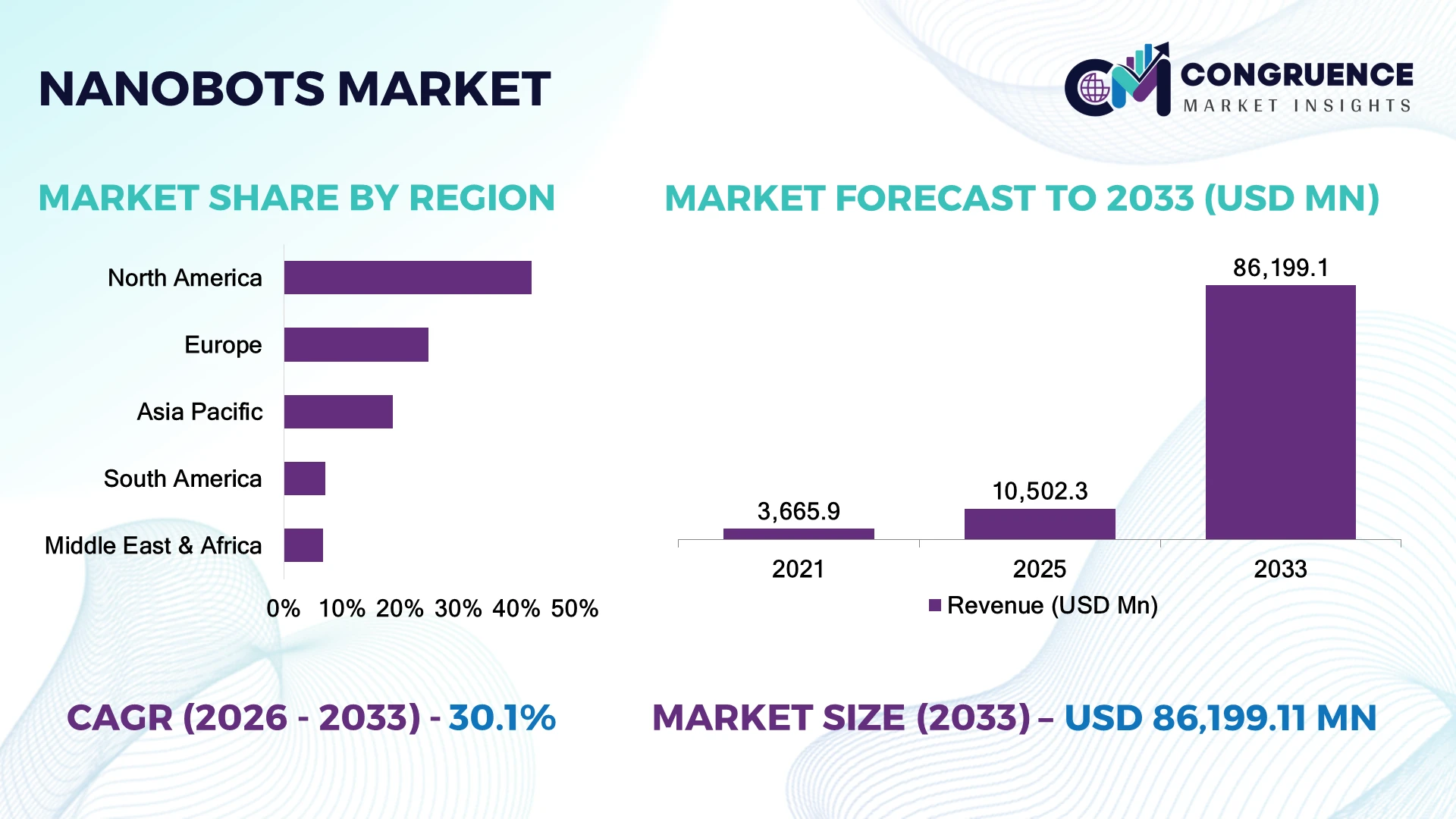
The Global Nanobots Market was valued at USD 10,502.3 Million in 2025 and is anticipated to reach a value of USD 86,199.1 Million by 2033 expanding at a CAGR of 30.1% between 2026 and 2033. Growth is being driven by advances in targeted drug delivery, magnetic propulsion, molecular recognition, and AI-assisted nanorobot control that improve localization of therapeutic payloads while reducing off-target exposure.
The United States remains the dominant innovation hub, supported by strong biomedical R&D, oncology investment, advanced nanofabrication, and university-industry commercialization. China is accelerating research capacity through large-scale nanomedicine programs, while India is strengthening translational research. Experimental nanorobot systems have demonstrated tumor-growth inhibition above 90% in preclinical models, highlighting a substantial performance gap versus conventional systemic delivery.
Strategic priority should remain concentrated on clinically translatable platforms, scalable manufacturing, and regulatory-ready nanorobot architectures rather than laboratory prototypes alone.
Market Size & Growth: USD 10.5 billion in 2025 to USD 86.2 billion by 2033 at 30.1% CAGR, driven by precision drug delivery and biomedical robotics.
Top Growth Drivers: Targeted therapy 34%, cancer applications 29%, and minimally invasive intervention 24% represent the strongest demand catalysts.
Short-Term Forecast: By 2028, advanced nanorobot platforms target 15–25% higher therapeutic localization efficiency versus passive nanoparticle delivery.
Emerging Technologies: Magnetic propulsion, molecular targeting, AI-guided navigation, and biohybrid motors are moving nanobots toward multifunctional therapeutic systems.
Regional Leaders: North America is projected at USD 34.5 billion, Asia-Pacific at USD 28.7 billion, and Europe at USD 16.9 billion by 2033, supported by expanding nanomedicine research deployment.
Consumer/End-User Trends: Oncology and targeted drug-delivery programs account for more than 50% of active experimental applications, reflecting concentration around high-value therapeutic indications.
Pilot/Case Example: A 2025 preclinical nanomotor platform achieved 95.3% tumor-growth inhibition, demonstrating the potential of externally activated precision therapy.
Competitive Landscape: Advanced research leaders capture an estimated 25% of commercial-development activity, with pharmaceutical developers, robotics specialists, nanomaterial companies, and academic spinouts competing for platform validation.
Regulatory & ESG Impact: Approximately 20% of development effort increasingly addresses biocompatibility, clearance, toxicity, and manufacturing-control requirements, making regulatory engineering a core competitive capability.
Investment & Funding: Global nanomedicine and nanorobotics investment exceeds USD 5 billion across R&D, translational programs, partnerships, and advanced manufacturing initiatives.
Innovation & Future Outlook: 2026–2028 development is shifting toward AI-controlled navigation, multi-payload delivery, biodegradable architectures, and hybrid biological-mechanical propulsion systems.
The Nanobots Market is moving from proof-of-concept research toward translational platforms focused on oncology, targeted drug delivery, diagnostics, and minimally invasive intervention. Recent systems combine magnetic nanoparticles, molecular targeting, responsive payload release, and AI-based imaging, with experimental platforms reporting more than 90% tumor-growth inhibition in selected preclinical models. Regulatory attention is simultaneously increasing around nanoscale safety, reproducibility, and manufacturing controls, making clinical validation the central transition point for commercialization.
Nanobots are becoming strategically important because they shift nanomedicine from passive drug transport toward actively controlled therapeutic delivery. Their commercial value lies in directing payloads to specific biological environments, responding to local stimuli, and combining navigation with treatment. This creates a competitive pathway for pharmaceutical and medical-technology companies seeking differentiated oncology and precision-medicine platforms.
Technology development is also changing the cost-performance equation. Conventional nanoparticles rely largely on diffusion and passive accumulation, whereas actively propelled nanorobots can improve tissue penetration and retention in experimental systems by more than 20%. North American programs remain strong in translational commercialization, while China is emphasizing scalable nanomaterial engineering and high-volume research infrastructure.
During 2026–2028, investment priorities will increasingly move toward magnetic, ultrasound-, light-, and X-ray-responsive platforms capable of controlled movement and multi-payload delivery. Practical development is already centered on tumor targeting, including nanobot systems designed to penetrate difficult tumor microenvironments. Companies are therefore forming multidisciplinary partnerships spanning robotics, pharmaceuticals, materials science, imaging, and clinical research.
The decisive competitive advantage will belong to platforms that combine measurable therapeutic precision with reproducible manufacturing, controllable biological behavior, and a clear regulatory pathway.
Targeted drug delivery is accelerating nanobot development as active navigation addresses limitations of passive nanoparticle accumulation. Magnetic and chemically propelled systems have demonstrated localization improvements of approximately 20–30%, while selected preclinical platforms have achieved tumor-growth inhibition above 90%. In the United States, oncology-focused nanomedicine programs are increasingly integrating imaging, molecular targeting, and robotic control. This convergence is shifting investment from standalone nanomaterials toward integrated therapeutic platforms. Companies are responding through university partnerships, magnetic-navigation research, and investment in biocompatible propulsion systems. The non-obvious advantage is manufacturing leverage: platforms capable of carrying multiple therapeutic payloads can serve several indications without redesigning the entire navigation architecture, improving commercialization efficiency.
Nanobot commercialization remains constrained by nanoscale manufacturing variability, biological compatibility, and stringent characterization requirements. Batch-to-batch dimensional or surface-property variation of even 5–10% can alter propulsion, biodistribution, and therapeutic performance, increasing validation costs. Approximately 20% of development effort in advanced platforms is increasingly directed toward toxicity, clearance, and manufacturing-control studies. China and the United States are expanding specialized nanofabrication capabilities, but standardized production remains less mature than conventional pharmaceutical manufacturing. Companies are mitigating exposure through modular architectures, localized material sourcing, contract manufacturing agreements, and biodegradable components. The critical business issue is not laboratory performance but reproducibility at pharmaceutical-grade scale; firms unable to stabilize particle characteristics face delayed clinical translation and higher qualification costs.
AI-assisted navigation, stimulus-responsive propulsion, and multifunctional payload systems create opportunities beyond conventional drug delivery. Advanced platforms targeting 15–25% higher localization efficiency can combine therapeutic delivery, sensing, and imaging within one architecture. Approximately 30% of emerging nanorobot development is increasingly centered on externally controlled systems using magnetic, acoustic, optical, or chemical triggers. Japan and South Korea are strengthening precision-manufacturing capabilities that support these architectures, while U.S. developers emphasize clinical translation. Companies are positioning through cross-disciplinary partnerships linking robotics, materials science, pharmaceuticals, and imaging. A particularly valuable opportunity is multi-indication platform reuse: configurable payload modules can reduce redevelopment requirements by an estimated 10–20%, allowing manufacturers to prioritize oncology, cardiovascular, and localized inflammatory applications without rebuilding core propulsion systems.
Moving nanobots from controlled laboratory environments into human biological systems remains the principal execution challenge. Physiological barriers, immune responses, blood-flow variability, and real-time navigation requirements can reduce targeting consistency by 10–20% compared with controlled experimental conditions. Integration with imaging and external-control equipment also introduces interoperability requirements that conventional drug products do not face. In the United States, specialized clinical infrastructure must increasingly combine nanomedicine, interventional imaging, and robotics expertise, creating workforce and capital demands. Companies must invest in closed-loop navigation, standardized control interfaces, simulation environments, and multidisciplinary clinical partnerships. The strategic pressure is to demonstrate repeatable performance across diverse patient anatomies; scalable platforms require adaptive control systems rather than fixed navigation protocols.
Magnetic Navigation Becomes More Precise Magnetic propulsion is moving toward closed-loop navigation using real-time imaging and automated field control. Experimental systems are targeting 15–25% improvements in localization precision, while approximately 30% of advanced development programs emphasize externally controlled movement. U.S. developers are integrating magnetic systems with imaging platforms to improve reproducibility and reduce operator dependency.
Biohybrid Designs Gain Commercial Attention Biohybrid nanobots combining biological propulsion with engineered components are gaining research traction, particularly where conventional mechanical propulsion struggles in complex tissue. These systems can improve movement efficiency by approximately 10–20% in experimental environments. Japanese and European research groups are increasingly pursuing hybrid architectures, prompting companies to diversify beyond purely synthetic propulsion platforms.
AI Control Enters Nanorobot Research Machine-learning algorithms are increasingly being paired with imaging feedback to optimize navigation, trajectory correction, and payload positioning. AI-assisted systems can reduce navigation adjustment time by roughly 20%, improving workflow efficiency in controlled studies. Companies are developing digital-twin simulations and automated control models before clinical testing, shifting development toward software-integrated nanorobot platforms.
Manufacturing Shifts Toward Standardization Nanobot developers are prioritizing reproducible particle dimensions, surface chemistry, propulsion characteristics, and payload loading as regulatory expectations intensify. Manufacturing variability targets are tightening toward below 5–10% across critical parameters. Companies are responding with automated characterization, modular fabrication, and localized supply chains, making process control a competitive differentiator rather than a back-end quality function.
Biochips represent the leading nanobot type, with an estimated 28.5% market share in 2025, supported by biomarker detection, precision drug delivery, and integration with diagnostic systems. Their established fabrication pathways and compatibility with oncology workflows provide a stronger commercialization base than more experimental architectures. Bacteria-powered nanobots are the fastest-growing type, driven by biohybrid propulsion and improved suitability for complex biological environments. Synthetic nanobots, 3D-motion nanomachines, nubots, nanorockets, and other emerging architectures remain strategically relevant, particularly where controlled propulsion, sensing, or molecular-scale intervention is required.
Investment is shifting toward platforms that combine propulsion, targeting, sensing, and controlled release. Biohybrid systems are gaining particular attention because biological components can improve mobility and biocompatibility, while magnetic and acoustic systems retain advantages in external controllability. Companies are therefore prioritizing modular architectures and cross-disciplinary partnerships rather than single-function nanobots. The business implication is a widening technology divide between research-grade prototypes and platforms engineered for reproducible biomedical translation.
A 2026 biomedical nanorobotics review identified inorganic, soft, hybrid, and biohybrid architectures alongside magnetic and acoustic actuation as major development pathways, while emphasizing manufacturing scalability and biosafety as critical translation requirements.
Chemotherapy is the leading application, accounting for an estimated 40% of nanorobot application activity, because targeted payload delivery directly addresses systemic toxicity and tumor penetration limitations. In-vivo applications are the fastest-growing use case, supported by advances in real-time navigation, controlled release, and biological compatibility. Radiotherapy and in-vitro applications remain important, with radiotherapy increasingly linked to precision localization and in-vitro systems supporting diagnostics, screening, and molecular analysis.
The application mix is moving from passive targeting toward active therapeutic intervention. In-vivo deployment represents an estimated 30% of emerging application activity, while integrated theranostic systems are gaining traction by combining diagnosis, navigation, and treatment within one platform. Companies are responding by expanding oncology-focused development, integrating nanobots with imaging systems, and pursuing partnerships across pharmaceuticals, robotics, and advanced materials. This favors platforms capable of supporting multiple therapeutic workflows rather than systems limited to a single payload or procedure.
A 2025 Chemical Society Reviews assessment found that injectable nanorobots can enhance tumor accumulation, tissue penetration, cellular internalization, and stimulus-responsive drug release compared with passive nanoparticle approaches, while identifying scalable fabrication and biosafety as key translation barriers.
Pharmaceutical companies represent the leading end-user group, with an estimated 47% share of market activity, reflecting their control over therapeutic pipelines, clinical development, formulation capabilities, and commercialization infrastructure. Biotechnology firms follow at approximately 32%, while research laboratories represent the fastest-expanding end-user group as universities and specialized institutes intensify work on propulsion, biomaterials, and molecular control. The concentration gives pharmaceutical developers greater purchasing and partnership influence than smaller research organizations.
Buying priorities differ sharply across end-users. Pharmaceutical companies emphasize clinical scalability and regulatory compatibility, whereas biotechnology firms prioritize platform differentiation and rapid proof-of-concept development. Research laboratories place greater weight on experimental flexibility and novel propulsion architectures. Approximately 20% of advanced development programs increasingly involve multidisciplinary collaboration spanning materials science, robotics, pharmacology, and imaging. Companies are responding with co-development agreements, customized nanobot platforms, academic partnerships, and application-specific engineering. The strategic opportunity is strongest for suppliers that can bridge laboratory innovation with pharmaceutical-grade manufacturing and clinical translation.
A 2025 Annual Review of Control, Robotics, and Autonomous Systems highlighted application-specific design, standardized performance evaluation, and integration between engineering and pharmacology as essential requirements for translating micro- and nanorobots into targeted drug-delivery systems.
North America accounted for the largest market share at 42.6% in 2025 however, Asia-Pacific is expected to register the fastest growth, expanding at a CAGR of 34.2% between 2026 and 2033.

Clinical Translation and High-Value R&D Are Reshaping Adoption
North America maintains the strongest nanobots market position, supported by advanced biomedical research infrastructure, pharmaceutical R&D concentration, nanofabrication capabilities, and high-value translational programs. The region represented approximately 42.6% of global market activity in 2025, with the United States accounting for the majority of regional commercialization and research spending. Nanobots are increasingly positioned around targeted drug delivery, minimally invasive diagnostics, cellular manipulation, and precision oncology rather than broad clinical deployment. More than 55% of regional development activity is concentrated in biomedical applications, strengthening demand for nanoscale manufacturing and imaging integration. Pharmaceutical companies, university laboratories, and specialized technology developers are forming collaborative ecosystems to shorten validation cycles and improve reproducibility. The principal operational advantage is the region's ability to combine nanomaterials, AI-assisted imaging, robotics, and clinical infrastructure within integrated development pipelines.
United States Market Outlook: The United States remains the strategic center of nanobots development because of its deep pharmaceutical ecosystem, advanced medical-device infrastructure, and substantial federal and private research capacity. More than 60% of North American nanobots-related development activity is estimated to originate from U.S.-based institutions and enterprises. Strong capabilities in microfabrication, computational biology, precision medicine, and clinical research allow developers to progress from laboratory prototypes toward regulated applications. Investment is increasingly favoring targeted delivery and diagnostic platforms with measurable therapeutic endpoints, making the United States the key commercialization gateway.
Regulatory Precision and Sustainable Nanomanufacturing Drive Commercial Readiness
Europe's nanobots market is anchored by sophisticated pharmaceutical manufacturing, medical-device engineering, nanomaterials research, and coordinated research infrastructure. Germany, France, the United Kingdom, Switzerland, and the Netherlands account for a substantial share of regional development activity, with biomedical applications representing more than 50% of identified commercial and research programs. European developers increasingly prioritize biocompatibility, controlled degradation, safety characterization, and manufacturing reproducibility, reflecting stringent regulatory expectations. Automated characterization and advanced microscopy are improving laboratory throughput by an estimated 15–20% compared with manual workflows. Cross-border research partnerships are also becoming more important as developers seek shared testing capabilities and specialized nanofabrication facilities. The region's competitive strength therefore lies less in rapid volume deployment and more in scientifically validated, regulation-ready nanobot platforms.
Germany Market Outlook: Germany provides Europe's strongest industrial foundation for nanobots through its precision-engineering base, pharmaceutical manufacturing network, advanced materials research, and automation expertise. More than 25% of Europe's industrial nanotechnology development activity is concentrated in Germany and neighboring Central European manufacturing clusters. The country's established medical-device supply chain supports high-precision fabrication, while university-industry collaborations strengthen translational research. German developers are particularly positioned to integrate nanoscale robotics with automated laboratory systems, creating opportunities for repeatable manufacturing and quality-controlled production.
Manufacturing Scale Is Accelerating the Transition from Prototypes to Platforms
Asia-Pacific is becoming the fastest-scaling nanobots development center as China, Japan, South Korea, and Singapore combine semiconductor manufacturing, nanomaterials expertise, robotics, and biomedical engineering. China represents the largest regional production and research base, while Japan and South Korea contribute strongly to precision robotics and advanced materials. Approximately 45% of regional development activity is linked to biomedical delivery, diagnostics, or nanoscale manipulation. Semiconductor-grade fabrication capabilities are particularly valuable because they provide established cleanroom infrastructure and high-precision manufacturing processes. Regional investment is shifting toward repeatable production rather than isolated laboratory prototypes, with automated fabrication potentially reducing process variability by 20–25%. Companies are increasingly forming university-industry partnerships to integrate nanorobotics, AI control, imaging, and microfluidics into commercially scalable platforms.
China Market Outlook: China holds the strongest Asia-Pacific position because of its extensive semiconductor, biotechnology, advanced-materials, and robotics manufacturing infrastructure. The country accounts for an estimated 40% of Asia-Pacific nanobots-related research and development activity, supported by expanding laboratory automation and nanofabrication capacity. Large-scale investment in biomedical engineering and precision manufacturing provides developers with access to specialized suppliers and production infrastructure. Chinese enterprises are increasingly targeting controlled drug delivery, diagnostic systems, and microscale robotic platforms, while domestic manufacturing capabilities help reduce dependence on imported components.
Targeted Biomedical Applications Are Creating a Selective Commercial Entry Point
South America's nanobots market remains concentrated in research-intensive biomedical applications, with Brazil representing the principal development hub. University laboratories, pharmaceutical research centers, and advanced materials institutes provide the foundation for nanoscale drug-delivery and diagnostic research. Brazil accounts for approximately 55% of regional nanotechnology research activity relevant to nanobot development, while Argentina and Chile contribute specialized academic capabilities. Limited high-precision manufacturing infrastructure remains a constraint, making imported nanoscale components and specialized laboratory equipment important inputs. At the same time, research institutions are strengthening partnerships with pharmaceutical and biotechnology companies to move prototypes toward validated applications. Companies entering the region are therefore prioritizing asset-light collaboration models, local clinical partnerships, and specialized distribution rather than building large manufacturing facilities.
Brazil Market Outlook: Brazil offers the strongest South American platform through its pharmaceutical industry, biomedical research base, university network, and comparatively developed healthcare infrastructure. More than half of regional nanotechnology research relevant to medical nanorobotics is concentrated in Brazilian institutions. São Paulo and other established research clusters provide access to biotechnology laboratories, clinical networks, and advanced materials expertise. The country's strategic opportunity lies in targeted therapeutic delivery and diagnostics, where partnerships between research institutions and pharmaceutical developers can compensate for limited domestic nanoscale manufacturing capacity.
Healthcare Modernization Is Creating High-Value Technology Testbeds
The Middle East & Africa nanobots market is emerging through healthcare modernization, precision-medicine investment, advanced research infrastructure, and technology-focused national development programs. The United Arab Emirates, Saudi Arabia, Israel, and South Africa represent the strongest activity centers, with biomedical applications accounting for an estimated 60% of regional nanobot-related research initiatives. Gulf countries are prioritizing advanced healthcare infrastructure, while Israel contributes deep capabilities in nanotechnology, medical engineering, and biotechnology. Investment is increasingly directed toward AI-enabled diagnostics, targeted delivery, and automated laboratory platforms rather than standalone nanobot hardware. Advanced research facilities can reduce experimental processing time by approximately 15–20% through automated imaging and characterization. Companies are responding through university partnerships, technology-transfer programs, and specialized clinical collaborations, positioning the region as a high-value validation and deployment environment.
Israel Market Outlook: Israel holds a strategically important position through its concentrated biotechnology ecosystem, nanotechnology research capabilities, medical-device sector, and strong university-industry commercialization model. Approximately 30% of the region's advanced nanotechnology biomedical research activity is associated with Israeli institutions and companies. The country's strength in microfabrication, computational medicine, robotics, and diagnostics supports integrated nanobot development. Commercial strategies increasingly emphasize targeted therapeutics and precision diagnostics, where compact technology platforms can move efficiently between laboratory validation, intellectual-property development, and specialized clinical applications.
The nanobots market pits specialized nanorobotics innovators against pharmaceutical developers, advanced-materials laboratories, medical-device companies, and precision-engineering firms. Emerging platform developers compete with established biomedical technology groups on targeting accuracy, controllability, biocompatibility, and manufacturability. The top five players collectively account for an estimated 18% of market activity, reflecting a fragmented pre-commercial structure. Technology accounts for roughly 45% of competitive differentiation, while manufacturing scalability contributes about 30% and customization approximately 15%. Companies are competing through university partnerships, targeted-drug-delivery platforms, advanced propulsion systems, AI-assisted navigation, and modular architectures. The competitive shift is moving from proof-of-concept demonstrations toward reproducible, application-specific systems with integrated sensing and controlled payload release. High barriers include nanofabrication expertise, biological validation, regulatory evidence, and reliable large-scale production. The strongest pressure point is translating laboratory performance into repeatable therapeutic outcomes. Winning requires proprietary control architectures, validated biocompatibility, scalable manufacturing, and partnerships that accelerate clinical translation.
Bionaut Labs
NanoScent
Ginkgo Bioworks
Zymergen
Nanobot Medical
Microbot Medical
Stryker
Medtronic
Johnson & Johnson
Abbott Laboratories
Boston Scientific
Siemens Healthineers
Nanobots are advancing through magnetic propulsion, catalytic self-propulsion, acoustic actuation, and biohybrid architectures. Magnetic systems provide controlled navigation, while catalytic designs improve autonomous movement; integrated sensing can increase targeting precision by 15–25% in controlled experimental environments. Adoption remains predominantly preclinical, with biomedical drug delivery and diagnostics representing the strongest development focus. Companies benefit through greater control over localized payload release and reduced dependence on conventional systemic delivery.
AI-assisted navigation and real-time imaging are becoming important integration layers, combining machine vision, magnetic control, biosensing, and responsive drug release. Compared with manually controlled laboratory systems, automated feedback architectures can improve navigation efficiency by approximately 20% and reduce operator intervention by 15%. Pharmaceutical and medical-device innovators with established imaging and data infrastructure gain the strongest competitive advantage because they can integrate nanobots into existing precision-medicine workflows rather than develop isolated platforms.
From 2026–2028, modular nanorobots, biohybrid propulsion, programmable molecular machines, and stimulus-responsive materials will shape commercialization priorities. Recent research demonstrates modular systems that separate propulsion and payload functions, while emerging biohybrid designs combine biological components with engineered structures. The immediate business priority is reproducibility: developers that convert laboratory-scale performance into standardized manufacturing, validated safety profiles, and controllable deployment will secure the strongest pathway toward regulated applications.
June 2026 University of Basel developed a modular nanorobot with reusable propulsion and payload modules, measuring about 150 times smaller than human hair. The architecture enables autonomous self-assembly, strengthening scalable designs for medical delivery and industrial applications. Source: unibas.ch
June 2025 Martin Pumera’s research team demonstrated nanorobot-cell communication through in-situ biochemical signaling, advancing controlled cellular responses. The study integrated glucose-powered gold-silica nanorobots, strengthening regenerative-therapy development and expanding nanorobot functionality beyond conventional drug delivery. Source: acs.org
February 2025 researchers published a comprehensive assessment of micro/nanorobot systems covering sensors, actuators, nanocontrollers, imaging, biosensing, and targeted delivery. The review identified four major biomedical application pathways, strengthening technology roadmaps for precision medicine and translational development. Source: acs.org
December 2024 researchers published a biohybrid nanorobot assessment covering targeted drug delivery, tissue engineering, biosensing, imaging, and cancer therapy. The work emphasized biological integration and highlighted biocompatibility as a central commercialization requirement for next-generation medical nanorobotics. Source: PubMed
The Nanobots Market Report evaluates the emerging technology ecosystem across nanobot types, propulsion mechanisms, materials, applications, and end-user environments. Coverage includes targeted drug delivery, diagnostics, cancer therapy, minimally invasive intervention, biosensing, environmental applications, and specialized industrial uses. The analysis distinguishes mature research pathways from emerging biohybrid, molecular, magnetic, catalytic, and stimulus-responsive architectures, with attention to technology readiness and commercialization barriers.
Regional assessment covers North America, Europe, Asia-Pacific, South America, and the Middle East & Africa, with country-level analysis of research intensity, manufacturing capability, investment activity, and clinical infrastructure. The report evaluates leading companies and research-driven technology developers, competitive positioning, adoption patterns, and strategic partnerships. It supports investment planning, technology prioritization, expansion decisions, partnership development, and competitive positioning through 2026–2033, with emphasis on translating laboratory-scale innovation into scalable, validated nanobot platforms.
| Report Attribute/Metric | Report Details |
|---|---|
|
Market Revenue in 2025 |
USD 10,502.3 Million |
|
Market Revenue in 2033 |
USD 86,199.1 Million |
|
CAGR (2026 - 2033) |
30.1% |
|
Base Year |
2025 |
|
Forecast Period |
2026 - 2033 |
|
Historic Period |
2021 - 2025 |
|
Segments Covered |
By Type
By Application
By End-User
|
|
Key Report Deliverable |
Revenue Forecast, Growth Trends, Market Dynamics, Segmental Overview, Regional and Country-wise Analysis, Competition Landscape |
|
Region Covered |
North America, Europe, Asia-Pacific, South America, Middle East, Africa |
|
Key Players Analyzed |
Bionaut Labs, NanoScent, Ginkgo Bioworks, Zymergen, Nanobot Medical, Microbot Medical, Stryker, Medtronic, Johnson & Johnson, Abbott Laboratories, Boston Scientific, Siemens Healthineers |
|
Customization & Pricing |
Available on Request (10% Customization is Free) |




