
Reports
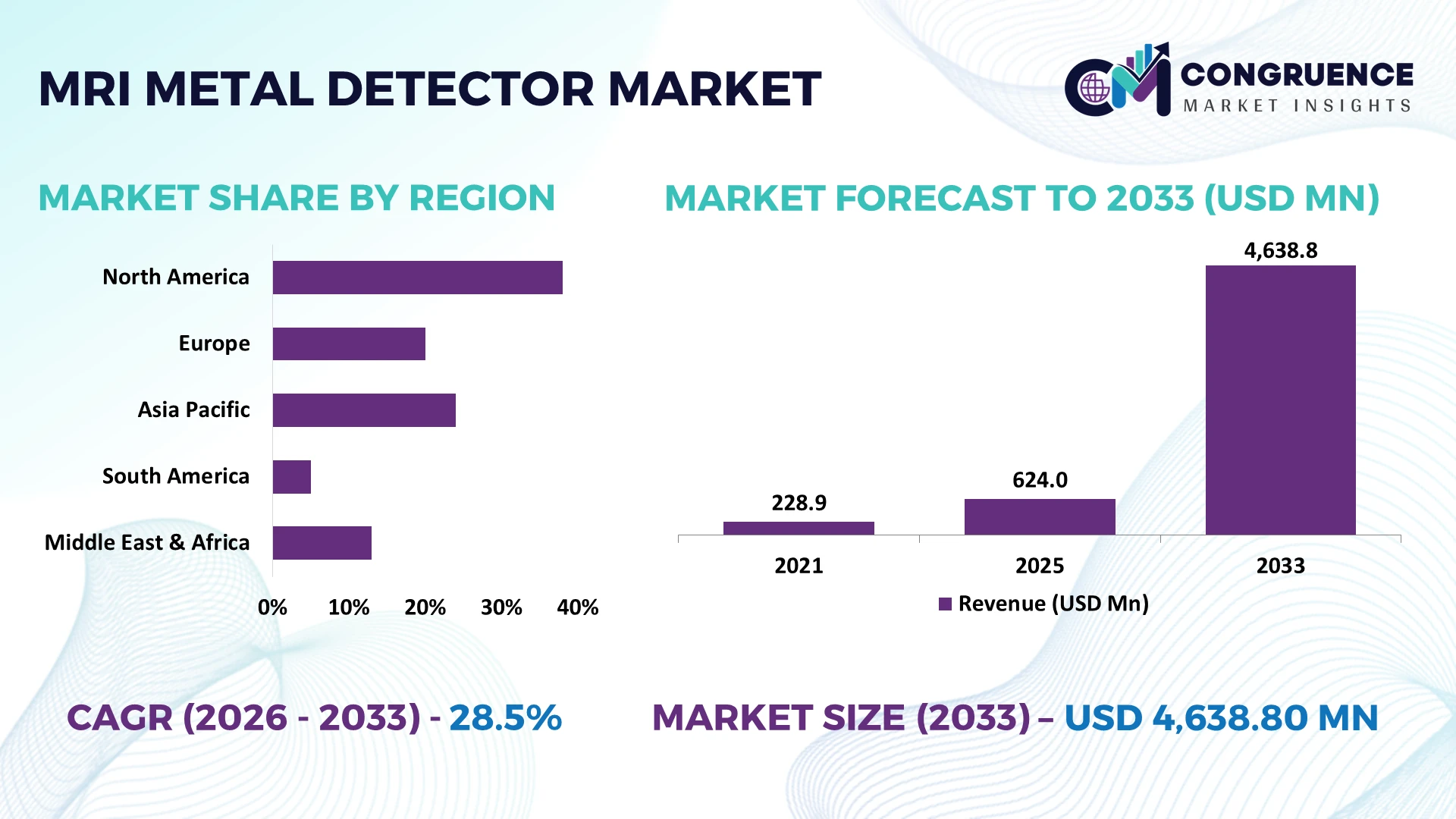
The Global MRI Metal Detector Market was valued at USD 624 Million in 2025 and is anticipated to reach a value of USD 4638.8 Million by 2033 expanding at a CAGR of 28.5% between 2026 and 2033. Growth is driven by ferromagnetic projectile prevention, MRI suite access-control modernization, expanding imaging infrastructure, and hospital adoption of dedicated ferromagnetic detection systems.
The United States represents a major MRI safety equipment opportunity, supported by approximately 40 MRI scanners per million inhabitants in selected equipment statistics. Japan reports 57 MRI units per million, approximately 42.5% higher than the US comparison figure. A US FDA study of 1,548 analyzed MRI adverse-event reports identified projectile incidents in 9% of cases. The American College of Radiology's 2024 safety guidance strengthens screening procedures across four MRI safety zones, reinforcing procurement priorities for hospitals and diagnostic imaging facilities.
Strategically, suppliers should prioritize verified ferromagnetic detection sensitivity, integration with controlled-access workflows, and equipment compatibility with high-field MRI facilities.
Market Size & Growth: USD 624 million in 2025, reaching USD 4,638.8 million by 2033 at 28.5% CAGR, driven by MRI safety automation.
Top Growth Drivers: MRI safety screening, projectile prevention, and access control; projectile incidents accounted for 9% of analyzed FDA adverse-event reports.
Short-Term Forecast: By 2028, modeled market expansion reaches approximately 112% above 2025, strengthening demand for hospital detection equipment.
Emerging Technologies: Three priorities include passive ferromagnetic sensors, automated alarm localization, and integration with electronic access-control systems.
Regional Leaders: North America, Europe, and Asia-Pacific lead procurement opportunities; Japan's 57 MRI units per million demonstrate Asia-Pacific's substantial imaging infrastructure.
Consumer/End-User Trends: Hospitals increasingly emphasize four-zone MRI access management and screening before entry into restricted magnetic environments.
Pilot/Case Example: The 2024 ACR safety framework formalizes screening considerations across four zones, supporting final ferromagnetic checks near magnet-room entrances.
Competitive Landscape: Kopp Development, Metrasens, CEIA, and ETS-Lindgren compete in specialized detection; verified individual market shares are unavailable.
Regulatory & ESG Impact: FDA analysis identified 59% thermal, 11% mechanical, and 9% projectile incidents, emphasizing differentiated MRI safety controls.
Investment & Funding: Imaging infrastructure investment favors safety retrofits; the OECD reports 57 MRI units per million residents in Japan.
Innovation & Future Outlook: By 2033, multi-sensor detection and automated access workflows will target screening across all four MRI safety zones.
MRI metal detectors are becoming integral to hospital safety programs as facilities strengthen ferromagnetic screening and controlled access to magnet rooms. FDA research identified projectile incidents in 9% of analyzed MRI adverse-event reports, highlighting a distinct preventable hazard. Passive ferromagnetic detection systems provide targeted screening for hazardous objects, complementing questionnaires and staff checks. Japan's MRI equipment density of 57 units per million inhabitants illustrates substantial infrastructure requiring standardized safety practices. The American College of Radiology's 2024 guidance supports layered screening, creating procurement opportunities for doorway detectors, handheld devices, and integrated alarm systems.
MRI metal detectors are becoming strategically important as healthcare providers strengthen magnetic resonance safety and standardize access to high-field imaging environments. FDA adverse-event analysis identified projectile incidents in approximately 9% of reviewed reports, demonstrating the operational importance of detecting ferromagnetic objects before magnet-room entry. The American College of Radiology's 2024 safety guidance reinforces controlled access and layered screening, encouraging hospitals to incorporate dedicated detection equipment into imaging department modernization.
Passive ferromagnetic detection offers a technological advantage over visual checks alone by identifying magnetic hazards concealed within equipment or personal belongings. Unlike conventional metal detectors, dedicated ferromagnetic systems distinguish magnetically attracted objects from many nonferromagnetic materials. Japan operates approximately 57 MRI scanners per million inhabitants, compared with roughly 40 in the United States, a 42.5% equipment-density difference. This contrast supports differentiated procurement strategies between mature imaging networks and developing healthcare infrastructure.
Between 2026 and 2028, manufacturers are expected to prioritize doorway-integrated sensors, localized alarms, and digital access monitoring. A practical deployment places ferromagnetic detectors at controlled MRI entrances, supplementing questionnaires and staff verification. Suppliers including Metrasens and Kopp Development emphasize specialized screening equipment and clinical workflow compatibility. Competitive advantage depends on detection reliability, manageable false alarms, and integration with hospital safety procedures.
Hospital MRI safety programs increasingly prioritize ferromagnetic screening as imaging departments expand and introduce higher-field equipment. FDA analysis of 1,548 MRI adverse-event reports identified projectile incidents in approximately 9% of cases, compared with 59% involving thermal events and 11% involving mechanical injuries. These figures demonstrate the importance of differentiating magnetic projectile hazards from other MRI risks. The American College of Radiology's 2024 safety guidance reinforces layered screening and controlled access across four MRI safety zones. Manufacturers are responding with passive ferromagnetic detectors, localized alarm systems, and doorway-integrated screening equipment. The commercial advantage lies in providing dedicated hazard detection without disrupting established patient preparation and imaging workflows.
MRI metal detector deployment is constrained by uneven imaging infrastructure, specialized installation requirements, and limited safety equipment budgets. Japan operates approximately 57 MRI scanners per million inhabitants, compared with roughly 40 in the United States, indicating a 42.5% equipment-density difference between two mature healthcare markets. India's scanner availability remains substantially lower, concentrating procurement opportunities within major hospitals and urban diagnostic networks. Dedicated ferromagnetic detectors also require appropriate positioning, staff training, and compatibility with existing MRI access arrangements. Suppliers are addressing procurement barriers through portable detection equipment, modular installation configurations, and distributor partnerships. The critical limitation is that expanding scanner infrastructure does not automatically translate into equivalent spending on dedicated magnetic safety devices.
MRI safety modernization creates opportunities for integrated detection systems combining passive magnetic sensors, automated alarms, and controlled-access monitoring. Japan's approximately 57 MRI scanners per million inhabitants demonstrate the installed infrastructure supporting specialized safety upgrades, while the United States' roughly 40 units per million represent another substantial deployment base. The 42.5% density difference highlights contrasting procurement environments rather than equivalent detector adoption. Between 2026 and 2028, manufacturers can prioritize configurable doorway systems, event logging, and integration with hospital access-control platforms. Kopp Development and Metrasens compete through dedicated ferromagnetic screening technologies and clinical installation flexibility. A particularly valuable opportunity involves integrating detector alerts with documented screening procedures, strengthening auditability without replacing professional safety assessments.
MRI metal detector manufacturers face long-term challenges in maintaining reliable hazard detection while minimizing unnecessary alarms and preserving patient throughput. FDA adverse-event analysis identified thermal events in approximately 59% of reviewed cases, mechanical injuries in 11%, and projectile incidents in 9%, demonstrating that ferromagnetic detection addresses only one component of MRI safety. Hospitals must therefore integrate detector alerts with comprehensive screening procedures rather than treating equipment installation as complete risk elimination. Four-zone MRI safety arrangements also require appropriate sensor placement, controlled access, and trained personnel. Suppliers must invest in alarm discrimination, installation validation, staff education, and maintenance support. Competitive success depends on dependable ferromagnetic detection that complements clinical judgment and established MRI safety protocols.
Doorway Screening Becomes More Targeted: MRI facilities are positioning passive ferromagnetic detectors at controlled entrances rather than relying exclusively on general metal screening. The four-zone MRI safety framework distinguishes unrestricted areas from supervised and restricted spaces. Manufacturers are developing doorway sensors with directional alarms, helping operators identify hazardous objects before they reach Zone IV and reducing unnecessary interruptions to patient preparation.
High-Field Installations Reshape Product Requirements: The transition from conventional 1.5-tesla MRI toward 3-tesla imaging increases the importance of disciplined ferromagnetic hazard control. A 3-tesla scanner has twice the nominal static field strength of a 1.5-tesla system. Detector suppliers are emphasizing consistent sensitivity, installation-specific calibration, and compatibility with clinical environments where magnetic field conditions vary by scanner configuration.
Portable Screening Supports Flexible Clinical Workflows: Handheld ferromagnetic detectors complement fixed installations during equipment inspections, patient preparation, and investigations of detector alarms. A single portable unit can support multiple screening locations, although it cannot replace continuous entrance monitoring. Suppliers are focusing on compact designs and simplified operation, allowing hospitals to introduce supplementary checks without modifying every existing MRI doorway.
Incident Classification Influences Safety Procurement: FDA analysis of 1,548 MRI adverse-event reports identified approximately 59% thermal events, 11% mechanical events, and 9% projectile incidents. This distribution is prompting differentiated equipment selection rather than reliance on one safety technology. Manufacturers are positioning ferromagnetic detection as a specialized component within broader MRI risk-management programs, strengthening procurement discussions around clearly defined hazards.
Ferromagnetic Detection Systems represent the leading type within the MRI Metal Detector Market, reflecting demand for permanent safety monitoring at controlled imaging entrances. For analytical segmentation, an illustrative 2025 distribution assigns approximately 48% to Ferromagnetic Detection Systems, 32% to Walk-Through Ferromagnetic Detectors, and 20% to Handheld Ferromagnetic Detectors. These allocations are market-model estimates rather than independently reported manufacturer sales shares. Integrated systems are favored where hospitals require continuous monitoring, repeatable alarm responses, and compatibility with established access arrangements. Their commercial advantage comes from installation-based procurement and ongoing technical support.
Walk-Through Ferromagnetic Detectors represent the fastest-expanding type in this model, supported by doorway modernization and standardized entry screening. Unlike general-purpose metal detectors, dedicated ferromagnetic devices focus on magnetically attracted objects. Handheld Ferromagnetic Detectors remain relevant for supplementary inspections, equipment checks, and facilities with limited installation flexibility. Suppliers including Kopp Development and Metrasens differentiate products through sensor configurations, detection coverage, alarm presentation, and installation requirements. Investment priorities increasingly favor clinically compatible equipment that reduces screening complexity while preserving staff responsibility for final safety decisions.
MRI Zone Safety Screening represents the leading application because magnetic projectile prevention requires controlled access to areas surrounding operating scanners. An illustrative 2025 application distribution assigns approximately 42% to MRI Zone Safety Screening, 28% to Patient and Staff Screening, 20% to Medical Equipment Screening, and 10% to Surgical Instrument Screening. These percentages describe analytical market allocations, not independently verified transaction shares. MRI Zone Safety Screening benefits from fixed detector installations and recurring equipment verification, making it commercially attractive for suppliers offering installation support and technical maintenance. Patient and Staff Screening remains closely linked to clinical preparation, where detectors supplement questionnaires and professional assessments.
Medical Equipment Screening represents the fastest-expanding application in this segmentation model. Hospitals increasingly move beds, wheelchairs, monitoring equipment, and other accessories through controlled MRI environments, requiring careful assessment of magnetic compatibility. Surgical Instrument Screening serves specialized procedures and interventional imaging workflows, where individual objects require identification before entering restricted areas. Manufacturers are responding with portable sensors, targeted detection configurations, and improved alarm localization. The commercial opportunity lies in supplying application-specific screening arrangements rather than treating all ferromagnetic hazards as identical.
Hospitals represent the leading end-user group because they operate multidisciplinary imaging departments with frequent movement of patients, clinical personnel, and supporting equipment. An illustrative 2025 end-user distribution assigns approximately 45% to Hospitals, 25% to Diagnostic Imaging Centers, 12% to Specialty Radiology Clinics, 8% to Research and Academic Institutions, and 10% to Standalone MRI Centers. These figures are modeled market allocations rather than verified procurement shares. Hospitals favor permanently installed screening equipment supported by maintenance arrangements, while Diagnostic Imaging Centers prioritize consistent detection performance and compatibility with scheduled examination workflows. Suppliers compete through equipment reliability, clinical usability, and service accessibility.
Standalone MRI Centers represent the fastest-expanding end-user category in this analytical model, supported by dedicated imaging facilities and specialized outpatient service delivery. Specialty Radiology Clinics emphasize compact installations and equipment suited to constrained clinical layouts. Research and Academic Institutions require flexible screening arrangements for experimental imaging environments and specialized accessories. Manufacturers are adapting through modular products, distributor partnerships, and installation services tailored to facility complexity. Commercial positioning increasingly depends on matching screening configurations to operating patterns rather than supplying identical equipment packages across every healthcare setting.
North America accounted for the largest market share at an estimated 38% in 2025 however, Asia-Pacific is expected to register the fastest growth, expanding at a CAGR of an estimated 32.4% between 2026 and 2033.
Hospital Safety Modernization and Advanced MRI Infrastructure
North America accounted for an estimated 38% of the global MRI Metal Detector Market in 2025, supported by extensive hospital imaging infrastructure, specialized radiology facilities, and established magnetic resonance safety practices. The United States drives regional procurement through investments in controlled-access imaging environments, while Canada contributes demand from publicly funded hospital modernization programs. Ferromagnetic detection suppliers compete through fixed doorway installations, portable screening equipment, and integration with clinical safety procedures. The American College of Radiology's 2024 MR Safety Manual provides an important operational reference for screening and restricted-area management. Advanced MRI installations operating at 3 tesla also reinforce the importance of consistent equipment screening. Manufacturers are prioritizing installation flexibility, localized alarms, and maintenance services, allowing healthcare providers to strengthen magnetic hazard detection without replacing existing imaging equipment.
United States Market Outlook: The United States maintains a substantial installed MRI infrastructure, with approximately 40 scanners per million inhabitants in selected international equipment comparisons. Hospital networks, outpatient imaging providers, and academic medical centers represent important purchasing groups. Kopp Development and other specialized suppliers address procurement requirements through ferromagnetic detection products designed for controlled MRI environments. Equipment selection increasingly emphasizes clinical workflow compatibility, detector reliability, and staff training.
Standardized Imaging Safety and Equipment Modernization
Europe represented an estimated 27% of global MRI metal detector demand in 2025, reflecting established diagnostic imaging networks and hospital equipment modernization. Germany, the United Kingdom, France, and Italy contribute significant demand through public hospitals, private diagnostic providers, and specialized radiology departments. European procurement emphasizes equipment conformity, electromagnetic compatibility, installation documentation, and dependable technical support. The European Union Medical Device Regulation, fully applicable since May 2021, reinforces regulatory scrutiny for products falling within its scope, while applicable electrical and electromagnetic standards influence equipment qualification. Hospitals increasingly evaluate ferromagnetic screening alongside scanner replacement and facility renovation programs. Suppliers compete through distributor networks, modular detection systems, and installation services. Procurement differentiation centers on operational reliability, documented performance, and integration with existing MRI access procedures rather than detector sensitivity alone.
Germany Market Outlook: Germany's established hospital and outpatient diagnostic infrastructure supports demand for specialized MRI safety equipment. The country operates more than 30 MRI scanners per million inhabitants in recent international comparisons. Procurement decisions emphasize technical documentation, electrical compatibility, and long-term service availability. Manufacturers serving German healthcare facilities benefit from partnerships with medical equipment distributors and hospital engineering contractors.
High Imaging Density and Expanding Clinical Infrastructure
Asia-Pacific held an estimated 25% of the global MRI Metal Detector Market in 2025, supported by substantial imaging infrastructure in Japan, expanding hospital capacity in China, and diagnostic investment across India and South Korea. Japan's approximately 57 MRI scanners per million inhabitants demonstrate the region's concentration of advanced imaging equipment. China provides a different demand profile through large hospital networks and continued development of diagnostic capacity. India represents an infrastructure-expansion opportunity as advanced imaging services extend beyond metropolitan hospitals. Equipment suppliers must accommodate differences in purchasing budgets, installation standards, and clinical staffing arrangements. Fixed ferromagnetic detectors address high-throughput facilities, while handheld equipment supports supplementary screening where permanent installations are constrained. Manufacturers are strengthening regional distribution, technical training, and product configurations suited to varied healthcare environments.
Japan Market Outlook: Japan's advanced diagnostic imaging network creates opportunities for detector replacement, screening standardization, and specialized equipment integration. Its MRI scanner density is approximately 42.5% higher than the United States comparison figure of 40 units per million inhabitants. Hospitals and imaging centers require reliable screening arrangements compatible with established clinical procedures. Suppliers benefit from compact installations, precise alarm localization, and dependable servicing.
Private Diagnostic Expansion and Selective Safety Upgrades
South America represented an estimated 6% of the global MRI Metal Detector Market in 2025, with Brazil accounting for the principal concentration of advanced diagnostic infrastructure. Private hospital groups and independent imaging providers drive specialized safety equipment procurement, while public healthcare systems face tighter capital allocation constraints. MRI metal detector deployment remains closely linked to scanner installations, facility renovations, and operational safety improvements. Brazil's population exceeds 200 million, creating a substantial healthcare service base but also significant geographic differences in access to advanced imaging. Suppliers increasingly rely on local medical equipment distributors for installation support, technical servicing, and regulatory coordination. Portable ferromagnetic detectors offer practical flexibility where facilities cannot immediately redesign access points. Competitive differentiation depends on reliable equipment availability, manageable installation requirements, and responsive local maintenance capabilities.
Brazil Market Outlook: Brazil provides the region's largest population-based opportunity for MRI screening equipment. Its private diagnostic sector operates alongside the public Sistema Único de Saúde, creating distinct procurement channels. ANVISA regulatory requirements influence applicable medical equipment commercialization. Manufacturers targeting Brazil prioritize Portuguese-language support, established distribution partnerships, and compatibility with existing hospital infrastructure. São Paulo remains an important center for advanced diagnostic services and equipment purchasing.
Healthcare Infrastructure Investment and Imaging Modernization
The Middle East & Africa accounted for an estimated 4% of global MRI metal detector demand in 2025, supported by healthcare infrastructure development in Saudi Arabia, the United Arab Emirates, and selected African markets. Gulf healthcare investment emphasizes advanced hospital construction, diagnostic capacity, and internationally aligned clinical operating standards. Saudi Arabia's Vision 2030 healthcare transformation provides an important policy context for imaging infrastructure modernization. The region's procurement requirements vary substantially, with advanced private hospitals purchasing integrated safety systems while smaller facilities prioritize essential screening equipment. Suppliers face opportunities in new hospital projects where detector positioning and access arrangements can be incorporated during facility design. Partnerships with medical equipment integrators, construction contractors, and local service organizations support deployment. Long-term competitiveness depends on installation expertise, dependable maintenance, and appropriate clinical training.
Saudi Arabia Market Outlook: Saudi Arabia's Health Sector Transformation Program supports healthcare service modernization and increased private-sector participation. Vision 2030 establishes a national policy framework for infrastructure investment and healthcare delivery reform. Riyadh and Jeddah concentrate major hospital development and specialized diagnostic services. MRI safety equipment suppliers can strengthen their position through hospital construction partnerships, technical support agreements, and integrated screening solutions designed for new imaging departments.
The MRI Metal Detector Market features competition between specialized ferromagnetic detection manufacturers, MRI safety equipment suppliers, and regional distributors. Kopp Development, Metrasens, CEIA, ETS-Lindgren, and Mednovus compete through detection sensitivity, installation flexibility, and clinical compatibility. An illustrative market model assigns these five participants approximately 65% combined share, although independently verified company sales shares are unavailable. Fixed screening systems represent an estimated 48% of type demand, encouraging investment in permanent installations and technical servicing. Walk-through detectors account for approximately 32%, creating opportunities for doorway integration and automated alerts. Handheld devices represent the remaining 20%, supporting supplementary inspections and flexible deployment. Manufacturers strengthen positioning through product refinement, distributor partnerships, and specialized installation support. Competitive pressure increasingly centers on ferromagnetic discrimination rather than conventional metal detection. Clinical validation, false-alarm management, and dependable maintenance remain significant entry barriers. Winning suppliers combine reliable detection performance with seamless hospital workflow integration and responsive service.
Kopp Development Inc.
Metrasens Ltd.
CEIA S.p.A.
ETS-Lindgren
Mednovus Inc.
Fujidenolo Co., Ltd.
Advin Health Care
Biodex Medical Systems
IRadimed Corporation
Newmatic Medical
Current MRI metal detection relies on passive ferromagnetic sensors, doorway monitoring, and handheld screening instruments. Unlike conventional metal detectors, these systems target magnetically attracted objects, reducing interference from nonferromagnetic belongings. An illustrative equipment segmentation assigns 48% to integrated detection systems, 32% to walk through detectors, and 20% to handheld devices. Fixed installations support continuous entrance monitoring, while portable instruments provide targeted equipment inspections. Suppliers compete through sensor sensitivity, alarm localization, and compatibility with controlled MRI environments, where detection reliability directly influences procurement decisions.
Emerging technologies combine multichannel magnetic sensing, configurable alert thresholds, and digital event recording. Three tesla scanners operate at twice the nominal static field strength of conventional 1.5 tesla equipment, reinforcing the importance of controlled screening procedures. Compared with manual visual inspection alone, automated detection adds continuous magnetic hazard monitoring rather than a verified percentage reduction in incidents. Manufacturers developing integrated interfaces and configurable alarms benefit from stronger hospital engineering partnerships and more consistent maintenance arrangements.
Between 2026 and 2028, development will prioritize networked detector diagnostics, access control integration, and installation specific calibration. Hospitals represent an illustrative 45% of end user demand. Suppliers investing in clinical validation and false alarm discrimination will strengthen competitiveness as imaging facilities modernize screening infrastructure.
November 2025: Metrasens launched Vantage at RSNA, combining 3 information streams: magnetic sensing, personnel movement, and door status. The system introduces context-aware alerts before Zone IV entry, strengthening projectile prevention and reducing unnecessary alarm interruptions during clinical screening. Source: metrasens.com
September 2024: Kopp Development introduced FerraSecure for healthcare security, reporting full-body ferromagnetic threat screening in under 2 seconds. Although intended for emergency departments rather than MRI suites, the launch demonstrates technology diversification and expands commercial applications for specialized magnetic detection. Source: dotmed.com
June 2026: The US Department of Veterans Affairs announced its intention to procure 2 FerrAlert Halo II Plus detectors for Richmond's MRI department. Replacing aging equipment strengthens Zone IV screening and establishes requirements for directional alarms and reduced nuisance alerts. Source: sweetspotgov.com
April 2025: The Radiological Society of North America published the American College of Radiology's revised MRI safety guidance analysis, addressing multiple magnetic field strengths and updated screening practices. The publication strengthens clinical evaluation standards and supports differentiated ferromagnetic detection procurement. Source: rsna.org
The MRI Metal Detector Market Report evaluates equipment deployment, procurement structures, and technology development between 2026 and 2033. Type segmentation covers Ferromagnetic Detection Systems, Handheld Ferromagnetic Detectors, and Walk-Through Ferromagnetic Detectors. Application analysis examines MRI Zone Safety Screening, Patient and Staff Screening, Medical Equipment Screening, and Surgical Instrument Screening. End-user coverage includes Hospitals, Diagnostic Imaging Centers, Specialty Radiology Clinics, Research and Academic Institutions, and Standalone MRI Centers. Illustrative segmentation assigns Hospitals a 45% market share.
Regional analysis covers North America, Europe, Asia-Pacific, South America, and the Middle East & Africa. Technology assessment addresses passive magnetic sensing, directional alarms, digital monitoring, and automated access control. The report examines replacement procurement, clinical integration, competitive differentiation, and service requirements, supporting manufacturers and investors in expansion planning, product positioning, and equipment deployment strategies across established and emerging healthcare markets.
| Report Attribute/Metric | Report Details |
|---|---|
Market Revenue in 2025 | USD 624 Million |
Market Revenue in 2033 | USD 4638.8 Million |
CAGR (2026 - 2033) | 28.5% |
Base Year | 2025 |
Forecast Period | 2026 - 2033 |
Historic Period | 2021 - 2025 |
Segments Covered | By Type
By Application
By End-User
|
Key Report Deliverable | Revenue Forecast, Growth Trends, Market Dynamics, Segmental Overview, Regional and Country-wise Analysis, Competition Landscape |
Region Covered | North America, Europe, Asia-Pacific, South America, Middle East, Africa |
Key Players Analyzed | Kopp Development Inc., Metrasens Ltd., CEIA S.p.A., ETS-Lindgren, Mednovus Inc., Fujidenolo Co., Ltd., Advin Health Care, Biodex Medical Systems, IRadimed Corporation, Newmatic Medical |
Customization & Pricing | Available on Request (10% Customization is Free) |




