
Reports
The Global Mobile MRI Scanner Market was valued at USD 430.0 Million in 2025 and is anticipated to reach a value of USD 658.4 Million by 2033 expanding at a CAGR of 6.0% between 2026 and 2033. Growth is driven by rising deployment of mobile diagnostic imaging units across underserved healthcare networks, military medical programs, and decentralized outpatient care facilities.
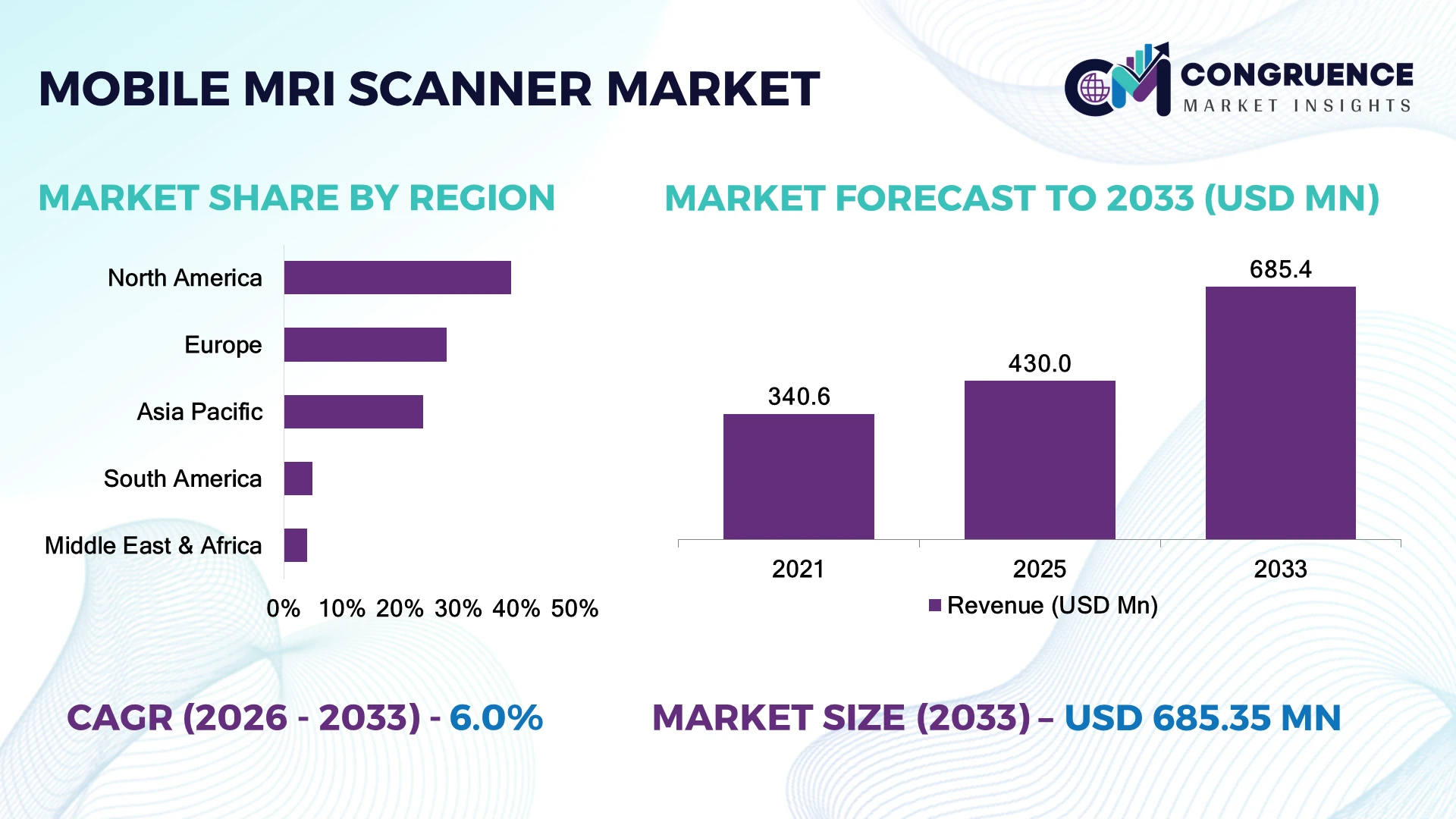
The United States dominates the market with approximately 36% of global mobile MRI scanner deployment capacity, supported by more than 6,100 hospitals, expanding outpatient imaging networks, and sustained healthcare infrastructure investments. Mobile imaging utilization in rural healthcare programs exceeds 22% in several states, while Germany accounts for nearly 8% of deployments through advanced diagnostic modernization initiatives. Ongoing healthcare resilience planning following post-pandemic infrastructure reforms has accelerated procurement of transportable imaging systems and AI-enabled workflow platforms.
Strategically, vendors that combine mobility, high-throughput imaging, and digital diagnostic integration are securing stronger positions in healthcare modernization programs.
Market Size & Growth: USD 430.0 Million in 2025 reaching USD 658.4 Million by 2033 at 6.0% CAGR, supported by decentralized diagnostic infrastructure expansion.
Top Growth Drivers: Rural imaging access (+22%), outpatient diagnostic adoption (+18%), AI-assisted workflow deployment (+27%).
Short-Term Forecast: By 2028, scan scheduling efficiency improves by 25% while patient travel requirements decline by 20%.
Emerging Technologies: AI image reconstruction, cloud-based diagnostics, and compact superconducting magnets reduce workflow time by up to 30%.
Regional Leaders: North America (~USD 235 Million), Europe (~USD 145 Million), Asia-Pacific (~USD 125 Million); driven by healthcare digitization and mobile care programs.
Consumer/End-User Trends: Nearly 40% of healthcare providers prioritize mobile imaging to improve diagnostic accessibility.
Pilot/Case Example: In 2024, mobile imaging deployments in community health systems reduced patient wait times by 28%.
Competitive Landscape: Siemens Healthineers holds roughly 18% share alongside GE HealthCare, Philips, Canon Medical, and Fujifilm.
Regulatory & ESG Impact: Mobile imaging networks cut patient transportation requirements by nearly 15% while supporting healthcare accessibility targets.
Investment & Funding: More than USD 1.2 Billion has been directed toward mobile diagnostics, partnerships, and imaging infrastructure upgrades.
Innovation & Future Outlook: AI-enabled portable MRI platforms and remote diagnostic ecosystems are reshaping high-growth healthcare delivery models.
Mobile MRI Scanner systems are increasingly deployed across rural healthcare networks, emergency response services, oncology screening programs, and outpatient diagnostic centers. Recent innovation focuses on compact magnet architecture, AI-assisted image reconstruction, and cloud-connected diagnostic workflows that reduce image processing times by nearly 30%. Healthcare infrastructure modernization and resilient care-delivery strategies are accelerating adoption, while transportable imaging fleets are emerging as a preferred solution for expanding diagnostic coverage and operational flexibility, creating a foundation for broader strategic transformation.
Mobile MRI scanners are becoming strategically important as healthcare systems prioritize diagnostic accessibility, capacity optimization, and decentralized care delivery. Competitive differentiation increasingly depends on the ability to deliver advanced imaging services beyond traditional hospital environments. Infrastructure modernization initiatives, expanding outpatient care networks, and digital healthcare adoption are accelerating investment decisions across developed and emerging healthcare markets.
Technological advances are significantly improving operational performance. Modern AI-enabled mobile MRI platforms can reduce image reconstruction times by approximately 25–30% compared with legacy systems while lowering workflow bottlenecks. The United States leads large-scale deployment through extensive outpatient imaging networks, whereas Japan and Germany emphasize precision imaging and compact system innovation. Over the next two to three years, mobile diagnostic integration with cloud-based radiology platforms is expected to expand substantially, improving utilization rates and diagnostic throughput.
Healthcare providers are increasingly deploying mobile MRI units for community outreach programs, rural diagnostics, and specialty screening initiatives. Manufacturers are responding through strategic partnerships, software integration investments, and expanded service-based business models. Organizations that successfully combine mobility, digital connectivity, and operational efficiency will secure stronger competitive positioning and long-term relevance in the evolving diagnostic imaging ecosystem.
Healthcare systems are rapidly expanding decentralized imaging networks to improve patient access and reduce diagnostic bottlenecks. Mobile MRI deployment in rural and community healthcare settings has increased by approximately 22%, while outpatient imaging utilization has risen by nearly 18%. AI-enabled workflow platforms improve scanner productivity by up to 27%, allowing providers to serve larger patient populations without major facility expansion. Post-pandemic healthcare resilience programs in the United States and Europe have accelerated investments in transportable diagnostic assets. In response, leading manufacturers are increasing production capacity, expanding service partnerships, and integrating remote diagnostics capabilities. A key strategic outcome is that healthcare operators can extend advanced imaging services into underserved areas while maintaining utilization efficiency and clinical quality standards.
Mobile MRI systems face significant adoption barriers due to infrastructure requirements, transportation logistics, and specialized operating costs. Mobile unit deployment expenses can exceed those of fixed-site diagnostic installations by 15–20% when transportation, shielding, and maintenance requirements are included. Approximately 35% of smaller healthcare facilities report budget constraints as a primary procurement obstacle. Dependence on specialized superconducting components and advanced cooling systems also creates supply-chain vulnerability, particularly when semiconductor or cryogenic component availability tightens. Companies are mitigating risks through localized sourcing, long-term supplier contracts, and modular system designs. A critical operational insight is that deployment economics remain highly sensitive to utilization rates, making asset optimization essential for profitability and scalability.
The convergence of artificial intelligence, cloud diagnostics, and compact MRI architecture is creating substantial opportunities for next-generation mobile imaging services. AI-assisted image processing can reduce interpretation workflows by nearly 30%, while remote radiology integration improves diagnostic turnaround times by approximately 20%. India and Southeast Asian healthcare systems are increasingly investing in mobile diagnostic programs to address underserved populations and expanding healthcare coverage targets. Emerging low-helium and compact magnet technologies are improving operational efficiency while reducing deployment constraints. Manufacturers are strengthening R&D investments, forming software partnerships, and building ecosystem-based service models. A particularly valuable opportunity lies in subscription-based mobile imaging networks that enable healthcare providers to access advanced diagnostics without major capital-intensive infrastructure investments.
Long-term scalability depends on solving workforce shortages, interoperability challenges, and complex digital integration requirements. Nearly 28% of healthcare providers report shortages of qualified MRI technologists, while integration of imaging data into broader health information systems remains inconsistent across many facilities. Mobile MRI deployments generate large diagnostic datasets that require secure transmission, storage, and compliance management. Increasing cybersecurity requirements and evolving healthcare data regulations add operational complexity, particularly for multi-site diagnostic networks. Companies are investing in workforce training, cloud-security frameworks, and interoperability partnerships to improve deployment consistency. A major strategic challenge is ensuring that mobile imaging networks can scale efficiently while maintaining clinical quality, cybersecurity resilience, and standardized patient outcomes across geographically dispersed healthcare environments.
AI-Driven Imaging Workflow Expansion Healthcare providers are accelerating AI-enabled MRI deployment, with image reconstruction times declining by 25% and reporting productivity improving by nearly 20%. U.S. hospital networks are integrating automated scan optimization into mobile units to address radiologist shortages. The shift is reducing operational bottlenecks and increasing daily patient throughput. Vendors are expanding software partnerships and embedding machine-learning algorithms directly into mobile imaging platforms to strengthen workflow efficiency and service differentiation.
Compact Low-Helium System Adoption New low-helium MRI architectures are reshaping equipment deployment strategies, reducing helium consumption by over 70% while lowering maintenance interventions by approximately 18%. Supply-chain pressure on cryogenic components has encouraged healthcare operators to prioritize compact scanner designs. This transition allows mobile units to access smaller clinical sites and remote locations more efficiently. Manufacturers are restructuring product portfolios and scaling compact-system production to improve deployment flexibility and lifecycle economics.
Cloud-Connected Diagnostic Networks Remote imaging interpretation has expanded rapidly, with cloud-enabled MRI workflows increasing by nearly 30% and diagnostic turnaround times improving by 22%. Healthcare systems in Germany and Japan are linking mobile scanners directly to centralized radiology hubs. The operational impact includes faster clinical decisions and better asset utilization across distributed healthcare networks. Companies are investing in cybersecurity infrastructure, interoperability platforms, and digital service ecosystems to support growing data-transfer requirements.
Mobile Fleet Optimization Models Healthcare operators are increasingly managing scanners through shared-service fleet models, improving equipment utilization rates by roughly 15% while reducing idle capacity by 12%. Labor shortages and infrastructure constraints are driving adoption of centralized scheduling platforms. A less obvious outcome is improved geographic balancing of diagnostic resources across underserved communities. Vendors are expanding managed-service offerings, forming healthcare partnerships, and deploying predictive maintenance technologies to maximize fleet performance and operational consistency.
Closed mobile MRI systems account for approximately 68% of total deployments, making them the leading segment due to superior image resolution, broader clinical applicability, and stronger integration with advanced diagnostic workflows. Healthcare providers continue prioritizing closed systems for neurology, oncology, and musculoskeletal imaging, where diagnostic precision remains critical. Their scalability across hospital networks and specialty care programs reinforces deployment preference. Companies are enhancing gradient performance, AI-assisted imaging capabilities, and mobile platform compatibility to maintain competitiveness.
Open mobile MRI systems represent the fastest-growing segment, supported by rising demand for patient-friendly imaging environments and improved accessibility for bariatric and claustrophobic patients. Adoption rates have increased by nearly 16% in outpatient diagnostic settings, while patient satisfaction scores often exceed those of conventional enclosed systems by over 20%. Vendors are investing in stronger magnetic field performance and compact open-system architectures. Investment priorities are gradually shifting toward balancing patient comfort with diagnostic quality, creating new opportunities for differentiated product development and service expansion.
Diagnostic imaging holds approximately 61% of market demand, driven by expanding requirements for neurological, orthopedic, cardiovascular, and oncology evaluations. Mobile MRI deployment allows healthcare systems to extend advanced imaging access without constructing permanent facilities, making diagnostic imaging the dominant application. Increasing patient volumes and capacity constraints are encouraging providers to deploy transportable scanners across community health networks. Companies continue expanding imaging service coverage through workflow automation and mobile fleet optimization.
Emergency and critical care imaging is emerging as the fastest-growing application segment, supported by rising demand for rapid diagnostic capabilities in disaster response, military healthcare, and remote medical settings. Utilization in urgent care environments has increased by nearly 18%, while scan availability times have improved by approximately 20% through mobile deployment strategies. Preventive screening and specialty outreach programs are also gaining relevance. Vendors are integrating cloud diagnostics, remote radiology support, and AI-assisted triage tools to strengthen operational responsiveness and improve clinical decision speed.
Hospitals represent the largest end-user segment with approximately 57% of total deployment activity, supported by extensive diagnostic workloads, infrastructure requirements, and integrated care pathways. Large hospital systems rely on mobile MRI units to manage peak imaging demand, expand outreach services, and support facility modernization initiatives. Their operational scale allows efficient utilization of advanced imaging assets. Manufacturers continue prioritizing hospital partnerships, long-term service contracts, and integrated software ecosystems to strengthen customer retention.
Outpatient diagnostic centers are the fastest-growing end-user group, with deployment activity increasing by nearly 19% as healthcare delivery shifts toward lower-cost and decentralized care settings. Independent imaging centers are adopting mobile MRI platforms to expand geographic coverage and improve service flexibility without major capital-intensive construction. Academic medical institutions and specialized healthcare providers remain important adopters for research and targeted clinical programs. Companies are responding through flexible financing models, subscription-based service offerings, and customized deployment packages designed to meet evolving outpatient operational requirements.
North America accounted for the largest market share at 39% in 2025 however, Asia-Pacific is expected to register the fastest growth, expanding at a CAGR of 7.4% between 2026 and 2033.
North America represents the leading regional market, supported by extensive hospital infrastructure, mature outpatient diagnostic networks, and strong adoption of advanced imaging technologies. The region accounts for approximately 39% of global deployment activity, with the United States contributing the majority of installed mobile MRI capacity. Healthcare providers increasingly utilize mobile scanners to address imaging backlogs, improve rural healthcare access, and optimize diagnostic utilization across multi-site networks. AI-enabled workflow systems and cloud-based radiology platforms are becoming standard operational components. Mobile imaging fleet utilization rates have improved by nearly 18% in large healthcare systems through centralized scheduling and remote diagnostic integration. Strategic partnerships between healthcare operators and imaging service providers continue to accelerate deployment efficiency while strengthening service coverage across underserved communities.
United States Market Outlook: The United States maintains a dominant position through its extensive hospital ecosystem, outpatient imaging infrastructure, and advanced healthcare technology adoption. More than 6,000 hospitals and numerous independent diagnostic centers support sustained demand for mobile MRI services. Rural healthcare programs have increased mobile imaging deployment by over 20% in several states, while healthcare operators continue investing in AI-assisted imaging workflows and fleet optimization technologies. The country's strong reimbursement environment and healthcare modernization initiatives reinforce long-term deployment activity.
Europe holds approximately 28% of global market activity and benefits from extensive healthcare modernization programs, strong diagnostic standards, and increasing demand for decentralized imaging services. Mobile MRI deployment is expanding across community healthcare networks to reduce patient travel requirements and improve diagnostic accessibility. Healthcare providers are integrating digital radiology systems with mobile platforms to improve workflow coordination and asset utilization. Several national healthcare systems have increased investment in transportable diagnostic infrastructure, leading to deployment growth exceeding 15% across selected healthcare networks. Regulatory emphasis on healthcare accessibility and operational efficiency continues to support market development. Vendors are strengthening regional partnerships and expanding service-based deployment models to address evolving healthcare delivery requirements.
Germany Market Outlook: Germany serves as the region's most strategically significant market due to its advanced healthcare infrastructure, diagnostic imaging expertise, and strong medical technology ecosystem. Mobile MRI adoption continues to expand across regional healthcare facilities seeking greater diagnostic flexibility. More than 80% of large healthcare institutions utilize integrated digital imaging environments, supporting efficient mobile scanner deployment. The country's focus on precision diagnostics and healthcare technology innovation continues to create favorable conditions for advanced mobile MRI solutions.
Asia-Pacific accounts for approximately 24% of global market activity and represents the fastest-expanding regional landscape due to healthcare infrastructure expansion, rising diagnostic demand, and growing investment in decentralized medical services. Governments and healthcare providers are increasingly deploying mobile MRI systems to improve imaging accessibility across densely populated and underserved areas. Mobile diagnostic utilization has increased by nearly 22% across selected healthcare networks, supported by infrastructure modernization programs and expanding outpatient services. Regional manufacturers are also enhancing production capabilities and strengthening supply-chain resilience to support growing demand. Digital health integration and remote diagnostic services are becoming important operational differentiators across the region.
China Market Outlook: China remains the largest market within Asia-Pacific due to its extensive healthcare infrastructure investments, expanding diagnostic capacity, and strong medical equipment manufacturing base. National healthcare modernization initiatives continue to support deployment of advanced imaging technologies in both urban and regional healthcare systems. Mobile imaging programs have expanded significantly across provincial healthcare networks, while domestic manufacturers continue increasing production efficiency and technological capabilities. Large-scale healthcare digitization efforts further strengthen operational adoption of mobile MRI platforms.
South America represents approximately 5% of global market activity, with demand increasingly driven by efforts to improve healthcare accessibility across geographically dispersed populations. Mobile MRI systems are being deployed to supplement limited fixed-site imaging infrastructure and reduce diagnostic service gaps. Healthcare providers are prioritizing transportable imaging solutions to serve remote communities and optimize resource utilization. Deployment activity has increased by nearly 14% across selected public healthcare initiatives focused on expanding diagnostic coverage. Infrastructure limitations and uneven healthcare funding remain operational constraints; however, strategic partnerships and service-based deployment models are improving market accessibility. Companies continue expanding regional service capabilities to strengthen long-term operational presence.
Brazil Market Outlook: Brazil leads regional demand through its large healthcare system, expanding diagnostic service network, and growing emphasis on healthcare accessibility. Mobile MRI platforms are increasingly used to support underserved regions where permanent imaging infrastructure remains limited. Public and private healthcare operators continue investing in diagnostic modernization initiatives, while deployment activity has increased across community healthcare programs. Expanding telehealth integration and digital diagnostic workflows are further enhancing the operational value of mobile imaging services throughout the country.
The Middle East & Africa region accounts for approximately 4% of global market activity and is increasingly influenced by healthcare infrastructure expansion, medical modernization projects, and growing investment in advanced diagnostic technologies. Governments and private healthcare organizations are deploying mobile MRI systems to strengthen imaging accessibility and support healthcare transformation initiatives. Several healthcare infrastructure programs have increased diagnostic equipment investments by more than 15%, improving access to specialized imaging services. Mobile diagnostic units are also supporting healthcare delivery in remote and underserved areas where fixed imaging infrastructure remains limited. Vendors are expanding regional partnerships and service networks to capitalize on modernization opportunities while addressing operational deployment challenges.
Saudi Arabia Market Outlook: Saudi Arabia represents the most strategically important market within the region due to substantial healthcare infrastructure investment, large-scale modernization initiatives, and strong government support for advanced medical technologies. Healthcare transformation programs continue driving deployment of mobile diagnostic systems across hospitals and regional healthcare facilities. Diagnostic capacity expansion remains a national priority, with mobile imaging solutions increasingly integrated into healthcare access strategies. Investments in digital health platforms and advanced clinical technologies further enhance adoption potential and operational efficiency.
The Mobile MRI Scanner Market is led by Siemens Healthineers, GE HealthCare, Philips Healthcare, Canon Medical Systems, and Fujifilm Healthcare, which collectively control approximately 67% of global market activity. Competition is primarily between global imaging OEMs with extensive MRI portfolios and emerging innovators focused on compact, portable, and AI-enabled systems. Siemens and GE compete through advanced imaging performance and workflow automation, while Philips emphasizes helium-free MRI architecture and cloud integration. Canon and Fujifilm increasingly target operational efficiency and patient-centric imaging environments. Technology remains the principal battleground, with AI-enabled workflow solutions reducing scan preparation times by nearly 25% and advanced reconstruction tools improving throughput by approximately 20%. Compact system designs can lower installation complexity by more than 15%, creating a significant competitive advantage. Companies are expanding through healthcare partnerships, managed-service models, software integration, and digital ecosystem development. The competitive landscape is shifting toward AI-enabled diagnostic platforms and service-driven deployment models. Regulatory compliance, installed-base relationships, and high development costs remain major entry barriers. Winning requires superior imaging performance, scalable digital integration, strong service infrastructure, and deployment flexibility.
GE HealthCare Technologies Inc.
Philips Healthcare
Canon Medical Systems Corporation
Fujifilm Healthcare Corporation
Hyperfine Inc.
United Imaging Healthcare Co., Ltd.
Esaote S.p.A.
Neusoft Medical Systems Co., Ltd.
Shenzhen Anke High-Tech Co., Ltd.
Aspect Imaging Ltd.
Time Medical Systems
Aurora Imaging Technology, Inc.
Mobile MRI technology is transitioning from conventional imaging hardware toward AI-enabled, digitally connected diagnostic ecosystems. Advanced image reconstruction algorithms now reduce reconstruction times by approximately 25% while improving workflow efficiency by nearly 20%. More than 40% of newly deployed mobile MRI platforms incorporate AI-assisted scanning protocols and automated image optimization. Healthcare providers benefit through higher patient throughput, reduced operator dependency, and improved diagnostic consistency. Companies with strong software capabilities are gaining a competitive advantage over hardware-focused suppliers.
Emerging technologies include low-helium magnet systems, cloud-connected radiology networks, and compact high-performance gradient architectures. Compared with older MRI platforms, modern AI-assisted systems can complete imaging workflows up to 30% faster while reducing repeat scans by approximately 15%. Adoption of cloud-enabled diagnostic workflows has surpassed 35% among large healthcare networks. These innovations improve fleet utilization, support remote interpretation, and expand deployment opportunities in underserved healthcare environments.
Between 2026 and 2028, portable low-field MRI systems, predictive maintenance platforms, and edge-based image processing technologies will reshape market competition. Vendors integrating AI, cloud infrastructure, and automated workflow management are expected to strengthen operational differentiation. Organizations acting now gain advantages in deployment efficiency, service scalability, and diagnostic accessibility as mobile imaging becomes increasingly integrated into decentralized healthcare delivery models.
February 2026 – GE HealthCare received FDA clearance for SIGNA Sprint with Freelium and SIGNA Bolt MRI systems alongside the SIGNA One workflow ecosystem. The platform introduced AI-driven workflow automation and sealed-magnet technology to expand imaging access and improve operational efficiency. Source: GE HealthCare
November 2025 – GE HealthCare unveiled next-generation SIGNA MRI technologies featuring AI-powered workflow solutions designed to reduce imaging inefficiencies. The company introduced two new MRI platforms focused on clinical efficiency, sustainability, and advanced diagnostics, strengthening its competitive MRI portfolio. Source: GE HealthCare Newsroom
December 2024 – Philips introduced AI-enabled imaging innovations and enhanced cloud-based informatics capabilities at RSNA 2024. Its next-generation BlueSeal MRI platform advanced workflow automation and operational productivity while supporting more flexible MRI deployment environments. Source: Philips Press Release
February 2024 – Philips partnered with SyntheticMR to launch Smart Quant Neuro 3D, enabling automated quantitative brain tissue assessment through AI-based MRI analysis. The technology improved neurological decision support and expanded advanced MRI diagnostic capabilities for clinical users. Source: Philips News Center
This report provides a comprehensive assessment of the Mobile MRI Scanner Market across major technology platforms, deployment models, clinical applications, and end-user categories. The analysis covers closed and open MRI systems, diagnostic imaging, emergency care, screening applications, hospitals, outpatient diagnostic centers, and specialized healthcare providers. Regional evaluation spans North America, Europe, Asia-Pacific, South America, and the Middle East & Africa, highlighting deployment concentration, infrastructure readiness, and technology adoption patterns. More than 60% of market activity remains concentrated among advanced healthcare systems, while decentralized imaging programs continue expanding across emerging healthcare networks.
The study evaluates AI-assisted imaging, cloud-connected diagnostics, low-helium MRI architecture, workflow automation, and portable imaging innovations shaping competitive dynamics through 2033. It examines deployment trends, operational efficiency metrics, investment priorities, and strategic positioning of leading market participants. The report supports expansion planning, product development, partnership evaluation, and competitive benchmarking by identifying high-opportunity segments, evolving healthcare delivery models, and technology-driven transformation pathways influencing future market direction.
| Report Attribute / Metric | Details |
|---|---|
| Market Revenue (2025) | USD 430.0 Million |
| Market Revenue (2033) | USD 658.4 Million |
| CAGR (2026–2033) | 6.0% |
| Base Year | 2025 |
| Forecast Period | 2026–2033 |
| Historic Period | 2021–2025 |
| Segments Covered |
By Type
By Application
By End-User
|
| Key Deliverables | Revenue Forecast; Market Trends; Growth Drivers & Restraints; Technology Insights; Segmentation Analysis; Regional Insights; Competitive Landscape; Regulatory & ESG Overview; Recent Developments |
| Regions Covered | North America; Europe; Asia-Pacific; South America; Middle East & Africa |
| Companies Profiled | Siemens Healthineers AG; GE HealthCare Technologies Inc.; Philips Healthcare; Canon Medical Systems Corporation; Fujifilm Healthcare Corporation; Hyperfine Inc.; United Imaging Healthcare Co., Ltd.; Esaote S.p.A.; Neusoft Medical Systems Co., Ltd.; Shenzhen Anke High-Tech Co., Ltd.; Aspect Imaging Ltd.; Time Medical Systems; Aurora Imaging Technology, Inc. |
| Customization & Pricing | Available on Request (10% Customization Free) |




