
Reports
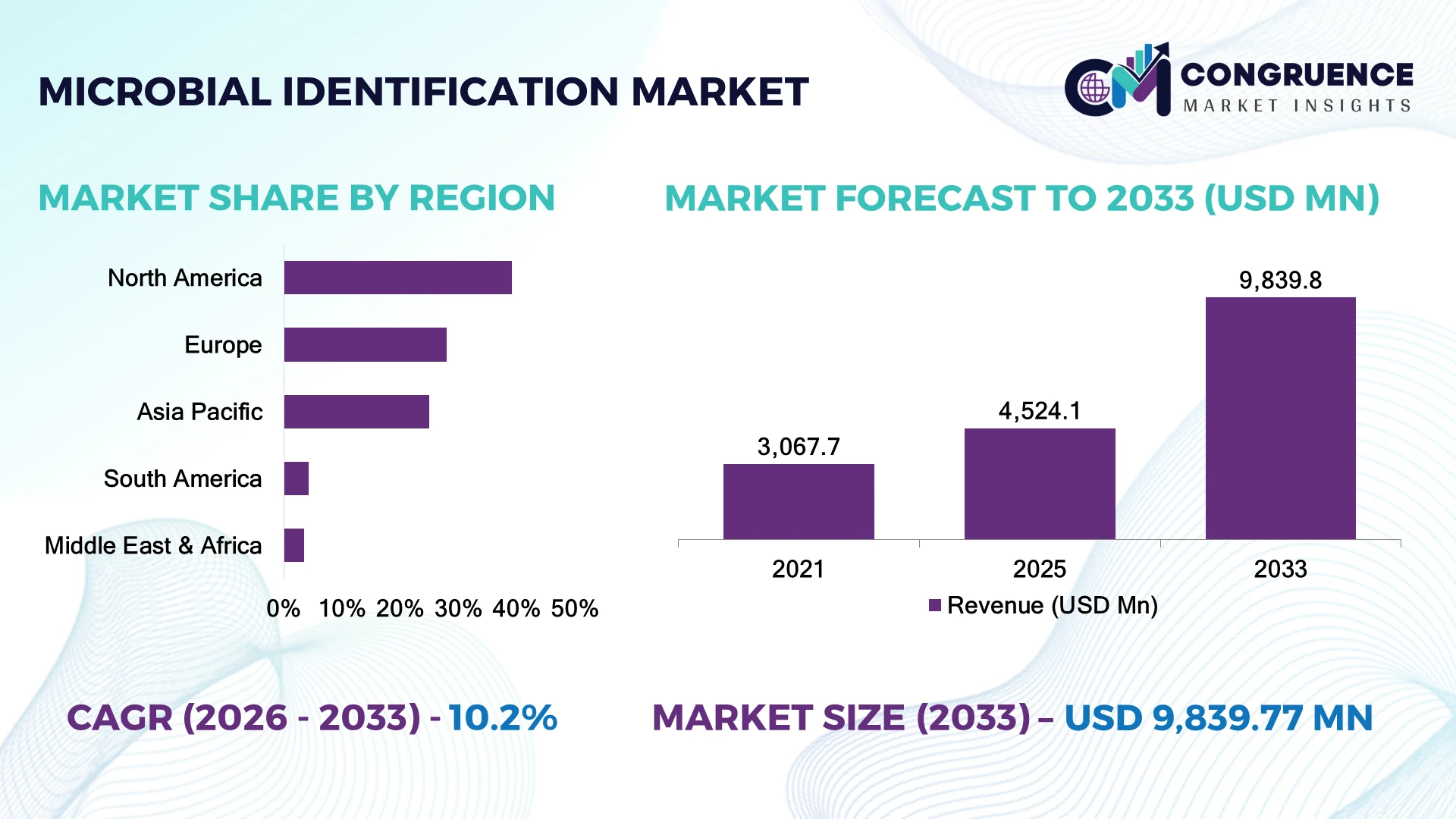
The Global Microbial Identification Market was valued at USD 4,524.1 Million in 2025 and is anticipated to reach a value of USD 9,839.8 Million by 2033 expanding at a CAGR of 10.2% between 2026 and 2033. Growth is driven by rapid adoption of molecular diagnostics, automated microbiology laboratories, antimicrobial resistance surveillance, and stricter pharmaceutical quality control requirements.
The United States accounts for approximately 34% of global microbial identification system deployment, supported by advanced clinical diagnostics, biopharmaceutical manufacturing, and food safety laboratories. The country invests heavily in laboratory modernization, while automated microbial identification adoption exceeds 68% across large healthcare networks. Deployment is approximately 2.4 times higher than India, and AI-assisted microbiology workflows improve pathogen identification efficiency by nearly 31%. Continued biosecurity investments and post-pandemic laboratory resilience initiatives in 2026 further strengthen demand for advanced microbial identification technologies.
Organizations investing in automated molecular platforms, AI-enabled microbiology, and integrated laboratory informatics will secure stronger operational resilience and regulatory readiness across healthcare and industrial diagnostics.
Market Size & Growth: USD 4,524.1 million in 2025 reaching USD 9,839.8 million by 2033 at 10.2% CAGR, driven by automated microbiology and molecular diagnostics.
Top Growth Drivers: Molecular diagnostics (+26%), pharmaceutical quality testing (+21%), antimicrobial resistance surveillance (+18%).
Short-Term Forecast: By 2028, laboratory turnaround time declines 27% while workflow efficiency improves 24%.
Emerging Technologies: AI-assisted microbiology, MALDI-TOF automation, and next-generation sequencing accelerate microbial characterization.
Regional Leaders: North America (~USD 3.4 billion), Europe (~USD 2.4 billion), Asia-Pacific (~USD 2.8 billion), supported by laboratory digitalization.
Consumer/End-User Trends: Approximately 72% of large clinical laboratories prioritize automated microbial identification platforms.
Pilot/Case Example: A 2026 hospital laboratory modernization program reduced organism identification time by 35%.
Competitive Landscape: Top five suppliers command nearly 61% market share through automation and integrated diagnostics.
Regulatory & ESG Impact: Digital laboratory workflows reduce paper-based documentation by approximately 42%.
Investment & Funding: More than USD 2.1 billion supports diagnostic innovation, laboratory expansion, and strategic partnerships.
Innovation & Future Outlook: Cloud-connected microbiology, multiplex diagnostics, and predictive analytics redefine laboratory competitiveness.
The Microbial Identification market is rapidly advancing through AI-enabled diagnostics, MALDI-TOF mass spectrometry, and next-generation sequencing platforms that improve identification accuracy and laboratory productivity. Nearly 47% of newly commissioned microbiology laboratories now deploy integrated digital workflows, while regulatory focus on antimicrobial resistance surveillance and resilient healthcare supply chains continues accelerating investment. These developments establish the foundation for the market's strategic evolution.
Microbial identification has become strategically important as healthcare providers, pharmaceutical manufacturers, and food safety organizations prioritize faster pathogen detection, regulatory compliance, and operational resilience. Laboratory modernization and digital transformation are shifting procurement toward integrated diagnostic ecosystems capable of supporting high-throughput testing and real-time data management. Strengthened biosecurity initiatives and supply-chain resilience programs following recent global health preparedness efforts continue reinforcing investment in advanced microbiology infrastructure.
Modern MALDI-TOF and molecular identification platforms process microbial samples approximately 45% faster than conventional culture-based identification while reducing reagent consumption by nearly 22%. The United States leads large-scale deployment through advanced clinical laboratory networks, whereas Japan emphasizes precision diagnostics and automated microbiology for pharmaceutical quality assurance. Over the next two to three years, more than 60% of newly established reference laboratories are expected to integrate AI-assisted interpretation and centralized laboratory informatics.
Pharmaceutical manufacturers and hospital laboratory networks are expanding investments in automated identification systems while strengthening collaborations with diagnostic technology providers. Integrated microbiology platforms enable faster outbreak response, improve batch release verification, and enhance antimicrobial stewardship initiatives. Organizations combining intelligent automation, molecular diagnostics, and interoperable laboratory software will achieve stronger competitive positioning through superior diagnostic accuracy, regulatory readiness, and scalable laboratory operations.
Healthcare systems and life sciences organizations are accelerating investments in automated microbial identification platforms to improve diagnostic speed, infection control, and laboratory productivity. Nearly 71% of tertiary-care hospitals now prioritize integrated molecular identification workflows, while AI-assisted microbiology reduces organism identification time by approximately 34% and improves laboratory efficiency by nearly 26%. The United States continues expanding antimicrobial resistance surveillance and digital laboratory infrastructure, driving demand for high-throughput diagnostic systems. Faster pathogen identification enables earlier clinical intervention and strengthens pharmaceutical quality assurance. Technology providers are expanding manufacturing capacity, investing in AI-enabled software, and forming strategic partnerships with healthcare networks. Competitive differentiation increasingly depends on delivering integrated diagnostic ecosystems rather than standalone identification instruments.
Advanced microbial identification platforms require significant investment in analytical instruments, proprietary consumables, and laboratory infrastructure, creating adoption barriers for smaller healthcare facilities and emerging diagnostic laboratories. Approximately 43% of total ownership costs are associated with maintenance, calibration, and consumable replacement, while specialized workforce requirements increase operating expenses by nearly 16%. India continues expanding diagnostic infrastructure, yet uneven laboratory capabilities delay widespread deployment of sophisticated identification technologies. These structural limitations reduce procurement flexibility and extend equipment replacement cycles. Companies are addressing these constraints through reagent rental models, localized manufacturing, long-term service agreements, and scalable instrument configurations that reduce capital requirements while improving accessibility across mid-sized laboratories.
Next-generation sequencing, cloud-connected microbiology, and AI-driven pathogen analytics are creating new commercial opportunities beyond routine organism identification. Approximately 49% of reference laboratories are expanding genomic surveillance capabilities, while integrated bioinformatics platforms reduce complex data interpretation time by nearly 28%. Japan continues strengthening precision medicine and genomic diagnostics initiatives, encouraging broader deployment of advanced microbial characterization technologies. Companies are increasing investments in bioinformatics software, collaborative research programs, and cloud-enabled laboratory ecosystems that support clinical diagnostics, pharmaceutical development, and food safety testing. A significant strategic opportunity lies in subscription-based analytical platforms that generate recurring value while enhancing outbreak monitoring and antimicrobial resistance surveillance.
Connecting microbial identification platforms with hospital information systems, laboratory information management systems, and national surveillance databases remains a major execution challenge. Approximately 31% of healthcare laboratories continue operating fragmented digital environments, while interoperability limitations extend reporting workflows by nearly 18%. Germany's increasing adoption of digital healthcare infrastructure is intensifying demand for standardized laboratory communication protocols and secure data exchange. Inconsistent integration affects reporting accuracy, operational scalability, and coordinated public health response. Companies must invest in interoperable software architectures, cybersecurity frameworks, and standardized digital interfaces while expanding implementation partnerships to ensure reliable deployment across diverse laboratory environments and healthcare networks.
Rapid MALDI-TOF Expansion: Clinical laboratories are accelerating deployment of MALDI-TOF platforms, increasing identification capacity by approximately 32% while reducing organism identification time by nearly 40%. Workforce shortages and rising diagnostic workloads are driving hospitals to automate microbiology workflows, prompting suppliers to expand service networks and integrated software capabilities.
Cloud-Connected Laboratory Ecosystems: Digital microbiology platforms are replacing isolated laboratory workflows, with centralized data management adoption increasing by approximately 37%. Connected systems reduce reporting delays by nearly 23% and improve traceability across multi-site laboratory networks. Diagnostic companies are strengthening cloud partnerships to support scalable laboratory operations and regulatory compliance.
Multiplex Molecular Testing Growth: Healthcare providers increasingly deploy multiplex molecular assays capable of identifying multiple pathogens within a single workflow, improving laboratory productivity by approximately 29% while reducing repeat testing requirements by nearly 17%. Growing antimicrobial resistance monitoring programs are encouraging manufacturers to expand integrated molecular testing portfolios and automation capabilities.
Predictive Microbiology Analytics: AI-enabled predictive analytics is transforming microbiology laboratories by improving result interpretation consistency by approximately 21% and optimizing laboratory resource utilization by nearly 19%. Pharmaceutical manufacturers and reference laboratories are integrating intelligent analytical software with existing diagnostic platforms, creating competitive advantages through faster decision-making, standardized reporting, and improved operational resilience.
Automated microbial identification systems account for approximately 42% of the global Microbial Identification market, driven by their high throughput, standardized workflows, and seamless integration with laboratory information management systems. Their ability to process large specimen volumes while minimizing manual intervention makes them the preferred solution across hospitals, pharmaceutical manufacturing, and reference laboratories. Conventional biochemical identification kits remain widely deployed in resource-sensitive laboratories due to lower acquisition costs, while MALDI-TOF instruments have become an established choice for rapid organism characterization in advanced clinical settings.
Molecular identification systems represent the fastest-growing segment as healthcare providers increasingly prioritize rapid pathogen detection, antimicrobial resistance monitoring, and precision diagnostics. Automated molecular platforms reduce organism identification time by approximately 38%, while AI-assisted interpretation improves reporting efficiency by nearly 24%. Manufacturers are expanding multiplex assay portfolios, integrating cloud-based laboratory software, and strengthening collaborations with healthcare providers. Investment priorities are shifting toward scalable, software-enabled diagnostic platforms capable of supporting decentralized testing and enterprise-wide microbiology operations.
A 2026 evaluation by the Clinical and Laboratory Standards Institute indicated that automated molecular identification and MALDI-TOF platforms are becoming the preferred technologies for high-volume clinical microbiology laboratories seeking standardized diagnostic workflows.
Clinical diagnostics account for approximately 51% of global Microbial Identification demand, supported by rising testing volumes, infection control requirements, and the need for rapid organism identification in hospitals and diagnostic laboratories. High patient throughput and antimicrobial stewardship programs continue concentrating investment in automated microbiology workflows. Pharmaceutical quality control remains a mature application supported by stringent manufacturing validation, while food and beverage testing and environmental monitoring continue expanding through stricter quality assurance and contamination control requirements.
Pharmaceutical and biopharmaceutical testing is the fastest-growing application as biologics manufacturing, cell therapies, and sterile production environments require increasingly sophisticated microbial characterization. Automated laboratory systems improve testing productivity by approximately 27%, while integrated digital workflows reduce batch release timelines by nearly 19%. Technology providers are expanding automation capabilities, integrating laboratory informatics, and developing application-specific identification panels. Demand is steadily shifting toward intelligent microbiology ecosystems that support both routine diagnostics and advanced quality assurance programs.
A 2025 laboratory benchmarking study conducted by the International Organization for Standardization highlighted accelerating deployment of automated microbial identification systems across regulated pharmaceutical and clinical laboratories to improve compliance and testing consistency.
Hospitals account for approximately 46% of global Microbial Identification system deployments due to their continuous diagnostic workload, advanced laboratory infrastructure, and increasing investment in infection surveillance. Large healthcare networks require high-throughput identification platforms to support emergency diagnostics, antimicrobial stewardship, and hospital-acquired infection monitoring. Independent diagnostic laboratories continue representing a mature purchasing segment, while pharmaceutical and biotechnology companies maintain steady investment in microbial quality testing across manufacturing operations.
Research institutes are the fastest-growing end-user segment as genomic microbiology, antimicrobial resistance studies, and precision medicine programs expand globally. AI-assisted laboratory platforms improve analytical productivity by approximately 23%, while integrated microbiology software reduces reporting turnaround by nearly 18%. Technology providers are targeting research organizations through customized analytical platforms, collaborative innovation programs, and flexible deployment models. Competitive positioning increasingly depends on delivering interoperable solutions that support translational research alongside clinical and industrial microbiology.
A 2026 enterprise survey by the International Federation of Clinical Chemistry and Laboratory Medicine reported increasing adoption of integrated microbial identification platforms across academic research centers and hospital laboratories to strengthen diagnostic standardization and laboratory efficiency.
North America accounted for the largest market share at 39.2% in 2025 however, Asia-Pacific is expected to register the fastest growth, expanding at a CAGR of 11.6% between 2026 and 2033.
Advanced Laboratory Automation Strengthens Diagnostic Leadership
North America leads the Microbial Identification market through its highly developed healthcare infrastructure, extensive pharmaceutical manufacturing base, and rapid deployment of automated microbiology laboratories. The region contributes approximately 39.2% of global demand, supported by widespread adoption of molecular diagnostics, MALDI-TOF systems, and AI-enabled laboratory workflows. More than 69% of large clinical laboratories have integrated automated microbial identification platforms with digital laboratory information systems, reducing reporting delays and improving diagnostic consistency. Pharmaceutical manufacturers and healthcare providers continue expanding laboratory modernization initiatives, while strategic partnerships between diagnostic technology developers and healthcare networks accelerate implementation of intelligent microbiology solutions across clinical, industrial, and public health laboratories.
United States Market Outlook: The United States dominates the regional market through its advanced hospital networks, reference laboratories, and biopharmaceutical manufacturing ecosystem. Large healthcare organizations continue investing in integrated microbiology platforms that strengthen antimicrobial resistance surveillance and infection control. Approximately 74% of tertiary-care hospital laboratories utilize automated microbial identification systems, reinforcing the country's leadership in diagnostic innovation, laboratory digitization, and enterprise-scale microbiology infrastructure.
Regulatory Excellence Drives Precision Diagnostics
Europe accounts for approximately 28% of the global Microbial Identification market, supported by stringent diagnostic quality standards, advanced pharmaceutical manufacturing, and expanding laboratory digitalization. Clinical laboratories are increasingly adopting integrated microbiology platforms to improve traceability, regulatory compliance, and workflow standardization. Nearly 44% of newly installed identification systems include AI-assisted interpretation and centralized laboratory software. Healthcare providers and pharmaceutical companies continue strengthening microbiology capabilities through automation, collaborative research, and modernization of accredited laboratory infrastructure.
Germany Market Outlook: Germany remains the region's strategic hub due to its strong biotechnology sector, precision laboratory equipment industry, and highly developed clinical diagnostics ecosystem. Healthcare institutions and pharmaceutical manufacturers continue deploying advanced microbial identification technologies to improve quality assurance and manufacturing validation. Automated microbiology workflows have increased laboratory productivity by approximately 22%, supporting faster diagnostic decision-making and more efficient regulatory compliance.
Healthcare Expansion Accelerates Diagnostic Deployment
Asia-Pacific is the fastest-expanding Microbial Identification market, supported by growing healthcare investment, expanding pharmaceutical manufacturing, and rapid laboratory modernization. The region accounts for approximately 25% of global market activity, while increasing adoption of molecular diagnostics and automated microbiology platforms is transforming diagnostic capacity. More than 31% of newly established microbiology laboratories now deploy integrated identification systems designed for high-throughput testing. Companies are expanding regional manufacturing, strengthening distribution partnerships, and investing in localized technical support to address increasing clinical and industrial diagnostic demand.
China Market Outlook: China leads the regional market through extensive healthcare infrastructure expansion, a rapidly growing biotechnology industry, and strong investment in infectious disease surveillance. National laboratory modernization programs continue accelerating deployment of automated microbial identification technologies. Nearly 36% of newly commissioned public health laboratories incorporate advanced molecular identification platforms, improving testing capacity while supporting pharmaceutical manufacturing quality assurance and public health preparedness.
Healthcare Modernization Expands Laboratory Capacity
South America is strengthening its Microbial Identification capabilities through increasing investment in healthcare infrastructure, clinical laboratory modernization, and pharmaceutical quality assurance. Brazil represents the largest share of regional demand due to its expanding hospital network and diagnostic laboratory capacity. Approximately 24% of newly upgraded microbiology laboratories now utilize automated identification platforms, improving testing consistency and reducing manual analytical processes. Diagnostic equipment suppliers continue strengthening regional service capabilities, training programs, and distributor partnerships while balancing infrastructure constraints and imported instrument dependency.
Brazil Market Outlook: Brazil maintains regional leadership through its expanding clinical diagnostics sector, growing pharmaceutical production, and increasing investment in public healthcare laboratories. Hospital groups and independent diagnostic providers continue adopting advanced microbial identification technologies to improve infectious disease management and laboratory productivity. Expanded digital laboratory infrastructure is strengthening microbiology services and supporting broader implementation of automated diagnostic workflows.
Healthcare Investment Strengthens Diagnostic Infrastructure
The Middle East & Africa Microbial Identification market is advancing through healthcare modernization, expanding clinical laboratory networks, and increasing investment in infectious disease diagnostics. Growing pharmaceutical manufacturing and stronger public health preparedness programs are accelerating demand for automated microbiology systems. Approximately 18% of newly established reference laboratories now deploy integrated microbial identification platforms capable of supporting digital laboratory operations. Equipment providers continue expanding regional technical support, service infrastructure, and implementation partnerships to improve deployment efficiency and laboratory performance.
Saudi Arabia Market Outlook: Saudi Arabia has emerged as the region's leading market through sustained healthcare infrastructure investment, biotechnology expansion, and modernization of accredited diagnostic laboratories. Hospitals and public health institutions are strengthening microbiology capabilities by deploying automated molecular identification systems that improve diagnostic speed and laboratory efficiency. Strategic investment in digital healthcare infrastructure continues supporting broader adoption of advanced microbial identification technologies across the country's healthcare ecosystem.
Global diagnostics leaders bioMérieux, Bruker, Thermo Fisher Scientific, Becton Dickinson, and QIAGEN compete directly with specialized molecular diagnostics providers and regional microbiology solution suppliers. Premium innovators differentiate through automation, AI-enabled interpretation, and integrated laboratory informatics, while regional manufacturers compete on affordability and localized service. The top five companies collectively control approximately 61% of the global market. Competition focuses on identification speed, diagnostic accuracy, workflow integration, and reagent portfolio breadth. Automated identification platforms reduce laboratory turnaround by nearly 30%, AI-assisted analytics improve interpretation efficiency by approximately 24%, and integrated software lowers reporting errors by around 18%. Companies are expanding manufacturing, acquiring molecular diagnostic technologies, strengthening hospital partnerships, and vertically integrating consumables with software ecosystems. Competition is shifting from instrument sales toward complete microbiology platforms combining sequencing, MALDI-TOF, and cloud connectivity. Regulatory validation, proprietary databases, and installed laboratory networks create formidable entry barriers. Winning requires rapid diagnostics, scalable automation, comprehensive microbial databases, and seamless laboratory integration.
bioMérieux
Bruker Corporation
Thermo Fisher Scientific Inc.
Becton, Dickinson and Company (BD)
QIAGEN N.V.
Shimadzu Corporation
Charles River Laboratories
Merck KGaA
Eurofins Scientific
Biolog Inc.
Luminex Corporation
Accelerate Diagnostics, Inc.
Microbial identification technology is rapidly advancing through MALDI-TOF mass spectrometry, multiplex molecular diagnostics, automated culture systems, and laboratory informatics platforms. Modern identification workflows improve organism identification speed by approximately 42% while increasing laboratory productivity by nearly 27%. Around 71% of newly commissioned high-volume microbiology laboratories now deploy integrated automation with centralized data management, enabling standardized reporting, improved traceability, and faster antimicrobial stewardship decisions across clinical and pharmaceutical environments.
Emerging technologies include AI-assisted microbial interpretation, cloud-connected laboratory ecosystems, next-generation sequencing, and bioinformatics-driven resistance profiling. Compared with conventional biochemical identification methods, MALDI-TOF and molecular platforms reduce reporting time by approximately 48% while improving identification accuracy by nearly 20%. Healthcare networks, pharmaceutical manufacturers, and reference laboratories benefit most because integrated workflows accelerate diagnostic decisions, strengthen quality assurance, and improve operational scalability across distributed laboratory environments.
Between 2026 and 2028, intelligent microbiology platforms integrating sequencing, AI, and predictive antimicrobial resistance analytics will redefine laboratory investment priorities. Increasing deployment of digital microbiology ecosystems, automated specimen processing, and remote laboratory monitoring will reduce operational bottlenecks while strengthening infection surveillance. Organizations adopting interoperable diagnostic platforms today will secure competitive advantages through faster clinical decisions, improved regulatory compliance, enhanced laboratory productivity, and stronger resilience against emerging infectious disease challenges.
October 2025 – Bruker received FDA clearance for new MALDI Biotyper CA System claims, expanding its validated reference library to 549 clinically validated microbial species and enhancing workflow software for faster clinical identification. Business impact: broader diagnostic capability and higher laboratory efficiency. Source: Bruker
April 2026 – Bruker expanded its MALDI Biotyper and IR Biotyper portfolio with reference libraries covering more than 5,300 microbial species and introduced cloud-based identification capabilities, strengthening outbreak management and laboratory automation. Source: Bruker Corporation
May 2026 – Oxford University researchers demonstrated a rapid nanopore sequencing workflow capable of identifying bloodstream pathogens and antimicrobial resistance significantly faster than conventional culture-based methods, supporting earlier targeted treatment and improved clinical decision-making. Source: Oxford University
December 2025 – Bruker completed the integration of Molzym into its Microbiology & Infection Diagnostics portfolio, expanding culture-independent pathogen detection capabilities through host-DNA depletion technology and strengthening next-generation sequencing-based microbial identification. Source: Bruker
This report delivers a comprehensive assessment of the global Microbial Identification market across major identification technologies, applications, end-user groups, and regional markets. It evaluates automated identification systems, molecular diagnostics, MALDI-TOF platforms, biochemical methods, and emerging sequencing technologies used in clinical diagnostics, pharmaceutical quality assurance, food safety, environmental testing, and research laboratories. The analysis also covers laboratory automation, AI-assisted microbiology, cloud-based informatics, antimicrobial resistance surveillance, and integrated diagnostic workflows shaping modern microbiology operations.
The report provides strategic intelligence for investment planning and competitive decision-making between 2026 and 2033 through detailed evaluation of deployment trends, laboratory modernization, technology adoption, and regional healthcare infrastructure. Approximately 70% of advanced microbiology laboratories are transitioning toward integrated digital identification platforms to improve diagnostic efficiency and traceability. The study enables stakeholders to benchmark competitors, prioritize expansion opportunities, identify high-value applications, evaluate technology roadmaps, strengthen product positioning, and capitalize on evolving precision diagnostics and laboratory automation trends.
| Report Attribute/Metric | Report Details |
|---|---|
|
Market Revenue in 2025 |
USD 4,524.1 Million |
|
Market Revenue in 2033 |
USD 9,839.8 Million |
|
CAGR (2026 - 2033) |
10.2% |
|
Base Year |
2025 |
|
Forecast Period |
2026 - 2033 |
|
Historic Period |
2021 - 2025 |
|
Segments Covered |
By Type
By Application
By End-User
|
|
Key Report Deliverable |
Revenue Forecast, Growth Trends, Market Dynamics, Segmental Overview, Regional and Country-wise Analysis, Competition Landscape |
|
Region Covered |
North America, Europe, Asia-Pacific, South America, Middle East, Africa |
|
Key Players Analyzed |
bioMérieux, Bruker Corporation, Thermo Fisher Scientific Inc., Becton, Dickinson and Company (BD), QIAGEN N.V., Shimadzu Corporation, Charles River Laboratories, Merck KGaA, Eurofins Scientific, Biolog Inc., Luminex Corporation, Accelerate Diagnostics, Inc. |
|
Customization & Pricing |
Available on Request (10% Customization is Free) |




