
Reports
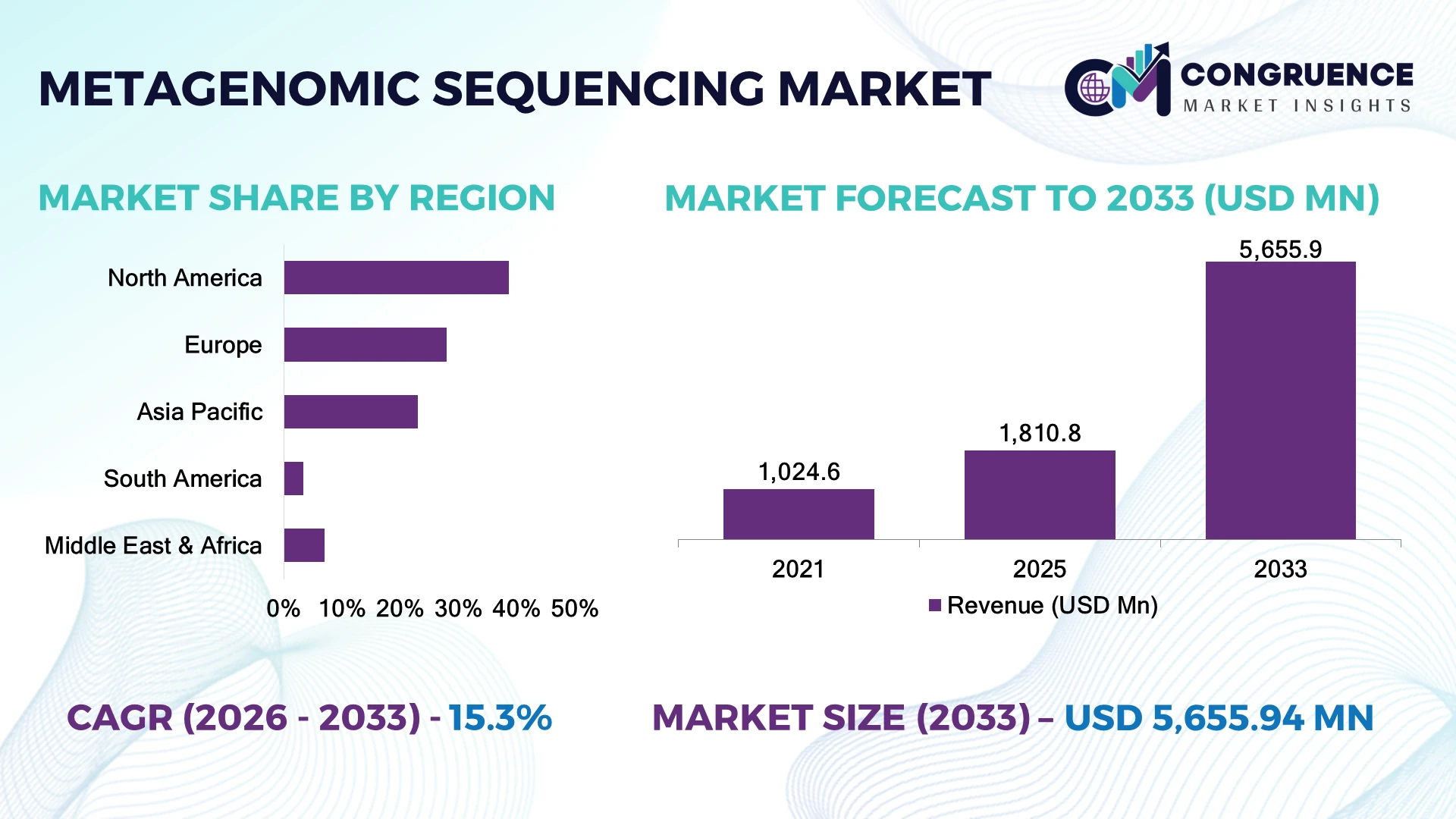
The Global Metagenomic Sequencing Market was valued at USD 1,810.8 Million in 2025 and is anticipated to reach a value of USD 5,655.9 Million by 2033 expanding at a CAGR of 15.3% between 2026 and 2033. Growth is being driven by rapid adoption of shotgun sequencing for pathogen detection, antimicrobial-resistance surveillance, microbiome profiling, and environmental monitoring, supported by faster long-read workflows and AI-assisted bioinformatics.
The United States remains the dominant country, supported by approximately 38% of global sequencing capacity across research, clinical, pharmaceutical, and public-health laboratories, while national investment in infectious-disease surveillance and precision medicine continues to expand. The U.S. maintains a clear lead over China, where large-scale genomics infrastructure is expanding rapidly. More than 30% of advanced metagenomic workflows now incorporate automated bioinformatics or machine-learning-assisted classification, strengthening throughput and interpretation.
The strategic priority is shifting toward integrated sequencing platforms that combine rapid sample-to-answer workflows, computational interpretation, and scalable data infrastructure.
Market Size & Growth: USD 1,810.8 million in 2025 to USD 5,655.9 million by 2033 at a 15.3% CAGR, driven by clinical pathogen detection and AMR surveillance.
Top Growth Drivers: Clinical diagnostics 34%, microbiome research 28%, environmental surveillance 22%.
Short-Term Forecast: By 2028, automated analysis can reduce interpretation time by 30% while improving laboratory throughput by 25%.
Emerging Technologies: Long-read sequencing, AI classification, and metagenome-assembled genomes are improving genomic resolution by 20%–35%.
Regional Leaders: North America reaches approximately USD 2.2 billion, Europe USD 1.4 billion, and Asia-Pacific USD 1.3 billion, with Asia-Pacific showing the fastest laboratory deployment.
Consumer/End-User Trends: Pharmaceutical and biotechnology users account for approximately 30% of advanced metagenomic workflows, increasingly integrating microbiome data into discovery programs.
Pilot/Case Example: A 2025 wastewater surveillance workflow identified 26 resistance-gene types and 1,225 subtypes, demonstrating stronger rare-AMR detection with targeted enrichment.
Competitive Landscape: Illumina leads high-throughput short-read infrastructure, competing with Oxford Nanopore, PacBio, QIAGEN, and Thermo Fisher across sequencing, sample preparation, and analysis workflows.
Regulatory & ESG Impact: Public-health genomic surveillance programs are expanding, while sequencing-enabled monitoring can improve early pathogen detection by more than 20% versus delayed culture-based workflows.
Investment & Funding: Global genomics investment remains concentrated in platform expansion, clinical sequencing, and AI-enabled bioinformatics, with multi-million-dollar laboratory infrastructure programs accelerating regional capacity.
Innovation & Future Outlook: By 2028, integrated long-read, cloud analytics, and AI interpretation will shift metagenomics toward faster clinical decisions, automated surveillance, and higher-value functional microbiome analysis.
Metagenomic sequencing is increasingly moving beyond academic microbiome research into clinical diagnostics, pharmaceutical discovery, food safety, agriculture, and wastewater surveillance. Approximately 35% of emerging deployments now emphasize functional or resistance-gene analysis rather than simple organism identification. The 2026 expansion of national One Health surveillance programs and rapid pathogen workflows is strengthening demand for scalable sequencing and computational infrastructure, creating a clear transition toward operationally integrated metagenomic platforms.
Metagenomic sequencing is becoming strategically important because it converts complex microbial communities into actionable genomic intelligence without requiring individual organism isolation. This changes the economics of pathogen surveillance, microbiome research, and antimicrobial-resistance monitoring. In 2026, public-health programs are increasingly linking sequencing with One Health surveillance, while pharmaceutical companies are using microbial functional data to accelerate discovery and biomarker development.
Technology economics are also shifting. Rapid long-read workflows can identify pathogens and resistance markers within hours rather than the 12-hour-plus timelines associated with conventional laboratory confirmation, while AI-assisted classification reduces manual interpretation workload by approximately 20%–30%. North America retains stronger clinical and pharmaceutical infrastructure, whereas Asia-Pacific is expanding sequencing capacity through national genomics programs and lower-cost laboratory deployment.
Over the next 2–3 years, laboratories adopting automated extraction, high-throughput sequencing, cloud pipelines, and AI-based interpretation are positioned to increase sample throughput by 20%–30%. A practical example is bloodstream-infection testing, where metagenomic sequencing has demonstrated identification approximately 3.5 hours after bacterial growth detection versus around 12 hours for standard testing. Companies are therefore prioritizing integrated workflows, regional sequencing hubs, and partnerships that combine instruments, reagents, analytics, and clinical interpretation. The competitive advantage will increasingly belong to providers that deliver reliable genomic intelligence at operational speed rather than sequencing capacity alone.
Clinical adoption is shifting metagenomic sequencing from specialist research into routine pathogen and antimicrobial-resistance workflows. In the United States, approximately 30% of advanced infectious-disease laboratories are integrating sequencing-based pathogen characterization, while AI-assisted classification can reduce interpretation workloads by 20%–30%. The 2026 expansion of One Health surveillance is strengthening demand for workflows capable of linking human, animal, and environmental samples. This shift improves organism identification when conventional cultures are inconclusive and increases the value of sequencing platforms beyond research. Companies are responding by expanding rapid library-preparation systems, automating sample processing, and partnering with diagnostic laboratories. The non-obvious advantage is workflow consolidation: suppliers controlling extraction, sequencing, and bioinformatics can capture more laboratory spending while reducing integration friction.
Metagenomic sequencing generates substantial computational and storage requirements, limiting deployment where bioinformatics infrastructure remains fragmented. Data-processing workloads can account for approximately 25%–40% of total operational effort in high-volume workflows, while skilled bioinformatics shortages affect nearly 30% of laboratories expanding advanced genomic programs. In India and parts of Southeast Asia, uneven access to high-performance computing and validated clinical pipelines creates longer turnaround times than in U.S. reference laboratories. High reagent dependency also exposes laboratories to international supply-chain disruptions, particularly for specialized library-preparation inputs. Companies are reducing exposure through regional sequencing hubs, cloud-based analysis, multi-supplier procurement, and standardized workflows. The operational pressure is shifting from sequencing capacity to computational readiness, making scalable analytics infrastructure a decisive purchasing criterion.
Functional metagenomics is creating higher-value applications beyond organism identification, particularly in pharmaceutical discovery, precision nutrition, agriculture, and antimicrobial-resistance surveillance. Approximately 35% of emerging deployments emphasize resistance genes, metabolic pathways, or functional profiling, while long-read workflows can improve assembly continuity by 20%–30% compared with fragmented short-read approaches in complex microbial communities. In Japan and South Korea, advanced sequencing programs are increasingly combining microbiome datasets with AI-driven interpretation, creating opportunities for predictive microbial signatures. Companies are investing in long-read platforms, automated annotation, and cloud-based analytics partnerships to monetize downstream interpretation rather than sequencing alone. The strongest strategic opportunity lies in converting raw microbial data into validated biomarkers, therapeutic targets, or operational surveillance indicators that command higher enterprise value.
The long-term challenge is converting metagenomic sequencing from technically capable testing into consistently deployable clinical infrastructure. Approximately 20%–30% of laboratories still require substantial workflow modification to integrate sequencing outputs with laboratory information systems, while interpretation variability can exceed 15% across complex microbial samples. In U.S. hospitals, cybersecurity and patient-data governance add further requirements when genomic datasets move into cloud environments. Rapid technology turnover also creates interoperability pressure between sequencing instruments, bioinformatics pipelines, and electronic health-record systems. Companies must invest in standardized reporting, validated reference databases, secure data architectures, and interoperable APIs. The critical competitive issue is not simply accuracy; it is reproducibility across sites, because inconsistent interpretation directly undermines clinical adoption, reimbursement confidence, and enterprise-scale deployment.
Long-Read Workflows Gain Ground Long-read sequencing is expanding in complex microbial profiling, with adoption across advanced laboratories increasing by an estimated 15%–20% as researchers seek improved genome assembly and strain-level resolution. Platforms delivering 20%–30% better assembly continuity are gaining attention in microbiome and pathogen workflows. Companies are responding with higher-throughput instruments and integrated library-preparation systems, particularly as 2026 surveillance programs demand richer genomic characterization.
AI Accelerates Genomic Interpretation AI-assisted taxonomic classification and resistance-gene annotation are becoming embedded in metagenomic workflows, reducing manual interpretation effort by approximately 20%–30%. Laboratories processing high sample volumes are increasingly automating quality control, organism classification, and functional annotation. The shift is particularly relevant in the United States, where clinical laboratories are under pressure to shorten reporting cycles. Providers are integrating machine-learning pipelines directly into sequencing platforms to strengthen turnaround performance.
One Health Surveillance Expands Metagenomic surveillance is moving across clinical, wastewater, food, and environmental testing as public-health programs adopt integrated One Health approaches. Approximately 25% of emerging surveillance deployments now combine multiple sample sources, increasing demand for standardized sequencing and shared databases. The 2026 emphasis on antimicrobial-resistance monitoring is accelerating this transition. Companies are developing portable workflows, regional sequencing hubs, and cross-sector partnerships to support continuous pathogen surveillance rather than isolated testing campaigns.
Cloud Pipelines Reshape Operations Cloud-based bioinformatics is reducing the infrastructure burden for laboratories lacking dedicated high-performance computing, with adoption among digitally enabled sequencing programs estimated at 30%–35%. Remote analysis can reduce local computational requirements by approximately 25%, while standardized pipelines improve reproducibility across geographically distributed sites. Supply-chain disruptions and specialist workforce shortages are reinforcing the model. Companies are increasingly combining sequencing instruments with subscription analytics, automated reporting, and secure data-management services, shifting competition toward recurring workflow value rather than hardware placement alone.
Shotgun metagenomic sequencing is estimated to hold the leading position at approximately 52% of the market, supported by species-level identification, functional profiling, antimicrobial-resistance detection, and broader microbial characterization from a single workflow. Its higher information density gives pharmaceutical, clinical, and advanced research laboratories stronger downstream value than targeted approaches. 16S rRNA sequencing remains important for cost-sensitive microbiome profiling, particularly in large cohort studies, while ITS and targeted amplicon workflows retain relevance for focused bacterial or fungal analysis. Approximately 30%–35% of large-scale microbiome projects continue to prioritize lower-cost targeted sequencing where species-level functional resolution is unnecessary.
Shotgun sequencing is also the fastest-growing type, with adoption shifting toward shallow-shotgun workflows that balance resolution and sequencing cost. Recent research demonstrates that shallow shotgun sequencing can deliver higher taxonomic resolution and lower technical variation than 16S while avoiding the cost burden of deep sequencing. Companies are therefore investing in automation, enrichment, long-read compatibility, and integrated bioinformatics to expand clinical and industrial use.
A 2025 multicenter clinical study found that clinical metagenomics identified clinically relevant bacteria in 19% of samples that were negative by 16S sequencing, supporting its complementary value in culture-negative diagnostics.
Clinical diagnostics is estimated to account for approximately 34% of metagenomic sequencing demand, reflecting increasing use for culture-negative infections, pathogen identification, antimicrobial-resistance profiling, and complex polymicrobial samples. Pharmaceutical and biotechnology research follows at roughly 27%, supported by microbiome biomarker discovery and microbial functional analysis. Environmental surveillance represents approximately 21%, while food safety, agriculture, and other applications collectively contribute the balance. Clinical use has stronger operational urgency than research applications because faster organism identification directly influences treatment decisions and infection-control workflows.
Environmental surveillance is emerging as the fastest-growing application, driven by wastewater monitoring, antimicrobial-resistance tracking, and One Health programs linking human, animal, and environmental samples. Pharmaceutical users are simultaneously increasing functional metagenomics investment, with approximately 30% of advanced discovery programs emphasizing metabolic pathways or microbial gene clusters rather than taxonomy alone. Companies are responding by developing rapid sample-to-answer workflows, automated analysis, and application-specific databases. The strategic shift is toward recurring surveillance and decision-support applications rather than one-time sequencing projects, increasing the value of interpretation and data services.
A 2025 study demonstrated that shotgun metagenomics can identify secondary-metabolite biosynthetic gene clusters in hospital and pharmaceutical-industry waste, reinforcing its relevance for environmental monitoring and bioprospecting workflows.
Pharmaceutical and biotechnology companies represent an estimated 31% of metagenomic sequencing demand, supported by microbiome therapeutics, drug discovery, biomarker development, and antimicrobial-resistance research. Hospitals and diagnostic laboratories account for approximately 29%, with demand concentrated around culture-negative infections and complex clinical specimens. Academic and research institutions remain significant users at roughly 25%, while environmental, food, and agricultural organizations account for the remaining share. Pharmaceutical buyers prioritize functional resolution and reproducibility, whereas hospitals place greater emphasis on turnaround time, validated workflows, and integration with laboratory information systems.
Hospitals and diagnostic laboratories represent the fastest-growing end-user group as metagenomic sequencing moves closer to routine infectious-disease workflows. Adoption is strengthening particularly where conventional culture provides incomplete results; a 2025 clinical comparison found clinically relevant organisms in 19% of samples that were negative using 16S sequencing. Pharmaceutical users continue investing in high-throughput and long-read platforms, while research institutions favor flexible, lower-cost sequencing configurations. Companies are responding with tiered product portfolios, clinical workflow partnerships, automated bioinformatics, and application-specific reporting. Future purchasing decisions increasingly favor providers capable of combining sequencing, interpretation, and standardized reporting rather than supplying instruments alone.
A 2025 clinical microbiology study comparing next-generation 16S rRNA sequencing with Sanger-based analysis demonstrated improved diagnostic performance, reinforcing the shift toward higher-throughput sequencing workflows in clinical laboratories.
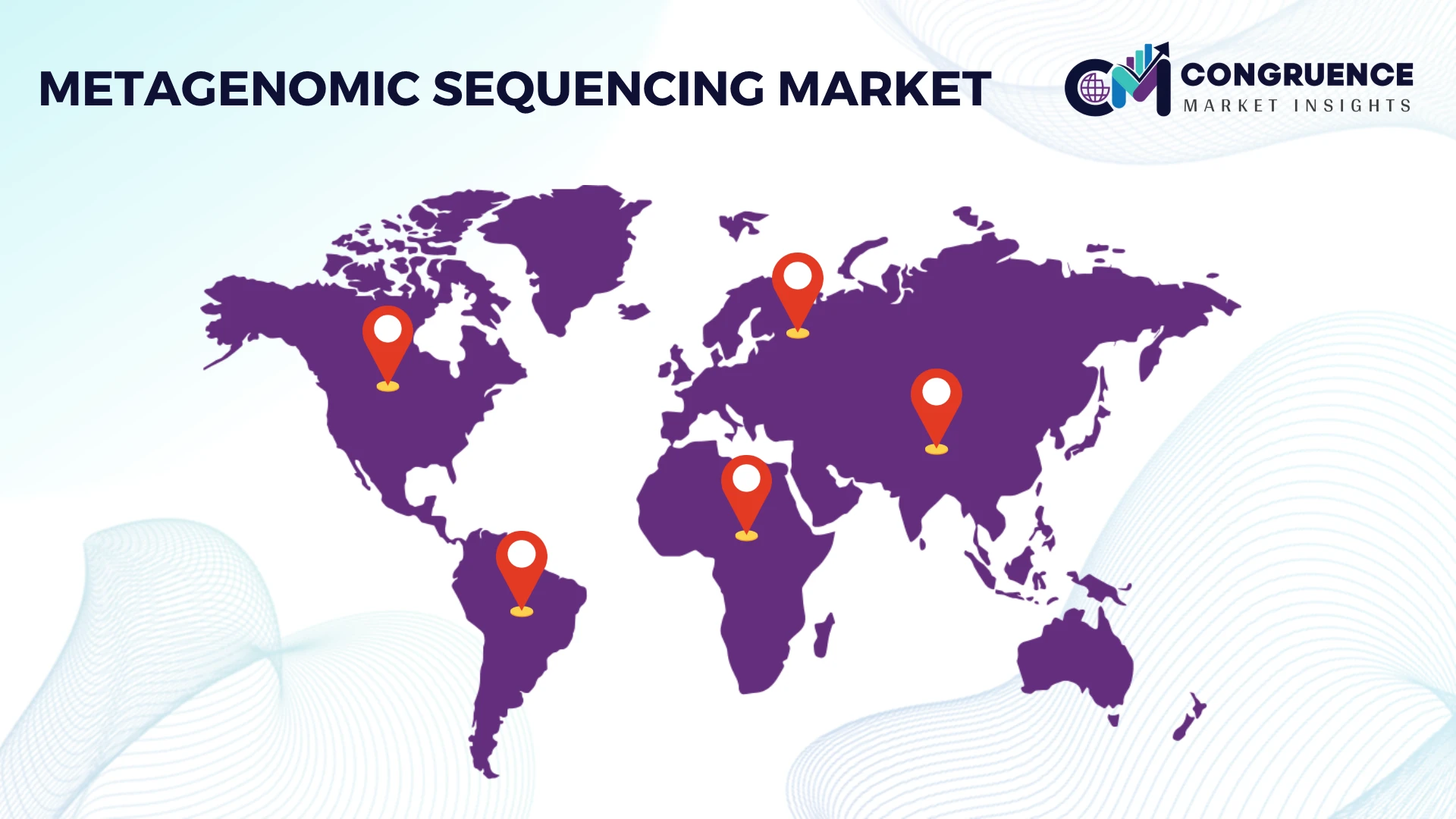
North America accounted for the largest market share at 38.6% in 2025 however, Asia-Pacific is expected to register the fastest growth, expanding at a CAGR of 17.8% between 2026 and 2033.
Clinical adoption and genomic surveillance deepen sequencing infrastructure
North America maintains the leading position in the Metagenomic Sequencing Market, supported by advanced clinical laboratories, pharmaceutical research, public-health surveillance, and extensive sequencing infrastructure. The region contributes approximately 38.6% of global market activity, with the United States representing the dominant deployment base. Clinical pathogen identification, antimicrobial-resistance surveillance, microbiome research, and wastewater monitoring are increasing utilization of shotgun and long-read sequencing. U.S. laboratories are increasingly integrating automated sample preparation with cloud-based bioinformatics, reducing manual processing requirements by approximately 20%–30%. Pharmaceutical companies are also expanding microbiome discovery programs, strengthening demand for high-throughput functional metagenomics. Suppliers are responding through platform expansion, diagnostic partnerships, and integrated sequencing-to-analysis workflows, while public-health investments are increasingly prioritizing rapid genomic surveillance and secure data infrastructure.
United States Market Outlook: The United States represents the region's principal metagenomic sequencing market because of its concentration of academic medical centers, biotechnology companies, pharmaceutical research facilities, and public-health laboratories. Advanced Molecular Detection programs are strengthening national sequencing and bioinformatics capacity, while clinical laboratories are expanding culture-independent pathogen characterization. More than 30% of advanced infectious-disease sequencing workflows increasingly incorporate automated classification or computational interpretation. Wastewater surveillance is also expanding the operational scope of metagenomics beyond clinical settings. Companies are therefore prioritizing faster library preparation, cloud analytics, long-read capabilities, and clinical-grade reporting, positioning integrated workflows as a stronger competitive advantage than sequencing hardware alone.
One Health surveillance accelerates cross-border genomic deployment
Europe represents a highly structured metagenomic sequencing market shaped by antimicrobial-resistance surveillance, infectious-disease preparedness, pharmaceutical research, and microbiome science. Germany, the United Kingdom, France, and the Netherlands account for a substantial concentration of advanced sequencing activity, while coordinated genomic surveillance is increasing cross-border data utilization. Approximately 28% of European metagenomic applications are associated with pathogen surveillance and infectious-disease research, reinforcing demand for rapid sequencing and standardized bioinformatics. European programs are increasingly combining wastewater, clinical, and environmental data, strengthening One Health applications. Companies are expanding sequencing services, cloud analysis, and standardized reporting capabilities to support multi-country deployments. Regulatory emphasis on data governance and laboratory quality is simultaneously favoring suppliers with validated, interoperable workflows.
Germany Market Outlook: Germany is strategically important because of its concentration of pharmaceutical research, clinical laboratories, biotechnology companies, and advanced academic sequencing centers. Metagenomic workflows are increasingly applied to microbiome characterization, antimicrobial-resistance research, and complex pathogen detection. More than 25% of advanced microbiome research programs increasingly combine shotgun sequencing with computational functional analysis, raising demand for higher-resolution datasets. German research institutions are also emphasizing standardized microbiome measurement and reproducible bioinformatics, encouraging adoption of automated quality-control and annotation pipelines. Companies are positioning through research partnerships, specialized sequencing services, and integrated analytics, while pharmaceutical users increasingly prioritize functional microbial signatures that can support drug discovery and biomarker development.
Large-scale genomics programs are accelerating regional adoption
Asia-Pacific is the fastest-expanding deployment center for metagenomic sequencing, supported by China, Japan, South Korea, India, Singapore, and Australia. The region accounts for approximately 23% of current global market activity, with pharmaceutical research, microbiome studies, infectious-disease surveillance, agriculture, and environmental monitoring driving sequencing utilization. China is expanding large-scale genomic infrastructure, while Japan is strengthening population-scale microbiome research through national databases and cohort programs. Approximately 30% of newly established advanced microbiome projects in leading Asian research centers increasingly use shotgun or combined sequencing approaches. Companies are responding with localized sequencing capacity, lower-cost workflows, automated bioinformatics, and partnerships with research institutions. The region's key advantage is the combination of large patient populations, expanding genomics infrastructure, and increasing availability of high-throughput sequencing expertise.
China Market Outlook: China represents the region's largest strategic opportunity because of its extensive genomics infrastructure, biotechnology ecosystem, pharmaceutical research base, and large-scale population datasets. Metagenomic sequencing is increasingly integrated into microbiome studies, pathogen surveillance, agricultural biotechnology, and drug-discovery programs. Approximately 35% of advanced genomics initiatives increasingly incorporate microbiome or microbial sequencing components, supporting demand for high-throughput platforms and computational analysis. Domestic sequencing capacity and local reagent development are also reducing dependence on imported workflows, improving procurement flexibility. Companies are strengthening positions through localized manufacturing, research partnerships, cloud-based analytics, and application-specific sequencing services, particularly where large datasets create advantages for AI-assisted microbial classification and biomarker discovery.
Genomic surveillance investment is broadening laboratory capacity
South America remains an emerging metagenomic sequencing market, with Brazil accounting for the majority of regional sequencing infrastructure and research activity. Public-health surveillance, infectious-disease diagnostics, environmental monitoring, agriculture, and microbiome research are the principal demand areas. Approximately 55% of advanced sequencing infrastructure in the region is concentrated in Brazil, creating a natural hub for regional genomic services. Brazil's investment in genomic surveillance is strengthening molecular-testing capacity and supporting wider adoption of next-generation sequencing. However, uneven access to computational infrastructure and specialized bioinformatics expertise continues to constrain deployment outside major laboratory centers. Companies are responding by expanding centralized sequencing services, training programs, regional partnerships, and cloud-based analysis. The strategic opportunity lies in hub-and-spoke sequencing models that extend advanced metagenomics without requiring every laboratory to maintain full infrastructure.
Brazil Market Outlook: Brazil is the strongest country market in South America because of its public-health laboratory network, biotechnology research base, agricultural sector, and expanding genomic surveillance infrastructure. Recent investments in genomic surveillance are strengthening molecular diagnostic capacity across underserved areas, while centralized laboratories provide the computational resources required for complex metagenomic analysis. Approximately 30% of advanced infectious-disease sequencing initiatives increasingly incorporate broader genomic characterization rather than targeted pathogen testing alone. Agriculture and environmental research add further demand for microbial profiling. Companies are positioning through centralized sequencing hubs, regional laboratory partnerships, training initiatives, and cloud-based interpretation services, reducing the capital burden associated with installing complete sequencing infrastructure at every site.
Public-health modernization is creating new sequencing hubs
Middle East & Africa is transitioning from limited research-focused sequencing toward broader genomic surveillance, clinical microbiology, food safety, and environmental monitoring applications. Saudi Arabia, the United Arab Emirates, Israel, and South Africa represent important deployment centers, supported by modern healthcare infrastructure and national genomics initiatives. Approximately 7% of global metagenomic sequencing activity is concentrated across the region, with adoption strongest in advanced research and reference laboratories. Wastewater surveillance and antimicrobial-resistance monitoring are emerging application areas as governments strengthen infectious-disease preparedness. Infrastructure remains uneven, particularly across lower-resource African markets, encouraging centralized sequencing and cross-border laboratory models. Companies are responding through regional partnerships, sequencing-service expansion, workforce training, and cloud-based bioinformatics. The most attractive opportunities combine high-end sequencing infrastructure with scalable regional data interpretation.
Saudi Arabia Market Outlook: Saudi Arabia represents a strategically important market because of national investment in genomics, healthcare modernization, biotechnology, and precision medicine. Metagenomic sequencing is increasingly relevant to microbiome research, infectious-disease surveillance, antimicrobial-resistance monitoring, and pharmaceutical development. Approximately 20%–25% of advanced genomics programs are increasingly incorporating microbial or microbiome-focused sequencing applications, creating demand for high-throughput platforms and specialized bioinformatics. National research infrastructure also supports large cohort studies that generate valuable microbial datasets for precision-health applications. Companies are positioning through research collaborations, localized sequencing services, advanced analytics, and workforce development. The country's combination of healthcare investment and genomics infrastructure creates a strong platform for scaling metagenomic applications beyond academic research into clinical and pharmaceutical workflows.
The competitive landscape pits Illumina and Thermo Fisher against Oxford Nanopore and PacBio, while QIAGEN and BGI Genomics compete through workflow breadth, long-read differentiation, and cost positioning. The top five players are estimated to control about 48% of market value, leaving meaningful share for regional laboratories globally. Competition centers on sequencing accuracy, turnaround time, reagent economics, informatics integration, and capability. Short-read platforms retain roughly 60% of routine metagenomic workflows, while long-read adoption is advancing as strain resolution becomes more important. Cloud and AI-enabled analysis can reduce interpretation time by 25%–35%, shifting advantage toward vendors controlling instruments. Players are expanding through platform launches, laboratory partnerships, workflows, and vertical integration of sample preparation. The competitive shift is moving from sequencer performance toward integrated data ecosystems. Entry pressure remains high because validation, installed infrastructure, bioinformatics expertise, and consumable compatibility create switching costs. Winning requires superior accuracy, faster workflows, scalable analytics, and reliable supply.
Illumina, Inc.
Oxford Nanopore Technologies plc
Pacific Biosciences of California, Inc.
QIAGEN N.V.
Thermo Fisher Scientific Inc.
BGI Genomics Co., Ltd.
Bio-Rad Laboratories, Inc.
Agilent Technologies, Inc.
New England Biolabs, Inc.
Takara Bio Inc.
Zymo Research Corporation
Element Biosciences, Inc.
Ginkgo Bioworks, Inc.
CosmosID, Inc.
Metagenomic sequencing is shifting toward short-read, long-read, automated library preparation, and AI-assisted interpretation. Short-read platforms remain preferred for microbial profiling, while long-read sequencing improves assembly and strain resolution, with performance gains of roughly 15%–25% for complex microbial genomes. Automated extraction and library preparation can reduce laboratory time by 30%–40%. Adoption is strongest in reference laboratories, pharmaceutical research, and infectious-disease programs, where throughput and reproducibility influence testing economics.
AI-enabled taxonomic classification, functional annotation, and antimicrobial-resistance prediction are becoming core workflow layers. GPU-accelerated pipelines can cut analysis turnaround by 25%–35%, while cloud platforms reduce data-transfer steps by about 20%. Hybrid sequencing, combining short and long reads, is gaining traction for samples because it balances accuracy with resolution. Vendors benefit most when they combine sequencing chemistry, sample preparation, bioinformatics, and workflow automation.
Between 2026 and 2028, the technology advantage will come from end-to-end automation, real-time nanopore sequencing, higher-fidelity long reads, and multimodal microbial analysis. Compared with legacy culture-dependent workflows, sequencing-based identification can shorten pathogen characterization timelines by more than 50% in suitable applications. Companies are prioritizing platforms, AI partnerships, and application-specific workflows. Laboratories that modernize interpretation and automation will gain faster turnaround, lower labor intensity, and stronger differentiation as metagenomic testing moves toward use.
January 2025 Illumina introduced the NovaSeq X single-flow-cell system and software upgrades, expanding lower-volume access to high-throughput sequencing while maintaining platform speed and quality. The move improves economics for metagenomic laboratories and supports broader decentralized sequencing adoption globally. Source: illumina.com
April 2025 QIAGEN advanced three automated sample-preparation instruments for 2025–2026, including systems processing up to 192 samples per run. The expansion strengthens laboratory automation, reduces manual handling, and broadens scalable genomics workflows for metagenomic sample processing. Source: biospectrumindia.com
July 2025 QIAGEN launched QIAseq xHYB Long Read Panels, adding customizable and fixed panels compatible with PacBio platforms. The portfolio expansion strengthens complex-region analysis, supports higher-resolution microbial characterization, and reinforces integrated sequencing workflows across research and clinical applications. Source: qiagen.com
April 2026 Cepheid and Oxford Nanopore expanded their partnership into phase two, developing rapid bacterial and fungal pathogen identification workflows. The collaboration builds on a beta solution already used by researchers, accelerating streamlined genomic testing for infectious-disease research. Source: prnewswire.com
The Metagenomic Sequencing Market Report evaluates the industry across sequencing technology, workflow components, applications, end-users, and geographic markets. Coverage spans short-read and long-read platforms, sample preparation, sequencing services, bioinformatics, and integrated analysis. Applications include infectious-disease surveillance, microbiome research, pharmaceutical discovery, environmental monitoring, agriculture, food safety, and antimicrobial-resistance profiling, with dedicated assessment of emerging clinical and One Health use cases.
The report provides comparative analysis across North America, Europe, Asia-Pacific, South America, and Middle East & Africa, emphasizing country-level deployment, laboratory infrastructure, research intensity, and commercialization patterns. Technology assessment covers AI-enabled interpretation, cloud bioinformatics, automation, hybrid sequencing, and real-time platforms. With adoption indicators, deployment patterns, competitive positioning, and company participation mapped across key segments, the study supports capacity planning, technology investment, geographic expansion, partnership strategy, and competitive decisions through 2026–2033.
| Report Attribute/Metric | Report Details |
|---|---|
|
Market Revenue in 2025 |
USD 1,810.8 Million |
|
Market Revenue in 2033 |
USD 5,655.9 Million |
|
CAGR (2026 - 2033) |
15.3% |
|
Base Year |
2025 |
|
Forecast Period |
2026 - 2033 |
|
Historic Period |
2021 - 2025 |
|
Segments Covered |
By Type
By Application
By End-User
|
|
Key Report Deliverable |
Revenue Forecast, Growth Trends, Market Dynamics, Segmental Overview, Regional and Country-wise Analysis, Competition Landscape |
|
Region Covered |
North America, Europe, Asia-Pacific, South America, Middle East, Africa |
|
Key Players Analyzed |
Illumina, Inc., Oxford Nanopore Technologies plc, Pacific Biosciences of California, Inc., QIAGEN N.V., Thermo Fisher Scientific Inc., BGI Genomics Co., Ltd., Bio-Rad Laboratories, Inc., Agilent Technologies, Inc., New England Biolabs, Inc., Takara Bio Inc., Zymo Research Corporation, Element Biosciences, Inc., Ginkgo Bioworks, Inc., CosmosID, Inc. |
|
Customization & Pricing |
Available on Request (10% Customization is Free) |




