
Reports
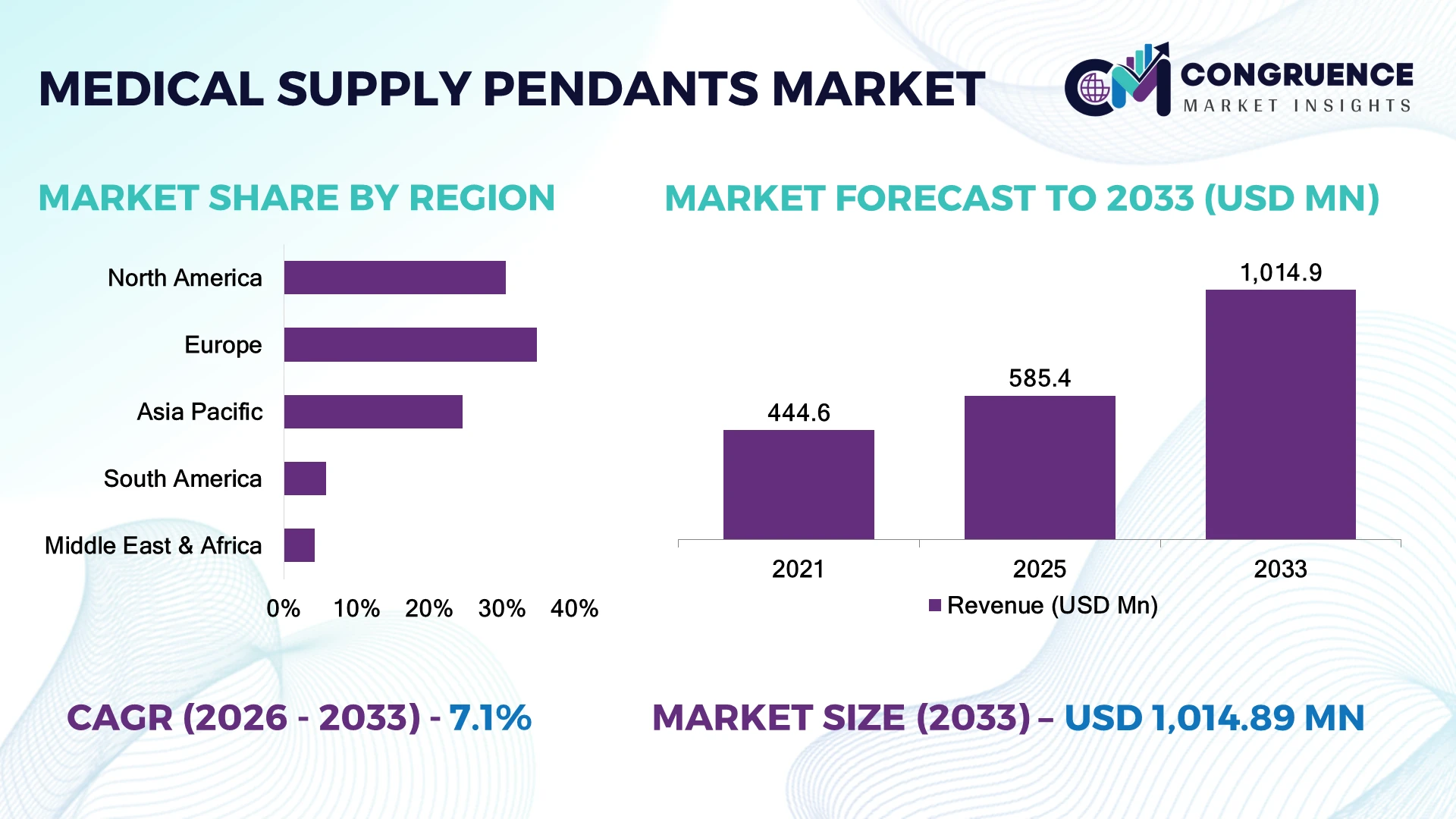
The Global Medical Supply Pendants Market was valued at USD 585.0 Million in 2025 and is anticipated to reach a value of USD 1,014.9 Million by 2033 expanding at a CAGR of 7.12% between 2026 and 2033. Growth is being driven by accelerated hospital infrastructure modernization, rising hybrid operating room deployments, and increased integration of digitally connected critical-care equipment requiring advanced ceiling-mounted utility management systems.
Germany remains the dominant country, accounting for approximately 18% of global advanced medical pendant installations, supported by over EUR 4 billion in healthcare infrastructure upgrades and strong adoption across surgical, ICU, and emergency care facilities. Compared with India, where hospital bed expansion exceeds 9% annually, Germany demonstrates higher penetration of integrated operating suites and smart clinical workflow systems. The country also reports utilization rates above 75% in major tertiary-care centers, reinforcing demand for sophisticated equipment management platforms. The European healthcare resilience agenda following recent geopolitical supply-chain disruptions has further strengthened procurement activity.
The strategic implication is clear, manufacturers that align product portfolios with smart hospital ecosystems, modular infrastructure, and digital operating room standards are positioned to secure higher-value healthcare projects and long-term procurement contracts.
Market Size & Growth: USD 585.0 Million in 2025 advancing toward USD 1,014.9 Million by 2033 at 7.12% growth, supported by smart hospital expansion.
Top Growth Drivers: Hybrid OR adoption +16%, ICU modernization +14%, digital equipment integration +12%.
Short-Term Forecast: By 2028, equipment access efficiency improves by 22% while workflow interruptions decline by 18%.
Emerging Technologies: AI-assisted room monitoring, modular pendant systems, and IoT-enabled asset connectivity accelerate deployment.
Regional Leaders: North America (~USD 320 Million), Europe (~USD 285 Million), Asia-Pacific (~USD 240 Million) with strong infrastructure-led adoption.
Consumer/End-User Trends: More than 68% of new tertiary hospitals prioritize integrated ceiling-mounted utility systems.
Pilot/Case Example: In 2024, a smart operating suite deployment improved equipment accessibility by 25% and reduced setup time by 19%.
Competitive Landscape: Market leaders hold nearly 34% combined share; key players include Dräger, STERIS, Getinge, Hillrom, and Amico.
Regulatory & ESG Impact: Energy-efficient clinical infrastructure programs support operational energy reductions of up to 15%.
Investment & Funding: Over USD 1.2 billion in hospital modernization projects supports advanced clinical equipment procurement globally.
Innovation & Future Outlook: Wireless connectivity, predictive maintenance, and modular expansion capabilities are reshaping competitive differentiation.
Medical supply pendants are becoming critical infrastructure assets across operating rooms, intensive care units, and emergency departments where equipment density continues to increase. Recent innovations include IoT-connected utility management, modular load-bearing designs, and integrated monitoring interfaces. Nearly 40% of newly commissioned high-acuity treatment spaces now incorporate digitally enabled pendant systems. Ongoing healthcare supply-chain localization initiatives and stricter clinical workflow standards are also influencing procurement priorities, setting the stage for deeper strategic transformation.
Medical supply pendants are evolving from facility equipment into strategic clinical infrastructure that directly influences operational efficiency, patient safety, and healthcare capacity utilization. As hospitals pursue infrastructure modernization and digital healthcare transformation, integrated utility management platforms have become essential for supporting increasingly complex treatment environments. Healthcare providers are prioritizing systems that improve workflow standardization while accommodating expanding volumes of connected medical devices.
Modern modular pendants deliver measurable advantages over conventional floor-mounted equipment configurations. Studies across advanced operating environments indicate setup efficiency improvements exceeding 20% and reductions in cable-related obstructions approaching 30%. Germany and the United States continue leading adoption through large-scale hospital modernization programs, while India and Southeast Asian healthcare networks are emphasizing rapid deployment across newly constructed tertiary-care facilities. Over the next two to three years, integrated digital monitoring and predictive maintenance capabilities are expected to become standard procurement requirements.
A practical example can be seen in hybrid operating rooms where ceiling-mounted utility systems streamline equipment access and improve procedural flexibility. Manufacturers are expanding partnerships with hospital planners, healthcare architects, and digital infrastructure providers while increasing investments in modular platforms. Organizations that establish strong positions within smart hospital ecosystems will secure meaningful operational advantages and stronger long-term competitive relevance.
Hospital operators are accelerating investment in advanced surgical and critical-care environments where equipment density continues to rise. More than 65% of newly developed tertiary-care operating rooms incorporate integrated ceiling-mounted utility systems, while hybrid operating room installations have expanded by approximately 15% annually in major healthcare markets. Germany and the United States continue prioritizing infrastructure modernization programs that support digitally connected treatment spaces. This shift improves equipment accessibility, enhances infection-control workflows, and reduces floor congestion. In response, manufacturers are expanding modular product portfolios, increasing load capacities, and integrating IoT-enabled monitoring features. A notable strategic insight is that hospitals increasingly evaluate pendants as workflow optimization assets rather than equipment-support structures, creating opportunities for premium configurations and long-term service agreements.
Installation of advanced medical supply pendants requires substantial capital expenditure, specialized engineering support, and facility modifications that can increase project costs by 20–30% compared with standard room upgrades. Import dependency for specialized components remains above 40% in several developing healthcare markets, creating procurement delays and cost variability. Healthcare providers in countries with fragmented reimbursement systems often postpone modernization projects despite operational benefits. Supply-chain disruptions affecting precision mechanical assemblies and medical-grade electronics have further complicated deployment schedules. To mitigate exposure, manufacturers are localizing component sourcing, negotiating long-term supplier contracts, and expanding regional assembly capabilities. A key operational insight is that procurement timelines increasingly depend on construction coordination rather than product availability alone.
The next wave of opportunity lies in digitally connected clinical environments where utility management systems function as intelligent infrastructure nodes. More than 55% of hospital digital transformation projects now include connected equipment management requirements, while smart asset-tracking initiatives have improved equipment utilization by nearly 18%. India and Saudi Arabia are expanding healthcare infrastructure programs that prioritize technologically advanced treatment environments. Emerging innovations include predictive maintenance, wireless monitoring integration, and AI-assisted equipment allocation. Manufacturers are investing in software partnerships, sensor-enabled platforms, and interoperable ecosystem development. A non-obvious opportunity exists in data-driven operational analytics, where pendant-connected infrastructure can help hospitals optimize equipment placement, maintenance scheduling, and room utilization without additional facility expansion.
As healthcare environments become increasingly connected, integration complexity is emerging as a major execution challenge. Approximately 35% of hospitals report interoperability difficulties between clinical equipment, monitoring systems, and infrastructure management platforms. Large healthcare networks frequently operate mixed generations of technology, increasing implementation complexity and extending deployment timelines by up to 20%. Cybersecurity requirements are also expanding as connected infrastructure becomes integrated with hospital information systems. In the United States and Germany, stricter digital compliance standards are increasing validation and testing requirements. Companies must invest in interoperable architectures, cybersecurity frameworks, and technical support ecosystems to maintain deployment consistency. The strongest long-term competitive advantage will belong to providers capable of delivering seamless integration across diverse clinical technology environments.
Smart Operating Room Integration Healthcare providers are increasingly connecting medical supply pendants with operating room management platforms and clinical equipment networks. More than 58% of newly commissioned hybrid operating rooms now include digitally integrated pendant systems, while device interoperability requirements have increased by nearly 25% since 2024. Hospitals are using centralized control interfaces to reduce setup time by approximately 18% and improve equipment accessibility. In response, manufacturers are expanding software partnerships and embedding connectivity modules directly into pendant architectures to strengthen compatibility with modern surgical ecosystems.
Modular Infrastructure Standardization Hospitals are shifting toward modular pendant configurations that simplify room redesign and future equipment upgrades. Around 52% of large healthcare construction projects now specify expandable ceiling-mounted systems, while installation-related disruptions have declined by nearly 20% through standardized mounting platforms. Labor shortages across technical healthcare facilities are accelerating demand for faster deployment solutions. Companies are restructuring product portfolios around configurable components, enabling healthcare providers to adapt treatment spaces without extensive infrastructure modifications or prolonged operational downtime.
Localized Supply Chain Expansion Recent healthcare procurement policies and supply-chain resilience initiatives are driving localized manufacturing strategies. Component localization rates have increased by approximately 17% across key medical equipment hubs, while average lead times have fallen by nearly 14%. Germany, India, and the United States are prioritizing domestic healthcare infrastructure supply networks. Manufacturers are expanding regional assembly operations, strengthening supplier partnerships, and increasing inventory buffers to improve delivery reliability and reduce procurement uncertainty for large hospital projects.
Data-Driven Asset Optimization Hospitals are deploying sensor-enabled pendant systems to improve equipment utilization and maintenance planning. Asset tracking integration has increased by over 30% in advanced healthcare facilities, while unplanned equipment downtime has declined by approximately 16%. A notable emerging shift involves using pendant-connected infrastructure data to optimize room scheduling and workflow allocation. Companies are investing in predictive maintenance technologies, analytics platforms, and digital service offerings that create recurring operational value beyond traditional hardware deployment.
Single-arm medical supply pendants remain the leading segment, accounting for approximately 42% of total installations due to their flexibility, lower installation complexity, and suitability across operating rooms, intensive care units, and emergency departments. Hospitals continue favoring these systems because they improve equipment accessibility while reducing floor congestion by nearly 25%. Their compatibility with existing clinical infrastructure makes them particularly attractive for facility modernization projects. Double-arm systems follow closely, benefiting from increased equipment density in advanced surgical environments where workflow efficiency and ergonomic access are critical.
Motorized pendants represent the fastest-growing type, supported by rising adoption of hybrid operating rooms and digitally integrated treatment spaces. Demand for motorized configurations has increased by nearly 18% as healthcare providers prioritize precise positioning and staff productivity improvements. Fixed pendant systems maintain relevance in cost-sensitive healthcare facilities, while specialized high-load configurations are gaining traction in complex surgical centers. Manufacturers are expanding modular product offerings, introducing smart-control capabilities, and strengthening customization programs to capture demand from both established and emerging healthcare infrastructure projects.
Operating rooms represent the largest application segment with approximately 48% market share, reflecting the critical role of medical supply pendants in managing surgical equipment, gases, power supplies, and clinical workflow requirements. Increasing deployment of minimally invasive procedures and hybrid surgical suites continues to reinforce demand. Hospitals report workflow efficiency improvements of nearly 20% when integrated utility management systems are deployed in advanced operating environments. Intensive care units remain a significant application area due to growing patient monitoring requirements and increasing equipment density.
Intensive care units are also the fastest-expanding application segment, supported by rising critical-care capacity expansion and digital monitoring integration. Utilization of advanced pendant systems within ICU environments has increased by approximately 16% over the past two years. Emergency departments and recovery units continue adopting modular solutions that enhance flexibility and equipment accessibility. Manufacturers are responding by developing application-specific configurations, integrated connectivity features, and scalable platforms designed to support evolving clinical requirements across multiple treatment settings.
Hospitals remain the dominant end-user segment, accounting for approximately 72% of total demand due to their extensive infrastructure requirements, high patient volumes, and concentration of surgical and critical-care services. Large tertiary-care hospitals continue investing heavily in operating room modernization and intensive care expansion projects. More than 65% of new hospital construction projects now include integrated ceiling-mounted utility management systems as standard infrastructure. Their scale and operational intensity make hospitals the primary purchasers of advanced pendant solutions.
Specialty clinics represent the fastest-growing end-user segment, with adoption increasing by nearly 15% as outpatient surgical procedures and specialized treatment centers expand. Ambulatory surgical centers are also strengthening demand through investments in space-efficient infrastructure and workflow optimization. Research and teaching institutions continue procuring advanced systems for simulation laboratories and clinical training environments. To address shifting demand patterns, manufacturers are introducing customized product configurations, flexible financing programs, and strategic partnerships tailored to both large healthcare networks and specialized clinical facilities.
Europe accounted for the largest market share at 34.8% in 2025 however, Asia-Pacific is expected to register the fastest growth, expanding at a CAGR of 8.4% between 2026 and 2033.
North America represented approximately 30.5% of global market demand in 2025, supported by continuous hospital modernization programs, high operating room density, and widespread adoption of integrated clinical infrastructure. Healthcare systems across the United States and Canada are increasingly replacing legacy utility management systems with digitally connected pendant platforms that improve workflow efficiency and equipment accessibility. More than 65% of newly commissioned hybrid operating rooms in the region now incorporate advanced ceiling-mounted equipment management solutions. Enterprise healthcare networks are prioritizing standardized infrastructure deployment across multi-hospital facilities to improve operational consistency and maintenance efficiency. The region also benefits from strong procurement activity in tertiary-care hospitals and ambulatory surgical centers, where clinical workflow optimization remains a key investment priority. Strategic partnerships between healthcare providers and medical infrastructure specialists continue accelerating deployment across high-acuity treatment environments.
United States Market Outlook: The United States remains the largest contributor within North America due to its concentration of advanced healthcare facilities, extensive surgical capacity, and strong infrastructure investment activity. More than 70% of large tertiary hospitals have ongoing modernization initiatives involving integrated operating room environments. Healthcare providers continue adopting modular pendant systems to support hybrid procedures, critical-care expansion, and equipment-intensive treatment spaces. Strong enterprise procurement capabilities and digital healthcare adoption reinforce the country's leadership position.
Europe held the largest regional share at approximately 34.8% in 2025, supported by extensive healthcare infrastructure upgrades, mature hospital networks, and strong adoption of advanced operating room technologies. The region benefits from sustained investment in clinical efficiency, infection-control standards, and integrated treatment environments. More than 60% of newly upgraded surgical suites across major European healthcare systems include ceiling-mounted utility management solutions. Healthcare operators are increasingly deploying modular and motorized pendant systems to improve space utilization and support growing equipment density. Infrastructure resilience initiatives following recent supply-chain disruptions have further encouraged healthcare facility modernization. Manufacturers are strengthening local production, engineering support, and customization capabilities to align with evolving hospital requirements and procurement standards.
Germany Market Outlook: Germany represents the most strategically significant market in Europe, supported by advanced healthcare infrastructure, high surgical procedure volumes, and strong hospital investment activity. The country accounts for roughly 18% of global advanced medical pendant installations and maintains one of the highest adoption rates for integrated operating room technologies. Large university hospitals and specialized surgical centers continue prioritizing digitally connected infrastructure that improves workflow coordination, equipment accessibility, and long-term operational efficiency.
Asia-Pacific accounted for approximately 24.6% of global demand in 2025 and represents the fastest-evolving deployment environment for medical supply pendants. Large-scale hospital construction programs, expanding critical-care capacity, and increasing adoption of advanced surgical infrastructure are reshaping procurement patterns across the region. More than 40% of newly commissioned tertiary-care facilities now include integrated ceiling-mounted utility systems as part of standardized treatment room designs. Healthcare providers are prioritizing operational efficiency, equipment management, and space optimization as patient volumes continue increasing. Manufacturers are expanding regional production networks and establishing localized partnerships to support growing infrastructure requirements. Rising investments in smart hospitals and digitally enabled treatment environments continue strengthening long-term deployment momentum.
China Market Outlook: China leads regional demand through extensive healthcare infrastructure development and large-scale hospital expansion projects. The country continues investing heavily in high-capacity medical facilities, specialized treatment centers, and technologically advanced surgical environments. More than 1,000 hospitals have undergone major modernization initiatives over recent years, creating sustained demand for integrated clinical infrastructure. Domestic manufacturing capabilities and strong healthcare investment pipelines position China as a key strategic market for global and regional suppliers.
South America accounted for approximately 5.8% of global market activity in 2025, driven primarily by private healthcare expansion and selective public-sector modernization initiatives. Demand is concentrated in major metropolitan healthcare networks where operating room upgrades and critical-care improvements remain priority investment areas. Hospitals are increasingly adopting modular pendant systems to improve treatment room efficiency while optimizing limited facility space. Infrastructure constraints and budget variability continue influencing deployment timelines, yet healthcare operators remain focused on upgrading high-acuity clinical environments. Strategic procurement programs and targeted healthcare investments are supporting gradual expansion across the region. Companies are responding through regional distribution partnerships, localized service capabilities, and flexible deployment models that reduce installation complexity.
Brazil Market Outlook: Brazil remains the largest market in South America due to its extensive hospital network, growing private healthcare sector, and concentration of advanced medical facilities. Large healthcare groups continue investing in surgical suite modernization and intensive-care infrastructure. Approximately 55% of advanced hospital expansion projects are concentrated within major urban centers, creating favorable conditions for integrated clinical equipment management solutions and long-term infrastructure upgrades.
The Middle East & Africa region accounted for approximately 4.3% of global demand in 2025, supported by healthcare diversification programs, hospital construction activity, and modernization of specialized treatment facilities. Governments and private healthcare operators are increasingly investing in advanced medical infrastructure to improve clinical capacity and service quality. Several large healthcare projects now incorporate integrated operating room and critical-care technologies as core design requirements. Deployment activity is particularly strong in premium healthcare facilities where workflow optimization and international accreditation standards influence procurement decisions. Manufacturers are expanding regional partnerships, technical support networks, and project execution capabilities to capitalize on infrastructure transformation initiatives.
Saudi Arabia Market Outlook: Saudi Arabia represents the most influential market within the region due to large-scale healthcare investment programs and extensive hospital development activity. National healthcare transformation initiatives continue driving adoption of advanced surgical and critical-care infrastructure. More than 30 major healthcare construction projects are actively progressing, creating sustained demand for integrated medical utility management systems. Strong government backing, modernization priorities, and increasing deployment of smart healthcare facilities reinforce the country's strategic importance.
The market is led by Dräger, Getinge, STERIS, Amico Group, Brandon Medical, and Starkstrom, with global healthcare infrastructure specialists competing against regional customization-focused manufacturers. The top five players collectively control approximately 58% of market activity, creating a moderately consolidated competitive structure. Competition is centered on operating room integration capabilities, installation flexibility, and lifecycle service support rather than hardware pricing alone. Leading suppliers achieve deployment efficiency improvements of 15–20% through modular product architectures, while digitally integrated systems reduce operating room setup time by nearly 18%. Global players compete through hospital network partnerships, clinical infrastructure projects, and integrated surgical ecosystem offerings, whereas regional manufacturers emphasize customization, shorter lead times, and local engineering support. The competitive shift is increasingly moving toward connected infrastructure, interoperability, and smart operating room compatibility. Strategic acquisitions, technology partnerships, and localized manufacturing expansion are strengthening market positions. Regulatory compliance requirements, clinical validation demands, and long procurement cycles remain major entry barriers. Success depends on delivering interoperable, scalable, and service-backed solutions that improve clinical workflow performance.
Getinge
STERIS
Amico Group
Brandon Medical
Starkstrom
Ondal Medical Systems
Tedisel Medical
BeaconMedaes
Megasan Medical
INMED-Karczewscy
Surgiris
Pneumatik Berlin
MZ Liberec
Medical supply pendant technology is shifting from mechanical equipment support toward connected clinical infrastructure. Current deployments increasingly incorporate IoT-enabled monitoring, digital device connectivity, and integrated control interfaces. More than 55% of advanced operating room projects now include digitally connected pendant systems. These technologies improve equipment accessibility by approximately 20% while reducing workflow interruptions by nearly 15%. Hospitals benefit through faster room preparation, improved asset visibility, and more efficient clinical operations.
Emerging technologies include predictive maintenance platforms, wireless device communication, and sensor-based equipment tracking. Compared with conventional fixed pendant systems, smart connected platforms can reduce maintenance-related downtime by up to 25% and improve equipment utilization by nearly 18%. Adoption levels are particularly strong within hybrid operating rooms, where integrated infrastructure supports increasingly complex surgical procedures. Manufacturers with software integration capabilities and digital ecosystem partnerships are gaining competitive advantages over hardware-focused suppliers.
Between 2026 and 2028, AI-assisted workflow optimization, real-time infrastructure analytics, and interoperable operating room platforms are expected to become important procurement criteria. Nearly 40% of newly planned high-acuity treatment spaces are expected to prioritize digitally managed infrastructure environments. Companies investing in intelligent connectivity, cybersecurity, and platform compatibility will strengthen customer retention, improve service revenues, and secure stronger positions in next-generation healthcare infrastructure projects.
July 2026 – Dräger Medical UK entered a three-year strategic partnership with Guy's and St Thomas' NHS Foundation Trust to advance healthcare innovation and clinical technology collaboration. The initiative reinforces long-term infrastructure modernization and strengthens engagement between healthcare providers and technology developers. Source: Dräger UK Newsroom
April 2025 – Dräger was awarded a Veterans Health Administration contract covering surgical lighting and equipment boom solutions across healthcare facilities. The agreement expands access to advanced operating room infrastructure and supports broader deployment standardization. Business impact: stronger institutional penetration and procurement visibility. Source: draeger.com
July 2025 – Getinge entered a strategic partnership with Zimmer Biomet to distribute operating room capital products through ambulatory surgery center channels. The collaboration addresses a market supporting more than 22.5 million procedures annually. Business impact: expanded reach into fast-growing outpatient surgical infrastructure. Source: getinge.com
October 2025 – Getinge and Philips introduced an integrated anesthesia workstation combining anesthesia delivery and patient monitoring technologies into a unified operating room platform. The solution enhances real-time connectivity and clinical efficiency. Business impact: stronger positioning within digitally integrated surgical environments. Source: getinge.com
The report provides comprehensive analysis of medical supply pendant deployment across healthcare infrastructure environments, covering key product categories, clinical applications, and end-user segments. The assessment evaluates operating room, intensive care, emergency care, and specialized treatment facility demand patterns while examining installation trends, workflow optimization requirements, and digital infrastructure integration. More than 70% of market activity remains concentrated within hospital-based deployments, while specialty care facilities continue expanding adoption.
The study covers North America, Europe, Asia-Pacific, South America, and the Middle East & Africa, highlighting deployment concentration, modernization programs, and technology adoption dynamics. It evaluates competitive positioning across major manufacturers, smart operating room integration trends, predictive maintenance technologies, modular infrastructure developments, and connected clinical ecosystems. Strategic insights support investment planning, market entry assessment, expansion prioritization, partnership development, and competitive benchmarking while identifying emerging opportunities expected to influence healthcare infrastructure procurement and operational decision-making between 2026 and 2033.
| Report Attribute / Metric | Details |
|---|---|
| Market Revenue (2025) | USD 585.0 Million |
| Market Revenue (2033) | USD 1,014.9 Million |
| CAGR (2026–2033) | 7.12% |
| Base Year | 2025 |
| Forecast Period | 2026–2033 |
| Historic Period | 2021–2025 |
| Segments Covered |
By Type
By Application
By End-User
|
| Key Deliverables | Revenue Forecast; Market Trends; Growth Drivers & Restraints; Technology Insights; Segmentation Analysis; Regional Insights; Competitive Landscape; Regulatory & ESG Overview; Recent Developments |
| Regions Covered | North America; Europe; Asia-Pacific; South America; Middle East & Africa |
| Companies Profiled | Dräger; Getinge; STERIS; Amico Group; Brandon Medical; Starkstrom; Ondal Medical Systems; Tedisel Medical; BeaconMedaes; Megasan Medical; INMED-Karczewscy; Surgiris; Pneumatik Berlin; MZ Liberec |
| Customization & Pricing | Available on Request (10% Customization Free) |




