
Reports
The Global Medical Speech Recognition Market was valued at USD 211.0 Million in 2025 and is anticipated to reach a value of USD 607.4 Million by 2033 expanding at a CAGR of 14.13% between 2026 and 2033. Growth is driven by AI-powered clinical documentation, increasing electronic health record integration, and automation of physician workflows that reduce administrative burden.
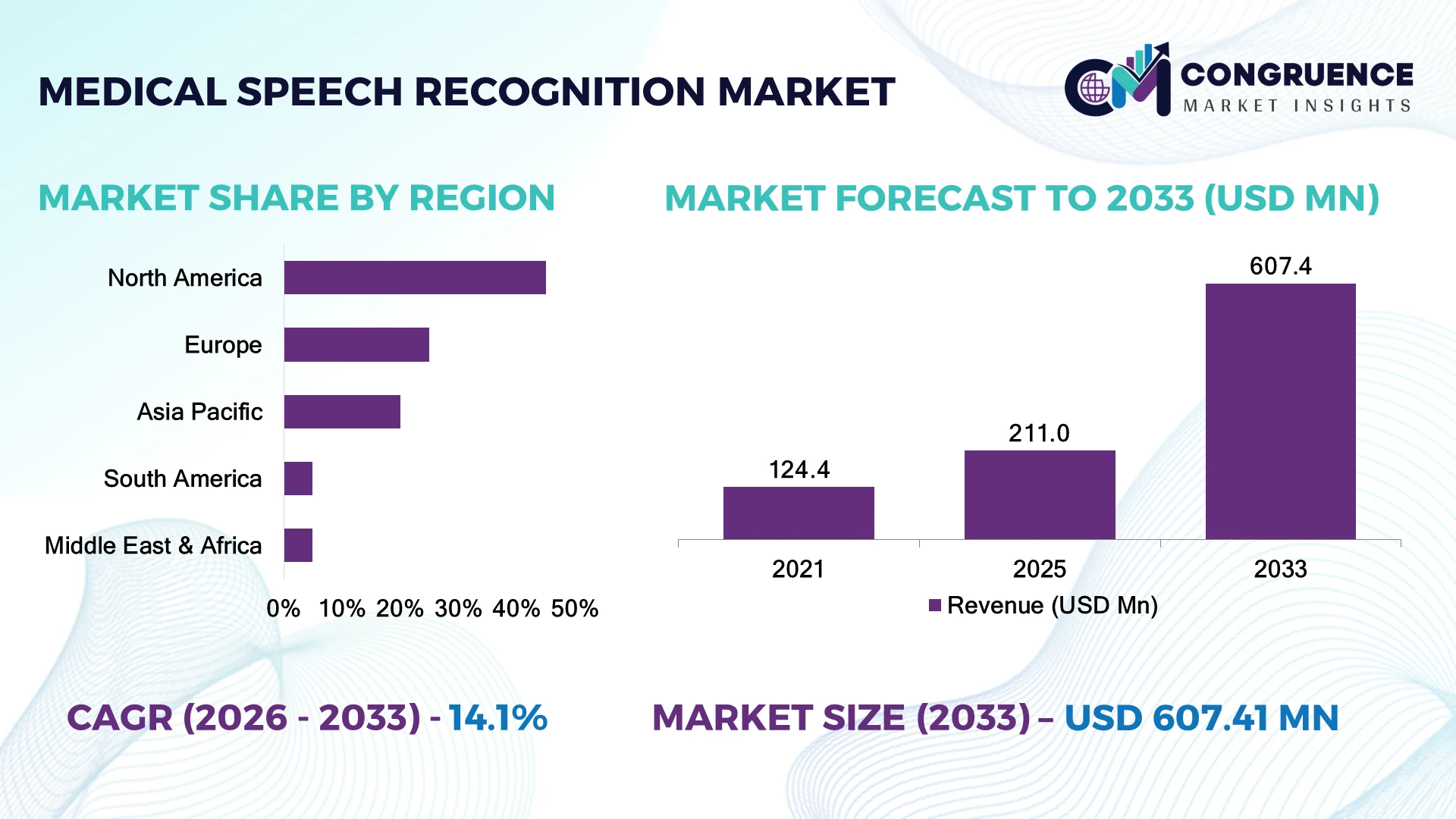
The United States dominates the market with over 45% share in 2025, supported by advanced healthcare IT infrastructure, more than 90% electronic health record adoption among hospitals, and investments exceeding USD 30 billion annually in healthcare digital transformation. Germany and the United Kingdom follow with strong adoption of voice-enabled clinical systems, while the U.S. maintains a wider deployment scale due to larger hospital networks and AI infrastructure investments. Healthcare providers are prioritizing intelligent speech platforms to improve documentation accuracy, operational efficiency, and clinician productivity.
Strategically, companies strengthening AI capabilities, interoperability, and enterprise healthcare partnerships are positioned to capture long-term opportunities in this high-growth digital healthcare segment.
Market Size & Growth: USD 211.0 Million (2025) to USD 607.4 Million (2033) at 14.13% CAGR, driven by AI-based clinical automation and EHR integration.
Top Growth Drivers: AI adoption (35%+ healthcare workflow penetration), voice automation demand (40%+ provider interest), and digital health investment expansion (25%+ annual growth).
Short-Term Forecast: By 2028, clinical documentation automation improves physician efficiency by 30% and reduces manual transcription workloads by 40%.
Emerging Technologies: Advanced AI speech models, natural language processing, ambient clinical intelligence, and automated medical coding platforms reshape healthcare documentation.
Regional Leaders: North America approaches USD 280 Million by 2033 with AI adoption; Europe reaches USD 170 Million with regulatory-driven digital healthcare; Asia-Pacific exceeds USD 120 Million through hospital modernization.
Consumer/End-User Trends: Over 70% of physicians prefer automated documentation tools to reduce administrative workload and improve patient interaction time.
Pilot/Case Example: In 2024, AI ambient documentation deployments achieved up to 50% reduction in clinical note preparation time across healthcare networks.
Competitive Landscape: Nuance leads with approximately 30% market presence, alongside Microsoft,3M, Google Health, and major healthcare AI solution providers.
Regulatory & ESG Impact: Digital documentation initiatives reduce paper-based processes by over 60% while supporting healthcare sustainability objectives and compliance improvements.
Investment & Funding: Healthcare AI investments exceeded USD 20 billion globally in recent years, accelerating partnerships between technology firms and hospitals.
Innovation & Future Outlook: Next-generation speech AI, multilingual clinical assistants, and cloud-based healthcare platforms are driving a strategic shift toward intelligent care delivery.
Medical Speech Recognition technology is becoming essential across hospitals, clinics, and diagnostic centers as healthcare organizations prioritize faster documentation and improved clinician workflows. Innovations in AI-based natural language processing are enabling more accurate medical terminology recognition, with leading platforms achieving accuracy rates above 95% in controlled clinical environments. Increasing regulatory focus on secure healthcare data management and cloud infrastructure expansion is accelerating adoption across emerging healthcare systems.
Medical Speech Recognition is becoming strategically important as healthcare organizations compete through operational efficiency, faster clinical decision-making, and digital transformation. Hospitals are shifting from traditional transcription models toward AI-enabled documentation ecosystems as physician workload pressures increase. The restructuring of healthcare IT infrastructure, particularly cloud migration and interoperability initiatives, is accelerating deployment of intelligent speech solutions.
AI-powered speech recognition systems process clinical conversations significantly faster than legacy transcription workflows, reducing documentation time by nearly 50% while improving consistency through automated terminology mapping. The United States leads in enterprise deployment due to mature healthcare technology infrastructure, while India and Southeast Asian markets are expanding adoption through affordable cloud-based healthcare platforms and digital hospital initiatives.
Over the next 2–3 years, healthcare providers are expected to increase investments in ambient clinical intelligence, multilingual recognition, and automated coding capabilities. Hospitals are partnering with AI technology providers to integrate speech platforms into electronic medical record systems and remote care networks. Strategic winners will be companies that combine accuracy, cybersecurity, interoperability, and scalable deployment models to strengthen competitive positioning in the evolving healthcare technology landscape.
The rapid adoption of artificial intelligence and natural language processing is accelerating Medical Speech Recognition deployment across hospitals and physician networks. AI-enabled systems reduce documentation workload by 30–50% compared with manual transcription processes while improving clinical note turnaround speed. In the United States, healthcare providers are increasingly adopting ambient listening technologies integrated with electronic health records to improve physician efficiency. Companies are responding through strategic partnerships, cloud-based platform expansion, and investments in medical language models. The shift toward automated documentation is creating measurable operational advantages by allowing clinicians to spend more time on patient care rather than administrative activities.
Healthcare data protection requirements and interoperability challenges remain significant barriers for large-scale Medical Speech Recognition adoption. More than 60% of healthcare organizations identify cybersecurity and system integration as key concerns when implementing AI-based clinical tools. Countries such as Germany and Japan maintain strict healthcare data governance frameworks, increasing compliance complexity for technology providers. Legacy hospital infrastructure also limits seamless integration with modern speech platforms. Companies are addressing these constraints through localized data processing, enhanced encryption technologies, compliance-focused partnerships, and hybrid deployment models that balance security requirements with operational scalability.
Ambient clinical intelligence represents a major opportunity as healthcare providers seek automated documentation solutions beyond traditional voice transcription. AI-driven platforms can reduce physician administrative workload by up to 40% while enabling real-time clinical insights. Emerging healthcare markets such as India, Brazil, and Indonesia are expanding digital hospital infrastructure, creating new adoption opportunities for affordable cloud-based solutions. Technology companies are increasing R&D investments in multilingual speech recognition, specialty-specific AI assistants, and remote healthcare applications. The integration of speech technology with telemedicine platforms provides a strategic opportunity to improve healthcare accessibility while creating scalable business models across developing healthcare ecosystems.
Maintaining consistent speech recognition accuracy across diverse accents, medical specialties, and clinical environments remains a major execution challenge. Healthcare organizations require systems capable of handling complex terminology, multilingual conversations, and high-security workflows. Approximately 20–30% accuracy variation can occur between controlled environments and real-world clinical settings due to background noise and language diversity. Hospitals in developing markets also face infrastructure limitations affecting cloud-based deployment reliability. Companies must address these issues through continuous AI model training, regional language adaptation, cybersecurity improvements, and stronger healthcare partnerships to ensure sustainable deployment and competitive differentiation.
Ambient Clinical Intelligence Growth: Healthcare providers are rapidly adopting ambient AI assistants that capture physician-patient conversations and generate structured clinical notes, with adoption rates exceeding 30% among digitally advanced hospitals. These systems reduce documentation time by 40–50% and improve clinician workflow efficiency. Major technology companies are expanding partnerships with hospital networks to integrate speech platforms with electronic medical record systems, while healthcare labor shortages are accelerating demand for automated documentation solutions.
Cloud Healthcare Migration: Cloud-based Medical Speech Recognition deployment is increasing as hospitals modernize IT infrastructure, with more than 60% of new healthcare AI implementations using cloud-enabled platforms. The shift is driven by scalability, remote accessibility, and lower maintenance requirements compared with on-premise systems. In countries such as the United States and Singapore, healthcare organizations are restructuring technology investments toward secure cloud ecosystems, while companies are strengthening cybersecurity, compliance capabilities, and subscription-based service models.
Multilingual AI Expansion: Medical speech platforms are evolving beyond English-focused systems, with multilingual recognition capabilities improving adoption across diverse healthcare environments. Advanced AI models now support 20+ medical languages and achieve accuracy improvements of 10–15% through specialized training datasets. Healthcare providers in India, Japan, and Europe are deploying localized solutions to address language diversity, while companies are investing in regional AI models and specialty-specific vocabulary libraries.
Automated Clinical Workflow Integration: Speech recognition is increasingly connecting with coding, billing, and decision-support systems, creating integrated healthcare automation ecosystems. Organizations implementing connected workflows report up to 35% faster documentation processing and improved coding consistency. Regulatory emphasis on digital healthcare compliance and operational efficiency is pushing enterprises to adopt interoperable platforms, encouraging technology providers to expand through strategic collaborations and healthcare ecosystem partnerships.
AI-powered Medical Speech Recognition solutions represent the leading type segment, accounting for approximately 65% of the market share due to superior accuracy, contextual understanding, and integration with electronic health record platforms. These systems outperform traditional rule-based recognition through machine learning capabilities, enabling healthcare providers to automate complex documentation workflows. Traditional speech recognition solutions maintain relevance among smaller clinics because of lower deployment complexity, but their adoption is gradually shifting toward intelligent AI-driven alternatives. Approximately 70% of enterprise healthcare technology investments now prioritize AI-enabled workflow automation, reflecting stronger demand for scalable clinical intelligence.
The fastest-growing segment is cloud-based AI speech recognition, supported by flexible deployment models and reduced infrastructure requirements. Companies are increasing investments in natural language processing, specialty-specific medical vocabulary, and interoperability solutions. Hospitals are prioritizing platforms that deliver 90%+ recognition accuracy, faster implementation cycles, and integration across multiple clinical applications. The competitive landscape is shifting toward vendors offering complete AI healthcare ecosystems rather than standalone transcription tools.
Clinical documentation is the dominant application segment, capturing approximately 60% market share due to widespread physician reliance on automated note generation, patient records management, and electronic health record integration. Hospitals and physician groups are adopting speech recognition solutions to address administrative workload, with automated documentation reducing manual note preparation by nearly 40%. Medical transcription applications continue supporting established workflows, particularly in specialty clinics, but demand is increasingly shifting toward real-time AI-assisted documentation.
The fastest-growing application area is virtual healthcare and telemedicine integration, driven by expanding remote care models and digital consultation platforms. Adoption of speech-enabled telehealth workflows has increased by more than 30% as healthcare providers seek efficient remote documentation capabilities. Companies are responding by developing voice-enabled clinical assistants, automated coding integration, and secure cloud platforms. Diagnostic reporting and administrative workflow applications remain strategically important as healthcare organizations seek broader automation across operational processes.
Hospitals represent the leading end-user segment with approximately 70% market share due to large-scale clinical operations, extensive electronic health record usage, and higher demand for workflow automation. Large healthcare networks in the United States, Germany, and Japan are adopting speech recognition platforms to improve documentation speed and reduce physician administrative burden. Clinics and specialty practices are also expanding adoption because affordable cloud solutions reduce technology barriers, with adoption increasing by nearly 35% among smaller healthcare providers.
The fastest-growing end-user group is outpatient and ambulatory care centers, supported by increasing patient volumes, digital healthcare expansion, and demand for faster clinical processing. Companies are targeting these users through subscription-based pricing, lightweight deployment models, and specialized solutions for individual medical specialties. Research institutions and diagnostic centers continue adopting speech recognition for reporting efficiency, while hospitals remain focused on enterprise-wide AI integration.
North America accounted for the largest market share at 45% in 2025 however, Asia-Pacific is expected to register the fastest growth, expanding at a CAGR of 16.2% between 2026 and 2033.
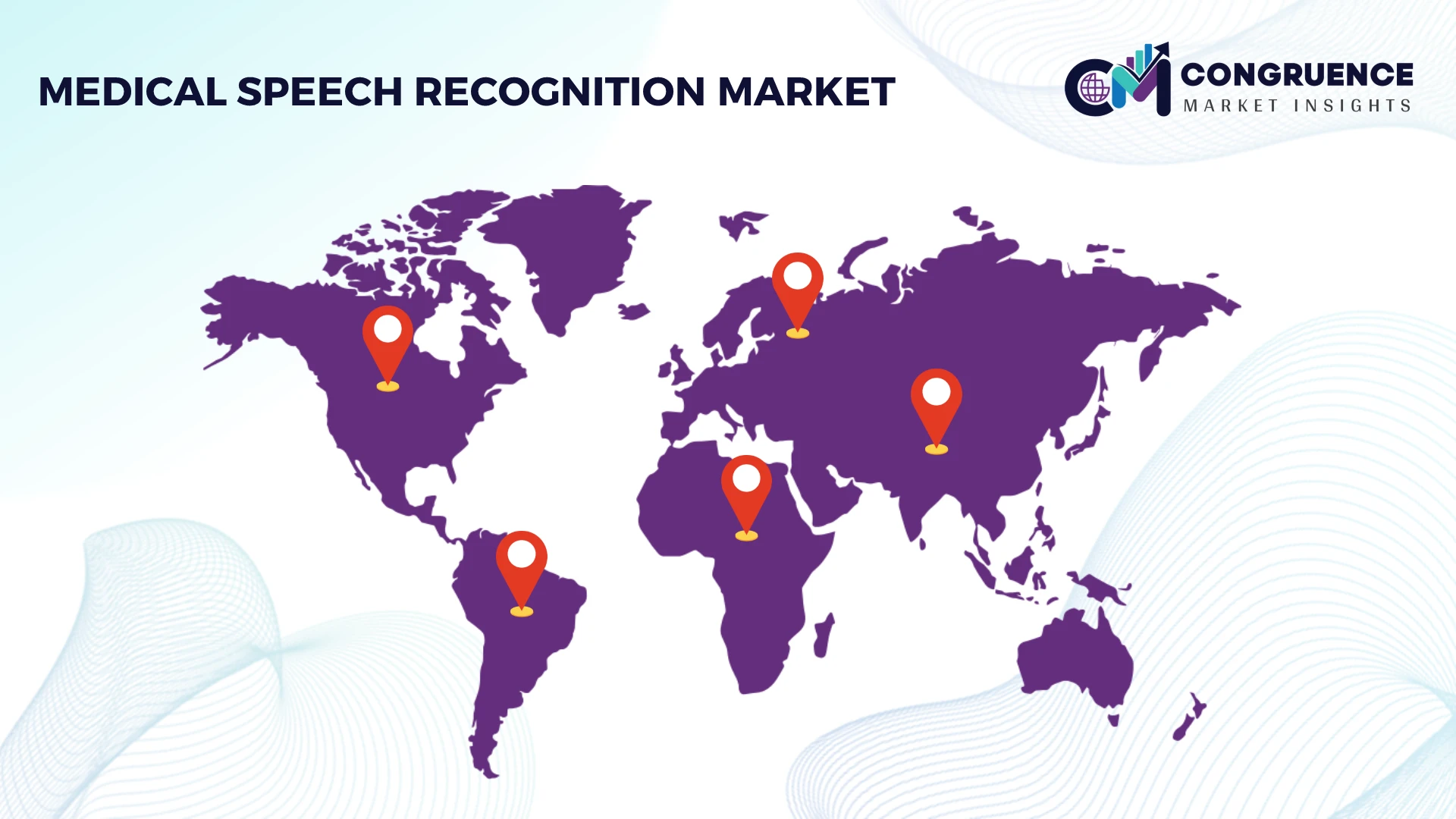
North America holds the leading position in the Medical Speech Recognition Market, supported by advanced healthcare IT infrastructure, widespread electronic health record usage, and strong adoption of AI-enabled clinical solutions. The region contributes approximately 45% of global market demand, with hospitals and physician networks representing the largest deployment base. The United States dominates regional adoption due to large-scale healthcare digitization and extensive investment in AI healthcare platforms. More than 90% of hospitals in the country utilize electronic health record systems, creating a strong foundation for speech-enabled clinical workflows. Healthcare technology companies are expanding partnerships with hospital groups to integrate ambient intelligence, automated documentation, and voice-based decision support solutions.
United States Market Outlook: The United States remains the strategic center of Medical Speech Recognition innovation due to its mature healthcare technology ecosystem and high enterprise adoption. Over 70% of healthcare organizations are actively evaluating AI-driven documentation solutions to improve physician efficiency. Strong cloud infrastructure, regulatory compliance capabilities, and partnerships between technology providers and healthcare networks continue strengthening deployment momentum across hospitals and outpatient facilities.
Europe represents a significant market for Medical Speech Recognition, supported by healthcare digitization initiatives, data governance frameworks, and increasing demand for efficient clinical documentation. Countries including Germany, the United Kingdom, and France are leading adoption through hospital modernization programs and AI healthcare investments. The region accounts for approximately 25% of global market activity, with public healthcare systems increasingly integrating speech technologies into electronic medical record platforms. European healthcare providers are prioritizing secure and compliant AI solutions due to stricter data protection requirements. Partnerships between technology firms and healthcare institutions are expanding, while multilingual speech capabilities are becoming a key differentiator for regional deployment.
Germany Market Outlook: Germany is the leading European market due to its advanced healthcare infrastructure, industrial technology capabilities, and focus on secure digital transformation. More than 80% of hospitals operate electronic health record systems or digital clinical platforms, supporting adoption of AI speech solutions. Healthcare providers are investing in automation technologies that improve documentation accuracy while meeting strict data privacy requirements under European regulations.
Asia-Pacific is emerging as the fastest-expanding market for Medical Speech Recognition due to healthcare infrastructure modernization, increasing digital hospital investments, and rising demand for affordable AI solutions. The region contributes nearly 20% of global market demand, with China, Japan, India, and South Korea driving adoption. Healthcare providers are increasingly deploying cloud-based speech platforms to overcome limited administrative resources and improve clinical efficiency. More than 60% of newly developed healthcare technology projects in major Asian economies incorporate AI-enabled automation capabilities. Technology companies are focusing on localized language models, partnerships with hospitals, and scalable solutions designed for diverse healthcare environments.
China Market Outlook: China represents the largest Asia-Pacific opportunity due to its expanding healthcare technology ecosystem and government-supported digital healthcare initiatives. The country has accelerated AI healthcare adoption across major hospitals, with more than 1,000 large medical institutions implementing intelligent healthcare platforms. Strong domestic AI development, cloud infrastructure expansion, and investment in smart hospitals continue supporting Medical Speech Recognition deployment.
South America is gradually adopting Medical Speech Recognition solutions as healthcare providers modernize digital infrastructure and improve operational efficiency. Brazil and Argentina represent the primary demand centers due to larger healthcare networks and increasing adoption of electronic medical systems. The region contributes approximately 5% of global market activity, with adoption concentrated among private hospitals and advanced healthcare facilities. Cloud-based solutions are gaining traction because they reduce upfront infrastructure requirements and support faster deployment. Healthcare technology companies are entering partnerships with regional providers to introduce multilingual speech platforms and affordable automation tools. However, uneven digital infrastructure remains a key factor influencing adoption speed across smaller healthcare facilities.
Brazil Market Outlook: Brazil is the largest South American market due to its extensive healthcare network and growing investment in digital health platforms. Private healthcare providers are increasingly adopting AI documentation tools, with digital health initiatives expanding across major urban hospitals. The country’s large Portuguese-speaking healthcare workforce creates demand for localized speech recognition systems tailored to clinical terminology and workflow requirements.
Middle East & Africa is experiencing increasing adoption of Medical Speech Recognition solutions as governments and healthcare providers invest in digital transformation and smart hospital initiatives. The region accounts for approximately 5% of global market demand, with adoption concentrated in the United Arab Emirates, Saudi Arabia, and South Africa. Healthcare modernization programs are encouraging deployment of AI-based clinical automation, particularly in advanced hospital networks. More than 50% of newly developed healthcare facilities in Gulf countries incorporate digital healthcare technologies, including automated documentation systems. Companies are expanding through government partnerships, regional technology alliances, and localized healthcare AI solutions to address language diversity and operational requirements.
United Arab Emirates Market Outlook: The United Arab Emirates is the leading Middle East market due to strong healthcare infrastructure investment, smart hospital development, and technology-focused government initiatives. Major healthcare networks are integrating AI solutions to improve operational efficiency, with digital transformation programs supporting adoption of automated clinical documentation. The country’s focus on advanced healthcare services positions it as a regional hub for AI-enabled medical technologies.
The Medical Speech Recognition Market features competition between global AI healthcare leaders such as Microsoft, Google, and 3M Health Information Systems and specialized innovators including Suki AI, Abridge, and DeepScribe. Global technology providers compete against regional healthcare software vendors through AI accuracy, EHR integration, customization, and deployment speed. The top five companies collectively account for approximately 60% market share, creating a moderately concentrated competitive structure. Leading platforms compete through advanced language models, with AI-based systems improving documentation efficiency by 30–50% compared with traditional transcription workflows. Companies are expanding through hospital partnerships, cloud-based deployments, and vertical integration into clinical workflows. The market is shifting toward ambient intelligence and generative AI, pressuring legacy transcription providers. High data-security requirements, clinical validation needs, and healthcare interoperability standards create strong entry barriers. Winning companies must deliver secure, accurate, scalable AI solutions with seamless healthcare ecosystem integration.
3M Health Information Systems
Nuance Communications
Google LLC
Amazon Web Services
IBM Corporation
Suki AI
Abridge AI
DeepScribe
Dolbey Systems
Philips Healthcare
eClinicalWorks
Oracle Health
Augmedix
Artificial intelligence, natural language processing, and deep learning models are transforming Medical Speech Recognition from basic voice transcription into intelligent clinical automation platforms. Modern AI systems improve contextual accuracy by 20–30% compared with legacy speech engines and enable automated clinical note generation, medical terminology recognition, and workflow optimization. More than 50% of digitally advanced healthcare organizations are adopting AI-supported documentation tools to improve physician productivity and reduce administrative workload.
Ambient clinical intelligence is emerging as the most disruptive technology by combining speech recognition, generative AI, and electronic health record integration. These platforms reduce documentation time by approximately 40–50% and enable real-time clinical workflow automation. Cloud-based speech platforms are also expanding, with over 60% of new healthcare AI deployments using cloud infrastructure for scalability, security, and faster implementation. Technology leaders with large healthcare datasets and strong interoperability capabilities are gaining competitive advantages.
Between 2026 and 2028, multimodal AI, multilingual medical language models, and automated clinical decision-support integration will redefine healthcare documentation. Companies investing in secure AI ecosystems, specialty-focused models, and enterprise partnerships will strengthen market positioning as hospitals transition toward intelligent digital care environments.
March 2025 Microsoft Dragon Copilot Announcement Microsoft launched Dragon Copilot, combining Dragon Medical One voice dictation with DAX ambient AI capabilities for clinical workflows. The platform supported over 3 million ambient patient encounters across 600 healthcare organizations, helping providers reduce documentation workload and improve operational efficiency through AI automation. Source: Microsoft News
May 2025 Suki and athenahealth Ambient Notes Partnership Suki expanded its partnership with athenahealth by making Ambient Notes generally available across the athenahealth network. The solution had already supported more than 60,000 clinical encounters during evaluation, enabling faster documentation and reducing administrative pressure on healthcare professionals. Source: Suki Press Releases
July 2025 Suki MEDITECH Expanse Integration Announcement Suki became the first ambient AI provider to integrate directly with MEDITECH Expanse Documentation APIs. The integration enables automatic generation and transfer of clinical notes into EHR workflows, expanding AI documentation accessibility across healthcare organizations. Source: Suki Press Releases
April 2025 Suki Ambient Orders Staging Announcement Suki introduced Ambient Orders Staging for its AI Assistant, enabling clinicians to generate and stage prescription orders from ambient visits. The capability targets administrative tasks that can consume up to 1.4 hours during an 8-hour clinical shift, improving workflow efficiency. Source: Suki Press Releases
The Medical Speech Recognition Market Report provides detailed coverage across technology types, applications, end-user segments, regional markets, and competitive landscapes. The study evaluates AI-based speech platforms, traditional recognition systems, clinical documentation, telemedicine applications, hospitals, clinics, diagnostic centers, and emerging healthcare automation solutions. Regional analysis includes North America, Europe, Asia-Pacific, South America, and Middle East & Africa with focus on adoption patterns, infrastructure readiness, and healthcare digital transformation.
The report examines key technologies including artificial intelligence, natural language processing, ambient clinical intelligence, cloud-based deployment, and healthcare interoperability solutions. It provides strategic insights into investment priorities, competitive positioning, partnership opportunities, and expansion strategies. The analysis supports decision-making from 2026 to 2033 by highlighting deployment trends, enterprise adoption patterns, innovation pathways, and evolving healthcare workflow requirements.
| Report Attribute / Metric | Details |
|---|---|
| Market Revenue (2025) | USD 211.0 Million |
| Market Revenue (2033) | USD 607.4 Million |
| CAGR (2026–2033) | 14.13% |
| Base Year | 2025 |
| Forecast Period | 2026–2033 |
| Historic Period | 2021–2025 |
| Segments Covered |
By Type
By Application
By End-User
|
| Key Deliverables | Revenue Forecast; Market Trends; Growth Drivers & Restraints; Technology Insights; Segmentation Analysis; Regional Insights; Competitive Landscape; Regulatory & ESG Overview; Recent Developments |
| Regions Covered | North America; Europe; Asia-Pacific; South America; Middle East & Africa |
| Companies Profiled | Microsoft Corporation; 3M Company; Nuance Communications; Google LLC; Amazon Web Services; IBM Corporation; Suki AI; Abridge AI; DeepScribe; Dolbey Systems; Philips Healthcare; eClinicalWorks; Oracle Health; Augmedix |
| Customization & Pricing | Available on Request (10% Customization Free) |




